



Abstract
BACKGROUND:
There is limited research that uses experience quality variables on cafes and restaurants.
OBJECTIVE:
To test the effect of experience quality on customer perceived value and customer satisfaction and its impact on customer loyalty to the visitors of natural outdoor cafes in the hilly areas of Joyo Agung, Malang, Indonesia.
METHODS:
This study uses four variables: Experience quality, customer perceived value, customer satisfaction, and customer loyalty. The population used in this research were all customers or visitors who bought and enjoyed the products and services provided by the natural outdoor cafes in Malang. This study used Structural Equation Modelling (SEM) as an inferential statistical technique.
RESULTS:
(1) Quality experience has a significant effect on customer perceived value, customer satisfaction, and customer loyalty; (2) Customer perceived value has a significant effect on customer satisfaction and customer loyalty; and (3) Customer satisfaction has a significant effect on customer loyalty.
CONCLUSIONS:
This study provides some ideas for future research on customer perceived value, customer satisfaction and customer loyalty.


Introduction
Consumer behavior can be predicted using the Theory of Reasoned Action proposed by [1]. The theory is an illustration of the integration of the overall attitude component that is structured in order to obtain an explanation of behavior [1]. Argued that behavioral intention is a determinant of actual behavior that the intention in behavior always refers to behavior in the future and after making a purchase. Thus, it can be concluded that behavioral intention is an action taken by customers before the actual behavior, whereas, the intention to behave is the intention of customers after making a purchase [2]. Criticized the Theory of Reasoned Action developed by [1] by saying that attitudes do not determine the purpose of behavioral actions because in general, the relationship between goals and behavior is conditioned by decision-making that is related on achieving goals. Behavioral intention is crucial to be taken into a study because it is the key to the actual buying behavior [3].
In the field of marketing, the emergence of technology (gadgets and Internet) has changed the geographical condition and purchasing power. This will slowly change the behavior, values, and culture of the customers. The results from Alvara Research Center in 2015 found that the “top searched” product information on the Internet from millennials customers was the information about prices, product features, promotion programs, and customer reviews. To date, gadgets and Internet are not merely a technology but also friends for millennials. One behavior that changes from Gen-X to millennials is a lifestyle. Initially, lifestyle is a secondary need for Gen-X but now, along with the development of lifestyle, it has turned into the millennials’ primary need [4].
Literally, the meaning of café is coffee but it changes over time. Not just for coffee, the concept of café has begun to develop into a place to drink, eat, and socialize [5]. The strategic location of the café, as well as the food and beverage presented, are important to attract customers’ attention. Currently, the concept of cafés is not only focused on the coffee variants but also on the menus of ice cream, dairy products, yogurt, chocolate, brownies, cookies, and others. Besides maintaining customer trust by creating superior products and having international standard quality, creating value that is unique in the eyes of customers is one of the strategies implemented by the company. According to Herlayanan, millennials like material things. This trend is reinforced by the emergence of many cafés in Indonesian regions including Malang [6].
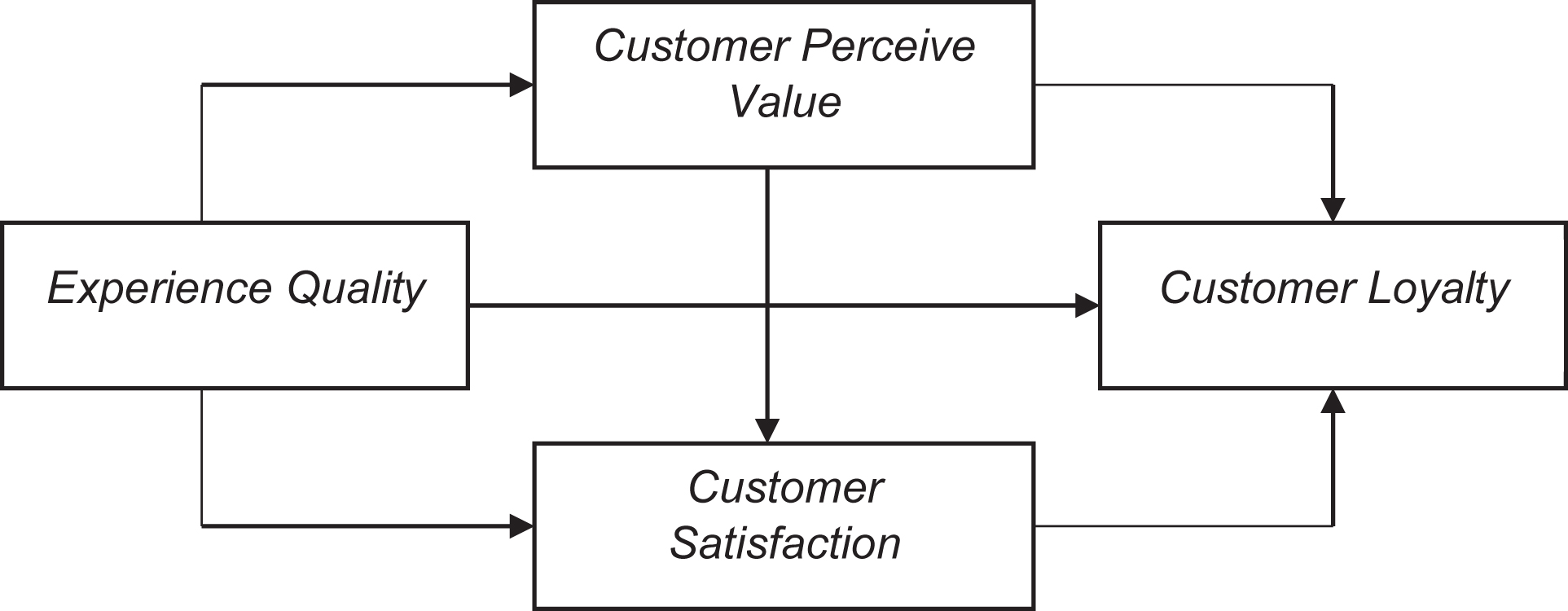
The conceptual framework.
The concept of experience according to [7] is an aspect of consumer behavior that is related to multi-sensory, fantasy, and emotive aspects of product consumption. The concepts from experience include visitor’s affective responses to the psychological benefits they want from the visit [8]. Experience Quality in the restaurant sector is their knowledge or observation of restaurant characteristics obtained through the eating process [9]. Mowen and Minor [10] believed that consumption experiences are formed by the awareness and feelings of the customers through the use of the products or services. Products or services consumed will form an important stimulus for the emotional behavior that is caused by the personal events experienced by the customers [11]. The experience felt by customers is a determinant of the long-term success of the outdoor café business. Customers will have a positive experience if they get what they expect. Generally, the aspects of experience from this consumption experience are accepted as important elements for conceptualizing the perceived values [12]. In addition, there are several other factors in the marketing field that are used as the determinant of success for long-term outdoor café business such as studying more about customer perceived values, customer satisfaction, and customer loyalty.
Based on the results of previous research and the phenomenon that has been described previously, the research gaps found in this study are: (1) The relationship between experience quality and customers perceived values. There are differences in the results regarding the effect of experience quality on customer perceived value; (2) There are differences in the relationship between experience quality and customer satisfaction found in the research which examines the effect of experience quality on customer loyalty; (3) Experience quality and customer loyalty variables still differ in the research concerning the effect of experience quality on customer loyalty; (4) The influence of customer satisfaction and customer loyalty is still different in the research results regarding the effect of customer satisfaction on customer loyalty; (5) There is still limited research that uses experience quality variables on café and restaurants. Some previous studies used experience quality variables in the tourism sector, the hospitality sector, and restaurant industry; (6) There is a change in millennials’ consumer behavior that they use the Internet as a media for information and recommendation through social media in making decisions for products or services; (7) [13] in his research suggested to conduct a research on fast food restaurants as a consideration for future research. This is recommended because the results of his research only represent hedonic and utilitarian categories and were conducted in one country so that different results can be made in each country.
According to the phenomenon and previous studies as explained above, the researcher of this study is interested to test The Effect of Experience Quality on Customer Perceived Value and Customer Satisfaction and its Impact on Customer Loyalty to the visitors of natural nuanced outdoor café in the hilly areas of Joyo Agung, Malang.
The conceptual framework of research is a framework of relationships between concepts and other concepts that will be measured or tested in the research. This study uses four variables, namely experience quality, customer perceived value, customer satisfaction, and customer loyalty. Those four variables have been determined by the researcher and have been examined by previous researchers to test a hypothesis. After that, the results of the hypothesis will be drawn into conclusions. This study adopted the attitude theory from [2] which includes cognitive, affective, and behavioral results. The conceptual framework of the research which adopts the attitude theory from [2] can be seen as follows:
Customer loyalty can be formed through experience quality, customer perceived value, and customer satisfaction. This can be seen from several previous studies conducted by [13–18]. The results of previous studies indicate several variables that can affect consumer loyalty such as experience quality, customer perceived value, and customer satisfaction which also show the relationship between each variable.
Based on the research concept, the hypotheses in this study are as follows:
H1 = Experience quality has a significant effect on customer perceived value
H2 = Experience quality has a significant effect on customer satisfaction
H3 = Experience quality has a significant effect on customer loyalty
H4 = Customer perceived value has a significant effect on customer satisfaction
H5 = Customer perceived value has a significant effect on customer loyalty
H6 = Customer satisfaction has a significant effect on customer loyalty
Research methods
This research was carried out at the natural nuanced outdoor cafés in Malang. The objects of the research were customers or visitors of the cafés. Based on the results of online media observations in Malang, there are six natural nuanced outdoor cafés that can be studied, namely Bukit Delight, Coklat Klasik, Warung Nakamo, Green Barn Eatery, Soimah Barn & Kichten, and Oikii café and resto [6] The reason for choosing the natural nuanced outdoor cafés as the research object was because this kind of place is the first natural outdoor café in Malang and is an alternative to new culinary tourism as suggested by Dias Satria who is an economist from Universitas Brawijaya to become a new culinary tourism destination in Malang [6]. Besides that, natural nuanced café is also recommended as a café destination that must be visited when in Malang (https://dolandolen.com).
The population used in this research was all customers or visitors who buy and enjoy the products and services provided by the natural outdoor cafés in Malang. The characteristics of the population in this study were: (1) The age of the respondents are at least 18 years old, by considering that above 18 years old already have a certain establishment based on a clear pattern; (2) The respondents are visitors of natural nuanced outdoor cafés in Malang. By considering the loyalty of the customers towards the products and services in natural nuanced outdoor café, respondents must buy the products and services at least twice. It is expected that the respondents can remember the experience that was felt before.
The design of the sample used in this study was nonprobability sampling with a technique of purposive sampling and judgment sampling. Purposive sampling is a sampling that is based on certain considerations [19]. Whereas, judgment sampling is the selection of samples that is based on an assessment of some sample characteristics that are customized to the purpose of the study [20]. Based on the calculation of [21], a number of the samples amounting to 167,182 respondents were obtained so that the research sample is rounded to 168 respondents.
There are four research variables in this study. The first is experience quality. This is the quality of the overall consumer experience both in terms of products and services that are felt when visiting the natural outdoor cafés in Malang. The indicators used in this study followed the indicators from the research proposed by [22] which consist of interaction quality, physical environment quality, outcome quality, and access quality.
Secondly, customer perceived value. This is a value that is perceived by visitors. Customer value can be formed if the value felt by visitors when visiting a natural nuanced outdoor café is in accordance with their expectations. The indicators used in this study referred to previous studies conducted by [15, 24] which include: Price, Benefit, and Sacrifice.
Besides experience quality and customer perceived value, there is customer satisfaction. Customer satisfaction is a feeling of satisfaction experienced by visitors to what extent the benefits of a product and service provided by the cafés exceed the hopes and expectations of the visitors. The indicators used in this study adopted the previous research from [15, 24] which used happiness, contentedness, and overall satisfaction.
Last but not least, there is customer loyalty. This is a commitment that is held firmly by visitors to repurchase the products and services provided by the cafés as well as the willingness of visitors to give positive reviews and to recommend the cafés to others based on their experiences. The indicators in this study referred to previous studies conducted by [15, 25] as follows: (a) Revisit intention, (b) Positive word of mouth, and (c) Recommendation.
The measurement of the variable in this research is using attitude scale. The type of the attitude scale used in this research is the Likert scale with the value of 1–5 (1 = to acquire the strongly disagree up to the value of 5 = for the opinion of strongly agree). The Likert scale is a scale that is based on the total number of respondents’ attitudes in responding to a question related to the indicators of variables being measured (Sanusi, 2017). The measuring scale of this research is elaborated in Table 1.
Research operational definition
Research operational definition
In more details, the operational definition of the variables can be seen in Table 2.
Research operational definition
This study used Structural Equation Modeling (SEM) as inferential statistical techniques. The reason for choosing this technique is because Structural Equation Modeling (SEM) is one type of multivariate analysis in social science and a general statistical model that is widely used in a variety of sciences. Structural Equation Modeling (SEM) has two main advantages such as able to test complex research models simultaneously and able to analyze variables that cannot be measured directly as well as to measure the errors in measurement [26]. SEM is divided into two types: covariance-based SEM and variance-based SEM or partial least square (PLS). Based on the research objectives in this research, the type of SEM analysis used is PLS. The SEM-PLS is a causal model approach that is aimed to maximize the variance of latent variables which can be explained by predictor variables.
Measurement model evaluation
The evaluation of the measurement model in this study consists of the outer model and inner model. Outer model is used to evaluate the results of the validity test and reliability test. Meanwhile, the inner model is used to measure the relationship between variables through the value of R square. The results of the research measurement model evaluation are described in this following section:
Outer evaluation model of this study evaluates the relationship of latent variables with the research indicators. There are four latent variables used in this study including experience quality, customer perceived value, customer satisfaction, and customer loyalty. The measurements made in evaluating the outer model of this research are Convergent Reliability, Discriminant Validity, and Composite Reliability which will be discussed in detail as follows:
Outer model of loading convergent validity
Outer model of loading convergent validity
Composite reliability
Based on the table above, it can be concluded that the evaluation of the measurement model has good discriminant validity. This can be seen that the overall AVE value is not less than 0.5. The value of Composite Reliability in each variable also has good reliability. It is known that the value of Composite Reliability in experience quality (X1) is 0.923 followed by 0.880 in customer perceived value (Y1), 0.914 in customer satisfaction (Y2), and 0.890 in customer loyalty (Y3). Therefore, it can be said that each variable has high reliability because it is bigger than 0.70.
The evaluation of the structural model (Inner Model) is aimed to measure the relationship between one variable and one another. This is also used to determine the size of the information that can be explained by the relationship of each variable. Based on the results of the SEM-PLS model, the overall goodness of fit assessment can be known from the Q2 value (predictive relevance). The test of goodness of fit model is done by using the total determination coefficient where the test results can illustrate the size of the path model to represent the observed data. Based on the calculation of Q2 value, it can be seen that the value of Q2 is 0.959. This means that the data diversity from the structural equation model is 95.9% while the remaining 4.1% is defined by other factors outside the research model. By that, the structural model in this research can be said to have good goodness of fit because the value of Q2 is ranging from 0 < Q2 < 1; if the value is closer to 1, it means that the model is getting better.
Hypothesis testing and discussion
The hypothesis testing is done to examine the effect of relationships between research variables. The test was carried out by using SmartPLS 3.0 application with the bootstrapping method.
The explanation for Table 5 above can be seen in this following section:
Table of path coefficient for hypothesis testing
Table of path coefficient for hypothesis testing
According to the results of the hypothesis test, it can be known that experience quality (X) has a positive and significant influence on customer perceived value (Y1) with path coefficient value as much as 0.772, t-count value by 20.682, and p-value by 0.000. The t-count value shows a greater value than the t-table which is equal to 1,960 whereas the p-value is less than 0.05. Referring to these results, it can be concluded that if experience quality is increased, customer perceived value will also increase. The average value of the overall experience quality indicators is 3.75 which means that the answers from customers about the research items are positive. In other words, customers have good experiences and are impressed when visiting the natural nuanced outdoor cafés. On the other hand, the average value of the overall customer perceived value indicators is 3.78. This means that the answers from customers concerning the research items are positive. It can be said that the prediction of the customers exceeds their expectation when visiting the cafés.
The results of this test are in accordance with the opinion from [13] that experience quality is used as an affective and cognitive aspect generated from the services in the visit so as to produce values that can be felt by customers in accordance with the benefits obtained. Gentile et al. [29] emphasized that experience quality comes from the interactions between customer and products, companies, or part of the organization that triggers customer involvement. This is in accordance with the findings of the research that the experience of the customers comes from the quality of the products and services provided by the cafés so that it can lead to customer involvement such as the value of benefits received by customers. This is also in line with the attitude theory developed by [2] that customer perceived value is the result of affective attitudes formed by cognitive attitudes, namely experience quality.
The findings of this research also confirm the equity theory proposed by [30] that there is a relationship between perceived value and sacrifices expected by customers in terms of time, cost, and effort so as they will feel satisfied after receiving the benefits. In this case, the experience felt by customers in the visit and purchase as well as the time, cost, and effort that has been sacrificed are already in accordance with their expectation. Besides that, the results of this study support the research from [31] that customer perceived value can be obtained through the aspects of the pre-purchase, transaction, and post-purchase [31] also defined customer values as preferences perceived by customers to be used as an evaluation for the product attributes and its performance as well as for the consequences arising from the use of the products to reach customer goals. This is the result of the experience obtained by customers in accordance with the expectation during pre-purchase by considering the evaluation of product attributes and its performance as well as its consequences from the use of the products that are in line with the initial goals of the customers.
The results of the study regarding the positive and significant relationship between experience quality and customer perceived value were supported by several previous studies. The research conducted by [32–34] highlighted that experience quality has a positive and significant relationship to customer perceived value in the objects of tourist attractions and restaurants. This is an empirical study which can support the results of the research due to the suitability of research object. However, the results of this research reject the findings from [34] that experience quality does not have a positive and insignificant relationship with customer perceived value in the visitors of Fancyworld Janfusan Tourism Park in Yun-Lin County Taiwan.
In addition to literature reviews and several previous studies, there are several characteristics of respondents that support the research findings. Most of the respondents who visited and made purchasing decisions are students aged 18–29 years old, are high school graduate and/or a bachelor. Respondents in this study are millennials; this is in line with the current trend that the emergence of technology (gadgets and the internet) has made changes in terms of geographical condition and purchasing power. Gadgets and the internet are no longer limited to technology but are the friends for millennials to find out about the information about the products such as the prices, product features, promotion, and customer reviews. Social media is mostly used by respondents to find information about cafés so that after they get the information, they can imagine getting the experience they expect. To make purchasing decisions, the majority of the respondents visit the cafés for more than 2 times with the intensity of visit as many as 1 to 3 times a week. Therefore, it can be concluded that the customers get the expected experience and are willing to recommend the cafés to others.
The effect of experience quality on customer satisfaction
Based on the results of the test, it can be seen that experience quality (X) has a positive and significant influence on customer satisfaction (Y2). It is shown that the path coefficient value is 0.527 with a t-count value by 7.124 and a p-value by 0.000. The value of t-count is greater than t-table which is equal to 1.960 while p-value is lower than 0.05. Based on the results, it can be said that if the variable of experience quality is improved, customer satisfaction will be increased too. The average value of the overall indicators of experience quality is 3.75 which means that the answers from customers about the research items are positive. In other words, customers have good experiences and are impressed when visiting the cafés. The average value of the overall indicators of customer perceived value is 3.83. This also means that the answers from customers about the research items are positive. This denotes that the customers are satisfied when visiting the natural nuanced outdoor café.
The results of this study are in accordance with the research from [7] that customer experience is input from the state of subjective awareness with various symbolic meanings, hedonic responses, and aesthetic criteria so as to produce output in the form of customer satisfaction. This confirms the opinion of [35] that customer satisfaction is formed on the results of evaluating the overall experience quality in purchasing the products and services that customers expect in accordance with their expectations. Moreover, the findings of this study are in line with the attitude theory developed by [2] that customer satisfaction is the result of affective attitudes formed by cognitive attitudes namely experience quality. This study also supports the equity theory that is proposed by [30] which explained that the experience gained from customers’ sacrifice in terms of time, cost, and effort, as well as the perceived value of the products and services, received can shape customer satisfaction.
The results of the study concerning the positive and significant relationship between experience quality and customer satisfaction are also supported by several previous studies. According to [16], experience quality has a positive relationship with customer satisfaction on guesthouse travelers in Ghana. Thus, the research can be used by the guesthouse owners as an evaluation material to always improve the quality of their places so that customers will be satisfied in the stay [36] also explained that experience quality directly influences customer satisfaction on hotel guests in Haridwar and Dehradun districts in India, both domestic and international guests [18] added that experience quality has a direct influence on customer satisfaction on Port wine customers who consumed wine in the research location.
On the other hand, the research from [34] who observed the customers of Tayih Landis Restaurant in Tainan City and Farglory Hotel Restaurant in Hualien City found that experience quality has a direct influence on customer satisfaction [22] in the research argued that experience quality is a determining factor of customer satisfaction for the visitors of Janfusan Fancyworld Tourism Park in Taiwan. In contrast, the findings of this study do not support the study conducted by [37] that experience quality does not have a significant relationship with customer satisfaction on the visitors of tourist villages in Hahndorf main road, Australia. As we can see from the theories and previous research, it can be concluded that experience quality is one of the determinants of customer satisfaction in the field of hospitality, tourism, and cafés or restaurants. The memorable experience that customers get when visiting and making purchases will result in the satisfaction of the customers.
Besides the literature reviews and previous studies as stated above, there are several characteristics of respondents’ descriptions that support the research findings. Most of the respondents who visited and made purchasing decisions are students aged 18–29 years old, a high school graduate and/or a bachelor. The respondents of this study are millennials. This shows that the satisfaction experienced by customers comes from the attitude of the customers itself. The majority of visits from the respondents in making the purchasing decisions are more than 2 times with the intensity of visits 1 to 3 times a week. Therefore, it can be said that the customers are satisfied with the experience obtained from the visit and purchase on the cafés. Most of the respondents are willing to recommend the cafés to others because they were satisfied with the whole products and services given.
The effect of experience quality on customer loyalty
The results from the hypothesis testing show that the experience quality (X) has a positive and significant influence on customer loyalty (Y3). The value of the path coefficient is known to be 0.225 while the t-count value is 2.682 and p-value is 0.000. It is shown that the value of t-count is greater than t-table which is equal to 1,960 and the p-value is less than 0.05. Based on that data, it can be assumed that if the experience quality is increased, customer loyalty will also increase. The average value of the overall indicators of experience quality is 3.75 which means that the answers from customers about the research items are positive. In other words, the customers have good experiences and are impressed with their visit on the natural nuanced outdoor cafés. Whereas, the average value of the overall indicators of customer perceived value is 3.71. This means that the answers from customers about the research items are positive. This points out that the customers will be loyal to visit the cafés. The results of this study confirm the Theory of Reason Action proposed by [1] that attitudes can be used as the predictions of future behavior. It is found that after making a purchase, customers have a positive word of mouth communication so that it can be predicted that customers will come back and invite others to go to the café.
Besides that, the results of this study support the opinions of [38] that customer loyalty can be understood through examination of beliefs, affective connections, and conative processes that direct customers to the products or services. In this study, customer loyalty can be formed from customers experience on affective and conative beliefs about the overall products and services perceived. However, this study is not in line with the definitions proposed by [39] that customer loyalty acts as a behavioral impulse to purchase the products or services repeatedly. Customer loyalty, in this study, is a behavioral impulse obtained from the experience of the customers to do positive word of mouth. According to [13], experience quality is the affective and cognitive aspects resulting from the services when visiting and making purchases of something which will lead to some attitudes such as satisfaction and behavioral outcomes such as loyalty and word of mouth.
In regards to the positive and significant relationship between experience quality and customer loyalty, [18] believed that there is a direct relationship between experience quality and customer loyalty to customers in Portugal’s Port wine. On the other hand, the results from [14] are in contrast with the findings of this study that physical environment as one of the indicators for experience quality does not affect customer loyalty to hotel guests in Malang and Magelang. Based on some theories and previous research that support the results of this study, it can be concluded that experience quality is one of the determinants of customer satisfaction in the field of banking, tourism, and cafés or restaurants while it is still doubtful in the hospitality sector. The memorable experience that customers get when visiting and making purchases will result in customer loyalty and will generate a positive word of mouth communication.
Besides the literature reviews and several previous studies as explained above, there are several characteristics of respondents that support this study. Most of the respondents who visited and made purchasing decisions are students aged ranging from 18 to 29 years old, a high school graduate and/or a bachelor. The respondents are millennials; this shows that the commitment held firmly by customers to become customer loyalty is obtained from the attitude of the customers itself. Most of the visits of the respondents are more than 2 times with the intensity of visits by 1 to 3 times a week. By that, it can be concluded that customer loyalty is constructed through a repeat purchase that is based on the experience gained during the visit and purchase at the cafés. Most of the respondents were willing to recommend the cafés to others because they had committed to be loyal customers by providing positive communication and reviews.
The effect of customer perceived value on customer satisfaction
Seen from the hypothesis test, it can be concluded that customer perceived value (Y1) has a positive and significant influence on the customer satisfaction (Y2). It is known that the path coefficient value is 0.330, the t-count value is 4.363, and the p-value is 0.000. The value of t-count is greater than t-table which is equal to 1,960 and the p-value is smaller than 0.05. This means that if there is an increase in the experience quality, the customer loyalty will also be increased. The average value of the overall indicators of experience quality is 3.75 which implies that the answers from customers about the research items are positive. In other words, the customers have good experiences and are impressed in the visits. Meanwhile, the average value of the overall indicators of customer perceived value is 3.71. This indicates that the answers from the customers are positive and customers will be loyal to visit the cafés.
The results of this study are in accordance with the research from [40] that customer perceived value is an emotional bond that is formed between customers and companies after using the products or services which able to provide an added value or satisfaction to customers. This is also similar with the opinion of [3] that satisfaction is the assessment of the customers towards the products and services received in accordance with the needs and expectations of the customers. The results of this study indicate that customers satisfaction is formed from the value of benefits received after using the products or services provided by the natural nuanced outdoor cafés.
In concern with the positive and significant relationship between customer perceived value and customer satisfaction, there are other studies which support this study [15, 25] wrote that customer perceived value has a direct relationship to customer satisfaction in the Indonesian aviation industry and visitors to historical tourist attractions in Taiwan [24] also proposed that customer perceived value has a positive and significant effect on the customer satisfaction of the waterpark visitors in South Korea. Moreover, according to [34], customer perceived value has a positive and significant influence on the customer satisfaction of Tayih Landis Restaurant customers in Tainan City and Farglory Hotel Restaurants customers in Hualien City.
Jin et al. [24] emphasized that customer perceived value is a determinant of customer satisfaction for the visitors of Janfusan Fancyworld Tourism Park in Yun-Lin County Taiwan. Based on the theories and previous research that support this study, it can be concluded that customer perceived value is one of the determinants of customer satisfaction in the field of the hotel industry, tourism, and cafés or restaurants. The value of benefits obtained by customers when visiting and making purchases can form a feeling of satisfaction if it is in accordance with customers desires and expectations.
In addition to the literature reviews and previous studies, there are several characteristics of respondents that support this research. Most of the respondents who visit and make purchasing decisions are students aged ranging from 18 to 29 years old, a high school graduate and/or a bachelor. Therefore, it can be concluded that the respondents consider their feeling of satisfaction based on the value received, whether it suits their point or not. Some respondents got information about the cafés from friends and social media. This shows that customers who are satisfied with their expectations will give positive reviews. The respondents usually visit the cafés for more than 2 times with the intensity of visit 1 to 3 times a week. By that, it can be said that the customers are satisfied because it confirms their expectations.
The effect of customer perceived value on customer loyalty
From the hypothesis testing, it is obtained that customer perceived value (Y1) has a positive and significant effect on customer loyalty (Y3). The value of the path coefficient is known to be 0.261 with a t-count value by 3.229 and a p-value by 0.001. The value of t-count is greater than t-table (1.960) while the p-value is less than 0.05. Generally saying, if the experience quality is increased, customer loyalty will also be improved. The average value of the overall indicators of experience quality is 3.75. This means that the answers from customers about the research items are positive and customers have good experiences and are impressed when visiting the café. On the one hand, the average value of the overall indicators of customer perceived value is 3.71. This points out that the answers from customers are positive and customers will be loyal to visit the café.
This is in line with the research from [41] that customer perceived value is related to the total costs incurred for visiting and making purchases at the cafés which also includes the benefits as desired by customers [42] also said that customer loyalty emphasizes more on the behavioral aspect which is the customer’s behavior to have a positive word of mouth communication. In other words, the customers who receive benefits after making a purchase will conduct a positive behavior of word of mouth communication. This finding is in accordance with the attitude theory developed by [2] that customer loyalty is the result of behavior that is formed by affective attitudes, namely customer perceived value.
On the other hand, the results of this study are not consistent with the research conducted by [43] which found that customer perceived value does not have a direct influence on customer loyalty in Australia’s outdoor public aquatic center. In this study, it is found that there is a positive and significant relationship between customer perceived value and customer loyalty [23] believed that customer perceived value has a positive relationship with customer loyalty in the Indonesian tourism and hospitality industry. The research from [15] also mentioned that customer perceived value is one of the important things in influencing customer loyalty in the Indonesian aviation industry.
Lai et al. [45] added that customer perceived value has a positive relationship on customer loyalty in the telecommunication service users in China. Based on some theories and previous research that support this study, it can be concluded that customer perceived value is one of the determinants of customer loyalty in terms of service in the field of hospitality and tourism. The novelty of this study lies in the object of the research that is the café culinary industry, particularly the natural nuanced outdoor cafés. It is found that customer perceived value is one of the determinants of customer loyalty. The value of benefits obtained when visiting and making purchases at the café can directly make customers to become loyal through a positive word of mouth communication to influence other people to visit the natural outdoor cafés in Malang.
Not only literature reviews and several previous studies, but there are also several characteristics of respondents that support the research findings. Most of the respondents who visited and made purchasing decisions are students, 18 to 29 years old, a high school graduate and/or a bachelor. Based on that matter, the reason why the respondents chose to become a loyal customer is because of its suitability to the value received. Some respondents got information about the cafés from friends and social media. This shows that loyal customers will give positive reviews. Most of the respondents visit the cafés for more than 2 times with the intensity of visit 1 to 3 times a week. It can be concluded that customers who get the expected value will immediately become loyal customers by making repeat purchases and by making a recommendation about the café to others.
The effect of customer satisfaction on customer loyalty
Seen from the test of the hypothesis, it is known that customer satisfaction (Y2) has a positive and significant influence on customer loyalty (Y3). The value of path coefficient is 0.425 with a t-count value as much as 5.923 and a p-value that is equal to 0.000. The value of t-count is greater than t-table (1.960) whereas the p-value is less than 0.05. Therefore, if the experience quality is increased, customer loyalty will also increase. The average value of the overall indicators of experience quality is 3.75 meaning that the answers from customers about the research items are positive. This clarifies that customers have good experiences and are impressed when visiting the natural nuanced outdoor café. The average value of the overall indicators of customer perceived value is 3.71. This indicates that the answers from customers about the research items are positive. In other words, customers will be loyal to the cafés.
Stated that customer satisfaction is one of the goals of marketing activities. This is in accordance with the opinions expressed by [46] that satisfaction is the overall evaluation of the products or services purchased based on the previous experience. In this case, the main purpose of the café is to get customer satisfaction so that customers will get experience from the entire products and services provided. The results of this study are in line with the research from [47] that customer loyalty is a condition where customers have a positive attitude seen from the positive communication (word of mouth) about the feelings felt towards the products and services provided. This is similar to the attitude theory from [2] that customer loyalty is the result of behavior formed by affective attitudes, namely customer satisfaction. Besides that, this study also confirms the theory of customer’s behavior that is the theory of reason action developed by [1] that satisfaction can be used to predict customer loyalty.
In regards to the positive and significant relationship of customer satisfaction and customer loyalty, [48] explained that there is a positive relationship between customer satisfaction and customer loyalty to local and foreign tourists in Malaysian tourist villages. Also found a positive relationship between customer satisfaction and customer loyalty to Garuda Indonesia airline passengers. Not only that, (49) conducted a study on 250 members of the performing arts audience and revealed that customer satisfaction has a very strong impact on customer loyalty and is positively and significantly related.
The research conducted by [17] highlighted that customer satisfaction is a predictor of customer loyalty at the amusement parks in Kuala Lumpur and Selangor, Malaysia. Based on several theories and previous research that support the results of these findings, it can be drawn into conclusion that customer satisfaction is one of the determinants of customer loyalty in the field of hospitality, tourism, and aviation services. The novelty of this study lies in the object of the research that is the café culinary industry, particularly the natural nuanced outdoor cafés. By that, it can be said that customer satisfaction is one of the determinants of customer loyalty in the natural nuanced outdoor cafés in Malang. The satisfaction felt by customers when visiting and making purchases can shape customer loyalty to have a positive word of mouth communication.
Besides the literature reviews and several previous studies as mentioned above, there are several characteristics of respondents that support the research findings. Most of the respondents who visited and made purchasing decisions are students, ranging from 18 to 29 years old, a high school graduate and/or a bachelor. Thus, the reason why the respondents are willing to be loyal customers is that they are satisfied with all of the products and services offered. Some respondents got information about the cafés from friends and social media. This means that customers who experience satisfaction will become loyal customers by giving positive reviews. The majority of the respondents in visiting the cafés are more than 2 times with the intensity of visit 1 to 3 times a week. This can be said that customers who are satisfied with all the things given by the cafás will immediately become loyal customers by making repeat purchase and willing to recommend the cafés to others.
Research limitations
Based on the description above, this study has several limitations including (a) the criteria for natural nuanced outdoor café is still not available so that it cannot be used as the literature of outdoor concept; (b) this research only focuses on natural outdoor cafés in Malang thus the results cannot be generalized into the wider sector of culinary industry, especially to cafés in other places although it has a semi-outdoor concept because there is no clear definition of outdoor; (c) the demographic classification of the community in Indonesia is divided into 4 generations, namely: baby boomer, Generation X (Gen-X), Generation Y (Millennials), and Generation Z. Each of the respondents’ criteria is not grouped in that generation. This study does not address the different results which are generated from different generations.
Conclusions and suggestions
The conclusions of this research are: (1) Quality experience has a significant effect on customer perceived value, customer satisfaction, and customer loyalty; (2) Customer perceived value has a significant effect on customer satisfaction and customer loyalty; and (3) Customer satisfaction has a significant effect on customer loyalty. Some suggestions that are proposed for future research and for the management of natural nuanced outdoor cafés are as follows: (1) Further research can develop the existing research model by adding other variables such as destination image and change the measurement indicators to expand the results of the study based on the theme of the research objects; (2) Further research can choose new customers as respondents so that the results of the study can be described further that the new customers and old customers can be compared. (3) Further research can be carried out on different research objects such as hospitality and culinary cafés. In regards to café as the research object, the next study requires accuracy in focusing on the characteristics of the cafés because each café has different concept and characteristics. Besides that, to enrich the research findings, further research can broaden the scope of the research to a wider area such as Malang Raya and other regional areas.