



Abstract
BACKGROUND:
Initiating knowledge management activities has proved challenging in many organizations as focus on wrong activities and not providing adequate leadership cause many failures. Leadership style significantly determines success of knowledge management activities, specifically activities related to knowledge infrastructure that consist of organizational culture, organizational structure and information technology.
OBJECTIVE:
The purpose of this study is to analyse how transformational and transactional leadership styles influence knowledge infrastructure which provides organizations a platform on which knowledge management can be developed.
METHODS:
PLS-SEM was used to analyse data obtained from 135 valid questionnaires.
RESULTS:
Transformational and transactional leadership styles both positively influence all three factors of knowledge infrastructure (organizational culture, organizational structure and information technology). The influence of transformational leadership style is, however, statistically significantly stronger.
CONCLUSIONS:
Based on research findings managers should use more transformational leadership elements when promoting knowledge management initiatives in organizations. Nevertheless transactional leadership style should be also used especially contingency reward as its dominant factor.
Keywords


Introduction
Many organizations are facing challenges of implementing knowledge management practices into their business model. Despite their efforts, failure is often the outcome of knowledge management implementation. Variety of reasons may contribute to this, such as lack of understanding knowledge management, universal instead of custom approach, unrealistic expectations, overemphasis on technology or lack of strategic alignment [1].
As knowledge management is paving its way into strategic focus of organizations as well as daily operations, managers are exploring variety of implementation initiatives. When thinking about knowledge management, we often think of knowledge management processes (acquisition, creation, transfer, storage or application). However, many leaders in modern organizations realized that those processes cannot be efficient without basic foundation and environment which are usually presented in the form of organizational culture, organizational structure, information technology, strategy or rewarding system [1–3].
Gold [4] studied the topic of knowledge management through capability of organization to recognize, create, transform and distribute knowledge. Knowledge management capabilities are therefore consisting of two type of capabilities: knowledge infrastructure capability and knowledge process capability. In this study we are interested in knowledge infrastructure capability that includes organizational culture, organizational structure and information technology. This present the basic infrastructure needed to efficiently organize knowledge management activities, hence knowledge management enablers are often used term to describe factors of knowledge infrastructure [5].
However, knowledge infrastructure cannot be built by itself. It takes strategic commitment, organizational resources and individual competency to achieve this goal. Responsibility for achieving these goals is always on the leader. But what kind of leader or leadership style is best suited to achieve complex goals like this? Leadership style represents behaviour of a leader when managing organization and people. We defined leadership style with the definition of the full range leadership model that basically consist of transformational and transactional leadership styles. Transformational and transactional leadership are two basic leadership styles that are covering majority of leaders’ behaviour spectre with former being more focused on motivation, inspiration and empowerment and latter being more focused on transaction between leader and followers [6].
The purpose of this study was to analyse influence of transformational and transactional leadership style on knowledge infrastructure represented by organizational culture, organizational structure and information technology. Research model was proposed based on literature review and partial least squares structural equation modelling (PLS-SEM) was used for conducting analysis.
The duration of this paper is structured as follows: theoretical framework and hypothesized model, an overview of the methodology, results of a study, a discussion of the results and the conclusion.
Theoretical framework and hypothesized model
Leadership style and knowledge management
There is no unified definition of leadership style. Hence Belinskaja and Pauliene [7] concluded that definition of leadership depends on author and his subjective view on the topic. Furthermore, there is no recipe for using certain leadership style in given situation. Nevertheless, long term existence of companies is largely depended of efficient leadership and because of that organization must develop leadership as strategic priority. Allio [8] suggested that leadership is one of the most important ingredients of management as leader must possess personal competency and integrity as well as understanding of organizational culture, business environment and above all its employees.
Burke [9] described two basic leadership behaviours: task-focused and person–focused with latter having greater positive impact on organization performance. The most often used leadership theory in different studies is the full range leadership model that describes leadership as transformational leadership, transactional leadership and laissez-faire leadership. Often laissez-faire leadership is not included in research as it is essentially non-leadership [10, 11].
Transformational leader leads by inspiration, motivation and empowerment of his followers. He uses his charisma, inspiration and clear communication to present his vision and organizational goals to employees who consequently take greater responsibility at their work place and identified themselves with common values. Transformational leadership is represented by factors of idealized influence, inspirational motivation, intellectual stimulation and individual consideration. Idealized influence encourages follower emotions and identification with the leader. Inspirational motivation is about motivation and inspiration of followers. Individual consideration consists of mentoring and coaching followers while intellectual stimulation stimulates employees’ creativity and innovativeness [12]. Transformational leadership is especially appropriate for environment of constant changes, turbulent and fast changing markets which are present in modern economy [10].
Transactional leadership is focused in relations between leaders and followers. Transactional leader stimulates followers, gives them clear directions and presents organizational goals. Main factors of transactional leadership are contingent reward, management by exception active and management by exception passive. Contingency reward is using rewards system to stimulate employees for conducting their responsibilities and to increase their performance. Active management by exception is based on corrective actions that prevent making mistakes by employees while passive management by exception is about letting followers’ actions by themselves and correcting mistakes only after already happened. Transactional leadership is best utilized in stable market and organizations that are not required to constantly adapt to unstable environment [10].
Knowledge management as a concept inside of general management is being recognized in recent years as a source of competitive advantage [13, 14]. Knowledge management uses organization knowledge resources to increase productivity and creates new value as well as promotes exchange and application of knowledge in organization [15–17]. Chawla and Joshi [18] defined knowledge management as acquisition and application of internal and external knowledge with purpose of achieving organizational goals. However, as knowledge management is only one part of management activities in organization, it must be aligned with organization strategic goals to have positive effect [19]. Because of that managers and organization’s leaders must also take in account organizational structure, organizational culture and information technology to efficiently manage knowledge [2, 3].
Leadership style’s influence on knowledge management is being addressed as a topic in various studies. Study of Singh [20] reported that leadership styles focus on people positively influence knowledge management activities in organization. Hayat [21] analysed relationship between transformational/transactional leadership and knowledge management. It was reported that both leadership style influence knowledge management significantly, however transformational leadership is influencing knowledge management more positively. Transformational leadership in particular was reported in many studies to have positive impact on knowledge management [22–24]. This does not come as surprise as transformational leader primary task is to motivate, empower and encourage employees to find ways to success while transactional leader focuses on improving hierarchical structure and reducing errors. Besides this transformational leader will promote knowledge as one of the main cornerstones of his function [25, 26].
Transformational leadership style proved to be very appropriate for managing knowledge as it is primarily focus on people. Role of transformational leader is to build teams and networks in company that are capable of managing information and knowledge in organization [27]. Beside that leadership style heavily influence culture of an organization which is perhaps most important aspect of effective management [28].
Knowledge infrastructure capacity
Gold [4] define knowledge management as capacity of organization to manage knowledge through infrastructure capabilities (technical, organizational, cultural) and knowledge process capabilities (acquisition, conversion, application, protection). Gold’s definition of knowledge management has been used in various others studies [29, 30]. Knowledge infrastructure capacity can be described as knowledge enabler that is necessary foundation which makes knowledge management processes effective. It consists of three key enablers: information technology, organizational structure and organizational culture. The idea behind combining both concepts is that it is essential to build knowledge infrastructure first to establish platform that enables efficient managing of knowledge [31].
Schein [32] defines organizational culture with two key elements: structural stability and integration. Structural stability refers to set of commonly held values and beliefs within an organization which is not easily seen from outside perspective and integration refers to behaviour patterns, rituals and climate that combined mould organization’s identity. There can be many different types of organizational cultures, among them results-oriented, tightly controlled, job-oriented, closed system or professional-oriented [33]. According to Gold [4] shaping organizational culture is central in company’s ability to manage its knowledge more effectively Interaction and dialogue between individuals and groups is often basis for new ideas and creation of knowledge. Employee interaction must be encouraged, formally and informally, so that relationship, contacts and perspectives are shared by those not working side by side [4]. Pyöriä [34] even claim that informal organizational culture is more important for effective knowledge management. Organizational culture as very important factor of knowledge management was recognized in various studies [3, 35–37]. Study of Oliver and Kandali [38] identified 10 factors that influence knowledge culture in organizations with leadership style being one of the most important ones. According to Bass [39], transactional leaders work within their organizational cultures and maintain consistent rules, procedures, and norms. Opposite of that, Bass [39] reported that transformational leaders frequently change their organizational culture with a new vision and revision of its shared assumptions, values and norms. Nam Nguyen and Mohamed [40] stated that it is possible that transformational leaders are shaping organizational culture to heavily support knowledge management and on the other hand organizational culture is a mediator between transactional leadership and knowledge management practices.
Structural infrastructure refers to the presence of norms and trust mechanisms, cultural dimension reflects shared values and technological dimension addresses the technology-enables ties that exist within the organization [4]. One of priorities in organization’s knowledge management activities is to develop organizational structure that enables maximizing efficiency of knowledge management [2, 41]. Furthermore, it must be flexible enough to support business processes, less hierarchical but with some elements of bureaucracy to maintain control over processes [2, 42]. Despite main goal of organizational structure is to rationalize individuals’ functions or units within organization, organizational structure often impact level of collaboration and knowledge sharing across organization, intentionally or even unintentionally [4]. Because of that optimization of organizational structure can increase knowledge management practices in organization.
Information technology supports the categorization and collaboration of explicit forms of knowledge [43]. Previously fragmented flows of information and knowledge can be integrated with a use of information technology and organizations must invest in a comprehensive infrastructure that supports various types of knowledge and communication [4]. After laying foundation of knowledge infrastructure in organization structure and organization culture, supporting information flow with information technology is crucial to maximize efficiency of knowledge management [44, 45]. Information technology provides codification, protection and sharing knowledge in organization and represents vital element of knowledge management system [46].
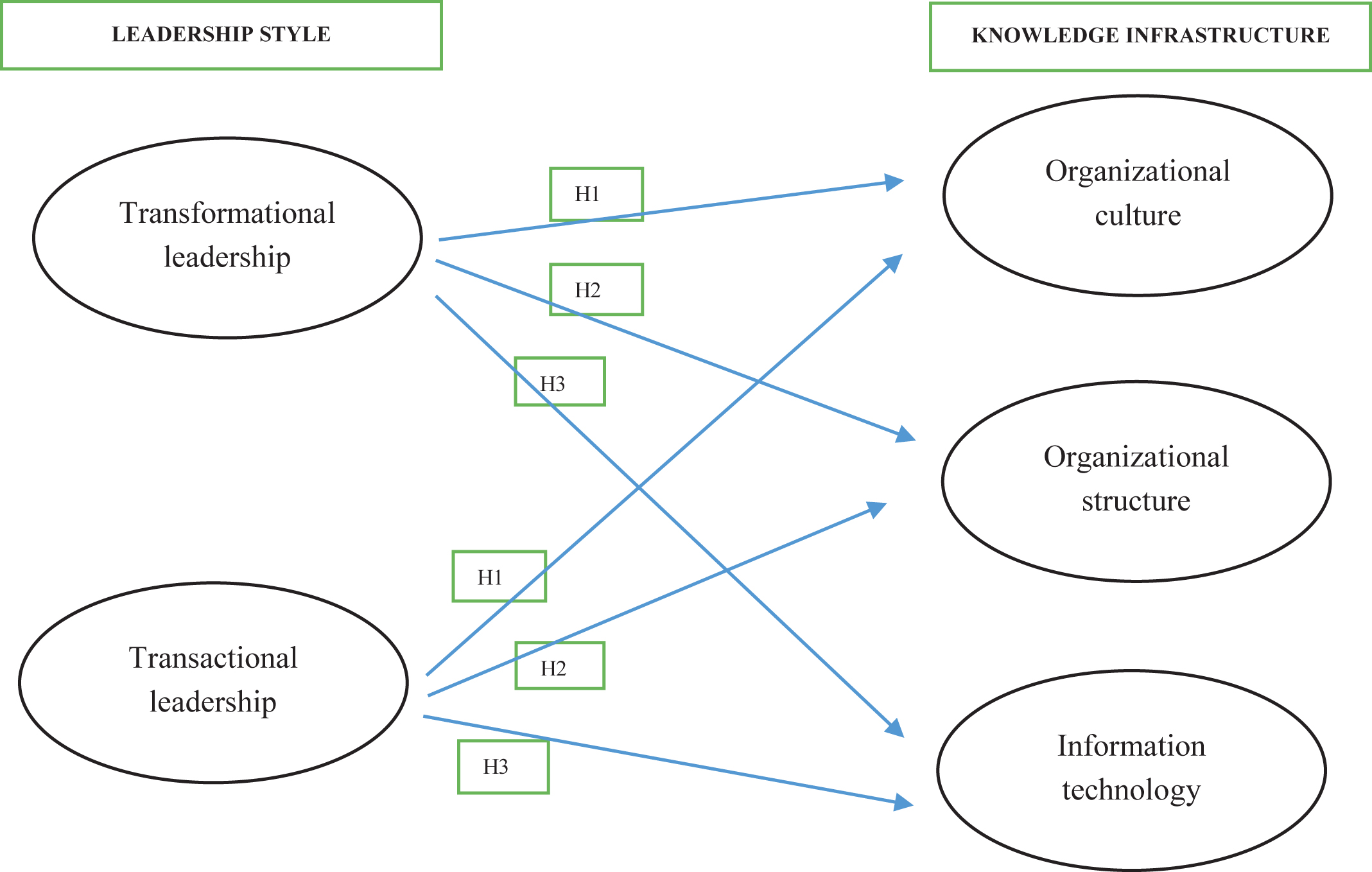
Proposed research model.
Presumed relations between transformation/transactional leadership and knowledge management were based on literature review. We defined knowledge management as capacity of organization to manage knowledge through infrastructure capabilities (and knowledge process capabilities). According to that definition, knowledge infrastructure is a part of knowledge management as well as three key elements of it: organization culture, organization structure and information technology. Leadership style influence on knowledge management has been topic of many studies which revealed strong influence of transformational leadership on knowledge management although transactional leadership also correlates positively with knowledge management [25, 48]. According to that we presume that transformational leadership is having stronger effect on knowledge management than transactional leadership. As we have analyzed only infrastructural elements of knowledge management we developed our next hypotheses:
H1: Transformational leadership is having more positive influence on organizational culture than transactional leadership.
H2: Transformational leadership is having more positive influence on organizational structure than transactional leadership.
H3: Transformational leadership is having more positive influence on information technology than transactional leadership.
Research methodoly
Data collection procedure and sample profile
Research was done on population of medium and big sized companies in Slovenia with two additional criterium of number of employees (ten or more) and years of operating (three or more). Criterion of more than ten employees and more than three years operating was applied strictly for focusing on population of companies that have potential to actively conduct knowledge management practices as smaller and younger companies usually do not have resources or awareness for managing knowledge. To be ranked as a medium sized company in Slovenia, company must exceed two of the following criterion: 50 employees, yearly turnover of 8 mio Euros and total assets of 4 mio Euros. Big sized companies must exceed criterion of 250 employees, 40 mio Euros of yearly turnover and 20 mio Euros of total assets.
Publicly available databases were used to collect contact information on companies from which data for 395 companies that fitted in selected criteria could not be obtained due to data not being published or it proved invalid after sending them request for participate in the study via email. The final population thus consisted of 883 companies.
Questionnaire was designed to collect research data for the study. Questions that represented manifest variables of each latent variable were selected based on literature review, and had been validated in previous studies. Email sending of survey was used with some follow up phone calls in case of respondent asked for additional information or clarification. We received 135 valid responds (15, 3% ) which is in line with expected percent of 10–20% as reported in other studies with similar samples.
Measures
Five constructs form the research model: transformational leadership and transactional leadership represent leadership style and organizational culture, organization structure and information technology represent knowledge infrastructure. Survey consisted of 8 questions for transformational leadership, 6 questions for transactional leadership, 8 questions for organizational culture, 8 questions for organizational structure and 8 questions for information technology. Questionnaire used seven-point Likert scale to measure responses with 1 being ‘strongly disagree’ and 7 being ‘strongly agree’.
In line with study of Arshad [49], we conceptualized transformational and transactional construct as second order hierarchical component construct (reflective – formative type) in which the first order constructs (Idealized influence - II, Inspirational motivation - IM, Intellectual stimulation - IS, Individual consideration - IC, Contingent reward - COR, Management by exception active - MA and Management by exception passive - MP) were measured by reflective factors – selected items from MLQ. Second order constructs of transformational and transactional leadership were measured with formative factors represented by first order factors (II, IM, IS and IC for Transformational leadership and COR, MA and MP for Transactional leadership. The instrument that has been developed to measure leadership style is the MLQ (Multifactor Leadership Questionnaire). Respondents describe the frequency of the behaviour described by the item on a designed scale. Different version of MLQ are consisting different number of items (36 to 90), each relating to a specific factor, we selected two items for each construct [50].
As defined by Gold [4] knowledge infrastructure consist of three key elements: Organizational culture - OC, Organizational structure - OS and Information technology – IT. All three elements were conceptualized as individual constructs measured with reflective factors – selected items from Gold’s validated questionnaire. Respondents were asked to express consent or disagreement with statements about knowledge management elements of organizational culture, organizational structure and information technology relating to their organization. We selected 8 items for measuring each construct of knowledge infrastructure.
Measurement scales
Measurement scales
Partial least squares – structural equation modelling (PLS-SEM) using SmartPLS 3.2.8 software was used to analyse the research model. PLS - SEM is a statistical approach for modelling complex multivariable relationships among observed and latent variables. Structural Equation Models include a number of statistical methodologies allowing the estimation of a causal theoretical network of relationships linking latent complex concepts, each measured by means of a number of observable indicators. From the standpoint of structural equation modelling, PLS-SEM is a component-based approach where the concept of causality is formulated in terms of linear conditional expectation. As an alternative to the classical covariance-based approach, PLS-SEM is claimed to seek for optimal linear predictive relationships rather than for causal mechanisms thus privileging a prediction-relevance oriented discovery process to the statistical testing of causal hypotheses. Using PLS-SEM approach to modelling exhibit greater flexibility in handling various modelling problems in situations where it is difficult or impossible to meet the hard assumptions of more traditional multivariate statistics. Within this context, PLS-SEM is only attributed to distributional assumptions and not to the concepts, the models or the estimation techniques. PLS-SEM approach was used in recent years by researchers on fields of management, marketing and accounting [51].
Two-step approach in conducting analysis is used in PLS-SEM where first step is the assessment of the measurement model (outer model) which specifies the relationship between manifest variables and latent variable. Second step is evaluating structural model (inner model) to test the extent to which the relationship specified by the proposed model are consistent with the acquired data [52].
Regarding to our research PLS-SEM is suitable for following reason [53]: relatively small sample (n = 135), focus on prediction of the dependable variables, reflective and formative constructs, conceptualization of constructs as higher order constructs, latent variable scores are applied in subsequent analyses, research model involves considerable complexity with regard to the type of relationships in the hypotheses.
Results
Measurement model
Two second order formative constructs (Type 2 Reflective – Formative) and three first order reflective constructs represent measurement model in this study. Two-stage approach was applied to evaluate hierarchical second order constructs. In first stage repeated indicator approach was used to extract latent variables scores for all the first order constructs. Latent variable scores were subsequently used as indicators in a separate higher order structural model analysis to measure second order constructs through a formative design approximation [54, 55].
Measurement model of first order reflective constructs was assessed in terms of individual item reliability, construct reliability, convergent reliability and discriminant reliability. Individual item reliability was analysed by examining their factor loadings and consequently one item of organizational structure and one item of information technology were removed from the model for not reaching recommended minimum value of 0.7. All other items in measurement model meet the minimum requirements as presented in Table 2. Hence, individual items were reliable.
Measurement model
Measurement model
Construct reliability determines whether the items measuring a construct are similar in their scores which means that correlations between items are large [55]. Values of Composite reliability (CR) and Cronbach’s alpha (CA) are measures of construct reliability and their values are suggested to be above value of 0.7. As seen in Table 2 are values of CR and CA are above minimum value and we can confirm construct reliability. Convergent validity was assessed by Average variance extracted (AVE). Fornell and Larcker [56] suggest that values of AVE should be above value of 0.5. Value of AVE over 0.5 means that at least 50 per cent of the indicator variance should be accounted for Table 2 shows that values of all first order reflective constructs were above 0.5 which means that constructs have an acceptable level of convergent validity.
Discriminant validity analyse whether a construct is truly different from other constructs in the model by how much it correlates with other constructs and how much items represent only a certain construct [55]. In this study, the confirmation of discriminant validity comes from three approaches: Cross – loading test Fornell – Larcker criterion The heterotrait-monotrait ratio of correlations (HTMT).
Cross loading refers to an item’s correlation with other constructs in the measurement model. All individuals’ items should be loaded higher on their respective constructs than on the other constructs to meet criteria [55]. Table 3 shows that loading of items in our research model meet this criterion.
Discriminant validity: Cross - loadings test
Fornell and Larcker [56] criterium of discriminant validity is comparing the AVE value of each construct with the shared variance between the constructs and suggest that he square root of AVE of each construct should be greater than its correlations with other constructs. Table 4 shows values on the main diagonal being greater than values below diagonal and by this discriminant validity is supported.
Discriminant validity: Fornell – Larcker and HTMT criterion
Notes: Values on diagonal represent the square root of AVE and values below diagonal represents shared variance between constructs.Values above the diagonal represent HTMT values.
Heterotrait-monotrait ratio (HTMT) is a mean of all correlations of items across constructs measuring different constructs relative to the mean of the average correlations of items measuring the same construct [55]. Table 4 shows value of HTMT above diagonal. All values are above the recommended threshold of 0.9 except for value between constructs of IC and IS. However, as they both represent lower order constructs of the same higher order constructs of transformational leadership, we can accept the value and confirm discriminant validity.
Multicollinearity testing among items and analysis of weights was used for assessing the structural model [53]. Table 2 shows that VIF values for all formative indicators were below the recommended threshold of 3.3, which means that there is no presence of high collinearity among indicators which would produce unstable estimated that would make difficult to separate effects of individual variable on the construct. Assessment of weights provide information about how individual formative indicator contributes to its composite construct. Bootstrapping procedure showed the presence of non-significant weight of formative indicator Idealized influence (construct of Transformational leadership) and Management Active (construct of Transactional leadership). Nevertheless, we decided to keep both indicators in the model as their loading (absolute correlation with the construct) is significant [55].
Bootstrap procedure with a number of 5.000 subsamples was used to estimate path coefficient and tested statistical significance.
As shown in Table 5 influence of transformational leadership on organizational culture is greater than influence of transactional leadership on organizational culture. As we predicted both styles of leadership to positively influence organizational culture with greater influence of transformational leadership we can accept hypotheses H1. Organizational structure is also heavily influenced by both leadership styles. Path coefficient of transformational and transactional leadership towards organizational structure are relatively similar however transformational leadership positive influence is greater and we can accept hypotheses H2. Both leadership styles are also positively influencing information technology although path coefficient of transactional leadership is relatively low. H3 can also be accepted.
Structural model results
Structural model results
Notes: n.s. - not significant; *** - significant at p < 0.001 level; ** - significant at p < 0.05 level; * - - significant at p < 0.1 level.
As seen in Table 6 values of R2 for Organizational culture is 0.583, for Organizational structure 0.544 and for information technology 0.359. Following the rule of thumb all R2 values exceed minimum value of 0.1 recommended by Falk and Miller [57] which shows satisfactory level of predictability. Cross-validated redundancy index (Q2) was measured for further assessment of predictive relevance. Q2 values greater than zero implies that the model has predictive relevance [51]. Table 6 shows that all endogenous constructs are above these requirements.
Model’s goodness of fit and predictive relevance
Notes: ** - p < 0.05 two-tailed bias-corrected confidence interval
Model’s goodness of fit was analysed through the value of Standardized root mean square residual (SRMR). The value of SRMR was 0.034 is well below than the maximum threshold of 0.08 [58]. We concluded that our model reached satisfactory level of goodness of fit.
Main goal of this study was to empirically test a conceptual model of leadership style’s influence on knowledge infrastructure capacity which is considered as a part of knowledge management concept. Knowledge infrastructure can also be interpreted as a knowledge management enabler that provides necessary foundation for efficient knowledge management. Organizational culture, organizational structure and information technology as three factors of knowledge infrastructure play important role in knowledge management [31]. Conceptual model predicts that leadership style adopted by managers in organizations is influencing knowledge infrastructure. Leadership style is represented by two basic styles of leadership styles: transformational leadership and transactional leadership. Both leadership styles are influencing knowledge management, however transformational leadership style which is more people-focused approach toward leadership is believed to have stronger positive influence on knowledge infrastructure elements.
Results of empirical analysis showed that both leadership styles are influencing all three factors of knowledge infrastructure in a positive way and thereby supporting various reports [25, 48] that both leadership styles are positively correlated with knowledge management. Transformational leadership was, however, found to have stronger positive effect on all three factors of knowledge infrastructure although level of influence on organizational structure was relatively very close. That can be attributed to the fact that organizational structure demands also transactional approach of leadership with some bureaucratic elements to be effective which is supporting studies of Acharya and Mishra [42] and Claver-Cortes et al. [2].
Strong positive influence of transformational leadership on knowledge management was expected as it was reported already in many other studies [20–24]. Results were also in line with studies of Birasnav [25] and Birasnav et al. [26] which claimed that transformational leader will promote knowledge as one of the main cornerstones of his function while also building teams and networks that are providing efficient information flow in organization [27].
As transformational leader primary task is to motivate, inspire and empower employees, knowledge is considered as one of the basic tools that modern leaders use to generate success in their organizations. Transformational leadership is therefore more appropriate for managing knowledge, however transactional leadership elements also need to be used in order to increase efficiency of knowledge management in organization. Transactional leadership provides clear direction and project goals while establishing organizational framework in which organization operate. System of corrective actions and stimulation by rewarding can be very effective, especcialy in stable market or organizational environment. Transactional leadership therefore adds complementary dimension of leadership to be combined with transformational leadership in order to maximize positive influence on knowledge management.
Implication for practice and theory
Study provided additional insights for managers on how to approach knowledge management initiatives in organizations. Results showed that leadership style can be a crucial element of efficient knowledge management. On one hand, transformational leadership that is based on motivation, individual consideration and intellectual stimulation provides better results. On the other hand, transactional leadership also contributes with positive effects. Hence it is necessary that mixture of both styles is adopted, however greater emphasis should be on transformational leadership style.
Knowledge management is often analysed only from the perspective of knowledge management processes which may not reveal us with the whole picture. Knowledge management infrastructure can also be described as knowledge management enablers and provides necessary foundation for efficient knowledge management. Because of that it is essential for managers to focus first on elements of organizational culture, organization structure and information technology to establish platform on which knowledge management processes can be build. As seen by the results of this study, influence of leadership style on all three factors of knowledge infrastructure is significant. This fact further establishes the need for managers to focus their activities in that perspective.
From a theoretical point of view study provides insight in different relationship between leadership style and knowledge management. Leadership style is defined as transformational leadership and transactional leadership that are different in aspects they are focus on. Both leadership styles are consisting of several additional components that all together define each construct. Transformational leadership consists of four components with similar weights towards transformational leadership construct. Transactional leadership on the other hand is consisting of three components with one being dominant in aspect of weight towards transactional leadership construct (Contingency reward). Knowledge infrastructure represents only one part of knowledge management concept, however very important one. With breaking knowledge management concept into two parts, we can more precisely analyse which specific factors are contributing to the whole concept. When analysing relationship between leadership style and those specific factors, namely organizational culture, organizational structure and information technology, we can see deeper relation between analysed factors.
Limitations and future research directions
First limitation of study represents geographical context of research as it was conducted of population of companies in Slovenia. The final number of valid responses was relatively small which may have consequence of limited overall generalizability. Quantitative research only also represent limitation as some respondents may prefer other research methods like interviews when participating in study. Survey for obtaining research data was conducted with respondents in companies using self-reported questionnaires which can present various opportunities for bias in the data. We assured anonymity of respondents and provided additional detail explanation of questions to minimize bias in the data. Unusable or unstable data were removed from the final sample to furthermore minimize bias.
Future studies should define leadership style with different yet similar concepts to analyse if basic distinction between person-focused and task-focused leadership style is influencing knowledge management similar to our study. Also, other leadership styles should be used to analyse basic relationship between them and knowledge management. There are many different definitions of leadership style which can be used and provide additional insight into its influence on knowledge management. Knowledge management should also be analysed from strategy perspective (codification vs. personalization) regarding to its relationship with leadership style. As with leadership style there are various definitions of knowledge management which may contribute to knowledge when analysed in relationship with other factors that are influencing it. Furthermore, other concepts of measuring construct of knowledge management should be used or developed as they also may provide new information about how respondents in surveys sees this relatively new concept. As our study is focused on one country only it would be useful if future studies would focus on other countries, or even more of them, to compare the results between them and also between different industries. Long term observation of researched object should be conducted in future studies, especially from the standpoint of influence of different leadership styles through time perspective on knowledge management infrastructure, as it would provide more in depth insight on how is leadership style influencing knowledge management as we can assume that influence of leadership can be (partially) delayed and can be fully effective over longer period of time.