



Abstract
BACKGROUND:
Human resource development in sustainability is a prerequisite of enhancing the success of any organization. Education for sustainable development has been recognized as a key process to support employees’ skills development to positively reoriented their behavior to the sustainable development values and principles. In the article context, based on a synthetic literature review for charting the sustainability taxonomy, there has been created a first general inventory of topics needed to be considered for designing a training program in the field.
OBJECTIVE:
The objective of the present paper is to identify the general Qualification Matrix defining the training program for sustainability management (based on a training needs assessment study). Furthermore, the research will demonstrate how the training program could be tailor for the case of “management position” research variable.
METHODS:
First method applied in the study include a synthetic literature review for charting the sustainability taxonomy (creation of comprehensive inventory of topics needed to be considered for designing a training program for sustainability management). Second, based on the sustainability taxonomy, a questionnaire was designed and used in a survey for the training needs assessment. The research sample consisted of 207 respondents, potential trainees that are employees of different companies (from Austria, France, Romania and Slovenia), with a balanced structure of management position and distribution of age. Predictive Analytics Software (PASW, developed by IBM, formerly known as SPSS) for statistical processing has been used for statistical data analyses.
RESULTS:
The study results have indicated that the most appropriate training methods to be used in the sustainability management training program consists in a combination of: “Theoretical knowledge + examples of good practices + exercises + individual projects”. The process of tailoring the sustainability management training program has been demonstrated for the case of “management position” research variable (with three sub-categories of respondents: top managers, middle and low managers and professionals with no management position) and was based on the defined Qualification Matrix (consists of 5 training units and 19 training elements).
CONCLUSIONS:
The research have valuable contribution in the field of human resources development, particularly by offering a concrete solution in designing and tailoring a training program for sustainability managers started with the training needs assessment and the Qualification Matrix definition.
Keywords




Introduction
Sustainable development has become a priority and more organizations are trying to find their way to a better future. In the same time, the industrialization process has increased the social and environmental impact of the uncontrolled consumption and production. The high level of production and the excessive consumption of the population leads to the increase of greenhouse gas (GHG) emissions due to anthropogenic activities and implicitly, these have created severe atmospheric problems such as climate change with an impressive local and global impact that forces population to adapt to these effects, which can often be quite serious [1].
To introduce the paper research context, the phases of sustainability achievement is explored. The process starts with an initial assessing of sustainability maturity on organizational level. In [55], the authors use to express the sustainability at organizational level by value added using the three sustainability dimensions. Furthermore, in [56] the sustainability achievement is seen more as a performance improvement of the business model. In [57] is depicted a study case from Korean electronics industry consisting of an initial assessment and then the business process optimization stage is starting, as part of continuous improvement management system. This requires a redesign of internal process management but also, the changing of mind set regarding sustainability in all organizational levels. In [58], authors explore two examples in the forest industry, which highlight the environmental certification implementation, by having a training and reward program for employees. The topic of energy sustainability training was also, addressed in [59], where the proposed training form is by using Massive Open Online Courses (MOOCs) delivered in 2017. As contrary, the training presented in [60], is a cross-disciplinary postgraduate course, targeting energy managers. However, similar approach is exhibited in [60], where the customized training solution of “European EnergyManager” (EUREM) is depicted for the case of energy managers.
Another training direction is given in [61], where in-house delivered courses are combined with on-line methods, preparing trainees for various certification as: Sustainable Facility Professional, Sustainable Procurement, Sustainable Resource Operation and Management, Corporate Social Responsibility (CSR), Sustainability, and the Foundation Certificate in Environmental Management provided by the Institute of Environmental Management and Assessment (IEMA) etc.
The first observation, based on the literature, is that sustainability training programs address to the participants (trainees) from different levels of management and are tailored to a specific sustainability dimension, rather than customizing a global solution (training program) to different categories of employees. However, in majority, the training programs are limited and cannot satisfy all organization needs in the sustainable development field. In conclusion, there should be explore the situation of sustainability training programs tailoring according to the initial training needs assessment, which is considered a knowledge gap in the literature and organizations’ practice.
The paper is organized as follow: section 2 presents the literature review; section 3 describes the method and tools used for training needs assessment in the field of sustainability; section 4 includes several debates on the research results on the training needs assessment, the debate on the tailoring process of the training programs for management and non-management categories of employees, and a comparison of the research results with other studies’ results in the literature. Finally, section 5 presents the general conclusion, the research limits and future works.
As supplementary materials, an Annex presents the detailed research results for the training needs assessment.
Background
First part of the research was dedicated to literature review (synthesis) for defining the sustainability taxonomy based on the dimensions involved in the field. Consequently, the existing models in literature, proposed three dimensions: economic, social and environment (the Triple Bottom Line Model), first proposed by [11] and further explored in [12], being used as framework for assessing competitive advantage in [13]. However, more models emerged, like the Eco-Centric Model [14], the Global Sustainability Model [15] or the Efficient Strategy for Sustainability Model [16] which proposed fourth dimensions: economic, social, environment and participative democracy.
Standardization in the field started with the normative and certification framework related to the ISO 9001 standard and gradually evolved, integrating other important aspects towards the sustainability performance of organizations which is seen as an integrated system [17]. Environmental challenges always lead to economic challenges, and the balance to be targeted must be viable (as supported by the development context of ISO 14001 standard) [18], since an imbalance in this area can also affect the social dimension. On the other hand, social inequality can lead to serious challenges and concerns of the economic effects, which can be extended over a longer period.
In this case, an important role is given to the implementation of the ISO 18000 standard that sets out the requirements of social responsibility. Furthermore, a comprehensive view over occupational health and safety (OHS) and sustainability standards is given in [19]. The ISO 9001 standard implementation, regarding organizational requirement was debated in [20], regarding influence over labor productivity. In addition, [21] discussed the quality integration with supply chain management. The implementation of international standards for work control and continuous improvement is the first step towards the sustainable development of the companies.
Over time, the emergence of different standards has been imposed by the industrial development and the challenges that various stakeholders in the organizational value chain have had. Standards evolved and their added value is to balance the internal organizational systems [22, 23]. The standards integration into the organization’s strategy and practices can lead to business excellence through sustainable development [24]. Furthermore, ISO 9001/2015, ISO 14001/2015, and ISO 45001/2018 consider the important internal and external aspects that may affect the organization. The early criticism for ISO 14001 was expressed in several papers [25 and 26], nevertheless case studies regarding the implementation are presented in [27–29]. In addition, the need for stakeholders management is essential for the dynamics of continuous improvement of the internal management system, as it requires the consideration and opportunities analysis of both the external environment and internal challenges (relative to change management) in defining the organizational strategy [30]. All these aspects should be direct correlated by defining the context in which the organization operates.
The United Nations’ program “Resource Efficient and Cleaner Production (RECP)” [31], stated, as objectives, the increase efficiency uses of resources in economy, resource conservation and minimize the industry impact and social sustainability. Part of those objectives, are also present into local level, expressed in Europe 2020 Strategy [32]. Furthermore, the sustainable use of energy, expressed in Europe 2020 Strategy is a mix of policies which envisages the increasing of both industrial facilities and households’ efficiency, rising the renewable resources, improving the energy systems and securing the nuclear energy resources. A more detailed view is given in [33, 34]. Nevertheless, even the energy is the main concern regarding the efficiency of use and the renewable resources [35]. Water is also considered as very important in day-to-day life and as an industrial resource, too. European Union developed a set of policies on water pollution [36] and a set of measures and policies to combat water scarcity and droughts [37]. For this reason, is mainly encouraged the rising of efficiency use of water and limiting the industrial use. Regarding materials and waste management, the sustainable solution, is an integrated approach on product life cycle [38], but also the waste collection and recycling, a smart city waste management being presented in [39].
In recent years, the global context of energy security, fuel price stability, greenhouse gas emissions and the acquisition of sustainable raw materials, ethical trade and corporate social responsibility (CSR) has led to the adoption of widely distributed business models are increasingly sustainable, energy efficient and lead to low emissions, being widely defined in [40].
About the relationship between environmental and economic dimensions, organizations can no longer neglect the negative environmental effects they cause, directly or indirectly, due to the processes of manufacturing/supplying products and/or services. CSR practices include integrated approaches to all dimensions of sustainability (economic, social and environmental), in direct interaction with stakeholders. These principles are also necessarily reflected in the business strategy [41] and emerged into Corporate Sustainability Management [42]. However, the CSR approach includes the implementation of OHS standards, regarding certifications and safety management system on corporate level are widely presented in [19, 43]. Furthermore, the social impact assessment of CSR is revealed in [44]. The stakeholders’ involvement concludes this section, being a premise of sustainability management system implementation. An example of achieving sustainability in construction site is given in [45].
The integrated approach of life cycle is a prerequisite of sustainability, being seen also, from the important point of view of production. The early research in the field, proposed various tools and methods as described in [46, 47]. Nevertheless, the product and process sustainability development solutions started from service or product design stage, by increasing the efficiency of resource usage in the manufacturing process and ends with recycling of goods at the end of life cycle [14]. In addition, [48] presented the key factors of services development. Innovation is integrated into the management systems, having positive influence on all already defined dimensions of sustainability. In [49], is analyzed the relation between open innovation, innovation and management system. An example of necessary actions and research structures to achieve sustainable innovation in information and communication technologies is given in [50]. Regarding the supply chain management, previous research, as presented in [21], explored the quality management and supply chain diagnosis as a premise for sustainability improvement. The term of sustainable supply chain management aligns the supply chain with the sustainability dimensions [51]. However, the business process management, as integrated part of supply chain management is presented in [52].
The framework of sustainability integration into organizational management, is presented, in a comprehensive way in [30]. The authors proposed a Sustainability Management System Framework (SMSF), that will act independently rather than as a part of standalone management systems. However, ISO GUIDE 82 : 2014(E) [53] offers a series of highlights for enhancing the sustainability issues role by ISO standards applications, cohesion among sustainability standards and systematic approach of sustainability issues. The sustainable business model is targeting the sustainability dimension inclusion into business process management. In [17], the term of Sustainable Business Process Management (SBPM) is defined by taking into consideration the main levels as: the enterprise system, the processes and implementation levels. Starting from enterprise system level, sustainability implementation requires strong leadership skills and competences. These aspects are debated in [22] and are offering a systematic view over sustainability issues. However, the term of leadership in sustainability is also, described in [54].
The synthetic literature review for charting the sustainability taxonomy has created a first overview of the topics needed to be considered for designing a training program in the field as can be seen in Fig. 1. In addition, the literature consists of various research for different industries, thus being a valuable source for learning examples, best practices and case studies development. But for a complete and adequate structure and content of the training program in the field there have been considered that it is mandatory to have a deep understanding of the human resources’ training needs (opinions from potential learners or trainees, considering different segments of employees, including managers of different levels). This research approach will be presented in the following section.
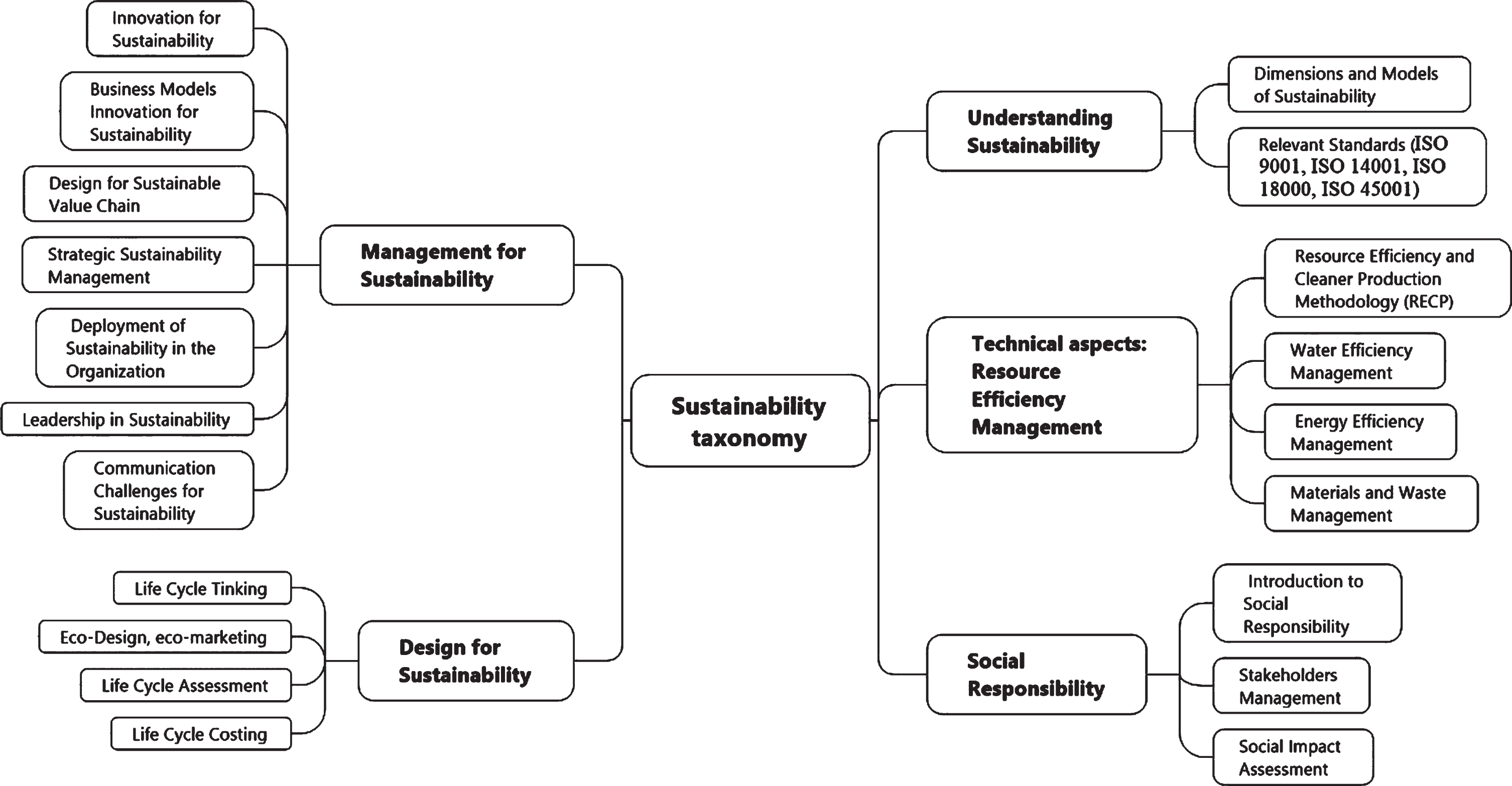
Sustainability taxonomy –A premise for designing the training program.
Based on the results of the literature review, a second research has been conducted to identifying employees’ training needs in the field of sustainable development is critical because of two important implications: (1) to understand the current state of the employees knowledge in the field and design the appropriate training program that will enriched their skills and competences; (2) to characterize the key competencies needed for sustainability management related to a specific organization. Thus, the training needs assessment should lead to the identification of the main training subjects being of employees’ interest to support their professional skills development. Alternatives of this approach should consider aspects as: Perception and satisfaction of the intrinsic needs, manifested as trends on the labor market that are oriented towards increasing individual performance, and which will affect the organization performance, too; Satisfying employees’ training needs in accordance with the balance between the principles and values of the organization and the individual once (personal perception of what is important or not for the professional life continuous improvement); The pressures of values induced by organizational culture that can influence the decision to satisfy individual training needs and the available financial support for this.
Most approaches for the training needs assessment use the questionnaire survey method [62]. The most difficult aspect of this approach is the way in which collected responses interpretation is developed to design an effective and efficient training program that will be able to full-fill the knowledge gap of the employees. In the case of the present research, the aims were related to: Determine the key topics that are most needed for respondents that are employees (managers and professionals with no management position). Though their implication they could act as change processes facilitators for sustainability improvement in their organization; Identify the most appropriate method of teaching/learning specific knowledge of sustainable development; Customize the training program for managers and professionals with no management position to obtain high levels of efficiency and effectiveness of the knowledge acquisition process during the training programs and, to better support the knowledge transfer process in organization’s practice.
The main operational objective of the research was the analysis of managers and non-managers (professionals without managerial position) training needs, the results being perceived as gaps in formal and informal education at the organizational level. In addition, the research results must provide a learner profile splits into three categories (top managers, other managers that are middle and low managers, and professionals with no management position), considering their training needs in the field of sustainability management. Thus, the tailoring process of the future training programs should be supported.
Research methodology
The research methodology consists of a survey based on a designed questionnaire combined with the analysis of the informal discussions with potential trainees (investigated subjects from the research sample). The research methodology for the training needs assessment was defined by the following tools used: the designed questionnaire, the database defined by the responses collected and the Predictive Analytics Software (PASW, developed by IBM, formerly known as SPSS) for statistical processing the collected data (Excel file has been used). The developed questionnaire includes questions with multiple and fixed answers and open questions (for collecting the opinion freely expressed by the respondents). The final version of the questionnaire is relatively short and compact (three pages and three chapters), and predominantly closed questions have triggered a rapid processing of statistical data. The structure of the questionnaire includes: An introduction with brief explanations about the context and objectives of the research; Chapter I, which includes 4 questions (3 closed and one open) that aim to identify the expectations of potential learners (respondents) and the benefits if they are involved in the a training program for the sustainability skills development (generic entitle sustainability management). The purpose of these questions was to capture the interest of the investigated subjects (potential future trainees) for the proposed training program; Chapter II includes close questions where potential learners (investigated subjects) must self-assess their training needs (using a Likert scale with 5 points where 1 - not needed, 2 - low need, 3 –medium need, 4 - high need, 5 - very high need). The topics were proposed based on the sustainability taxonomy presented in Figure 1. In addition, an open question allowed other topics of interest to be proposed by the respondents for the future training program. Finally, a question was included to identify the most appropriate training method aligned with the respondent’s learning style; Chapter III includes questions to describe the research sample demography; The final paragraph invites respondents to leave their email addresses if they are interested to be involved in the next training sessions.
Chapter II defines the questionnaire core through which the collected responses (opinions expressed using the Likert scale) there have been characterized the training needs of different category of respondents. These allow and support tailoring the training programs for sustainability management. The considered topics (subject to specific questions) were established by refining the sustainability taxonomy (Fig. 1) as can be seen in the following: Relevant references (for own professional development); Standards and norms for sustainability; Resource efficiency and cleaner production; Water, Energy; Energy management; Waste management Social responsibility definition; Health and safety management; Social impact assessment; Stakeholder management; Integrated approach to life cycle; Innovation by designing and delivering sustainable products/services and systems; Procurement and supply chain; Business model’s innovation for sustainability; Strategic sustainability management; Environmental accounting; Leadership in sustainability; Communication with experts from different fields; Knowledge Management for sustainable management.
Finally, in the process of tailoring the training program for different categories of respondents, the preliminary research results (related to the training need assessment) have been detailed based on the collected information from the observations and discussions results that were collected using the informal interview method. An interview list form (designed with the same structure of the questionnaire but all questions were open) has been the tool use during the informal discussions to record the detail description of the proposed training elements. The informal interviews were developed with potential trainees that have been subjects of the research sample for the training needs assessment.
Initially, the designed methodology for the training need assessment in the field of sustainability has been defined and applied in as a pilot research (with a small group of respondents from Romania, Slovenia, Austria and France, through the support of the organizations’ partners in the LeadSUS and TeachSUS projects) to refine the questionnaire and the methodology of the statistical data process. In the final semester of 2019, the research has been developed in a coherent and well-established base (with the purpose of designing a new tailored training program in the field of sustainable management); in 2020 the research results were ready to be published.
Data collection and statistical analyses
The questionnaire distribution has been done on-line by e-mail and using the regional and national network of the LeadSUS and TeachSUS projects’ partners (https://www.teachsus.eu/). More than 600 potential respondents have been targeted. Mainly, respondents were from Romania, Slovenia, Austria and France. The received fill-up questionnaires have been validated to ensure they are complete and questionnaires with missing data (relative to gender, age, occupation or questionnaire with more than 10% missing data in other questions or more than three unanswered questions) were excluded (only six questionnaires were not validated), having under 3% invalidated from total questionnaires. As a result, a total of 213 fill-up questionnaires were collected, of which six were invalidated, remaining 207 for statistical analysis and evaluation. Valid questionnaire data were centralized into an Excel database of responses that were then statistically processed. After the valid questionnaires’ centralization, all the variables have been checked for: not missing data, presence of data outside the subject, or other inconsistencies; these were certified in the source documents. In addition, missing values/responds were discussed and reported. Once all inconsistencies have been clarified, the database have been considered for statistical processing.
The Likert scale was used to determine the score for each topic training need (notation “S”, weighted average of the answers corresponding to each training topic). In addition, compound score, was calculated for each topic, as the median value of contended criteria. For this research, synthesis measures include the number and percentage of subjects per the category “job position” (top managers, other management position, no management position). It was not intended to generate continuous variables from the questionnaire. For ordinal data, comparative tests between genders and positions at work were performed using non-parametric tests (as Mann-Whitney and Kruskall-Wallis). The statistical significance threshold is 5%, unless otherwise stated, due to the Bonferroni correction. The value of the applied test was reported, as well as the exact level of significance. All data summaries and the research result tables were developed using the PASW18 software version.
The demographic characteristics of the research sample
The variables, characterizing the sample surveyed were gender, age, the field of activity in which respondents operate, position or professional role (management position or not) and their education level by specifying the last graduated program. Descriptive statistics have been applied for the considered demographic variables. The responses highlighted a balanced sample by gender and age variables; the main respondents in the survey were female (68.5%) and people aged 25–35 years. The age and gender distribution are presented in Fig. 2. The sample of research from the point of view of the management position of the subjects is balanced: 56% of the respondents do not have a leading position and 44% are in management positions (top, middle and low management positions) as depicted in Table 1. The demographic data did not reveal major differences in gender distribution among management positions as shown in Table 2, the sample being balanced.
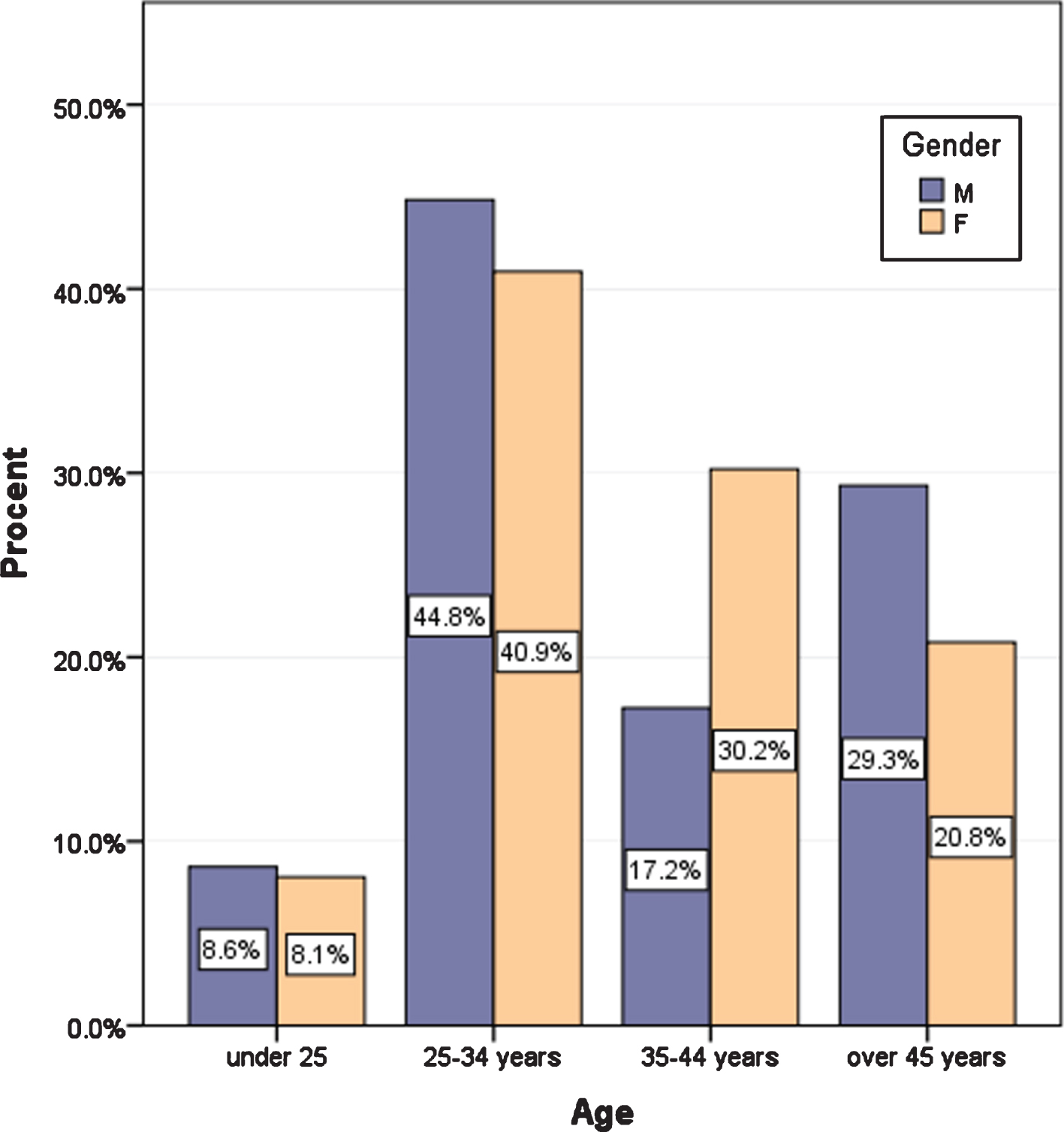
Respondents’ distribution by age and gender (demographic data of the research sample).
Distribution by management position of the sample
Distribution by gender between management position of the sample
Respondents’ field of work demonstrated a balanced sample, too (including employees from almost all industries and from different type of companies: small and medium size, big companies, national and multinational enterprises). The respondents’ education level distribution reveals a high intellectual level (bachelor 28%, Master 43% and PhD 17%) which guarantees a high level of commitment and responsibility for the research. Furthermore, the research sample consists of 35.32% respondents (considering their workplace location) from Romania, 23.17% from Austria, 27.82% from France and 13.69% from Slovenia.
For the purpose of this article, the research results analysis on the training needs (detail analysis of each proposed topic, according to the Chapter II of the designed questionnaire) will be presented only for the case of the “management position” variable, which has been considered the most relevant for the human resource development in the field of sustainability management. The research results of the statistical data processing and debate are presented in Annex to this article.
Identification of the most appropriate training method
At the end of Chapter II of the questionnaire, the question was asked to identify the most appropriate training method aligned with the respondent’s learning style; 60.4% of them chose the answer: “Theoretical knowledge + examples of good practices + exercises + individual projects” (Table 3). The research results have shown that the appropriateness of the method “Theoretical knowledge + examples of good practices + exercises + individual projects” was preferred by 62.2% by the respondents on “other management positions” (middle and low managers) than the “top management” and 61.2% of the specialists (respondents with “no management position”).
Distribution of the responses on the most appropriate training method
Distribution of the responses on the most appropriate training method
The statistical data processing shown no significant differences between the management position regarding the most suitable training method (p = 0.316). In conclusion, the respondents’ choice should orient the pedagogical method used in the training programs, but also the teaching methodology (knowledge + examples of good practices) –learning (exercises and projects) –evaluation (projects assessment). Also, the answers to the last question of questionnaire once again confirmed the “very high need” of the respondents (of all categories) for sustainability management trainings, because 80.7% of them expressed their acceptance to participate in future training programs (Table 4). The statistical data processing did not reveal any significant differences between the management position regarding the willing to participate in future training programs (p = 0.269).
Distribution of responses to the willingness to participate in the future training programs
Table 5 presents the Qualification Matrix associated with the training program structure (curriculum proposal), defined by units (U) and elements (E) that should be trained for the developed knowledge and skills in the field of sustainability management. Furthermore, the Qualification Matrix allows the visualization of the area of competences given by the specific themes chosen in accordance with research results on the training needs (as a fundamental part of the continuing development of human resources). In addition, the scores for each training unit and element need are presented could be used for the prioritization of the training sessions (related to specific unit).
Units and training elements - Qualification Matrix (global results for entire sample)
Units and training elements - Qualification Matrix (global results for entire sample)
As seen in Table 5, all proposed and considered training units in the training program received high total scores for their training need, between 4.02 and 4.43. The research results revealed the respondents’ high need in “Sustainable management U5” with a total score of 4.43. However, this topic is closely followed by “Social responsibility U3” having the total score of 4.35. Even it seems that respondents are more interested in implementing management systems rather than implement a radical change of thinking (caused by low total score for training need for “Resource management U2”), the change may come because of the interest in “Sustainability of products and services U4” (related to eco-design and eco-innovation topics). The hierarchy of the most training needed elements is presented in Table 6 (details of each elements have been provided based on the results of the informal discussions with potential trainees).
The hierarchy of the most needed training elements (global results for entire sample)
After the general Qualification Matrix definition, the research results analysis has allowed the process of tailoring the training program content for the respondents’ categories related to the “management position” variable. The research results consist of the determination of the hierarchy of the most needed training elements, based on the calculated scores (S) and the detail description of the training elements that have been supported by analysis of the informal discussions with potential trainees (investigated subjects from the research sample).
Top managers’ needs for training are presented in Table 7. The highest need for training is related to the “Sustainability management” training unit (U5) with a score of 4.38, followed by “Social responsibility” one (U3). The results are not surprising, having in mind the job description of top management position, with close responsibilities regarding the above-mentioned training units. However, because of the tight range of scores, in Table 7 are presented the first ten elements needed for training based on the research results achieved by integrated the survey results (score calculation) with those from the informal discussions with potential top managers trainees.
The content of the tailored training program for top managers
The content of the tailored training program for top managers
The most needed training element is “Business model’s innovation for sustainability” U5E1 having a score of 4.61, followed by “Strategic sustainability management” U5E2 with a score of 4.50 and “Leadership for sustainability” U5E4 with a score of 4.48. If the tailored training scenario is taken into consideration in case of top managers, it is mandatory that the training program should include the units of “Sustainability management” U5 and “Social responsibility” U3; the results of the tailoring process shown in Table 7 give details about the content of the training program in the field of sustainable development.
For “other managers” (middle and low managers) category, the hierarchy of the training elements is presented in Table 8. The process of tailoring the training program in this case, has shown the highest need for training for “Sustainability management” U5 with a score of 4.55, which can be justified by the intention of this category of managers to perform better their tasks and to be trained and ready to occupy top management positions. Next training need was related to the “Social responsibility” U3 with a score of 4.25. Furthermore, in comparison with top managers’ needs for training, in case of middle and low managers the top three training elements, indicates “Leadership for sustainability” U5E4 with a score of 4.62 being the most needed training element followed very closely by “Knowledge management” U5E6 with a score of 4.60 and “Business models’ innovation for sustainability” U5E1 and “Strategic sustainability management” U5E2 with the same score of 4.56.
The content of the tailored training program for middle and low managers
Regarding the process of tailoring the training program for middle and low managers, research results have underlined that it should include also, the units of “Sustainability management” U5 and “Social responsibility” U3 as in the case of the top managers. However, depending on the activity area (industrial field) and the expertise of middle and low managers it is recommended that the training program to include at least one element from “Sustainability of products and services” U4 as “Integrated approach to life cycle” U4E1. This category or respondents were highly interested in training topics as life cycle thinking, eco-innovation, eco-design, eco-marketing etc.
The last category considered for the “management position” variable definition was defined by those professionals (being graduates of university programs) which do not have a management position. For this category of specialists, the research results (shown in Table 9) reflect the same specific of the training needs, but smoother than previous two categories of managers, varying from a score of 4.40 in case of “Sustainability management” U5 and a score of 4.07 in case of “Resource management” U2. The interest of the specialists with no management position for those training units was determined by the concern for increasing their professional performances related to the efficient and effective implementation of innovative methods and tools for sustainable development in organizational practice (facts gathered during the informal discussions with potential trainees of this category).
The content of the tailored training program for professionals with no management position
Related to the hierarchy of the most needed training elements for the case of professionals with no management position (Table 9), the interest is more flattened and opened to various training elements, because of their professional experience. Thus, the professionals have proved their openness to acquire new knowledge and innovative methods and tools in the field of sustainable development. The elements’ content description are research results obtained by integrated the survey results with those achieved by informal discussions with professionals (potential trainees).
The large part of the existing research focused on how to design the curricula for sustainability, by including as stand-alone subject or entire training program for Bachelor or Master degree. In [63], the authors present the assessment method for sustainability programs starting from the analyses of 54 existing bachelor and Master degree programs. In the study, the assessed programs, covering relevant universities from Unite States and United Kingdom mainly, the relevant comparison with our work is concentrated on the content, as course subject and the trainees. The study uses as content general description elements like Climate change, Intro to sustainability, Enterprise or Research methods, in our work in the curriculum design we use the learning unit in correspondence with the proposed refined taxonomy for sustainability. Our work is oriented to enhance the learning outcomes, instead of the subject content descriptors. However, another relevant difference, is the targeted audience. In the above mentioned study, the trainees are part of bachelor or master programs, with no or limited experience in business operation, in comparison with our research which is focused on companies employees which are already graduates of bachelor or master academic programs, with a history and experience in the company business operation.
Another similar research is presented in [64], where the authors reveal the improvement made in the JMU for the School of Engineering, introducing the redesigned bachelor program. The curriculum design follows the fourth proposed dimensions of sustainability: environmental sustainability, social sustainability, economic sustainability, and technical sustainability. However, the curriculum is not oriented to the needs of a specific target group and is not assessing the existing knowledge. In comparison, the design method presented in our study, starts with existing trainees need and their perception of already mastered skills.
Regarding the design method of the training, similar method is presented in [65], where a more targeted approach is present. The curriculum design is starting from analyzing the existing training needs expectations using individual in-depth interview, focus group interview and postal, telephone or electronic survey. The study is enriched with valuable examples of conducted analyses in various European countries (Poland, Serbia, Malta) with different target groups. Comparing with our study, we found many similarities regarding the training needs assessment with regard of interview or survey instruments, assessing the Likert scale, but also differences consisting in the taxonomy usage and training units in our case and the segmentation of the audience, having as division criterion the job position. In addition, there research revealed in [65], is suitable for governmental organization, and in our case is not depending on organization type.
The fourth case, presented in [66], examines the training needs in sustainability field from a different perspective. The targeted audience was the work population from a rural area. The study’ goal was identifying the five most important training needs. However, the perspective over the sustainability is limited to the environmental dimension only (the study debates only the environment education only). So, we conclude that the research presented by [66] is limited and in our research we proposed a full refined taxonomy of sustainability that could be considered the basis of any training program in this field (considering all three dimensions of sustainability and not only the environment).
The fifth study identified in the literature [67] is dedicated to the development of a framework for viable environmental-sustainability or “green” education and training in a specific company (steel manufacturer). In this context, given the content analysis of twenty managers and steel experts interviews, an education model was proposed and it detailed the obstacles and challenges for training execution (as training needs, training design and execution, and assessment process) and their consequences at the individual, organizational and ultra-organizational levels. Further, the achieved quantitative research results show the need to prioritize topics to be trained to cultivate an environmental-sustainability culture (without indicating precisely how this hierarchy could be achieved), and the need for existing a “prerequisite infrastructure to better support green education and training. To render environmental-sustainability education-and-training programs viable, their design must be grounded in situation specific frameworks that reffect the work entailed in protecting nature”. Finally, because of the research context, the qualitative results suggested to keep the purposes of education and training up to date and coordinate the programs with international standards of environment and sustainable development. In conclusion, authors of the study presented by [67] confirmed the practical problems that face each company when confronting with the design and implementation of an efficient and effective program in the field of sustainability management. By comparing the research [67] with the presented research in this article, we conclude that the present research is much concrete by offering a practical solution for designing a training program for sustainable managers or leaders and thus, changing managers behaviors and organizational culture.
As a general overview, the research described in the preset article clearly emphasizes a different need of training in sustainability field, with respect of the job position. The reusage of research findings in the design of a tailored sustainability training program might have the following directions: Fast deployment, where the findings are used for the reference, and the curriculum and the training methods (including the training content and delivery program) are used from the LeadSUS and TeachSUS projects’ results (working and interacting with different target groups), dividing the participants from the job position perspective; In-depth deployment, where the survey is applied again for the targeted audience, the data being re-analyzed and conceiving an entire new curriculum oriented to specific target group assessed.
However, in both reusage scenarios the refined taxonomy and training units remain the same as in the present research, shortening considerably the time need for deployment. The training content and the training program could be also reused.
Conclusions
The presented study contributes to existing literature in the field of training assessment and training programs design for sustainability, by presenting a self-developed method of training assessment needs, combing the assessment questionnaire with face-to-face interview, refining the taxonomy of sustainability, interpreting data and delivering a management position tailored training program, despite organization type. The designed training program is using standardized training units, combined with a dedicated schedule for each category, including the delivery form of training.
The paper proposed a refined taxonomy of sustainability, proposing as process improvement, the combined assessment method for training in sustainability field, the questionnaire and face-to-face interview. The collected data is analyzed using the job position as division criteria. The design of the training program, for each type of job position, used standardized training units, for a faster training delivery and to enhance the knowledge transfer into the study groups, from different points of view.
The proposed research approach and the results have confirmed the efficiency and effectiveness of the designed methodology (including the associated methods and tools) for the training needs assessment to support the process of tailoring the training programs for managers and specialists in the field of sustainability. The main purpose for designing such approach was to adequate meet the needs for continue human resource development at the organizational level. Furthermore, the presented research provides not only the theoretical framework (what should be done and how should be done), but also a detailed case on the practical “exploitation” of it. Factually, the described methodology (survey based on a designed questionnaire combined with the analysis of the informal discussions with potential trainees) has been proofed as adequate for providing valuable information about the training needs of different sub-categories related to the research variable (as described through the experimental case of “management position” variable). Other research variables considering for the tailoring process of future training programs could be educational background, work experience or employees’ field of activity (related to different departments in the organization).
The research approach originally is determined by the process of tailoring a training program in the field of sustainability based on the training needs assessment (better exploit the research results). In the experimental case, the proposed approach has concluded to the training program structure proposal as a Qualification Matrix (described in Tables 5 and 6, that consists of 5 training units and 19 training elements). Finally, the experimental research results for the training needs assessment have contributed to the definition of the training program content (top 10 topics that are most needed) for top managers (Table 7), other managers (middle and low level as could be seen in Table 8) and employees (professionals) with no management position (Table 9). According to the research results, there is a predominant “high need” and “very high need” training for all the subjects analyzed; differences have been reported between the training elements needs at the strategic and operational level of the organizations. In addition, research results have underlined the pedagogical method to be use for sustainability management trainings: most appropriate training method, suggested by most of the respondents was “Theoretical Knowledge + examples of good practices + exercises + individual projects”.
The research approach on tailoring a training program in the field of sustainability management could be applied for other variables of the sample as: the respondents education background, respondents sector of activity (manufacturing, services providers, art and entertainment etc.) and/or company dimension (big or small and medium size enterprises, public or private companies) etc.
One of the research limits is related to the research sample dimension because of the research development conditions; the questionnaire has been distributed by the LeadSUS and TeachSUS projects partners, three of them being small and medium size enterprises from Romania, Austria and Slovenia, and have limited business relations. In addition, the research conclusions are limited to the companies located in the two projects’ partners market areas (most respondents target belong to these) as the West Region of Romania, Rhône-Alpes Region in France, Podravska Region in Slovenia and Steiermark Region in Austria. Thus, the results can be reported and are only valid for the 207 respondents.
Future researches include the application of the proposed framework for the training needs assessment for tailoring the training programs in other areas of sustainability (e.g. workplace well being connected to occupational health and safety and sustainable workplace management) and for other target groups of employees (e.g. public servants, teachers from different schools etc.). The wisdom achieved during the research for tailoring the training programs for sustainability management through the training needs assessment will support the adaptation and extension of the proposed methodology. In addition, the future research will be aligned with the findings of [68] on sustainable human resources management valuable contributions in organizational practices.
Footnotes
ACKNOWLEDGMENTS
The paper is linked with the research activities related to the projects: “LeadSUS - Leadership in Sustainability” project (LLP- LdV/TOI/2013/RO/022) and “TeachSUS - Teaching and Educating for Sustainability” project (2018-1-RO01-KA204-049253), founded with support of the European Commission. This paper reflects the views only of the authors, and the Commission cannot be held responsible for any use, which may be made of the information contained therein.
Author contributions
CONCEPTION: Anca Draghici and Gabriela Fistis
METHODOLOGY: Anca Draghici and Gabriela Fistis
DATA COLLECTION: all authors
INTERPRETATION OR ANALYSIS OF DATA: all authors
PREPARATION OF THE MANUSCRIPT: all authors
REVISION FOR IMPORTANT INTELLECTUAL CONTENT: George Carutasu and Anca Draghici
SUPERVISION: all authors
