



Abstract
BACKGROUND:
Work engagement and corporate volunteering increasingly draw the attention of researchers and practitioners because they significantly and positively contribute to individual and organizational outcomes. However, it is not clear whether employee age and financial satisfaction contribute to higher levels of employee engagement and volunteering.
OBJECTIVE:
The aim of this study was to investigate the mediating role of corporate volunteering between financial satisfaction and work engagement, and to explore work engagement and financial satisfaction relations with regard to age and corporate volunteering.
METHODS:
The study encompassed 1,109 multi-occupational employees of business and public sector in Poland. Work engagement (UWES), corporate volunteering and financial satisfaction measures were applied online. We investigated work engagement, corporate volunteering, and financial satisfaction interaction by means of two-way analysis of variance (ANOVA) and straightforward mediation analysis using PROCESS.
RESULTS:
Our results indicate the importance of corporate volunteering as a mediator between financial satisfaction and work engagement: employees participating in corporate volunteering had higher levels of financial satisfaction than those not participating.
CONCLUSIONS:
Firstly, corporate volunteering should be included in job design to increase work engagement; and secondly, organisations should increase employee financial satisfaction to facilitate corporate volunteering.
Keywords


Introduction
Work engagement and corporate volunteering increasingly draw the attention of researchers and practitioners because they significantly and positively contribute to individual and organizational outcomes. Engaged employees work to the best of their ability and are more willing to go the extra mile; unsurprisingly, they are the most sought by organizations. While there are numerous studies indicating positive links between work engagement and job satisfaction, such as [1–3], the literature lacks studies examining the relationship between work engagement and financial satisfaction. Job satisfaction usually includes financial status satisfaction, but it is not clear whether a direct link between engagement and financial satisfaction also exists.
Moreover, links between work engagement and age also lack clarity because studies evidence diverse outcomes; for example, in a study by [4], age positively correlates with work engagement; conversely, [5] argues that positive relationships between age and engagement might apply in Anglo-Saxon contexts but not in post-Soviet/post-communist contexts, including the aging-related Polish context. This study provides clarity by bridging this research gap and offers insight for human resources professionals to better manage organizational work engagement and volunteering to foster favorable organizational climate [6].
Organizations have started to promote employee volunteering activities and incorporate them into their corporate social responsibility programs. Corporate volunteering is good for business and employee volunteer well-being. Corporate volunteering has been positively linked to work engagement [7]. Moreover, many other individual and organizational level benefits have been highlighted, such as: [8–15]. However, the relationships between corporate volunteering, work engagement, age and financial satisfaction remains unexplored. This study aims to bridge this gap by investigating corporate volunteering’s mediating role between financial satisfaction and work engagement; it also explores work engagement and financial satisfaction with regard to corporate volunteering and age.
Work engagement
According to [16], work engagement is a positive, fulfilling psychological state accompanied by vigor, dedication and absorption. Engaged employees experience high levels of energy, resilience, pride, challenge and significance. They are proactive, open to change, and cognitively and emotionally immersed in their work [17]. Work engagement and job satisfaction are positively associated constructs, but the former is a more active form of workplace well-being [11]. Work satisfaction and work engagement presuppose high work pleasure [7], but work engagement also means one is highly active and absorbed in one’s work. Work engagement also differs from work flow [18] by being longer-lasting than peak experience [19].
Work engagement is positively associated with productivity, performance, and organizational commitment and identification [20]. Work engagement is explained by the mediating role of work place well-being between authentic leadership and work engagement [21].
Job-related and personal characteristics best predict work engagement [22, 23]. Job-related characteristics, such as autonomy, learning opportunities, support and regular feedback from colleagues, have been positively correlated with work engagement [24, 25], as well reduced absenteeism [26–28].
To experience work engagement, one needs personal resources such as positive self-evaluation and a sense of control over one’s life and environment [23]. [19 and 29] demonstrated that efficiency, self-esteem, locus of control, emotion regulation and optimism are all positive predictors of work engagement. Therefore, engaged employees are efficient, believe they can satisfy complex demands, have a sense of control in their life and generally believe that good things will come to them.
Work engagement is positively correlated with work performance. [24] showed that engaged employees exhibit more organizational citizenship behavior; similarly, [30] demonstrated that engaged employees perform better. As a consequence, there is a positive correlation between employee daily engagement and objective financial gains, for example, [31] showed work engagement affects hotel employee job performance. Furthermore, [32] established that employee work engagement is a mediator between service leadership and follower performance.
Corporate volunteering
Organizations are not only responsible for maximizing profits, they are also responsible for the impact they exert upon society and the environment. Many organizations have introduced corporate social responsibility (CSR) into their operations to improve their corporate brand and to positively change their communities [33]. Employees are actively aware of CSR program benefits and that organizational fairness is related to engagement. Organizations have recently started to promote employee volunteering activities into corporate social responsibility agendas [34, 35]. Corporate volunteering is defined by [13] (p. 1274) as “giving time or skills during a planned activity for a volunteer group or organization, such as a charity or a non-profit organization.” [13] also proposes that corporate voluntarism has three components: 1) donating time, e.g. skills, knowledge, helping with activities outside one’s field of expertise; 2) planned and formalized corporate volunteering activities; and 3) better development of a culture of voluntarism [9].
Organizations formally and informally offer practices and policies to support employee volunteering activity. These can be: a) time-related benefits such as paid leave or flexible work arrangements; b) financial benefits, such as the purchase of materials needed for volunteering or reimbursement of costs; and c) logistics support at the organization’s expense, such as transport or use of employer facilities [9, 25]. Organizations may foster volunteer activities formally or informally, with employees choosing their volunteer organizations, which reduces administrative load [36].
In the past decade, corporate volunteering has attracted the interest of researchers and practitioners in the field of organizational psychology because of the benefits it confers on employees and organizations [25]. At an individual level, motivation for corporate volunteering varies from the prosocial to escaping one’s personal problem, increasing recognition and career opportunities [10, 37]. Furthermore, [14] states that employees perceiving their jobs as important and meaningful volunteer to express their gratitude and sense of belonging to employers. Conversely, employees not perceiving their jobs as important may volunteer to find meaning in such activity [38]. [15] showed that age, education and health status are significantly associated with volunteering activity. Moreover, corporate volunteering positively affects the personal well-being of employee volunteers, such as an increased sense of belonging, connecting with other people, experiencing purpose in life [13] and lower stress [39]. Volunteering also facilitates employee personal growth and the ability for employees to feel good about themselves [18], and consequently stay with their employers [39].
Corporate volunteering’s organizational level benefits have also been evidenced; for example, [10, 15] state that employee volunteers are more dedicated, better identified with their organizations and performed better. In addition, corporate voluntarism correlates positively with job satisfaction and with affective organizational commitment [8]. Furthermore, [25] evidenced that corporate volunteering was positively associated with work engagement. A recent study by [40] revealed that positive emotions mediate corporate volunteering climate and work engagement, and that it may mitigate work-family conflict, role overload and competitiveness. However, it is unclear as to whether corporate volunteerism correlates with financial satisfaction. We have therefore formulated two key research questions: What is the role of corporate volunteering and age in relation to work engagement and financial satisfaction? Does corporate volunteering play a mediating role between financial satisfaction and work engagement?
Hypotheses
Based upon the review of literature, the following hypotheses were posed: Work engagement differs with regard to corporate volunteering and age. Work engagement increases along with the participation in corporate volunteering and with age. Financial satisfaction differs with regard to corporate volunteering and age. Financial satisfaction increases along with the participation in corporate volunteering and with age. There is a direct positive effect of financial situation on work engagement. Corporate volunteering mediates the relationship between financial satisfaction and work engagement. Employees with higher financial satisfaction are keener to participate in corporate volunteering. In addition, the more employees volunteer, the higher their degree of work engagement.
Study design
The study was facilitated online. The study adhered to ethical requirements pertaining to anonymity and voluntary participation. The study was conducted between December 30, 2019, and January 26, 2020. The survey was usually completed in 20 minutes. The invitation to participate in the study was sent via email to employees and HR departments.
Measurements
Corporate volunteering was determined in terms of the frequency of initiatives requiring personal engagement in volunteering activities initiated by organizations, not by employees themselves. Respondents determined the frequency of such activity in the specified period of time (last 12 months) on a single item 5-point scale, the scale being: a. Never; b. Once; c. Twice; d. 3–5 times; and e. Always.
Responses were coded on a 1–5 scale. The measurement applies to specific behavior in a specified period of time. As a consequence, assessment pertains to the behavioral aspect of corporate volunteering rather than the emotional and cognitive.
Work engagement was measured by means of a 17-item UWES questionnaire [16]. Respondents used a 0–6 scale encapsulating the following: 0. Never; 1. Almost never/A few times a year or more seldom; 2. Seldom/Once a month or more seldom; 3. Sometimes/A few times a month; 4. Frequently/ Once a week; 5. Very frequently/A few times a week; and 6. Always/ Every day. The UWES questionnaire consisted of three subscales: Vigor, Absorption, Dedication.
A single item scale for Financial Satisfaction was applied with scores ranging from 1 to 5, with 1 being Extreme dissatisfaction and 5 being Extreme satisfaction. Responses were coded on a 1–5 scale. Financial satisfaction being in terms of respondents’ subjective cognitive assessment and not objective salary values. The study also includes a socio-demographic questionnaire, including questions pertaining to gender, age, marital status, position and public/private sector employment.
Sample
The study encompassed 1,109 multi-occupational employees of the business (n = 799, 72%) and public sector. Women represented 58% of the sample (n = 641) and men 42% (n = 468). Participant ages ranged from 18 to 66 (M = 37.50, SD = 11.79). Employees were divided into four age categories: 18–23 (n = 239, 22%), 23–34 (n = 384, 34%), 35–45 (n = 274, 25%), and 46–66 (n = 212, 19%). The selection of age groups was motivated by the Polish Statistical Office’s [41] indices stating that the 30–34 group is the most active on the labor market. Nevertheless, pursuant to labor market opportunities based on education and experience, we also needed data from younger groups. The 35–45 group is of similar scope (10 years) to its preceder and the oldest group 46–66 is characterized by a broader age range because there fewer employees over 50. Our division in this manner enables fairer comparison because it makes group size similar.
Over a half of employees (n = 593, 53%) had participated at least once in corporate volunteering activity in the preceding 12 months and 47% (n = 516) had not. The highest percentage of participants worked in administrative positions (n = 278, 25%) and managerial positions (n = 235, 21%). The positions which followed were sales (n = 230, 21%), production (n = 170, 15%), and other (n = 196, 18%). The distribution of volunteers in terms of marital status was 41% married persons (n = 451), 37% never-married singles (n = 413), 6% divorced (n = 63), 3.5% widowed (n = 39), and 13% unspecified (n = 143).
There was no statistically significant difference in corporate volunteering and work engagement with regard to gender (p > 0.05). However, women had significantly lower financial satisfaction (M = 2.98, SD = 1.09) when compared to men (M = 3.13, SD = 1.05), t(1107) = 2.25, p = 0.025.
Results
The SPSS 25 software was applied for the purpose of statistical analysis. Variables conformed with the fundamental premises of parametric tests regarding homogeneity of variance. The Kolmogorov-Smirnov Test with Lilliefors significance correction and the Shapiro-Wilk Test were conducted with regard to normal distribution; even though said analysis did not prove a normal distribution of variables (p < 0.05), further analysis of distribution based on skewness and kurtosis coefficients indicated sufficient symmetry and similarity to the Gaussian curve because absolute values of obtained coefficients did not exceed 1, which indicates good psychometric properties [42]. It is important to note that ANOVA is considered a robust test against the normality assumption and that it tolerates violations to its normality assumption.
The first step taken to analyze our data was employing Pearson’s r coefficient for correlation. The next step was a two-way ANOVA to reveal key work engagement interaction effects with regard to corporate volunteering, age and financial satisfaction. The final step introduced a straightforward mediation model with the use of PROCESS. This allowed for the mediating role of corporate volunteering between financial satisfaction and work engagement to be verified.
Descriptive statistics
The descriptive statistics for work engagement, corporate volunteering, and financial satisfaction are presented in Table 1. Work engagement can be described as average. There were 45% (n = 504) of employees who achieved an average score of work engagement, 12% (n = 134) who scored very low, and 29% (n = 324) who scored low. Therefore, 41% of employees scored lower than average, whereas only 13% above average: 11% (n = 123) higher than average, and 2% (n = 24) much higher than average.
Descriptive statistics (N = 1109)
Descriptive statistics (N = 1109)
Financial satisfaction was medium. Considering the specific distribution of scores in this regard, it can be seen that 9% (n = 100) reported very low levels of financial satisfaction, 20% (n = 220) low, 39% (n = 429) average, 23% (n = 257) high, and 9% (n = 103) very high.
There were 46% (n = 514) of employees who have never participated in corporate volunteering, 20% (n = 216) who volunteer once a year, 17% (n = 189) volunteer twice a year, 10% (n = 110) 3–5 times a year, and 7% (n = 80) constantly participated in corporate volunteering within the preceding 12 months.
Correlation analysis evidenced a positive medium correlation between work engagement and financial satisfaction. Correlation between work engagement and corporate volunteering and between work engagement and age were also positive but low. Corporate volunteering was positively related to financial satisfaction and age, though effect size was small in both cases. There was no statistically significant correlation between financial satisfaction and age. (see Table 2)
A correlation matrix between work engagement, corporate volunteering, financial satisfaction, and age with Pearson’s r coefficient (N = 1109)
A correlation matrix between work engagement, corporate volunteering, financial satisfaction, and age with Pearson’s r coefficient (N = 1109)
*p < 0.05; **p < 0.01; ***p < 0.001.
In order to compare the simple main effects of corporate volunteering, age, and corporate volunteering-age interaction on work engagement, a two-way ANOVA was employed. The individual effects of corporate volunteering and age were insignificant. The corporate volunteering-age interaction effect on work engagement was also statistically insignificant (p > 0.05).
Analysis evidenced the significant but very low effect of corporate volunteering on work engagement, F(1.1108) = 41.21, p < 0.001, η2 = 0.005. Employees who participated in corporate volunteering were slightly more engaged in work (M = 58.37, SD = 19.66) compared to those who did not participate (M = 54.57, SD = 19.78).
Age’s effect was statistically significant but low, F(3.1101) = 3.68, p = 0.012, η2 = 0.01). Pairwise comparison showed that the youngest group in particular (18–23 years old) (M = 53.83, SD = 1.29) had significantly lower work engagement when compared to the adult group (35–45 years old) (M = 58.75, SD = 1.20).
Even though the relationship was insignificant, it is worth noting that work engagement consistently rises with age in the first three age groups (18–23, 24–34, 35–45) and that a trend diversifying work engagement between those who participate in corporate volunteering and those who do not appears in the 46–66 group. It appears there is a tendency, though not significant, for corporate volunteers in the eldest group to manifest slightly lower work engagement compared to those who did not in contrast to the younger groups (Fig. 1).

Two-Way ANOVA Analysis of Variance of Work Engagement by Corporate Volunteering and Age.
A two-way ANOVA test was conducted to analyze corporate volunteering and age’s effect on financial satisfaction with the corporate volunteering variable given as a dichotomous variable to provide clarity. Pursuant to this, participants who hadn’t volunteered were coded as 0 (Corporate Volunteering: No, n = 516, 47%) and those who had participated at least once during the study period were coded as 1 (Corporate Volunteering: No, n =593, 53%).
It showed that corporate volunteering’s effect on financial satisfaction was statistically significant but low, F(1.1108) = 26.62, p = 0.027,  2 = 0.024. Corporate volunteers evidenced higher financial satisfaction (M = 3.21, SD = 1.01) than those who hadn’t volunteered (M = 2.85, SD = 1.12).
The simple effect of age and the corporate volunteering-age interaction were statistically insignificant, p > 0.05.
Corporate volunteering’s mediating role between financial satisfaction and work engagement
Simple mediation analysis was performed using PROCESS to investigate corporate volunteering’s mediating role between financial satisfaction and work engagement: the outcome variable for analysis was Work Engagement (Y); the predictor variable for analysis was Financial Satisfaction (X); and the mediator variable for analysis was Corporate Volunteering (M).
In step 1 of the mediation model, the regression of financial situation on work engagement, ignoring the mediator, was significant, β= 0.31, t(1105) = 10.83, p < 0.001. Step 2 showed that the regression of the financial satisfaction on the mediator (corporate volunteering), was also significant, β= 0.15, t(1105) = 5.08, p < 0.001. Step 3 showed that the mediator (corporate volunteering), controlling financial satisfaction, was significant, β= 0.08, t(1105) = 2.91, p = 0.004. Step 4 of the analysis revealed that, controlling for the mediator, financial satisfaction was still a significant predictor of work engagement, although slightly smaller, β= 0.30, t(1105) = 10.30, p < 0.001.
The indirect effect of financial satisfaction on work engagement mediated by corporate volunteering was found to be statistically significant (Table 3). Unstandardized indirect effect was computed for each of 5,000 bootstrapped samples and was 0.2332, with a 95% confidence interval not including zero, ranging from 0.0650 to 0.4414. Therefore, the indirect effect was statistically significant. The standardized indirect effect was 0.0127.
Description of Corporate Volunteering mediation between Financial Satisfaction and Work Engagement’s coefficients (N = 1109)
Description of Corporate Volunteering mediation between Financial Satisfaction and Work Engagement’s coefficients (N = 1109)
It is currently assumed that for the determination of the mediation effect, it is crucial that there are significant relationships (p≤0.05) between the independent variable (X) and mediator (M) and the Mediator (M) and dependent variable (Y). Therefore, even though the effect of financial satisfaction (X) on work engagement (Y) was only slightly smaller in mediation, it can be stated that the mediation effect is significant (Fig. 3). It can be described as partial mediation, though expecting a single mediator to be completely explained by an independent variable is unrealistic [43]. Therefore, corporate volunteering plays a mediating role between financial satisfaction and work engagement.
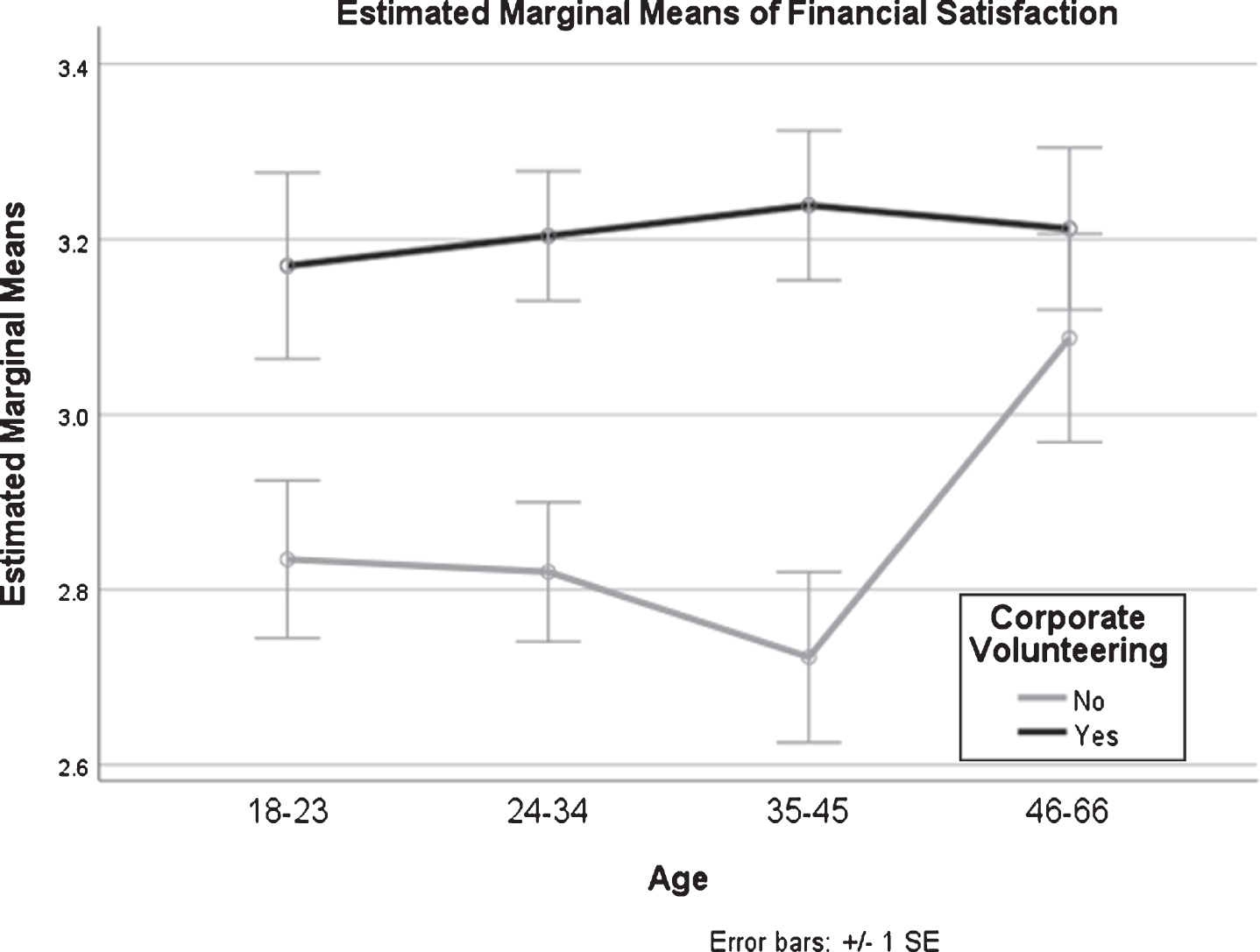
Two-Way ANOVA Analysis of Variance of Financial Satisfaction by Corporate Volunteering and Age.
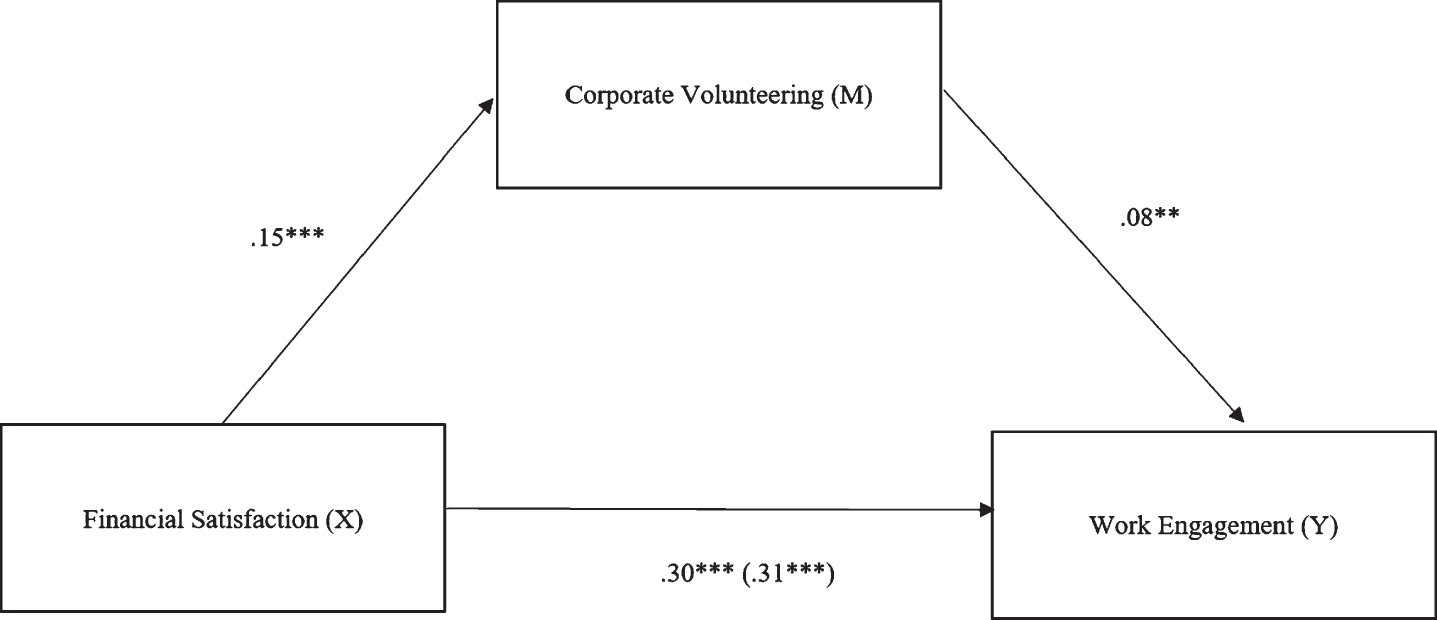
Standardized regression coefficients for the relationship between financial satisfaction and work engagement as mediated by corporate volunteering. The standardized coefficient between financial satisfaction and work engagement is in parentheses. ***p < 0.001, ** p < 0.01.
Analysis confirmed positive significant correlations between all combinations of work engagement, corporate volunteering, financial satisfaction and age, except for age and financial satisfaction.
The positive, albeit weak, relationships between work engagement and age have already been noted in nine researched countries [16]; our study confirms this. Research also evidences that employees are more likely to corporately volunteer if they are older and/or have higher education [15, 45]. Because we analysed work engagement with regard to age and corporate volunteering, the linear increase of work engagement in line with ageing is only true for the following groups: 18–23, 24–34 and 35–45. We observed an insignificant reverse trend in corporate volunteering in those with 46 or more years. Those from the oldest age group (46–66) of participants who corporately volunteered evidenced slightly lower work engagement compared to younger groups, whereas work engagement increased in those who did not volunteer. Therefore, we claim that those who are participating in corporate volunteering are more engaged in work except for the oldest group of participants (46–66). Corporate volunteering’s lack of effect on work engagement in this group may be explained in two ways: firstly, older employees may be more engaged in corporate volunteering than in work itself because of volunteering’s strong prosocial aspect; secondly, older employees may feel overwhelmed by additional duties, such as corporate volunteering, which slightly reduces work engagement. Nevertheless, identifying factors affecting this phenomenon is worth further research.
It is noteworthy that in our study gender does not diversify work engagement levels as it does in the global literature, indicating higher work engagement in men [16]. Similar results revealing congruous work engagement between male and female employees were obtained in other Polish studies [6], and these results reveal the underlying culture-dependence inherent in the issue. In our study, women did not manifest lower levels of work engagement or corporate volunteering despite lower levels of financial satisfaction compared to men.
Even though other research showed a significant positive relationship between age and financial satisfaction, a ‘satisfaction paradox’ ascribing higher satisfaction to poor conditions [46], our research did not confirm this. The general higher financial satisfaction in older people compared to those younger may be explained by greater wealth and fewer liabilities [47], which may not be the case for older Polish employees.
Our study evidences, unlike others, that even though financial satisfaction was not differentiated by age, it was significantly differentiated by corporate volunteering participation. Employees with higher financial satisfaction were more involved in corporate volunteering at all ages. Therefore, our results confirm that an individual participating in corporate volunteering to the benefit of others, should have satisfied own basic needs in the first place. This paradox in terms of corporate volunteering initiatives determined by the focus upon profit/“business” aspect seems compelling. This issue may be incorporated into the trend examining “selflessness in business”, which constitutes the new outlook on people’s functioning in business reality from the point of view of prosocial activities and organizational virtue [48], and cooperation rather than competition[14].
Research shows that salaries are crucially related to organizational commitment [49], work motivation and job satisfaction [50], and work engagement [51]. JD-R Theory posits remuneration as a potential predictor of work engagement in [17, 52], but research shows that financial reward is not a significant predictor of work engagement via job resources and job demands [53]. We have confirmed that the wider notion of subjective financial satisfaction, in contrast to pay satisfaction, directly affects work engagement, as well as exerting an indirect effect through corporate volunteering. This draws attention to the role of basic human needs being satisfied by financial satisfaction and its satisfying of higher needs. It appears that multi-occupational employees with higher financial satisfaction are more eager to participate in corporate volunteering, and via corporate volunteering and become more engaged in work. Therefore, financial satisfaction is a crucial factor in determining the undertaking of additional, though prosocial, activity related to the work environment. Unless this basic criterion is fulfilled, corporate volunteering will not positively affect work engagement. This is why a comprehensive understanding of employees’ financial satisfaction is important; otherwise, implementing corporate volunteering into work design instead of increasing job resources, might increase job demands, as with low financial satisfaction, corporate volunteering might be treated as an obstacle in occupational activity. Therefore, financial satisfaction should primarily be taken into account when designing enriched volunteering projects [14].
Conclusions
Our research evidences corporate volunteering’s importance as a mediator between financial satisfaction and work engagement. The research proved corporate volunteering is an important factor in fostering work engagement when the financial satisfaction criterion is fulfilled. This leads to two basic conclusions: firstly, corporate volunteering should be incorporated into job design to increase work engagement; and secondly, organisations should improve employee financial satisfaction to better facilitate corporate volunteering.
Study limitations and suggestions for future research
This study has limitations: firstly, self-reporting may lead to under- or over-reporting; secondly, we used purposive sampling to collect data, but random sampling would provide insight into work engagement, employee volunteering, age and financial satisfaction relationships. In line with [5], who argued that a positive relationship between age and engagement may be Anglo-Saxon specific but not for post-Soviet/former-Communist contexts, it would be beneficial to explore this relationship in other cultural and historical contexts, and compare results from several countries. The same pertains to studying the relationship between gender and work engagement; it would be of interest to explore the factors affecting gender difference in relation to work engagement, for example, comparing the study by [22] with Polish studies evidencing no gender-related difference vis-á-vis work engagement.
As [54] observed, our research findings would benefit from supplementary qualitative analysis: in-depth interviews with employees at various managerial levels would deepen our understanding of why corporate volunteers in the oldest group of participants were characterized by lower work engagement compared to younger groups, and why work engagement progressively increased in those not corporately volunteering in the oldest group. Additionally, in-depth semi-structured interviews may deepen insight into the relationship between age and financial satisfaction.
Author contributions
CONCEPTION: Dominika Ochnik
METHODOLOGY: Dominika Ochnik
DATA COLLECTION: Dominika Ochnik
INTERPRETATION OR ANALYSIS OF DATA: Dominika Ochnik and Ana Arzenšek
PREPARATION OF THE MANUSCRIPT: Dominika Ochnik and Ana Arzenšek
REVISION FOR IMPORTANT INTELLECTUAL CONTENT: Dominika Ochnik and Ana Arzenšek
SUPERVISION: Dominika Ochnik and Ana Arzenšek