



Abstract
BACKGROUND:
Social attachment has been identified as a key antecedent motivating users’ social media involvement. However, there is a scarcity of research investigating whether and how three dimensions of social attachment exert impacts on users’ continuous usage intention of social media.
OBJECTIVE:
Based on structural equation model analysis, the current research clarifies the relationships between social attachment, affective commitment and social media continuous usage intention, which unveils the underlying mechanism through which three dimensions of social attachment influence users’ continuous usage intention of social media.
METHODS:
A survey was conducted with 536 informative responses obtained from TikTok public users for hypothesis testing analysis.
RESULTS:
Results indicate that three dimensions of social attachment (social connections, social dependence and social identity) are all positively related to users’ continuous usage intention of social media. Affective commitment partially mediates the relationship between social attachment and users’ continuous usage intention of social media.
CONCLUSIONS:
The current research makes an in-depth study about the underlying mechanism whereby social attachment exerts impacts on social media continuous usage intentionand provides several managerial and theoretical implications. Future research directions are discussed as well.




Introduction
Users’ continuous usage of social media still remains vital and challenging for e-business prosperity and has aroused burgeoning research efforts in recent years [1, 2]. For business practitioners, users’ continuous usage of social media is deemed to be more important than the initial usage, because the long-term business value is largely decided by users’ loyalty and social media continuous usage. Previous research investigated the new emergence from the marketing perspective [3, 4], and more scholars attempt to apply interdisciplinary approaches to research users’ social media behaviors from the perspectives of information system and interactive relationships between users and social media platforms [5, 7].
Among all research of social media behaviors, continuous intention of social media usage attracts increasing scholarly interests [8, 11]. Relevant research has explored antecedents influencing users’ continuous usage intention of social media including users’ satisfaction [12, 13], and previous usage experience [14, 15]. Among all theoretical lens explicating users’ social media behaviors, scholars contend that technology acceptance models and extension theories demonstrate powerful explanations for users’ continuous use. The technology acceptance theory argues that users’ cognitive beliefs (perceived usefulness and perceived ease of use) are the key variables driving their willingness of continuous usage [16, 18]. The Information System Continuous Use Model (ISCM) further points out that the users’ intention to use information system (IS) depends on their satisfaction and perceived usefulness in the early stage [5].
Although scholars have endeavored to illustrate users’ continuous usage intention from the perspective of cognitive paradigm within the framework of corresponding technology acceptance model or information system continuous use model, there is still a scarcity of research about the underlying mechanism underpinning how users’ continuous usage intention is generated [19].
In order to unveil the underlying mechanism which affects users’ continuous usage intention, Carroll and Ahuvia [20] made a call on investigating the roles of attachment and love. Scholars argue that users show loyalty to a particular social media platform, not switching to other providers of similar services or content of social media, not because of their lack of motivation or conversion of inertia, but rather due to the affective commitment to that social media platform [21, 22]. Therefore, social attachment and affective commitment may be the key elements explicating users’ loyalty to social media and deserve further investigation. However, there is paucity of research investigating how social attachment and affective commitment are connected with users’ continuous intention of social media usage.
In fact, some scholars have discussed the social media continuous usage intention from the perspective of attachment, but there are still some limitations in previous studies. First, scholars have regarded attachment as a major factor driving users’intention of social media continuous usage and reached the conclusion that attachment is positively related to users’ continuous usage intention. However, they regarded attachment as a general concept driving continuous usage intention [19]. Therefore, the effects of different dimensions of attachment exerted on the continuous usage intention still deserve more scholarly attention. Secondly, prior research mainly focused on the effect of attachment on the social media continuous usage intention, while ignoring how attachment affects the social media continuous usage intention. In this regard, those studies have not answered well to the questions why users’ continuous usage underscores the value of developing social software and acquiring competitive business advantages.Thirdly, the majority of previous research on social media continuous usage intention was conducted with samples from western countries. As a second largest economy, more empirical studies are necessary so that a much clearer picture about how to enhance social media continuous usage intention could be developed.
To address the above gaps, a research framework is designed and the structural equation model is adopted to unveil the potential mechanism influencing users’ continuous usage intention of social media. To be more specific, we explore the relationships between the different modes of social attachment (social connection, social dependence and social identity), affective commitment and users’ social media continuous usage intention (see Fig. 1 for the theoretical model).
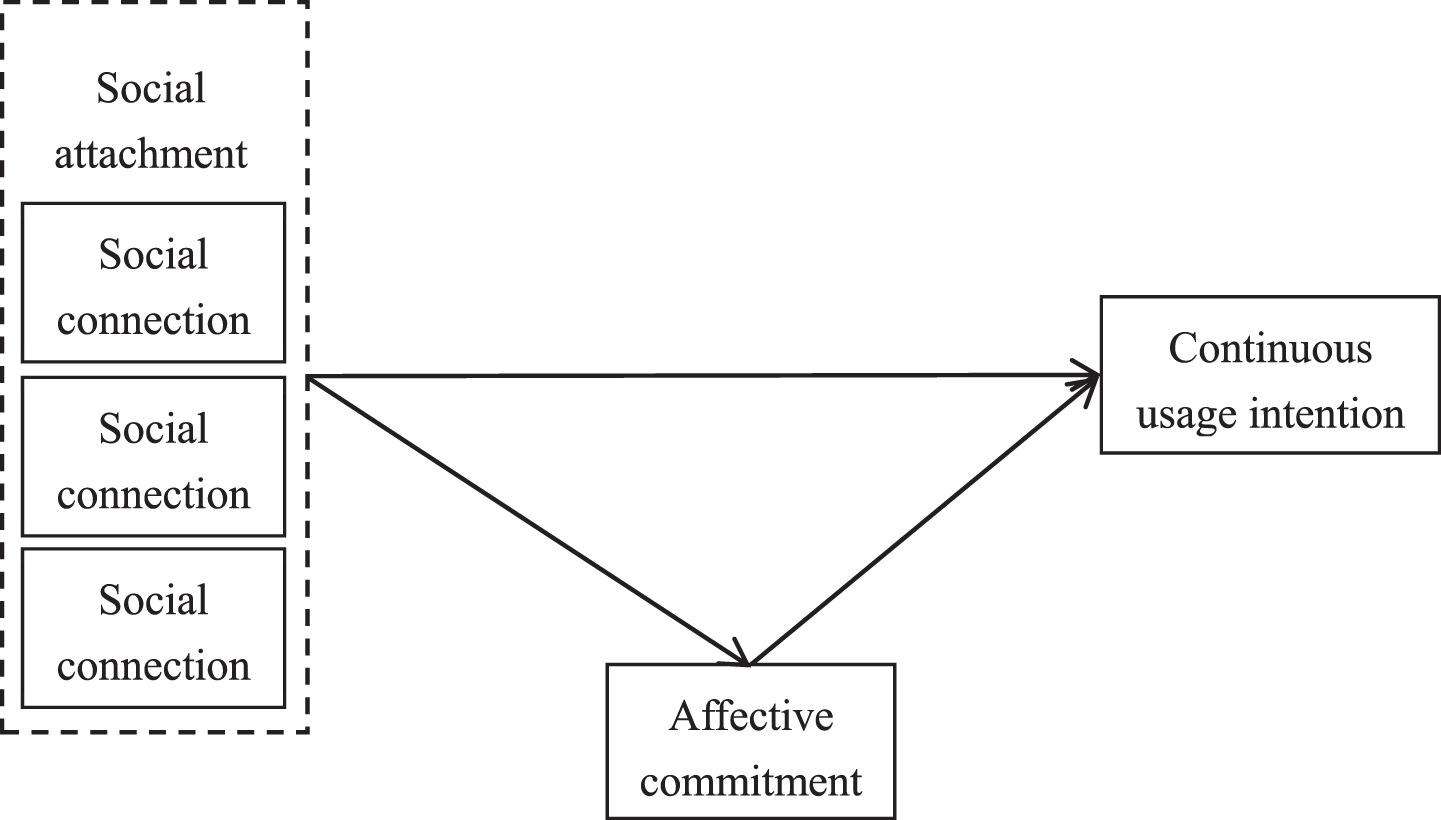
Research framework.
The remainder of the paper is organized as follows. The next section is about literature review and hypothesis development. After that, research methodology is demonstrated, followed by data analysis result. And the part of conclusion ends the whole paper.
Social attachment and continuous usage intention
As a typical character attachment, social attachment has the basic attributes and functions of attachment, paying attention to the emotional characteristics and behavioral tendencies that individuals form with specific objects in their growth [23]. In this study, social attachment is a unique and affective bond between users and social media [24]. According to the basic point of view of character attachment theory, users with a strong sense of attachment regard social media as an integral part of their lives, and are willing to pay extra time, energy, and money and other personal resources for using social media, thereby generating sustained and positive usage behaviors [21, 25]. It is acknowledged that social attachment theory can well explain the bond between users and social media [26] which mainly contains three important aspects: social connections, social dependence and social identity [24]. It indicates that individuals who have more close friends on the social media platform have a stronger attachment to the social media. Social connections provide networks for individuals to establish and maintain interpersonal interactions [27]. In this regard, users keep connected with other users in the virtual world and exchange information, share ideas and offer feedback about online shopping experiences. Those sharing common interests are bounded together and build up affective and personal relationships, which can stipulate the users ’ willingness to use social media [28, 29]. Social dependence reflects the users’ dependence on a certain social media or a sort of characterized function. We argue that users who demonstrate more dependence on a social media platform are supposed to show more willingness to continuously use that platform [23, 28]. Social identity is the degree to which an individual feels connected to social media and belongs to social media as a whole. In this regard, users are expected to have sense of belonging to that social media community and thus develop strong intention of continuously using social media platforms as well [30]. Overall, based on the analysis of prior research, we hypothesize that:
H1: Social connection (H1a), Social identity (H1b) and Social dependence (H1c) are positively related to users’intention of social media continuous usage intention.
Affective commitment and continuous usage intention
Affective commitment refers to the identification, participation and affective attachment of the relationship between users and specific targets (such as virtual communities, social platforms) [31]. Affective commitment affects the users’ intention to use social media and long-term affective relationships between users and social media platforms. On one hand, social media satisfies users’ cognitive and emotional needs by searching for relevant information and interacting with community members [25]. On the other hand, users’ emotional bonds with social media have been encouraged as well [27]. Thus users’ affective commitment to the social media platforms have been finalized [32]. Relevant research has identified that affective commitment is an important prerequisite for generating users’ willingness and behavior for social media continuous usage. Zhou et al. [33] adopted the commitment dedication constraint framework to discuss the issues on customers’ continuous usage of information system. The structural equation model analysis with 438 experienced users found that the impact of affective commitment on users’ continuous usage intention of information system services is stronger than that of satisfaction. Furthermore, users’ continuous usage of information system is determined jointly by two mechanisms, affective commitment (attraction) and computational commitment (lock), among which affective commitment plays a more central role. Therefore, affective commitment is supposed to be a key predictor of users’ continuous involvement in information systems or virtual communities [34, 35]. Based on the above analysis, we hypothesize that:
H2: Affective commitment is positively related to users’ intention of social media continuous usage intention.
Social attachment and affective commitment
Emotional commitment is the emotional tendency to maintain continuously valuable relationship. It can encourage individuals to maintain this relationship and serves as the basic element of long-term relationship success. It is developed on the basis of personal dedication. That is to say, the individual hopes to maintain long-term mutually beneficial relationship [36], reflecting the individual’s sense of participation and belonging in the desirable relationship. Due to the good attitudes, influences, emotions, and perceptions of experiences in valuable relationship, emotional commitment has always been considered as the most important factor to predict continuous intention [32]. Therefore, some scholars argue that affective commitment is a desire-based attachment that attracts users to maintain long-term relationship with support of social media [33]. Previous research has identified that affective commitment is an important predictor determining users’ continuous usage of virtual communities and information systems [25]. Affective commitment reflects the degree of affective bond that users perceive to connect with community members emotionally. During the experiences of using social media usage, users have developed affective bond with social media due to perceived usefulness and satisfaction with functionalities created by social media [25, 27]. In order to attach self to the group identity, users enhance their affective bond to the degree of affective commitment to social media usage [25, 33]. Given the user’s openness and self-identification features, social media provides users with various opportunities to benefit them from multiple sources, including social connections, social dependence and social identity. The basic principle of social attachment’s impact on affective commitment is to satisfy users’ personal needs stemmed from their work (i.e social connection) to their social life (i.e social dependence) and finally to spiritually-oriented applications (social identity) [37]. When expecting a high level of future value, users are inclined to establish and maintain a relatively long-term relationship with preferred social media [19]. During the process of social media application, users’ affective commitment to the social media has thus been developed [38, 39].
Based on the aforementioned, we make the following hypothesis:
H3: Social connections (H3a), Social identity (H3b) and Social dependence (H3c) are positively related to users’ affective commitment.
Mediating role of affective commitment
Relevant research has identified both the direct and indirect associations between social attachment and affective commitment [40]. Taking the perspective of the attachment theory, scholars have identified that social attachment is significantly associated with affective commitment, which positively responds to users’ continuous use of social media [41]. During the process of users’ social attachment with a social commerce website, they are inclined to acquire emotional support when interacting with members of that social media community built by that social media platform [35, 39]. Received support from community members brings happiness and satisfaction to users and thus contributes to growth of affective commitment, thereby positively influencing their intention of social media continuous usage [35, 42]. Related research has also found that the attachment relationship between users and social media will affect the social attachment between users and social media platforms through the partial mediating effect of the emotional commitment to social media usage [5, 43]. Therefore, we argue that the social attachment stimulated by the use of social media may have an indirect positive effect on the user’s social attachment through the mediating effect of emotional commitment.
Based on the above statement, we hypothesize that
H4: Affective commitment plays a mediating role between social connections (H4a), social identity (H4b), social dependence (H4c) and users’ intention of social media continuous usage intention.
Research methodology
Participants and procedure
Participants were recruited through the online platform TitTok in mainland China, which achieves increasing popularity and provides functions equivalent to Amazon Mechanical Turk (MTurk). In order to stimulate participants’ interest, a monetary reward of $6 was offered. The online platform has been successfully used for collecting primary data in published social media research [44]. Research has also demonstrated that the platform allows researchers to collect data with good quality and reliability [44].
More importantly, the study selected TikTok mass users as the research samples. We chose this local social media for the current research for several reasons. First, Tiktok, as the largest leading social platform in China, has been proved to be feasible and reliable in previous studies [44, 45]. Secondly, TikTok is a local representative APP, which is a leader in the market segments of social software and possesses the typical characteristics required by the research work. If research findings are supported by the data of TikTok, the current study can just provide management suggestions to improve the corporate brand strategy of the local social software platform. Therefore, from this perspective, the use of TikTok public users to conduct data surveys is compatible with our original research purpose. A questionnaire was delivered to samples from TitTok mother group users [45, 46]. The feasibility sampling method was used to collect the data.
The whole research period lasted 6 months. Participants were asked to complete general background information and then a formal survey was conducted. Survey links were sent to participants’ mobile phones. We recruited 536 participants who were engaged in a variety of industries (e.g., finance, health care, professional services, education). And 520 returned their responses with an overall response rate of 89.7%.Among 520 participants, female accounted for 74.6% and male accounted for 25.4%. The average age is 26.36 and 29.6% participants were under 20 years old, 31.5% between 21 to 30 years, and 19.6% between 30 to 40 years. Over 41 years old accounted for 19.3%. Unmarried participants accounted for 51% and the married accounted for 49%.
Measures
The variable measurements were selected from existing SSCI journal papers, and necessary modifications were made to meet the status quo of samples using TikTok.
To measure affective commitment, we used four items proposed by Zhou et al. [32]. The sample items included “When I use TikTok, I immerse myself unconsciously” and “I have a deep affection for TikTok”.
A five-item scale was adapted to measure social media usage, which was originally developed by Thong et al. [47]. The sample items included “I share the experience of using TikTok with my friends” and “ When I have the need, I use TikTok”.
A 16-item scale, proposed by Kyle, et al. [48] and Yang, et al. [24], were adopted to measure three dimensions of social attachment, among which 5 items were used to measure social connection, 5 items for measuring social identity and 6 for assessing social dependence. The sample items included “TikTok has a special connection with me (for example, following stars, entertainment)”, “TikTok has become a part of my life or work” and “TikTok can show oneself or express emotions”.
In addition, we also listed 7 items including participants’ gender, age, marital status, education, occupation, monthly consumption level and time spent on social media usage as control variables because those items are closely connected with TikTok usage.
Data analysis method
After deleting the invalid responses, the research applied Mplus7.0 to examine relevant CFA, convergence validity, discriminant validity, composite reliability, average variance extracted, and path coefficients to ensure the match between research model and statistics. As Bagozzi and Yi [49] indicated, SEM was developed from covariance structure analysis to examine the relationships between different variables at the same time. And this analysis method fits well with the current research.
Data analysis result
Confirmatory factor analysis
In this study, the evaluation and reduction of CFA measurement model variables were revised based on the two-stage model proposed by Kline [50]. If the measurement model fit is acceptable, the full SEM model report can be followed.
There are five constructs in this research model, namely continuous usage intention, affective commitment, social connection, social dependence and social identity. According to the standards proposed by Anderson and Gerbing [51], CFA analysis was performed on all constructs. Following the standard proposed by Hair, Anderson, Tatham and Black [52], Nunnally and Bernstein [53], and Fornell and Larcker [54], convergent validity was tested with standardized factor loadings greater than 0.50, the composite reliability higher than 0.60, and the average variance extracted was higher than 0.50. Therefore, according to the results shown in Table 1, each variable of this study has a good reliability and polymerization validity.
Confirmatory factor analysis
Confirmatory factor analysis
Note, Unstd., Unstandardized factor loadings. Std, Standardized factor loadings. SMC, Square Multiple Correlations. CR, Composite Reliability. AVE, Average Variance Extracted.
The discriminant validity analysis is to examine whether different two variables shut in the statistics are different or not. This study uses the latest discriminant validity analysis method, namely confidence interval method [55]. The confidence interval method is used to confirm the confidence interval of the correlation coefficient between variables. If it fails to include “1”, then it is completely correlated, indicating that the facets have different validity. As Hancock and Nevitt [56] suggested, bootstrap test was conducted in this study. 95% confidence interval of the correlation coefficient does not involve 1 (see Table 2 below), which shows the good discriminant validity between all the variables.
Distinct validity
Distinct validity
Note, SC, Social Connection. SI, Social Identity. SD, Social Dep-endence. AC, Emotional commitment. CI, continuance intention.
The purpose of research hypothesis testing is to understand the impacts of the independent variable on the estimated value of the dependent variable proposed in the theoretical model. In the current research, Table 3 suggested that social connection (β= 0.167, p < 0.001), social identity (SI) (β= 0.249, p < 0.001) and social dependence (SD) (β= 0.413, p < 0.001) were positively related to the continuous intention. Thus H1a, H1b and H1c were supported. In addition, affective commitment (AC) (β= 0.231, p < 0.01) was also found to be positively related to continuous usage intention. Thus H2 was confirmed. Further, the statistics showed that social connection (SC) (β= 0.216, p < 0.05), social identity (SI) (β= 0.239, p < 0.05) and social dependence (SD) (β= 0.237, p < 0.05) were all significantly associated with affective commitment (AC). Therefore, H3a, H3b and H3c were supported as well.
Hypothesis testing
Hypothesis testing
Note, *p-value < 0.05. **p-value < 0.01. ***p-value < 0.001.
This study used goodness-of-fit indices to investigate the measurement model’s goodness-of-fit. The purpose is to evaluate whether or not it can explain the actual observed data or if there is a gap between the theoretical model and actual observed data [57]. The first part is “Absolute Fit Measures”, which includes MLχ2/df, Normed Chi-square (χ2/df), GFI, AGFI, SRMR and AGFI, MLχ2and degree of freedom. The maximum of MLχ2/df is 3 [58]. GFI and AGFI should be over 0.9 [58, 59]. SRMR and RMSEA should be below 0.08 respectively, and a value close to 0 indicates that the model fits very well [59–61]. Comparative fit indexes include NNFI and CFI. Bentler [59] suggested that the value of comparative fit indexes should be higher than 0.9.
The measurement model used in this research met all the required criteria, which suggested that the current research model adequately matches well with the data, as shown in Table 4.
Measurement and structural model goodness-of-fit indices
Measurement and structural model goodness-of-fit indices
In order to test the mediating effects of affective commitment, this study also employed structural equation model analysis. First, the bootstrap estimation was conducted to estimate the standard error of the mediating effect, and then the significant level of the mediating effect was examined. The results (Table 5) showed that the overall effect of social connection on continuous intention is 0.187. The standard error was 0.095. And the Z value was 1.972, which was greater than the benchmark of 1.96. At the 95% confidence level, the lower limit of the confidence interval obtained by the Bias-corrected estimation method was 0.18 and the upper limit was 0.78, which excluded 0. The result indicated that mediating hypothesis was supported. In the same way, the indirect effect and the direct effect were also confirmed. Therefore, affective commitment partially mediates the relationship between social attachment and users’ continuous usage of social media. In this regard, H4a, H4b and H4c were all supported.
Indirect effect analysis table of intermediary model
Indirect effect analysis table of intermediary model
Note, **p-value < 0.01. ***p-value < 0.001.
Research results
The research confirmed that the three dimensions of user’s social attachment all exert significant impacts on the continuous intention.
To be more specific, social connection is positively related to user’s continuous usage intention. The research finding is consistent with the previous research [28, 29]. Based on prior experiences, affective reactions and cognitive representations, users interact with social media platforms. In this regard, users’ emotional connection is developed [23] and thereby users’ continuous usage intention is influenced through affective bonds. Second, social dependence was found to be significantly related to users’ continuous usage intention. This has also confirmed the previous research findings [27, 29]. As Lewicka [63] indicated, developing and maintaining users’ social dependence not only contributes to growth of users’ continuous usage intention, but also stimulates users’ positive social attitudes toward social media platforms. Finally, social identity is also positively related to users’ continuous usage intention. The research result is in line with previous investigations [28, 30]. In a virtual world, users interact with others by establishing a virtual identity. Similar to the real world, social media users are motivated by sense of belonging and self-demonstration when they surf the virtual world. This reflects users’ demand of social identity, which increases users’ communications and emotional bonds with others, and thus improves their continuous usage intention.
In regard to affective commitment, three dimensions of social attachment are all significantly related to affective commitment, which confirms the prior research as well [34]. When exposed to social media environment, users tend to interact frequently with others. During the process of interpersonal interactions, users’ affective bonds with other community members are created and strengthened through the social media platform. During the process of emotional appraisals, established affective bonds increase users’ understandings and favoritism about social media, and thus affective commitment is fostered. Likewise, social dependence is also positively associated with affective commitment. Goel et al. [64] argued that products and relevant services are supposed to satisfy users’ utilitarian purposes. When users’ expectations are satisfied, their emotional distress and skepticism about product’s quality are mitigated, and their dependence on social media is naturally increased. Further, when users perceive the potential value of functionalities and uniqueness of social media, their confidence is also boosted by appropriate products and perceived satisfaction. In this regard, their affective commitment to social media is developed. Accordingly, the current research has also confirmed that social identity contributes to affective commitment. Social media provides a virtual environment and support for users’ interaction with others. With regard to the increasing popularity of social media, a wide range of platforms create opportunities for social interactions and self identifications between individuals. When users’ interaction is responded and self identity is accepted by other members of communities, their social identity is developed in that social media community. We contend that users’ social identity and affective commitment will be increased when they are involved more in the activities supported by social media platforms.
The current research has also confirmed the effect of users’ affective commitment on continuous usage intention. The findings keep consistent with previous research [19, 38]. Affective commitment is expected to accumulate resources for users’ learning activities when they use social media to interact with others. In case users’ attitudes and affective reactions may shift between social media platforms, affective commitment should be considered a priority except that users’ basic needs are satisfied by social media.
More importantly, the research has also identified the mediating role of affective commitment, which unveils the underlying mechanism through which social attachment exerts impacts on users’ continuous usage intention. The findings are also consistent with prior research [19, 42]. The research findings suggest that affective commitment is an efficacious channel through which three dimensions of social attachment (social connection, social dependence and social identity) are connected with users’ continuous usage intention.
Theoretical and practical implications
The current research makes an in-depth study about the underlying mechanism whereby social attachment exerts impacts on social media continuous usage intention. Based on research findings, the current research makes several important contributions.
The current research makes important theoretical contributions.
First, this article takes the interdisciplinary perspective of combining social media continuous usage intention and social attachments. Existing research on continuous usage intention currently focuses on marketing, while social attachment belongs to the field of psychology. This research fills the gap of previous related research perspectives by combining social media continuous usage intention with social attachment and this method unveils whether and how social attachment impacts social media continuous usage intention. And this approach serves as a new avenue for future research.
Second, the current research extends the application of attachment theory. This study divides social attachment into three categories, namely, social connection, social dependence, and social identity and examines the underlying mechanism whereby different components of social attachment influence social media continuous usage intention. The research findings enrich the literature on social attachment and attach the theory to the field of information management.
Third, this study contributes to literature on affective commitment as well. As a connecting bond between social attachment and social media continuous usage intention, affective commitment was found to play an enabling role. To the best of our knowledge, this study is among the first trials to identify the role of affective commitment in bridging social attachment and social media continuous usage intention. And this contributes to a part of efforts made for unveiling the mechanism driving social media continuous usage intention.
Except for the theoretical contributions, the current research also offers practical implications for business practitioners.
First, practitioners should endeavor to improve users’ social attachment because three dimensions of social attachment have been identified to be able to enhance users’ social media continuous usage intention. Faced with the fierce market competition, social media providers should lay much emphasis on the development of users’ social attachment by offering services to satisfy their hedonic, functional and representative demands. And necessary investments should be made to contribute to affective bonds between users and social media platforms, which help users to satisfy self, realize self and get rich in self. In this way, users’ cognitive framework would be re-structured and integrated with social media. Thus users are willing to invest personal resources for developing social attachment and continuous intention of using social media as a return.
Second, practitioners should make sufficient efforts to increase users’ affective commitment, thereby increasing users’ continuous usage intention of social media. In light of functioning similarities possessed by various social media platforms, more investments should be made to increase uniqueness of social media platforms in case users may shift their interests to other ones. Strategies to further loyal users’ interests and favoritism should be considered. Social media providers should increase the attractiveness of platform design, style, content and offer more conveniences for users’ usage to search for what they are most interested in. In this regard, users’ social attachment could be enhanced. In addition, social media providers should endeavor to bring more easiness and opportunities for users to communicate with others to help users establish social identity and belongingness to that social media community. Necessary measures should be taken as well for those active or potential users to encourage them to continuously use the platform. Timely and intimate gifts and individualized services could be offered to stimulate users’ loyalty about the social media usage. Those measures are supposed to be effective to increase users’ affective commitment, thereby encouraging users’ continuous usage intention of social media.
Limitations and future research directions
Although our study provides useful insights, it has several limitations which could be addressed in the future research efforts.
First, the current research has only explored the mediating role of affective commitment. More empirical research is required to further explore boundary conditions for social media usage in social media environment. In light of the importance of the research topic, future studies should attempt to extend our proposed model by incorporating other potential social commerce factors including moderating and mediating elements.
The second limitation is about an inherent problem of a common method bias which was caused by a single questionnaire to measure all constructs at the same time in this study. Although Harman one-factor testing revealed a low possibility of common method bias, a marker-variable technique should be designed whether common method bias inflates or deflates the results within the cross-sectional data. The power of the proposed model in predicting the relationships between social attachment, affective commitment and social media continuous usage intention may be further validated in the future studies by measuring users’ real social media behaviors.
Third, the current research adopts the cross-sectional design. All variables in the research model were measured at the same time and their relationships can only be inferred to be associative, not causal ones. Future longitudinal or experimental design could be alternatives to solve this problem by working out the potential causal relationships between variables.
Finally, the research findings should be cautiously generalized because of the research samples. Although all variables measurement has demonstrated good validity and reliability and no serious common bias problem, the research was conducted with samples of Chinese social media users. Sample groups from other countries could be selected from various social media platforms including Facebook, Twitter to duplicate the research findings of the current study.
Footnotes
Acknowledgments
The research was financially supported by 2019’ National Education Sciences Planning Project of China under Grant BBA190019 and Anhui Provincial Natural Science Foundation under Grant 1908085MG238.
Author contributions
CONCEPTION: Shangui Hu and Maosheng Yang
INTERPRETATION OR ANALYSIS OF DATA: Maosheng Yang and Lei Liu
PREPARATION OF THE MANUSCRIPT: Maosheng Yang and Bagna Essohanam Kpandika
REVISION FOR IMPORTANT INTELLECTUAL CONTENT: Shangui Hu, Lei Liu and Maosheng Yang
Appendix
1. When I use TikTok, I immerse myself unconsciously
2. I have a deep affection for TikTok
3.TikTok gives me a strong sense of belonging
4.TikTok is very attractive to me
1. I share the experience of using TikTok with my friends
2. When I have the need, I use TikTok
3. In the future, I will continue to use TikTok
4. I recommend TikTok to my friends
5. I use TikTok to communicate with friends and share information
1. TikTok has a special connection with me (for example, following stars, entertainment)
2. TikTok has become a part of my life or work
3. TikTok can show oneself or express emotions
4.TikTok brought me happiness and joy
5.TikTok can meet my virtual social needs
1. I like TikTok better than similar social software (such as Kuaishou)
2. I get more satisfaction from TikTok
3. Compared with similar social software (such as Kuaishou), using TikTok is more important
4. Compared with similar social software (such as Kuaishou), TikTok is irreplaceable
5. TikTok is my favorite local social software
6. If possible, I would like to spend more time on TikTok
1. TikTok is of great significance to me (such as gaining recognition and respect/being an anchor or influencer)
2. I really like TikTok
3. I strongly agree with TikTok
4.TikTok can reflect my personality and style
5. I have a crush on TikTok