



Abstract
BACKGROUND:
Given the importance of the roles of psychological contract and voice in organizational life, this study highlights the effect of contract breach on managers and their voice directed at top management members, key representatives of the organization.
OBJECTIVE:
Drawing on social exchange theory, this study examines the relationship between a psychological contract breach (PCB) and concurrent organizational cynicism resulting in a considerate and aggressive managerial voice behavior.
METHODS:
Data came from an online survey on PCB and subsequent behaviors from a sample of 336 in-company European and Asian employees with managerial responsibilities working in France.
RESULTS:
The results provide partial support for the hypothesized relationships and show the consequences of the bi-dimensionality of aggressive voice behavior (fight and negativity). Moreover, organizational cynicism mediates the relationship between PCB and the negativity dimension of aggressive voice. However, data analysis shows no support for organizational cynicism’s mediating role in the relationship between PCB and considerate voice.
CONCLUSIONS:
The study results of 336 in-company European and Asian employees having a managerial position, like project managers, middle managers, executives, employs a great insight into managerial voice behavior. This study contributes to the limited research conducted on the managerial voice in response to PCB. The findings have important implications for employers to understand managers’ psychological contracts and related voice behavior.
Keywords



Introduction
A significant stream of research has examined the psychological contract and its breach in the past two decades. Rousseau [1] defines a psychological contract as the perception of the mutual obligations owed by employees and employers to each other. The psychological contract is a critical part of the relationship-building process between employees and the company [2]. When employers fail to fulfill these obligations, employees perceive this as a psychological contract breach (PCB) [3]. PCB refers to “the employee’s perception regarding the extent to which the organization has failed to fulfill its promises or obligations” [4] and results in negative emotions, attitudes, and behaviors [2–4]. For example, employees may develop negative feelings after perceiving a PCB and retaliate in the form of withholding information, voicing against the issue, or expressing other concerns. Voice is one-way employees contribute to the organization, and thus voice can significantly impact the organization [5].
Research has explored various organizational, supervisory, and individual-level antecedents of voice [6]. However, scholars have primarily focused on positive factors that can give rise to voice behavior, while paying less attention to potentially negative factors [7]. Although PCB can have detrimental effects on various employee attitudes and behaviors [4, 9], scant research has explored PCB and voice behavior [e.g., 7, 10]. This study aims to examine the influence of PCB on two forms of voice behaviors: considerate voice and aggressive voice.
Hagedöorn et al. [11] classified voice into considerate and aggressive voice. They argued that employees engage in a considerate voice when they attempt to solve an organizational problem by considering their concerns and those of the organization, such as by discussing a problem with management until reaching an agreement. By contrast, when engaging in an aggressive voice, employees aim to win the argument rather than to agree with the organization mutually and are concerned only about their interests. An example of aggressive voice includes showing persistence with management on what the employee wants and even fighting with their supervisor.
Concerning the PCB’s effect on these two forms of voice behavior, we expect PCB to negatively influence voice behavior through organizational cynicism. Organizational cynicism refers to “a negative attitude toward one’s employing organization, comprising of three dimensions: (1) a belief that the organization lacks integrity; (2) negative affect toward the organization; and (3) tendencies to disparaging and critical behaviors toward the organization that are consistent with these beliefs and affect” [12].
Although organizational cynicism is not a new phenomenon, it has not been adequately investigated [13]. A review of studies on the topic shows that only one or a few cynicism dimensions [e.g., 14–16] have been considered, or it has been exclusively evaluated concerning organizational change [17, 18], such as mergers and acquisitions. Studied antecedents of cynicism include work, family, and role conflict; perceived fairness; burnout [19]; low supervisor trust and integrity [20]; low job autonomy [21]; trust [22]; discrepancy in organizational prestige and support [23]; and violation of the psychological contract [15, 24]. Also, organizational cynicism can occur if the organization lacks sincerity and reliability [21, 25]. Studied consequences of organizational cynicism include loss of interest in the [26]; alienation, carelessness, distrust, resignation, despair, disappointment, disdain, uncertainty, personal conflict, absenteeism, fatigue, and poor performance [12, 27]; and counterproductive work behaviors [28], including the intention to sabotage[29] and turnover intentions [30].
Drawing on social exchange theory [31], we expect PCB to influence considerate and aggressive voice through organizational cynicism. That is, when first-line or middle managers believe that top management has treated them unfavorably by breaching their psychological contract, their attitudes toward top management will be negative. They will reciprocate with negative behaviors to balance the exchange relationship. When PCB occurs, managers will likely develop cynicism toward the top management and be more likely to engage in aggressive voice behavior. Thus, we posit a positive association between PCB and aggressive voice and a negative association between PCB and considerate voice.
Examining managerial voice behavior is important for several reasons. First, managers represent their teams [32] and are also responsible for their teams’ performance. To provide resources to facilitate their subordinates’ work, managers need to raise their voice on certain issues [5, 33], especially when a breach of expectations has occurred. In particular, middle managers act as a bridge between first-line managers and top managers. They have a greater responsibility for implementing employee relations and human resources practices [34, 35] and communicating any first-line managers and the team’s grievances. Despite the important role of the manager’s voice in influencing subordinates’ attitudes and behaviors and their expectations, scant research has explored the role of the manager’s upward voice to top management [36, 37].
By filling this research gap, this study contributes to the literature in three ways. First, while previous studies have sought to understand and explain various employee behaviors at work as a result of PCB [4, 38], it has largely ignored the relationship between the psychological contract and voice, except for a few exceptions [e.g., 10, 39, 39–41]. To investigate PCB–voice link, studies have employed Hirschman’s [42] traditional “exit, voice, and loyalty” model, which proposes that individuals discretionally react by engaging in voice when they perceive unsatisfactory working conditions. However, to our knowledge, research has not examined the relationship between PCB and considerate and aggressive forms of voice [11] [for an exception, see 10]. Thus, we explore these two forms of voice as predicted by PCB.
Second, prior research on voice (e.g., 10, 40) has explained voice in exchanging positive interactions between employees and employers. However, this does not explain how employees might react when the relationship is challenged by a contract breach, which is largely implicit. To address this limitation, we apply social exchange theory [31] and explore organizational cynicism as the underlying explanatory variable through which PCB indirectly affects the voice.
Third, most of the research on PCB has considered employees’ psychological contract obligations to the organization as a whole [4, 43]. However, in this study, we investigate managers’ (who are also considered representative of the organization) psychological contract obligations to managers above them (top management). Therefore, we contribute to the literature by showing how PCB works at higher organizational levels to influence managers’ voice behavior.
Background literature and hypotheses development
Social exchange theory
Social exchange theory [31] is based on the notion of reciprocity [44]. Individuals build social relationships based on exchanges. For example, if one person greets another person with respect and dignity, the other person, in turn, will also greet the focal person with respect and dignity [45]. If employees perceive positive attitudes and behaviors from their employer (e.g., fairness, rewards, support) [46], they will likely reciprocate the favor [47]. In a similar vein, if employees believe that their employer has failed to meet certain obligations, they will perceive this as a PCB, leading them to adopt a cynical attitude, leading to low engagement in constructive suggestions high engagement in aggressive voice.
PCB
A psychological contract breach occurs when organizational agents fail to fulfill contractual obligations or promises made to employees, resulting in an imbalanced social exchange relationship [48]. This breach is conceptualized as a cognitive evaluation and can result in negative emotions due to contract violations [49, 50]. Empirical work on the psychological contract has found that PCB is associated with negative consequences for both employees and organizations. Three meta-analyses [2, 51] evaluated more than 100 empirical studies on PCB and its associated outcomes and revealed important implications concerning PCB’s effect on employees’ thoughts, behaviors, and even well-being. For example, a PCB can lessen the mutual respect and trust between employees and organizational agents [52], in turn, triggering employees to reciprocate with negative behaviors [53, 54]. Coyle-Shapiro et al. [55] provided a more detailed past, present, and future review of the psychological contract literature.
Included among the studied consequences of PCB are employee cynicism, turnover, counterproductive work behavior [24, 56–60], in-role performance [61–64], citizenship behaviors [40, 65–67], absenteeism [68], reduced engagement an turnover intention [69], and poor customer service [70]. Although a few studies have explored the relationship between PCB and Hirschman’s [42] “exit, voice and loyalty” model [39–41,i.e., 71], the relationship between PCB and voice behavior, particularly voice toward top management, is rather unclear. Therefore, this study explores the impact of PCB managers’ perceptions on both voice behaviors directed to top management.
Employee voice behavior
Hirschman [42] defined voice as employees’ discretionary behavior toward unsatisfying working environments or conditions. By contrast, other studies [72, 73] defined voice as employees’ other-oriented and discretionary but pro-social behaviors toward improving its overall workings. It is also suggested that voice is a theoretically and empirically distinct phenomenon from in-role and extra-role behaviors of employees and does not reconcile with these behaviors. Van Dyne and LePine [74] also suggested that voice is associated with “making innovative suggestions for change and recommending modifications to standard procedures even when others disagree” (p. 109).
Hagedoorn et al. [11] argued that voice could be more or less constructive, which they call considerate and aggressive voice, respectively. A considerate voice aims to solve a problem by considering one’s concerns and the organization’s interests. Aggressive voice can be less constructive, as it turns employees’ efforts into attempts to “win” without considering the consequences to supervisors and colleagues. Examples of aggressive voices include quarreling with others until they agree to fulfill the personal demand, deliberately over-stating grievances so that more attention is paid to them, and involving external sources to exert more pressure on supervisors or colleagues, who are viewed as competitors. Therefore, an aggressive voice is more likely to result in a hostile work environment and interfere with managers’ strategic decision-making and operational efficiency.
Chamberlin et al.’s [6] meta-analysis shed empirical light on the antecedents of voice. Although voice can be risky in general, it is also associated with various positive workplace outcomes, such as team learning [75], in-role performance [58], managerial efficiency [33], innovation in team dynamics and safety [76], and overall performance [77]. However, the decision to withhold voice and remain silent may negatively affect the organization, such as poor organizational learning, organizational failure [78, 79], and workplace crises [80]. The organization’s significant impact has raised questions about the factors motivating employees to engage in voice behavior, and as such, a great deal of research exists on voice [6]. In this study, we investigate the effect of employees’ perception of PCB on their considerate and aggressive voice behavior to further contribute to this stream.
As employee voice is a type of organizational citizenship behavior [81], we expect that PCB can influence it. Social exchange theory can help explain this relationship. This theory suggests that when parties enter an exchange relationship, they try to benefit each other [31], based on reciprocity norms [44]. Norms of reciprocity mean offering favorable treatment in return for favorable treatment, and vice versa. That is, individuals’ perceptions of unfavorable treatment by another party may compel them to reciprocate in the same way with negative or poor behavior [82, 83].
Similarly, when employers violate psychological contracts with their employees, the social exchange theory indicates that employees will respond more aggressively. Ng et al. [10] showed that PCB is positively associated with aggressive voice and negatively related to constructive voice. Turnley and Feldman [40] also found a link between PCB and the higher intensity of negative voice (also conceptualized as voicing one’s displeasure to overcome personal issues or concerns). Building on this discussion of the norms of reciprocity, we thus predict the following:
H1a: PCB is negatively related to considerate voice behavior
H1b: PCB is positively related to aggressive voice behavior.
The mediating role of organizational cynicism
When employees have negative experiences in the workplace, such as PCB [see 84], they may develop cynicism toward the organization [12, 85]. When PCB occurs, employees may feel a negative shock and believe that they lack integrity [4, 86]. They may also believe that the organization has failed to fulfill one or more of its responsibilities [3]. This perception of a breach then generates negative feelings toward the employer in the form of organizational cynicism [12, 84]. Violations of implicit promises often break employees’ trust in the employer. Feelings of betrayal can also trigger anxiety and stress and result in reduced performance [61]. It may happen for two reasons: a desire to reciprocate negatively to balance the exchange relationship [21, 85] and as a self-defense mechanism to protect oneself from further disappointments [87–89].
Research has also found that employees engage in negative word of mouth to other stakeholders, such as customers, to damage organizational reputation [90]. Sometimes, this can develop into a vicious cycle, in which a contract breach in the form of disrespect from the employer results in cynical employee beliefs and disrespect for others [91]. Low-quality relationships and identification help trigger employees’ cynical beliefs [92], but this may also happen the other way around. That is, cynical employees may not develop a high-quality relationship with their supervisor and, thus, will be less loyal [93].
Studies have shown that cynical employees often believe that top management does not want or value their opinions, leading to withholding important ideas [94–96]. Conversely, less cynical employees are more willing to suggest changes and improvements to the organization [95]. Recently, Pfrombeck et al. [97] found that PCB positively predicts organizational cynicism.
Building on this discussion and social exchange theory, we expect that PCB perceptions may lead to cynicism and employees’ willingness to reciprocate with an aggressive voice. We, therefore, hypothesize the following:
H2a: Organizational cynicism mediates the relationship between PCB and considerate voice.
H2b: Organizational cynicism mediates the relationship between PCB and aggressive voice.
Figure 1, representing the research model, is incorporated here.
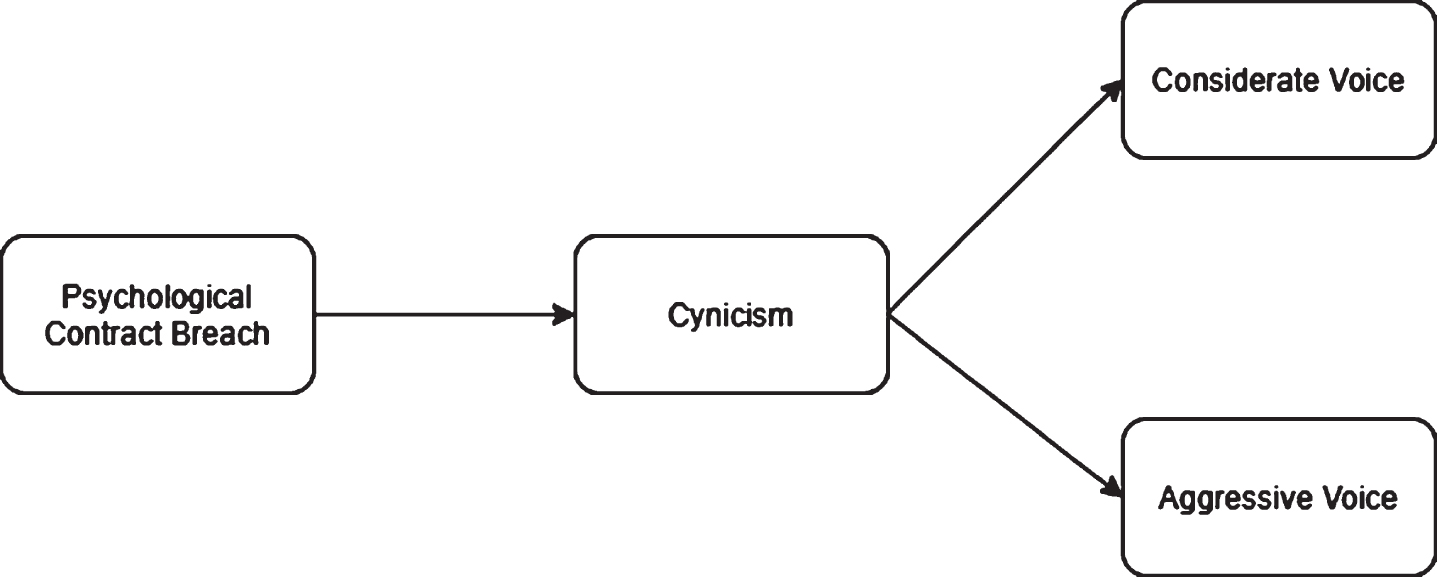
Research Model.
The study is based on a cross-sectional design using the survey questionnaire. The well-established scales from the literature are taken to test the relationship among study variables. The detailed procedure for data collection is given below.
Sample and data collection
We sent an online survey to a sample of 515 in-company employees with managerial responsibilities. The database used comprises all the personal and professional contacts of one of the authors, who is in charge of an executive MBA program at a major French university. A large number of the respondents (45%) are alumni of the same institute. This convenience sample included potential respondents who were all consistent with the study, i.e., employed in a company and had a managerial position, like project managers, middle managers, executives, in-charge of functional or operational functions. However, to ensure sample consistency, we added filter questions to exclude respondents who would not be relevant (like independent consultants or self-employed people). To obtain a high response rate, the author sent a personal message to each contact, reminding them that their participation was voluntary but explaining the study’s importance and assuring them that all responses would be anonymous. She also sent a reminder email to those who did not answer the first time. The method yielded a 67% response rate (N = 345) and covered a wide range of occupations. In this study, the chosen sample represents the French population in a managerial position, mainly based on three characteristics, nationality, age, and status. The sample comprises alumni of the executive MBA program, working at managerial positions in France. Thus 90% of the respondents were French nationals, while 8% were European from other countries, and 2% were Asian. Moreover, the average age of respondents was 39 years with an experience of three to six years. Of the respondents, 58% were male. Thus the demographic information of the respondents increases the confidence in the chosen sample representativeness of the population.
There were no missing values in the data. We used Cook’s [98] leverage method to check for any multivariate outliers, which resulted in the removal of 9 observations (N = 336).
Measures
First, to measure PCB, we used the 5-item scale of Robinson and Morrison [99]. A sample item is “I have not received everything promised to me in exchange for my contributions”. The alpha reliability of the scale is 0.94.
Second, we measured organizational cynicism with 11 items comprising cognitive, affective, and behavioral cynicism developed by Brandes et al. [100] and based on Dean et al.’s [101] study scales. The reliability of the scale in the current study is 0.92.
Third, we measured the considerate voice with the 5-item scale of Naus et al. [21]. A sample item is “I discuss the problem with my superior and try to work out a solution together.” The alpha reliability of the scale is 0.86. We measured aggressive voice with the 7-item scale of Hagedöorn et al. [11]. A sample item is “I am persistent with my supervisor to get what I want.” The alpha reliability of the scale is 0.74.
Finally, for the control variables, we included age, gender, and hierarchical position, category of manager, and experience in the current organization to test the variation in our study’s dependent variables. In other words, we included these demographic variables to control for their effects on the main variables [e.g., 10, 102].
Data analysis and results
We tested the hypothesized research model using the R packages lavaan [103] and semTools [104]. Table 1 reports the descriptive statistics and inter-correlations among all the studied variables. To confirm factor validity, we carried out a confirmatory factor analysis (CFA). We conducted CFA on separate scales in a preliminary stage to assess the quality of the measurement model. After checking for multi-normality assumptions, we used the MLR estimator, a robust variant of the maximum likelihood estimator adapted to non-normal data and suitable for relatively small samples.
Descriptive statistics and inter-correlation
Descriptive statistics and inter-correlation
Notes: n = 336. PCB = Psychoogical contract Breach. Cronbach’s alpha values for each scale are on the diagonal. Gender was coded as 1 = male and 2 = female. Descriptive statistics and correlations at the item level are available on request from the first author *p < 0.05; **p < 0.01.
All the scales demonstrate good psychometric properties (Table 2), except for the measure of aggressive voice behavior (AVB). The aggressive voice behavior scale’s poor psychometric properties justify a further examination of this scale; therefore, we used exploratory factor analysis (EFA) to re-examine the scale. Among all the factors, EFA showed that aggressive voice behavior is not unidimensional but consists of two correlated sub-dimensions: AVB1 (items 2, 4, 5, and 6) describing active protestation (“fight”) and AVB2 (items 1, 3, and 7) describing a pessimistic presentation of the problem (“negativity”). We removed item 5 from AVB1 and item 7 from AVB2 because of low contribution. The fit of the bi-dimensional model (AVB1, AVB2) is significantly better than the unidimensional model, and thus we retained it for subsequent analysis. The average variance extracted (AVE) for AVB1 is lower than 0.5, but it is acceptable. According to Fornell and Larcker [105], if AVE is lower than 0.5, composite reliability is higher than 0.6, the construct’s convergent validity is still adequate.
CFA
Notes: RMSEA for models with small df can be misleading and should not be interpreted [121]. VB = voice behavior.
We hypothesized that for organizational cynicism as a multidimensional construct, we obtain the best fit in the CFA of this construct with a bifactor model (every item loaded on a general factor and simultaneously on a separate dimension). It means that cynicism can be a general construct and a multidimensional construct comprising three distinct dimensions. To keep the model parsimonious, however, we retained organizational cynicism as a general construct.
Finally, we tested for the proposed hypothesized relationships. First, we tested for a direct relationship between PCB and considerate and aggressive voice (H1a and H1b). The results (Table 3) confirmed that PCB was significantly and negatively related to considerate voice (β= –0.18, p < 0.05) and significantly and positively related to AVB1 (fight) (β= 0.17, p < 0.05) but non-significantly to AVB2 (negativity) (β= 0.10, ns). Thus, the data provide full support for H1a but partial support for H1b.
Simple, direct and indirect effects
Notes: OC = organizational cynicism; AVB1 = aggressive voice behavior (fight), AVB2 = aggressive voice behavior (negativity), CV = considerate voice *Mediation effect (%)=indirect effect/total effect.
Second, we tested the mediating role of organizational cynicism in the relationship between PCB and considerate voice and found that the indirect effects of PCB on considerate voice were non-significant (β= –0.02, ns). Thus, the data show no support for H2a. We then checked for the indirect effect of PCB on AVB1. We found a non-significant mediating effect (β= 0.02, ns), though organizational cynicism significantly and partially mediated the effect of PCB on AVB2 (β= 0.08, p < 0.05). Both Hayes [106] and Rucker et al. [107] justified analyses of the indirect effect even with non-significant direct effects. Overall, H2b is supported for one dimension of aggressive voice (AVB2), though the mediating effect is only partially significant (44% of the PCB effect on AVB2 is mediated by organizational cynicism). Organizational cynicism is more strongly associated with “negativity” (a passive behavior) than with “fight” (a more active behavior). Thus, the results show a distinction between the two components of aggressive voice.
Given the rising employment complexities due to the global business environment, PCB is generally difficult to prevent [93]. However, to determine employees’ needs and the required practices and strategies, organizations must understand the nature of the psychological contract and the relevant consequences if breached. Such an understanding can help organizations motivate employees to continue to contribute to their overall functioning. By examining the PCB–voice relationship, this study contributes to the literature on the consequences of PCB and the underlying mechanism of organizational cynicism to explain the employee-employer relationship.
The results provide substantial support for the hypothesized relationships. Specifically, we found partial support for the direct relationship between PCB and both types of voice (H1a and H2b). We tested for the direct relationship between PCB and AVB1 (fight) and AVB2 (negativity) because of aggressive voice bi-dimensionality. The data showed a direct relationship between PCB and AVB1 (fight) but a non-significant relationship between PCB and AVB2 (negativity). These results are somewhat similar to those of Ng et al. [108], who showed that PCB was negatively correlated with constructive voice but not correlated with an aggressive voice.
H2a and H2b dealt with the mediating role of organizational cynicism in the PCB–voice relationship. The analysis of the mediating relationship showed that PCB indirectly affects AVB2 (negativity) toward top management. However, PCB did not mediate the relationship with AVB1 (fight) or with a considerate voice. A possible reason for this non-significant mediating role of organizational cynicism in the relationship between PCB and considerate voice is that, in general, individuals are more likely to remember negative events [109] and, thus, to respond with negative behaviors. Research also shows that employees increase their negative behaviors to balance the exchange relationship in response to negative events compared to engaging in positive work behaviors (i.e., job performance, citizenship behavior) [50, 110–112].
This study’s contribution is the exploration of aggressive voice behavior as a bi-dimensional construct, which, to our knowledge, has not been investigated before. EFA’s re-examination of the aggressive voice behavior scale demonstrated that aggressive voice behavior comprises active (fight) and passive (negativity) forms. However, managers who faced a PCB became cynical and often engaged in the passive form of aggressive voice behavior, negativity. It is also rational to conjecture that voice, which is risky, would motivate employees to engage in negativity toward top management rather than indulging in a fight. We found evidence in the literature that PCB affects employees’ beliefs, which changes attitudes and behaviors in the workplace [3, 52], such as cynical attitudes toward the organization [12, 113–115]. Although we found no study to compare the results directly, these results are partly in agreement with Bashir and Nasir [113]. They found that organizational cynicism plays a mediating role in the relationship between PCB and union commitment. Griep and Vantilborgh [116] also found that organizational cynicism mediates the relationship between PCB and counterproductive work behavior. Employees who perceived a PCB were cynical and engaged in counterproductive work behaviors to balance the social exchange relationship. In summary, this study’s findings through the social exchange theory framework provide an insightful perspective on the detrimental effects of PCB on employee voice through cynicism.
Managerial implications
This study shows that employees speak out against a PCB in voice behavior to balance the social exchange relationship. Given the importance of the roles of the psychological contract and voice in organizational life, this study highlights the importance of contract breach and managers’ voice directed at top management members, who are the organization’s key representatives. As such, organizations need to work on mitigating breaches through different trust-repairing tactics [117]. For example, organizations could offer tangible benefits such as a pay increase and apology or offer an excuse to show that the breach happened because of external factors beyond their control.
Considering the detrimental effects and high cost of PCB for both employees and employers, it is highly important for organizations to be aware of the situations that can damage employment relationships. Individuals’ reactions to PCB are not necessarily based on objective criteria such as pay or promotions, but rather on the subjective perception of the quality of relationships at work and how fairly employees are treated in the organization. According to prior research, employees tend to react less negatively to breaches when they have a high-quality (vs. low-quality) relationship with their supervisors and coworkers at work [118]. Therefore, organizations should strive to develop and maintain high-quality relationships among organizational members, especially in times of growth and limited resources, to minimize the negative effects of PCB. Organizations should set and communicate realistic and achievable goals to employees rather than setting unrealistic ones.
Besides, management needs to understand that interpersonal relationships and interactions should be based on truth and fair principles. If a breach occurs, it should be recognized and justified to the employees. In this way, PCB is unlikely to cause employees to develop cynical feelings toward top management. Both managers and employees could better understand the reasoning behind the breach and work toward better organizational functioning.
Although cynical employees are often labeled as rotten apples due to their negative cognitive, affective, and behavioral attitudes, management should realize that it spoiled those fruits through PCB. Thus, top management should avoid PCB so that employees do not delve into cynicism and, consequently, engage in aggressive voice behaviors. Employees’ ideas, suggestions, and opinions should also be encouraged to feel free to achieve organizational goals through their voice. An organization’s current practices need evaluation to see if such practices foster or hinder employees’ performance. When employees believe to be heard, they may perceive the breach and unfair treatment as corrected.
Limitations and future research directions
This study has several limitations, which provide avenues for future research. First, we conducted a cross-sectional study, which does not account for causal relationships. However, a longitudinal study could investigate whether causal relationships can be drawn or not. Second, our data come from only managers; thus, future research could use multi-source data to develop more concrete results about managers’ voice in response to PCB, such as that from first-line or middle managers and top management. Third, our findings show that managers who perceive a PCB were cynical and engaged in a passive form of aggressive voice behavior (i.e., negativity). Despite their power and a certain number of employees working under them, managers expressed their aggression through negativity. Still, they did not opt for an extreme form of aggressive voice (i.e., fight). A possible reason is that top management could take action against them because first-line and middle managers are also employees of the organization and must report to and respect top management. These findings show that managerial reaction to PCB is not so different from that of non-managerial staff. However, we recommend that future research validate these findings for generalizability.
Furthermore, the research could analyze the moderating effects of individual characteristics, such as age and gender, on the PCB–voice relationship to determine whether they make a difference in the perception of PCB and outcomes. Research indicates that the perception of a breach differs depending on individual personality characteristics [i.e 109,119]; however, we did not account for any individual characteristics in our study. Thus, future research could explore how these affect this relationship.
Moreover, we did not measure the effect of social context on PCB and outcomes. However, as Ho [120] argued, other people’s perceived PCB or fulfillment shapes how employees perceive their breach or fulfillment. Thus, we call for research to investigate how coworkers’ PCB affects a focal employee’s PCB and related outcomes. Finally, we examined the bi-dimensionality of aggressive voice (“negativity” and “fight”) and recommend further study on the re-evaluation of this scale to ensure its generalizability.
Footnotes
Acknowledgments
We acknowledge all the respondents who participated in the survey of this study. The authors received no financial support for this research.
Author contributions
CONCEPTION: Gul Afshan
METHODOLOGY: Gul Afshan and Carolina Serrano-Archimi
DATA COLLECTION: Carolina Serrano-Archimi
INTERPRETATION OR ANALYSIS OF DATA: Alain Laroux
PREPARATION OF THE MANUSCRIPT: Carolina Serrano-Archimi, Alain Laroux and Gul Afshan
REVISION FOR IMPORTANT INTELLECTUAL CONTENT: Carolina Serrano-Archimi and Gul Afshan
SUPERVISION: Carolina Serrano-Archimi