




Abstract
BACKGROUND:
Servant leadership can be viewed as a leadership theory that stresses personal integrity and focuses on protecting and promoting the interests of others.
OBJECTIVE:
This article investigates whether the relationship between servant leadership and nurses’ upward voice behavior in an Egyptian hospital is contingent on prosocial motivation. Invoking substitutes for leadership theory, we propose that the relationship between servant leadership and nurses’ upward voice will be attenuated when nurses have a strong desire to protect and promote the well-being of others.
METHODS:
Using a sample of 341 nurses working in a large governmental hospital in Egypt, this proposition was tested using PROCESS Macro for SPSS.
RESULTS:
The results revealed that the relationship between servant leadership and nurses’ upward voice was stronger for those lower in prosocial motivation than for those higher in prosocial motivation.
CONCLUSION:
These results were explained through communal impulsion which adds a new insight into Greenleaf’s theory of servant leadership. Overall, the results of the study shed new light on the conditions through which servant leadership enhances upward voice behavior in an Egyptian hospital.
Keywords



Introduction
In the past few decades, servant leadership has gained considerable attention from management scholars and practitioners. The concept “servant leadership” was coined by Robert K. Greenleaf in “The Servant as Leader”, an essay that he first published in 1970. Greenleaf states that “ ... the servant-leader is servant first..., it begins with the natural feeling that one wants to serve, to serve first”. According to Greenleaf, servant leaders are service-oriented leaders who strive altruistically to help and support others before themselves [1]. Servant leadership can be viewed as a leadership theory that stresses personal integrity and focuses on protecting and promoting the interests of others [2]. Miao and colleagues describe servant leaders as leaders who “ ... strive to serve individuals under them, develop those being served, and benefit others in society” [3, p.728]. Servant leaders focus mainly on the growth and wellbeing of their employees and the communities to which they belong. Servant or employee-centered leadership influences the quality of human resource management as it recognizes the totality of employees concerns and demonstrates that employees are valued and respected [4]. As highlighted in previous studies, core ethical values such as integrity, justice, independence and caring have been considered as basic elements for servant leadership [5].
Recent research has revealed that servant leadership is positively associated with employees’ prosocial behaviors [6, 7]. Prosocial behaviors are individual discretionary and voluntary behaviors, which goes beyond the formal reward system and supports organizational effectiveness [8]. It has been assigned a variety of labels: organizational citizenship behavior [8, 9], civic organizational behavior [10], extra-role behavior [11], and organizational spontaneity [12]. Such behaviors include acts such as accepting order without a fuss, or tolerating temporary unsatisfying work conditions without complaining, helping co-workers with a job-related problem.
One type of employees’ prosocial behaviors is upward voice. It refers to “employees’ expression of constructive work-related ideas to organizational leaders” [13, p. 238]. Such behavior is not formally prescribed by the organization, it is outside the employee’s formal job description. Upward voice is behavior that supports the organizational environ-ment rather than contributes directly to the accomplishment of work task. Examples of upward voice behaviors include pointing out problems at workplace and giving useful solutions regarding work-related issues.
However, less is known about why servant leadership is associated with such positive work behaviors. The current investigation seeks to address this issue by testing the moderating role of employees’ prosocial motivation on the relationship between servant leadership and employees’ upward voice. Prosocial motivation is defined as an individual strong desire to protect and promote the wellbeing of others [14], it has been consistently found to be related to increased levels of employees’ extra-role behaviors including upward voice [15]. There are evidence that individual and communal differences have an impact upon the relationship between employees’ perceptions of leadership and employee work outcomes [16, 17]. The current investigation aims to extend this line of research by shedding light on prosocial motivation as a boundary condition of the relationship between servant leadership perception and employees’ prosocial behavior (i.e., upward voice).
While this research article focuses upon two specific concepts concerning leadership behavior and work motivation such as “servant leadership” and “prosocial motivation”, one needs to appreciate the nature of relationship that exist between leadership and motivation in general. Hal Rainy [18]. in his book has extensively dealt with the two concepts in the context of public organizations. According to him, leadership to most people means “the capacity of someone to direct and energize people to achieve goals” and the challenge for leaders involve dealing with the complexity of public organizational environments. The author, based upon his study of work motivation, goes further to define work motivation referring to “a person’s desire to work hard and work well-to the arousal, direction and persistence of effort in work settings” [18, p. 219]. Morse et al. [5] suggests that leadership is a dynamic influence process whereby leaders influence followers to do something. Following the work of Hal Rainey [18] and Morse et al. [5], this article should be viewed as an attempt to investigate the interaction effect of a certain type of leadership called servant leadership, and a certain type of motivation called prosocial motivation, on employee upward voice behavior.
Previous studies have indicated that servant leadership is positively related to employees’ prosocial motivation [19–22]. For example, Liden et al. [20] suggested that servant leaders help the organization and its employees to make contributions to society at large. Later, Hunter et al. [19] revealed that servant leadership perception positively impacts the organizational service climate by cultivating a culture that stresses on the importance of taking an interest in the development of others. Recently, Liden et al. [21] confirmed the positive relationship between servant leadership and the creation of a serving culture among members of an organization. Further, it has been proved that servant leaders have an influence on employees’ public service motivation (PSM) [22], “a construct that is theoretically and practically related to prosocial motivation” [23, p. 117].
Previous studies have contributed to enhance our understanding of the relationship between servant leadership and employees’ prosocial motivation. However, the current study raises an important ques-tion: What is the relationship between servant leadership and upward voice behavior when employees already have a strong desire to serve others (i.e., high level of prosocial motivation)? Particularly, will prosocial motivation strengthen or weaken the influence of servant leadership on employees’ upward voice? Since prosocial motivation implies an internal desire to serve others, employees with high prosocial motivation are likely to contribute to the organization’s success and less likely to need any additional motivation from leaders to display prosocial behaviors such as upward voice. In contrast, employees with low prosocial motivation lack the desire to engage in prosocial behaviors. For those employees, additional motivation from leaders is likely to stimulate prosocial behaviors including employees’ upward voice. As such, we argue that the relationship between servant leadership and employees’ upward voice behavior will be attenuated when employees have an internal desire to serve others or prosocial motivation.
The proposed interaction effect of servant leadership and prosocial motivation could be explained through substitutes for leadership theory [24]. Substitutes for leadership theory propose that, under some circumstances, certain individual and situational factors will weaken the effects of leaders’ behaviors on followers’ performance [25]. This theory is helpful for leaders who attempt to create substitutes in their environment to boost their effectiveness [26]. Substitutes for leadership theory stresses the important role that followers play in the leadership process [27]. Overall, by assessing whether employees’ prosocial motivation may substitute the role of servant leaders in promoting upward voice behavior, this investigation seeks to extend the literature on substitutes for leadership, draw attention to the potential role of prosocial motivation as a boundary condition of servant leadership in public sector and provide a better understanding of how to boost employee engagement in upward voice behavior.
This research article has been organized in the following manner: section two discusses the concept of servant leadership. Section three provides a literature review on the relationship between servant leadership and employees’ upward voice behavior. Based upon the substitutes for leadership theory, the moderating role of prosocial motivation on the relationship between servant leadership and upward voice behavior has been discussed. Two hypotheses are proposed in the article for testing the relationships among servant leadership, prosocial motivation, and employees’ upward voice. Section four presents a description of the research methodology including a description of sample, and measuring instruments, data analysis and research findings. Finally, practical implications and limitations of the study are presented and discussed.
Literature review and hypotheses development
Greeleaf’s theory of servant leadership
Robert K. Greenleaf is often referred to as the father of servant leadership theory, as he was the first to introduce and later advance our understanding about his philosophy of developing servant leaders [28]. Greenleaf [1, 29] explained that the primacy of servant leadership is to care about other’s needs. Hence, servant leadership is more about others before the self. In that sense, Greenleaf believes that servant leaders will invest most of their time in developing their staff and giving them a clear vision to discover their inner spirit [30], which in turn can build trust and cultivate credibility [31, 32].
Greenleaf [29], clarified that the successful servant leader can be tested through answering specific questions: “Do those served grow as persons? Do they, while being served, become healthier, wiser, freer, more autonomous, more likely themselves to become servants? and what is the effect on the least privileged in society? Will they benefit or at least not be further deprived?” (p. 27). Greenleaf explained that practicing servant leadership will positively impact the leaders’ ability to gain more trust by their employees. This positive impact emanates from leaders’ certain characteristics that help in the process of being trustworthy. These characteristics include conceptual skills, empowering, helping subordinates to grow and succeed, emotional healing, creating value for the community, behaving ethically, and putting subordinates first [33]. Having said this, Greenleaf [29] regarded the creation of community trust as a pivotal element in servant leadership practices. According to him, trust should not only be a product of the leader’s actions and characteristics but also an important antecedent of servant leadership [33, 34].
Servant leadership is not far from the community and its National culture [35]. As the Egyptian community and its national culture are different from the American culture - where Greenleaf’s theory was originated and practiced. These differences are in three pillars of Hofstede’s national culture typology namely Individualism/collectivism, power distance and uncertainty avoidance. Prior work classified Egypt as a high collectivism country in contrast to the US context which is considered as a high individualism country. Beekun et al. (2009) [36] reported that Egyptian managers deal with lower-level employees better than U.S. managers, the reason behind this was explained through shedding light on the differences that exists between these two contexts. In the current study, we take into consideration these differences in cultures and how they are important in understanding management practices (i.e., leadership style) and employees (i.e., nurses) reactions.
Having said this, applying the American theory of Greenleaf in the Egyptian context which has different culture raises several concerns: Is the trust conception will be the same in Egypt which is characterized by more collectivism rather than American individualistic culture? Is the role of servant leaders will be the same in a society which have different levels of power distance and uncertainty avoidance? Are their characteristics and practices will have the same impact? Based on this, our main assertion is how the Egyptian nurses understand and react to servant leadership practices, and how the community particularity and differences in national culture typology play vital role in the process of understanding and action. More specifically, we need to explore whether community identity and national culture will affect employees’ reactions to the American theory. Accordingly, the study hypotheses in the next section will test whether the Egyptian community (i.e., Egyptian nurses) which is different in national culture, religious, and social relations will produce different/same reactions to the servant leadership?
Servant leadership and employees’ upward voice
As mentioned earlier, servant leadership consists of seven characteristics: conceptual skills, empowering, helping subordinates to grow and succeed, emotional healing, creating value for the community, behaving ethically, and putting subordinates first [20, 37]. Conceptual skills involves having the knowledge required to help and effectively support others; empowering involves supporting self-directed decision making; helping subordinates to grow and succeed involves supporting followers to grow professionally and boost their career development; emotional healing refers to showing sympathy and understanding of the personal concerns of subordinates; creating value for the community involves showing an authentic concern for helping the community; behaving ethically involves behaving fairly and honestly with others. On the contrary to the traditional leadership philosophy which involves the accumulation of power by one at the top of the hierarchy, servant leaders share power, put the needs of followers first and encourages followers to develop and perform in highly effective ways.
The relationship between employees’ perceptions of servant leadership and employee prosocial behavior has been examined in several empirical studies [6, 39]. Most of these studies found the existence of a positive relationship between servant leadership and employee prosocial behaviors. For instance, Yan and Xiao [7] found in their study of 430 employees in China that servant leadership perceptions had a significant impact on employees’ voice behavior. Tuan [38] indicated that there is a positive relationship between perceived servant leadership and employees’ citizenship behavior. Tuan [38] also found that organizational citizenship behavior plays a mediating role for the positive association between servant leadership and knowledge sharing among employees in public organizations.
Most recently, a group of studies attempted to investigate the psychological mechanisms that could explain the positive association between servant leadership and employee upward voice. Sun et al. [7] confirmed the positive relationship between servant leadership and employee upward voice and found that feeling of gratitude had a mediating role in this positive association. According to the results from their investigation, employees’ perceptions of servant leadership positively impact employees’ feelings of gratitude, which in turn increased employees’ upward voice behavior. Arain et al. [39] conducted a study of 231 employees and their immediate supervisor working in a number of organizations in the Kingdom of Saudi Arabia and found that employee felt responsibility for constructive change mediated the positive relationship between servant leadership and upward voice behavior.
The positive relationship between servant leadership and employees’ upward voice could be explained through the social exchange theory [40]. The social exchange theory is based on the norm of reciprocity which proposes that individuals feel obligated to give back to those who have given to them [41]. The social exchange theory suggests that positive treatment from leaders (e.g., servant leadership characteristics) leads subordinates to reciprocate; thus, employees respond positively to leader behavior by going beyond the specifications of their job description and engage in voluntary behaviors that benefit both the leader and the organization [42]. In other words, servant leaders send messages to employees about the extent to which they value and respect them. Servant leadership signals that leaders seek to build exchange relationship with its employees. According to the norm of reciprocity, employees shall therefore reciprocate in positive ways by displaying positive work behaviors (i.e., upward voice behavior).
That there is a positive relationship between the servant leadership and the upward voice behavior exhibited by employees is evident from the literature reviewed above. Accordingly, the current investigation of leadership and employee behavior submits the following hypothesis:
Prosocial motivation as a boundary condition
Motivation is a fundamental construct in organizational psychology. It enables scholars and professionals to understand the reasons of individual behavior in organizations [43]. According to the literature, there are different types of motivation such as intrinsic and extrinsic motivation. Extrinsic motivation refers to behavior that is driven by external rewards such as money, fame, grades, and praise. This type of motivation arises from outside the individual. As opposed to extrinsic motivation; intrinsic motivation originates inside of the individual. Intrinsic motivation refers to “ ... doing an activity simply for the enjoyment of the activity itself, rather than its instrumental value” [44, p. 60]. Another important source of motivation is prosocial motivation. It has been defined as the desire to have a positive impact on the lives of others [45]. Prosocial motivation “ ... emphasizes meaning and purpose as drivers of effort” [46, p. 682]. Research on prosocial motivation contributes to the stance that employee behavior in the workplace is not always driven by self-interest. According to Abdelmotaleb and Saha [47], prosocial motivation stresses the social facet of work by highlighting individuals’ concerns about how their actions and behaviors can influence others’ wellbeing.
Prosocial motivation is regarded as a powerful tool in explaining employees’ positive behaviors at workplace. Previous studies indicated that employees’ prosocial motivation is one of the major factors that positively influence employee prosocial behaviors at work such as taking initiative [48], task persistence [49], organizational citizenship behavior [15, 50]. The present investigation, however, raises a question about the impact of servant leadership when employees do already possess a high degree of prosocial motivation. Will the servant leadership impact the same way upon an employee who has a high degree of prosocial motivation as compared to an employee who has a low degree of prosocial motivation? Why did we raise this question? We raised this issue because of what we know about the substitutes for leadership theory by Kerr and Jermier [24]. According to the Substitutes for leadership theory, employees may not always need leadership influence for certain actions. For example, there are employees who are intrinsically motivated to perform task duties and may act without needing much leader supervision. An argument could be made that employees who have a high degree of prosocial motivation, are those intrinsically motivated employees who do not need a servant leader.
Thus, drawing upon substitutes for leadership theory [24], the current study proposes that nurses’ prosocial motivation will moderate the relationship between servant leadership and nurses’ upward voice behavior. Substitutes for leadership theory states that specific factors can substitute for the leader’s ability to impact followers’ behaviors. As a result, the effects of leader behaviors on employees are replaced by relevant substitutes [51]. Servant leadership substitutes are supposed to be factors that could replace the impact of servant leaders upon employees. As nurses with high levels of prosocial motivation help their organization to achieve its goals, they are more likely to engage in behaviors that benefit the organization and its individuals such as upward voice behavior. In this case, servant leaders’ behaviors are likely to be less effective in stimulating upward voice behavior for prosocially motivated nurses. Prosocially motivated nurses are likely to expand effort to help the organization and its managers despite their perceptions of the leadership.
As such, prosocial motivation may act as a substitute for servant leadership. In other words, while servant leadership is likely to encourage nurses upward voice behavior because of the norm of reciprocity, high level of prosocial motivation is likely to stimulate upward voice even in the absence of servant leadership, because of nurses’ self-interest in serving others. Accordingly, it is expected that servant leaders will be more effective in promoting upward voice when nurses have lower levels of prosocial motivation compared to those with higher levels of prosocial motivation. As such, the second hypothesis is proposed:
Research methods
Sample and procedure
The data were collected from a sample of nurses working in a large governmental hospital in Egypt. Paper and pencil questionnaires were distributed to the participated nurses during working hours by a member of the research team. The study questionnaire was designed to measure prosocial motivation, upward voice behavior and nurses’ perceptions of servant leadership shown by their supervisors. Since the survey was conducted in Egypt, we used the back-translation method [52]. A bilingual scholar independently translated the scales’ items from English to Arabic and another one translated them back to English. Both versions of the survey were then compared, and necessary modifications were made. All items were measured using Likert scales, with 1 representing “strongly disagree” to 5 representing “strongly agree”. The questionnaires were distributed to 445 nurses. However, valid questionnaires were obtained from only 341 nurses. Most of the responding employees were female (68%). As for the age of nurses, thirty nine percent of them were between twenty and thirty years old. Forty three percent of the respondents were between the ages of thirty to forty. The rest of them were above forty years old. Regarding the organizational tenure of the sample of nurses, forty one percent of the nurses had working experience of more than ten years in the hospital, thirty five percent had worked for between five and ten years, and the remainder had worked in the hospital for below five years. The sample of respondents can be broadly described as mainly female employees with a good deal of work experiences with their organization.
Measures
Servant leadership was measured using the 7-item scale developed by Liden et al. [53]. A sample item is “my supervisor makes my career development a priority”. The Cronbach’s alpha of this scale was 0.87. Employees’ prosocial motivation was assessed utilizing the 4-item scale developed by Grant [54]. To illustrate the nature of the scale, two of the items in the scale are: “Why are you motivated to do your work?”, and “because I want to have positive impact on others”. Cronbach’s alpha of this scale was 0.90. Upward voice behavior was measured using 3-item scale from Liu et al. [55]. A sample item from the scale is “I give my supervisor constructive suggestions regarding work-related issues”. Cronbach’s alpha of this scale was 0.83. Previous empirical studies have indicated that employees’ gender, and organizational tenure are related to employee work behaviors. Accordingly, these variables were controlled for in the analysis.
Data analytics strategy
Prior to examining the study hypotheses, a confirmatory factor analysis (CFA) was conducted using AMOS to assess discriminant and convergent validity. The moderation analyses were then performed using IBM SPSS 25.0 software. The moderation model (model 1) was tested using the PROCESS macro [56]. The direct effect of servant leadership perception on employee upward voice behavior was examined. Prosocial motivation was treated as a moderator in the servant leadership-upward voice relationship (i.e., Regression analysis with one interaction term).
Common method bias
To reduce the potential problems of common method bias, several procedural remedies have been used such as protecting participants anonymity and interspersing items [57, 58]. By ensuring confidentiality to the participants, we reduced their “incentive to artificially inflate or disguise their responses” [59, p. 127]. Furthermore, the use of interspersed items is a useful way to reduce priming effects of the items. We further checked for common method bias using the common method factor approach [60]. This approach involves estimating a measurement model in which all items can load on their theoretical construct and a common factor. The variance explained by the common factor was 0.32, which is lower than the 0.50 criterion threshold suggestive of a substantive construct [61], suggesting that common method bias is not a significant issue in this investigation.
Confirmatory factor analysis
CFA has been conducted to analyze whether the factor structure for the three scales (servant leadership, prosocial motivation, and employee upward voice behavior) were presented in the data. The CFA model provide a good fit of the data (CFI = .941, RMSEA = .077, TLI = .928). Moreover, all items loaded on their predicted factors (see appendix 1), and the factor loadings ranging from 0.62–0.77 for servant leadership perceptions, 0.79–0.87 for prosocial motivation, and 0.74–0.83 for upward voice behavior and were significant at the statistical level of 0.01, supporting convergent validity [62]. All composite reliability (CR) scores were acceptable, they exceeded the minimum value of 0.70 [60]. Further, to assess discriminant validity, the study adopted the procedures outlined in Fornell and Larcker [61] and calculated the square root of average variance extracted (AVE). As suggested by Fornell and Larcker [61], the square root of AVE for each variable should exceed the correlation value between that variable and all other variables. The findings revealed that this condition is met for all variables. Table 1 presents the means, CR scores, square root of the AVE, and inter-correlations among the variables under investigation.
Mean (M), inter-construct correlations, CR, and the square root of AVE
Mean (M), inter-construct correlations, CR, and the square root of AVE
N = 341. Diagonal entries (in bold) are the square root of AVE, and values in brackets are the composite reliability scores. Sub-diagonal entries are the latent construct inter-correlations. **p < 0.01, *p < 0.05.
Table 2 presents the results of the hypotheses tests. As shown in Table 2, the direct path from servant leadership to upward voice behavior is positive and statistically significant (β= 0.35, 95% CI 0.24, 0.46), supporting our first hypothesis. Results also indicate that there is a positive relationship between prosocial motivation and nurses upward voice behavior (β= 0.31, 95% CI 0.23, 0.39). In the model, servant leadership and perception and prosocial motivation explained together almost 39% of the variance in upward voice behavior (R2 = 0.392). More importantly, as shown in Table 2, the interaction between servant leadership perceptions and prosocial motivation was significant and negative for employees’ upward voice behavior (β= –0.15, 95% CI –0.25, –0.04). Thus, hypothesis 2 is supported. The negative interaction indicates that, as prosocial motivation increased, the positive correlation between servant leadership and employees’ upward voice behavior becomes weaker. This result provides support for the moderation effect of prosocial motivation.
Testing the moderating effect of prosocial motivation
Testing the moderating effect of prosocial motivation
Note. All coefficients standardized SL servant leadership PM prosocial motivation CI = confidence interval; LL = lower limit, UL = upper limit. Analyses conducted using PROCESS model 1, N = 341. **p < 0.001, *p < 0.01.
To better understand the moderating effect, using the conventional “pick-a-point” approach, the conditional effects of the focal predictor (servant leadership) at two different values of the dependent variable (upward voice) was estimated [64]. This involves computing the slopes when nurses scores on the moderator (i.e., prosocial motivation) are one standard deviation below the mean (-1SD), and one standard deviation above the mean (+ 1SD). The strength of the relationship between servant leadership perception and nurses upward voice behavior was weaker for nurses high in prosocial motivation (β= 0.20, CI 0.02, 0.39), than for nurses’ low in prosocial motivation (β= 0.51, CI 0.38, 0.63). Figure 1 outlines this pattern and shows the moderating effect of different levels of prosocial motivation on the positive association between servant leadership perception and nurses’ upward voice.
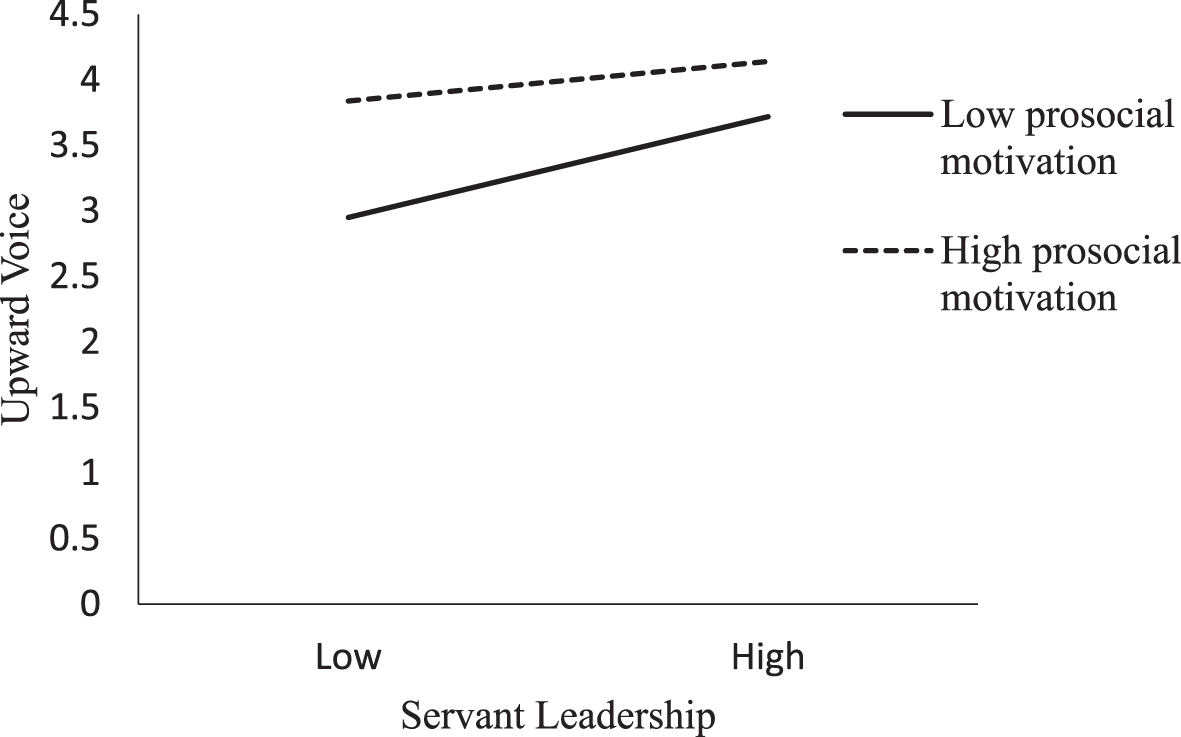
The moderation effect of different levels of prosocial motivation on the relationship between servant leadership and nurses upward voice.
This study was designed to find out the re-lationships among three important variables: servant leadership, prosocial motivation, and upward voice behavior. The first hypothesis addressed the relationship between servant leadership and nurses’ upward voice behavior in an Egyptian hospital. The findings from the current investigation supported the hypothesis that nurses’ perceptions of servant leadership would be positively related to upward voice behavior. This implies that, serving, supporting nurses, and treating them with dignity and treating them in selfless and good manner is consider as an important means for the development of nurses’ positive behaviors such as pointing out problems at workplace and giving useful solutions regarding work-related issues.
This finding provides support to Greenleaf as-sumption that servant leadership will lead to positive impact on employees’ positive behaviors including voice behavior [29]. This finding also supports social exchange theory and reveals that when leaders empower employees and express concern about their wellbeing, employees will be more likely to reciprocate by displaying prosocial behaviors that benefit the organization and its managers. Furthermore, the study results showed that nurses who hold high levels of prosocial motivation will be more likely to undertake positive behaviors that benefit the hospital and its individuals such as upward voice behaviors, which is consistent with the basic assumptions of prosocial motivation theory [14, 45].
More importantly, the current study advances our theoretical understanding of servant leadership. It follows suggestions made by other scholars [6], encouraging more studies to investigate the individual and communal factors that impact the way servant leadership is viewed by different employees. The current investigation was designed to examine the contingent role of prosocial motivation on the relationship between servant leadership perception and upward voice behavior. Using substitutes for leadership theory, the present investigation found that prosocial motivation moderated the positive association between servant leadership and nurses’ upward voice behaviors in an Egyptian hospital. The findings reported from the current investigation indicate that the positive relationship between servant leadership and upward voice behaviors was stronger for nurses lower in prosocial motivation than for those higher in prosocial motivation. As such, when nurses hold high levels of prosocial motivation, the positive correlation between servant leadership and upward voice behavior becomes weaker. Overall, these results extend previous research which has revealed that individual factors are likely to influence subordinates’ perceptions of leaders’ positive behaviors [16, 17].
The results obtained from the current study stresses the importance of recognizing the vital role that individual differences play in determining the effectiveness of servant leadership at the employee level. A major contribution of this investigation was to introduce prosocial motivation as a moderator of the relationship between servant leadership and employees’ upward voice. The literature review conducted for this study indicated that this investigation could be one of earliest insights to examine the relationships among servant leadership, prosocial motivation, and employees’ upward voice behavior.
Practical implications
The research investigation has two important practical implications for the enhancement of leadership and employee management practices. Firstly, the results reported in the study showed that servant leadership behaviors encourage nurses to display prosocial behaviors (i.e., upward voice). Hospital top management must find a way to hire managers who practice servant leadership. HR department should exert more efforts on the selection process to hire the right managers who can clearly understand the surrounding community and show the proper servant leadership behaviors [37]. Once the right type of managers has been selected and recruited, the hospital then could conduct management training, induction, and development programs so that servant leadership are reinforced among the selected managers. The hospital could also consider utilizing appropriate selections tests, management assessment centers, and in-depth interviews with job applicants to screen out candidates who do not display servant leadership behavior.
The results reported in the study also showed that the relationship between servant leadership and upward voice is affected when nurses hold high levels of prosocial motivation. Based upon the finding, a practical question that could be raised is “How does hospitals find nurses who hold prosocial motivation for the performance of his/her job”? Not all nurses coming to work for hospitals will have the prosocial motivation. One-way the hospital could find nurses with the desired prosocial behaviors would be to recruit, select, and hiring nurses who have a strong desire to serve the patients/clients and the public. Not only the selection process, but also various training and reinforcement programs could be initiated by the hospital to encourage prosocial behavior among nurses.
Research limitations
While this investigation has contributed to the literature on servant leadership, prosocial motivation, and upward voice behavior, the results of this investigation should not be interpreted without consideration of some of the limitations. The current investigation adopted a cross-sectional design, conclusions about causality between the variables under investigation cannot be made. To draw any conclusion about causality, future studies may be advised to utilize longitudinal and/or experimental designs to address this issue. Secondly, the investigation utilized a convenience sampling method for data collection purposes. Future investigations may be well advised a random sampling method. Since this was a first study of its kind in Egypt, and the purpose of the investigation was to explore leadership and upward voice behavior issues, the results should be taken as exploratory in nature.
Another limitation that is worth mentioning concerns the generalizability of the findings from the current study. Data were collected from nurses working in an Egyptian governmental hospital. Thus, the findings from the study cannot be applied to other contexts. Future studies may be able to overcome these limitations by collecting data from a larger sample of organizations.
Conclusion
Two main conclusions from the investigation worth considering are: first, that servant leadership behaviors displayed by supervisors contributed to the upward voice behavior of nurses. Second, among nurses who have a high degree of prosocial motivation, the role played by the servant leadership was found to be limited. As such, prosocial motivation is an important boundary condition of servant leadership and that servant leadership may be useful in many situations but not all. Further research is needed to confirm or disconfirm findings from the study.
Author contributions
CONCEPTION: Moustafa Abdelmotaleb, Abdelmoneim Metwally and Sudhir Saha
METHODOLOGY: Moustafa Abdelmotaleb
DATA COLLECTION: Moustafa Abdelmotaleb
INTERPRETATION OR ANALYSIS OF DATA: Moustafa Abdelmotaleb
PREPARATION OF THE MANUSCRIPT: Mous-tafa Abdelmotaleb, Abdelmoneim Metwally and Sudhir Saha
REVISION FOR IMPORTANT INTELLECTUAL CONTENT: Moustafa Abdelmotaleb, Abdelmoneim Metwally and Sudhir Saha
SUPERVISION: Cross supervision, all authors
Footnotes
Appendix 1
Assessment of measurement properties CR composite reliability, AVE average variance extracted.
Factors & References
Items
Factor loading
CR
AVE
Servant leadership, Liden et al. [50]
0.673
0.87
0.50
0.687
0.727
0.771
0.766
0.680
0.623
An introductory question asked: Why are you motivated to do your work?
0.90
0.70
Prosocial motivation, Grant [51]
0.814
0.859
0.870
0.795
Upward voice, Liu et al. [52]
0.836
0.83
0.63
0.791
0.743