



Abstract
BACKGROUND:
How to reconnect the disengaged learners has been a major challenge for human learning. Motivating the disengaged learners through traditional interventions has not been effective.
OBJECTIVE:
The study aims to examine whether feedback from an external unit would be more persuasive for the disengaged learners. The perception on a lack of learning stems from poor attitude of learning, poor behavior, laziness, and lack of learning ability and attention.
METHODS:
A foreign business community has collaborated with two Bangkok Metropolitan Administration schools since 2016 on creating constructive and indirect feedback. There were 337 students from both schools participated in the survey. 163 students participated in the revised practices while 174 students attended the traditional practices.
RESULTS:
The results show the gap between the two groups on the effects from constructive and indirect feedback. The disengaged students from the revised pedagogy show that they are attracted to constructive feedback and indirect feedback more.
CONCLUSIONS:
The findings show that, unlike the traditional paradigm, the disengaged students are perceptive to external feedback. The findings show some consistency with previous studies. Integrating external feedback can attract the attention from the disengaged students which could potentially contribute to human learning.




Introduction and background
Education and training have been the foundation for a country’s human capital development [2, 28]. Thus, human learning is critical for a productive workplace [18, 31]. Human learning reflects a process of understanding and acquiring knowledge to complete a set of tasks though training and education [4, 33]. Effective human learning often requires a learner to be constantly engaged for continuous development [34]. For instance, an individual can learn from useful feedback from a supervisor, a mistake pointed by a colleague, and a customer interaction. At school, children (or students) learn when they play and experiment with friend(s) and interact with a teacher. Constant engagement with fairness is thought to be a useful stimulus that accelerate long-term learning capability [35, 36].
In a workplace (or even at school), a learning process involves learning, unlearning, and relearning through feedback, engagement, and interaction [7, 33]. Continuous learning is important for future employability which contributes to growth and creative mindset [18]. Typically, engaged staffs and personnel in an organization are expected to acquire approximately 70% of their needed skills and knowledge from hand-on experiences (e.g., use of job rotation or assignment of a challenging task with active engagement and encouragement from others), 20% from interactions with others (including receiving feedback from peers, supervisors, subordinates, and outsiders), and 10% from formal educational events and training [4, 15]. The 70–20–10 framework provides a general idea on how an engaged individual learns and develops him/herself through time, especially with feedback [17, 29].
In a workplace or a classroom alike, overcoming a lack of learning and development among disengaged learners has been one of major issues for human capital [30, 35]. Lack of learning often results in underperformance, loss of productivity and creativity, and dropout or turnover [27, 37]. Previous studies point to self-confidence and sense of hope as a key stumbling block since many disengaged learners are afraid of a failure which prevents them from trying [1, 34]. Most disengaged students are not equipped and prepared for life-long learning. Their talents and potential have been regrettably ignored due to a wrong perception of their mindset in a classroom [22, 25]. This is because those talents are not within traditional subject matters which are often aligned with higher education.
Given the above, how to reconnect the disenga-ged learners has been a major challenge for human learning. Motivating the disengaged learners through traditional interventions relating to closed learning environment, learning opportunity and method, and technology have not been effective and has contributed to underperformance in a workplace [17, 19]. As a result, the potential use of feedback to achieve a reconnection with disengaged learners has been continuously examined [23, 29]. Some has highlighted that the attitude and perceived role towards work is influenced by the quality of feedback [29].
Research problem
To comprehensively examine the roles of and the impacts from feedback on human learning, the organizational setting may not provide reliable findings due to constant turnovers of staffs and personnel through promotion, transfer, and departure and dismissal [6, 38]. Therefore, this study has adapted a school which largely resembles a workplace. The reason is that the issues facing a typical workplace can be found in a school such as social ladder in a school and social climbing in a workplace, and school bullying and workplace harassment [18, 37].
The study focuses on how to better motivate learning among the disengaged learners. The significance of this study stems from the apparent lack of positive impacts from current practices which stress more assessment, more examination, more classroom hours, more interactions with a teacher, and more usage of positive feedback from a teacher on the disengaged learners [27, 34]. Note that there has been a shift from negative to positive feedback through a teacher for many decades when interacting with a student. In school, a teacher still plays a key role as a feedback provider. And, learning often takes place in confined area and closed environment [13, 22]. Despite several improvement interventions to induce the disengaged students (especially through digital technology), the general performance level has not been satisfactory [30, 32]. Instead, a more humanistic approach should be explored with more attention on the use of feedback from an outside source in conjunction with engagement and empathy [12, 33].
Despite the country’s numerous efforts to improve the quality of learning, Thailand’s education gap has inadvertently widened. This is based on the national assessment that shows that the gap when comparing Ministry of Interior’ schools with those from Ministry of Education as well as from the higher educational institutes with Faculty of Education 1 . Apparently, motivating disengaged students at Ministry of Interior schools has been a challenge due to poverty and family background. Furthermore, this feeling of disengagement stems from a lack of the compatibility with the learning contents and the one-size-fits-all mindset for curriculum development. This is due to the presumption that the students, who enroll at the upper secondary level, plan to continue their study at a university [7, 24]. Lack of hope and essential skills at work have been cited as the roadblock for successful interventions [7, 11].
From Table 1, the need to reconnect the disengaged learners becomes more serious because there is little value from the grades and national assessment [8, 9]. Further, the stereotype of these students is mostly negative because their low achievement is attributed to poor attitude of learning, poor behavior, laziness, and lack of learning ability and attention [1, 14]. Without recognizing that disengaged learners are different, the focus has been unfortunately on more schoolwork and activities, more vigorous assessment and examination, and more disciplinary actions [7, 25]. There has not been enough attention on the development of feedback and the roles of an outsider at school [14, 29]. See Fig. 1 for comparing how to deal with the disengaged students.
The 2011 Score from Trends in International Mathematics and Science Study (TIMSS)
The 2011 Score from Trends in International Mathematics and Science Study (TIMSS)
Source: Department of Education, BMA. Note that there are two primary ministries responsible for education- Ministry of Education and Ministry of Interior. Local municipalities under Ministry of Interior are responsible for health and human services to local population which also includes education. Currently, about 15% of the student’s population or 800,000 students in basic education are attending these schools. Included in this category is Bangkok Metropolitan Administration (BMA) which is administering 437 schools and is watching over 350,000 students.

Engaging Students in Academic Environment (what it is VS what it could be)
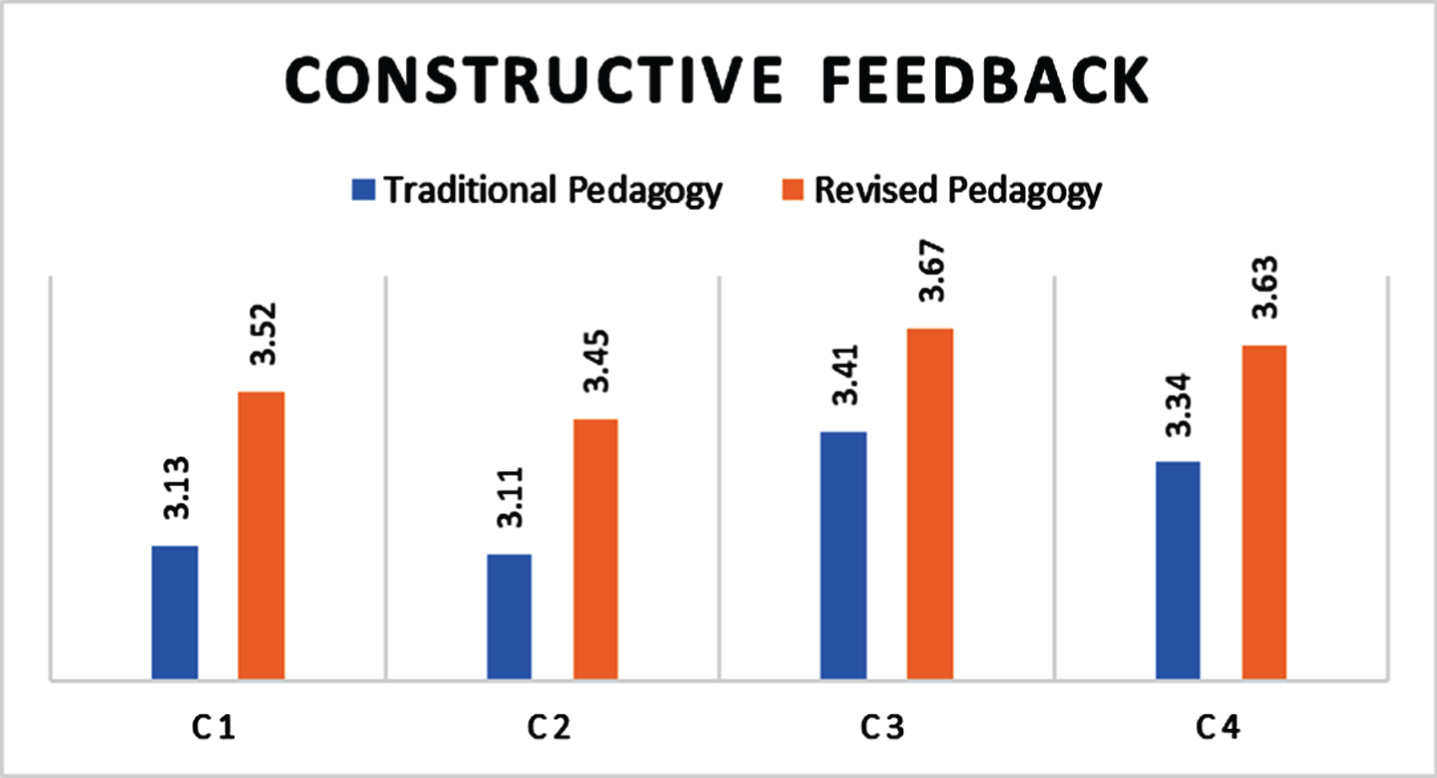
Average Results on Constructive Feedback.

Average Results on Indirect Feedback.
The study aims to examine whether feedback from an external unit would be more persuasive for the disengaged students to learn. Specifically, the study explores whether the use of constructive and indirect feedback from an external source would attract the attention from the disengaged learners. It is important to note that, to overcome the influence from the Hawthorne Effects, ongoing efforts and activities need to take place for a few years with persistence and commitment [19, 32]. Joint Foreign Chambers of Commerce in Thailand (JFCCT) 2 is to be an external unit in this study. The collaboration began in 2016 with the focus on science education and experiment.
In this study, the key to tackle a lack of learning among the disengaged students is not to view it as a standalone problem and a classroom as a closed system. Overcoming this lack of learning does not have to invest more in expensive technology, more tests, and more advanced assessment methods. It is possible that motivating the disengaged students do not require a school to radically redesign classroom and learning environment or change how teachers teach. Trust and understanding with empathy are needed as they cannot be built with a project, one visit, or one meeting.
Research method
Several steps have been taken to blend external feedback from an external body into a classroom, especially science experiments. Students have continuously participated and engaged during the study. Teachers have also been involved. An engagement with JFCCT was initially made in 2016 and have been carried out and repeated until the present. Some of important tasks conducted by JFCCT together with students and teachers can be described as follows. For constructive feedback, JFCCT decided to work directly with both the teachers and the disengaged students. For the teachers, the focus was on transferring business knowledge on customer engagement and psychology. For the disengaged students, support for self-belief and positive outlook was planned.
JFCCT and the teachers agreed that science skills (e.g., problem identification, experimentation, parameter analysis, sharing and discussion, verification, and proof, etc.) would be the priority instead of the contents and subject matters. Instead of conducting a science experiment to write a report, JFCCT has continuously encouraged the disengaged students to develop a product that can be a proof of understanding and knowledge on science. In addition, due to limited resources and laboratory’s readiness, JFCCT and the teachers decided that the study on environment and ecology to help integrate Physics, Chemistry, Biology, and Mathematics as part of integrated lesson plan for science experiment.
JFCCT’s involvement has taken place in terms of workshop, school visit, invitation to display of products, product purchase, etc. In the past, the focus of the workshops has been on the following subjects for both teachers and students - entrepreneurship, engagement with customers, financial literacy, product development, digital application for commerce (e.g., Facebook for Business and Line for Marketing), etc. See Appendix A for more details.
To learn more whether external feedback can entice and attract the attention of the disengaged students, a preliminary survey was developed in early 2020 jointly with the teachers. The focus was on assessing whether the disengaged students noticed and recognized the feedback (i.e., constructive, and indirect) due to JFCCT’s involvement. Constructive feedback represents supportive comments and tips that would contribute to a desirable outcome [23]. It reflects a corrective measure to a person who received it. In this study, constructive feedback focused on how the teachers engaged and interacted with the students (which was not related to formal assessment). There are four items to be surveyed in this feedback category.
At the same time, indirect feedback contends with a challenge which would reflect self-belief and personality of a learner [9]. Indirect feedback is part of the emphasis on the learner’s cognition and psychology and would allow a learner to make self-corrections. JFCCT has engaged with the students in many areas to provide indirect feedback on a progress of their work (i.e., product). Instead of providing the evaluation on the correctness of their ideas, continuous engagement implies that what the underprivileged students have attempted to achieve is the right path. There is a total of nine items in the survey for indirect feedback. See Appendix B.
Altogether there were 337 participants (i.e., former, and current students) from both schools partici-pated in the survey which took place in February 2020. Out of 337 participants, 163 persons had participated in the revised pedagogical practices (with JFCCT’s involvement) while the remaining 174 persons attended the traditional practices (i.e., regular science education without outdoor experimental learning and product development). Note that since almost of these students did not continue their education further after the completion, it was not suitable to use the national examination score for this comparison and in this study.
Results
The preliminary results from the surveys on constructive and indirect feedback show the apparent gap between the groups. The average difference from the scores relating to all items in constructive feedback and some in indirect feedback appear to be noticeable. In other words, the disengaged students who have gone through the pedagogy with JFCCT’s involvement show that they noticed and are attracted to constructive feedback and indirect feedback. For constructive feedback, the disengaged students appear to pay attention to examples outside a classroom. Willingness to be more considerate and attentive by the teachers has been a good signal of an approval to the products and activities undertaken by the disengaged students. This reflects what JFCCT has advocated and shared the ideas with the teachers.
For indirect feedback, the results show that the more visible gap for its last four items. Being receptive to the skills shown by the disengaged students (although these skills are not within academic requirements for higher education) provide strong endorsement to their achievement. In-kind donation could be viewed as a powerful message for this endorsement. Meaningful engagement (without the focus on their academic failures) has given the disengaged students self-confidence and hope which attract their interests.
A further analysis was made to statistically compare the average values of constructive and indirect feedback from the two sample groups. The use of t-test was applied since it helps determine if there is a significant difference between the means of two groups. See Table 2.
Survey findings on feedback and its impacts
Survey findings on feedback and its impacts
Note: *indicating p-value <0.05.
For the preliminary analysis, it is significant difference between the overall averages for constructive feedback from the two student groups. Knowledge sharing on customer engagement and psychology by JFCCT appeared to be beneficial to how the teachers with the students. All survey items in this category also show the significant difference between the students who had gone to the revised pedagogy. On the other hand, for indirect feedback, the overall averages from the two groups have not been significantly different. Despite this indifference, there are four items in this group that are noteworthy. Items 6 to 9 from indirect feedback clearly highlight the significant impacts from JFCCT active engagement.
It appears that the students who had attended the revised pedagogy with active JFCCT involvement feel or sense the difference in constructive feedback and possibly to a certain degree in indirect feedback. Simply put, constructive feedback appears to have more significant impacts on attracting the attention from the disengaged students. As a minimum, the notion (that the underperformed or disengaged students have no feeling about any feedback since they do not care about the grade due to poor attitude and laziness) should be dismissed.
The findings show some consistency with previous studies on the importance for the disengaged learners to experience creative learning activities outside a classroom [1, 34]. In other words, a school needs to dismantle the psychological barrier that separates the confidence of learning [19, 35]. Involvement with an external entity has shown that the disengaged students were previously reluctant to learn and were not interested in learning because of the way a teacher took them through irrelevant lessons. Integrating external feedback can attract the attention from the disengaged students which could potentially contribute to human learning. Since most disengaged students chose to work after their graduation, an academic grade was not critical. Thus, external feedback was probably a more suitable factor for learning. Constructive feedback was about sharing business experiences with the teachers for better student’s engagement while working with the students on product improvement represented indirect feedback.
Constant engagement with the teachers has contributed to the significant effects from constructive feedback. This implies that these students have paid the attention to the feedback and appear to welcome it for their learning and development. Despite some of the prevailing viewpoints on the disengaged students that they are not particularly concerned about the feedback, the findings show that this paradigm may not be accurate [8, 10]. If viewed as helpful and beneficial to their future, the disengaged learner would embrace its existence [19, 23].
The follow-up interviews with the disengaged students from the revised pedagogy also revealed that they had felt more positive about learning when receiving constructive and indirect feedback (e.g., workshop, school visit, purchase of products, displays and exhibition’s participation, and engagement and discussion). Product development from science experiment seems to be the key linchpin. The products from science experiments have allowed the students to experience more interactions with external stakeholders (in addition to JFCCT such as potential online buyers). At the same time, these products have allowed JFCCT to vigorously work with the teachers while consulting with the students on product improvement and extension.
Based on a little more than 4-year engagement, the findings point to many important courses of future study on dealing with the disengaged learners. Despite a prevalent paradigm on the underperformers (i.e., laziness, poor learning attitude, lack of learning capability, etc.), the work of JFCCT has shown the potential of the disengaged learns in several areas, especially creativity. Many products from science experiments show the innovativeness of these students. In addition, these disengaged students care about learning but need to be trusted that learning activities would lead to their needs. The roles of an external source on feedback should be more examined.
For the future research, the details relating feedback (e.g., whether feedback could lead to a more effective learning process, how this learning interacts with a learner’s motivation, and how feedback can be better designed) should be further examined. This suggestion is based on the 70–20–10 framework which argues for better design of feedback in a workplace [12, 15]. It is also important to recognize that, after about four years of continuous engagement by JFCCT, the survey results could be trustworthy since the Hawthorne Effect was minimized. Consistency over the collaboration period should minimize any temporary feeling stemmed from the awareness of being monitored [3, 32]. Finally, there are several issues that represents the study’ shortcomings. Learning culture between a school and a workplace was not recognized when developing the survey on the students’ attention to constructive and indirect feedback. The possibility to revisit the results on indirect feedback should be made. This could confirm the actual effects from indirect feedback.
Conclusion
The study focuses on gaining more insights into the interactions between constructive/indirect feedback and the disengaged students. Working with the disengaged students can be a challenge due to their academic underachievement and perceived poor attitude and behavior. Thus, more assignments and tests are provided which negatively affect learning of these students further. JFCCT has engaged with two BMA schools since 2016 through active collaboration and partnership with the teachers. JFCCT attempted to use constructive and indirect feedback when working with both teachers and students. During the study, there were many activities undertaken by JFCCT for the development of constructive and indirect feedback. The preliminary findings constructive feedback stemmed from an external body can significantly attract the attention from the disengaged students. In addition, indirect feedback appears to be noticeable by the disengaged students. Therefore, there is a potential for the disengaged learners to learn and excel in their work. More suggestions on future research are provided together with the recognition on the study’s limitations.
Footnotes
Acknowledgments
The authors have no acknowledgments.
Author contributions
CONCEPTION: Kongkiti Phusavat
METHODOLOGY: Kongkiti Phusavat
DATA COLLECTION: Kongkiti Phusavat
INTERPRETATION OR ANALYSIS OF DATA: Zbigniew Pastuszak and Achmad Nizar Hidayanto
PREPARATION OF THE MANUSCRIPT: Zbigniew Pastuszak and Jukka Majava
REVISION FOR IMPORTANT INTELLECTUAL CONTENT: Kongkiti Phusavat
SUPERVISION: Kongkiti Phusavat
See OECD/UNESCO (2016), Education in Thailand: An OECD-UNESCO Perspective, Reviews of National Policies for Education, OECD Publishing, Paris
JFCCT is the umbrella body for various Thai- foreign chambers or business associations operating in Thailand. Altogether, there are 36 foreign chambers which represent more than 9,000 companies. JFCCT has many committees which are responsible promoting trade and investment while assisting the country’s economic and social development. Education and Skills Committee is one of the six committees and started in 2015. This committee has worked closely with BMA for improving science education and other related areas to strengthen learning and development of BMA students and teacher alike. Visit for “ ” additional information.