




Abstract
BACKGROUND
Traditionally, teachers with less work experience receive more training in non-academic areas such as school disengagement. This circumstance affects a school’s readiness when attempting to create a student-focused environment. Teachers need to have a consistent approach when dealing with disengaged students.
OBJECTIVE
The study examines the relationship between work experience on the decision relating to in-service training needs to cope with school disengagement. This study focuses on the schools from Bangkok Metropolitan Administration.
METHODS
The method consists of several steps. The first step is to identify a general set of non-academic training needs. The next step is to distribute the survey to teachers. Finally, statistical analysis is applied to examine the impacts from work experience.
RESULTS
Based on the surveys completed by 147 teachers who are categorized into four work-experience groups. The findings show that work experience does not affect the decisions regarding training needs. Thus, younger as well as older teachers alike should be provided with similar training programs to deal disengaged students.
CONCLUSIONS
Work experience should not be used as a criterion when selecting teachers when providing in-service training for non-academic areas. Consistent practice by teachers is needed when creating a student-focused environment.



1. Introduction
In-service teacher training focuses on many areas and issues. They include understanding the challenges facing learning and development of students, planning, budget preparation, selection and prioritization of teachers, development of training programs, and follow-up on training effectiveness [1, 2]. Due to financial, time, and travel restrictions, the selection of teachers for training needs to be effective and consistent with current challenges [3]. General practice shows that teachers with less experience likely need more training in communication and engagement (with students and parents) while more experienced teachers probably need additional training to become more familiar with digital technology. Traditionally, work experience is viewed to be an important criterion when selecting teachers for in-service training programs [4, 5].
There are many ongoing changes which affect learning and development at schools. These changes include a more diverse group of students (e.g., a slow learning person), language proficiency, national origin and ethnicity, socioeconomic status, educational background, and culture or norm of learning (e.g., listening, rote learning, active participation, emphasis on individual assessment, and teambuilding, etc.) [6–8]. Not only these changes affect students directly but also involves with teacher’s classroom management such as a lack of trust by the parents (as they feel that the lessons do not prepare the children for their future employment), and disruptive behaviors of the students (such as bullying and harassment).
These non-academic challenges are more common for schools where the students are from disadvantageous backgrounds [9–11]. Poverty and economic hardship (due to migration of a family along with affordability to continue further education after high school) have contributed to the feeling of school disengagement by the students [10, 12]. This situation was further compounded by extended social isolation during the COVID-19 pandemic in which quarantine and learn-from-home were adapted [11, 13].
The development of in-service training has gradually included non-academic areas [14–16]. Traditionally, a teacher with longer work experience traditionally equates to having higher capability to handle student-related problems [17, 18]. Despite being well-prepared in their academic knowledge (e.g., ability to teach Science, Technology, Engineering and Mathematics or STEM integrated pedagogy), younger teachers are also required to deal with the issues stems from non-academic areas such as school disengagement. This task often needs extensive experience due to the need to cope with students’ behaviors and attitudes. Thus, in-service training programs for non-academic areas are often planned for younger or less-experienced teachers [1, 7]. This circumstance affects the school’s ability to deal with disengaged students. The reason is that teachers need to have a consistent approach when tackling school disengagement [7, 19].
The post COVID-19 pandemic has resulted in a higher level of school disengagement [13]. Passive learning behavior has become increasingly more disruptive for classroom management. Teachers are often unable to deal effectively with this challenge. This inability includes the following- to recognize diverse learning styles of individual students, to develop empathy to students, to explain the importance of safe internet, to engage with students and their parents, and to motivate and sustain learning behavior. School disengagement is an essential problem since disengaged students will likely become disengaged workers who are neither innovative nor productive [10, 21].
1.1. Significance of the Research
The 2011 score from Trends in International Mathematics and Science Study

*denoted as central-government agencies. Source: Department of Education, BMA.
Tackling school disengagement has been a major part of in-service training for non-academic areas to enhance a learner or student-focused environment [8, 23]. A prevailing presumption is that teachers with less experience need more training. This is due to the perceived lack of familiarization with a situation and practices during their pre-service teacher training. Thus, in-service teacher training programs (when dealing with school disengagement) are often intended for less- experienced teachers [2, 25]. This presumption has affected an overall readiness at school since all teachers need to handle disengaged students [25, 26]. This readiness requires a school to practice a consistent approach when dealing with disengaged students [7, 19].
Engaging students (regardless of learning ability, physical limitation, and financial well-being) is essential for creating a student-focused environment. A lack of success in and effectiveness for in-service teacher training stems from many issues [3, 23]. They include a reliance on a top-down approach when selecting teachers for their training needs, poor training incentive with an unclear path for professional or career development, and lack of accessibility to training programs. The study focuses on the selection of teachers for their training needs in non-academic areas while using work experience as a criterion. The use of work experience has been part of a top-down approach [4, 19].
Finally, creating a student-focused environment at school is important for a country’s human development. The reason is that education contributes positively to the livelihood of people [27]. Quality Education is part of the Sustainable Development Goal of the United Nations which stresses equity, accessibility, inclusiveness, and a safe learning environment. Thus, continuous skill development for teachers is essential for this goal [1, 27].
1.2. Problem background at bangkok metropolitan administration or BMA
In Thailand, the education gap remains one of a country’s most serious issues which affects long-term national competitiveness and social development [6, 8]. The achievement gap between the two school categories (i.e., central government with Ministry of Education and higher education institutes VS local municipalities which are part of Ministry of Interior, including BMA) becomes widened. Thus, it is common that students who attend Ministry of Interior schools are viewed as low performers who feel disengaged from school. This feeling stems from many factors. They are: (1) personal factors such as sense of hopelessness, poverty, poor school reputation, family abuse, single-parent family, and (2) health factors- slow learning ability and need of psychological/ physical safety [9, 12]. See Table 1 for the comparison.
Thailand’s local-government (or municipality) schools were initially created when the country’s population was growing rapidly, especially in 1960 s [9, 11]. Thus, the communities in the rural and remote areas were provided with so-called opportunity schools which had been extended from a daycare and a kindergarten (as part of the responsibility of a local government). During the 1970 s (and the subsequent two decades), rapid industrialization created many urban areas where families from provincial areas would migrate and seek employment, especially the Bangkok area [20]. Thus, Bangkok Metropolitan Administration or BMA was later established to provide basic services such as healthcare and education.
As of 2023, there are 437 BMA schools that are responsible for about 260,000 students. Note that approximately 30% of these schools offer a secondary level of education. There are more than 12,000 teachers, teaching assistants, and academic employees. BMA’s Department of Education oversees school-related affairs (e.g., curriculum development, assessment and evaluation, procurement, teacher training and professional development, etc.). Despite the massive size, BMA students are generally perceived to be underachievers (or low performers) with little self-esteem, self-confidence, and motivation- generally classified as disengaged [28–30].
Many BMA students exhibit the slow-learning ability and short-attention span which intensify further school disengagement and disruptive behavior [27, 28]. In addition, social-related issues such as drug, bullying, harassment, and early teen pregnancy are also common among BMA schools. Drop-out, absence, and tardiness as well as lack of attention are expected. This circumstance creates an unsafe and unattractive learning environment. To tackle this problem is extremely difficulty since most students are faced with poverty and are from either a broken family or a single-parent family.
In addition, most students cannot afford to continue their education after completing their high-school diploma. What students learn and how the knowledge and skills can help them when they work becomes a concern among the parents [9, 10]. Simply put, the ongoing challenges for BMA schools that result in school disengagement include rigid control through assessment and evaluation, rote learning, and relatedness of academic subjects to future employability [20, 30–32]. School disengagement indicates decreasing classroom participation, increasing tardiness, late assignment submissions, persistent non-response to peers, and serious disruptive behavior [24, 34].
To make this matter worse, BMA’s in-service teacher training traditionally focuses on academic subjects due to political pressure to narrow the achievement gap mentioned earlier [20, 28–30]. For instance, the in-service training programs have included science, mathematics, environment, technology, and English such as STEM (Science, Technology, Engineering, and Mathematics) Education. However, the above challenges facing BMA schools require skills and knowledge in many non-academic areas for teacher training. For BMA schools, a top-down approach, through the Department of Education and BMA Training and Development Institute with ready-made training materials or standalone development of training programs by outside experts, is generally practiced [28–30]. Work experience is often used as a criterion when selecting teachers for training. Teachers with less experience are primarily provided with non-academic training such as student engagement. Teachers with higher work experience are given academic subjects such as STEM and flipped classroom.
2. Research question
The research question is as follows. Does work experience matter when selecting teachers for training in non-academic areas? The research question stems from the presumption that teachers who have had longer work experience should be better equipped to handle students’ behavior than younger colleagues, especially at secondary-level schools. Thus, the viewpoints on training needs for school disengagement should not be similar.
2.1. Research objective
The primary aim of the study is to examine the impacts of work experience on determining and prioritizing non-academic training needs among teachers for schools at the secondary level.
2.2. Research method
The method for this study can be described as follows. The first step is to identify a set of non-academic training needs that help respond to ongoing school-disengagement challenges. This step is completed with two senior BMA teachers (Mr. Weeraphong Pimsarn and Mr. Apichart Intha). This step is later completed with the participation of six additional younger teachers. The next step is to distribute the survey which is to be made available for one month. Teachers responsible for secondary-level schools are the target group. Finally, the remaining steps involve statistical analysis when evaluating the impacts of work experience on the decisions regarding training needs in non-academic areas.
3. Results
For the first step, the discussion is made with two senior teachers who have been working at BMA schools for more than a decade and have regularly visited students’ homes to deal with personal and family problems. Both teachers also work with a small group of six younger teachers (2 to 6 years of work experience) to identify a set of non-academic training needs which help strengthen a student-focused learning environment at school. Various issues that have contributed to school disengagement are examined. It is agreed by participating teachers that the following six training areas are essential. See Table 2 (as part of the survey).
Critical areas of training needs

Description: The term ability indicates both skills and knowledge to be gained from in-service training.
•How to engage with the students from diverse backgrounds (e.g., conversations): the ability to have productive and constructive conversations with the students during and outside the lessons, classroom activities, and work assignments with the recognition of the diverse backgrounds of the students- poverty, family background, etc.
•How to build trust and relationships with the students: the ability to illustrate the understanding of needs and hardship experienced by the students with the empathy towards them with care, fairness, and honesty on a consistent basis.
•How to entice learning and to motivate the students (to learn): the ability to provide constructive feedback and to create the conditions (with extrinsic and intrinsic rewards) that instill the confidence to change and sustain specific behavior toward learning objectives.
•How to increase/ improve the students’ social and soft skills: the ability to provide an opportunity to develop social and soft skills for employability or future employment.
•How to build and sustain teamwork and teambuilding in a classroom and school: the ability to inspire and encourage individual students to form a team that works effectively and creatively together and to achieve learning objectives and expectations.
•How to develop relationships with key stakeholders such as parents and community: the ability to professionally connect and communicate effectively with the parents and relevant people who share common interest in the development (maturity and employability) of students.
The second step involves the distribution of the survey to the targeted teachers (by using Google Form). Note that this step took place during the month of June 2023. There are altogether 147 teachers who participated. The SPSS software is applied for statistical analysis. Out of 147 teachers, 21 teachers have had working experience of 1–3 years. 42 teachers have had work experience of 4–6 years. 8 teachers have worked for 7–9 years. Lastly, 76 teachers have had working experience for more than 9 years. Note that the reliability of the survey (or the Cronbach’s Alpha) through the SPSS shows the value of 0.856. See Table 3.
Profile of survey’s participants

The overall results show the needs for in-service teacher training as follows: (1) how to build and sustain teamwork and teambuilding in a classroom and school, (2) how to build trust and relationships with the students, (3) how to increase/ improve the students’ social and soft skills., and (4) how to entice learning and to motivate the students (to learn). See Table 4.
Selection and prioritization of in-service training needs for disengaged learners

•Note: the value of 3.21 (from the survey Question 1) is based on the following- {[(2 - 1) + (20 × 2) + (82 × 3) + (31 × 4) + (12 × 5)]/147}.
The next analysis examines the effects of work experience on the selection of training needs. If a significant effect is detected, the pair-wise comparison with the Least Significant Difference (LSD) would be applied to assess the means of the group’s populations. See Table 5.
Impacts from work experience on the level of training-needs agreements

Based on the results from Table 5, there is no statistical difference when determining in-service training needs across four work-experience groups. In other words, when dealing with school disengagement, work experience does not significantly influence the determination of in-service training needs. In other words, teachers (regardless of their years of work experience) generally express the training needs in the same way. Thus, the use of LSD became unnecessary.
Despite this finding, there is a need to substantiate the previous results (that there is no impact on the selection of training needs based on work experience. Therefore, the study separately scrutinizes individual work-experience groups and identifies the top-half prioritized training areas. The frequency of training areas for each work experience group would be identified and compared. If the frequency of the top-half selection of training needs for each work-experience group remains essentially the same, then a confirmation of the insignificant effects from work experience can be made. See Tables 6–9 for each work-experience group.
Results on in-service training needs from group 1 (1–3 years of work experience)

Note: for the 1–3 years’ work experience, the top-half selection includes training areas 2, 4, and 5.
Results on in-service training needs from group 2 (4–6 years of work experience)

Note, for the 4–6 years’ work experience, the top-half selection includes training areas 3, 5, and 2.
Results on in-service training needs from group 3 (7–9 years of work experience)

Note, for the 7–9 years’ work experience, the top-half selection includes training areas 5, 4, and 2.
Results on in-service training needs from group 4 (9 years of work experience)

Note, for the more than 9 years’ work experience, the top-half selection includes training areas 5, 2, and 4.
Apparently, training areas 5, 2, and 4 are consistently selected across four work-experience groups. The areas relating to how to build and sustain teamwork and teambuilding in a classroom and school, and how to build trust and relationships with the students appear in all four work-experience groups (denoted as training areas 5 and 2 respectively). On the other hand, how to increase/ improve the students’ social and soft skills emerges in three of the four work-experience groups (denoted as training area 4). See Fig. 1.
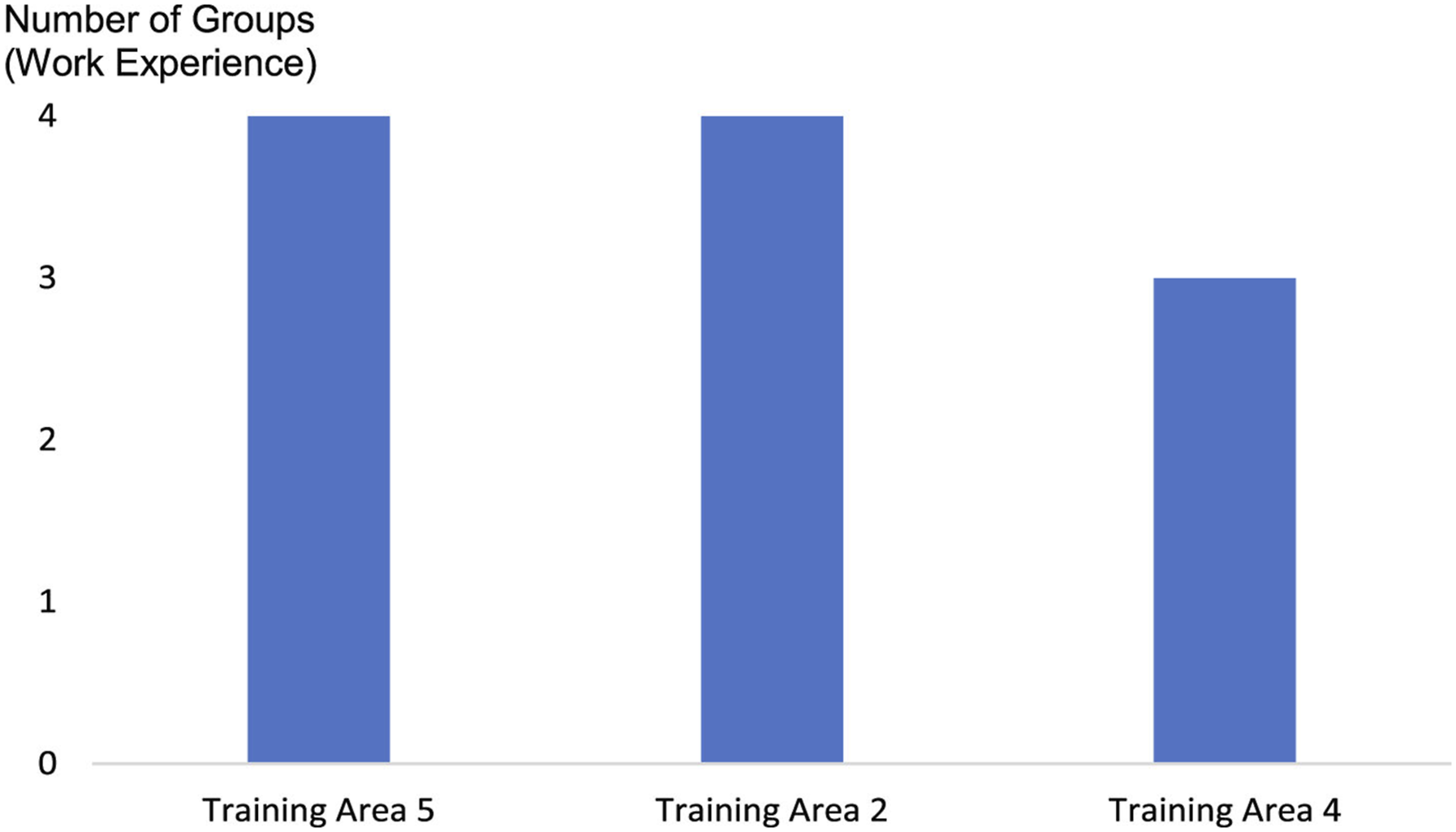
Frequency of the selected top-half training-need areas.
Thus, based on the findings from the above two methods, work experience among teachers does not impact the decisions regarding training areas. Teachers, no matter work- experience groups, generally agree on training areas that they need to tackle school disengagement.
4. Discussion
In-service teacher training programs are often determined by many factors which can be uncontrollable and controllable [3, 23]. They are budget, size of training, location of a training facility, urgency of a school’s problem, public policy, academic specialization, and work experience. For instance, pedagogical-related practices on coding and robotics are primarily developed for teachers in science and mathematics, especially for older teachers. For broad non-academic training areas such as bullying and harassment, the focus is on instilling better understanding and knowledge relating to behavioral, psychological, and emotional aspects of students, especially for younger teachers. Proper teaching training should provide a consistent approach to deal with major school’s challenges as well as the reduction of teachers’ stress and burnout [4, 22].
Despite a traditional view that work experience is an important factor in selecting teachers (i.e., prioritizing who needs to be trained), the findings from this case study show no relationship between work experience and training needs for non-academic areas, especially when dealing with school disengagement at the secondary level. In other words, work experience does not affect teachers’ decisions regarding their training needs. More- and less- experienced teachers alike express a similar opinion regarding the areas of training needs. The results are supported by the fact that classroom management (e.g., how students interact, how students view lessons and study subjects, how students deal with outside-school issues such as poverty, how social media is being used, etc.) has rapidly changed over the past two decades [6, 29].
Finally, even more experienced teachers realize that dealing with disengaged students requires a new set of skills. Previous methods such as disciplinary actions and additional assignment are no longer viewed as being helpful [1, 23]. For BMA schools, disengagement is not about attention and attendance with the specific solution only on students. Creating a positive learning environment for students nowadays requires a comprehensive viewpoint. This includes social (e.g., working with parents), economic (e.g., employability after graduation), and personal (e.g., trust and teambuilding) consideration [12, 32]. A similar understanding and a consistent approach when engaging with students by teachers is needed [2, 5]. This is essential when a school attempts to create a student-focused learning environment [7, 19].
4.1. Future Research
Based on the preliminary findings on work experience, future research should examine other factors that influence how teachers are selected or prioritized for their training programs for non-academic areas. For instance, should schools’ characteristics such as size (e.g., large VS small) and location (e.g., inner VS outskirt areas of the city) be used to determine training need for teachers? It may be possible that specific challenges and factors that contribute to school disengagement vary, based on these characteristics. The clarity of the impacts from these issues (i.e., school size, and school location) should result in a more customized approach for in- service teacher training.
5. Conclusion
The study examines the impacts of work experience on the decisions regarding training needs, especially for non-academic areas such as school disengagement. Traditionally, less- experienced teachers are prioritized when dealing with behavioral-related issues from students at the secondary level. Altogether, 147 teachers from BMA schools participated in this survey study. The findings show that work experience does not affect teachers’ decisions on their training needs. The reason is that younger or older teachers alike need to be upskilled when dealing with school disengagement. This insight should enhance a school’s ability to create a student-focused environment. The reason is that teachers should address disengaged students in a consistent manner. Future research is also proposed which should further strengthen the preparation of in-service teacher training for non-academic areas.
Funding
The study is funded by National Research Council of Thailand (NRCT) through the contract (N42A660996) with Kasetsart University.
Author contributions
CONCEPTION: Kongkiti Phusavat
METHODOLOGY: Kongkiti Phusavat
DATA COLLECTION: Kongkiti Phusavat
INTERPRETATION OR ANALYSIS OF DATA: Bordin Rassameethes and Kongkiti Phusavat
PREPARATION OF THE MANUSCRIPT: Bordin Rassameethes and Kongkiti Phusavat
REVISION FOR IMPORTANT INTELLECTUAL CONTENT: Zbigniew Pastuszak and Kongkiti Phusavat
SUPERVISION: Kongkiti Phusavat