




Abstract
BACKGROUND:
During such an uncertain time like a pandemic, job autonomy can play a pivotal role. It can build bridges between performance feedback and work performance in the millennial workplace. To do so, a set of management practices must be put in place to meet millennial needs.
OBJECTIVE:
This paper’s aim is to explore how job autonomy can be used at its best in the context of the millennial generation and the relationship to both performance feedback and work performance.
METHODS:
A theoretical performance feedback-work performance model mediated by job autonomy has been built based on current literature and empirical research. The research sample consisted of 185 purposefully selected working students from the Faculty of Management at the University of Łódź.
RESULTS:
Individual autonomy can play a positive mediating role between performance feedback and work performance in the millennial workplace. Job autonomy is a partly mediating construct regarding the model.
CONCLUSIONS:
Job autonomy is an important tool to improve individual performance through individual-tailored performance feedback. This study shows how a line manager can be a more future-oriented coach and an effective listener rather than just being somebody who constantly monitors their work.

Introduction
The traditional workplace is changing as telework prevails. Forbes has called this phenomena the world’s biggest experiment in employee autonomy [1]. The Deloitte Insights [2] stresses that work redesign should make remote work sustainable by using ample opportunities to broaden job autonomy (JA). The report finds that allowing for personal choice in determining how work gets done as the second highest factor in this regard. Simultaneously it shows the different expectations towards the effects of work transformations between senior executives and individual workers. It is not going to be easy to tailor management skills in the new working environment. One of the managerial practices to introduce is performance feedback (PF) which is a vital part of supporting and appraising an employee performance management system (EPMs) [3]. Individual work performance (WP) can be positively influenced by using an effective EPM system.
As the pandemic struck US millennials seemed to be perfectly prepared to work remotely by using broader JA features thanks to the key characteristics of this generation: techno savvy, independence, being connected 24/7, self-reliant and entrepreneurial [4, p.17]. At work they are comfortable with change, more interested in corporate social performance and responsibility, want to produce something that makes a difference and they thrive on flexibility and space to explore. It is worth noting from a PF perspective that they require an explanation and like feedback/guidance [4, 41]. Deloitte Global Millennial Survey from May 2020 points out that stress levels of millennials surprisingly decreased about 8%(from 50%till 42%) during the pandemic in comparison to before the pandemic [5]. Interestingly, their loyalty towards their employers is now increasing because employers have become more open to their employees’ needs by providing them with a more inclusive culture, diversity support and new competency investment. It seems that the pandemic has given millennials an opportunity that could allow them to have a greater impact on the working environment and society as a whole. Polish millennials constitute an important group for the present labour market. On one hand, they dominate many social media platforms such as YouTube, Facebook and LinkedIn. They usually use online technology and smartphones on a daily basis and in their professional work [6]. On the other hand there are 11 million Polish millennials that accounts for over a quarter of the population [7].
In general the literature on management points out that: (1) if PF is seen by an employee as individually-tailored support then it can help to adjust JA specificity, i.e. PF ⟶ JA [8] and (2) JA is often seen as a positive drive regarding WP, i.e. JA ⟶ WP [9]. Based on the aforementioned initial remarks this paper’s aim is to explore how JA should be used at its best in the context of the millennial generation and its relation to both PF and WP. There is currently little known about these relationships. However, due to characteristic features for this generation, the theoretical PF-WP model mediated by JA has been built (i.e. PF ⟶ JA ⟶ WP) based on managerial literature and empirical research.
Theory
Millennials expectations towards job autonomy
The term autonomy sets out that it is “the degree to which the job provides substantial freedom, independence, and discretion to the employee in scheduling the work and in determining the procedures to be used in carrying it out” [10, p.162]. Most findings show a positive effect of job autonomy on work performance [11–13]. Giving employees more job autonomy might increase their intrinsic motivation and may therefore lead to engagement with their work [14, 15]. In accordance with participative management, autonomy can influence goal setting, decision making, problem solving and making changes in the organization [16]. Job autonomy is positively related to company profit but only for young companies. These results suggest that it is important for young companies especially, to provide their employees with job autonomy and its supporting practices [17].
However, an employee who believes that autonomy is being unreasonably withheld may want to withhold his or her best efforts as a means of restoring balance [8]. In fact, unethical behavior can occur from having the freedom of JA. Nevertheless, this effect is compensated for and reversed by a set of indirect and advantageous effects exerted through the influence of job satisfaction and perceived organizational support [18].
Polish millennials (born between the late 1970s and the mid-1990s) don’t deviate much from worldwide preferences regarding job autonomy. In general, the literature on management highlights the importance for them to be independent and flexible enough to do their work and satisfy their need to develop. It also shows that they have little interest for the rules of the workplace [19]. However, the pandemic may have in some way changed our understanding of this generation: worldwide millennials now declare being much less stressed, more loyal to the company, assess CSR activities better, are more financially optimistic and feel more socially responsible in comparison to the pre-pandemic era [5]. According to the quoted survey Polish millennials are not yet so optimistic: almost half of those surveyed want to change their job within the next 2 years and also assessed CSR activities less positively. What is interesting is that the pandemic’s restrictions on business made millennials more active and strengthened their will to change. This positive hope for the future can be a strive for good personal self-esteem, responsibility and JA need in the workplace. In accordance with the Great Place to Work Report 2021 millennials aren’t ready for a return to the in-office 9-to-5 and want to continue flexible work arrangements [20].
Performance feedback (PF)
PF is a two way communication process to convey information regarding individual performance between a subordinate, their superior and coworkers [21]. It is only timely and constructive future-oriented feedback that determines work performance improvement [22]. No doubt organizational justice should associate feedback practices because it is an important motivating factor for employees in order to improve organizational productivity [23]. Too little feedback can bring about employee frustration from a lack of direction, whereas too much can make an employee feel like a mindless mechanical device without their own will [24]. Regardless of the scope of employee autonomy, feedback can usually improve performance behaviours. Feedback can empower an employee or may decrease results by applying too much control [25]. Moreover, feedback and autonomy go together well to produce even more beneficial results in terms of expected behaviours [8]. Inclusive leadership can ensure the participation of employees in crucial matters and is the primary factor behind the promotion of innovative work behaviours [26]. Psychological safety empowers employees to assert creative methods in the workplace and mediates the aforementioned relationship.
Feedback does not always improve performance. However adding rewards and/or goal setting within PF is beneficial. Some characteristics of PF are more consistently associated with improved performance than others [27]. Workers who receive organizational support are less sensitive to perceived job insecurity in tough times [28].
Polish millennials seem to appreciate the importance of PF. They were raised in the economic turmoil of the 1990s and this fact made them different to their western counterparts. They were found to be less optimistic than the previous Polish generations. Pragmatism has always been a base to achieve satisfaction at work and in everyday life [7]. This is why Polish millennials appreciate a good relationship with their superior and want to have a fair and square performance assessment. They are not afraid of criticizing bad supervisors and they need continuous feedback and open and sincere communication. They have a critical attitude and are less inclined to be loyal [29–31]. Due to the aforementioned features of this generation they require PF that is well suited to their needs to make them feel satisfied.
Work performance (WP)
Latham et al. [32] indicate that if we do not know what WP is, it is difficult to specify the diagnostic tools of effectiveness. The tools, on the other hand, are a prerequisite for preparing and delivering feedback, as well as the basis for setting goals. WP regarding the individual may take on different meanings either in terms of competencies or behaviors [33] or output or both [34].
Contextual factors
The literature on management highlights a few contextual factors which should be taken into consideration. Their influence somehow moderates the presented model. These factors are described below in detail.
Online applications and mobile tools used during feedback are in common use. Millennials bring their own devices (i.e. phone, computers) into work to stay in constant connection with others and to maintain a balance between work and leisure time [35]. The impact of mobile games, technological innovations and collaborative learning can have a significant positive impact on student motivation [36]. During the pandemic this phenomenon was most likely strengthened. The change in the working environment is supported by transformational leadership which is positively associated with employee perception of job autonomy, which in turn promotes extended use of information exchange [37].
Autonomy cannot be assigned to an employee for whom it is not motivational and who has little knowledge of the complexity of the task itself. At the same time, the task is characterized by a high degree of dependence on other tasks, has a low coefficient variability, and its implementation requires compliance with many rules and procedures [11, p. 492]. The necessary information must be given regarding what to do and how to do it in order to achieve the best results in terms of JA [38].
In fact millennials want to be autonomous but don’t want to feel alone [39]. They are motivated by personal development and independence [40] and are not interested in the rules of the workplace [19]. The question of high remuneration is paramount. They don’t care about having a long-term career, they are skeptical about the question of organizational loyalty, they prefer to learn through being engaged in work projects, they usually don’t share organizational values but want to have a say in how the company is run [29]. From this perspective incentives seem to have high potential.
Method and hypotheses
Theory model and variables
The initial purpose of this research was to develop, verify and analyze the findings of job autonomy (JA) as a mediator between performance feedback (PF) features and work performance (WP), as presented in Fig. 1. The following research questions were derived from the theoretical model: What is the PF, JA and WP architecture in terms of items used to build constructs? Which items were excluded? Is there a possibility to develop the model? Is JA a mediator for the PF-WP model? How do contextual factors influence the model and JA in particular?
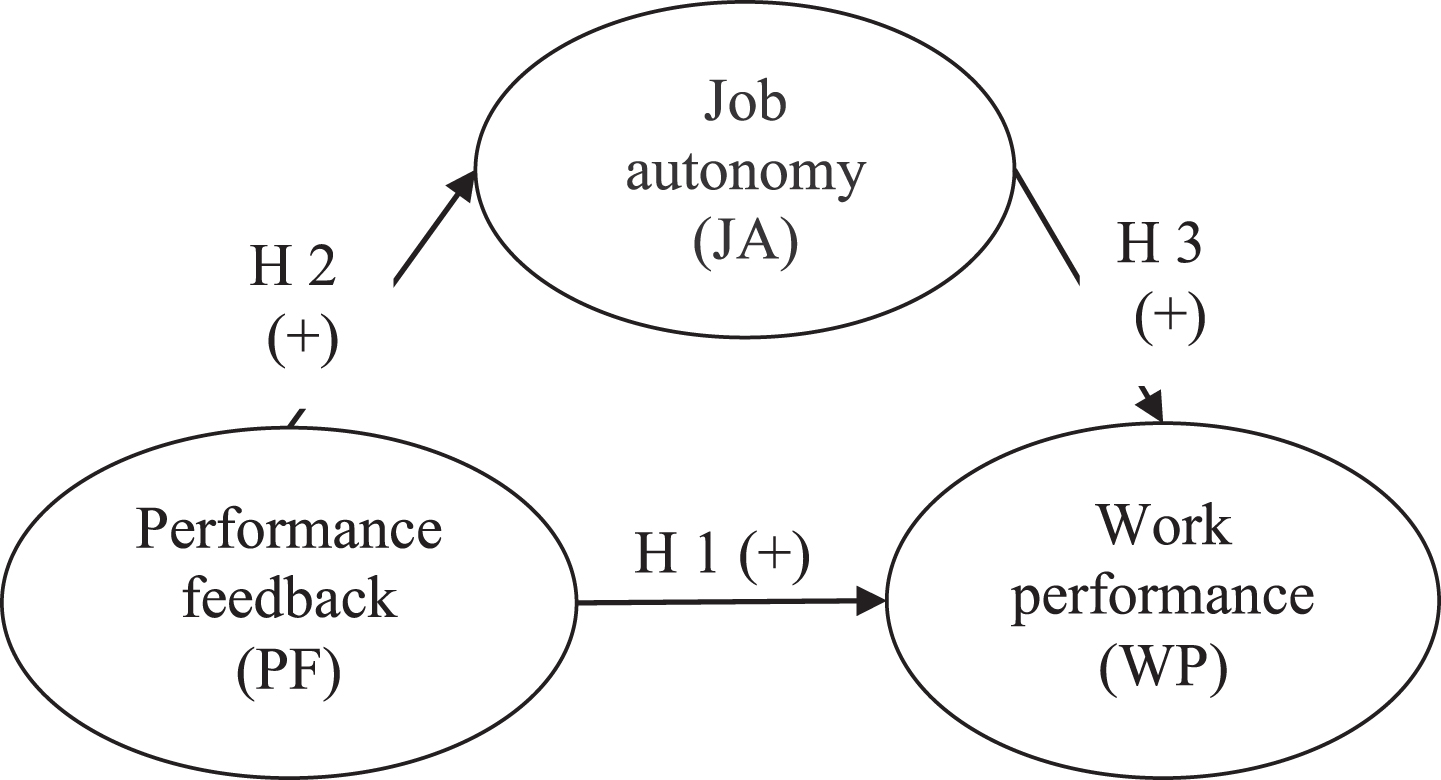
The theoretical model presenting the influence of performance feedback (PF) on work performance (WP) mediated by job autonomy (JA) - based on the literature.
The theoretical model was developed based on the presented theory review (Fig. 1). Constructs were developed (Table 1) using other research instruments and theories as the base.
The development of the model was carried out using modeling of structural equations and IBM SPSS Statistics 27 and SPSS Amos 27 software. Three hypotheses were derived from the theoretical model:
H 1: Performance feedback (PF) is positively related to work performance (WP)
H 2: Performance feedback (PF) is positively related to job autonomy (JA)
H 3: Job autonomy (JA) is positively related to work performance (WP)
Development of constructions
The first step to build the model was to develop three constructs: JA, WP and PF. Although for all 9 items of the JA construct the Cronbach’s Alpha value was appropriate (0.910), it then produced an unsatisfactory value of 44.7%for the variance test (much lower than the appropriate value of 70%). Exploratory factor analysis (EFA) by generalized least squares (GLS) and Kaiser’s normal varimax rotation methods were then used. This enabled the building of two JA constructs, one with 3 items (planning JA) and one with 6 items (decisions and methods of work within JA). However, the planning JA construct disrupted the model development and so was excluded from building the construct. As a consequence only 6 of the 9 initial items (Appendix 1) were used to build the JA construct (Table 2) with a value of 68.7%for variance test.
Reliability Coefficients of the Constructs
In turn only 3 out of 5 items (Appendix 1) were used to build the PF construct with a value for variance test equal to 77.1%. The construct meets the statistical requirements (Table 2). The two excluded items represented important managerial responsibilities towards subordinates. The third WP construct consists of 4 items and also meets the statistical requirements (Table 2) with a value for variance test equal to 68.7%.
The research sample (Table 3) consisted of 185 purposefully selected working students from the Faculty of Management at the University of Łódź, Poland in terms of the following criteria: (1) being employed based on a full or part time contract or civil agreement and (2) being a subordinate. Student opinions and their work experiences were collected using a 5 point Likert scale questionnaire (Appendix 1). Correlation analysis examined the degree of association between the three constructs (Table 3). Computer-Assisted Web Interview (CAWI) research methodology was used to collect data in January 2021. It is somehow striking that 48.6%of respondents only performed their work from the office (headquarters) and the rest did it remotely 25%to 100%of the working time during the pandemic.
Descriptive statistics and correlation between constructs (n = 185)
Descriptive statistics and correlation between constructs (n = 185)
*Correlation is significant at the 0.05 level (2-tailed). **Correlation is significant at the 0.01 level (2-tailed). Note: Age:18 –24 years old (73%), 25 and more (27%); level of study: bachelors (54%), masters degree (46%); gender: women (75%), men (25%); work experience: up to 5 years (81%), 6 years and more (19%); managerial responsibility: yes (11%), no (89%).
The data in Table 3 points out that bachelor students aged 18–24 assessed PF activities better than masters students. In turn, women’s WP self-assessment turned out to be better than men. Respondents with 6 or more years work experience found WP and JA better than those less experienced. It was also found that respondents with managerial responsibilities who routinely reported to their superior assessed PF better than regular employees, and also valued JA more.
An attempt was made to build a general model of the impact of PF on WP mediated by JA in accordance with the theoretical model (Fig. 1). Regression analysis was used to check the outcomes of the tested hypothesis. As a result a global model was developed (Table 4) which supported the theoretical model. JA is a partly mediating construct regarding the model. The standardized indirect effects between PF and WP is higher than the direct effects by 0.061 and equal to 0.318 (p < 0.003). In Table 5 some of the “goodness of fit” measures for the model are presented, which meets the requirements. Having all the presented results it is now possible to positively verify all three hypotheses.
The model of PF-WP mediated by JA –findings
The model of PF-WP mediated by JA –findings
Note: p < 0.001***.
Results of the PF-WP mediated by JA model fits
The above results regarding the general model go together well with premises included in managerial literature. PF can help a millennial who works in a JA system to get things done in the proper manner [8, 27]. Similarly, in accordance with many other surveys [8, 11–13] there is a positive effect of job autonomy on work performance. These findings show an important research gap: millennials can build bridges between PF and WP via JA due to their characteristics and the competencies they possess. Nevertheless it is worth emphasizing that methodological premises between generational studies are not based on clearly articulated and generally accepted definitions or generational determinants [41]. Therefore, the conclusion can be made that organizations may achieve more by making PF and JA practices more widespread beyond millennials. However, there is still a question regarding contextual factors, which play an important role to moderate the aforementioned model and can be found in the form of items in Appendix 1. Online applications and mobile tools used during feedback are found to have the highest influence on the model among all contextual factors. For those respondents who scored this item 4 and 5 (Group 2, Table 6) JA in the model takes on a full mediating role between PF and WP. The results are congruent with the literature on millennial needs referring to the use of online tools and devices. These findings point out that if there is a strong need to use them then JA is a perfect method to build bridges between PF provided by management and self-assessed WP.
Online applications and mobile tools used during feedback (n = 185)
Note: Group 1 (34.1%) represents respondents scoring the item 1, 2 and 3, whereas respondents of Group 2 (65.9%) scored the item 4 and 5. SRW = Standardized Regression Weights.
When we take a look at the results regarding the need of JA, the findings are twofold. Those who need JA scored this item 4 and 5 (56.2%). They need precise PF to know how to use JA (PF ⟶ JA, SRW = 0.457, p = 0.001). In turn the respondents scoring the item 1, 2 or 3 (43,8%) find JA less supportive and for them JA only sets the framework for achieving WP (JA ⟶ WP, SRW = 0.294, p = 0.021). There is a statistical significance and influence of PF on WP for both groups but there is no basic mediating role for JA in this regard.
As far as the type of task is concerned for 40%of respondents JA isn’t important for simpler (standardized) tasks as long as it influences PF on WP (PF ⟶ WP, SRW = 0.320, p = 0.019). In turn more complex tasks need PF to change JA limits (PF ⟶ JA, SRW = 0.300, p = 0.017). The remaining relationships within the model constructs were not of statistical significance.
For 50.8%of respondents who scored the leadership style of their superior between 4 and 5 found it to be democratic. It is unusual not to see any statistical relationship between JA and other constructs for this group. It is likely that these respondents are not concerned about JA constraints as JA freedom is taken for granted. Instead there is an influence of PF on WP (SRW = 0.361, p = 0.007). However, the rest of the respondents (49.2%) found a more autocratic leadership style in their workplace and paid more attention to JA limits and its influence on WP (JA ⟶ WP, SRW = 0.237, p = 0.042). The remaining relationships within the model constructs were not of statistical significance.
Motivational factors can be divided into three categories: (1) persuasion (generates a partnership between the employee and line management using tools like coaching or support), (2) rewards (e.g. financial as well as a pleasant work environment and L&D in exchange for expected behaviour), (3) coercion (threat of consequences if employee doesn’t adhere to instructions or job description).
Group 1 scored persuasion low, suggesting that their superior used other motivational tools (Table 7). Surprisingly, in such circumstances the model takes on a full mediating role between PF and WP and points to the fact that there is high awareness among the respondents regarding both JA as well as “what to do” and “how to do it”. Group 2 scored persuasion at the highest rate but there was no mediating effect.
Motivational factors applied to employee: persuasion (n = 185)
Note: Group 1 (50.8%) represents respondents scoring the item 1, 2 and 3, whereas respondents of Group 2 (49.2%) scored the item 4 and 5. SRW = Standardized Regression Weights.
Group 2 appreciated higher rewards more than Group 1 (Table 8). Here JA has indirect effects between PF and WP. In turn, coercion turned out to be useless for 2/3 of respondents (Group 1, Table 9) and was not used by their superiors. But then again, low scores show that JA has indirect effects between PF and WP.
Motivational factors applied to employee: rewards (n = 185)
Note: Group 1 (38.9%) represents respondents scoring the item 1, 2 and 3, whereas respondents of Group 2 (61.1%) scored the item 4 and 5. SRW = Standardized Regression Weights.
Motivational factors applied to employee: coercion (n = 185)
Note: Group 1 (69.2%) represents respondents scoring the item 1 and 2, whereas respondents of Group 2 (30.8%) scored the item 3, 4 and 5. SRW = Standardized Regression Weights.
These findings point out that in the general model individual JA can also play a positive mediating role between PF and WP in the millennial workplace. This is particularly evident when participants are very eager to use online applications and mobile tools during feedback. Then JA in the model takes on a full mediating role between PF and WP. This is an obvious hint for practitioners to let millennials use devices at work to broaden their JA. Those who need JA very much (56.2%) and those who do more complex tasks (48.1%) need precise PF to know how to use JA, but there is no basic mediating role for JA between PF and WP.
Surprisingly, for those who scored their line manager as using democratic leadership (50.8%) there is no statistical relationship between JA and other constructs for this group. However, it’s very interesting to highlight that for half of respondents (50.8%) JA takes on a full mediating role between PF and WP when persuasion is rarely used towards them. Similarly, JA has an indirect influence between PF and WP when coercion is scored very low by respondents (69.2%). It is of no surprise that for 61.1%of respondents who scored rewards highly, JA has an indirect influence on the model. For managers it is a clear sign that line management should not interfere too much, provide attractive rewards, use no coercion, and simply let millennials work. This is an optimistic picture for a Polish millennial who wants to work with little help from their manager whilst simultaneously using the benefit of JA.
The above motivational factors worked well with practices used by line management. The line manager was a more future-oriented coach and good listener than assessor who regularly monitored tasks and goals or provided individuals with up-to-date feedback on their progress or performance of work. This probably also has a lot to do with the form of employment contract (civil agreement) in which a contractor doesn’t need to respond to a line manager and is only responsible for results. Besides, it‘s worth mentioning that participants don’t want to put in extra individual effort to do work because this does not go together well with the millennial work-life balance.
Limitations and research opportunities
The aforementioned verification of hypotheses brings into question some remarks regarding the findings. Firstly, the sample of working students tested is small and so it is not possible to speak of representativeness in statistical terms. Secondly, the type of contract i.e. civil agreement (41.6%) or full / part time employment (58.4%), can influence the findings because reporting to management is not the same in both cases. This situation can bring about disturbing suspicions about the lack of knowledge of students regarding both labor law and their work rights. Yet there is one more possible option to assume that the line manager only plays a facilitator and coach role regardless of the type of contract. Thirdly, employee perspectives can only reflect opinions regarding WP. The above limitations can be regarded as opportunities for subsequent researchers.
Conclusions
When answering the research questions posed in this study it should be noted that: (1) it was possible to build all three constructs of PF, JA and WP. However items regarding planning JA and some PF items had to be excluded to build the model; (2) it was possible to develop a PF-JA-WP model; (3) the PF-WP model is partly mediated by JA which indicates precisely the importance of JA in the workplace for millennials; (4) the model changes under moderating factors. However, the importance of JA as a mediator can be increased when a specific set of contextual factors appear.
These findings point out that autonomy of work in terms of planning seems not to be an important part of a millennials workstation nowadays. It should be an area for deeper research. However, this can derive from quite different contextual factors influencing complicated organizational systems, not only during a pandemic. This study has shown that decisions and methods of work regarding JA are nowadays broadly used by millennials, and if wisely organized JA can have indirect or direct effects between PF and WP. This study also clearly advocates the importance of the interaction of system components to meet both parties requirements.
Footnotes
Acknowledgments
The author has no acknowledgments.
Appendix 1. Questionary items
Job Autonomy (JA)
Autonomy of work - planning
WSA_1 - The work I perform allows me to plan the sequence of work stages
WSA_2 - The work I perform allows me to plan the sequence of activities in each work stage
WSA_3 - The nature of work tasks allow me to plan the manner of work execution
Autonomy of work - decisions
DMA_1 - The work I perform gives me a chance to use my own initiative or judgment
DMA_2 - The work I perform allows me to make many decisions on my own
DMA_3 - The nature of work tasks provide me with a lot of autonomy in the decisions I make
Autonomy of work - methods of work
WMA_1 - I have total freedom to choose my working methods
WMA_2 - The work I perform gives me a lot of freedom to implement my working methods
WMA_3 - The nature of work tasks determine the level of freedom to choose different methods of work
Work Performance (WP)
WP_1 - The quality of my work (i.e. the level of meeting the standards of process implementation and behaviors presented) is at the highest level
WP_2 - I perform tasks and achieve goals at the highest level
WP_3 - I intentionally and consciously put a lot of effort into doing my work
WP_4 - I usually don’t hesitate to put in extra effort when it is needed (e.g. when work is piling up)
WP_5 - I regularly have to put in extra effort to do my work
Performance Feedback (PF)
PF_1 - My line manager provides me with timely and constructive future-oriented feedback regarding performance improvement
PF_2 - My line manager regularly monitors my progress to achieve my goals / tasks
PF_3 - My co-workers provide me with up-to-date feedback on my progress / performance of my work
PF_4 - My line manager is able to listen to me regarding problems related to my performance
PF_5 - My line manager allows me to propose solutions to improve my performance
Contextual factors
CON_1 - online applications and mobile tools are used during feedback
CON_2 - simple (standardized) tasks / complex tasks
CON_3 - leadership –autocratic / democratic
CON_4 - motivational factors applied to me: persuasion (i.e. encouragement), incentives (e.g. financial), order (i.e. threat of consequences)
CON_5 - I like a lot of work autonomy
CON_6 - type of contract: civil agreement, full-time contract, other
CON_7 - way of performing work: from the office (headquarters) / remotely up to 25%of the working time / 50%/ 75%/100%of the time