



Abstract
BACKGROUND:
Due to the significant role of IT personnel (ITP) in the 21th century, how to retain the qualified ITP should now be considered as a critical issue in the e-era. Career planning has been a critical issue for the turnover rate of the ITP. IT researchers have identified many anchors among the ITP, but these career anchors are too difficult to manage. Although Wils et al. [1] provides a model which has classified these career anchors into different categories; however, whether it can be suitable to ITP, and expect the management to easily manage the career anchors of the ITP emphasized anchors.
OBJECTIVE:
This study expects to provide a suitable Category of Career Anchors to ITP, and management to easily manage the career anchors of the ITP emphasized anchors.
METHODS:
This study conducted a multiple-case study as the research strategy, and followed a positivist process while allowing sufficient evidence to suggest additional relationships. Therefore, a qualitative study involving 16 ITP was conducted to validate the propositions.
RESULTS:
The results have provided these new propositions: (1) The quadrants relationship of a circumplex career anchor model of Wils et al. [1] is not appropriate to an ITP, hence, this study provides three new sub-propositions (
CONCLUSIONS:
This study has explored the different results from Wils et al. (2016) [1], and it should mention that scholars and experts in different professional fields could have a different aggregated way of career anchors. Organizations should provide career anchors that not only are desired by ITP, but also are complementary anchors for the ITP, instead of opposite anchors for increasing their job/career satisfaction. Thus, this study provides a correct and valuable direction for future study, and both academic and practice can refer to it.

Introduction
In point of fact, information systems (IS), with the ITP maintaining this core capability for the organization, are a critical role in controlling the downstream and upstream data. Therefore, the turnover of the ITP is costly, not only in terms of replacing staff and training new employees, but also in terms of systems development productivity and quality [2, 3]. In the 21st century, notwithstanding the recent trend towards relocating IS jobs offshore, the ITP’s turnover remains a chronic problem [4, 5]. Thus, both professionals and academics have serious concerns about how to retain the qualified ITP [4, 6].
Joseph et al. [6] found that in comparison with other occupations, the ITP were more affected by the newly-developed information technology. In addition, they have a higher demand to stay current with respect to the professional knowledge beyond their own field [7, 8]. Most such studies come down to understand the IT employees’ needs and desires, which influence the selection of occupation and their intention to leave an organization [8–11]. In practice, career planning has been a critical issue for the turnover rate of the ITP [12].
The concept of a career anchor was originally proposed by Schein [13] as a guidance towards career decisions. Career anchors are a set of career-related aspirations that an individual does not easily surrender even when facing a difficult, major decision [13]. Due to career anchors being related with personality [11, 14], the personality of the ITP is also different from other professionals [8, 15]. Thus, it is a significant issue and well worth paying attention to the ITP. Till now, IT researchers have identified a number of anchors among the ITP that include autonomy, creativity, managerial competence, technical competence, organizational stability, geographic security, identity, service, variety, lifestyle, challenge, entrepreneurship, and learning motivation [2, 16].
Unfortunately, it is too difficult for management to manage because 13 kinds of career anchors are too many and complex. Meanwhile, due to some career anchors having similar meanings for the ITP, scholars have classified them into different categories and models [1, 17–21], and expect the management to easily manage the career anchors emphasized (desired) by employees. Nevertheless, how to manage and improve organization to retain valuable ITP from the categories of the career anchors perspective is still scarce; thus, this study expects to fulfill this gap.
In point of fact, this study adopts the circumplex career anchor model of Wils et al. [1] to analyze the qualitative data of the ITP. Firstly, Wils et al. [21] used two perpendicular axes to divide the circular model from 240 employees working in a Canadian health care organization into four quadrants (
Prior research has investigated the implications of a career anchor for the ITP’s job satisfaction [3, 6]. In terms of career management, prior research has argued that career anchors are of paramount importance in understanding the ITP’s career aspirations [22, 23]. Career anchors have been related to several indicators such as career success, job/career satisfaction, etc. [8, 25]. Because the ITP emphasized (desired) career anchors differed from other professionals [8, 15], and how job/career satisfaction has been impacted by their emphasized (desired) career anchors and also differed significantly from other occupations [8]. Thus, academic is still scare that what kinds of career anchors of the ITP have positive effect on their job/career satisfaction. For fulfilling this gap, the second research question of this study is expected to explore as to whether organizations can satisfy the dominant (desired) career anchors of an ITP and thereby increase their job/career satisfaction.
Because when management need qualified ITP to improve organizational IS/IT; thus, increasing their job/career satisfaction will be a good way to reduce their turnover [12]. Thus, the first step of management should provide them desired career anchors. These two questions can help an organization to promote the best qualified employees starting from an understanding of the ITP’s career anchors, and their job/career satisfaction. Furthermore, for the ITP, organizations which employ them to share a joint responsibility in effectively planning a career path that not only suits them, but also helps them to progress through a consecutive career life [1, 27]. For the organization, both of the following strategies can improve the efficiency and effectiveness of the organization:
Therefore, this study introduces the literatures of career anchor theory, the circumplex career anchor model of Wils et al. [1], and the relationship between the career anchors and job/career satisfaction in the following section.
Theoretical background
Career Anchor Theory (CAT)
A career anchor is a self-concept that refers to the combination of an individual’s needs, attitudes, values, and talents in the process of career development [13]. It is shaped by long-term testing and accumulated experience, in terms of the aspects of self-development, learning, family, and work. The majority of extant research related to career anchors is based on the conceptualization originally proposed by Schein [13], adjusted by DeLong [28], and measured by Igbaria and Baroudi [29]. They suggested that the ITP possess a variety of career anchors, and that, as a consequence, there should be more than nine career anchors in the model (autonomy, creativity, managerial competence, technical competence, organizational stability, geographic security, identity, service, and variety) [12, 30]. Later, Chang [16], highlighted the importance of “learning motivation” as a career anchor, referring to the extent to which companies provide learning opportunities for the ITP, and this especially reflects the growth demand for the ITP.
Hence, on the basis of the aforementioned literature review [13, 30], this study adopts a comprehensive typology to include the following 13 career anchors (please see the definition of each career anchor in Appendix): (1) technical competence, (2) managerial competence, (3) autonomy, (4) organizational stability, (5) challenge, (6) lifestyle, (7) identity, (8) creativity, (9) variety, (10) service, (11) entrepreneurship, (12) geographic security, (13) learning motivation. Career anchors are central to career planning, and hence, have received considerable attention from both academia and HR practitioners [1, 31–34].
In addition, approximately one-third of the respondents in Schein’s [13] research, self-report that they have multiple career anchors. Schein [20] suggested that due to the profound changes in the occupational environment since his 1978 study, the accumulation of an individual’s life experiences may generate a broader set of needs.
Circumplex Career Anchor Model (CCAM) of Wils et al. [1]
Although scholars have classified career anchors into different categories and models [17–19, 35], and expected management to easily manage the career anchors of the employees emphasized (desired). However, Wils et al. [21] asserted that the absencent validation of these models comes from a theoretical weakness to justify the relationships between anchors. Therefore, Wils et al. [21] provided anchors based on the theory of the universal structure of the fundamental values of Schwartz [36], and proposed a model for structuring career values. They used two perpendicular axes to divide the circular model into four quadrants: (1) Horizontally: bureaucratic quadrant, versus protean quadrant; (2) vertically: careerist quadrant, versus social quadrant. These four quadrants corresponding to the four quadrants of Wils et al. [37], in which, the bureaucratic corresponding to the conservation quadrant; protean corresponding to the openness to change quadrant; the careerist corresponding to the self-transcendence quadrant; and the social corresponding to the self-transcendence quadrant (see Fig. 1).

Career anchors and value career structure quadrants (Wils et al., 2014).
Meanwhile, career anchors are theoretically associated with these quadrants [21]. In addition, Wils et al. [1] has tested the model of Wils et al. [21]. Then, they provided a circumplex model, and refined the theoretical model by arranging career anchors in a circular logic (circumplex) to represent their dynamic (see Fig. 2).

Circumplex Model for Structuring Career Anchor (Wils et al., 2016).
(1) The careerist quadrant: places personal interests above those of others, which rests on the concept expressed in terms of wage increases and prestige, refers to individuals who see their career in a competitive individual perspective. Therefore, individuals see power is followed by accomplishment (self-enhancement quadrant). In fact, values such as social power or hierarchical authority, which characterize managers who have a managerial competence anchor, belong to the motivational area of power [1].
(2) The protean quadrant: flexibility is the priority, which rests on the concept of self-development emphasizing the individual’s career in an individual learning perspective. Individuals are prone to hedonism, stimulation, and self-orientation (openness to change quadrant). Thus, they see their career as a succession of projects that allows them to develop professionally in keeping with their personal priorities [38], including following anchors, i.e. challenge, entrepreneurial creativity and autonomy/independence. People purse varied or exciting life (challenge), independence, and daring or the risk associated with entrepreneurial, self-orientation (creativity).
On the one hand, the challenge anchor is associated with the motivational area of stimulation based on the sharing of values such as a varied or exciting life. On the other hand, the autonomy/independence anchor is associated with the motivational area of self-orientation because of the sharing of values such as independence [1]. Between these two anchors, Wils et al. [1] placed the entrepreneurial creativity anchor, which is straddled between the motivational area of stimulation (value such as daring or the risk associated with entrepreneurial) and self-orientation (value of creativity).
(3) The social quadrant: gives precedence to the interests of others, and is based on the concept expressed in relationship terms. Accordingly, individuals are universalism, followed by benevolence (self-transcendence quadrant), and they see their careers as an opportunity to help others, which allows them to maintain internal harmony, including the service/dedication to a cause anchor. The service/dedication anchor based on shared values because the motivational areas of universalism and benevolence use values required for service to others (open-mindedness, being helpful, a meaning for life).
(4) The bureaucratic quadrant: emphasizes stability, which rests on the concept of stability, allows individuals to envision their career from a long-term organizational perspective. Individuals are prone to tradition/conformity, and focus on security (conservation quadrant), their motivation comes from satisfying their need for security, covers the anchor of security/stability, which is directly associated with the motivational area of security.
Meanwhile, the careerist and social quadrants are negatively correlated, as are the bureaucratic and protean quadrants.
In addition, because the job characteristics of ITP induce the characteristic of some of their career anchors which are different from other professionals, such as: (1) Managerial competence anchor: are the critical skills for the ITP because they can combine the technical competence to perform qualified IS [8, 39]. (2) Technological competence anchor: ITP have to keep modifying their knowledge, skills, and abilities of the state-of-the-art IT, therefore, this anchor is quite significant for them [8, 40]. Career anchors also reflect the changes in careers as ITP advance through their career stages [40]. Technical competence and security anchors are important at all stages of an IS career; managerial competence becomes more important in the latter stages [40]. Therefore, the above discussion leads this study to believe that: For the ITP, the career anchors associated with the careerist quadrant is in opposition to the career anchors associated with the social quadrant For the ITP, the career anchors associated with the bureaucratic quadrant is in opposition to the career anchors associated with the protean quadrant
However, the studies of Chang [16], Igbaria and McCloskey [41], Sumner and Yager [12] have found that ITP emphasized (desired) organizational stability, geographic security (bureaucratic quadrant), and challenge, variety, learning motivation (protean quadrant). Meanwhile, both of the studies of Igbaria et al. [22], and Wynne et al. [42] found that ITP emphasized (desired) managerial competence, identity (careerist quadrant), and service (social quadrant). The result of these studies is not consistent with the circumplex career anchor model of Wils, et al. [1]. For this reason, it is necessary to explore why the ITP has different career anchors in each quadrant with the health care employees’ subjects in the study of Wils, et al. [21], and management graduates’ subjects in the study of Wils, et al. [1].
Coetzee and Schreuder [43] explored that career anchors are potentially flexible and adaptable to people’s work and life circumstances. Some people strive to redefine their career priorities when they have met their most important career goals. People’s career anchors significantly predict their job/career satisfaction, overall life satisfaction, and the importance they attach to work. An individual’s career-related value system will be correlated with, or even predict job/career satisfaction [9, 44–47], and turnover intention.
Because job satisfaction is an employee’s overall affective, cognitive and evaluative reaction towards their job [48], it considers the status quo of an individual’s job situation, and relates to one’s current work situation and is dependent on many factors, including the marketplace, work conditions, job location, and other dynamic influences [49].
In contrast, career satisfaction is a self-referent measure of subjective career success, whereby individuals evaluate their professional development relative to personal standards and aspirations [48]. Wassermanna et al. [48] believed that career satisfaction refers to the contentment deriving from various aspects of employees’ career trajectories, including success, advancement, income, and development opportunities. It is defined as the overall affective orientation of the individual toward their career, and is considered to be an indicator of perceived quality of life [48]. Meanwhile, it is as the level of overall happiness experienced through one’s choice of occupations, and the progress to date and anticipated achievements will be considered. [48]. Career satisfaction has remained strong and steady in recent years.
Some may perceive dissonance between their current situation and their desired career because their current job does not provide adequate opportunities for skill growth and career development [48, 50]. Therefore, job satisfaction and career satisfaction have different meaning for nurses [25], overall workforce [49], immigrants [48], and Swiss French-speaking employees [14]. Therefore, this study proposes: Satisfied dominant career anchors of the ITP have a positive effect on their job satisfaction Satisfied dominant career anchors of the ITP have a positive effect on their career satisfaction
Research methodology
According to the data of the circular model of Wils et al. [21], and the circumplex career anchor model of Wils et al. [1] did not come from the ITP, and whether it is not suitable to the ITP [12, 50]. Therefore, one objective of this study is to explore the appropriate categories for career anchors of the ITP, complementary or conflict among these anchors, and anchors that relate with job/career satisfaction. Another objective is to redefine the theoretical constructs and propositions for any subsequent empirical studies. To achieve these objectives, we conducted a multiple-case study as our research strategy [51, 52]. Case study researchers and methodologists have articulated both positivist and interpretivist approaches [53, 54]. This study follows a positivist process while allowing sufficient evidence to suggest additional relationships [55–57]. The process and expectations of validity and rigor for our study are derived from the current practice.
The cases demographical data
The cases demographical data
This study focuses on how and why the outcomes might occur, and looks for a literal replication of these expectations on a case by case basis. The causal relationships that are the foundation for generalized knowledge should be able to predict patterns of behavior across situations. According to career anchors of an ITP, it is of individual cognition, therefore, the individual level of a multiple-case design for this study is selected [51]; and each case must be satisfied with the selection criterion of this study. To confirm, disconfirm, or refine the propositions of the study, a theory-based sampling and explanatory case study approach were adopted [55].
The ITP served as the target cases and were selected according to the principle of theoretical sampling. Unlike sampling prepared in quantitative investigations, theoretical sampling cannot be fully planned before embarking on a case study [58]. As to the specific sampling decisions that evolve throughout the research process itself during the initial data collection, when the main categories are emerging, ‘deep’ coverage of the data is necessary. Subsequently, theoretical sampling requires only collecting data on categories, for the development of properties and propositions. When no additional data are found, whereby, the researcher can develop the properties of the category. Meanwhile, with the similar instances repeated, the researcher becomes empirically confident that a category is saturated, and the criterion for judging when to stop the theoretical sampling is the category’s “theoretical saturation” [59].
In order to have sufficient experience to make judgement of the dominant career anchors, our selection criterion for representative cases include having at least two IT jobs and over 10 years IT work experience through the career life of the ITP, and from different industries and companies of the IT industry association in Taiwan. After contacting a number of potential interview candidates, this study selected 16 ITP as our cases - more would be chosen if the data from the first selection are not enough to achieve the theoretical saturation. The data collection took place at the convenience of each individual chosen. Table 1 summarizes the demographic data of the subjects.
ITP Emphasized (Desired) Career Anchors in Different Ages
ITP Emphasized (Desired) Career Anchors in Different Ages
Note: 1. Protean Quadrant: Tech: Technical competence; Auto: Autonomy; Chall: Challenge; Creat: Creativity; Vari: Variety; Entre: Entre-preneurship; Learn: Learning motivation. 2. Bureaucratic Quadrant: OrgS: Organizational stability; GeoS: Geographical security. 3. Careerist Quadrant: Mang: Managerial competence; Iden Identity. 4. Social Quadrant: Life: Lifestyle; Ser: Service.
A case study protocol, including the procedures and general rules that should be followed, was created prior to the data collection. The aim of the case study protocol is to ensure the consistency of the interviews for each case and to increase the reliability of the study. The protocol for the study consists of guidelines suggested by Paré and Yin [52]. These guidelines are applicable to the process of collecting primary data from open-ended interviews [60]. An open-ended interview approach is recommended when the researcher identifies many of the interview questions but cannot predict the answers [51]. It allows open questions and follow-up conversations between the analysts and interviewees to provide full responses, as well as the freedom to respond in detail with illustrated concepts.
The interview team consisted of one researcher and two analysts, the researcher interviewed all the ITP, and analyzed data by the researcher and the two analysts. The interviews were taped, with agreement from the interviewees. The taped interviews were transcribed verbatim into text files. The interview questions included four parts: Please describe your career life story. What are your emphasized (desired) career anchors now? Are they different from before (20∼30/30∼40 years old)? How do you feel about these career anchors which you emphasize (desired)? Why or why not? If your workplace cannot provide these career anchors which you emphasize (desired), how do you feel? Why or why not?
Data analysis
A coding scheme served as a template for organizing the data similarly to a positivist case study [61]. The analyst relies on the predefined codes that are generally rooted in an understanding of prior research and theoretical constructs. Based on the key constructs from the backing theory CAT and CCAM, this study has developed a preliminary list of coding categories (career anchors, job/career satisfaction,). The original list was refined after each interview to reflect the information gained, and a subsequent additional examination of published research due to the results acquired beyond expectations. Once all the transcripts associated with Case#1 were coded by an initial analyst, a second analyst was acquainted with the coding scheme and performed another coding of the data. After the second analyst completed all the tasks, both analysts met and modified their coding based on discussions of any variances on categories, meanings, or procedures. At this point, the two analysts achieved an acceptable agreement with an inter-rater reliability above 80%, which should be also achieved in the subsequent cases [62]. Table 2 presents the coding categories of cases emphasized (desired) career anchors and account numbers. Accordingly, if Chinese was the native language of the subjects, the description of cases quotations were translated and proofread by a professional proofreader; thus, these quotations were not being used in a normal English conversation. Meanwhile, the English translation fully reflects the subjects’ meaning.
Meanwhile, there are 13 career anchor categories in this study that are consistent with Chang et al. [44], therefore, we have added the three anchors of identity, variety, and learning motivation, into the circumplex model of Wils et al. [1] (Fig. 2). Based on cases (interviewees) that always mentioned identity and managerial competence being related with each other, variety and challenge are related with each other, technical competence and learning motivation are related with each other. Meanwhile, our result is consistent with the studies of DeLong [28] and Schein [13]. For this reason, this study has added ‘identity into the careerist quadrant’, ‘variety and learning motivation into the protean quadrant’ of circumplex model of Wils et al. [1] (see Fig. 3).
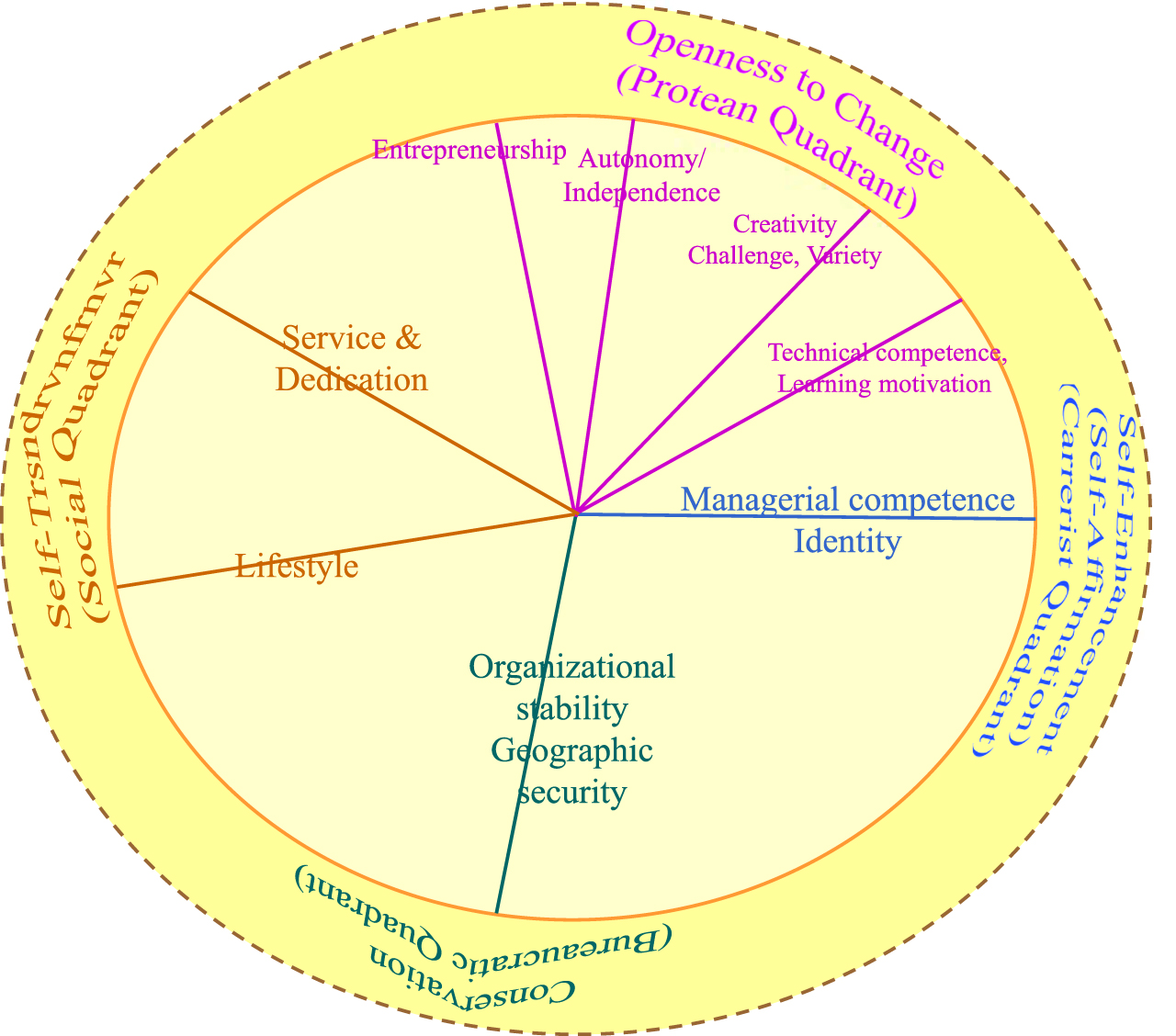
Circumplex Model for Structuring Career Anchor of ITP.
The Circumplex Career Anchor Model (CCAM) of Wils et al. [1] for ITP
This study finds that the dominated (desired) career anchors of the ITP have a different result from that of Wils et al. [1], and discusses these phenomena in the following sections:
Bureaucratic quadrant and protean quadrant for ITP are compatible
Although Wils et al. [1] believed that the bureaucratic quadrant is opposed to the protean quadrant, but in our cases, there are six ITP that noted five situations’ anchors that complemented each other: (1) organizational stability and learning motivation; (2) Organizational stability, challenge, and autonomy; (3) Organizational stability, and autonomy; (4) Organizational stability, and challenge; (5) Geographic security, technical competence, learning motivation, autonomy, and challenge. In fact, the former two subjects’ anchors (Case#2 and Case#8) complement each other due to the fact that they can learn more in a stable organization. Meanwhile, there are four subjects’ (Case#8, Case#10, Case#11, Case#12) anchors that complement each other because of the organizational guarantee to achieve their desired goal. In addition, the job of Case#10 also can provide her technical competence, learning motivation anchors, and be near her home (geographic security) at the same time; and the current job of Case#16 not only can provide his autonomy, challenge anchors, but is also near his home too (geographic security). They stated that: Case#8 (20∼30 & 30∼40): The most important criteria is to search for a job in a big company (identity). Because it is more stable (organizational stability), and I will have the chance to learn more (learning motivation) in a very short period of time. Case#8 (over 40): The company is very stable (organizational stability), I can do my job with more autonomy, provide good management for it (managerial competence), and of course, all are my challenge when necessary. Case#10 (20∼30): I always expect to work for a company which is very close to my home (geographic security). Fortunately, I can easily pick up and learn new IT knowledge (technical competence, learning motivation). Case#10 (over 40): If my company is stable (organizational stability), then it can provide me with a high level of autonomy, then my lifestyle will be better. Case#11 (over 40): My current company is a stable organization (organizational stability) it guarantees me a certain autonomy to achieve my job, meanwhile, I can also take care of my family too (lifestyle). Case#12 (over 40): Now, I prefer to work in a stable organization (organizational stability), and hope my job can achieve the goal which takes care of both my physical and spirit (lifestyle). Meanwhile, I need to have diverse challenge in different career stages. Case#16 (over 40): Accordingly, GOG provides me with a very high level of autonomy, to take a challenge all the time. In addition, my wife expects I should stay here for my family, so I will consider the job location (geographic security).
In light of above findings of this study, the career anchors associated with the bureaucratic quadrant can complement the career anchors associated with the protean quadrant for the ITP; therefore, this study refutes P1 - 1, and revised it to P1 - 1new. For the ITP, the career anchors associated with the bureaucratic quadrant are not in opposition to the career anchors associated with the protean quadrant
Careerist quadrant and social quadrant for ITP are compatible
Although Wils et al. [1] found that the careerist quadrant was opposed to the social quadrant, but seven ITP of this study described that managerial competence can help them to increase their service ability (Case#2, Case#4, Case#5, Case#12, Case#13, Case#14, Case#16). These two anchors, indeed, complement each other; due to the higher management position (managerial competence) that can help subordinates and clients (service) much more than before. In addition, the managerial competence of Case#12 not only can he satisfy and help subordinates and clients (service), but also can achieve his family and job balance (lifestyle). They noted that: Case#2 (30∼40): I believed that a government should improve the service quality as well as the manufactory industry, and then suggest a better management idea (managerial competence) into the government. Case#4 (over 40): In the beginning I worked for DG, and I focused on IT (technical competence). Now, managerial competence is the most important anchor for me, because it can increase the ability to help others (service). Therefore, the anchors provided by the company will not conflict with but will complement each other. Case#5 (30∼40): For subordinates, my management ability can enhance their aptitude, and increase their confidence (managerial competence). For clients, I can help them perform their job with more efficiency and effectiveness (service). My critical anchors will not conflict with each other. Case#13 (30∼40 & over 40): The most important issue for a CEO is to resolve problems (managerial competence), and I can provide useful IS to clients. Because this is my interest and favorite thing, and I enjoy it (service). Case#14 (over 40): I will try my best to help my subordinates (service), as it is the responsibility of a manager (managerial competence); I only need to help them from the sidelines, as I enjoy solving problems for them (service).
For the above analysis, the career anchors associated with the careerist quadrant can complement the career anchors associated with the social quadrant for the ITP; then, this study refutes P1 - 2, and revised it to P1 - 2new. For the ITP, the career anchors associated with the careerist quadrant is not in opposition to the career anchors associated with the social quadrant
Conflict each other between four quadrants of ITP
There are four phenomena of ITP, indeed, that exhibit some quadrants have a conflict with each other, and against the study of Wils et al. [1], thus, it is in need of clarity: Although Wils et al. [1] believed that the careerist quadrant is not opposed to the protean quadrant, but one subject asserted that managerial competence can impede ITP to pursue a challenge (Case#12). Meanwhile, managerial competence can inhibit autonomy when being a young manager, but these two anchors will complement each other after becoming a senior manager (Case#2). Case#12 (over 40): Managerial competence and challenge sometimes will conflict with each other due to management emphasizing their performance, goal, and effectiveness; but challenge sometimes will be a self-casual action, and it will impede the performance of the organizational goal. Case#2 (30∼40 vs. over 40): Because, as a manager (managerial competence), the autonomy of the work is restricted by various laws and regulations. However, the conflict anchors of managerial competence and autonomy complemented each other after I made every effort to overcome my difficulties. The above results exhibit that if an ITP emphasizes the managerial competence anchor, they will not have enough time to pursue challenge and have to sacrifice this anchor. Meanwhile, the power of a younger ITP manager is relatively smaller than the senior manager, therefore, the autonomy of a younger manager will be limited by the senior manager. Although Wils et al. [1] found that the social quadrant is not opposed to the protean quadrant, but Case#15 asserted that lifestyle will be influenced by pursuing the state-of-the-art IT knowledge (technical competence, learning motivation). Case#15 (over 40): I am still able to manage my own IT expertise brand and the company’s job very cautiously. Therefore, technical competence, and learning motivation will be in conflict with lifestyle. Because an ITP emphasizes the lifestyle anchor, the time for pursuing the new IT knowledge will decrease; therefore, their technical competence, and learning motivation anchors will be influenced because they pursue the lifestyle anchor at the same time. Although Wils et al. [1] asserted that the social quadrant is not opposed to the careerist quadrant, but Case#3 asserted that the responsibility of a manager (managerial competence) will absolutely influence his lifestyle. Case#3 (30∼40): Of course, if the company provides me with a higher and executive position (managerial competence), then my lifestyle will be influenced at the same time. Due to the responsibility of an ITP manager (managerial competence) who has to take care of the whole organizational IT, then their lifestyle anchor will be influenced; thus, these two anchors, indeed, will be in conflict with each other. Although Wils et al. [1] believed that the social quadrant is not opposed to the bureaucratic quadrant, but Case#1 asserted that with a workplace close to home (geographic security), she has to sacrifice her lifestyle. Case#1 (30∼40): A work place close to home is very important to me (geographic security), therefore, I can spend time with my family (lifestyle). Because the IT jobs are always located in some technology areas (geographic security); therefore, the ITPs have to time spent time with their family (lifestyle).
For the above analysis, the career anchors associated with protean, careerist, social, and bureaucratic quadrants can conflict with each other, or complement and conflict at different ages of the ITP; then, this study proposes a new proposition P1 - 3new. The career anchors associated with protean, careerist, social, and bureaucratic quadrants need to be appropriate and aggregated for the ITP
In sum, the result of this study exhibits that: firstly, career anchors belong to the bureaucratic quadrant and the protean quadrant is not in opposition to each other and not negatively correlated; secondly, the career anchors belong to the careerist quadrant and the social quadrant is not in opposition to each other and not negatively correlated neither. Therefore, the circumplex model of Wils et al. [1] is not appropriate for the ITP in the current study.
Thirdly, Career anchors associated with the careerist quadrant and the protean quadrant could be complementary and conflict in the different ages of the ITP; in the other three situations, career anchors associated with the: (A) social quadrant and the protean quadrant; (B) the social quadrant and the careerist quadrant; (C) the social quadrant and the bureaucratic quadrant –will also conflict with each other for some of the ITP.
Career anchors and job/career satisfaction
Although job satisfaction and career satisfaction have different meaning for some occupations [14, 49]; however, the cases of this study did not mention job and career satisfaction have different meaning for them. Both Case#9 and Case#13 have created their own business, thus, they believed their job/career satisfaction will be unlimited if their career anchors will be satisfied and sustained in the future. For instance, Case#9 enjoyed taking responsibility and had the highest job/career satisfaction. According to the DDGo that was created by Case#9, it is a realization of his idea and dream, and he didn’t feel tired at all. Case#13 was glad to resolve the technical problems, and his company can therefore satisfy his desired career anchors. For this reason, although both Case#9 and Case#13 are quite busy, because they have been pursuing their challenge for a long time (career satisfaction), this implied that the anchor will increase the job/career satisfaction, as emphasized: Case#9 (over 40): Accordingly, there are many challenges in the future, thus, my satisfaction will be unlimited. Meanwhile, entrepreneurship, challenge and variety, together these three anchors can build my Business Model, as all of them are necessary, and it will also increase my job satisfaction. Case#13 (over 40): My company can provide me with the desired career anchors to solve any related technical problems, and challenges (technical competence, challenge), so my job satisfaction will increase to an unlimited level.
For Case#1, her company is very stable, although lifestyle is a very important anchor for her, however, if the company can provide her with a challenge, then her family life (lifestyle) will be influenced. In light of this, the job/career satisfaction will decrease, as indicated: Case#1: If the job has a too higher level challenge, then it will influence my family life (lifestyle). Due to this lifestyle being desired, but challenge is not what I wanted; thus, my job satisfaction will be decreased.
In sum, when the organization provides the career anchors for the ITP, there are two results: (1) if the career anchors are desired by the ITP, and these anchors complement each other (such as: Case#9, Case#13); thus, they can both achieve their job/career satisfaction; (2) if the career anchors are not desired by ITP, and in conflict with their desired anchors (such as: Case#1); then it will decrease their job/career satisfaction. According to the above analysis, this study refutes P2 - 1, P2 - 2 and revised it to P2new. Providing career anchors is desired by ITP and if the dominant anchors complement each other, they will increase their job/career satisfaction; otherwise, their job/career satisfaction will be decreased
In light of above result, this study summarizes the two propositions (four sub-propositions), and provides a Reorganized Quadrant Anchors Framework of ITP (see Fig. 4).

New Proposition Development of ITP.
For academy
Because past studies (Bristow [17], Chapman [18], Feldman & Bolino [19], Schein [20]; Wils et al. [1, 21]) have collected data from Canada, Norwegian, the US etc., and they did not collect data from Taiwan, and the subjects of these studies did not focus on ITP. Therefore, the finding of this study is not consistent with past studies in country settings.
In light of above reason, this study used the qualitative research methodology to interview 16 ITP and found the result, indeed, different from the data of Wils et al. [21], and Wils et al. [1]. Therefore, the propositions P1 - 1, and P1 - 2 from Wils et al. [1] that are not appropriate to the ITP, and this study revised them and confirmed the propositions of P1 - 1new (the career anchors associated with the bureaucratic quadrant is not in opposition to the career anchors associated with the protean quadrant), and P1 - 2new (the career anchors associated with the careerist quadrant is not in opposition to the career anchors associated with the social quadrant). Meanwhile, this study also provides a new proposition P1 - 3new (the career anchors associated with protean, careerist, social, and bureaucratic quadrants need to be appropriate and aggregated for the ITP). In light of this, this study has found that the circumplex career anchor model of Wils et al. [1] is not appropriate for ITP; and the result has resolved the first research question too. At the same time, the current study also provides an appropriate circumplex career anchor model for ITP.
Moreover, for the ITP, the organization should provide their desired career anchors and these anchors are complementary to each other, thus, their job/career satisfaction will be increased (P2new). Unfortunately, the above findings have not been proposed by any research before, thus, the result can provide scholars to research other occupations in the future. Therefore, this finding is the circumplex career anchor model of Wils et al. [1] uncovered. Meanwhile, the reorganized quadrant anchors framework of ITP has added job/career satisfaction (see Fig. 4). This framework is not only appropriate to ITP, but also has added job/career satisfaction into this framework, and extend it; thus, job/career satisfaction will, in turn, influence the retention or turnover of ITP; and the result has resolved the second research question of this study.
In light of the aforementioned results of the current study, we believe that although the qualitative data of this study can provide the reasons for each result, and management can adopt it to their organization. Meanwhile, this study has explored the different results with Wils et al. [1], and it should mention that scholars and experts in different professional fields could have a different aggregated way of career anchors. Thus, this study provides a correct and valuable direction for future study, and both academic and practice can refer to it.
For practice
To easily retain the valuable ITP and to satisfy their dominant (desired) career anchors, organizations should provide the appropriate approach to aggregate these anchors and fit their demands dependent on the job characteristics of the ITP (e.g., pursue a state-of-the-art IT ability, take challenge, help others etc.). Organizations should also provide career anchors that not only are desired by ITP, but also are complementary anchors for the ITP instead of opposite anchors for increasing their job/career satisfaction.
The result has provided a direction to organizations to retain valuable ITP, such as: both of the managerial competence and the service anchors that are complementary of each other due to the former being able to increase the latter’s capability of the ITP; a stable organization (organizational stability) can also make the ITP take challenges more easily (challenge), and has a chance to learn more (learning motivation); and as pursuing technical competence, learning motivation anchors is the basic ability to an ITP, it should not be in conflict with their expectations to work near home (geographic security) at the same time.
Conclusion
This research entails both theoretical and practical implications for career anchor research, and provides a reorganized quadrant anchors framework of ITP, which includes:
Footnotes
Acknowledgments
The author would like to thank the National Science Council of the Republic of China for its financial support of this study (NSC96-2416-H-251-006; MOST103-2410-H-153-024-MY2; MOST106-2410-H-153-005-).
Appendix
The definition of career anchors: Technical Competence: focus on the exercise of technical expertise. Managerial Competence: pursuit of higher managerial level and greater responsibility. Autonomy: the individual is free from organizational constraints and control. Organizational Stability: seeking loyalty, and tenure security. Challenge: preference for conquering difficult tasks or problems. Lifestyle: integration of individual, family, and career. Identity: strong desire for status and prestige pertaining to specific organizations. Creativity: the building of self-affirmation through creation. Variety: desire to work on a number of different tasks. Service: dedication to helping and contributing others. Entrepreneurship: establishing a new business and/or a new product independently of others. Geographical Security: linking to a particular area on a long-term basis. Learning Motivation: an incentive which motivates an individual to achieve a specific goal, to satisfy one’s knowledge growth, and initiate the learning behavior.