



Abstract
OBJECTIVE:
Turnover of IT professionals has become a pressing problem for the management of Banks. To date, limited research has examined the role of human resource management practices (HRMP), person-organisation fit (POF), and person-job fit (PJF) in retaining IT professionals. This study provides an empirical analysis of the direct and indirect effect of HRMP on IT professionals’ turnover intention through POF and PJF.
METHODS:
The quantitative data collected from 292 IT professionals were analysed through PLS-SEM.
RESULTS:
The findings revealed a negative and significant relationship between HRMP and employees’ turnover intention. It was further revealed that HRMP relates positively to POF fit and PJF, whereas POF and PJF relate negatively to employees’ turnover intention. Moreover, the findings revealed that POF and PJF explain the intervening mechanism (mediation) between HRMP and turnover intention.
CONCLUSIONS:
This study shows that IT professionals’ turnover intention is affected by their perceptions of HRMP, POF, and PJF. The study has further extended our understanding of the mediating mechanism involved between HRMP and turnover intention. This study suggests that organisations need to implement HRMP that not only enhances IT professionals’ knowledge, skills, and abilities but also strengthens their congruence with the values and goals of the organisations.
Keywords



Introduction
Employees’ perceptions of human resource management practices (HRMP) have been an essential aspect of the employment relationship in the management literature, as employees’ positive perceptions of HRMP are linked to several organisational outcomes such as organisational commitment, person-organisation fit [1], and job satisfaction [2]. While on the other hand, employees’ negative perception of HRMP results in emotional exhaustion, burnout [3, 4], absenteeism [5] and turnover intention [6]. However, several scholars have criticised that a missing piece in this stream of research is the process or the mechanism through which HRMP are linked to organisational outcomes [7, 8]. Thus, further research on the underlying psychological mechanisms that link Information Technology (IT) professionals’ perceptions of HRM practices to work outcomes (i.e., IT professionals’ turnover intention) is needed. This is because IT professionals are knowledgable and skilled workers and their stay with the organisation is critical for the success of the organisation [9]. However, with the growing managerial and technological challenges, IT professionals’ mobility within companies and their turnover is on the rise [10]. The turnover of such knowledgeable and skilled workers not only raises the cost of attracting, recruiting, and training new employees, but also results in knowledge drain, deteriorated client relationships and a decline in companies’ competitive edge [10, 11]. Thus, during this time of “war for talent” among IT companies, the implementation of sound HRM practices is critical for the organisation [10]. This study aims to examine the effect of IT professionals’ perceptions of HRMP on their turnover intention through two additional mechanisms: (1) person-organisation fit (POF; i.e, fit between person and organisation), and (2) person-job fit (PJF; fit between person and job).
To gain a clear understanding of the proposed mechanism involved between HRMP and turnover intention, we draw upon Blau’s [12] Social Exchange Theory (SET) and seek to add to HRM and fit literature in two ways. Our first contribution is to explore the mediating role of POF and PJF as a causal chain in linking HRMP to turnover intention. While a stream of research has looked inside this mechanism by identifying numerous constructs that may explain the mediation between HRMP and organisational outcomes. For example, trust in organisation [13], organisation commitment [1], organisation citizenship behaviour [14], and job satisfaction [5] have been found to mediate the impact of HRMP on turnover intention. However, the findings of these studies are limited because their results are built on actual HRMP implemented by the organisation. However, research shows that it is not actual HRMP that matters in HRM-organisational outcomes linkage, but rather how employees perceive those practices [3, 15]. Besides, Farndale and Jiang [16, 17] provide empirical support that employees’ perception of HRMP is the proximal predictor of their attitudes and behaviours. Hence, following the preceding theoretical arguments and consistent with the recent call made by Jiang et al. [17]; this article adds to the body of knowledge by exploring the mediating role of POF and PJF in the relations between perceived HRMP and turnover intention.
Furthermore, the current understanding of the nature, causes, and outcomes of HRMP, PJF and POF is largely based on research carried out in western countries. Since employees’ perceptions of HRMP and fit may be affected by organisational, individual, and societal factors [16, 18]; therefore, the findings of these studies are subject to generalizability limitations. For example, in a culture characterised by uncertainty avoidance, in-group collectivism, high power distance, and performance-oriented cultures, the effect of HRMP on employees’ attitudes were stronger than a culture low on these dimensions [16]. Therefore, this research is designed to further explore the linkage between perceived HRMP, POF, PJF, and turnover intention in a different context of Pakistan and among the Information Technology professionals working in banking sectors of Pakistan.
In doing so, this study extends HRM literature, fit literature, and turnover literature by investigating the missing linkages among these constructs. The research further aims to investigate whether POF and PJF explain the mechanism (mediation) through which HRMP are related to turnover intention. Besides, this study, to our understanding, is the first of its kind that investigates the combined effect of HRMP, POF, and PJF on IT professionals’ turnover intention.
Literature review
Perceived HRMP and employees’ turnover intention
For the last few decades, a burgeoning body of research in HRM literature has established the relationships between HRMP and turnover intention, and a particular emphasis among this literature is on the concept of perceived HRMP. Perceived HRMP refer to the employees’ subjective evaluations, interpretation, and experience of HRMP implemented by the organisation. Implemented HRMP are intended HRMP that are formulated by HR professionals for the attainment of individual and organisational goals. According to Nishii and Bowen [15, 18], employees evaluate, perceive, and react to HRMP differently. Hence, it is more likely that the desired influence of intended HRMP on work outcomes may depend upon employees’ positive or negative evaluation (perceptions) of HRMP. For example, if an organisation conduct training on information technology to increase the technical skills of the employees and employees perceive that such training will increase their work responsibilities (negative perceptions) only. In this case, the intended training is not likely to attain the desired outcomes because of the negative perceptions of the employees. Thus, understanding employees’ perceptions regarding HRMP is vital for the achievement of organisational goals. Prior scholarly works have shown that employees’ positive perceptions of HRMP result in numerous work outcomes such as job satisfaction, person-job fit [6, 16], and turnover intention [19].
Turnover intention is one of the most researched attitudes, which represents an individual subjective probability of leaving the job. According to Koslowsky et al. [20], the turnover intention is the last stage of the withdrawal cognition and a significant antecedent of actual turnover [21]. Besides, it is a subjective concept that can be measured easily, while actual turnover is the actual resignation of an employee from the job that can not be measured subjectively. Therefore, scholars have primarily focused on examining employees’ intentions rather than their actual turnover. Thus, in the present study, the focus is on turnover intention.
One of the main problems for HR professionals and IT institutions in Pakistan is the turnover of their employees. The reasons attributed to the turnover of IT professional is lack of training and development opportunities, workplace bullying, inequality in pay [22, 23], employees’ morale [24] and long working hours [25]. Research in non-IT organisations also shows that employees’ perception of HRMP negatively relates to their turnover intention. These studies built their argument on the theory of social exchange [26]. This theory posits that when employees perceive that they are getting some benefits from an entity, then, in the norms of reciprocity, they are likely to reciprocate the benefits they receive from the organisation with work outcomes that are beneficial for the organisation, such as reducing their turnover intention. Following this, we hypothesize that:
H1: IT Professionals’ perceptions of HRMP relate negatively to their turnover intention.
HRMP, person-organsiation fit, person-job fit
The fit of a person with an organisation, commonly termed as POF, is conceptualised as the congruence of employees’ values and goals with the values and goals of the organisation [19]; while PJF refers to the congruence of an individual’s needs and preferences with job demands and resources [27]. Prior research has shown that the fit of the employees with the organisation and job is associated with desirable outcomes, such as organisation commitment (OC), JS, and organisational citizenship behaviour (OCB); while misfit between person, organisation, and job results in stress and turnover intention [28–31].
Given the indispensable importance of fit, prior research has identified several factors that enhance the fit of a person with the organisation and job respectively. These factors include the selection and socialisation process [32, 33], high-performance work practices [1], work-life balance practices [25] and vocational interest [34]. These scholarly works suggest that fit is not a static concept, rather it is a dynamic process that can be changed through organisational practices. Following this, we presume that IT professionals’ perceptions of HRMP is one of the significant factors that may induce POF and PJF.
A possible explanation for the positive impact of IT professionals’ perceptions of HRMP on POF and PJF lies in the tenet of social exchange theory proposed by Blau [12]. This theory posits that the employment relationship between employee and employer depends on the norms of social and martial exchanges. The theory explains that as long as parties privy to the relationship (employee and employer) are mutually satisfied with exchanges, the relationship will continue. In an employment relationship, HRMP such as pay, benefits, performance appraisal, job security, parental leave, training and development programs, and compensation reflect the investment that an organisation makes in its employees. These HRMPs also reflect the expected behaviours that organisations seek of their employees. Hence, in the norm of reciprocity, it is expected that employees are likely to reciprocate organisations’ investment in HRMP with positive work behaviours and attitudes [26, 36], such as exhibiting fit with the organisation and job characteristics.
Previous scholarly research has also shown that employees’ perceptions of HRMP are important mechanisms through which their fit with the organisation and job can be improved. For instance, these studies suggest that employees’ knowledge, skills, and competencies are enhanced and their needs are fulfilled with the provision of HRMP [1, 37]. Besides, with positive perceptions of HRMP, employees are more likely to have a clear view of the organisation’s norms and values [38]. Employees’ positive perception of HRMP is also found to have significant effects on POF, affective commitment [1], OCB [14], and their wellbeing. Following this, we propose that:
H2: The relationship between employees’ perception of HRMP and person-organisation fit is positive.
H3: The relationship between employees’ perception of HRMP and person-job fit is positive.
Person-organisation and turnover intention
The congruence between employees’ characteristics and organisation’s characteristics is called person-organisation fit [29]. The fit between person and organisation could be supplementary or complementary [39]. The former fit is attained when the attributes of the person and organisation are identical [40, 41], while the later fit is achieved when “individual and environment each provides what each other needs” [41]. In other words, complementary fit occurs when an organisation fulfils the need and desires of the employees, and employees compensate the organisation with the required knowledge, skills, and abilities [42].
The scholars agree that POF has significant implications for individual behaviour and attitude. For example, among employees working in the USA and Japan, POF was found to be associated with affective commitment [43]. POF is also related to employees’ OCB, JS [44], need-supply fit, demand-ability fit [45], and intention to stay [46]. In contrast, when employees feel incompatible with the organisation, they are more likely to think of leaving the job or profession [29, 46]. In sum, the literature suggests that POF is an essential antecedent of employees’ turnover intention. Thus, by further exploring the relationship of POF with turnover intention in Pakistani organisations, this study proposes that:
H4: The relationship between POF and employees’ turnover intention is negative.
Person-job fit and turnover intention
According to Vogel and Feldman [40], PJF is achieved when employees’ attributes are identical to the attributes of the job. PJF consist of two dimensions, namely demands-abilities fit (DAF) and need-supplies fit (NSF) [44]. DAF refers to the congruence of individual ability, knowledge, skills, and competencies with the job demands [40], while NSF is the fit of an individual’s needs, desires, or preferences with the job supply and resources [47]. Thus, a high PJF implies that individual needs and preferences are met by the job supply and the job’s requirements are met by individuals’ abilities, knowledge, and skills.
Prior research and theories suggest that when employees’ characteristics match those of the job, positive outcomes, such as work adjustment, OCB, and JS, can be attained [40, 48]. In contrast, when employees’ characteristics are not incongruent with those of the job, they are more likely to experience stress and develop an intention to leave the job [27, 49]. Indeed, previous studies substantiate the significant linkage between PJF and turnover intention, yet, most of the prior studies were carried out in non-IT work settings and Western countries. Thus, to further explore such a relationship in IT and Pakistan’s context, we propose the following:
H5: The relationship between PJF and turnover intention is negative.
The mediating role of POF and PJF
As mentioned above, the relationship of HRMP with POF and PJF (H1 and H2) is positive, and, in return, POF and PJF (H3 and H4) have a negative relationship with turnover intention. Hence, considering the logical flow of the proposed relationship, there exists a likelihood that POF and PJF may explain the mechanism (mediation) between HRMP and turnover intention. The theory of social exchange provides a theoretical foundation for explaining the mediating role of POF and PJF in the relationship between HRMP and turnover intention. This theory posits that employees give great importance to being cared for and valued by their organisations. When employees believe that their organisations are caring and supportive, then, in the norm of reciprocity, they show positive work behaviour. Several HRMPs, such as performance evaluation, pay, training, and development opportunities, are indicative of the organisation’s care and value for its employees. Thus, the employees’ positive perception of HRMP implies that these practices are formulated for their care and wellbeing. From the social exchange perspective, when employees believe that they are being cared for and valued by their organisations, this will engender an obligation among employees to respond to the good conduct of the organisation with positive work outcomes. For instance, research shows that employees feel more compatible with the organisation [1], job [50] and lower their turnover intention [27] when their belief about HRMP is positive. In simple words, employees’ positive perception of HRMP positively influences POF and PJF, and POF and PJF, in turn, negatively influence their intention to quit. Thus, we expect that POF and PJF are the mediating variables between HRMP and turnover intention.
H6: The relationship between HRMP and turn-over intention is mediated by POF.
H7: The relationship between HRMP and turn-over intention is mediated by PJF
Methodology
The target population of the study were IT professionals working in private Banks in Baluchistan, Pakistan. The researcher collected data from the respondents through a self-administered survey using convenience, a non-probability sampling. The survey contained 28 questions (i.e., 25 were related to variables of the study and three questions were asked about their age, gender, and designations) and a set of instructions. The surveys were distributed to 450 employees within the Banks from July 2021 to February 2022. In total, 321 surveys were returned (71% response rate). Of the 321 participants who completed the survey, 28 cases had missing values and suspicious responses. These cases were deleted from the study. Thus the remaining 292 cases were the final data which were subsequently used for analysis. Of the 292 participants, 39.2% were female and 60.8% were male. The study also included Managers (IT) 77.2%, Assistant Managers Network, Security, and Web Developer (12.8%), and Branch Managers (10%).
Instruments
All instruments were measured on a five-point Likert scale ranging from 1 (“strongly disagree”) to 5 (“strongly agree”). Alfes et al. [51] 8-items scale was used for the measurement of HRMP. An example item is “I receive the training I need to do my job”. For the measurement of POF, a 6-items scale was adopted from Vogel and Feldman [40]. An item of the measure is “The things that I value in life are very similar to the things that my organisation values”. Likewise, PJF was measured with a 6-items scale developed by Cable and DeRue [52]. An example item is “There is a good fit between what my job offers me and what I am looking for in a job”. Finally, items for the measurement of turnover intention were adopted from Cennamo and Gardner [53]. The sample item is “I have thought seriously about changing organisations since beginning to workhere”.
Data analysis
Descriptive analysis
The descriptive statistics such as mean, standard deviation, and correlations are presented in Table 1. The results show that HRMP, POF, and PJF are correlated negatively with turnover intention. Further, the correlation of HRMP with POF and PJF was positive and significant.
Descriptive analysis
Descriptive analysis
Note: N = 292 individuals; POF = Person-organisation fit; PJF =Person-job fit; **p < 0.01.
Items and constructs reliability and validity
For the present study, Partial Least Squares Structural Equation Modelling (PLS-SEM) was used for the assessment of the measurement and structural model. Since the objective of the study is to explain variance in turnover intention, therefore, PLS-SEM was appropriate for this study. In the analysis of the model, we first estimated the constructs and items’ reliability and validity. The reliability of the items were tested using factor loadings (FLs), while constructs reliability were estimated through Composite Reliability (CR) and Cronbach’s Alpha (CA). According to Bryne [54], items are reliable if the values of FLs are greater than 0.60. Likewise, constructs with CR and CA higher than 0.70 are considered reliable. To obtain the values of FLs, CA and CR, we used PLS algorithm through SmartPLS software. The results presented in Table 2 indicate that all the measures of internal consistency (factor loading, CA and CR) exceeded their minimum thresholds, thus demonstrating sufficient reliability for items and constructs, respectively.
Measurement model results
Measurement model results
Note: AVE = Average variance extracted; FLs = Factor Loadings.
The validities of constructs such as convergent and discriminate validity were also measured. The former refers to the degree to which the measures of a construct are in agreement or share a large proportion of variance in the underlying constructs. The most commonly used metric for the measurement of convergent validity is Average Variance Extracted (AVE) (see Table 2). According to Hair et al. [55], the convergent validity of a construct is accepted if the AVE is equal to 0.50 or higher. The findings showed that all the AVE exceeded the 0.50 threshold, thus providing evidence of convergent validity.
Discriminate validity, which reflects the uniqueness of a construct by empirical standards from other constructs of the same model, was evaluated through Fornell and Larcker [56] criteria and Heterotrait-Monotrait ratio (HTMT). Fornell-Larcker criteria indicate that inter-constructs correlations should be less than the square root of AVE of each construct. The results of the study show that inter-construct correlations is less than each construct square root of AVE (Table 3). Furthermore, we also used HTMT recommended by Henseler et al. [57] to examine the discriminant validity. HTMT is the “average of the hetero-trait-heteromethod correlations (i.e., the correlations of indicators across constructs measuring different phenomena), relative to the average of the monotrait-heteromethod correlations (i.e., the correlations of indicators within the same construct”) (p. 122). For discriminate validity to be established, the HTMT should be less than 0.90. The results shown in Table 4 of the study indicate that all the HTMT values are less than 0.90 threshold. Thus, based on AVE and HTMT, we concluded that discriminant validity is not an issue.
Fornell-Larcker criteria
Note: HRMP = Human resource management practices; POF =Person organisation fit; PJF = Person job fit; TI = Turnover intention.
Heterotrait-Monotarit method correlations
Note: HRMP = Human resource management practices; POF =Person organisation fit; PJF = Person job fit; TI = Turnover intention.
After confirming that all variables of the study are reliable and valid, the next step in the PLS-SEM analysis was assessing the structural model. The structural model shows the hypothesised relationship among study variables and the measures of the structural model are: estimating the values of coefficient of determination (R2), model predictive relevance through blindfolding redundancy Q2 and estimating the significance of the path coefficients. R2 shows the explanatory power of the model. A value of R2 greater than 0.10 indicates that the model has sufficient explanatory power [58]. In this study, the R2 values were obtained through the PLS algorithm and the results showed that 40% variance is exaplined in turnover intention and 42.9% in PJF, and 46% variance in POF. Further, we estimated the model’s predictive relevance through the blindfolding procedure. A model is said to have predictive relevance if the Q2 values are greater than zero. The results of our study also provided support for the predictive relevance of the model and found that values of Q2 for endogenous construct were larger thanzero.
Hypotheses testing
Direct relations among constructs
Hypotheses of the study were tested through bootstrapping procedure using 5,000 subsamples in SmartPLS software. The results presented in Table 5 and Fig. 1 of the study revealed that HRMP had a negative and significant influence on turnover intention, thus providing support for H1 (β= –0.165, t = 2.119, p < 0.05). Besides, the study also found a positive and significant relationship of HRMP with POF (β= 0.580, t = 14.055, p < 0.05) and PJF (β= 0.588, t = 14.970, p < 0.05). Thus, H2 and H3 are supported. Furthermore, a significant negative relationship was also observed between POF and turnover intention (β= –0.212, t = 2.814, p < 0.05) and between PJF and turnover intention (β= –0.268, t = 3.291, p < 0.05). Therefore, H4 and H5 were supported.
Structural model results
Structural model results
Note: HRMP = Human resource management practices; POF =Person organisation fit; PJF = Person job fit; TI = Turnover intention.
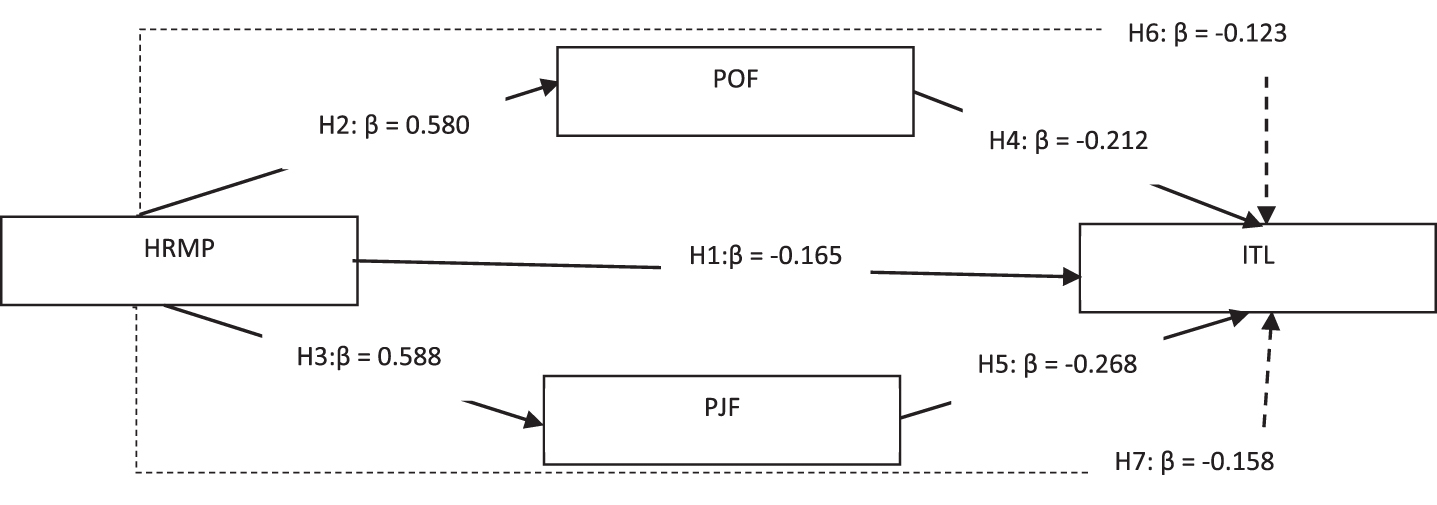
Conceptual model. Note: HRMP = Human resource management practices; POF = Person organisation fit; PJF = Person job fit; TI = Turnover intention.
For the assessment of the indirect path coefficient between HRMP and turnover intention through POF and PJF, we used Preacher and Hayes [59] approach. The findings shown in Table 5 and Fig. 1 revealed that perceived HRMP had an indirect effect on turnover intention via POF (β= –0.123, t = 2.727, p < 0.05, LL: –0.235, UL: –0.042). Moreover, the results β= –0.158, t = 3.061, p < 0.05, LL: –0.251, UL: –0.054 also indicate that PJF mediated the relations between HRMP and turnover intention. Thus, H6 and H7 were accepted.
Discussion
Drawing upon SET, this study aimed to examine the mechanism through which IT professionals’ perceptions of HRMP are related to their willingness or intent to leave the job. With regards to the direct effects, the findings showed that the effects of perceived HRMP on turnover intention were negative and significant. This finding is consistent with other studies such as Kooij and Kakar [1, 19], who found that employees’ positive perception of HRMP reduces their intention to quit the job. Besides, the findings of this study also substantiate that employees’ perceptions of HRMP are linked with POF and PJF. These findings are also in agreement with previous studies that found that HRMP increases employees’ perception of fit with the organisation and job [1, 6]. Moreover, in previous literature, perceived HRMP have also emerged as an important antecedent of workplace outcomes, particularly intention to leave, organisation commitment, POF, PJF, and performance [4, 50]. This study also substantiates the basic assumption of a social exchange theory that employees reciprocate with positive work outcomes if employees perceive that the organisation is investing in them through organisational practices.
With regard to the indirect effect, the results showed that POF and PJF explain the mechanism (mediation) between perceived HRMP and turnover intention. Although previous studies endorse the indirect effect of HRMP on turnover intention through other variables such as job satisfaction and organisation commitment, however, an empirical test of how HRMP are indirectly through POF and PJF linked to IT professional turnover intention is limited, especially in Pakistan’s context. The present study adds to HRMP by examining the relationships among perceived HRMP, POF, PJF, and turnover intention in Pakistan’s context. Consistent with the work of Uppal and Boon [6, 50], our study found that perceived HRMP are indirectly linked to turnover intention via POF and PJF. These results imply that when employees perceive HRMP positively, they are more likely to understand the organisation’s values and goals. Accordingly, employees’ perception of fit with the organisation is likely to enhance the bond of the employees with the organisation, thereby lowering their turnover intention.
Our study further contributes to HRM literature by analysing the mediating impact of PJF on the relation between perceived HRMP and turnover intention. This finding suggests that the outcomes of HRMP such as reducing turnover intention is achieved through the intervening mechanism of PJF. In other words, the results revealed that PJF explains the underlying mechanism between perceived HRMP and intention to quit the job. These findings concur with the findings of Kooij and Uppal [1, 6] that IT professionals’ positive perceptions of HRMP enhance their congruence with the job characteristics, which, in turn, discourage their turnover intention.
Implications
The theoretical and practical implications of this research are that employees’ perception of POF and PJF plays an essential role in determining the effectiveness of HRMP. These results indicate that the organisation needs to be aware that a mere provisions’ of HRMP will not result in lowering turnover intention; rather organisation needs to enhance the compatibility of a person’s attributes with the demands and resources of the job, and the organisation’s values and goals. An organisation can enhance the fit of a person with the job and organisation through better hiring practices [33], training, remuneration [60], and provision of high involvement practices [4]. In simple words, the study findings suggest that IT professionals will feel compatible with the job and organisation if they are provided effective training, development opportunities, competitive pay, and fair performance appraisal.
Limitations
Although this study contributes significantly to the literature and theory, but the findings may be interpreted with caution considering the limitations of the study. First, this study is cross-sectional and the data was collected at a particular point in time. Therefore, the causality among variables of the study can’t be established. To overcome this limitation, future scholars may test the same model with longitudinal data. Besides, the respondents of the study are IT professionals working in Banks, therefore, the possibility of common method bias is high. Future scholars may test the same model with data collected from diverse groups of employees. Furthermore, the respondents of the study were from Pakistan therefore, contextual factors of a country such as its culture, norms, and values and external factors including the availability of job opportunities may be considered by future researchers. In other words, future researchers are encouraged to examine the same model with moderating variables such as job opportunities and organisational culture.
Footnotes
Acknowledgments
The authors have no acknowledgments.
Author contributions
CONCEPTION: Abdul Samad Kakar
METHODOLOGY: Abdul Samad Kakar
DATA COLLECTION: Nida Muhammad Khan
INTERPRETATION OR ANALYSIS OF DATA: Abdul Samad Kakar
PREPARATION OF THE MANUSCRIPT: Abdul Samad Kakar and Nida Muhammad Khan
REVISION FOR IMPORTANT INTELLECTUAL CONTENT: Aftab Haider