




Abstract
BACKGROUND:
The process of involving sustainability in the Human Resources (HR) area, which is still a major challenge to be faced, will only occur when the leadership shares the values that influence ethics at work and have a more involved relationship with all business stakeholders.
OBJECTIVE:
The objective of this study was to verify the relationship between the dimensions of Spiritual Leadership, the functional and competitive dimensions of Human Resources and Organizational Sustainability.
METHODS:
Through the Systematic Review Method, the available literature has been categorized based on the thematic alignment of the topics. Content analysis of 49 articles included predetermined codes verifying the most recurrent dimensions of each thematic axis.
RESULTS:
Among the HR functional dimensions, the one represented by training and development, assumes an intermediate role between the achievement of the intended cultural management, which can be through communication and teamwork, until reaching the organizational sustainability actions, which is the main purpose of this thematic relationship.
CONCLUSIONS:
This article makes a unique contribution to the existing literature on spiritual leadership and sustainable human resources management as well as reveals new avenues of in-depth research focusing specifically on the relationship of the thematic axes uncovered in the study.
Keywords




Introduction
The identification of leadership and management practices that drive organizational sustainability and the creation of sustainable companies has become a mission for professionals and academics [1]. The strategy of focusing on the values and capabilities of internal resources requires a management philosophy based on assumptions of social well-being and ultimately, based on the management of cultural and financial risks [2, 3].
The process of involving sustainability in the Human Resources (HR) area, which is still a major challenge to be faced, will only occur when the leadership shares the values that influence ethics at work and have a more involved relationship with all business stakeholders [4]. HR policies and practices help to develop a mindset and actions for sustainability to be achieved in organizations. [5] claimed that studies comparing the perceptions of employees about sustainable human resources management with the practices effectively practiced and communicated within the organization are necessary, mainly to know how the leaders have acted in a sustainable way.
In addition, the existence of vulnerability in the development of policies and practices for sustainability is highlighted, if they are not well consolidated. It is important that organizational support is institutionalized in organizations, regardless of what may happen in the system. The UN 2030 Agenda [6–8] support this impulse for leadership and management practices that promote organizational sustainability.
For this reason, this article examines the relationship between human resources policies and practices, the dimensions of spiritual leadership and sustainability in organizations. Thus, the literature was examined and evaluated to understand the connections between the themes, to propose a framework for the relationship between the dimensions of the themes and a future research agenda (Fig. 2).
Literature review
Organizational sustainability and human resources management
It is much more common to find organizations focused only on making a profit, instead of the common good. Many employees even claim that the greatest difficulty they face in organizations involves the fact that their superiors are not able to “listen” to their demands and act to resolve them.
And if, more and more, leaders have experienced a world in which people have sought more meaning and purpose in their actions, working relationships need to be rethought. Thus, at the same time, researchers have increasingly focused on a more holistic perspective of organizational practices, instead of focusing only on economic results [9].
This focus converges with the direction taken by sustainability research. [10] claim that research in this area has presented a more systemic perspective. They also claim that the world’s largest sustainability initiatives have meant that when organizations are committed to sustainability, they take on a shared responsibility to achieve a better world. Thus, this work assumes organizational sustainability based on three aspects that organizations must follow: environmental integrity, internal and external social equity, and economic prosperity [11–13].
In this more systemic panorama, [14] considers three existing approaches to managing people - individual, organizational and social/global, the most recurrent being organizational. The individual refers to individuals, because the decisions about what to implement or develop in the HR area come from them. The second approach, the organizational approach, raises the question of the need to hire, motivate and develop people with skills and talents that the organization needs, always related to high performance [15]. Such a practice is relatively unilateral and, in a way, neglects the perspectives and values of the individual and society, and some HR practices are largely ignored (eg.organizational climate research). Finally, the last approach, social/global, refers to the engagement between organizations and workers, which takes place within a context that encompasses society and communities. People management is renewed as the competitive environment changes [14].
However, new models in the HR area are emerging to transform business environments into markets more aligned to the tripod of sustainability. The most emerging isthe sustainable human resources management. [16] claims that the SHRM is considered an extension of strategic HR, not being a concept to replace the previous ones, but to address the challenges of sustainability and face the urgency of transforming existing policies and practices.
The SHRM literature has developed over the past few decades, dealing with the relationship between HR practices and organizational results that go beyond the predominantly financial ones [17–19]. This literature is fragmented, diverse and full of difficulties regarding consensus. The writings on the theme differ in the emphasis given to the organization’s internal and external results. This difference can be explained by the debate about sustainability still being relatively recent, especially in this area of HR and in its theoretical frameworks [20, 21].
In this way, the emergence of the sustainable human resource management as a conceptual framework is in line with the increased interest in expanding the contemporary dimensions of corporate social responsibility, as the authors eg. [16, 21–23], have affirmed. In addition, there must be greater recognition of the implementation of organizational strategies for sustainability, through the human resources area [24, 25].
The effectiveness of the implementation of a SHRM directed to the employees benefits both the organization and the improvement of the behavior of these employees, including with the organizational identity and the performance of tasks by the workers [20, 27]. The human dimension of sustainability, especially in the areas of development and learning, strengthens organizations, because if there is no investment in integrating work with personal life, employees will tend to leave companies in search of greater balance, professional fulfillment and more purpose in their activities [28, 29].
The benefits that can be granted to employees and their influences, with the development of SHRM in organizations, reduce damage to people in the same way that promotes better organizational profitability [30–32]. That is, organizations should reconcile the goal of profitability with the well-being of all. [23] understands HR management as the standard behavior for implementing personnel management programs and activities, designed to allow a balance between achieving organizational goals and personnel management. To guide organizations, it is necessary to recognize the importance of the value and quality of the people within them.
Attempts should be made to maintain organizations and, especially, the HR area as a means of survival in the future, requiring studies and theories to examine development and sustainability issues, because the business that observes sustainability must create possibilities for employees develop their full potential in the long term, with different strategies [3, 33].
To provide this possibility to employees, organizational support plays a fundamental role. In the SHMR literature, the highlight is because managers and leaders are responsible for managing human resources and their practices, which affect not only the organization, but also the community in the long term [16, 34].
Among the HR practices for sustainability, the main basis must be on organizational support. It is from this support that values and organizational culture will be developed. Thus, internal organizational communication, as well as HR policies and practices, are expected to be efficient and effective in favor of sustainability. Given the articles by [4, 35–38], Fig. 1 was prepared to represent the functional and competitive dimensions of Human Resources with a focus on Sustainability.
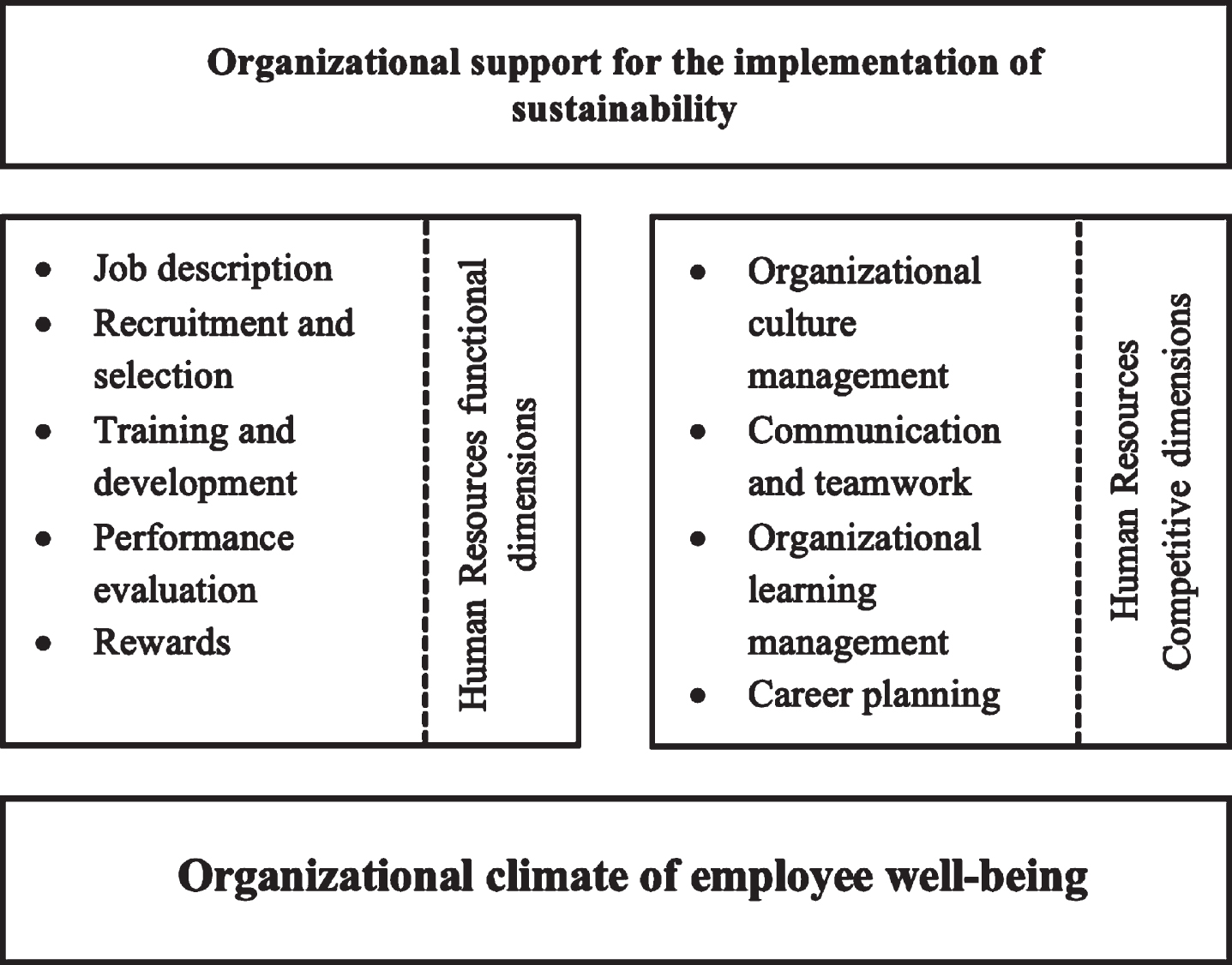
Human Resources Policies and Practices with a focus on Sustainability. Source: Theoretical perspective of HR Policies and Practices with a focus on Sustainability.

Framework of the relationship between the thematic axes.
For the implementation of sustainability, organizational support is essential, because without the intention of the leadership, actions in favor of sustainability will not occur. At the same time with this support, it is expected that there will be an organizational climate of well-being for employees, especially if the sustainability mentality is an integral part of the organization.
An extensive field to be explored as an intermediary for the support and well-being of employees is the HR area [3]. Within the functional dimensions of HR, the job description may include the focus on sustainability, as well as recruitment and selection, training and development to disseminate knowledge and skills in sustainability in the organization, the goals (performance evaluation) and rewards generated through sustainability practices.
Within the competitive dimensions of HR, there is the management of the organizational culture, where the values of sustainability can be managed and through Communication and teamwork, be disseminated throughout the organization. An organization willing to organizational learning will take charge of internalizing the basic principles of sustainable management. And finally, career planning must focus on the purpose of sustainability, being able to align personal values and goals with organizational ones, generating more meaning and purpose for everyone.
Thus, it is important to remember the implicit role that leadership has, mainly for organizational effectiveness, values, and changes in processes within it. In this sense, corporate leadership that makes choices based on a purpose that goes beyond profit, brings the theory of spiritual leadership to this study, which is further explored in the following section.
Leadership plays an important role in sustainable human resources management, and for this reason, [4] suggest that there is a demand for converging sustainability, leadership and the HR area. Traditional leadership theories are based on characteristics, behaviors, skills or situational factors [39, 40].
As an alternative to those looking for a more sustainable work environment, in the last decades, Spiritual Leadership (SL) has been brought, as it contributes to the behavior of individuals in acting for sustainability [40–43]. However, there are few studies on how SL relates to sustainability [40, 45].
The theory of spiritual leadership is brought as a proposal for transformation and continuous success in an organization that always seeks learning. One of the biggest challenges faced by organizations is the development of people, so that it is possible to align individual and organizational goals. [46] research advanced the theory of SL [47]. This theory states that “the understanding of the values, attitudes and behaviors that are necessary for the intrinsic motivation of oneself and others, so that there is a sense of spiritual survival through calling and belonging” [46], and its practical implementation can help companies.
The term spirituality does not have a consensus in its definition [48]. Although, historically, spirituality is linked to religious roots, in the organizational context, it is not associated with any specific tradition, being much broader than religions and other similar conceptions [49, 50]. Spirituality is a private, non-systematized, and individually interpreted experience, whereas religion is an institutionalized and public process [51].
According to [52], there are two common elements associated with spirituality: The desire for and, if achieved, the experience of doing meaningful work which aligns with one’s own values, benefits others, and perhaps serves the larger good. The experience of engaging with others at work and with partners and consumers, as well as, if necessary, forging long-term ties.
Spirituality is defined as: “an awareness of the connection that exists between the inner self of individuals and the world” [53]. This definition implies: “(i) creating a vision in which the members of the organization experience a sense of vocation, in which their life has meaning and makes a difference; and (ii) establishing a social and organizational culture based on selfless love, through which leaders and followers have genuine care, concern and appreciation for themselves and for others, thus producing a sense of belonging and feeling understood and appreciated".
Basically, spiritual leadership is the relationship with individuals, so the concern for them holistically (body, mind, heart and spirit) is paramount to elevate each other to higher levels of awareness and action, so that continuous improvement of self, culture and productivity are targeted and achieved [46, 54]. The term spirituality encompasses the perception that a person is part of a world and is acting in it for a greater good for society, that is, it is something systemic [50].
A spiritual leader has a sense of vocation characterized by altruistic love, to combat the imbalance in the socioeconomic environment that the world has been facing, as ethics, morals and trust eventually disappeared [50, 55–57]. Understanding spirituality can be a way to develop new approaches to the action of managers and promote organizational learning, social changes and driving leaders. It is believed that, in the post-industrial period, which is currently being experienced, there is a maturity for the reintegration of the spirit in business life [58].
Developing the spiritual side can make the workplace stronger, safer and a healthier place to do business, because self-awareness and inner vision are where change begins [49, 50]. This leadership model defines a holistic and community conception of the organization, both as an economic enterprise and as a human system [57]. Such a system, composed of individuals, brings the values and attitudes of each person to work. This reflects on moral principles that each one considers important and starts to guide their behavior in organizations, acting in the ethical system of a company [41].
Thus, considering organizations that always seek continuous learning, spiritual leadership is seen as a driver for improving their processes and operations. With the appeal of the UN Agenda 2030, this leadership style must encompass an explicit set of values and criteria, so that the institution of the sustainability tripod reflects on organizational success [59].
New business models must consider ethical leadership, employee well-being, sustainability, without sacrificing profitability, maximizing Elkington’s Triple Bottom Line [41, 61]. The potential for unifying sustainability issues with spiritual leadership is great. The tendency for humanity to adopt spiritual and sustainability values are globalized phenomena [62]. Spiritual leadership can show a strong commitment to the sustainable environment, transmitting values, attitudes and behaviors for a better world for future generations [63].
Thus, in view of all of the above, it is expected that the contribution of spirituality in the workplace will encourage the search for actions in sustainability. Consequently, organizational actions aim to promote sustainability in business and provide general well-being, through HR Policies and Practices.
Methodological procedures
This study presents a systematic literature review with the objective of exploring the concepts of human resources policies and practices, organizational sustainability and spiritual leadership, investigating the potential relationships between them [64]. The author in the theory of spiritual leadership, Louis Fry 1 , was consulted on the possibility of using the HR area as a facilitator of SL and Sustainability and confirmed that it could be a path, and that it had not yet been explored by him. Thus, the work was initially based on a search of secondary data, using as a data collection method the search for keywords within the universe of the proposed themes. This aims to identify the main theoretical aspects and highlight the main characteristics of publications.
Publications in journals linked to the Scopus, Web of Science and Google Scholar databases were considered, with the period between 1991 and 2020. This choice was made because the first two cited databases do not present enough results 2 or the proposed objective, because they are emerging themes. And, as claimed by [64], it is necessary to exhaustively search for studies within the themes, to ensure that the results present all available evidence and in the best contributions.
The collection was carried out considering the predefined keywords that were present in the search sections by Title, Keywords or Abstract. The terms used were: “Spiritual Leadership” AND “Sustainable HRM”, OR “Human Resources Management”, OR “Sustainable Work System”, OR “HR Sustainability”, OR “Sustainable Management of HRs”, OR “Sustainable Leadership”, OR “Human Resources”, OR “People Management”, OR “Sustainability”, OR “Sustainab*”, and “Spiritual Leadership” AND “HR” AND “Sustainability”. A second round of research with these terms was also conducted.
After collecting the articles, a preliminary analysis was performed, checking the abstracts to make sure that all articles were related to the thematic axes. Cases such as “spiritual intelligence", “spirituality at work", among others not corresponding to the SL, were used as exclusion criteria. In addition, all articles with a religious slant were also eliminated, because in the organizational context spiritual leadership is not associated with any specific religious tradition. After excluding articles that did not adhere to the scope of this research, 49 studies were considered for review.
For the analysis and treatment of the data of this research, the dimensions of the thematic axes were suggested, a priori, by the existing literature. This deductive approach was subsequently tested to verify the main themes and standards, to adapt them within the analytical process, relating all the material collected and looking for similarities and differences within the group [65, 66].
For the analysis of these data, the Atlas.ti software version 8.4.4 was used, to assist in the determination of the main themes and subthemes involved in this research. The software Atlast.ti and its use for analyzing theoretical work has been mentioned by a few scholars [67, 68]. Recently, many researchers have used Atlas.ti in conducting their analysis such as [69–73] and [74] to name a few.
For the present paper, the pattern matching technique was used to find patterns of behavior, so that it was possible to establish the relationships that meet the research question.
Results
In this section, the thematic axes, dimensions and codes used are presented first (Table 1), to later present the main relationships between the themes. The thematic axes were divided into four, with dimensions from the literature. The articles were analyzed to search for occurrences of each of the chosen dimensions. Thus, in the next section, discussions are held and a research agenda that integrates all the themes is provided.
Framework with dimensions and their respective categories
Framework with dimensions and their respective categories
The articles that fall within the scope of the research are those presented in Table 2. It was possible to verify that the themes, researched in a relational manner, are not yet well consolidated in the literature, which had already been noticed by the number of occurrences in the databases with highly indexed journals, which was even more evident in the analysis. There is a wave of publications over the analyzed years (2004–2020), with 2014 and 2017 having the highest number. The journal with the most publications (5) was the Journal of Management, Spirituality & Religion, followed by the Journal of Business Ethics (2). And the countries of origin of the authors who published the most are the United States (13), followed by Iran (6).
Articles used in the systematic review
When analyzing the articles, it was possible to verify that the empirical type of study represents 51%, and the theoretical articles 43%. The research approaches were equivalent between qualitative and quantitative (49% and 47%, respectively). The most used theory was that of spiritual leadership (63%), and the most frequent method of data collection was surveys (41%). Therefore, the types of primary data (51%) and the cross-sectional scope (88%) of the study were the most used. To understand the purpose of each article analyzed, Table 3 is presented.
Relationship of thematic axes
Among the analyzed articles, the most recurrent combinations of thematic axes were the competitive dimensions of human resources and spiritual leadership, with 28.6%, followed by the combination of the same dimensions, but with the addition of the Functional Dimensions of human resources, with 28.6% % too. About 16% of the articles listed all thematic axes, and 10% of them related only the HR Competitive dimension to the sustainability and SL axes. Those that related sustainability and SL add 12%. Table 3 describes the relationship between the thematic axes and the aforementioned codes for the presence of each in each analyzed article.
After analyzing and categorizing the articles, each dimension was distributed to identify which ones were most used. Within the HR competitive dimensions, management of organizational culture and communication and teamwork were the most recurrent. In the HR functional dimensions, the highlight was training and development. Figures 1and 3 show the distributions of this thematic axis.
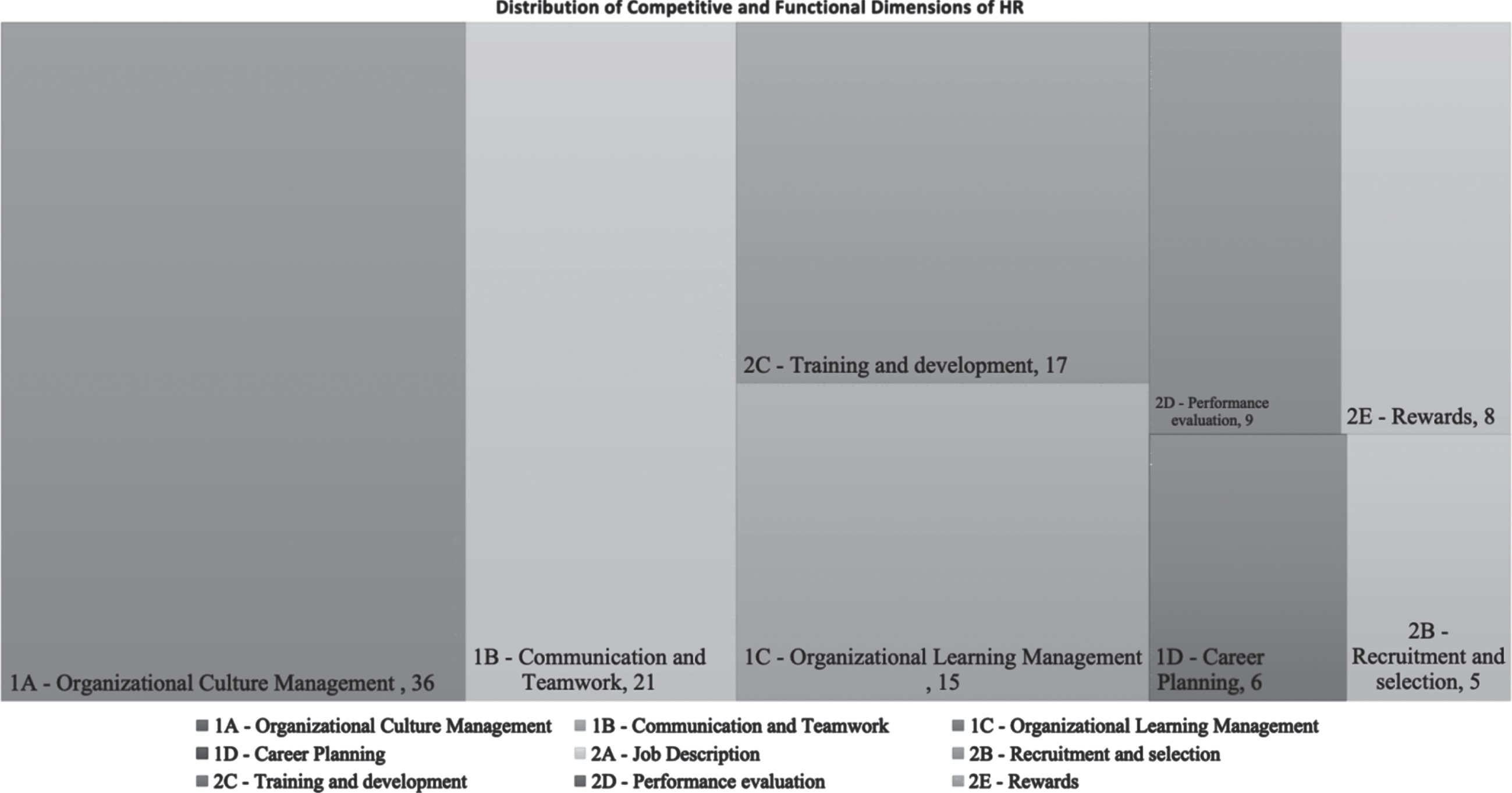
Distribution of competitive and functional dimensions of HR.
In the thematic axis of sustainability, it is clear that in only 45% of the articles the dimensions appeared. And of these, there is not so much differentiation between them (Fig. 4), with External Social being slightly more recurrent. Although there is no relation of this thematic axis in all the articles analyzed, it is possible to verify that there is an opportunity to deepen future research in this relationship.

Distribution of sustainability dimensions.
Finally, in the thematic axis of spiritual leadership, the dimension of the calling (makes a difference, life has meaning) was the most recurrent. However, the dimensions of altruistic love, vision, hope/faith, belonging (is understood, is appreciated) and organizational commitment, do not show much difference in relation to the recurrence of the calling (Fig. 5).

Distribution of spiritual leadership dimensions.
With the systematic review this study analyzes the main relationships between the thematic axes. At first, it verifies that some dimensions of these axes are already related. And, there is still great potential for bringing together sustainable and spiritual issues through leadership. This is not only because globalization through technology has made the work of organizations more accessible to nations and communities, but also due to the challenges of sustainable issues and the tendency for humanity to adopt spiritual values, which are phenomena that are becoming globalized [61].
Within the axis of spiritual leadership, some authors distinguished it with religious convictions. They claim that a leader does not need to be religious to have a spiritual foundation, and that this style is based on the principles of serving and caring for others [75, 76]. It is true that leaders affiliated with religious organizations can employ the same techniques and attributes as SL, however, it can be said that any leader who is ethical, kind, considerate, treats people with respect and generosity, promoting well-being to all, is probably a spiritual leader, capable of making a difference in people’s lives [75]. Thus, an alternative to avoid the confusion of the theme’s meanings, and to embrace all the themes covered in this work, could be the definition of a new nomenclature capable of covering all the themes involved.
Another verified work front was the need to further test the validity of SL construct, because the field of study still presents a position to face challenges regarding the scientific understanding of spirituality [77]. Reflecting through the spiritual perspective does not mean sacrificing economic rationality. In fact, SL is able to improve productivity and organizational performance by increasing employee well-being, because it can bring a deeper sense of meaning and purpose, as well as a broader sense of community and interconnectivity [78].
Adapting to the SL facilitates employee engagement [60]. It is a model that aims to answer the uncertainties and complexities faced by leaders in an increasingly competitive global environment, while communication and teamwork have become essential so that a balance between personal and professional life is possible [79]. In addition, it is vitally important that the leader has unselfish love for his employees [80], so that this can generate an organizational commitment.
The calling and belonging, which are components of spiritual well-being, will reinforce the experience of workers at the level of their perceptions, to the point of inducing beneficial results [81], reaching the levels of actions for organizational sustainability. However, to achieve this state, the incorporation of spiritual values and behaviors can be sustained by the way that organizational culture management is expressed [81–83]. Therefore, it was possible to verify that there is a gap to be explored on how this cultural management can occur through SL.
Because this is a competitive dimension of HR, it is important to note that, within this thematic axis, the role of the spiritual leader occurs in encouraging the organization to establish values, practices and competences that aim to support employees [62, 84]. However, before implementing a program to disseminate and strengthen these organizational values, it is important to measure, through a test with the employees, how they are established [85]. After measurement, the functional dimension of HR that can assist in this context is the training and development, in which programs can be developed.
This dimension can help to build the foundations of spirituality, showing employees that the organization supports their whole being, their work, until they reach the point where their decisions are integrated with sustainable actions [37, 86]. Thus, by allowing employees to get involved and participate more in the organization, and through training, it helps in recognizing current sustainable problems and solving them.
The human dimension of sustainability, especially in the areas of development and learning, strengthens organizations, because if there is no investment in integrating work with personal life, employees will tend to leave companies in search of greater balance, professional fulfillment and more purpose in their activities [28, 29].
As such, this body of knowledge still lacks greater understanding of how issues of organizational sustainability can be addressed and undertaken by spiritual leaders [45]. And the results obtained indicate that the development of the SL theory is relevant and applicable to creating and maintaining a sustainable workplace by and for employees [40].
Finally, it was possible to understand that sustainability requires organizations to operate within complex environmental, economic and social systems, which are dynamic and interconnected. In fact, leaders need the skills that an inner journey of self-knowledge and self-awareness can provide, so that they can focus on empathy, compassion, understanding of themselves and what is around them [87].
As thematic axes are emerging, there is still a lot of opportunity for research to be developed.
Future directions
Considering the above, some directions for future research are proposed below. A research agenda was developed with provocative research questions that are still lacking in the literature. To stimulate the interest of scholars, as suggested by [88], they can guide new paths for future studies on the relations of the thematic axes.
From a theoretical point of view, it is necessary to explore the scientific understanding of spirituality and how it can influence the search for sustainable actions. Future studies can avoid the confusion of meanings between spirituality and religiosity, suggesting an alternative nomenclature to cover the thematic axes discussed here. In addition, there is a great opportunity to deeply explore the relationship between the management of organizational culture and SL, that is, how it occurs.
The results made it clear that there is a construct of the SL to be tested, however, there is not one that combines it with actions for sustainability. Still, the body of this knowledge can gain relevance if longitudinal studies are carried out. After measuring these constructs, programs can be developed to assist the dissemination of knowledge and sustainable actions.
Finally, additional studies relating the dimensions of spiritual leadership and sustainability to the competitive and functional dimensions of HR reflect numerous study possibilities. In this study, it is clear which relationships were the most recurring, but also how far future studies need to advance to consolidate these themes.
Conclusion
This work verifies the relationship between the dimensions of Spiritual Leadership, the competitive and functional dimensions of human resources and organizational sustainability. It was possible to evidence that the SL attributes assume the management of organizational culture and communication and teamwork so that the values are disseminated, so that everyone in the organization can express themselves honestly, overcoming individual differences in the search for the organizational vision [87]. Both the attributes of SL, as well as the HR competitive dimensions, can provide spiritual well-being. This, by creating the feeling of calling and belonging in people, promotes both commitment and organizational support in favor of organizational sustainability actions.
Among the HR functional dimensions, the one represented by training and development, assumes an intermediate role between the achievement of the intended cultural management, which can be through communication and teamwork, until reaching the organizational sustainability actions, which is the main purpose of this thematic relationship.
Thus, to achieve the objective of this research, the selected studies were classified and coded and, subsequently, a research agenda with recommendations was presented. Even so, there are avenues for the development of more in-depth studies, which focus specifically on the relationship of these competitive dimensions of HR to the SL and actions for sustainability.
This study contributes to the literature on spiritual leadership and sustainable human resources management, which aims to promote sustainability actions in organizations. And yet, it opens the way for future research to relate other dimensions of the thematic axes that were not yet recurrent in the studies, or well explored. Among the limitations of this study are: (i) the use of journals that do not have high indexes; (ii) the keywords used in the search for articles that may not have been as comprehensive as possible.
Author contributions
CONCEPTION: Nayele Macini and Adriana CF Caldana
METHODOLOGY: Nayele Macini and Adriana CF Caldana
DATA COLLECTION: Nayele Macini
INTERPRETATION OR ANALYSIS OF DATA: Nayele Macini and Adriana CF Caldana
PREPARATION OF THE MANUSCRIPT: Nayele Macini and Ayesha Sengupta
REVISION FOR IMPORTANT INTELLECTUAL CONTENT: Nayele Macini and Ayesha Sengupta
SUPERVISION: Adriana CF Caldana and Muhammad Farrukh Moin
Footnotes
ACKNOWLEDGMENTS
This study was financed in part by the Coordenação de Pessoal de Nível Superior –Brasil (CAPES) –Finance Code 001.
The teacher held a video conference with the author in December 2018.
Seven (7) results were found in the Scopus database and six (6) in the Web of Science database, with four (4) of these results being repeated articles. Google Scholar found 684 results.