



Abstract
BACKGROUND:
Transformational leadership is critical in today’s organizations from a social exchange perspective as it helps create a positive work environment, drives innovation and change, and leads to improved organizational effectiveness.
OBJECTIVE:
The purpose of this study is to test the direct effect of transformational leadership on person-job fit (PJ fit), person-organization fit (POF), and organizational citizenship behavior (OCB). This study also examines the mediating role of PJ fit and POF on the relationship between transformational leadership and OCB.
METHODS:
This study collects data using a cross-sectional survey from professional lecturers of three selected public universities in Southeast Sulawesi - Indonesia. A total of 221 purposively sampled responses are utilized in the data analysis. A quantitative approach with structural equation modeling (SEM) via Amos 21.0 software is used to test the proposed hypotheses.
RESULTS:
The findings acknowledge that transformational leadership seems to have a direct positive effect on PJ fit, POF and OCB. Also, this study reveals that PJ fit and POF have significant positive effects on OCB. This study further unveils that PJ fit and POF fully mediate the relation between transformational leadership and OCB.
CONCLUSION:
The results indicate that the more transformational leadership behaviors are demonstrated by leaders within organization, the more PJ fit and POF of followers will accomplish and experience with their organization, which in turn, increase OCB. It further means that transformational leadership can be crucial for recent organizations from a social exchange perspective by promoting healthy relationships and positive outcomes by encouraging followers to engage in behaviors that benefit the organization.
Keywords

Introduction
The emergence of the COVID-19 pandemic has placed immense pressure [1, 2] on organizations across the globe. The COVID-19 pandemic has not only impacted healthcare systems [3, 4] but has also placed significant pressure on organizations of all types worldwide [5, 6]. Meanwhile, employees, globally, are considered one of the most valuable assets of an organization. Maintaining and encouraging employee involvement in the organization can increase their work productivity and also overall organizational performance. The development of empirical and theoretical studies has proven that leadership style greatly influences performance at the individual and organizational levels [7], especially transformational leadership [8, 9]. Transformational leadership encourages the achievement of performance and results through good and high-quality interactions between leaders and subordinates [10], thereby leading to increased organizational citizenship behavior (OCB) [11, 12].
However, the existing literature also shows that transformational leadership is not significant in influencing OCB [13–16]. In addition, Kayaalp, Page [17] found that transformational leadership has a significant effect on OCB. Motivation and inspiration from higher transformational leaders reduce employee passion for providing extra roles in the organization.
Further, to the author’s knowledge, there has been no research linking transformational leadership and OCB through the mediating variables of person-job fit (PJ fit) and person-organization fit (POF) in Indonesia. In particular, there is little research that has identified some of the underlying mechanisms that demonstrate the influence of transformational leadership and OCB. Mediation pathways that have been proposed include supportive management and job autonomy [18], affective commitment and organizational justice [19], and psychological empowerment as well as leader-member exchange [20]. Therefore, more advanced research is needed to enrich the understanding of the relationship between transformational leadership and OCB through mediator variables. Hence, this study examines the effect of transformational leadership on OCB mediated by PJ fit and POF using a social exchange perspective.
Literature review and hypotheses development
Social exchange perspective
The social exchange perspective is a theory in organizational behavior that explains the relationships between employees in an organizational setting [21]. Social exchange theory (SET) is based on the idea that employees engage in social exchanges with others in order to maximize their benefits [22] and minimize their costs. SET occurs when employees engage in transactions of resources, such as information, time and skills [23], with the expectation of receiving something in return.
SET focuses on the importance of mutual benefit in interpersonal relationships in organizations [24, 25]. When employees engage in social exchanges that are equitable, they are more motivated and engaged in their work, which leads to higher levels of performance [26]. For example, in a workplace setting, if an individual receives appropriate recognition and resources for their work, they perform effectively. In contrast, if an individual feels that the social exchange is one-sided [27], they are less motivated and their performance may suffer.
Organizational citizenship behavior
Organizational citizenship behavior (OCB) refers to voluntary behaviors that are not part of an individual’s formal job requirements but nonetheless promote the organizational effectiveness [28]. OCBs are behaviors such as going beyond the call of duty, assisting colleagues, and exhibiting a positive attitude [29].
OCBs refer to discretionary and helping actions [28, 29], which are typically categorized as follows: (a) Altruism: the actions that employees take to help others, such as helping a co-worker who is struggling with a task, (b) Civic virtue: the actions that employees take to help their organizations, such as volunteering for committees or participating in organizational events, (c) Conscientiousness: the employees’ actions who take responsibility for their own actions and the impact they have on others, such as being punctual and completing tasks on time, (d) Sportsmanship: the employees’ actions who are supportive and positive, even in the face of adversity, such as congratulating a co-worker on their success, and (e) Courtesy: the employees’ actions who display a strong sense of ethics and values in their work, such as speaking up when they observe unethical behavior and showing appropriate appreciation for others’ contributions.
OCBs have been found to be positively related to organizational reputation and effectiveness [30, 31]. Organizations that have employees who engage in OCBs tend to have a more positive work environment, increased job satisfaction [32], and improved performance outcomes [33]. This is because OCB can contribute to the smooth functioning of the organization by improving communication [34], and promoting a sense of unity among employees [35]. For example, an employee who is always willing to assist others, even if it is not part of their job description, can enhance the reputation of the organization as one that values its employees and provides excellent performance [36].
OCBs can play a significant role in the success of an organization and are an important factor to consider when evaluating organizational effectiveness. The factors that precede OCB based on social exchange relationships, are generally thought to include transformational leadership [17, 19], person-organization fit [38, 39], and person-job fit [37].
Person-job fit
Person-job fit (PJ fit) refers to the degree to which a person’s knowledge, abilities, skills, values, and personality match the demands of the job they hold [72, 73]. When there is a good fit between employees and their job, they are more likely to perform well and be satisfied with their work [38], as well as stay a long time with the organization [74].
In organizations, ensuring a good person-job fit is important for both the employee and the organization [75]. For the employee, a good fit can lead to increased motivation, meaningful work and work engagement [76], resulting in better performance and career growth. For the organization, having employees who are a good fit for their roles can lead to improved job performance and willingness to put high effort performing a more positive work environment [77]. Additionally, organizations can cultivate a positive work environment that aligns with the values, interests, and needs of employees to increase the likelihood of a good fit.
PJ fit is an important consideration for organizations looking to improve their effectiveness [73]. By matching employees with jobs that are well-suited to their skills and abilities, organizations can foster a more positive work environment and improve their overall performance [78]. Additionally, the importance of PJ fit may vary depending on the type of organizations. However, when employees fit well with their jobs, they more contribute to overall organizational effectiveness [79, 80].
Person-organization fit
Person-organization fit (POF) refers to the degree to which an individual’s values, attitudes, and personality match those of the organization they work for [72, 87]. When there is a high level of POF, it is thought that employees are more likely to be satisfied and fully engaged with their jobs [88], be more productive to their work [89], lead to trust and greater communication within the organization [90], and experience lower levels of stress [91].
Organizations can improve POF by effectively communicating their culture and values to potential employees during the hiring process, aligning job responsibilities with individual strengths and values, and providing opportunities for employee development and growth [92]. Additionally, organizations can promote transparent communication and rendering assistance for employees to adapt to the organization’s culture and values over time. A high degree of fit can lead to improved job satisfaction and better performance [93, 94], while a poor fit can result in dissatisfaction, decreased motivation and performance [95].
The studies have revealed a favorable link between POF and organizational effectiveness [96, 97]. As employees perceive themselves as harmonizing well with the organization, they would be more satisfied with their jobs and motivated to perform at a high level. This, in turn, can contribute to overall organizational effectiveness by increasing employee engagement and improving performance as well as productivity [98]. Additionally, while a high level of POF is generally beneficial, it is possible to have too much of a good thing regarding skills, experiences, and perspectives.
Transformational leadership
Transformational leadership is a style of leadership that focuses on motivating, inspiring, and empowering employees within an organization to achieve a common goal [40]. Transformational leaders transform the employees and the organization [41, 42] as a whole to create a positive work environment [43] as well as promoting and advancing organizational innovation and growth [44, 45].
Transformational leaders aim to bring about positive change by inspiring their employees and creating a vision [46] that appeals to their values, and aspirations [45]. By using various techniques, such as setting challenging goals, providing individualized consideration, intellectual stimulation, and offering opportunities for growth and development [47], transformational leaders encouraging employees to develop their skills and abilities to become more adaptive and responsive to change, which in turn, lead to improved decision-making, efficiency, and better overall results [48].
Transformational leaders have ability to prioritize building a deep emotional connection and create a sense of shared purpose with their employees [49]. The following are the key constructs of transformational leadership [40, 50]: (a) Idealized influence: leaders serve as role models and inspire employees by exhibiting values and behaviors that are consistent with organizational goals and expectations, (b) Inspirational motivation: leaders articulate a compelling vision and create a sense of mission that inspires and motivates employees to achieve exceptional results, (c) Intellectual stimulation: leaders encourage creativity and innovation, challenge employees to think critically, and foster a culture of continuous learning, and (d) Individualized consideration: leaders provide coaching and support, and take a personal interest in the development of each individual.
Previous studies have shown that transformational leadership significantly improves performance among employees [10, 51]. The leader’s ability to create a positive work environment and provide support also lead to greater levels of employee creativity and innovation [52]. In addition, transformational leadership further has a positive impact on organizational effectiveness [53, 54].
Hypotheses development
Relationship between transformational leadership, OCB, POF and PJ fit
Transformational leadership has been shown to positively impact OCB by creating a positive work environment and fostering a sense of commitment [55, 56] and identification with the organization among employees [57, 58]. When transformational leaders extend acknowledgment, assistance, and avenues for personal and professional advancement, employees are more likely to engage in behaviors that benefit the organization as a whole [59]. In the SET, transformational leadership is perceived as a reciprocal relationship between leaders and employees, where employees provide certain outcomes (such as effort and commitment) [51] in return for specific inputs (such as support and recognition for development) [60] from leaders. Additionally, the clear vision and sense of purpose provided by transformational leaders can increase employees’ motivation to engage in OCB [11, 17], as they feel that their actions align with the organization’s goals and values. Thus,
H1: Transformational leadership significantly affects OCB.
Transformational leaders create a positive work environment and help employees feel a sense of belonging [46, 61] in their organization. Transformational leaders provide opportunities for growth and development [62, 63], which align with individual goals. Furthermore, transformational leaders encourage employees to take the initiative to increase person-organization fit (POF) [64, 65]. Therefore,
H2: Transformational leadership significantly affects POF.
Transformational leaders focus on inspiring and empowering employees to achieve their full potential [66]. In this sense, the transformational leader seeks to understand the unique capabilities of each employee [67, 68] to align them with responsibilities that fit their skills. Transformational leaders also communicate a compelling vision for the organization [69], which can help employees understand the purpose and meaning behind their work, which in turn, promotes person-job fit (PJ fit) [64, 71]. Thus,
H3: Transformational leadership significantly affects PJ fit.
Impact of PJ fit on OCB and its mediating effect
In the SET, PJ fit is viewed as a reciprocal relationship between the individual and the organization. The individual provides their abilities to the organization, and in return, the organization provides various rewards [81, 82], such as financial compensation, job security, and opportunities for growth and development. When there is a good PJ fit, both the individual and the organization are likely to experience mutual benefit [72]. Previous studies have shown that PJ fit influences OCB [78, 83]. Employees who perceive a strong fit between themselves and their job are more likely to engage in OCB because they are motivated and having a sense of commitment as well as identification with the organization. Therefore,
H4: PJ fit significantly affects OCB.
PJ fit refers to the compatibility between an individual’s characteristics and the requirements of the job they are performing [72]. Recent studies have shown that transformational leaders who foster an environment of trust and empower their employees can lead to improved person-job fit, which in turn, increases OCB [84, 85]. This is because transformational leaders are able to create opportunities for employees to use their strengths, develop their skills, and find meaning and purpose in their work [70]. By creating a positive work environment that empowers employees and encourages them to contribute to the success of the organization [86], transformational leaders engage employees in behaviors that benefit the organization as a whole, such as volunteering for extra tasks, supporting co-workers, and helping others. Thus,
H5: PJ fit significantly mediates the effect of transformational leadership on OCB.
Impact of POF on OCB and its mediating effect
In the SET, POF can influence OCB [38, 98] by creating a sense of obligation and reciprocity between the individual and the organization. When an individual perceives that their organization values and supports their goals and interests [89], they are more likely to feel a sense of obligation and commitment to the organization, which can lead to increased OCB. Thus,
H6: POF significantly affects OCB.
POF refers to the compatibility between an individual’s values, beliefs, and goals of the organization. A good fit can lead to increased performance and extra behavior [99]. Transformational leaders can enhance POF by creating a work environment that aligns with the values and goals of their employees [64]. By communicating the organization’s goals and values, creating a supportive and inclusive work environment, and inspiring employees to achieve their full potential, transformational leaders can enhance both POF and OCB [100, 101]. Therefore,
H7: POF significantly mediates the effect of transformational leadership on OCB.
Research methods
Sampling and data collection
This study collects data using a cross-sectional survey from professional lecturers of three selected public universities in Southeast Sulawesi –Indonesia. Accordingly, 300 questionnaires of this study were distributed to ensure representativeness. This study further collected a response rate of 86.3% of fully completed questionnaires received. A total of 221 purposively sampled responses are utilized in the data analysis as shown in Table 1.
Demographic information of respondents
Demographic information of respondents
The demographic information for the 221 respondents that 139 (62.9%) are males, and 82 (37.1%) are females. In addition, their ages (years) ranged as follows: ≤30 (19); 31–40 (42); 41–50 (97); and >51 (63) (8.6%, 19%, 43.9%, and 28.5%, respectively). Regarding education level, 143 respondents had a Master’s degree and 78 held a Doctor’s degree (64.7% and 35.3%, respectively). The functional structure of participants varied as follows: expert assistant 96 (43.4%), assistant professor 73 (33%), associate professor 51 (23.1%), and full professor 1 (0.5%). The work experience of participants varied as follows: three to five years (22), six to ten years (34), eleven to fifteen years (94); and more than 16 years (71) (10%, 15.4%, 42.6%, and 32% respectively).
Transformational leadership in this study is measured with four dimensions adapted from [102–105]: 1. Core transformational leadership behavior, which included the leader’s behavior in articulating a compelling vision of the future (three items: CT1, CT2, CT3); 2. Supportive leader behavior, which covered the leader’s behavior in paying special attention to the followers needs and aspirations to reach their full potential (four items: SL1, SL2, SL3, SL4); 3. High-performance expectations, which included the leader’s behavior in serving as a role model to gain the trust and respect of their followers (three items: HP1, HP2, HP3); and 4. Intellectual stimulation, which covered the leader’s behavior in stimulating critical thinking explore new ideas and approaches (three items: IS1, IS2, IS3). A six-item scale adapted from Goetz and Wald [95], Lauver and Kristof-Brown [75] is used to assess PJ fit. Four items adapted from Saether [106] and originally further developed by Cable and Judge [107], Lauver and Kristof-Brown [75] are used to measure POF. Organizational citizenship behavior in this study is associated with three dimensions: 1. OCB towards students, which included the behaviors deliberately directed towards enhancing the teaching quality to effectively facilitate student learning (four items: BS1, BS2, BS3, BS4); 2. OCB towards colleagues, which included the behaviors involving assistance to colleagues burdened with substantial workloads (four items: BC1, BC2, BC3, BC4); and 3. OCB towards the organization, which included the behaviors directed towards enhancing the effectivity and efficiency of the organization (four items: BO1, BO2, BO3, BO4) [108, 109]. The perceptions and responses of participants are measured using a seven-point Likert scale (1 = strongly disagree to 7 = strongly agree).
Analytical technique
A quantitative approach with structural equation modeling (SEM) via Amos 21.0 software is used to test the proposed hypotheses. SEM approach is used since it has been familiar [110] in management and social sciences studies.
Results and discussion
Regarding the results of data analysis in this study, Table 2 shows construct validity that the loading values of each item description variable (e.g., OCB, PJ fit, POF and transformational leadership) are greater than 0.5, ranging from 0.548 to 0.950. This result indicates acceptable factor loading [111, 112].
Factor loadings
Factor loadings
Note: N = 221, OCBO = OCB towards organization, OCBC = OCB towards colleagues, OCBS = OCB towards students, CT = Core transformational leadership behavior, HP = High-performance expectations, SL = Supportive leader behavior, IS = Intellectual stimulation.
Table 3 provides the assessment of convergent and discriminant validity. The composite reliability (CR) of all constructs (e.g., OCB, PJ fit, POF and transformational leadership) was above the threshold of 0.7, as recommended by Hair, Anderson [111]. In addition, all of the average variance extracted (AVE) values are larger than 0.5, ranging from 0.577 to 0.851. This result confirms the discriminant validity as suggested by Fornell and Larcker [113], Henseler, Ringle [114].
Measurement model convergent and discriminant validity
Note: N = 221, CR = Composite Reliability, AVE = Average Variance Extracted.
CFA model fit indices
Table 5 provides the results of hypotheses testing regarding the values of path coefficients (β), standard errors (S.E), critical ratios (C.R), and probability values (ρ). The final tested model is shown in Fig. 1. The results revealed the significant and positive effect of transformational leadership on OCB (β= 0.309; C.R = 2.269; p = 0.023), POF (β= 0.383; C.R = 3.580; p = 0.000), and PJ fit (β= 0.296; C.R = 3.063; p = 0.002), respectively. These results confirmed H1, H2, and H3. In addition, it supported a positive and significant effect of PJ fit (β= 0.562; C.R = 4.264; p = 0.000) and POF (β= 0.287; C.R = 2.334; p = 0.020) on OCB, indicating to confirm H4 and H6. Also, the results of Sobel for testing the mediation effect indicated that PJ fit (t-statistic = 3.6296, one-tailed probability = 0.0001, two-tailed probability = 0.0003) and POF (t-statistic = 3.6684, one-tailed probability = 0.0001, two-tailed probability = 0.0002) are positively mediating the relationship between transformational leadership and OCB, as expected in H5 and H7.
SEM hypotheses testing
Note: N = 221, β= Path coefficient, S.E. = Standard error, C.R. = Critical ratio.
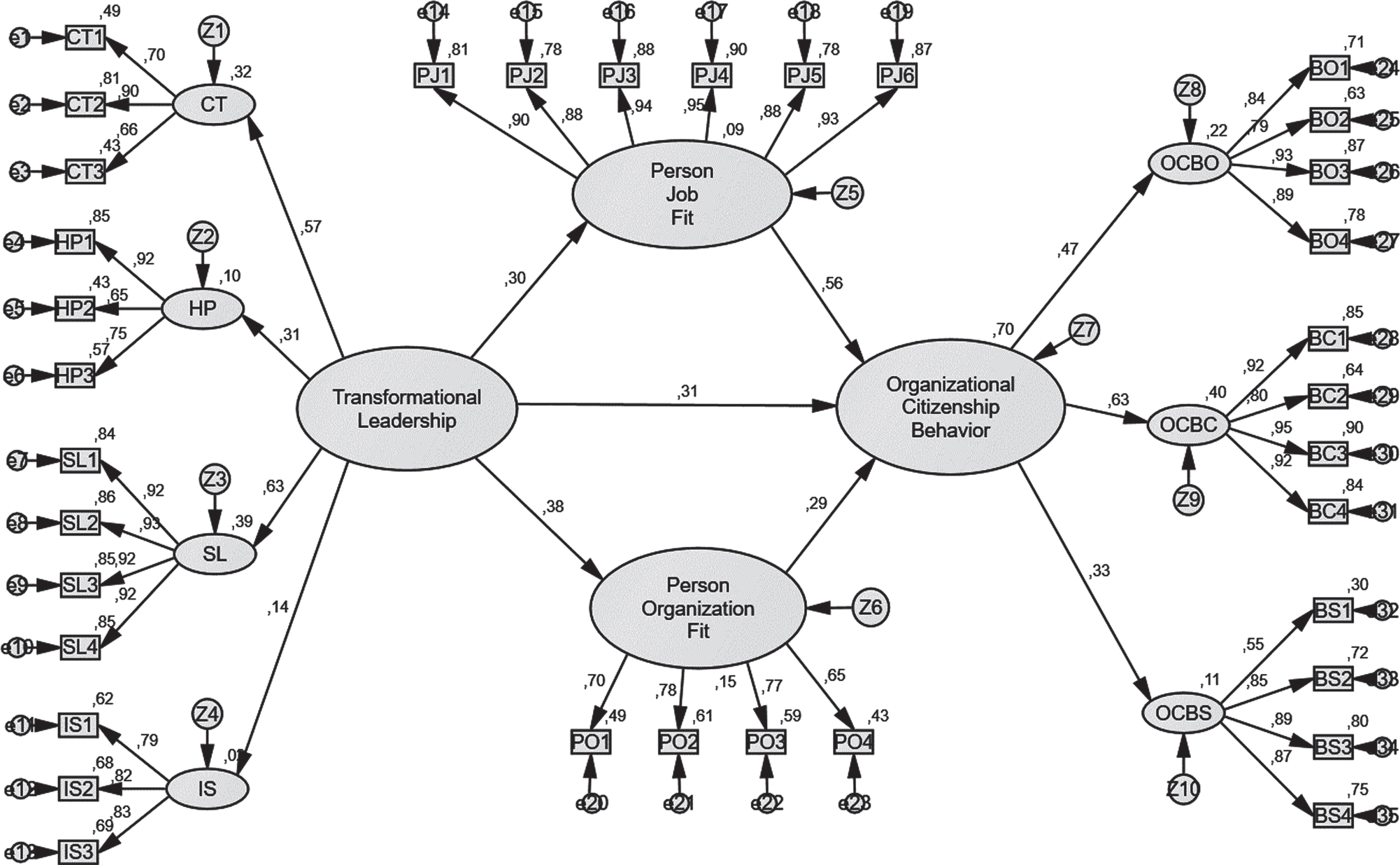
Results of SEM model.
This study acknowledged that transformational leadership can be important in recent organizations from the SET because it can enhance the quality of the leader-employee relationship and positive outcomes, such as OCB, PJ fit, and POF. Transformational leaders inspire and motivate employees to achieve their personal goals and strive for the organization’s greater good [115, 116]. Transformational leadership creates a sense of shared purpose and a feeling of trust and loyalty between the leader and employees, leading to a positive social exchange dynamic to effectively improve OCB [17].
According to the SET, transformational leadership can also promote positive outcomes by encouraging employees to engage in behaviors that benefit the organization. Transformational leaders provide support and resources [18], and the employees reciprocate by putting forth their best effort and contributing to the organization’s success. This can lead to increased employee motivation to engender extra-role behaviors [11] and productivity.
In recent organizations such as higher education, transformational leadership can also play a key role in promoting PJ fit and POF to continuously adapt to new challenges and opportunities. Transformational leadership ultimately improves PJ fit [117] and POF [64] by fostering a culture of motivation, effective communication, and better collaboration. Transformational leaders encourage employees to think creatively and take risks by developing new ideas and solutions to face problems within rapidly changing organizations.
This study further brings to light that PJ fit and POF convincingly promote and increase OCB. These findings are consistent with the previous studies of Ashfaq and Hamid [98], Pattanawit and Charoensukmongkol [78], Sørlie, Hetland [96]. When employees feel that their abilities, values and interests match the demands of their job and organization, they are more likely to engage in OCB to contribute meaningfully to the organization. This is because they feel a sense of connection, trust, loyalty and commitment to the organization, and are therefore more willing to go beyond what is required of them in engaging discretionary behaviors.
The results of the study show that transformational leadership seems to have direct positive effect on PJ fit, POF and OCB. Also, this study reveals that PJ fit and POF have significant positive effects on OCB. This study further unveils that PJ fit and POF fully mediate the relation between transformational leadership and OCB. The results indicate that the more transformational leadership behaviors are demonstrated by leaders within organization, the more PJ fit and POF of employees will accomplish and experience with their organization, which in turn, increases OCB. It further means that transformational leadership can be crucial for recent organizations from the SET by promoting positive relationships and positive outcomes by encouraging employees to engage in behaviors that benefit the organization.
The research implications
The findings of this study have several implications for management practices and organizational effectiveness. Firstly, transformational leaders inspire, motivate and encourage their employees to go beyond their own expectations and self-interest as well as work towards a shared vision to enhance voluntary behaviors and organizational effectiveness. Second, by encouraging their employees to think creatively and take risks, transformational leaders challenge employees’ new ideas and innovations to fit their skills, abilities and personality to perform better, be more engaged, and contribute more to the organization. Third, transformational leaders strive to create a positive work culture to attract high-quality employees who align with their values and mission to maintain a high-performing workforce. Lastly, PJ fit and POF become important considerations for organizations seeking to enhance employees’ OCB and productivity [78, 83]. When employees engage in behaviors that are not required by their job, they may experience a greater sense of fulfillment and purpose, and are more likely to feel committed to the organization and its goals. Positive behaviors of OCB, such as helping others, volunteering for extra tasks, and showing loyalty to the organization can be seen as indicative of a healthy and supportive work culture to improve the organization’s reputation and growth.
Limitation and future research direction
In this study, transformational leadership, PJ fit, POF and OCB have been empirically investigated based on employees’ responses without involving leaders’ perspectives and responses. Thus, it becomes the limitation of the recent findings of the study. Future research further should be conducted to provisionally examine the same proposed research model by paying attention to the leaders’ responses [118] to greatly enhance the employees’ OCB, PJ fit and POF.
Policy recommendations
Based on the findings, this study recommends organizations to establish leadership development programs that focus on cultivating transformational leadership skills and abilities via training, mentoring, and coaching. These programs should emphasize the importance of inspiring and empowering employees as well as setting a compelling vision to exhibit desired behaviors that benefit the organization as a whole. When employees are inspired by their transformational leaders and feel a strong sense of purpose, they are more likely to engaging to higher levels of OCB, PJ fit and POF.
Footnotes
Acknowledgments
The author has no acknowledgments.