



Abstract
BACKGROUND
The progress made in wireless communications has led to a higher adoption of mobile devices among users and has spurred the development of mobile commerce technology.
OBJECTIVE
This research examines the factors influencing the intention to adopt mobile commerce in Jordan. These factors include perceived usefulness, perceived ease of use, trust, social influence, personal innovation, and mobility.
METHODS
The study relied on Technology Acceptance Model (TAM), incorporating additional variables to suit the Jordanian context. The researchers gathered data from 540 users, and the research hypotheses were evaluated using smartPLS analysis. The study utilized a convenience sample due to the absence of a comprehensive list of names of mobile commerce users.
RESULTS
The results reveal that perceived usefulness, trust, social influence, personal innovation, and mobility play a significant role in influencing adoption intentions of mobile commerce. Furthermore, the study finds that mobility significantly affects the perceived usefulness of mobile commerce. In contrast, perceived ease of use does not show a statistically significant relationship on the intention to adopt mobile commerce.
CONCLUSIONS
The outcomes of this research provide valuable insights for companies, service developers, and mobile marketers, enabling them to enhance the adoption rate of this service among individuals.

1. Introduction
Mobile commerce has developed greatly in recent years due to the growth in the production of mobile phones and their widespread use. Thus, the reliability of electronic transactions between companies and customers has increased [1, 2]. The Middle East region is considered one of the highest rates in the use of mobile phones for online trading, knowing that the numbers of retailers and wholesalers are flourishing all over the world [3]. Mobile commerce has gained importance due to the growth of the digital economy and has become an integral part of business strategy [4]. The lack of users is considered one of the biggest obstacles for software companies, which prevents them from manufacturing special applications in mobile commerce. Also, the lack of services may hinder users from using these applications [5–7]. Because of their wireless nature, in addition to the flexibility of smart devices, this allows easy online shopping [8, 9]. In this context, there are many advantages of mobile commerce, the most important of which is that the customer can conduct transactions at any time and in any place, which leads to saving travel expenses to a physical place. For service providers, mobile commerce enables access to the largest number of users to display their products and services, and the operating costs in mobile commerce are considered lower [10].
The use of mobile devices, such as phones and tablets, by consumers to purchase goods and services is a major factor contributing to the growth of e-commerce globally. The most recent data indicates that mobile commerce accounted for $2.2 trillion in sales in 2023 and currently accounts for 60% of global e-commerce sales. Mobile commerce’s percentage of overall e-commerce has been steadily increasing, from just 56% in 2018 to a projected 62% in 2027. Given the ongoing global expansion of the mobile commerce industry, the increase in sales of this product has been even more pronounced. In sharp contrast to the $982 billion that was made in this segment as recently as 2018, statistics predict that mobile commerce sales will reach $3.4 trillion in 2027 [11]. These statistics, which are constantly increasing, are evidence that mobile commerce is growing rapidly, necessitating researchers to investigatethe most important factors that motivate consumers to adopt these services.
The policies and regulations set by governments are in favor of the consumer with regard to electronic business applications, and they also work to protect the rules of electronic commerce [12]. Despite the many positives that the adoption of mobile commerce offers to many parties, such as companies and customers, in addition to its support for the digital economy, there are some negatives related to its adoption. [13] explained that it lies in the fact that the customer lacks direct interaction with the seller in this type of trade. Also, the customer may be surprised when he/she buys the product because the company is not credible in providing correct information about the product. Many studies have been conducted in the Jordanian context, but important factors such as mobility and personal innovation have been ignored. These factors are important in motivating customers to adopt mobile commerce. This study comes as an effort to bridge the gap by constructing a model that includes these factors in addition to the following factors: perceived usefulness, perceived ease of use, trust, and social influence, as most previous studies agree on the extent to which these factors influence the intention to adopt mobile commerce [14]. Activities such as mobile banking, mobile payment, mobile shopping, and mobile-based services are part of mobile commerce. As for mobile banking, customers can use a mobile device to check account balances, transfer funds, and pay bills, which provides convenience to individuals who do not have sufficient access to traditional banking services [15]. Due to the widespread use of digital wallets and the emergence of mobile payment services, there is no longer a need for cash payment cards [16]. Accordingly, these services have gained great popularity in Jordan.
Customers in Jordan have recently started purchasing their phones, which has developed the retail scene and resulted in a continuous rise in the number of mobile phone users. E-commerce platforms have improved their websites and mobile applications and developed the technological infrastructure as a result of this development. Businesses also focused on increasing the number of payment options, particularly safe ones. This, together with the growing availability of home delivery options, has made Jordanian consumers more inclined to explore and make purchases using their phones [17]. The utilization of mobile-based services has expanded to encompass ride-hailing, food delivery, and transportation. The rise of smartphone applications has enabled businesses to offer services in response to client requests. With a few taps, they can now plan vacations, purchase meals, and utilize a plethora of other services [18, 19]. However, despite this progress, mobile commerce in Jordan still faces significant challenges that need to be taken into account, just like any new industry. Security and trust are critical concerns for consumers, as they need reassurance that their personal and financial information is protected when engaging in mobile transactions [20, 21]. Therefore, building trust and implementing robust security measures are essential for the sustained growth of mobile commerce in Jordan. Additionally, ensuring accessibility and inclusivity is important to cater to individuals from diverse socioeconomic backgrounds and varying levels of digital literacy. Efforts should be made to bridge the digital divide and provide equal opportunities for all segments of the population to participate in mobile commerce.
From a research standpoint, numerous studies have been conducted in the Jordanian context [22–24]. The current study is characterized by the addition of new variables that have not been previously researched, such as mobility and personal innovation. Previous studies indicated that the mobility feature of smartphones is considered one of the most important motivators that facilitate the adoption of mobile commerce applications [22, 26]. Personal innovation is a critical factor that influences an individual’s decisions and behavior towards technology. In other words, the higher the personal innovation, the higher the percentage of conviction in using and accepting technology [27, 28]. Consequently, this study contributes to the existing body of knowledge by introducing these two critical variables.
2. Literature review
Today, the advancement of technology has revolutionized various aspects of human life, including business. One of the most notable developments has been the popularization of mobile commerce, which means conducting business transactions through mobile devices [29]. Understanding the factors that influence individuals’ use of mobile commerce is crucial for both companies and researchers. TAM has emerged as a central theoretical framework to understand and predict the acceptance of technology by individuals in various contexts [30]. Fred Davis originally proposed TAM in 1989 as a model to explain and predict individuals’ acceptance of information technology. This model is based on the observation that attitudes and intentions about the adoption of new technology are contingent upon perceived usefulness and ease of use [31]. Later, TAM gained popularity because of how well it predicted the adoption of new technologies. It developed into a widely utilized model that was applied in various technological contexts. To fit these settings, further factors were included, such as social influence and trust [32].
The next section will address the significance of these two variables: “perceived usefulness and perceived ease of use”. Studies have indicated that although the fundamental components of TAM are universal, the significance of perceived usefulness and perceived ease of use might differ among cultural groups [33, 34]. Cultural values, social norms, and technological infrastructure can influence people’s perceptions of the usefulness and ease of use of mobile business technologies. Thus, researchers have emphasized the need for culturally sensitive TAM adaptations to effectively capture the nuances of technology acceptance in different cultural settings. Accordingly, in addition to perceived usefulness and perceived ease of use, this study expanded by incorporating other variables capable of predicting the intention to use mobile commerce.
3. Hypotheses development and research model
As illustrated in Fig. 1, this section will delve into the discussion on the formulation of the study hypotheses.
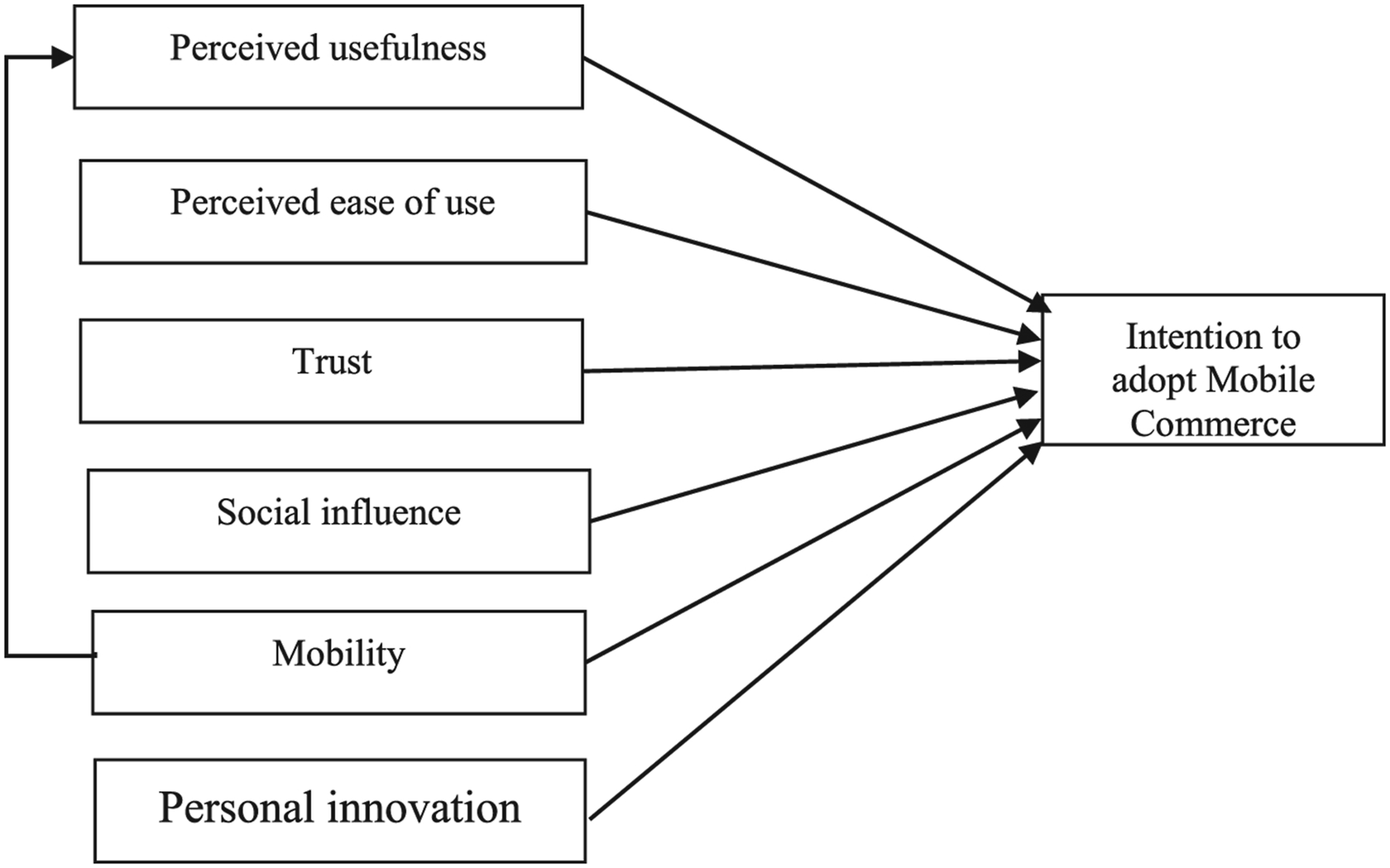
Proposed framework.
3.1. Perceived usefulness
According to [31], perceived usefulness is considered one of the most crucial factors influencing technology acceptance. If users believe mobile commerce as a practical and convenient way to conduct business, they are more likely to adopt it. Positive attitudes toward mobile commerce adoption are nurtured by the belief that it can simplify the shopping process, provide access to a wide variety of goods and services, and offer convenience in terms of both time and place [35]. Previous studies have also demonstrated that perceived usefulness significantly impacts the acceptance of technology in general and the acceptance of mobile commerce [1, 36–38]. In fact, customers are inclined to adopt mobile commerce when they recognize the benefits of the service. Therefore, this study considers perceived usefulness to be an added value for the customer. The first hypothesis is formulated as follows:
Hypothesis 1: Perceived usefulness has a positive impact on the intention to use mobile commerce.
3.2. Perceived ease of use
Similar to perceived usefulness, [31] regards perceived ease of use as a critical factor in influencing technology acceptance. Users’ perceptions of the ease of using a mobile commerce platform are greatly influenced by an interface that is clear, user-friendly, and intuitive. The perception of easy-to-use mobile commerce applications is reinforced by intuitive navigation, clear product and service categorization, and a neat layout, all of which encourage users to embrace the platform [35]. Based on the results of previous studies, perceived ease of use statistically affects the acceptance of mobile commerce [1, 36–39]. The rate of acceptance of using m-commerce among individuals will increase when they believe that the service is easy to use and does not require a lot of mental effort to complete it. Based on this, perceived ease of use plays a fundamental role in the customer’s perception, leading us to the second research hypothesis:
Hypothesis 2: There is a positive relationship between perceived ease of use and the intention to use mobile commerce.
3.3. Trust
Trust plays a vital role in influencing the acceptance of technology. If users believe that the platform will protect the security and privacy of their financial and personal data, they are more likely to use mobile commerce. Strong security features, such as data encryption, safe payment gateways, and strict privacy regulations, increase users’ trust in the platform by reassuring them that their private information will not be misused or accessed by unauthorized parties [40]. This trust is considered a general umbrella that involves reliability, protection, risk and credibility [41]. In studies focusing on financial contexts, previous research has demonstrated that trust is one of the most significant factors that motivate or discourage customer from using technology [42, 43]. In other words, as the customer’s level of trust in the service provider, communications, and payment methods increases, so does their inclination to use the technology, and vice versa [1, 37, 38].
Hypothesis 3: trust has a positive impact on the intention to use mobile commerce.
3.4. Social influence
The adoption of mobile commerce is strongly influenced by the display of social proof, which includes user engagement metrics, likes, shares, and positive comments. When individuals perceive that a significant number of their peers and community members are using the platform, it provides them with a sense of social validation and motivates them to use it as well, thereby increasing their intention to use the mobile commerce platform [44]. In studies related to the technology acceptance, the social circle surrounding an individual has a notable impact on their technology adoption [45]. This circle encompasses family members, peers, co-workers, and relatives, among others. Specifically, individuals close or important to or influential in an individual’s life have a substantial influence on their adoption of mobile commerce or other applications such as mobile banking services, Financial Technology (Fintech), or electronic payment [5, 43]. This influence may outweigh the individual’s personal convictions regarding the service. Consistent with related studies, this research assumes that:
Hypothesis 4: There is a positive relationship between social influence and the intention to use mobile commerce.
3.5. Mobility
Mobility has been defined as the customer’s ability to access the service via the Internet, regardless of time or place restrictions [46]. In fact, mobility is considered one of the advantages enjoyed by mobile commerce. Mobility is linked to good internet coverage for the smooth operation of applications, although such coverage may not be available in some developing countries. Users of mobile devices can conduct business on the go and are not confined to a single physical location due to the devices’ mobility. Whether for travel, commuting, or leisure activities, the ability to shop, compare prices, and make well-informed decisions about purchases in real-time improves the user experience and promotes the use of mobile commerce as a practical and effective business solution [47, 48]. Previous studies have demonstrated that mobility plays a positive role in the adoption of mobile commerce [49, 50]. Moreover, these studies have confirmed that mobility has a positive effect on perceived usefulness [51]. Accordingly, this study proposes two hypotheses as follows:
Hypothesis 5: There is a positive relationship between mobility and the intention to use mobile commerce.
Hypothesis 6: There is a positive relationship between mobility and the perceived usefulness of mobile commerce.
3.6. Personal innovation
[19] defined personal innovation as “the degree to which a person tends to adopt new things such as new technologies, products, or services before others”. Personal innovation is considered one of the most important reasons for customers to accept new technologies, as the greater the personal creativity of individuals, the higher the acceptance rate of new technologies [52]. One way that personal innovation can be applied is by encouraging a proactive approach to acquiring new technological skills and platforms. Personal innovators actively seek opportunities to explore the features and capabilities of mobile commerce. They experiment with different transactional procedures and interact with the platform to gain more knowledge and expertise, which strengthens their resolve to embrace mobile commerce [53]. Mobile commerce is considered one of the technological innovations, so individuals with a high level of innovation tend to accept it easily [54]. Previous studies have indicated the importance of personal innovation and its positive relationship with the adoption of mobile commerce [55–57]. Therefore, the following hypothesis was formulated:
Hypothesis 7: There is a positive relationship between personal innovation and the intention to use mobile commerce.
4. The methodology
4.1. Participants and procedure
The study utilized a convenience sample due to the absence of a comprehensive list of names of mobile commerce users. Data were collected through a questionnaire from individuals who had prior experience using mobile commerce. Data collection took place in Amman, the political and economic capital of Jordan, where the use of mobile commerce is widespread and well-developed. The questionnaire was distributed in various locations, including travel agencies, commercial banks, universities, and malls. Initially, 540 questionnaires were distributed, where invalid answers were excluded for several reasons, including incomplete responses and instances of respondents not taking the questionnaire seriously. The number of valid responses for analysis totaled 436, resulting in an 80% response rate. Data analysis was conducted using the smart PLS 4 system. A five-point Likert scale ranging from 5 (’strongly agree’) to 1 (’strongly disagree’) was used. The distribution of the questionnaires took place between May 2, 2023, and June 25, 2023. Given that Arabic is the official language of the respondents, the survey was back-translated into the language [58]. Back translation is a helpful method for translating different kinds of documents, questionnaires, and surveys. Three translations of the instrument are thought to produce better results and cover every facet of the original text [59]. Three academic experts with vast experience in information systems conducted a pre-test to make sure the survey items were worded, formatted, and sequenced appropriately. With the help of expert suggestions and notes, this step attempted to improve comprehension of the survey items and the overall structure.
4.2. Measures
There are three sections to the questionnaire. Four questions about gender, age groups, educational attainment, and prior experience using mobile commerce applications are included in the first section. The study’s six independent variables are covered in the second section, which has 19 questions. Three questions, covering the dependent variable, are included in the third section. Every item on the questionnaire was taken from an earlier study. The study items were tested to ensure validity and reliability, and the results showed that the measurement scales are both valid and reliable when used. Table 1 presents the questionnaire items and their origins, specifying the sources from which these items were derived.
Measurement items

5. Results
This section consists of two parts: the measurement model and the structural model.
5.1. Measurement model
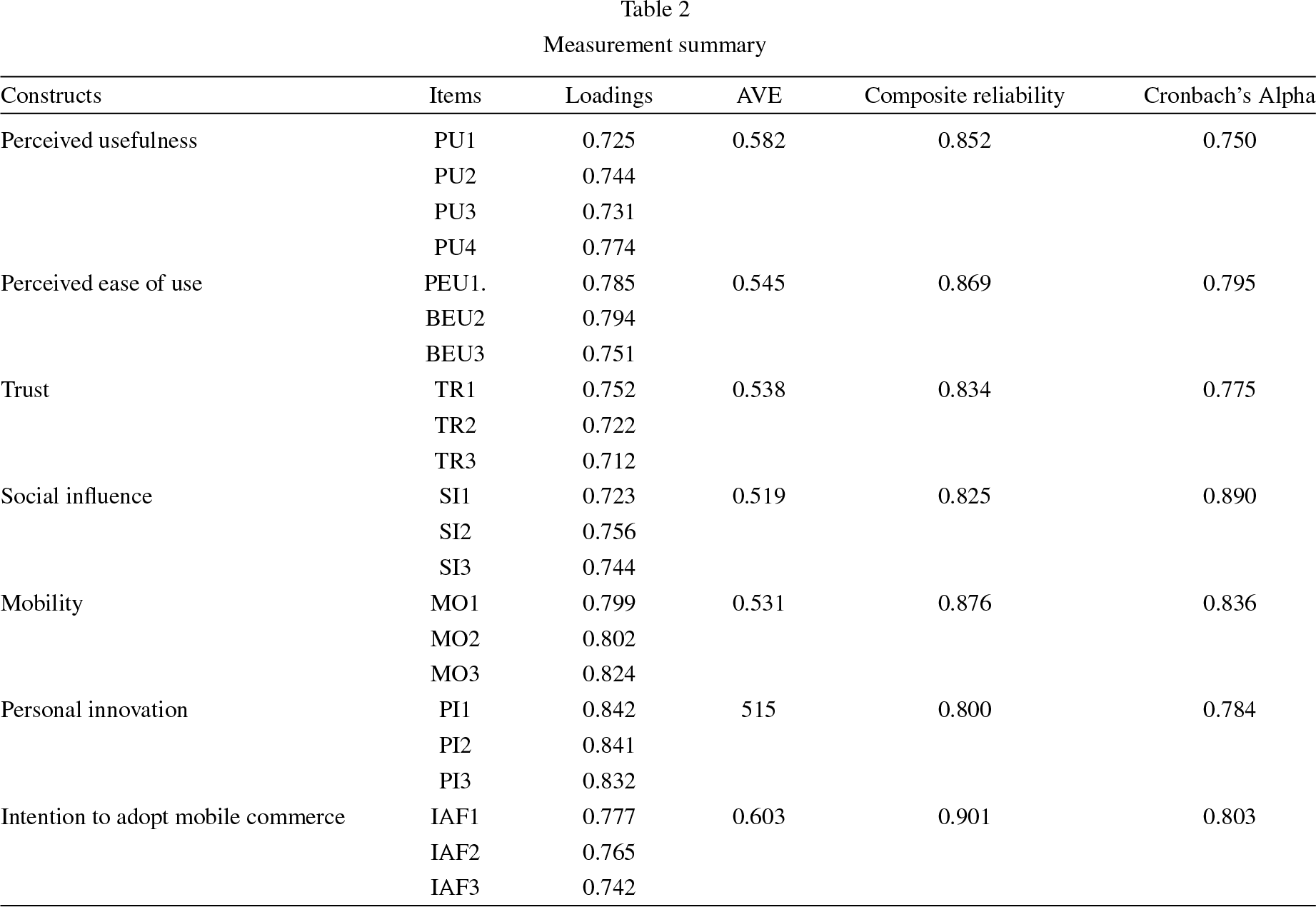
Specialized studies have indicated that reliability is achieved if the Cronbach’s alpha values exceed 0.7 [60, 61]. The values in this study ranged between 0.75 and 0.89, thus demonstrating strong internal consistency. Furthermore, as depicted in Table 2, all values were above the recommended minimum value of 0.07 as suggested by [62]. In terms of Average Variance Extracted (AVE), the values exceeded 0.5 [63–65]. indicating that the variance captured by the constructs is greater than the variance due to measurement error. Additionally, the values for Composite Reliability (CR) surpassed the suggested minimum level of 0.7 [62, 66], signifying that the measures have high internal consistency. Therefore, the study has achieved convergent validity.
Measurement summary
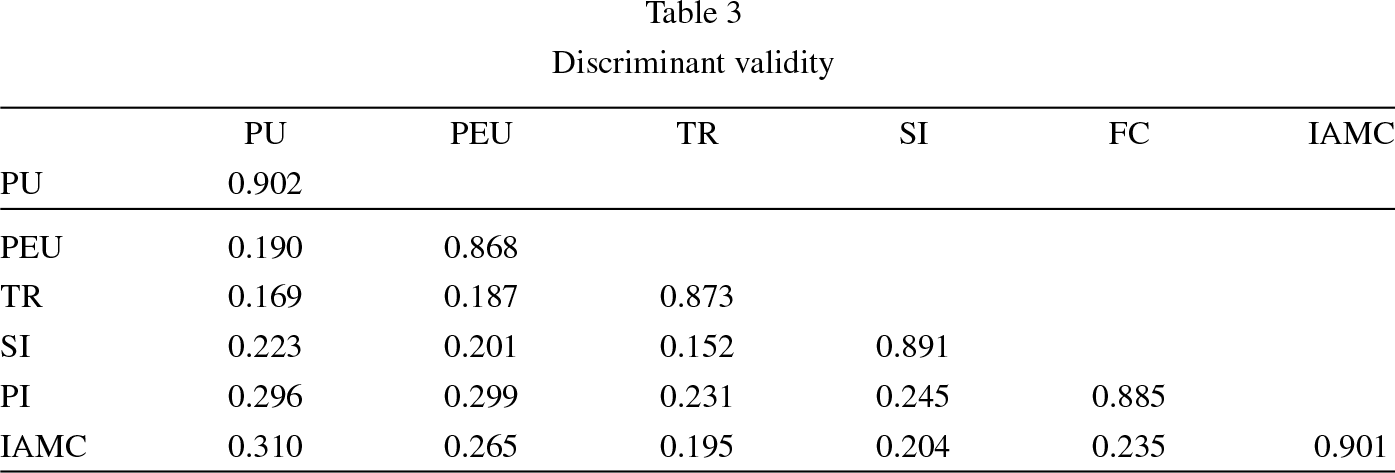
To ensure discriminant validity, there should be no significant correlation exceeding a certain threshold, typically 0.90, between two variables [65]. Table 3 demonstrates that all correlation values were below this threshold, indicating that the variables have adequate discriminant validity.
Discriminant validity
5.2. Structural model
The path analysis in Fig. 2 summarizes the support for six hypotheses and the rejection of one hypothesis. The study found that perceived usefulness is the most decisive factor for the intention to adopt mobile commerce (β= 0.396, p < 0.001). In contrast, perceived ease of use does not exhibit any statistically significant relationship with the intention to adopt mobile commerce (β= 0.035, p > 0.001). The results also indicated that trust is one of the most critical factors influencing the intention to adopt mobile commerce (β= 0.332, p < 0.001). Additionally, the study revealed that the remaining factors, including social influence (β= 0.190, p < 0.001), personal innovation (β= 0.136, p < 0.01), and mobility (β= 0.096, p < 0.05), played comparatively less significant roles in shaping the intention to adopt mobile commerce. Ultimately, the study found that the perceived usefulness of mobile commerce is strongly influenced by mobility (β= 0.187, p < 0.001).
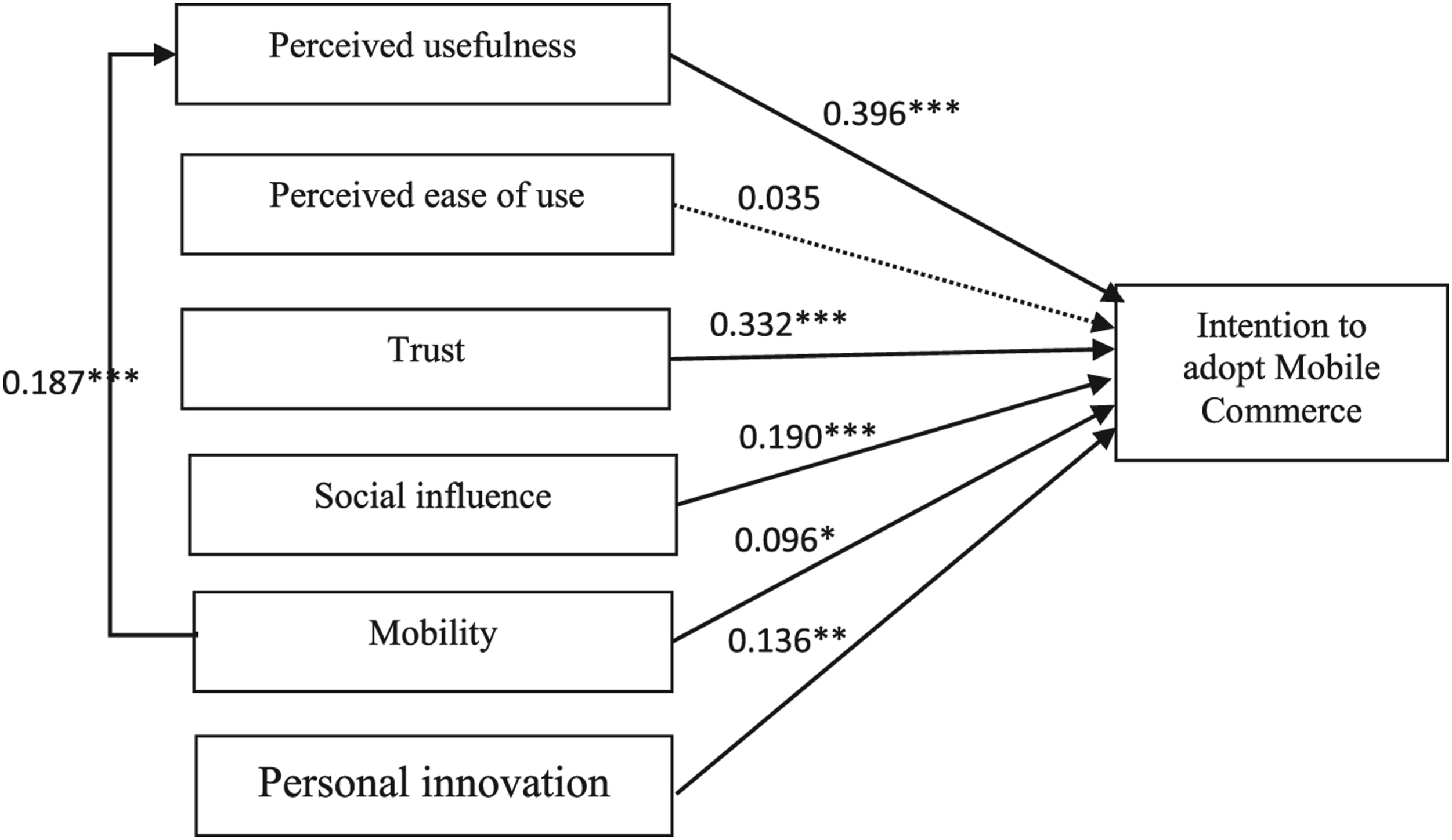
Results of path analysis.
6. Discussion
The findings indicated that intention to utilize this kind of service is significantly influenced by perceived usefulness. Customers should understand that mobile commerce is more advantageous and effective than traditional methods of making transactions. Businesses may encourage customers to adopt mobile commerce by promoting this belief. The investigation’s findings are in line with other research that highlights how important perceived usefulness in influencing consumers’ intentions to utilize mobile commerce [1, 36–38]. The findings showed that a key factor affecting consumers’ intentions to adopt mobile commerce is trust. Companies must prioritize protecting clients’ privacy and personal data, as well as bolstering security measures within the organization’s systems, if they hope to grow its clientele. Customers like to engage with businesses that have a high degree of safety in their operations and search for safe payment methods, especially with the recent advancements in hacking and fraudsters’ techniques of breaking into networks. These findings support earlier research by highlighting the critical role that trust plays in influencing consumers’ intention to use mobile commerce 1, 37, 38].
In this study, social influence significantly affects adoption intentions. A person’s immediate social circle, including his classmates, coworkers, and family, has a significant impact on his purchase decisions. The person regards them as a trustworthy source and mostly follows their advice. As a result, businesses need to focus on marketing their services by sharing positive client experiences and promoting their advantages on social media. These findings are in line with other studies that discovered a statistical connection between social influence and intention to use mobile commerce [5, 9, 43]. This study’s findings also highlighted the significance of personal innovation. People with an innovative mindset are more inclined to utilize mobile commerce applications since they are regarded as a contemporary technical novelty. These people are known for their inventiveness, inventiveness, and pursuit of technical advancements. Another thing that sets them apart is how curious they are to utilize new technologies. As a result, to draw in customers who are known for their own creativity, businesses must consider the modernization and innovation of their websites and applications. These results are in line with earlier studies that demonstrate a strong relationship between mobile commerce usage intention and personal innovation [55–57].
The current study shows that mobility has a positive effect on mobile commerce usage intention. The customer’s ability to complete the purchasing process whenever and wherever they want highlights the significance of mobility. Thus, as compared to traditional commerce, the attribute of mobility is seen to be one of the most significant benefits of mobile commerce. This is in line with other study findings that support the critical influence of mobility in determining the intention to utilize this service [49, 50]. Furthermore, mobility has significant effects on ease of use. This suggests that those who value mobility and use mobile devices more frequently have a stronger tendency towards m-commerce. These findings highlight how crucial it is to take mobility into account when creating and marketing mobile commerce services. There was no connection found between the intention to use mobile commerce and ease of use. This conclusion can be attributed, in part, to the study sample consisting primarily of people who are familiar enough with mobile commerce applications to be skilled users of these apps. As a result, they do not view usability as a barrier. Similarly, the Jordanian client sees usefulness as the primary advantage of this service. Contrary to this conclusion, the majority of pertinent research has demonstrated that perceived ease of use significantly influences the intention to use mobile commerce [1, 36–39].
7. Implications
This study identified several variables that affect consumers’ intention to adopt mobile commerce. The findings showed that one of the main benefits of mobile commerce is thought to be mobility. This benefit is the ability to execute transactions and purchases anywhere, at any time. This demonstrates how crucial it is to carry out an in-depth study on how this characteristic influences the uptake of digital services in various settings. The startling results of perceived ease of use call for a thorough reassessment of their ostensible significance in the adoption of new technologies. This raises doubts about the significance of perceived ease of use in the context of mobile commerce adoption and encourages researchers to look into this matter more.
Customers’ intention to use mobile commerce is significantly influenced by perceived usefulness. Businesses and developers need to use a variety of communication channels to promote the advantages of adopting these services. Pay close attention to the service’s efficacy as well as any potential benefits for the client. Another key element influencing how customers shape their intents is trust. It’s critical that businesses concentrate on winning over customers’ trust. This is accomplished by safeguarding his privacy, preserving private data, and utilizing carefully encrypted security technologies.
Since social influence plays a major role in drawing in clients, there are strategies to accomplish this aim. Some of these strategies include posting about positive client experiences on social media, encouraging word-of-mouth marketing, and implementing user referral systems. Given the intense rivalry among businesses today, organizations must consider this and integrate it with contemporary marketing strategies. Furthermore, businesses must continue to be interested in refining and updating their advertising and marketing strategies to draw in and pique the interest of creative consumers, as those who possess a high level of personal innovation have unique needs when it comes to their conviction in utilizing mobile commerce. Thus, while creating these apps, a few considerations need to be made, such as encouraging innovative use cases and creating a setting where users are motivated to do new things and learn about new technology.
Because mobility is a sensitive problem for clients utilizing mobile services, businesses must streamline the platform for transactions that happen while they are on the go. They should also improve cross-platform and cross-device interoperability, as well as offer customized location-based services, to improve the mobile commerce experiences for customers. By taking these theoretical and practical consequences into account, businesses, academics, and stakeholders may successfully handle the issues involved with embracing mobile commerce. Furthermore, promoting a user-centric approach that considers consumers’ requirements, inclinations, and preferred technologies may aid in enhancing the accomplishment of projects associated with mobile commerce.
8. Conclusion
This research delves into the factors that play a pivotal role in shaping the intention to adopt mobile commerce in Jordan. The study’s findings reveal that several factors, including perceived usefulness, trust, social influence, personal innovation, and mobility, significantly influence the adoption intentions of mobile commerce. Notably, the study underscores the impact of mobility on the perceived usefulness of mobile commerce. However, the research does not establish a statistically significant relationship between perceived ease of use and the intention to adopt mobile commerce. Stakeholders can utilize these insights to tailor their strategies and approaches effectively, thereby fostering the promotion and adoption of mobile commerce.
8.1. Limitations and future directions
It is critical to recognize the limitations of the research and to think about possible future research directions. There are certain restrictions and recommendations for more research. First, 436 Jordanian consumers provided data for the study. Although a sample size of this size can yield insightful information, it might not be a true representation of the total population. In order to increase the generalizability of the findings, future research might think about increasing the sample size or carrying out multi-location studies, particularly since adoption factors and consumer behavior can differ between cultural contexts and geographical areas. Second, quantitative analysis was used in the study to evaluate the research hypotheses. Although this approach is appropriate for some research goals, in the future, studies could combine qualitative and quantitative research techniques, like focus groups and interviews, to collect more detailed information and offer a more profound comprehension of the elements impacting the adoption of mobile commerce. Third: the study found that a number of variables, including perceived utility, trust, social influence, individual creativity, and mobility, affected adoption intentions. There might be additional factors, though, that this study did not examine. To obtain a more thorough understanding of adoption behavior, future research could look into examining other factors like perceived security, price sensitivity, and prior experience with mobile commerce. Finally, further studies may examine how different factors mediate and moderate the association between the factors found and adoption intentions. Potential mediators or moderators could include the impact of technological factors like internet speed and device capabilities, or demographic variables like age, gender, and income.
Footnotes
Acknowledgments
The author has no acknowledgments.