



Abstract
Keywords


1 Introduction
Ambidextrous leadership has emerged as a critical factor in navigating contradictory organizational goals [1, 2]. Management research has increasingly focused on ambidextrous leadership in recent years [3–5]. Ambidextrous leadership was defined as a leader’s ability to foster exploitation and exploration among followers, while flexibly switching between opening and closing leader behaviors as required by situational demands [5]. The literature highlights the importance of ambidextrous leadership in fostering flexibility and adaptability among subordinates in dynamic environments, and in driving individual ambidextrous behaviors and team innovation [6, 7].
Existing research has primarily focused on the positive effects of ambidextrous leadership on subordinates, including improved self-efficacy[8], harmonious passion [4], trust in leaders [9], and creative performance [10]. However, there has been comparatively less attention given to understanding how ambidextrous leadership affects the leaders themselves. Specifically, leadership is regarded as a social process involving changes in leaders’ resources, which in turn have downstream effects on the workplace well-being of leaders [11, 12]. Scholars argue that the lack of theoretical frameworks addressing the effects of ambidextrous leadership on leaders’ well-being is a notable concern. This issue arises because leaders function as the cornerstone of organizations, and their effectiveness and well-being are essential for organizational success. Recent evidence suggests that ambidextrous leadership has a beneficial effect on leaders themselves [12], yet engagement in ambidextrous leadership may also deplete leaders’ cognitive and emotional resources[13]. This contradictory conclusion highlights the need for further exploration into whether and how ambidextrous leadership is beneficial or detrimental to leaders.
To understand the above question, we propose an integrative model wherein ambidextrous leadership indirectly impacts leaders’ work engagement through processes of resource generation and resource consumption (i.e., positive affect and ego depletion) by adopting conservation of resources (COR) theory. In this research, we consider work engagement as the outcome variable. Work engagement refers to a fulfilling work-related state of mind characterized by higher levels of vigor, absorption, and dedication, which contribute to one’s well-being [14]. On one hand, ambidextrous leadership has the potential to elevate leader’s positive affect by generating important resources. Positive affect, viewed as a key to well-being, encompasses emotional states characterized by being active, enthusiastic, and inspired. COR theory considers resources to be anything that can help individuals achieve their objectives, motivate them to obtain, retain, and protect their resources [15]. By engaging in ambidextrous leadership, leaders may acquire valuable psychological resources, such as trust and leader identification from their followers [16], those esteemed resources are useful to increase leader’s positive affect. Consequently, the acquisition of positive affect as a resource will perpetuate the acquisition of new resources and further engagement in work-related efforts. On the other hand, ambidextrous leadership may be a cause of leaders’ ego depletion by consuming personal resources. Ego depletion refers to a state where an individual’s psychological resources are depleted after engaging in activities that require self-regulation. According to COR theory, job demands lead to a depletion of resources, prompting individuals to resort to avoidant behaviors to shield against further resource loss[17]. Ambidextrous leadership entails the integration of two seemingly conflicting actions, necessitating sustained cognitive effort and self-regulation, which can deplete leaders’ psychological resources, potentially leading to ego depletion. Thus, ego depletion motivates individuals to take measures to safeguard their resources, often by reducing their work engagement.
Moreover, COR posits that key resources, such as emotional intelligence (EI), can shape the resource generation or consumption process [17]. Therefore, we integrate leader’s emotional intelligence into the model and investigate its moderating role. We contend that EI equips individuals with access to additional role resources, enabling effective regulation of emotions and adaptation to complex job demands. Consequently, leaders with higher EI are likely to experience lower levels of stress and exhibit more positive affect [18]. Conversely, individuals with lower EI may struggle to navigate job complexity, leading to heightened depletion, particularly when engaging in ambidextrous leader behaviors. Thus, we hypothesize that the impact of ambidextrous leader behaviors on psychological resource generation or consumption is contingent upon the leader’s level of EI.
Overall, our study makes three key contributions. First, unlike previous literature primarily focusing on the outcomes of ambidextrous leadership on followers, our research adopts a leader-centric perspective to investigate whether ambidextrous leadership influences leaders’ work engagement. In doing so, we respond to calls for greater attention to be directed towards leaders themselves in the realm of leadership development [19, 20]. Second, by introducing positive affect and ego depletion as two distinct pathways, we propose a theoretical framework that allows for the simultaneous examination of resource-generating and resource-consuming processes linking ambidextrous leadership to leaders’ work engagement. Third, our research contributes to the literature by exploring the boundary conditions under which ambidextrous leadership can be beneficial or detrimental for leader themselves. Our theoretical model reveals that individual characteristics, such as Emotional Intelligence (EI), can shape the varied influences of ambidextrous leadership on leaders.
2 Theory and hypothesis development
2.1 Ambidextrous leadership
Rosing (2011) proposed the concept of ambidextrous leadership, which is defined as the ability to flexibly switch between opening and closing leader behaviors to promote exploration and exploitation among followers [5]. Opening leader behaviors encourage followers to challenge routines and think independently, fostering exploration and the pursuit of new ideas [5, 21]. Conversely, closing leader behaviors focus on maintaining decision control and monitoring goal attainment to reduce variability and promote exploitation among followers [5, 22]. Thus, followers dare to challenge established approaches and explore new ideas and directions through experimentation under the impact of opening leadership, and followers under closing leadership adhere to specific rules and regulations. Although the purposes of these two behaviors differ, a skilled leader can effectively perform both types in a balanced manner [5, 8].
2.2 The mediation role of positive affect
Positive affect is an emotional state characterized by feelings of inspiration, enthusiasm, and excitement [23, 24]. Drawing from COR theory, we propose that ambidextrous leadership is likely to improve leader’s positive affect by generating important resources. First, opening leadership entails empowering subordinates and providing them with opportunities to explore new approaches. As a result, subordinates’ loyalty and commitment are activated, leading to the development of high-quality leader-member exchange relationships [25]. This may enhance leaders’ emotional resources by fulfilling relatedness needs and enhancing feelings of self-worth. Observing subordinates’ identification and interpersonal trust is likely to be encouraging and satisfying for leaders’ need for relatedness. Existing research has shown that the fulfillment of psychological needs is associated with positive affect [19]. Therefore, opening leadership can enhance leaders’ positive affect by acquiring personal resources, such as the heightened fulfillment of relatedness needs.
Second, closing leadership involves providing employees with clear guidelines and monitoring goal achievement [5]. In other words, leaders’ closing behavior encourages followers to comply with orders and rules, thereby enhancing leaders’ sense of control and influence [26]. Research suggests that an enhanced sense of control can improve one’s positive affect [27], indicating that leaders exhibiting closing leadership are more likely to experience this affective state. Additionally, helping followers recognize role boundaries and fulfill prescribed duties also contributes to leaders’ positive affect [28]. Hence, leaders exhibiting closing leadership are likely to experience an increase in positive affect.
Third, ambidextrous leadership entails both opening and closing leader behaviors, allowing leaders to integrate these different actions in a well-balanced manner [5]. Consistent with COR theory, a manager’s ability and skills to execute various actions in an integrated manner are regarded as important resources for meeting contradictory job demands [17], facilitating progress toward different goals, which further elicits positive states [29, 30]. Furthermore, ambidextrous leadership is perceived as more effective by both leaders and followers, this positive performance feedback communicates to leaders that they are capable of achieving organizational goals. Previous studies have also shown that perceived competence, as a valued psychological resources, can improve positive affect [31, 32]. Therefore, leaders who exhibit ambidextrous leadership are more likely to experience higher positive affect.
H1: Ambidextrous leadership is positively associated with positive affect.
We further argue that increased positive affect can enhance leaders’ work engagement. A high level of positive affect can augment leaders’ cognitive and psychological resources, expanding their attention and thought-action repertoires [33, 34], thereby fostering vigorous, dedicated and absorbed in their job roles. Moreover, prior research has indicated that individuals experiencing higher levels of positive affect are more inclined to be engaged in their work [35, 36]. Thus, we propose the following hypothesis:
H2: Leaders’ positive affect is positively associated with their work engagement.
Overall, ambidextrous leadership facilitates managers in experiencing positive affect, and positive affect serves as a significant predictor of work engagement. Therefore, we anticipate that ambidextrous leadership may exert a positive indirect effect on leaders’ work engagement through positive affect.
H3: Positive affect mediates the relationship between ambidextrous leadership and leaders’ work engagement.
2.3 The mediation role of ego depletion
The core tenet of COR theory is the primacy of resource loss, which posits that psychological damages of resource loss outweigh the benefits of resource gain [17]. Consequently, ego depletion occurs when individuals are less capable of converting resource expenditures into gains. Ego depletion, a mechanism of resource consumption, refers to the reduced capacity to engage in volitional actions [37].
Ambidextrous leadership demands that leaders exercise self-control, as it requires them to balance between opening and closing leadership behaviors. Since self-control is a finite resource, individuals with fewer available self-control resources are prone to experiencing ego depletion [38]. Specifically, leaders may experience depletion when engaging in opening leadership, which involves empowering employees and encouraging explorative thinking [5, 39]. In such instances, leaders must exercise self-control by suppressing their authority and biases. For instance, when promoting idea generation, leaders must restrain their inclination to provide specific directives and regulations, allowing employees to challenge authority[5]. Similarly, closing leadership behaviors also require self-control, as leaders must refrain from excessive delegation to prevent subordinates from deviating from organizational goals. Instead, they must meticulously monitor goal achievement and maintain a low tolerance for mistakes[5]. These self-restrictive actions in exercising power or authorization can significantly deplete self-control resources. Consequently, when leaders experience resource depletion, they may incur costs such as ego depletion.
Furthermore, ambidextrous leadership may be viewed as a demanding role behavior [5, 40], which requires sustained psychological and/or physical effort and consumes leader’s finite pool of resources. Rosing (2011) posited that ambidextrous leaders need to be precise and flexible to switch opening and closing behaviors in line with the requirements of the situation. Untimely switches from opening to closing behaviors may result in employees feeling controlled and lacking confidence in generating novel ideas. Conversely, delayed switches may leave employees without clear guidance, leading to confusion and unrealistic actions [4]. Being ambidextrous requires leaders to carefully consider the appropriate timing for transitioning between different types of leadership behaviors [5], thereby continuously taxing their limited resources and further contributing to their depletion [15, 41].
H4: Ambidextrous leadership is positively associated with leaders’ ego depletion.
Work engagement refers to the investment of personal efforts and energies into role performance in the workplace [42]. Conservation of resources theory suggests that people are motivated to engage in avoidant behaviors to protect against further loss of resources when they experience resource consumption [43]. According to Muraven (2000), depletion impairs the attention and efforts that an individual can allocate to their work roles [44]. Thus, ego depletion prompts people to take action to protect their resources by decreasing their work engagement, because engagement requires people to devote regulatory resources to their job. Previous research also showed that ego depletion is negatively associated with work engagement [45]. We further propose that depletion of personal resources is likely to diminish leaders’ engagement at work.
H5: Ego depletion is negatively associated with leaders’ work engagement.
Overall, ambidextrous leadership is likely to induce ego depletion for leaders, which in turn may lead to reduced work engagement [46, 47]. Thus, we propose that ambidextrous leadership may decrease leaders’ work engagement via the mediating effect of ego depletion.
H6: Ego depletion mediates the relationship between ambidextrous leadership and work engagement.
2.4 The moderation effect of emotional intelligence
COR theory suggests that personality traits influence individuals’ reactions to resource gains or losses [28, 48]. Accordingly, we draw on emotional intelligence (EI), considered a personal resource characteristic, as a moderating variable that may influence the strength of the relationship between ambidextrous leadership and its outcomes.
Emotional intelligence is defined as the ability to perceive, manage, control and regulate one’s own emotions and actions [49, 50]. According to COR theory, individuals with abundant resources are more likely to continuously acquire additional resources, whereas those with limited resources are prone to resource depletion. EI is considered a fundamental psychological resource that enables individuals to effectively manage their emotions and acquire contextual resources through interpersonal interactions [51]. Therefore, individuals with high EI are inclined to prioritize resource acquisition and anticipate improved performance. In other words, emotionally intelligent leaders perceive “displaying ambidextrous leader behaviors” as an effective means to obtain resources and achieve organizational success. By engaging in ambidextrous leadership, leaders can help the organization in achieving task efficiency and innovation performance [5, 8]. Furthermore, leaders can perceive trust from subordinates as well as foster harmonious social relationships with them through ambidextrous leadership [4]. These positive feedback and resources enable leaders to experience more positive affect. Hence, positive emotion may be stronger for emotionally intelligent leaders when displaying ambidextrous leader behaviors.
H7a: Emotional intelligence moderates the relationship between ambidextrous leadership and positive affect, such that the relationship is stronger when leaders have high EI.
Ambidextrous leadership is hypothesized to be indirectly associated with leaders’ work engagement through positive affect, and EI is expected to moderate the relationship between ambidextrous leadership and positive affect. We further propose that the positive indirect effect of ambidextrous leadership on leaders’ work engagement through positive affect is stronger when EI is high.
H7b: Emotional intelligence will moderate the positive indirect effect of ambidextrous leadership on work engagement through positive affect, such that the indirect effect will be stronger when EI is high.
When leaders have a larger pool of psychological resources, they have more self-regulatory resources to deal with the behavioral demands, thus weakening the positive effect of ambidextrous leadership on depletion [52]. Specifically, EI is the ability that aids individuals in avoiding dysfunctional emotions and regulating their own feelings and actions [53, 54]. Therefore, leaders with high EI have ample resources for self-regulation, allowing them to replenish continuously depleted resources [51]. In contrast, leaders with low EI are more susceptible to resource loss due to their inadequate emotional resources to regulate ambidextrous behaviors consistently. These leaders may perceive “engaging in ambidextrous leadership” as a potential threat to their resources, thus heightening their awareness of resource depletion. Consequently, leaders with low EI are more likely to experience depletion when engaging in ambidextrous leadership.
H8a: Emotional intelligence moderates the relationship between ambidextrous leadership and ego depletion, such that the relationship is stronger when leaders have low EI.
Given that low EI is hypothesized to strengthen the effect of ambidextrous leadership on ego depletion, and reduced resources will decrease their work engagement, we propose that the negative indirect effect of ambidextrous leadership on leaders’ work engagement through ego depletion is stronger when EI is low.
H8b: Emotional intelligence will moderate the negative indirect effect of ambidextrous leadership on work engagement through ego depletion, such that the indirect effect will be stronger when EI is low.
Our research model is illustrated in Fig. 1.
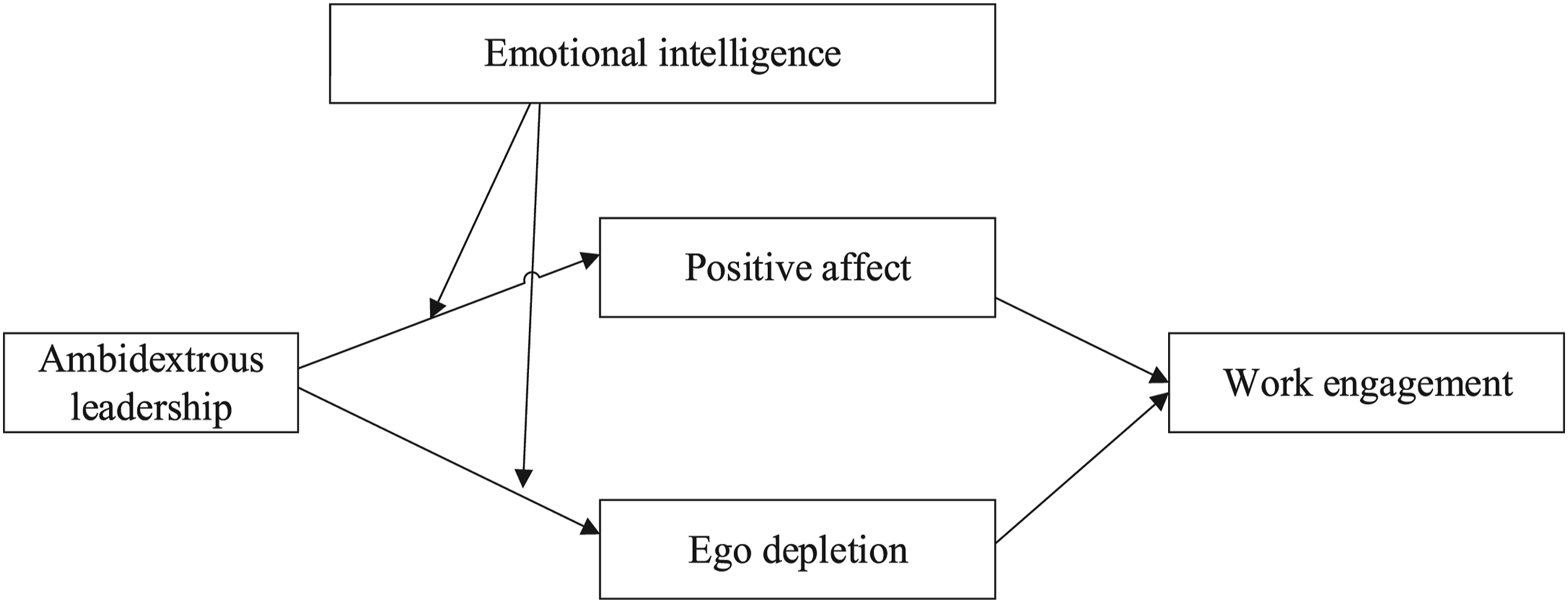
A Theoretical Model.
3 Research method
3.1 Participants and procedures
To investigate the proposed theoretical framework, participants were recruited from Credamo, a reputable online survey service provider in China. Credamo serves as a professional online platform offering paid survey services for governmental bodies, corporations, and researchers. With a track record of recruiting over 2.8 million online participants through various means, Credamo has provided research services to over 2,000 universities and colleges worldwide. It is widely recognized for its ability to provide valid and representative samples [55, 56].
We constructed our questionnaire on the Credamo platform and compensated the research institution for each completed survey. In the first section of the survey, we introduced the research background and explained that this survey would be administered twice over a three-month period. Then, participants were informed that their involvement was voluntary, anonymous, and confidential, and were instructed to complete the survey according to the fact. Additionally, we assured participants that their responses would be exclusively utilized for academic research purposes.
We targeted participants holding managerial positions within businesses. Prior to the formal survey, we screened participants by asking, “Are you an employee or a manager?” Respondents indicating that they were not managers were prevented from proceeding with the survey. We finally recruited 300 targeted managers. We conducted a time-lagged design to minimize common method variance. At Time 1, we collected participants’ demographic information (including age, job tenure, education, and gender), along with measures of emotional intelligence, opening leadership, closing leadership, and job demands. We received 255 completed questionnaires from the invited respondents, yielding an 85% response rate; 59.22% of respondents were male. One month later, at time 2, managers who had completed the first-wave survey were invited to rate their positive affect, ego depletion, and work engagement. Out of the 255 questionnaires sent, 194 were returned, resulting in a response rate of 76.08% . However, eighteen participants detected as careless responses were excluded, and twenty-three participants failed to select a specific response to the attention check. Therefore, our final sample consisted of 153 participants who provided valid data at both time points.
Among all respondents, 60.78% were men. Their average age was 32.86 years (SD = 4.70). Of the total, 9.15% of respondents had a junior college or below, 74.51% had a bachelor’s degree, and 16.34% had a master’s degree (13.6% ). In addition, the average organization tenure of respondents was 3.2 years (SD = 0.86).
3.2 Measures
All items used in our study were initially developed in English and then translated into Chinese using a back-translation procedure. Specifically, one bilingual assistant translated the English version into Chinese, while another assistant translated the items back into English. The Chinese version was finalized after discrepancies were discussed with both bilingual assistants to reach a consensus.
Ambidextrous leadership. Ambidextrous leadership was measured using Rosing et al.’s 14 items. Opening leader behavior was assessed using seven items (α= 0.78). Sample item is “Encouraging experimentation with different ideas”. Closing leader behavior was assessed using seven items (α= 0.76), such as “Monitoring and controlling goal achievement”. Respondents used a five-point scale ranging from 1 = strongly disagree to 5 = strongly agree. We followed the ambidexterity theory of leadership to score ambidextrous leadership by computing the multiplicative interaction between opening and closing leader behavior [57, 58].
Positive affect. We measured managers’ positive affect with a 5-item scale developed by Mackinnon and colleagues (1995) [23]. A sample item is “I feel enthusiastic.” The scale ranged from 1 = never to 5 = always. α= 0.78.
Ego depletion. We measured ego depletion with Twenge et al.’s 3-item [59], which is proved to be validated by Liao et al. (2020) [60]. A sample item is “I feel drained.” The scale ranged from 1 = never to 5 = always. α= 0.85.
Work engagement. We used nine items from Schaufeli et al. [61] to measure work engagement. Sample items are “At my work, I feel strong and vigorous” (Vigor), “My job inspires me” (Dedication), and “I am immersed in my work” (Absorption). Participants rated the items on a five-point scale ranging from 1 = never to 5 = always. α= 0.92.
Emotional intelligence. We measured EI with 16 items from Law et al. [54]. Sample items are “I am sensitive to the feelings and emotions of others”, “I have good control of my own emotions” and “I am a self-motivating person.” The scale ranged from 1 = strongly disagree to 5 = strongly agree. α= 0.87.
Control variables. We controlled for leaders’ age, gender, education, and job tenure. In previous research, job demand has been shown to predict resource depletion [62]. Thus, we also controlled for job demand, which is measured with eight items from Janssen [63]. A sample item is “Do you have too much work to do?” The scale ranged from 1 = never to 5 = always. α= 0.96.
4 Results
4.1 Confirmatory factor analysis
We evaluated the discriminant validity of the variables using confirmatory factor analyses (CFA) conducted in Mplus. Following common practice, we formed four parcels for emotional intelligence according to four dimensions and created three parcels for other variables to simplify the measurement model. The analysis of the proposed seven-factor model yielded a better fit (χ2= 348.02, p < 0.01, χ2/df = 1.53, CFI = 0.94, TLI = 0.93, RMSEA = 0.06) than alternative models. The results are presented in Table 1.
Results of the confirmatory factor analysis

Notes: OB=opening leader behaviors, CB = closing leader behaviors, PA = positive affect, ED = ego-depletion, WE = work engagement, EI = emotional intelligence, JD = job demand.
4.2 Descriptive statistics and correlations
Table 2 presents the means, standard deviations, skewness, kurtosis and correlations for all variables. Ambidextrous leadership was positively related to positive affect (r = 0.28, p < 0.01) and work engagement (r = 0.30, p < 0.01) and negatively related to ego depletion (r=–0.10, p > 0.01). Positive affect was positively associated with work engagement (r = 0.75, p < 0.01), and ego depletion was negatively related to work engagement (r=–0.48, p < 0.01).
Descriptive statistics and correlations

Note: N = 153, *P < 0.05; **P < 0.01.
4.3 Hypotheses test
We tested our hypotheses using path analysis in Mplus. According to a procedure developed by Preacher and Hayes [64], we used the bootstrap method to test the mediation hypotheses. The mediation model has an acceptable fit (χ2/df = 1.84, p < 0.05, CFI = 0.93, TLI = 0.92, RMSEA = 0.07).
The association of ambidextrous leadership with positive affect was positive and significant (B = 0.31, p < 0.01), supporting H1. In turn, positive affect was significantly and positively related to work engagement (B = 0.82, p < 0.01), supporting H2. In support of H3, the indirect effect of ambidextrous leadership on leaders’ work engagement through positive affect was positive and significant, with a 95% confidence interval (CI) excluding zero in a bootstrapping test run 5,000 times (indirect effect = 0.26, CI = [0.09, 0.43]). Thus, H3 was supported. In addition, ambidextrous leadership was negatively associated with ego depletion, but not significantly (B = – 0.13, p > 0.05). In turn, ego depletion was negatively and significantly related to leaders’ work engagement (B = –0.27, p < 0.05). The indirect effect of ambidextrous leadership on leaders’ work engagement through ego depletion was positive and nonsignificant (indirect effect = 0.03, 95% CI = [–0.00, 0.12]). Thus, H5 received support, but H4 and H6 were not supported.
Then, we tested moderation and moderated mediation effects. Table 3 shows the results of the moderating effect of EI and the corresponding moderated mediation effect. As shown in Table 3, the interaction effect of ambidextrous leadership and emotional intelligence on positive affect was positive but not significant (B = 0.02, p > 0. 05). Thus, H7a and H7b were not supported.
Moderation and moderated mediation effects
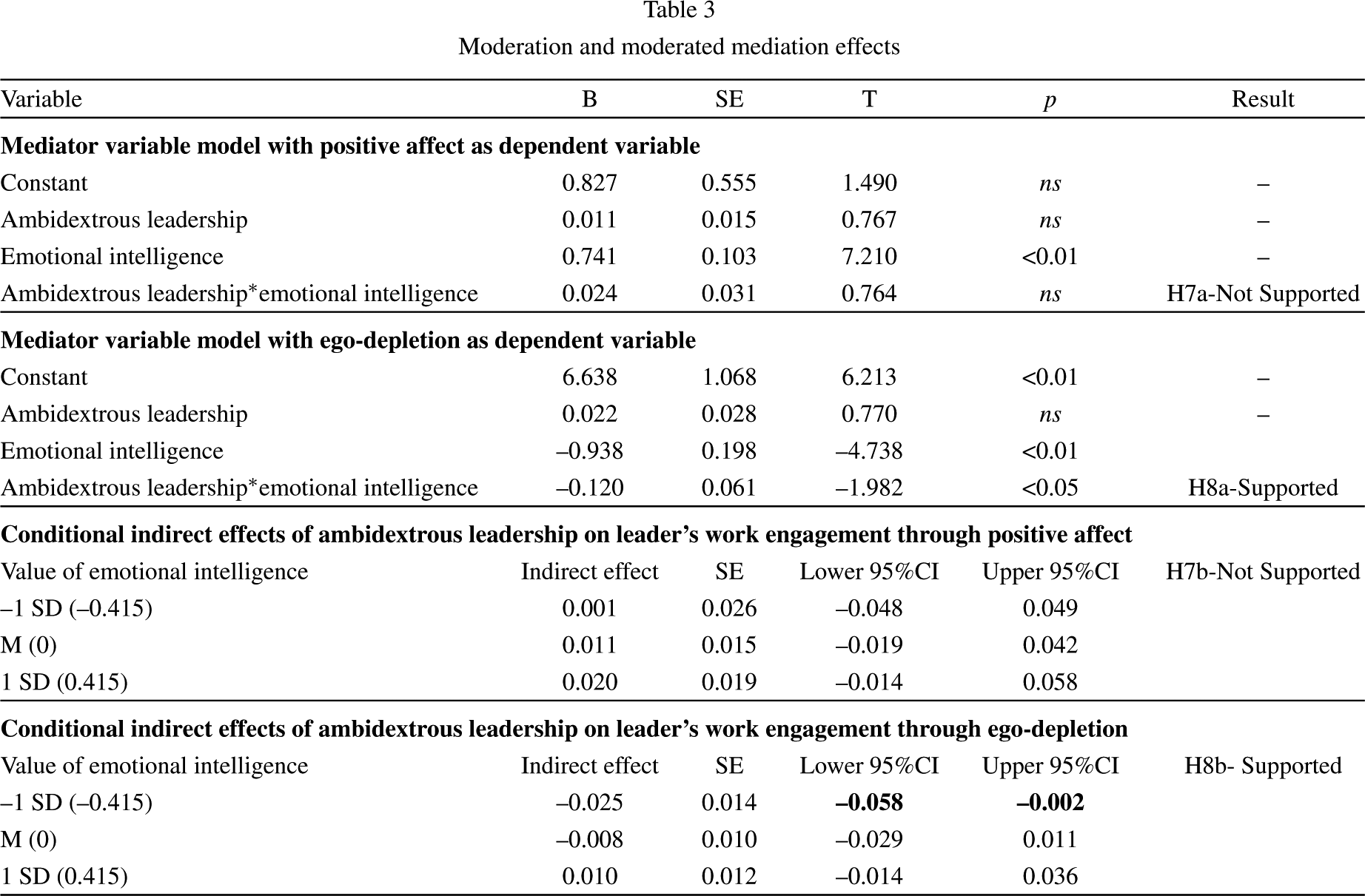
In addition, consistent with our H8a, the negative interaction effect between ambidextrous leadership and EI on ego depletion was significant (B = –0.12, p < 0.05). We then analyze plot simple slopes. The plot is shown in Fig. 2. Furthermore, the simple slope test showed that ambidextrous leadership was positively and significantly related to ego depletion under a low level of EI (simple slope = 0.14, p < 0.05), but the relationship was negative and nonsignificant when leaders’ EI was higher (simple slope = –0.01, n.s.). To support H8b, we bootstrapped the CIs to estimate whether EI also moderated the indirect effects of ambidextrous leadership on leaders’ work engagement via ego depletion. The results indicated that the conditional indirect effect was significant (indirect effect = –0.03, 95% CI = [–0.06, –0.00]) when EI was low. However, when EI was high, the conditional indirect effect was not significant (see Table 2). To sum up, the above evidence supports H8a and H8b.

Interaction Effect of Ambidextrous Leadership and Emotional Intelligence on Ego Depletion.
5 Discussion
This study examined how ambidextrous leadership influences leaders’ work engagement drawing from COR theory. The findings revealed that ambidextrous leadership was positively associated with leaders’ work engagement through increased positive affect. Surprisingly, our results did not align with the expected detrimental effect of ambidextrous leadership on depletion. However, we observed that leaders experienced greater ego depletion and reduced engagement only when they exhibited a low level of emotional intelligence (EI).
5.1 Theoretical contributions
First, this study contributes to the existing body of knowledge by examining the consequences of ambidextrous leadership on leaders themselves. Previous research has predominantly emphasized the positive outcomes of ambidextrous leadership on employees or organizations, such as enhanced self-efficacy and innovation performance [8, 10]. However, there has been limited attention given to investigating whether and how leaders engaging in ambidextrous behaviors impact themselves. Considering that leader behaviors are intricately linked to social exchange processes that influence not only their followers but also the leaders themselves, it becomes imperative to focus on the outcomes of ambidextrous leadership for leaders. Our study takes a significant step towards exploring the effects of ambidextrous leadership on leaders themselves, thereby expanding the current understanding of ambidextrous leadership studies from the follower’s perspective to the leader’s perspective.
Second, this study broadens the scope of COR theory by integrating it into the realm of ambidextrous leadership. We take a leader-centric perspective to investigate how ambidextrous leadership affects leader work engagement through the mechanism of resource generation (i.e., positive affect) and resource consumption (i.e., ego depletion). The limited research that has examined the effects of ambidextrous leadership on the actor has predominantly focused on its resource generation [12], but as shown in this work, ambidextrous leadership has negative consequences as well. Our findings support Keller and Weibler’s (2014) assertion that maintaining a balance in ambidexterity may strain personal cognitive resources and lead to adverse outcomes [13]. By exploring both the positive and negative effects of ambidextrous leadership, our study enhances our current understanding of the mechanisms behind its potential benefits or drawbacks for leaders themselves.
Third, we were successful in revealing leader personality as a boundary condition influencing the extent to which that dark side appears. We identified leader emotional intelligence as a factor influencing whether ambidextrous leadership are consumed. The results support the hypothesis that, leaders with lower EI are likely to experience role stress and depletion when performing ambidextrous leader behaviors, because they have fewer cognitive or psychological resources with which to regulate and replenish the self-control resources they consume. Our consideration of leader emotional intelligence adds to a comprehensive understanding of when ambidextrous leadership is beneficial or harmful for leaders and highlights the importance of taking personal factors into consideration in the research of how ambidextrous leadership affects leader themselves.
5.2 Practical implications
In terms of management practice, organizations need to be aware that emphasizing the value of ambidexterity for managers may cause cognitive stress for leaders. This is particularly the case for managers with specific characteristics, such as a lower level of EI. Indeed, ambidextrous leadership is required to manage the complex nature of the innovation process. In these contexts, organizations should provide support or stress-reduction activities to replenish leaders’ resources and buffer the negative outcomes of ambidextrous behaviors.
Moreover, given that ambidextrous leadership may have negative effects on leaders, organizations should be careful of placing leaders with a low level of EI in positions where they need to perform ambidextrous leader behaviors. Our results suggest that leaders who are hard-pressed to integrate opening and closing leadership are more likely to experience exhaustion or depletion. Thus, human resources professionals ought to recognize that individual differences affect leaders’ resources at work and take effective measures to improve leaders’ emotional regulation abilities. Furthermore, organizations could establish a high level of EI as a criterion for managers’ selection and promotion, thereby reducing leaders’ susceptibility to resource depletion resulting from the multiple contradictory demands of management.
5.3 Limitations and future directions
Although our study makes several contributions, it has some limitations that should be considered. First, our study only investigated the effect of ambidextrous leadership on leaders’ work engagement. We did not consider whether other factors or additional leadership styles also influence their engagement. Thus, it may be important to consider other factors as control variables in future research. Second, all variables in our study were obtained from the same source; in other words, the collected data were self-reported by leaders. This may introduce common method bias and affect the reliability of the results. Future studies could employ multi-source data collection methods to mitigate this limitation and provide a more comprehensive understanding of the relationships examined. Third, the mediating effect of ego depletion was not supported without considering the moderating effect. Hence, based on COR and other theories, it would be meaningful to explore other possible negative outcomes, such as role stress or experience tension, as other scholars have posited that dual-oriented leaders may experience more psychological stress. Finally, although we focus on leaders’ EI as a moderator of the effects of ambidextrous leadership, other individual characteristics may also serve as moderators. An example of such a characteristic is paradox mindset, which is defined as the extent to which people accept and are energized by tension [66, 67]. A paradox mindset can shape how people make sense of the tension they experience and mitigate the negative potential effects of tension. Leaders with a high paradox mindset would embrace tension and acknowledge the potential benefits of engaging in ambidextrous behaviors. Thus, future research should consider the role of the paradox mindset playing in ambidextrous leadership.
Footnotes
Acknowledgments
This work was supported by the Jiang Open University Scientific Research Planning Project [grant numbers 2023XK012], the National Natural Science Foundation of China [grant numbers 72002154], and the Humanities and Social Sciences of Ministry of Education Planning Fund of China [grant number 20YJC630042].
Author contributions
For every author, his or her contribution to the manuscript needs to be provided using the following categories: CONCEPTION: Miaomiao Wang, Wenan Hu, Shuangshuang Chen.
METHODOLOGY: Miaomiao Wang
DATA COLLECTION: Miaomiao Wang
INTERPRETATION OR ANALYSIS OF DATA: Miaomiao Wang
PREPARATION OF THE MANUSCRIPT: Miaomiao Wang, Shuangshuang Chen
REVISION FOR IMPORTANT INTELLECTUAL CONTENT: Miaomiao Wang, Wenan Hu
SUPERVISION: Shuangshuang Chen