



Abstract
Background
With Big Resignations on and the job hopping trend difficult to stop, HR needs to arrive at a less frustrating and more relevant approach that can curtail employee turnover in the first place and arrive at a mutually beneficial approach for both parties in case they decide to depart. The turnover intentions of employees are an outcome of uncertainty at work, toxic work culture, lack of appropriate work-life balance, stagnation in career, lack of mental well-being or improper monetary compensation. It also is influenced by the work experience of employees within the organization and trust at the workplace. When an employee decides to quit, he is already mentally gone, here it becomes even more critical to ensure that they stay relatively engaged during the transition so as to ensure effective knowledge transfer. Within the given context, what should be the duration of a notice period? How can organizations ensure a win- win approach for both employer and employee so as to ensure effective knowledge transfer? The paper is an attempt towards exploring this aspect further so as to arrive at a mutually beneficial approach both from the employer and employee perspective.
Objective
With an objective to review the ‘process and mindset’ which are often counterproductive when an employee responds to dissatisfaction at work, the paper aims to look at the ideal duration of a notice period and the context in which it works best.
Methodology
Based on a mini thematic review and using a qualitative approach, the paper explores the current trends, challenges and implications of big resignations to HR as well the problems associated with the different duration of a notice period. An empirical attestation of the study can further validate the feasibility of a notice period that varies across jobs, organizations, industry and levels. It can further be validated empirically the impact of “open discussions about career transitions and job opportunities as less taboo” at workplace on employee engagement of people while on notice period as well employee retention in organizations.
Results
Employees need to be engaged even during their notice period, which may be possible only by ensuring a culture that promotes honest and open dialogues between employer and employee without any fear of reprisal when they are vocal about being unhappy in their jobs. An ideal notice need not be a ninety days, two months or two weeks period but has to vary across jobs, organizations and industry depending on the experience; job role; seniority; technicality; industry; availability of a person ready to take charge; or even period of employment of the leaving employee with the organization. The notice period works best i.e. ensures effective knowledge transfer within a workplace setting where job prospects or career transitions are considered less taboo and where the different reactions to dissatisfaction at work (EVLN) are handled through a ‘culture of open communication’, problem solving through ‘Happy, Present, Engaged’ conversations, “Training towards receiving & giving feedback and a ‘smooth transition’ in case the employee decides to quit.
1. Introduction
Working people when resort to mass resignations from their jobs, empowered with self-reliance and new skills, it is called ‘The Great Resignation’ [1]. The pandemic has considerably changed the thought process of people about their work and lives in general and has also drastically led to employee turnover both mandatorily and voluntarily. Moreover today the reality is that job- hopping or for that matter even career hopping has become very common for the younger generation of employees [2].
With the ‘Big resignations’ also called the ‘great resignations’ and the silent resignations an emerging concern for HR today, and the job hopping trend difficult to stop it becomes vital to reach on to a less frustrating and more relevant approach for employers that can lead to reduced turnover in the first place or even a mutually beneficial approach for both parties in case they decide to depart by means of an ideal notice period. This can facilitate knowledge transfer at the organizational level and a smooth exit as well a positive feedback during a backchannel reference check for the departing employee.
The Information Technology sector is witnessing almost a 52 percent increase in the hiring of skilled professionals indicating an immense requirement for a skilled workforce as well as high job changes [3].The resignations among low-wage workers have been more as compared to their counterparts and the sectors mostly affected include retail, education, hospitality, and transport [4]. Moreover, a million or more resignations are expected in the sector of technology which is an all-time high [5] with the millennium and Gen Z workers switching jobs mostly followed by baby boomers and Gen X [6].
[7] in his study concluded that almost 64% of employees consider job-hopping as an acceptable and even useful practice, particularly the millennial workforce. Lack of promotional opportunities has been identified as the key driver of millennial resignations in a US Study on Millennial Employees [8]. It was also concluded in the same that millennial resign almost twice as often as non-millennial with similar tenure (34.5% compared to 19.4) [8, 9].
The ‘process and mindset’ of employees are often counterproductive when they respond to dissatisfaction at work. Moreover the most dangerous employees aren’t the ones who leave, but the ones who quit and stay, as they are physically present, but mentally they are already gone [2].
Though the job-hopping tendency can be a challenging phase to halt, it is essential to arrive at a less frustrating and more relevant approach for the employers that curtails employee turnover in the first instance; or else a less provoking and mutually beneficial duration of a notice period which ensures smooth transition and effective handing over in case the employee decides to quit. The “job opportunities and career transitions at work place as less taboo’ approach has been proposed as the context that can ensure a relatively engaged employee while on notice period which further needs to be nurtured by reaching out to employees through ‘Happy, present, engaged’ dialogues at workplace settings. Thus the paper aims to look an ideal duration of a notice period and the context in which it works best thereby ensuring a smooth transition and an effective handing over. The rest of the paper has been organized as follows: The methodological details have been presented followed by findings of the study. The discussion on the findings and future agenda has been presented followed by a section that summarizes the outcomes and discusses the limitations of this study.
1.1. A smooth transition and effective handing over
When individuals work together, they often develop workplace friendships and start socializing which generally are based on trust, common interests, shared values and reciprocal liking. In time they create networks of friendship bonds connecting many coworkers [10–12]. These networks of friendship are made the most of for both non-work-related and personal matters, eventually which serve as an informal channel for knowledge dissemination [13] even after the employee decides to quit.
While self-reliance and trust are majorly accountable for turnover intention [14] by the time employees give their notice they are already disengaged and mentally out of the door. As most of the employers can confirm that most dangerous employees aren’t the ones who leave, but the ones who quit and stay, as they are physically present, but mentally they are already gone [2]. Unexpected resignations happening during a very narrow timeframe disrupt these friendship networks and destroy the informal knowledge distribution channels because organizations lack time and resources to rebuild them [14] and hence an environment of trust can ensure a smooth transition with relatively more engaged employee even during the notice period so as to ensure smooth transition and handing over. The relationship between employee engagement and employer fairness is moderated by trust as an intermediary variable [15] and hence within an environment of trust, even if the work partnership doesn’t work and the employee decides to leave, the employer- employee can at least work towards a mutually beneficial outcome thereby ensuring reasonable engagement of departing employees even during the transition period.
The job – hopping mindset in combination with a month or four or two weeks customary notice wherein the employee is relatively less engaged can be an extremely costly and contentious problem for enterprises, depending on the type of job and kind of industry. Moreover how an employee leaves can also turn out to be an ongoing obstacle in the career of an employee with those unending use of backchannel reference checks.
Supervisors being the direct leaders in an organizational setting are the first point of reference of trust between the organization and the employee [16, 17]. Interactional justice is linked to trust in the supervisor, and employee trust in the organization is fully mediated by the relationship between interactional justice and turnover intentions and so employee-employer trust is critical in reducing the turnover- intentions of employees [18].
Though valuing open communication, developing trust with employees, having open discussions, trying to resolve issues than having problems aggravate in secret, may not necessarily stop people secretively looking for different job options during working hours and may be followed by two weeks’ or a month notice at an inopportune time. The fact that the constructs of intention to resign and resignation are related to one other while being moderated by the employee-employer trust and the work- experience and trust remains a key factor responsible for the turnover intention [14] and personal growth influences to a great extent the job satisfaction of millennial [19] cannot be overlooked.
The fit between organizational and personal values is very important to employee retention [20, 23] but the attraction-selection-attrition model, as proposed by [23] also briefly describes that particular type of individuals are generally attracted to particular organizations and those who do not fit the organization soon leave. The question is whether the match with individual attributes play more important role than the retention effects that are explained by a work situation itself. [24] in his study states that the person-organization fit may have less influence on employee retention than the situational effects of new employees experiencing particular cultural values. Hence a culture that promotes trust between employer and employees remains crucial even during the transition period.
Employees tend to reveal different levels of dissatisfaction which may or may not result in turnover or an employee going through the notice period. Here the study uses the EVLN framework [25] to predict the ways employees respond to dissatisfaction while stressing on “Less taboo about Career transitions and job opportunities” approach [2] as a context to be created in a workplace setting, for an ideal notice period to work thereby ensuring smooth transition and effective handover of responsibilities. The study further evaluates the pros and cons of different duration of notice period by recording the experiences of few employees who were chosen at random and were serving their notice period to arrive at an ideal notice period from the perspective of both employer and employee in a workplace setting.
The Exit Voice Loyalty Neglect (EVLN) framework as proposed by [25] explains the different ways in which employees respond to dissatisfaction. Exit–Exit is a basic act of leaving something that is undesirable to self [26]. [27] view exiting a job as not only resigning, quitting or leaving an organization but also searching for a different job or even thinking about quitting. He believed that the psychological thought of exiting an organization had great strength in influencing the decision of the original exit option. Voice–Voice is an attempt to change a dissatisfying situation which would be in the form of making complaints and spreading negative energy instead of leaving the organization and takes place when the exit not necessarily might be employees’ first choice or desire [26]. [28] view voice as a constructive and an active effort in improving the current conditions. Loyalty- is reflective of passive reactions of employees who support the organizations and wait until the undesirable conditions are resolved. [29] define loyalty as not necessarily remaining with the same organization but employee’s commitment even after they have resigned. Loyalty increases the susceptibility of voice because it creates a barrier to exit while leaving room for voice to deepen in the effort of resolving any grievance that an employee might have. Neglect- is viewed as a more destructive and passive response by the employee as the behavior attracts acts of late coming, absenteeism, less of efforts in work and lack of productivity. The behavior has a high likelihood of situations of resignations or dismissals in a workplace setting [30].
Having a clear framework in place that allows managers to understand issues which are fixable (and how to fix them), as well as those that are not is essential, as the processes and attitudes which are often counterproductive when the employee is dissatisfied at work, needs to be revisited. This would mean allowing room for open discussions about career transitions and job opportunities. Herein it becomes essential for “happy, present, and engaged” dialogues with employees while learning to identify and making a diagnosis of early signs of disengagement or unhappiness which may lead to dissatisfaction and in turn exits. The leaders need to make dialogues about ‘job opportunities and career transitions less taboo’ at workplace in the first instance so as to ensure employee retention or smooth transition during the employee departure, as the case may be. This strategy of management can also better ensure effective engagement and smooth transition during the notice period in case the employee has already decided to quit.
Any of the reactions EVLN (Exit, Voice, Loyalty, Neglect) which is an outcome of dissatisfaction can be better tackled through the HPE (Happy, Present, Engaged) employer- employee conversations i.e. probing into if the employee is happy at workplace; feels engaged and is present physically and mentally; while making discussions about job opportunities and career transitions less forbidden in the workplace thereby making notice period relatively more engaged for employees in case they have decided to quit.
The Fig. 1 represents the Notice period within the context of EVLN reactions and ‘Job opportunities and career transitions less taboo’ at workplace which is more likely to be ensuring a smooth transition and effective handing over.
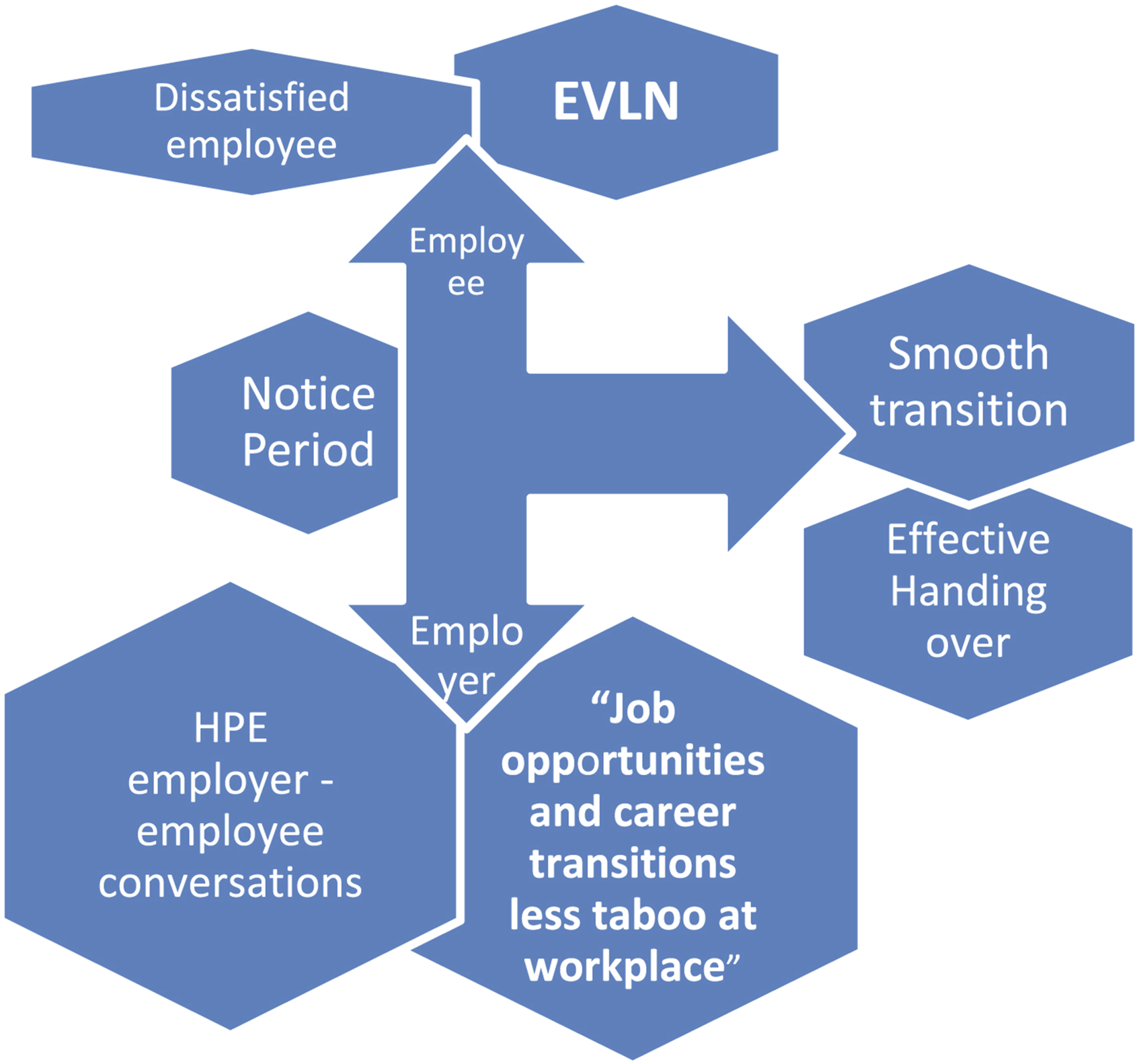
Notice Period within the context of ‘EVLN’ reactions and ‘Job opportunities and career transitions less taboo’ approach.
Meanwhile questions that look at the duration of a notice period wherein the employees are relatively engaged also demands attention? As there is no universal rule as to how long a notice period is to be as two-weeks is a normal duration for many positions while highly technical jobs and high-level leadership positions generally require an extended notice period to facilitate the organization to reorganize their crucial functions [31]. So the question as to how can employers ensure an engaged transition during the notice period of an employee; why shouldn’t the organizations vary the notice period across roles rather than follow a ‘one size fits all’ approach as a longer notice period not necessarily makes sense for all the roles and may perhaps do good only for a certain set of senior executive roles? “What should an ideal notice period be and in what conditions it works best? are questions that are probed by the researcher.
2. Methods
With an objective to examine the process and mindset which are often counterproductive while an employee reacts to dissatisfaction at work place – (EVLN) framework, the paper aims to arrive at an ideal notice period with relatively better engaged employees through ‘job opportunities and career transitions at work place as less taboo” approach. The paper looks at an ideal notice period both from the perspective of an employer and the employee, ensuring smooth transition and effective handover and thereby knowledge transfer for the organization and a smooth exit and a positive feedback during a backchannel reference check for an employee.
While adopting a qualitative approach along with a mini thematic review, the researcher reviewed the literature to understand the current trends, challenges and implications of Big resignations to HR and the possible transitions and problems associated with the notice period of employees both from the perspective of organizations and employees.
[32] saw thematic analysis as not another qualitative method” but a process that can be used with most, if not all, qualitative methods. The approach in the study concurs with this conceptualization of thematic analysis. The method used towards formalizing the identification and development of themes in the study are those that are techniques commonly described as ‘thematic analysis’.
The researcher first identified the keywords including but not limited to Resignations, Big Resignations, Great Resignations, Notice period for subsequent screening through databases including Google Scholar, Web of Science, and Research gate. The data that were relevant to the study was mostly from 2020 onwards. This was followed by identifying the suitability of the content by reading through abstract and main body, after which the potential themes were encapsulated for reporting the findings. Since not many studies were in the area the researcher also reviewed the opinions of practitioners and practicing leaders from survey reports, LinkedIn, newspapers, magazines, and blogs.
The objective of the paper is to arrive at an ideal notice period. The researcher has proposed the “job opportunities and career transitions at work place as less taboo’ approach for a notice period to work best while reaching out to employees through ‘ Happy, present, Engaged’ dialogues at workplace setting, that can lead to reduced turnover in the first place; and even if the employee decides to quit- an ideal notice period thereby ensuring effective knowledge transfer for organization and a smooth exit and a positive feedback during a backchannel reference check for the employee.
3. Results
The findings of the study are reflective of the reviewed material and present the different ideas through the following sections- Building a climate of trust while making career and job opportunities less taboo at work place; Longer Notice period may not necessarily be productive: Employer and Employee perspective; “Big notice period” – Does it meet its purpose?; Evaluating the different duration of a Notice Period- Employer and Employee Perspective
3.1. Building a climate of trust while making Career transitions and Job opportunities less taboo at workplace
Environments that supports trust can better foster knowledge transfer as well promote a culture of retaining good employees [2]. “Human resource systems that are driven by commitment shape employee attitudes and behaviors while building psychological associations between employee and organizational goals.
HR strategy has the most substantial impression on what employees essentially do on the job and the best HR strategy shall essentially stay focused on getting the best performance from employees which would mean employees to have (abilities, competencies and skill) feel (engaged, motivated and committed) and deliver or do something (be productive, come to work, stay with the organization, serve customers) [33].
Since the intra-organizational knowledge flows may be hindered at the time of departure of fellow coworkers due to the negative psychological effect on the remaining employees, causing anxiety, stress and disappointment [34, 35], it becomes essential for HR managers to strike “happy, present, and engaged” conversations with employees, thereby learning to spot and diagnose early signs of unhappiness or disengagement.
The following program was proposed by [2] in order to create a smooth transition both for employers and employees thereby building a climate of trust: Establish a “transition program” within the onboarding: It needs to be made clear to the employees early on as to how they are expected to depart for the duration of their hiring process or in their onboarding. The purpose is to communicate to the employees that there is in place a transparent, safe and a productive exit strategy. The employees are assured that even if their job doesn’t work out or they come across a better opportunity at another company, their career doesn’t end in a disaster. Individual career concerns have a direct relationship with their intention of resigning along with the buffer influence of organizational commitment on this relationship [36] and hence this seemingly paradoxical approach actually makes the company a less risky bet for the employee. “Present, happy and Engaged” conversations on a regular basis.: The answers to the questions on whether the employee is happy, present and engaged is reflective of whether the employee is bringing his whole self to work. This can serve as an early warning detection system for potential problems and unhappiness. Formal and informal mentoring has a positive effect on the organizational citizenship behaviour (OCB), which in turn can negatively impact the turnover intention of employees [37, 38]. Train the leaders and managers on how to give and receive feedback- Ability to give and receive feedback being a vital skill in itself is also closely tied to millennial job satisfaction. Hence regular trainings on how to give and receive feedback as well what it means to encourage and welcome difficult conversations needs to be ensured. The mental well-being of employees on the job is of utmost importance and its absence can lead to depression, and many a times it is underdiagnosed and not treated in a proper manner [39, 41]. Conversations on a regular basis build foundation for an employee to feel safe about telling their manager when they are no longer happy, discontented or engaged, or that they’re looking for a jobchange. Do not let problems aggravate- Encouraging both employers and employees to engage in open conversation while taking those conversations much deeper, can make a central timeline shift in the typical path of disengagement. The organization should ensure the well-being of the mental health of the employees, as employee productivity and efficiency are connected to it [42, 44].
While ensuring open communication and respectful outcomes as a priority in the organization and making ‘career transitions and job opportunities less taboo’ at workplace, a program like this can yield better results. The program might not necessarily mean people not quitting the workplace but can definitely make the transition smooth while ensuring relatively more engaged employee while on notice period, as the most dangerous employees aren’t the ones who leave, but the ones who “quit and stay” as they are physically present, but mentally already gone. Hence if the issue can be identified and addressed early on - even if it is that the work partnership not necessarily works out, there can be efforts towards mutually beneficial outcome while helping to ensure an engaged employee even during the transition thereby ensuring effective handing over and hence knowledge transfer.
3.2. Longer duration of notice period not necessarily productive: Employer and employee perspective
X and Y (males), aged 26 and 32 working as programmers with IT companies, with two and nine years of experience respectively, have put in their papers as both of them landed with a better opportunity in hand. A, B and C (males) aged 27, 29 and 32 with an average 3 years of experience working as software engineers with IT Firms landed up with better options in hand while on their notice period. The two-month notice period with their current employer now has given all of them both a good long window to try for more options and maybe they might even land up with another two more offers in hand.
Y, K and Z, all females aged 35, 34 and 38 respectively are not looking for a hike but want flexibility to work from anywhere. By the end of her notice period, Y has three offers in hand from which she has to select one. The lack of flexibility in the current job has been irking her and the other two offers did not promise her flexibility so her choice was quite clear. Z and K have one offer each in hand which fit in their choice and hence they have decided to quit. Long working hours, official and family responsibilities, and job insecurity can manifest as stress leading to frustration and anxiety, especially in females [45] which can result in their turnover intentions.
A, B, C, D and Z all males, working in different companies with average of over six years of experience as software engineers have better offer in hand but being part of critical project they need to serve a notice period of four months each. All of them managed to bag three job offers in between their notice period. Their current employers managed to retain them with a promotion and almost a fifty percent hike in their salary. Since they all were on the lookout for a higher salary and position they decided to stay. The effective and efficient statutory and non-statutory welfare facilities make employees perform better in their jobs making them better engaged in their work [46]. Y, K and J all males, aged 24, 24 and 23 respectively who have been employed in the IT industry for over four years now have resigned as they have lucrative offer in hand, and now have to serve a lengthy four months’ notice period as they are a part of a crucial client project, but while on notice period they are on the lookout for jobs and have landed up with four job offers each.
The most likely answer an employee gets if he is not in a position to serve the stipulated 90-day notice period generally is to pay for the 10 Weeks or serve the notice period. The other option before him is to finish off the task before leaving which generally may not be possible as the project itself requires more than 3 months for completion. Uncertainty at work leads to a feeling of tension, anxiety, worry, and stress along with a feeling of insecurity about the job of the employees [47].
The employee is generally asked to pay and leave as it is a company policy. Employees’ decision to quit their current job is generally due to poor monetary compensation, lack of mutual trust between employer and employee, uncertainty at the workplace, poor work-life balance, and sluggishness in career growth [14] and hence the longer duration of the notice period not necessarily needs to be productive both from an employer and employee perspective.
There are numerous cases wherein employees put in their papers and use the long notice period to find better opportunities. And in many cases, they have more than one option and have the liberty to choose the best. The HR community calls the phenomenon ‘offer shopping’. The common factor in all cases is the long notice period which the employees have taken advantage of which at the time extends to almost six months, especially in theIT sector.
Longer notice periods are known to lead to ‘offer shopping’ as well a rise in the offer drop ratio which stands at 35- 38 percent average in other industries and a 50 percent average in IT sectors which would mean twenty offers to be made against every 10 positions [48]. Does this mean people are busy putting in more efforts in looking for other offers than focusing on their current jobs? Do employees work with equal belongingness and are equally productive while on notice period?
3.3. “Big notice period”: Does it meet its purpose?
A notice period typically looks at effective handover, knowledge transfer and accounting for the time thereby finding a suitable replacement. It does not necessarily require 90 days in all the cases though the organizations typically end up spreading the whole process in a 90-day time frame.
How can a notice period be termed as “BIG”? Experts have highlighted that a notice period that spreads across a period of three months heavily costs the company from which an employee resigns. The employee has one foot out the door and is inclined to think more about his plans for his future organization than the current one. Moreover, the employees do not put their heart into the work while on notice periods.
The purpose of a long notice period in the first place is to ensure business continuity, after all, employees are working for the clients of the organizations and not for the business per se hence any sudden or abrupt disruption in the projects needs to be avoided which make companies rely on longer notice periods. For instance, a manager /technical lead might certainly need an additional period and not necessarily four weeks to make sure that the whole team is settled well with the new employee who is taking over. A robust talent management system in place; a strong succession planning with enough people to take other’s places; and longer benches are going to cost more than some options worth considering, especially in IT.
With the number of turnover intentions on a continuous hike, it becomes crucial to rethink the ideal notice period from the perspective of both employer and employee. Quick quitting amongst white-collar workers is a new alarming development in HR wherein employees leave even before completing tenure of one year and has been on the rise and reaching almost 10 percent [49, 50]. The reasons are expectations mismatch, culture-fit issues, compensation hikes, onboarding issues, and speed of learning and assimilation while in a new work, culture becoming tough thereby resulting in transactional and task-oriented relationships at the workspace. The longer notice period allows them to explore and find a suitable match. Career-progression is one of the strongest factors determining employee commitment and motivation in the job [51].
3.4. Evaluating the different duration of a notice period: Employer and employee perspective
So the question as to what an ideal duration of notice period is to be; what factors ensure a relatively engaged employee while in the notice period? Does a notice period that runs into a quarter be chosen, even if the management cannot justify it with an equivalent worth of work? It is worth probing.
If workplace issues are left unattended then the management has chosen to experience the different shades of the parting employee’s productivity. Here the employer needs to cognize the psychological state of an employee who has put in his papers because a lack of a smooth exit can make the employee unconsciously create discontent around other team members. The purpose of a notice period is to let the firm know about the resignation of an employee who is on rolls to fill-up the place left by an employee to conveniently handle the job without much of a problem. Both employer and employee probably have a different take on the notice period.
A notice period of 15 days from the employee’s perspective seems good enough to wind up all chores and wrap up the essentials as probably the payroll month has 15 days left enabling him to join the beginning of the next month.
From the management perspective, the time frame needs to be best utilized to deliver the firm a more responsible candidate to enable handling the responsibilities.
A one-month notice period from the employee’s perspective gives him ample time not only to accomplish the assigned tasks but also enables the employer to assign duties to someone equally capable. A 30-day notice period is the most accepted among employees. It enables employees to achieve the allocated targets and leave the firm without any chaos. A one-month time can enable the employer to oversee the tasks accomplished as well as hand over the tasks to someone else.
A 60-day’ or two-month notice period in a developing firm implies the task assigned can last for a month or even two and hence candidates prefer a notice period of two months wherein they are bound to make the new employee develop a precise understanding of the work and quality to be delivered.
A 90-day or three-monthly notice period may be useful for candidates who probably are thinking of moving out from the city so as to acquire a new job, look out for a new home, interview processes, and much more which can be time-consuming. A three-month notice period in such cases would mean adequate time to handle the chores and earn better security. Employers on the other hand can able to have a reasonable time to hire a capable candidate.
Uncertainty at work, work-life balance, monetary compensation, career growth, and mental well-being impact the turnover intention of employees substantially. The turnover intention of employees is significantly related to uncertainty at work, stagnation in career growth, lack of proper work-life balance, improper monetary compensation and lack of mental well-being. A culture that promotes honest and open dialogues between employer and employee if they are forthcoming about being unhappy in their job without any fear of reprisal, retribution, or of being escorted out the door can build trust [2] and hence even if the employee decides not to stay with the company the chances that the transition remains smooth for both employer and employee is high while having an employee who is relatively engaged thereby ensuring effective knowledge transfer. Though the gig economy calls for an agreement in terms of employment conditions and a transitory legal compulsion [14] the notice period can look at employee flexibility and an on-demand fulfillment of responsibilities with a commitment that not necessarily has to be a standard one and can vary across industries, organizations and across jobs.
4. Discussion
Organizations need to develop beliefs, norms and values that all employees are able to identify with and appreciate at the workplace so as to enable retaining the employees [52]. Employees do not work with equal belongingness and are not equally productive while on notice period and longer notice periods lead to ‘offer shopping’ as well a rise in the offer drop ratio. [53] states that developing committed employees who can be trusted to use their discretion to carry out tasks in ways that are consistent with organizational goals becomes essential.
The turnover intention of employees is considerably linked to uncertainty at work, poor work culture, stagnation in career growth, lack of proper work-life balance, improper monetary compensation and lack of mental well-being. With the increasing rate of employee turnover it becomes essential for employers to provide a culture that promotes respectful and open communication wherein employees feel safe expressing they are unhappy, not present, or even not engaged. It necessarily may not mean that employees do not revert to the notice, but it definitely can increase the chances of employee retention as well lead to a relatively engaged employee even during the notice period.
With quick quitting amongst white-collar workers on a high, reaching almost 10 percent, employees are leaving jobs even before completing tenure of one year [49, 50]. Longer notice periods have also catalyzed ‘offer shopping’ as well a rise in the offer drop ratio [48]. Moreover longer notice period allows them to explore and find a suitable match and hence [54] say that the managers should focus on cultural values that are attractive to most new employees’ needs rather than the selection and socialization of particular individuals who fit a specific profile of cultural values.
A dissatisfied employee may respond to dissatisfaction by resorting to Exit, Voice, Loyalty, and Neglect (EVLN) model [25, 55, 58] which offers four specific responses typology that employees may possibly exhibit: “to leave the organization”, “speak up, patiently and confidently”, “hope for a better future”, or “ be lax and disregardful”. A culture that allows space for “open discussions about career transitions and job opportunities as less taboo” in the first place, while mobilizing “happy, present, and engaged” conversations with employees can help better in framing systems that identify and diagnose early signs of disengagement or unhappiness. This in turn can probably help employees exhibiting ‘Voice’ and ‘Loyalty’ to feel relatively more engaged thereby reducing their turnover intentions. And in case the employee decides to quit it can lead to a transition with a relatively engaged employee even while on notice period.
The notice period is meant to inform the organization about the resignation of an employee who is on rolls, while filling-up the place left by the employee, thereby conveniently handling the job without much of a problem. Within the context, the factors that ensure relatively engaged employee while on notice period as well the duration of a notice period is worth looking at objectively.
Why cannot the notice period be viewed from an employee flexibility and on-demand fulfillment of responsibilities, with a commitment that not necessarily has to be a standard one and may vary not only across industries, organizations but also acrossjobs?
Ideally a notice period has to be fit into; the years of experience; job role; seniority; technicality; industry; availability of a person ready to take charge; or even duration of employment of the leaving employee with the organization, while ensuring conditions for a smooth transition and effective engagement of the employee serving the notice period. Moreover an environment of trust wherein job transitions and career progress are less taboo can create an environment of trust. Trust in the workplace is very crucial as employees with low- trust in their employers are likely to feel more disengaged, insecure, and less communicative leading to a stressful work environment [59, 60]. Hence a notice period works best in an environment wherein “open discussions about career transitions and job opportunities are less taboo” and ’Happy, Present and engaged ‘dialogues watchful of the “EVLN’ reactions of the employees happen on a regular basis and situations are handled through a ‘culture of open communication’, problem solving through ‘HPE’ conversations, “training towards receiving & giving feedback and a ‘smooth transition’.
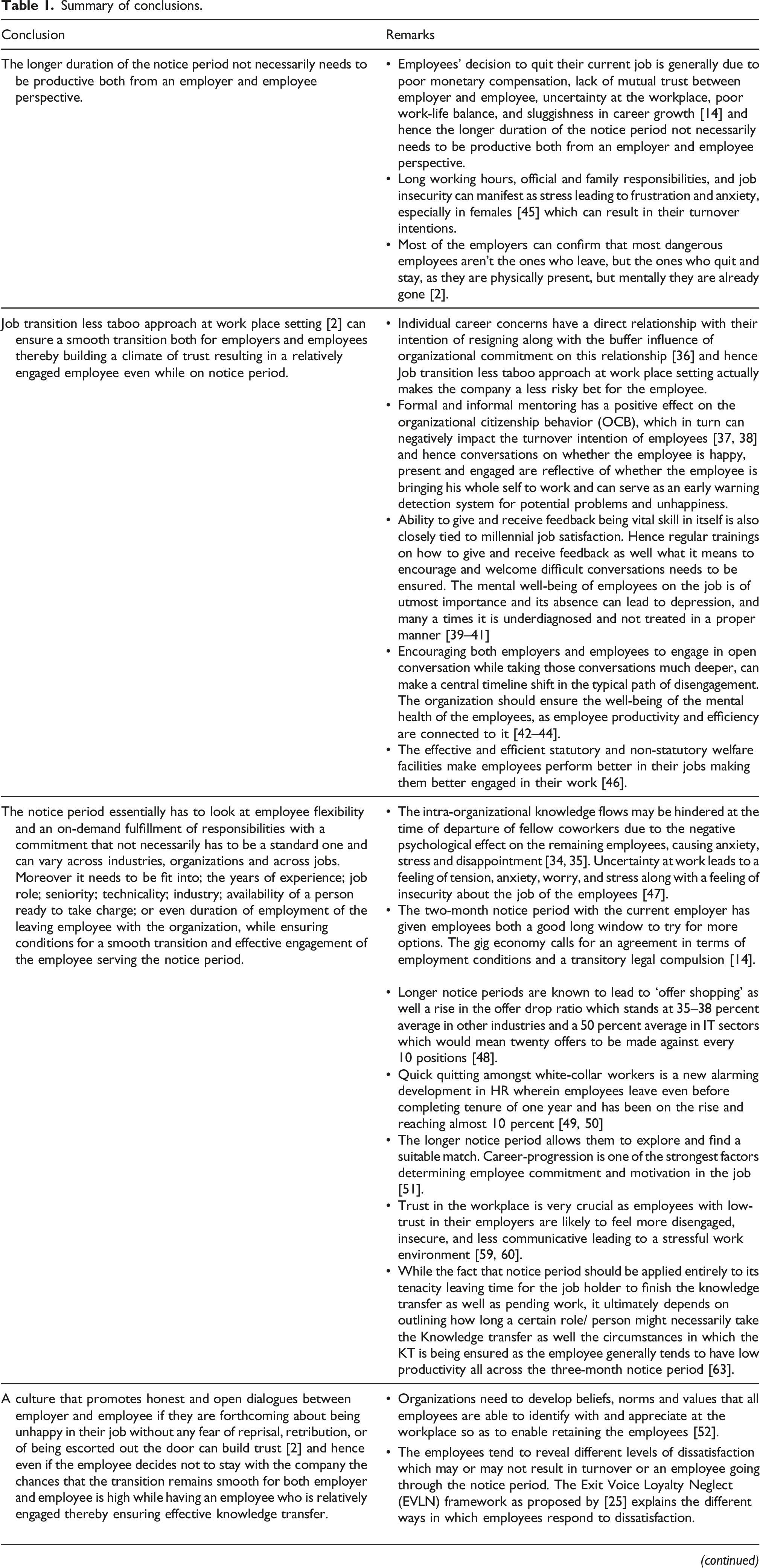
Summary of conclusions.
5. Conclusion
Intention to resign or turnover intention generally is an outcome of uncertainty at work, lack of proper work-life balance, improper monetary compensation, stagnation in the career and lack of mental well-being [61]. It can be also influenced by work experience as employees with less work experience generally have a greater urge for positive change [62] as well they expect more self-regulation resources and better growth at their workplace. Employees’ intention to stay is moderated by managerial support to a great extent [60].
When an employee has decided to quit he is physically present but mentally gone and may not necessarily work with equal belongingness and not being equally productive. Struck with it if the notice period is too long the chances that the employee ends up in ‘offer shopping’ while creating negativity at workplace cannot be either overlooked as longer notice periods result in ‘offer shopping’ as well a rise in the offer drop ratio.
The most ungenerous explanation of employee retention may simply be attributed to an organizational culture that emphasizes inter-personal relationship values uniformly, as that looks more attractive to professionals than a culture that emphasizes work task values [24] and hence a culture that promotes “open discussions about career transitions and job opportunities as less taboo” at workplace, problem solving through ‘HPE’ conversations, “Training towards receiving & giving feedback and a ‘smooth transition’ while being watchful of the “EVLN’ reactions of the employees can help towards retaining employees and even if the employee decides to quit it necessarily can create a relatively engaged employee even while on notice period. The organizations can ensure an engaged employee while on notice period by emphasizing inter-personal relationship values uniformly in the organization.
While the fact that notice period should be applied entirely to its tenacity leaving time for the job holder to finish the knowledge transfer as well as pending work, it ultimately depends on outlining how long a certain role/ person might necessarily take the knowledge transfer as well the circumstances in which the KT is being ensured as the employee generally tends to have low productivity all across the three-month notice period [63].
The conditions for a smooth transition need to be ensured all through irrespective of which phase of EVLN framework [20] the employee is going through, by timely and continued ‘Happy, Present, Engage’ employer- employee communication [2] thereby promoting a culture of open discussion while extending support without any fear of vengeance, punishment, or of being guided out the door in case employees are approaching about being unhappy in their jobs; ‘ Culture of open communication”; “Training towards receiving & giving feedback’; and “ensuring ‘smooth transition”.
Open transitions make the most sense for any professional-service firm having client-facing teams, or organizations having highly skilled employees who are difficult to replace without impacting their bottom-line heavily. Hence a culture that is open and positive which promotes engagement of employees during the notice period would mean having an engaged employee for few months while finding their replacement thereby making transition smooth and effective for both employer and employee.
Hence the period of notice however small or big cannot ensure effective knowledge transfer unless a culture of trust prevails and people feel safe and are encouraged through open conversations to communicate if they are unhappy, not present and not engaged. Acknowledging openly that the organization might not necessarily be the best- fit for everyone in long-term allows managers to completely change their dialogue with their team members. Herein promoting a culture where employees can honestly discuss their career goals or for that matter their professional unhappiness, employees of all generations are more likely to stay and are inclined to do their best work. And even if they decide to leave they would care as much about what’s best for the company as they would for their own career path as they would be engaged all through the transition too. And within the context ie a culture where employees feel they can trust management, open communication and objective outcomes are a priority an ideal notice period that is objectively designed in terms of its duration, depending on the years of experience; job role; seniority; technicality; industry; availability of a person ready to take charge; or even duration of employment of the leaving employee with the organization can ensure best results in terms of knowledge transfer i.e. whosever (a new joiner or an existing employee) is trained well in the job thereby ensuring no impact/loss to the workings of the current organization.
A mere transfer of information does not account for Knowledge transfer. Hence ideally a notice period has to be fit into; the years of experience; job role; seniority; technicality; industry; availability of a person ready to take charge; or even duration of employment of the leaving employee with the organization, while ensuring conditions for a smooth transition and effective engagement of the employee serving the notice period. Moreover an environment of trust wherein job transitions and career progress are less taboo can create a good work environment as [58, 59] claim that building trust in the workplace is very fundamental for the employer, as employees in a low-trust workplaces feel very disengaged, insecure and uncommunicative thereby creating a stressful work environment.
Organizations having highly skilled employees who are difficult to replace without impacting their bottom-line heavily or for any professional-service firm having client-facing teams, open transitions make the most sense. Here an open and positive culture can ensure relatively more engaged employee for few months in notice period while finding their replacements.
The study is not free of limitations, as an empirical attestation of the study can further validate the feasibility of a notice period that varies across jobs, organizations, industry and levels. It can further be validated empirically the impact of “open discussions about career transitions and job opportunities as less taboo” at workplace on employee engagement of personnel while on notice period and employee retention at workplace. Though the researcher tried to cover the different sentiments of an employee who has decided to quit there can be other emotions also that forms the psychological state of a departing employee. The notice period is considered only from the perspective of resignation or turnover intentions of employees’ further studies can look at it from the perspectives of the employers, i.e. when the organizations resort to downsizing.
Footnotes
Acknowledgments
The author has no acknowledgments.
Supplemental material
My manuscript has no associate data.

Author Biography
In addition to many Consultancy and Research projects with the Chamber of Commerce & Industry in Rajasthan and the Swiss Development Corporation, New Delhi, she has many publications in National and International Journals and conferences. She has also been associated as a trainer with many corporates. An approved Research Guide, she has over 7 candidates who have been awarded their Ph.D. degree under her guidance.