




Abstract



1 Introduction
The development discourse on women’s economic involvement frequently discusses women’s dual obligations, for the disproportionate allocation of domestic work hinders female labour force participation (FLFP), and in most circumstances, it leads them to informal work that is low-waged, non-productive, and indecent [1]. Moreover, informal employment intensifies women’s work and systemic poverty and vice versa [2]. Hence, it clashes with the Sustainable Development Goals (SDGs) of the Vision 2030 that aim to eradicate poverty (SDG 1), create gender equality (SDG 5), provide decent work to everyone for economic growth and development (SDG 8), and reduce inequalities (SDG 10).
In this regard, literature examines what is sought in terms of women’s paid work [3, 4] and finds a significant correlation between women’s non-market work and their economic participation [5]. This relationship is a worldwide phenomenon, owing to the gender-based norms that hold women responsible for social reproduction [6] and mock men who try to assist them with domestic work.
The micro, meso, and macro factors, i.e., the institutions of family, labour market, and society fail to acknowledge the interdependence of women’s non-market (reproductive/domestic work) and market (economic/paid work) activities arising due to the lack of fair division of domestic work among all family members; inflexible work schedules, and absence of need-based facilities in the labour market; and societal unwillingness to challenge the gender-based division of labour [5].
Institutional indifference towards women’s unshared burden of reproductive labour is the outcome of the gender-based norms which identify some jobs with men and others with women [5]. This division is historically rooted in social, cultural, and economic structures and shaped by traditions, socialization, and stereotypes, preferring one gender over the other in power allocation, leadership roles, decision-making power, and control over resources [7].
Non-market activities (domestic and care work) are a crucial component of the overall welfare of a family, society, and economy. However, this work impacts women’s capacity to engage in and derive advantages from economic participation (SDG 5) because it is decisive of the amount of time and effort women may dedicate to the market work [8]. Hence, compelled by poverty and economic needs [9], when women try to engage in market work, they opt for informal sector because it offers part-time and flexible work schedules that fit with their non-market work, requires minimal mobility, and is socially acceptable [10]. Consequently, especially in the absence of education and skills, women are mostly employed as unpaid/underpaid contributing family workers, semi-skilled own account workers, and unskilled domestic/home-based workers [11]. Moreover, they often undertake numerous tasks due to destitution and sporadic nature of the informal employment, which contradicts the concept of decent work for all (SDG 8). Hence, women’s presence in the labour market (LM), particularly in the formal sector, remains low [12], and they are perpetually entangled in systemic poverty (SDG 1).
Pakistan, more precisely the Islamic Republic of Pakistan, continually underperforms in FLFP [13] although Islamic jurisprudence advocates women’s rights, and the Constitution of Pakistan promises women’s integration in all socioeconomic activities [14]. In line with that, Pakistan has formulated several pro-women Bills as well [15]. Nonetheless, despite the high incidence (75%) of absolute female poverty in Pakistan 1 , FLFPR in the country remains perpetually low (12–23%) and three times lower in the formal sector [16]. Without inclusion, integration, and advancement in the mainstream workforce, majority of women in Pakistan remain deprived and disadvantaged because their paid work does not translate into empowerment [17]. In this context, the development rhetoric evades acknowledgement of the interdependence between women’s non-market and market work and scrutiny of the nature of market work available to women (SDG 8) [18].
Women’s non-market work is the hidden energy behind the market workforce, yet it remains unrecognized, unappreciated, and unpaid [19]. Moreover, it constrains women from joining decent work in the formal sector, keeping them disadvantaged (SDG 1) and dependent on men. Thus, despite the inclusion and equality rhetoric (SDG 5, 10), women’s dependence on men for everything from resources and decision-making to mobility and employability erodes women’s dignity [20].
Intrinsically, the perspective of unpaid work as the women’s duty is the brainchild of patriarchal social ideology because it suits the male workforce in both spheres although being dual burden and bringing double day for women. Therefore, the problems faced by women due to the interdependence of their non-market and market work require contextual understanding of the issue for policy intervention because one-size-fits-all policy framework of the developed countries is non-productive in the context of developing countries [21]. Hence, this study offers a great contribution by surfacing women’s dual role and drawing policy attention towards their double burden.
2 Literature review
Last few centuries have brought numerous significant changes to the position of women in the Indian subcontinent. From equal status in prehistoric times through the darkest moments of the mediaeval era, to the present moment of global rhetoric of equal rights, women have been through turbulent shifts [22, 23].
Women, at present, are a marginalised group, susceptible to harm and excluded from the mainstream society [24]. Being underprivileged, paid work often becomes necessary for poverty-stricken women from low-income and/or female-headed households [25] to ensure food security and avert hunger. In such circumstances, women’s LFP is primarily shaped by factors such as job prospects in their locality, work schedule flexibility to accomplish unpaid work along with paid work, family support and encouragement for paid work, and societal expectations around the gender roles [26]. Besides, poverty also deprives women of education and skills without which there is no formal job opportunity available to them [22]. Moreover, socio-cultural limitations such as lack of decision-making power and mobility, and the unshared burden of domestic work restrict women from pursuing occupations that offer decent employment in the formal sector [27]. Hence, they join informal work, which offers ease of employment and time flexibility. However, it lacks socio-legal security for economic stability and productivity required for empowerment [28].
Because informal work and poverty are interconnected [29], women’s concentration in the informal sector perpetuates poverty through feminization of the informal sector [30]. Although women’s engagement in the informal sector allows some immediate economic respite to them, it fosters systemic gender discrimination. The main beneficiaries in the whole process are: the male workforce that is socially accommodated by women’s unpaid work, and the capitalist market that is on the look for economical workforce [31]. This pattern also arises due to the conflict between women’s private and public life because formal employment demands extended working hours that are incompatible with women’s reproductive responsibilities [32]. Dissuaded from formal employment and decent work because of the lack of education and the burden of unpaid work, which intercepts with the paid work causing work-life imbalance, women’s socioeconomic reliance on men remains unchanged. Moreover, informal market work does not result in reduction of women’s non-market work, nor does it lead to a substantial increase in their involvement in paid labour [33]. Rather, the simultaneous engagement in dual work results in a conflicting situation that necessitates compromises [34]. This compromise mostly favours the unpaid work which remains indispensable in any case [30].
Considering the influence of meso (LM) and macro (society) factors on family dynamics, negotiations alone are unlikely to resolve the conflict arising from the interdependence of the two types of work [35] because it is an ongoing phenomenon that entails continuous interplay between many responsibilities, and any favourable or unfavourable encounters in one domain impact the other domain [36].
Research on economic underdevelopment of women frequently focuses on how women are denied paid work [37] and management roles [38]. Moreover, investigations into workplace gender inequalities highlight male dominance in the public sphere [39], organizational gender practices [40], and prejudiced management and HR policies [41]. However, women’s economic underdevelopment is understudied in the context of developing countries where the phenomenon is widespread [42]. Moreover, the intersection of gender and FLFP as a reason of women’s underdevelopment in the third-world countries is also scarcely investigated [43, 44].
Furthermore, despite global focus on market operations, there is limited work on women’s economic underdevelopment stemming from the intersection of women’s paid and unpaid work [45]. Therefore, it is an important area of investigation, particularly because of the conflicting situation between the ambitious goals of women’s empowerment in Vision 2030 and the ground reality in the contemporary democratic Pakistan. Hence, the present study tries to fill this gap by investigating the interdependence of women’s non-market and market work; the problems women face due to their dual work; and the nature of market work available to women due to the intersection of their gender-based and need-based work.
3 Methods
The study used qualitative research design because the phenomenon under investigation involved real-life experiences that could not be effectively captured by statistical methods.
Research population comprised FLF in Pakistan, and the study sample constituted thirty (30) respondents from the informal sector. The inclusion criteria were market experience of at least 2 years and age between 20–60 years. Hence, purposive sampling technique was used. Respondents were deliberately chosen from both urban and rural backgrounds to explore a wide range of socioeconomic backgrounds.
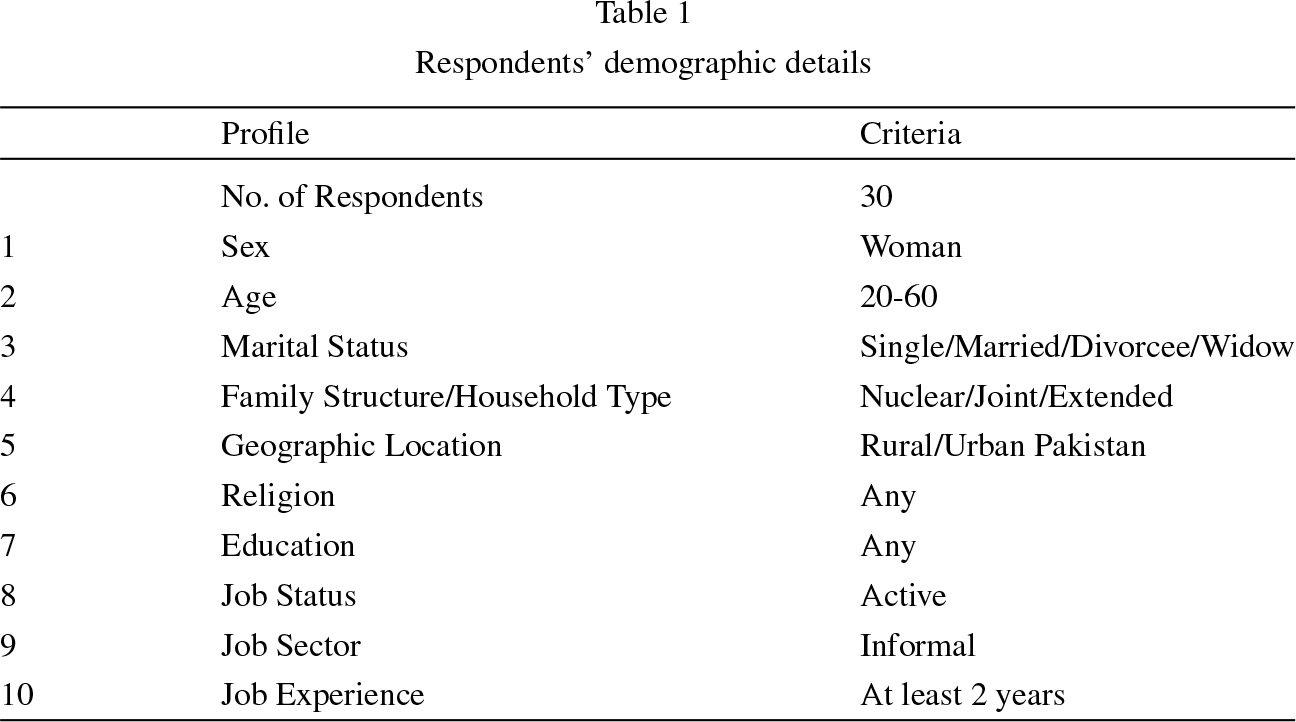
The principal investigator contacted 50 potential respondents via telephone and in-person and offered payment of PKR 1000 for research participation. Eventually, 30 of them agreed to be part of the research. Upon their verbal consent, respondents were briefed on research objectives, questions, procedure, and implications along with assurance of data confidentiality to obtain their informed consent in writing. Afterwards, interview schedule was prepared in coordination with the respondents. Table 1 shows demographic details of the study respondents.
Respondents’ demographic details
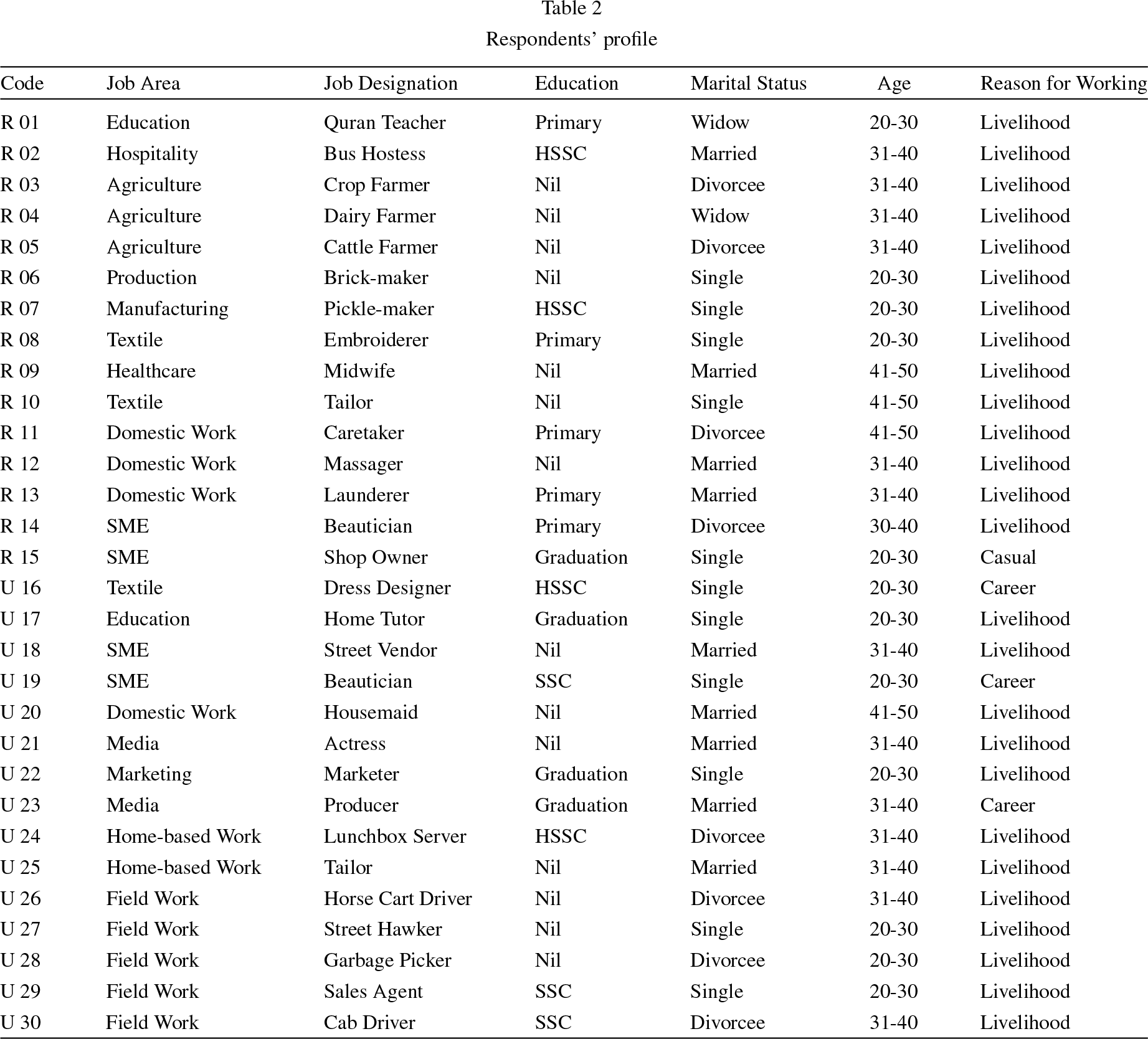
To ensure anonymity and confidentiality, respondents were assigned alpha-numeric codes: “R” for Rural and “U” for “Urban” along with their sequence number. Table 2 given below presents respondents’ profile.
Respondents’ profile
A semi-structured interview guide was prepared as the research tool. It covered respondents’ demographic details; their experiences of the interdependence of non-market and market work; and the problems they faced due to the intersection of their gender-based and need-based work.
Systematic collection, processing, and evaluation of data were done according to Glaser’s theoretical framework [46], which does not include premeditated data collection prior to analysis. Hence, data collection and analysis were driven by the research question: “What is the interdependence of women’s non-market and market work regarding their LFP in the formal sector?”
Each session started with small talk for ice-breaking, followed by guided conversation through open-ended questions and probes to avoid digressions. Urdu and Punjabi languages were used according to respondents’ convenience. Respondents’ low education did not allow them to read and write, and they were also reluctant for audio/video recording. Therefore, interview responses were recorded on paper. Each interview lasted between 10-20 minutes. Interviews and data transcription went on simultaneously. After each interview, data were transcribed and verified through substantive coding (the process of data formulation) proposed by scholars [46, 47]. To establish credibility, data saturation and triangulation were observed.
Data analysis utilized Thematic Analysis (TA) framework [48], which provides a systematic and rigorous analysis of qualitative data while generating new insights about complex phenomena. Following the six-stage process of TA, the dataset was meticulously read for familiarisation and code creation based on the degree of occurrences and commonalities in data chunks. Codes were closely examined to classify them under the larger themes. The whole process was carried out rigorously to ensure objectivity, reliability, and validity. Systematic comparisons to monitor the development and expansion of themes helped with objectivity and prevention of bias. Upon finalization of codes and themes, peer review was requested to ensure objectivity in thematic coding.
4 Results and discussion
This section presents findings and interpretation followed by the discussion of results.
4.1 Results
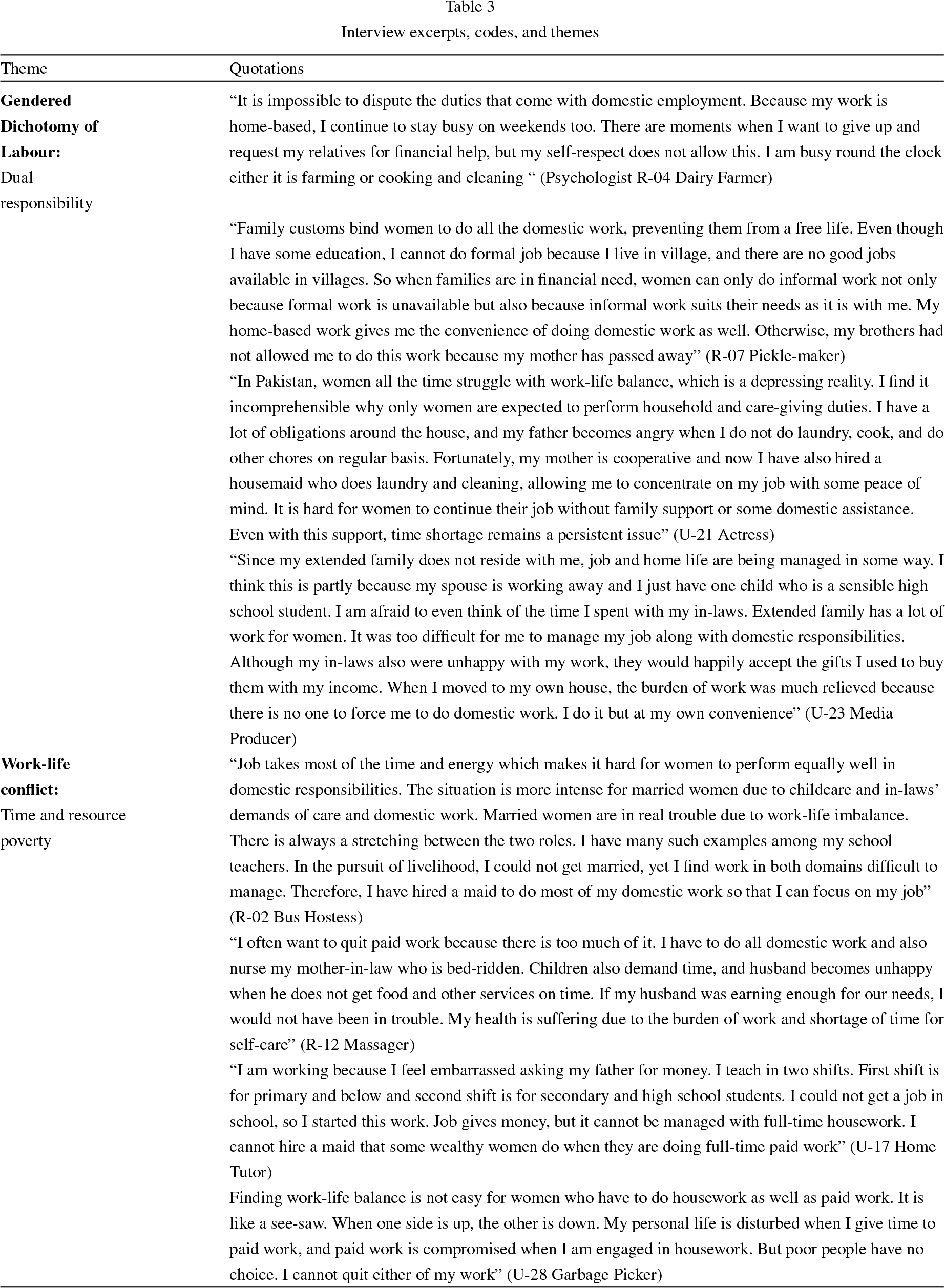
Data analysis highlighted “gendered dichotomy of labour” and “work-life conflict” as the overarching themes. The former was related to the dual responsibility of women due to the socio-cultural norms based on the traditional gender hierarchy, and the latter was associated with the unshared domestic responsibilities of women which interfered with their paid work and vice versa. The intensity of work in both roles stemmed from women’s resource poverty and resulted in their time poverty. Moreover, the intersection and interdependence of work in both spheres in the absence of social and family support created constant work-life conflict and negatively impacted respondents’ capacity to participate in the LM. Table 3 presents related excerpts from the dataset along with conceptual codes and umbrella themes, and Fig. 1 shows thematic map of the findings.
Interview excerpts, codes, and themes

Thematic map.
4.2 Theme 1: Gendered dichotomy of labour
Data analysis revealed the traditional socio-cultural structure of Pakistan society that is marked by strong adherence to social hierarchies, maintained through the dichotomy of gender. Socio-cultural norms, predominantly influenced by the gender-based division of spaces and labour, imposed unpaid domestic and care work on women to restrict them to the private sphere and create/maintain their dependence on men. Moreover, the categorisation of men and women into distinct categories of males and females, and their places as public and private served to strengthen the established gender norms and hierarchies by restricting women’s participation in formal economic activities.
4.3 Dual responsibility
Respondents’ accounts highlighted the biased gender norms that assigned women the role of primary caregivers and homemakers, making them responsible for all the non-market work. The 24/7 non-market work of respondents was neither recognised nor appreciated although it involved physical and emotional labour. Not only this, respondents had to undertake all the domestic labour despite their market work commitments and limited availability of time. Not being able to stand up against the norms, respondents continued their domestic work and care-giving duties despite fatigue and time constraints. Hence, instead of offering relief to them, paid work created dual responsibility and double burden of work. Almost all respondents mentioned time constraint as a challenge resulting from the cumulative workload of both domains. A participant expressed her situation in the following words:
When I go out for work, my family assumes that I am engaged in recreational activities outside, enjoying a pleasant day. Consequently, upon returning home, my desire to rest remains a dream because household chores are waiting to be done, and most of my time at home is consumed in work. Late night, when I go to bed, I am so tired. I dread waking up for another day full of work. I wish people in the family understand how challenging a woman’s life is. Men at least have some time to rest and relax and do not have the burden of double day and dual jobs (U-19 Beautician).
Another respondent shared her experience as follows:
Handling paid work and family responsibilities multiplies my work. It is difficult to manage both due to time limitations. The whole day passes and there is no opportunity for personal or recreational pursuits. Even weekends are busy because my work is home-based. I am not married yet, but my parents want me to be trained for married life. Therefore, they have assigned most of the housework to me. Apart from cooking, cleaning, and attending guests, I have to ensure that my parents take their medicine on time. I usually stay awake till late night to do my work of dress designing. This work helps me earn some pocket money and pursue my passion. Honestly, if married life is all about these chores, I am afraid of getting married. After all, a woman is also a human being and needs rest and leisure. She must not be treated as a machine (R-16 Dress Designer).
Irrespective of their occupations, the respondents were expected to do all domestic and care work. Hence, the double day also deprived them of recreational activities, personal time, and social gatherings. Moreover, the psychological stress and exhaustion resulting from multitasking had a negative impact on their health and wellbeing. According to a respondent, in her efforts to alleviate economic distress, she experienced additional hardships.
I often have the urge to close my business of food service. There are so many things happening in life, and there is so much of work to do that I feel miserable, but every day I wake up and start working like a robot. After divorce, I had to do something for livelihood, but due to limited education and burden of housework, I could not get a decent job. I can cook well, so I started food service, which is home-based. I have some daily orders of lunchboxes that I prepare and deliver through Bykea. Side by side, I keep doing my household work as well. My children are school-going, so I have to do all the work alone. The earning is not much to hire house help. I see that most of the women in the neighbourhood living a miserable life. There is no fun, no joy, only work and work. The situation is frustrating because there is no self-time (U-24 Lunchbox Server).
Respondents were extremely perturbed by the dual burden of their family duties and professional commitments because male family members were unwilling to share any responsibility of household chores. Urban respondents appeared to be comparatively less bothered than their rural counterparts as the latter were extremely deprived and disadvantaged. One such respondent shared her misery in the following words:
I leave home tired, and I come back home even more tired. Tiredness is all I feel the whole day. Poverty is a bad thing. Poor people have no life. I was born in a poor family, and I am engaged to a poor man. Some girls at least get some life after marriage. I have no chance of that too. I have been working at a brick kiln since I was 12. I am only 22, and I already feel old. Being overworked, I cannot enjoy even the sleep hours. My bones ache. My brothers do not do anything at home. They do not even drink water themselves. I wish my family considered me a human being and treated me well. I wish that my brothers shared the domestic work with me instead of lying down on their beds and scrolling their cell phones when they come back home from work. Alas! Life is a burden for girls (R-06 Brick Maker).
4.4 Theme 2: Work-life conflict
Thematic analysis revealed that the combination of family responsibilities and paid work resulted in a twofold increase in the respondents’ workload and consumed all of their time, leading to work-life imbalance.
Work-life conflict was prevalent among all respondents, primarily due to insufficient time to fulfil responsibilities of both domains. Time was a significant concern for all the respondents. Given the limited hours in a day, they found it challenging to simultaneously manage many things at home and work and were confused about whether to give priority to non-market or market work. It was difficult particularly because they lacked family and social support and were short of the financial resources for convenience consumption that some of the respondents in slightly better socioeconomic positions availed by outsourcing their domestic work in the form of hiring house help for some tasks. Nevertheless, work-life conflict undermined their efficiency in both domains, presenting a formidable challenge to decide between the two roles.
Respondents acknowledged the crucial role of domestic work in ensuring the survival and wellbeing of their families. Nonetheless, they encountered difficulties in both domains. On the one hand, in the absence of familial support and financial insufficiency, their non-market work was difficult to manage. On the other hand, market work was disturbed due to their household obligations that required similar amount of time.
4.5 Time and resource poverty
Respondents’ accounts indicated that they were unfairly burdened by domestic work and care-giving duties. The indifference of family, especially the male family members continued even though respondents were also involved in paid work and came home tired and in need of rest. Respondents shared that they started own accounts, home-based work, and low category informal jobs due to poverty-driven illiteracy, lack of time because of domestic responsibilities, lack of resources to hire house help for domestic tasks, and lack of formal job opportunities for women with low education and skills. Two respondents’ accounts are shared below:
If you are a primary caretaker, it is impossible to balance job and work at home. I do not have time to relax or to socialise. My work demands networking, but it is not possible due to time shortage and family restrictions. Honestly, I do not like working outside home. I do it so that my family has food and good clothing, but my family does not appreciate my work at home or outside home. Domestic work is forced on me although I am doing a job. Men in my family do not do anything at home. They are earning lesser than me, but they are seen as breadwinners. They lead the family and keep hold of the resources. Women work for money, but they remain poor and disrespected. The type of jobs we do and our extra responsibilities at home make us worthless. It is paradoxical but true (U-29 Sales Agent).
Our cultural traditions give all the respect to men and all responsibilities to women. As a divorcee, I had to do something for livelihood, but good jobs need high education, so I started driving a cab on daily commission. My family strongly opposed this. They had issues about what will people say, but I resisted because I could not see my children die of hunger. I feel that poor women’s life is just meant to suffer. I have forgotten who I am and what my own needs are. The burden of work takes up all my time and energy. I wish I had resources. I wish I had enough time to rest (U-30 Cab Driver).
Ironically, men were the family leaders, but they only passed orders and did not participate in any domestic chores. Women, on the other hand, not only fulfilled their non-market duties but in circumstances where men’s income was insufficient for family needs, entered the public sphere to share the financial burden. However, it was otherwise for men, who refused to reciprocate by sharing household work. Furthermore, supported by societal norms, men determined respondents’ freedom of movement under the guise of safety, which in fact induced more male dependence. The limitations and constraints hindered respondents’ chances of social networking, education, and formal employment.
I am confused seeing my eldest sister who is married and always busy with housework and sewing. It upsets me to think when I get married how I would balance work and life. My sister shares financial responsibility with her husband but he does not share her domestic work. I see women sharing the financial burden when men cannot earn much, but men do not share housework when women are doing extra work or when they are tired or sick. Work keeps women tired. How can one row in two boats? Poverty is our issue. Men are our problem. Both sides have to accommodate each other. How long can one side play her part? (R-10 Tailor)
Respondents also indicated that the imbalance between personal and professional life negatively affected their opportunities and decisions regarding education, professional choices, personal growth, and even the parenting.
Balancing work and household is challenging. Doing everything alone is hard. My child suffers most due to my paid work. He demands attention that I am unable to give due to work pressure (R-01 Quran Teacher).
Due to the scarcity of resources and gender-based norms, respondents were lacking the required education and skills needed for formal employment. Furthermore, limited resources kept them from outsourcing their non-market work and allocate more time towards market work, which few of the comparatively less underprivileged urban respondents did. The intra-gender hierarchy pointed towards intersectionality that rendered additional susceptibility to rural respondents.
5 Discussion
Individuals cannot accomplish all tasks on their own, which makes dependence and interdependence unavoidable [49]. Hence, to establish a smooth social order, institutional structures heavily rely on the principle of interdependence [25]. In traditional societies, this interdependence is based on the biological differences between the two genders which lead to gender-specific tasks, making women do all the “reproductive” work in the private sphere and men perform the “productive” work in the public domain [3].
Within the framework of gender-based roles, respondents took responsibility of all household and care-giving tasks in addition to their market work while men were responsible for only earning. They did not share women’s domestic work although women shared their financial burden [5]. Hence, it was found that the gender-specific labour established on the principle of reciprocity was significantly skewed towards a particular gender. Gender, in fact, acted as the driving force of discrimination against women as pointed out by previous research [8, 51].
Findings emphasised the detrimental connection between women’s economic and non-economic activities which hindered women’s opportunities for decent paid work and subjected them to systemic poverty and reliance on men. Results demonstrated that the intersection of women’s gender-based and need-based work resulted from the gendered dichotomy and socio-cultural norms [33] which exclude women from the formal sector by creating work-like imbalance as evidenced by previous research [42]. Moreover, women join market work to shoulder men with finances, but the absence of family support and workplace facilities make it difficult for them to achieve work-life balance, resulting in a debilitating work-life experience leading to intersectionality.
Moreover, the socio-cultural manipulation of women through gender-based norms is evident as domestic work is imposed on women, pushing them to the informal sector, a finding corroborated by empirical evidence [10, 44] that proposes bridging the gender-based skills gap to foster gender equitable economic empowerment [52]. Furthermore, while the present research indicated that patriarchal cultures push women to the informal sector based on the similarity of informal work with their reproductive work, empirical evidence [6] from Bangladesh indicated that patriarchal structures offer safe economic environment to women from underprivileged communities. In this context, findings of this study highlight feminist perspectives regarding the patriarchal structures that control women’s lives in the private and public spheres.
The findings illuminate how women navigate and negotiate their roles in the male-dominated institutional structures. Besides, the results highlight that women’s role as the providers of unpaid labour is indispensable for sustenance of male workforce, supporting patriarchal capitalism. However, when economic necessity forces women to engage in economic activities, their non-market gender-based work intersects with their need-based market work [2], making it difficult to simultaneously continue both, and demanding difficult trade-offs. Hence, from resource poverty, women become additionally poor in terms of time poverty, and the combination of multiple poverties exacerbates their situation [9, 10].
6 Conclusion
Women’s work constitutes their non-market work, unpaid family work, and the market work. This study investigated the core dimension of women’s work by gaining insight into the interdependence between the gender-based and the need-based work of women, which is, in fact, the intersecting point of gender and FLFP.
Findings reveal that the common practice of correlating women’s market work with their economic growth and development irrespective of the nature of their work and working conditions is a myth. Economic growth is a process rather than a result of paid work because it involves complete exercise of power in various dimensions which primarily encompass job opportunities and working conditions; socio-legal protection; and social advocacy. Moreover, it is imperative to recognise that women’s integration into the LM in isolation from their interconnected family relationships, roles, and responsibilities is unlikely to result in economic development. Undoubtedly, FLFP results in a rise in household spending; however, its productivity is contingent upon the presence of predictable work schedules, high visibility, and socio-legal benefits, which are missing in informal sector employment. Furthermore, market work must adhere to the principles of fairness, empowerment, and productivity, and more crucially, it must strike a balance with women’s family responsibilities, which unfortunately underpin the social fabric of patriarchy and the economic framework of capitalism. Achieving equilibrium between women’s work in both spheres is vital for a sustainable and enabling market experience of women that translates into their economic empowerment.
6.1 Implications
This research is significant because of its relevance to the SDGs, especially Goal 1 (No poverty) Goal 5 (Closing gender gap), Goal 8 (Decent work and economic growth), and Goal 10 (Reducing inequalities). Vision 2030 aims to increase FLFPR by twofold to achieve accumulative results on the SDGs, and this multidimensional study has policy implications in identifying the root cause for policy formulation and implementation to facilitate women with economic participation and making it an empowering experience. In this context, findings of this study surface the unique challenges faced by women due to the intersection of gender and LFP that call for individual coping mechanisms. The unique experiences of women in the rural and urban settings need discrete policy interventions, which have implications for all stakeholders of the LM.
While macroeconomic employment policies are essential for expanding and diversifying economic prospects, there is crucial need for microeconomic policies to ensure women’s equal access to these opportunities in varied circumstances. Moreover, measures such as providing policy assistance to the informal sector, and recognising the potential for female employment in areas where traditional patriarchal standards have not yet established a strong presence is also required. In addition, the study calls for efforts towards economic inclusion of informal sector in the System of National Accounts (SNA).
Furthermore, findings also have theoretical implications. Social reproduction as the process of perpetuating social norms is a derivative of Karl Marx’s theory of capitalism and pertains to a specific aspect of economic reproduction that depends on women’s non-market and informal work. The study elucidates women’s position within the broader social framework as well as their unacknowledged involvement in the capitalist economy through their conventional responsibilities in the private domain, validating their crucial role in the economy. Moreover, the findings substantiate the theory of intersectionality which posits that various social categories intersect and impact women’s experiences in the private and public domain.
6.2 Limitations and future suggestions
The study’s small sample size creates unlikelihood of results’ generalisation although it contributes to the scant body of research on the microeconomic and macroeconomic implications of women’s dual work. Secondly, this study used qualitative research design, which was appropriate to capture the essence of real-life experiences. Future research may use quantitative or mixed methods approach to explore the phenomenon. Third, the study sample constitutes informal female workforce, which can be replaced with formal workforce or a combination of both. Fourth, the study used a comparatively small sample size (30) due to time and travel constraints. Future research can use a large sample that is more representative of the whole female population. Fifth, this research dealt with the wider context rather than individual characteristics, which can be explored in future research. Lastly, the study did not discuss the possibility of integrating men into the private sphere, which is one important proposition in this context and needs investigation to fill the gap.
