



Abstract
BACKGROUND
The reconciliation of professional and family life has been growing in importance in recent years, and although progress has been made, there is still much to be done. It is crucial to understand the extent to which the individual’s attachment to the organization contributes to identifying the mechanisms related to work-lifebalance (WLB) and workplace well-being.This study highlights the need for a more in-depth and comprehensive investigation into the determinants of workplace well-being and the development of effective strategies to promote it.
OBJECTIVE
Analyze the mediating role of job embeddedness in the relationship between WLB and workplace well-being.
METHODS
Quantitative methodology grounded in a hypothetical-deductive perspective. Data was gathered through the use of well-being, job embeddedness, and WLB as measuring elements.The sample included 243 participants employed in the public and private sectors.This is a cross-sectional study in which data were collected through a questionnaire survey administered to a convenience sample.
RESULTS
Well-being in the workplace is positively influenced by WLB and job embeddedness. With the inclusion of the mediating variable in the model, WLB tends to decrease. The indirect effect of job embeddedness on the relationship between WLB and workplace well-being is significant, indicating the existence of partial mediation.
CONCLUSIONS
It is important to promote WLB and strengthen the connection between employees and their work roles, because only through this is it possible to promote lasting and sustainable well-being within the context of work as well as a real engagement of workers.


1. Introduction
The current work context is characterized by a fast-paced environment, constant demands, and an increasing interconnection between personal and professional life. This is why work-life balance (WLB) emerges as one of the key social challenges of the 21st century [1]. A study conducted by Chung and Van der Lippe [2] revealed that the main issues are related to excessive working hours and/or fatigue induced by professional activity, compromising the performance of family roles. La Torre et al. [3] add that concerns related to work often hinder individuals from fully enjoying personal life moments. Therefore, WLB can be defined as the ability to find a life rhythm that allows for the harmonious integration of personal and professional dimensions [4]. Following this idea, Priya et al. [5] argue that WLB refers to the ability to balance work demands with personal commitments and activities, ensuring well-being in both aspects. Facilitating this balance is crucial, necessitating flexibility in work arrangements (e.g., flexible schedules, remote work), effective time management (e.g., task prioritization), a supportive culture (e.g., parental leave), realistic expectations regarding work requirements, clear communication about deadlines and schedules, and establishing clear boundaries between work and personal life (e.g., refraining from accessing work email outside of working hours). These factors foster a healthy and balanced work environment where individuals can thrive both personally and professionally [6].
Nevertheless, it is observed that, over the past decades, the difficulty in achieving this balance has significantly increased, especially when both members of a couple are employed and there are dependents (e.g., children, parents) [7]. On the one hand, the personal sphere requires time for leisure activities, rest, or social life; on the other hand, professional life demands highly committed individuals to their organizations [8].
According to Fotiadis et al. [9], when employees successfully balance their professional and personal responsibilities, they tend to be more productive and efficient, reflecting on their satisfaction level and well-being in the workplace. Building on this idea, Abhitha and Hebbar [10] demonstrate that the balance between these two spheres reduces stress levels and positively influences quality of life. The ability to allocate time for family and personal interests helps recharge energy, enabling individuals to approach work with a clearer and renewed mindset [11]. Workers who can reconcile their family and professional responsibilities feel more motivated and committed to the organization, contributing to overall well-being in the workplace [12].
Therefore, it is essential to understand the factors influencing this relationship. One such factor is job embeddedness, which, besides describing employee’s connection to the organization, seeks to explain the reasons that lead them to stay within it [13]. This connection extends beyond task fulfilment and encompasses aspects such as interpersonal relationships with peers and leadership, alignment with the company’s values, and opportunities for professional development [14].
Job embeddedness is heavily contingent on working conditions and employees’ perception that the organization cares about their needs and expectations, particularly those related to WLB [15]. Organizational policies can contribute to achieving this balance, whether through task autonomy, flexible work schedules, remote work options, extended parental leaves, reduced overtime hours, or an organizational culture that values the personal lives of its employees [16]. However, it is observed that in the absence of this balance, individuals feel burdened by their family responsibilities and tend to be absent from work more frequently, significantly impacting organizational performance [17].
Investing in policies and practices that promote a balance between work and family life not only benefits employees but also contributes to a healthier and more productive work environment [18]. This study underscores the necessity for further comprehensive investigation into the determinants of workplace well-being and the development of effective strategies to promote it. Thus, the aim was to explore the influence of WLB on employees’ well-being in the workplace. Furthermore, it sought to analyse the mediating role of job embeddedness as a determinant factor in this relationship. Traditionally, WLB has been perceived as a direct factor influencing workers’ well-being [19]. However, the model examined in this investigation proposes that job embeddedness acts as a linkage between WLB and well-being in a work context. This reveals that the positive impact of the balance between work and personal life on well-being is mediated by the degree of employees’ rootedness within the organization.
This approach represents a significant contribution because, in addition to recognizing the importance of WLB, it also considers the environment in which this balance occurs. By considering job embeddedness as a mediating mechanism, the influence of employees’ connection with the organization on the relationship between WLB and the enhancement of well-being in a work context is highlighted. This broader understanding of the dynamics between WLB, job embeddedness, and well-being suggests that organizational interventions aimed at promoting a better balance between personal and professional life not only directlyinfluence workers’ well-being but also indirectly affect the strengthening of job embeddedness.
This process is directly related to the factors preceding integration (antecedents). The alignment between an individual’s values, beliefs, and attitudes and those of the organization helps align the expectations of the new employee with reality [14]. For this adjustment to occur, it is essential to implement onboarding programs that provide guidance and support during the initial phase, as this is when job embeddedness begins to emerge. The outcomes, in turn, concern the consequences of this integration, which have a significant impact on workplace well-being. When employees are well integrated, they tend to achieve higher levels of productivity because they better understand their roles and how to perform them effectively. Job satisfaction increases when employees feel welcomed and supported, resulting in a more positive work environment and a significant increase in well-being levels [9]. Workplace integration is a fundamental process that links antecedents to outcomes in the work environment and plays a crucial role in promoting employee well-being [15].
As such, it can lead to a more holistic and effective approach to improving workplace well-being, considering both individual and contextual factors. When workers have a healthy balance between work and personal life, they tend to be more productive and perform better at work. Organizations that value and promote WLB typically exhibit higher talent retention rates, reducing costs associated with staff turnover and ensuring continuity of knowledge and experience within the organization.A more comprehensive understanding of the dynamics between these three constructs provided valuable insights to promote the creation of healthier work environments where individuals feel well.
2. Literature review
2.1. Hypothesis development discussion
Work is extremely important in people’s lives, as it contributes to their survival and adaptation to the world. Therefore, it is essential to understand the factors responsible for well-being in this context, given that a significant portion of life is spent in the workplace [18]. Despite its relevance, there is no clear-cut definition of the concept. However, it is widely agreed that well-being reflects positive feelings manifested in physical, social, and psychological terms [20].
Hirschle and Godim [21] state that well-being in the workplace is strongly influenced by job satisfaction, task commitment, and emotional engagement with the organization. These factors can be classified into two categories: hedonic and eudaimonic [22]. According to the hedonic approach, well-being at work depends on the frequency, intensity, and predominance of positive emotions over negative ones [23]. On the other hand, the eudaimonic perspective focuses on personal fulfilment and the full expression of human potential [24]. When workers feel valued and see their work recognized, their well-being levels increase significantly [25].
Research conducted by Barrena-Martínez et al. [26] demonstrates that a pleasant and harmonious work environment, allowing for the reconciliation of personal and professional life, is a strong indicator of well-being in the workplace. When employees have this experience, they tend to have a positive attitude towards the organization [27]. Based on this premise, Batista et al. [28] assert that there is a direct relationship between well-being and job satisfaction. The more satisfied the employee, the higher their levels of well-being and productivity, resulting in lower absenteeism rates and a decrease in turnover intentions. A study by the Bruntwood Group [29] draws attention to organizations, emphasizing that it is the people behind their success and, therefore, they should prioritize their well-being. Thus, organizations must invest in socially responsible practices that promote diversity and inclusion, foster work-family balance, and invest in training and development. These practices, highly valued by employees, are the primary drivers of well-being in the workplace [30].
Over time, well-being in the workplace has been elucidated through various models, among which the Demand-Control-Support Model, proposed by Karasek in 1979 [31], stands out. This model posits that workplace well-being is influenced by the interaction between job demands (e.g., quantity and complexity of work), control over work (e.g., degree of autonomy a worker has over their tasks), and social support provided by the organization to prevent high levels of stress [32].
In 1981, Maslach and Jackson [33] developed the Burnout Model, which identifies three components that negatively affect well-being in the workplace: (i) emotional exhaustion, referring to the feeling of being emotionally drained due to work; (ii) depersonalization, characterized by a negative attitude towards work and colleagues; and (iii) diminished personal accomplishment, concerning a sense of inefficacy at work [34].
Subsequently, Ryan and Deci [35] proposed the Self-Determination Theory (SDT), according to which well-being in the workplace depends on the satisfaction of psychological needs related to autonomy in controlling activities, competence in effectively performing job tasks, and interpersonal relationships, pertaining to the quality of social interactions in the workplace. According to this theory, when these needs are met, individuals tend to experience greater well-being and higher levels of intrinsic motivation at work [36].
More recently, Bakker and Demerouti [37] developed the Job Demands-Resources Model (JD-R Model), which suggests that job demands (e.g., workload, time pressure, role ambiguity) and job resources (e.g., social support, feedback, development opportunities) influence well-being in the workplace. According to this model, when job demands are excessively high, they lead to burnout syndrome. Conversely, adequate resources promote embeddedness, engagement, and well-being at work [38]. These theoretical frameworks provide valuable insights into the factors influencing well-being in the workplace and can guide interventions and organizational practices to promote a healthy and productive work environment [39].
2.2. Influence of work-life balance on well-being in the workplace
WLB refers to the ability to successfully reconcile the responsibilities and demands of work with the obligations and needs of personal life [40]. This topic has been gaining increasing importance in recent years, and although there have been advancements in this regard, there is still much to be done [17]. Therefore, various sectors of society (e.g., public administration, businesses, and the social sector) must continue promoting and implementing measures that support the satisfactory reconciliation of work and family life for all [2].
Several strategies can help achieve this balance, including establishing clear boundaries between work and personal life, setting priorities, delegating task, and adopting habits that promote quality of life [41]. These measures not only contribute to the well-being of employees but also significantly influence individual performance and, consequently, organizational productivity [42].
According to Hassan et al. [43] and Murtaza et al. [44], the balance between both contexts is strongly influenced by the type of work, working hours, organizational expectations, and family responsibilities. The reconciliation between these two crucial life spheres has been exacerbated due to the pandemic situation caused by COVID-19, which forced individuals to handle professional and family tasks simultaneously [45]. These shifts in work dynamics have directed research on WLB towards an enrichment perspective rather than focusing solely on conflict [1]. This theory stems from experiences, values, and know-how that are mobilized from one domain to another, revealing positive evidence [46]. This enrichment can be associated with an employee’s performance and well-being in their workplace, extending to their personal life, and vice versa [47].
Studies conducted by Rothbard et al. [48] demonstrate that resources are expandable and that the relationship between personal and professional contexts is synergistic. Positive experiences enhance affective, cognitive, and material resources, enabling them to be directed towards other life domains later. These resources positively influence well-being and the quality of life in various environments [49]. According to the Person-Organization Fit Theory [50], when there is alignment between personal and professional demands, there is a better person-job fit. A positive WLB is associated with greater well-being in the workplace as a result of person-job fit facilitated by effective reconciliation between work and personal life [51, 52]. Based on these assumptions, the first hypothesis was formulated:
Hypothesis 1: WLB positively influences well-being in the workplace.
2.3. Influence of job embeddedness on well-being in the workplace
Workplace well-being manifests the interaction that occurs between the individual and the organization [21]. Thus, it is observed that when the organization cares about the needs and expectations of employees, the degree of engagement and well-being tends to increase [25]. Therefore, it is crucial to ensure that employees feel engaged with the tasks they perform and with the organization’s objectives [53]. It is in this context that the concept of job embeddedness arises, which, instead of focusing on the reasons people leave organizations, seeks to explain the reasons workers choose to remain within them [14].
Several studies [54–56] highlight a positive relationship between job embeddedness, organizational commitment, performance, satisfaction, and well-being in the workplace. Losekann and Mourão [57] suggest that employees who feel strongly engaged with the organization and their tasks exhibit higher levels of psychological well-being [58], lower job stress, increased self-esteem, and a stronger sense of belonging.
Job embeddedness can be an effective strategy to enhance employee well-being in the workplace [59]. Moreover, it contributes to increased productivity, greater talent retention, and the promotion of a more positive organizational climate [60, 61]. When employees perceive loyalty, camaraderie, and concern for their well-being in their workplace, they feel more integrated and engaged with the organization’s objectives [56]. In this context, Ahmad et al. [6] state that job embeddedness is a strong predictor of well-being in the workplace, gaining considerable relevance in both the scientific community and organizational settings. According to Afsar and Badir [62], person-organization fit is influenced by job embeddedness, which in turn is positively associated with well-being in the workplace context, resulting in higher levels of satisfaction and organizational commitment.In accordance withthis evidence, the second hypothesis was formulated:
Hypothesis 2: Well-being in the workplace is positively influenced by job embeddedness.
2.4. Mediating role of job embeddedness in the relationship between work-life balance and well-being in the workplace
The balance between personal and professional life has been recognized as a crucial component of workers well-being in the workplace [11]. When this balance is successfully achieved, individuals tend to experience higher satisfaction, lower levels of stress, and better mental health [63]. However, the work of Sudibjo and Suwarli [13] indicates that the relationship between WLB and well-being in the workplace, as evidenced by the intention to remain in the organization, can be mediated by job embeddedness.
Awan et al. [64] argue that WLB can lead to a greater sense of job embeddedness. When individuals have more time and energy to dedicate to their personal lives, they tend to feel more satisfied with their work and more committed to the organization [11]. This can result in a greater willingness to stay in the job, seek development opportunities within the company, and contribute more significantly to organizational objectives [53]. Employer-promoted policies and practices aimed at enhancing the balance between personal and professional life, besides benefiting their employees, also contribute to the success of the organization [16].
Balancing work with personal life positively influences well-being in the workplace, reflecting the desire to remain within the organization, and this enhances levels of job embeddedness [65]. Whenever the workplace environment aligns with the interests of employees, well-being levels tend to increase, and job embeddedness can be used as a mediator in this relationship [13].
As previously mentioned, the relationship between WLB, job embeddedness, and well-being in the workplace is grounded in the Person-Organization Fit Theory [66]. According to Tian et al. [67], when an individual’s values align with the culture and values of the organization, they feel more connected to it, which is reflected in their levels of well-being at work. These positive experiences strengthen emotional resources that can subsequently be transferred to the personal context [47]. Person fit helps better understand how WLB and job embeddedness can influence employee well-being, either through person-job fit or person-organization fit, thus fostering well-being in the workplace [52]. This theory suggests that person-organization fit mediates the relationship between individual characteristics, including WLB, and organizational outcomes, notably well-being in the workplace [67]. This theory postulates that WLB, job embeddedness, and well-being in the workplace are interrelated, suggesting that these factors can mutually influence each other and affect workers’ adaptation and satisfaction in the workplace [66]. Based on the mentioned literature, the third hypothesis was formulated:
Hypothesis 3: The relationship betweenWLBand well-being in the workplace is mediated by job embeddedness.
3. Methods
3.1. Research design
This study adopted a quantitative approach which, through statistical techniques, allows for the analysis of relationships between variables and the objective testing of hypotheses. The research was conducted based on a hypothetico-deductive perspective, with hypotheses formulated based on existing theories or prior knowledge of the subject. It is a cross-sectional study in which data were collected through a questionnaire survey.
3.2. Sampling technique
The data were collected from a convenience sample. The utilization of this sampling method is attributed to the ease of access for participants [67]. Additionally, a snowball sampling method was employed, in which initially recruited participants were encouraged to invite their contacts to participate in the study. This procedure facilitated the expansion of the sample and provided access to individuals who might not have been identified otherwise.
3.3. Sample
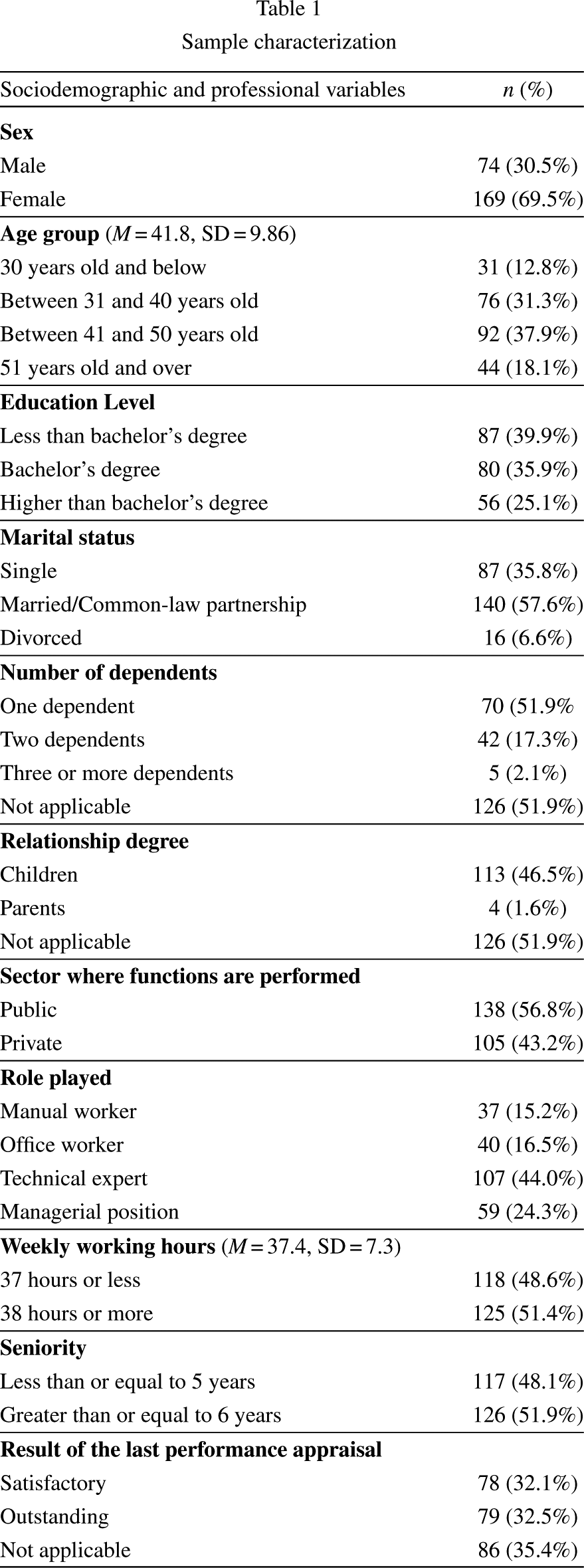
This study had the participation of 243 waged workers, aged between 18 and 61 years (M = 41.8, SD = 9.86), with 69.5% being female. Table 1 describes the personal and professional characteristics of the sample.
Sample characterization
3.4. Measures
Well-being. To assess well-being in a work context, the Flourishing Scale developed by Diener et al. [68] was used and subsequently adapted for the Portuguese population by Junça-Silva and Caetano [69]. In a previous study, Diener et al. [70] referred to it as psychological well-being, but the name was changed to reflect its content more accurately. The eight items (e.g., I am competent and capable in the activities that are important to me) that compose the scale describe important aspects of human functioning (e.g., positive relationships, feelings of competence). All items are formulated in a positive direction. Scores can vary from 8 (strong disagreement with all items) to 56 (strong agreement with all items). Although the scale does not offer separate measures for specific facets of well-being, it provides a comprehensive view of positive functioning across various domains that are commonly considered significant. In this current research and the previously mentioned studies, Cronbach’s alpha coefficients were, respectively, 0.81, 0.87, and 0.80.
Job embeddedness. The degree of involvement of workers with the organization where they perform their functions was assessed through the seven developed by Crossley et al. [71] (e.g., I am tightly connected to this organization). In the original questionnaire, responses were provided using a five-point Likert agreement scale. However, in this study, a seven-point scale was chosen. In both the scale validation study (α=0.83) and the current investigation (α=0.93), the questionnaire demonstrated high internal consistency.
Work-lifebalance. The eight items that assessed WLB were adapted from the questionnaire developed by Kumarasamy et al. [52] (e.g., My job makes personal life difficult). Respondents indicated, on a seven-point scale, the degree to which they agreed or disagreed with each statement (1 = totally disagree; 7 = totally agree). High scores indicate that participants have no difficulty balancing work and family spheres. The validation study of the scale demonstrates that the instrument has adequate internal consistency (α=0.92). In the current research, the Cronbach’s Alpha coefficient is 0.85.
We chose to utilize a seven-point agreement scale for all instruments, following the recommendation of Lozano et al. [72], who argue that expanding the range of response alternatives optimizes reliability. Furthermore, Dalmoro and Vieira [73] emphasize the potential for confusion among respondents when using scales with diverse formats, highlighting the importance of avoiding such variations in scale design.
Sociodemographic and professional questions. At the end of the questionnaire, participants were requested to respond to a set of questions about their sociodemographic characteristics (e.g., sex, age) and their professional activity (e.g., seniority, weekly working hours).
Control variables. Age and gender were employed as control variables. According to Teo et al. [74], older workers tend to exhibit a more positive attitude towards their work, which reflects in their well-being levels. Gender was also utilized as a control variable. In line with Stronge et al. [75], men tend to demonstrate higher levels of well-being in the workplace compared to women, possibly attributed to generally holding higher hierarchical positions.
3.5. Procedures
Data was collected through online surveys. The link containing the survey was sent by email to the professional contacts of researchers. The email included a succinct study overview, informed consent information, and a commitment to preserving the anonymity and confidentiality of the data.It is important to mention that prior to data collection, a pilot test was conducted with 15 individuals to ascertain the suitability and comprehension of the items concerning the instructions and the response scale utilized. After data collection, statistical analysis was carried out using the SPSS and AMOS software (version 29).
4. Results
4.1. Preliminary analyses
In the initial phase, multivariate normality was assessed by checking the Mardia statistics [76] using the Web Power tool available at https://webpower.psychstat.org/models/kurtosis/, which provides information on skewness and kurtosis coefficients along with the p-value.Chowdhury et al. [77] they state that the standardized Mardia coefficient should exceed 5% (p > 0.05) to consider the data as normally distributed. The results showed that the data followed multivariate normality(coefficient of Mardiaskewness = 1.15, p = 0.741; coefficient of Mardiakurtosis = 12.39, p = 0.102).
Next, it was deemed appropriate to conduct the Harman’s test (single factor) with the inclusion of all items. This analysis showed that the unrotated solution (with all measured items included) explains 31.6% of the total variance, indicating that the results were not affected by Common Method Bias, as it is below the recommended threshold of 50.0% by Enomoto et al. [78].
Subsequently, it was observed that the skewness intervals (between -0.45 and 1.10) and kurtosis intervals (between -0.57 and 1.08) of the studied variables were within the range recommended by Lam and Zhou [79], which is between -2 and 2.
Furthermore, it was found that the values of Composite Reliability (CR) and Average Variance Extracted (AVE) for all variables were above the threshold of 0.70 and 0.50, respectively [80], supporting the convergent validity of the measures. The Maximum Shared Variance (MSV) was also analysed, and the results demonstrated values lower than AVE, ensuring discriminant validity. Table 2 reports the descriptive statistics and correlations between the variables under study. The results showed that all variables have significant associations with each other. It was also determined that neither age or gender are significantly associated with the main variables.
Descriptive statistics
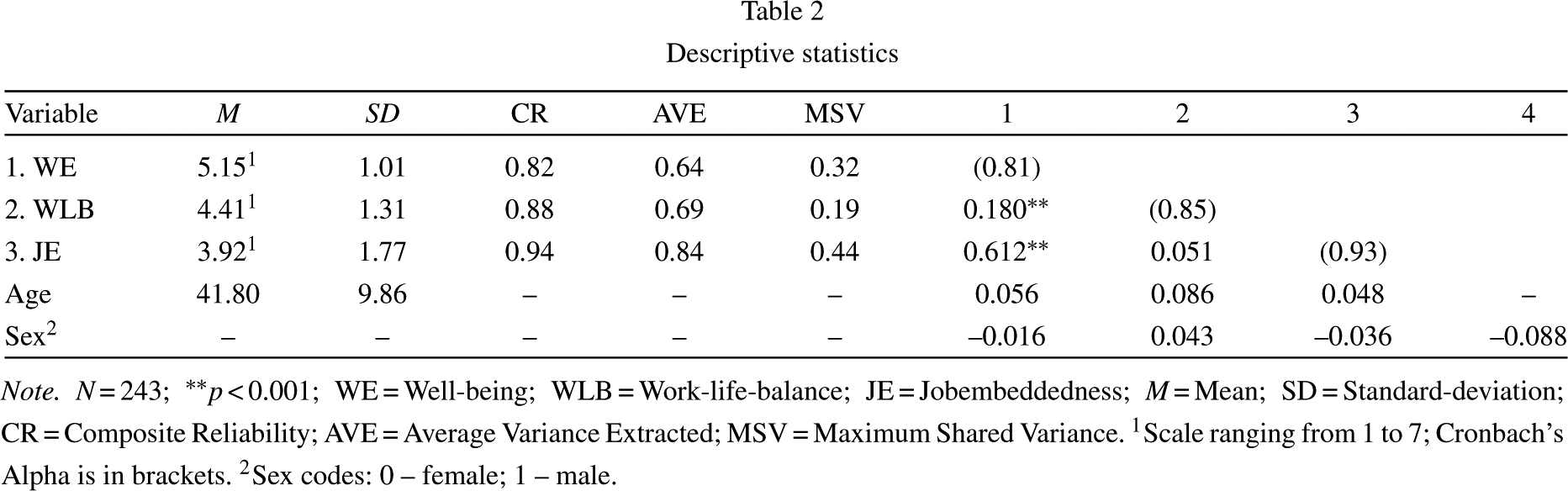
Note. N = 243; **p < 0.001; WE = Well-being; WLB = Work-life-balance; JE = Jobembeddedness; M = Mean; SD = Standard-deviation; CR = Composite Reliability; AVE = Average Variance Extracted; MSV = Maximum Shared Variance. 1Scale ranging from 1 to 7; Cronbach’s Alpha is in brackets. 2Sex codes: 0 – female; 1 – male.
Subsequently, a Confirmatory Factor Analysis (CFA) was conducted to test whether the measured variables adequately represent the latent factors responsible for the behaviour of the observed variables [81]. The results showed that, after the covariation of errors indicated by modification indices in AMOS, the model was well-fitted to the sample data [χ2(216)=1.92, p < 0.001, CFI = 0.94, TLI = 0.93; SRMR = 0.07, RMSEA = 0.06, LO90 = 0.05, HI90 = 0.07]. In the next section, the research hypotheses are tested according to the proposed model.
4.2. Validation of research hypotheses
The first hypothesis, which posited that WLB positively influences well-being in the workplace, could be supported. The results of the linear regression demonstrated a direct and statistically significant relationship between the predictor variable and the criterion variable (β = 0.180, t = 20.151, p < 0.05). It was also possible to determine that the model is linear and significant (F(1,241)=8.108, p < 0.05). The coefficients obtained indicate that when WLB levels increase by one unit, well-being in the workplace tends to increase by 3.3%.
It was also found that well-being in the workplace is favourably influenced by job embeddedness, aligning with the second study hypothesis (β=0.612, t = 12.021, p < 0.001). The results suggest that 37.5% of well-being in the workplace is positively influenced by job embeddedness.
Finally, the relationship between WLB and well-being in a work context, mediated by Job Embeddedness, was assessed using Model 4 of the PROCESS macro in SPSS [82]. The findings revealed a significant indirect effect of WLB on well-being through on-the-job embeddedness (B = 0.07, SE = 0.02, 95% CI [0.03, 0.19]). Furthermore, the results demonstrate that with the inclusion of the mediating variable in the model (Fig. 1), WLB tends to decrease yet remains significant (β=0.150, t = 12.049, p < 0.001).
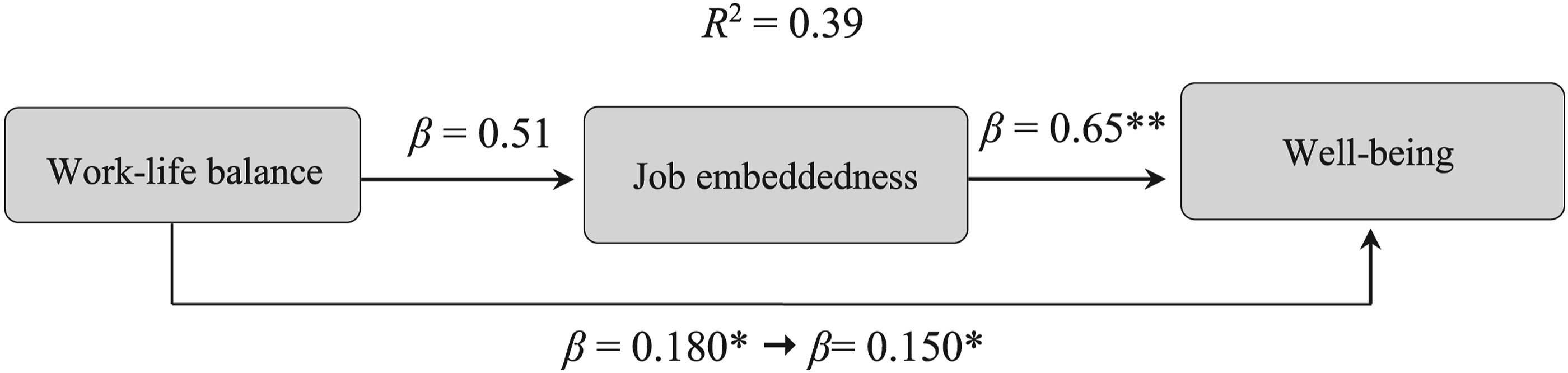
Mediation model.
4.3. Complementary results
The literature review on well-being in the workplace drew our attention to the possibility of it being influenced by both personal and organizational factors [83]. Therefore, it was deemed relevant to proceed with a comparison of means based on sociodemographic variables. Gender and age were not included since they have been previously analysed.
It is important to recall that all responses were provided using a seven-point Likert scale ranging from 1 (Strongly Disagree) to 7 (Strongly Agree), depending on participants agreement with the statements. The scores for each construct were calculated by summing the values assigned to each of the items comprising them, so a higher average value indicates higher levels in that construct. To facilitate data interpretation, the results from the comparison of means were summarized in Table 3.
Comparison of means of well-being based on personal and organizational factors

Note. N = 243; *p< 0.05; M = Mean; SD = Standard-deviation. 1Who do your dependents stay with when you go to work? 2Sector codes: 1 – public; 2 – private.
With the results seen above, it can be concluded that only marital status, the number of dependents, the sector of employment, and the job position significantly impact the average values of well-being in the workplace.
5. Discussion
This study aimed to understand how WLB influences the well-being of workers in the workplace. Additionally, it sought to explore how job embeddedness functions as a mediating mechanism between these two constructs.
The data analysis revealed that WLB is a strong predictor of well-being in the workplace, supporting the first hypothesis. These results align with findings by Wayne et al. [42] who suggested that setting boundaries between work and personal life, task delegation, and adopting habits that enhance quality of life and priority setting contribute to the well-being of workers.
Moreover, the results indicate that when there is a balance between personal and professional contexts, individual performance significantly increases, consequently enhancing the overall efficiency of the organization [17]. Building on this notion, Presti et al. [47] argue that when positive knowledge and experiences acquired in one context are transferred to another, well-being and quality of life tend to increase in both spheres. Additionally, Rothbard et al. [48] state that a balanced relationship between personal and professional lives leads to higher levels of well-being. Positive experiences enhance emotional, mental, and material resources, positively impacting well-being in various contexts [49].
Additionally, it was observed that well-being is positively influenced by job embeddedness, confirming the second hypothesis. Workers who show strong engagement with the organization exhibit higher levels of psychological well-being. Consequently, they tend to experience less stress and demonstrate higher self-esteem [57]. Zhou and Chen [56] further support this premise, stating that there is a positive connection between job embeddedness, commitment to the organization, satisfaction, and workplace well-being. According to Baek and Kim [25], when the organization pays attention to the needs and expectations of employees, it contributes to increasing their levels of engagement and well-being. Ahmad et al. [6] add that job embeddedness is a significant indicator of well-being in the workplace, justifying its growing recognition in both the scientific community and organizational context. In this context, several studies [14, 59] highlight the relevance of job embeddedness in promoting well-being. Therefore, it has been considered a factor that fosters a healthy and satisfying work environment. It is evident that job embeddedness plays a positive role in promoting employee well-being, influencing not only their performance at work but also their overall quality of life [12].
Finally, it was found that the relationship between WLB and well-being in the workplace is mediated by job embeddedness, validating the third hypothesis. Similar conclusions were drawn by Obrenovic et al. [11], suggesting that when workers reserve time for family and personal interests, they rejuvenate their energy. Thus, when they arrive at their workplace, they feel refreshed and exhibit low levels of stress [57]. These results align with findings in the studies of Labrague et al. [15], demonstrating that the harmony between personal and professional life is widely recognized as a crucial element for workers well-being in the workplace. Sudibjo and Suwarli [13] also note that the relationship between WLB and well-being in the workplace can be mediated by job embeddedness, as evidenced by the intention to remain in the organization.
When the balance between these two contexts is successful, individuals feel more satisfied and exhibit better mental health [63]. When working conditions align with the interests of employees, well-being tends to increase, and job embeddedness plays a mediating role in this connection [64].
5.1. Theoretical and practical contributions
From a theoretical perspective, this study contributes to clarifying how job embeddedness influences workers perception of well-being, providing a more detailed understanding of the mechanisms that impact the balance between work and personal life and work-related well-being. By identifying job embeddedness as a mediator in the relationship between WLB and well-being, it offers valuable insights into how contextual aspects of work, such as interpersonal relationships, engagement with tasks, and development opportunities, can affect the effects of WLB on well-being.
Furthermore, it is relevant to alert human resources managers to the importance of implementing policies and practices that promote an organizational culture that values both WLB and job embeddedness. These initiatives may focus on flexible working hours, family support programs, parental leave policies, and incentives fostering strong emotional ties between the employee and the organization.
It also emphasizes that the healthier the work environment, the more valued and supported employees feel. This positive perception of the organization’s concern for their needs and expectations results in higher commitment, increased satisfaction levels, and improved professional performance. Additionally, this research can contribute to the development of theoretical models on well-being at work, focusing on the perceptions and experiences of workers rather than just the working conditions.
From a practical standpoint, this research highlights the importance of prioritizing strategies that strengthen workers bonds with their roles and the organization. This may include activities promoting an inclusive work environment, career advancement opportunities, and the establishment of social support networks within the organization. Understanding how job embeddedness influences the relationship between WLB and well-being can assist managers in identifying specific interventions to enhance workers well-being. These may involve flexible work programs, parental leave policies, and measures to reduce stress and prevent burnout.
5.2. Research limitations and recommendations for future research
Certainly, the changes implemented post-pandemic, such as widespread telecommuting or hybrid work arrangements, represent a notable limitation in this research. These alterations might introduce bias into participants responses, as their current work situations could significantly influence their perceptions. Additionally, the use of a self-assessment questionnaire is another limitation, as individuals commonly recall more recent situations more vividly. This can impact the accuracy of responses, potentially reflecting the participants current circumstances more prominently than their general experiences.
There is no doubt that the characteristics of the sample represent a notable limitation, particularly the predominance of female participants, which hinders the generalizability of the results to a broader population. This imbalance may have influenced the relationships between variables and limited the applicability of the findings. Additionally, the complexity of constructs like job embeddedness, WLB, and well-being suggests that the measures employed might not capture them comprehensively. Being an intricate construct, job embeddedness suggests that further exploration is needed to understand how it is influenced by professional growth opportunities, the type of commitment that binds the individual to the organization, and the relationships they have with their peers. Studying the interaction of job embeddedness with perceived social support, leadership style, and organizational culture can provide valuable insights into the mechanisms through which organizational involvement impacts workers’ well-being.
It would have been relevant to assess the perceptions of individuals working on shift-based schedules, as this variable could impact how WLB is perceived. Therefore, it is recommended that future studies consider this aspect. Furthermore, the inclusion of other variables as potential mediators in the relationship between WLB and well-being, such as quality of life, relationships with colleagues and direct supervisors, type of organizational commitment, job characteristics, and turnover intentions, would enhance the depth of the investigation.
There are undoubtedly several insightful suggestions for additional study. It is suggested to assess the impact of a four-day workweek, as it is a growing trend in Europe, to understand how results may vary based on the number of working days. Additionally, evaluating whether paternal leave and the age of dependents contribute to influencingWLB and job well-being is considered important. Including sectors of activity and specific professions, especially those involving international travel (e.g., diplomatic careers), in future studies would provide a more nuanced understanding of these dynamics. These recommendations aim to enhance the comprehensiveness and relevance of future research in thisarea.
It would also be interesting to conduct a longitudinal study to understand how the relationships between WLB, job embeddedness, and well-being change over time, allowing for a more dynamic understanding of these interactions.This approach would help to better understand the developmental trajectories of organizational engagement and employee well-being, and to identify how interventions can be made to promote positive outcomes in the short, medium, and long term. These research directions may encourage the implementation of human resource practices focused on worker well-being.
Furthermore, there is a lack of studies investigating how certain contextual aspects (e.g., culture) in different work environments affect worker well-being. There is a scarcity of research examining how management practices, human resource policies, and/or workplace physical structure influence well-being in different sectors or geographic regions. This gap underscores the need for more in-depth and comprehensive investigation into the determinants of workplace well-being and the development of effective strategies to promote it.
6. Conclusion
This research highlighted the significance of job embeddedness as a crucial mediator in the relationship between WLB and well-being in the workplace. Through data analysis, it became evident that when workers feel deeply connected to the organization, they tend to experience higher levels of well-being. This scenario is particularly meaningful in environments where the balance between work and personal life is valued and supported by the organization.
The results suggest that promoting job embeddedness can be an effective strategy to enhance the well-being of workers in contexts where the balance between work and personal life is challenging. Investing in practices that strengthen workers connections to the organization and colleagues, in addition to increasing satisfaction and organizational commitment, also contributes to reducing stress and enhancing their sense of professional fulfilment. When workplaces are healthier and more productive, it is beneficial for both workers and theorganization.
Footnotes
Acknowledgments
The authors have no acknowledgments.
Conflict of interest
None to report.
Author contributions
CONCEPTION: Pedro Nunes
METHODOLOGY: Pedro Nunes and Rosa Rodrigues
DATA COLLECTION: Pedro Nunes
INTERPRETATION OR ANALYSIS OF DATA: Rosa Rodrigues
PREPARATION OF MANUSCRIPT: Pedro Nunes
REVISION FOR IMPORTANT INTELLECTUAL CONTENT: Pedro Nunes
SUPERVISION: Rosa Rodrigues.