




Abstract

After completing Understanding Minor Piece Endgames (Müller and Konoval, 2017), I reflected on the extent to which progress in computer technology has influenced all aspects of the royal game of chess. In the endgame, it can very clearly be seen in the generation of tablebases with more and more men. The chess engines themselves can search more deeply and can access these endgame tablebases more easily.
All this is particularly useful to the analyst, particularly when studying duels between bishop and knight which can be very deep, especially when the knight is trying to win by long manoeuvres. I have picked out two striking examples of such duals from our book and the reader can see how the computer contributes its knowledge and judgement to increase human understanding.
The first example comes from game 9 of the famous 1984 World Championship Match between Karpov and Kasparov, see Fig. 1. The second example comes from the Arkell-Burke game, played at the Nottingham Open of 2013. Romero’s F

The World Chess Championship of 1984: Karpov v Kasparov. 1
The Karpov-Kasparov game sets a riddle at position 66b, see Fig. 2a. At first it was believed to be winning as Karpov had two extra pawns. But as no really convincing proofs were published, doubts remained. When 5-man tablebases became widely available, proofs using them were published including mine in Endgame Corner 43 (Müller, 2017). But doubts still remained as the engines did not reach tablebase wins in all lines. When 6-man tablebases became available, the tables were turned. One major case could be seen as generally drawn as Mark Dvoretsky pointed out in Endgame Corner 55. Since then, it has been believed that the position is drawn, and this is now definitively confirmed by F

Karpov-Kasparov (Chessgames, 2017): (a) mainline 66b, and analysis (b) 73b, (c) 77 w, (d) 69 w and (e) 74b.
Black draws despite White’s two extra pawns but this might be the drawn endgame where the most false proofs of a win have been published in the history of chess so far. The comparison with Fermat’s Last Theorem in mathematics is not exact because, despite many false proofs, the theorem does indeed hold as proved by Andrew Wiles (1995).
I was reminded of Arkell-Burke from the 2013 Nottingham Open, when Steve Burke sent me his analysis of the endgame. This time it is known, Fig. 3a, that White always wins as the engines can reach won tablebase positions in their analysis. But the difficulty of explaining the winning process for human understanding remains of course.
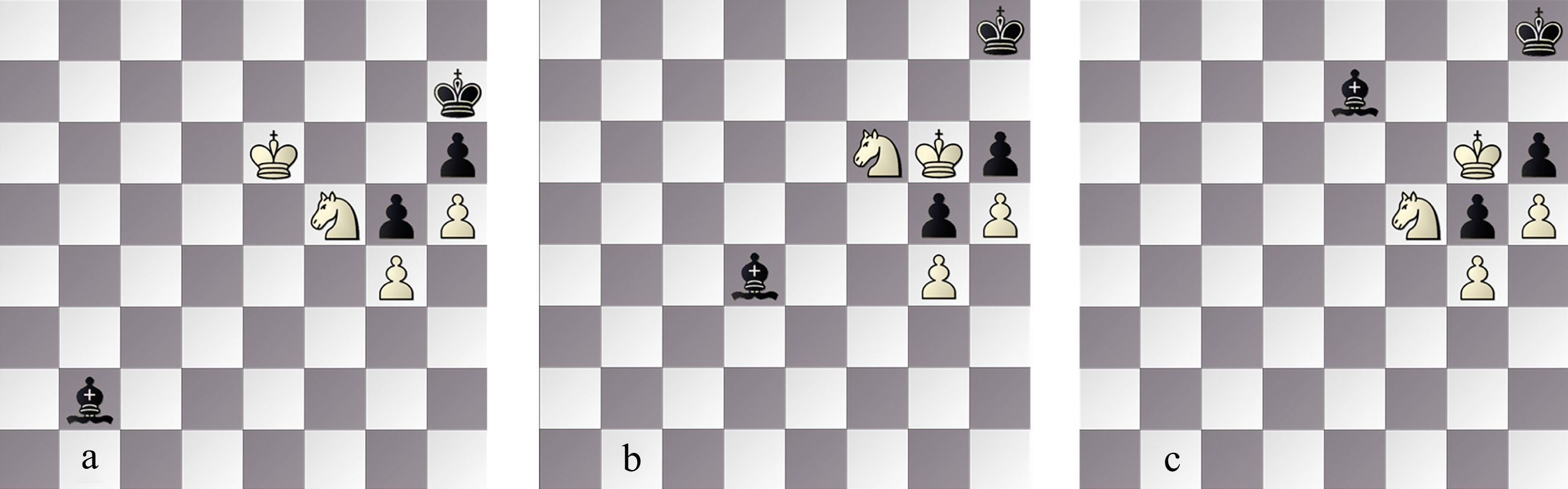
Arkell-Burke, Nottingham Open, 2013: (a) 70b, (b) 76 w and (c) 79 w, mate in 18 m.

Arkell-Burke, analysis 1 from (a) 73w: (b) 74b, (c) 76 w, (d) 79 w, (e) 76b, (f) 79b.

Arkell-Burke, analysis 2 from (a) 73b: (b) 79w, (c) 85w, (d) 78b, (e) 83w, (f) 89w, (g) 91w, (h) 99b and (i) 108b.
As flagged above, the position of Fig. 4a merits its own analysis: it is mate in 66 moves for White according to the Lomonosov ‘DTM’ depth-to-mate tablebases (2017). The following scheme and moves are however not necessarily DTM optimal. I suggest the following four-step winning process: Bring the white king to f7. Therefore put the king to f5 and the knight to e4 or e6. Then Kf6 will come or the pawn can be taken. Bring the king to g8. Therefore the knight moves to f8 as pointed out by Kasimdzhanov in Endgame Magic 52 at Playchess.com. Bring the knight to c4. This forces the bishop to f4. Now the bishop is dominated and White’s king can come back, but it is still deep. There are two important further intermediate positions as Steve Burke has pointed out.
Let us start with the first step to Kf7.
74.... Bc1 75. Kf5 Be3 (75.... Kh7 76. Kf6 +–) 76. Nxg5 Kh6 77. Nf7+ Kg7 78. Nd6 Kh6 79. Kf6 Bd4+ 80. Kf7 Kg5 81. Nf5 Kxg4 82. Kg6 +–.
74... Ba3 75. Kf5 Bc1, Fig. 4c, 76. Nc5 (76. Nxg5? is only drawn, which is the difficulty. The pawn can only be taken when White can force a direct win very soon. 76. …Kh6 77. Ne6 Ba3! 78. Nf4 Be7 !=, Fig. 4d, and Black’s blockade cannot be broken.) 76.... Bd2 (76.... Bb2 77. Kxg5 +–) 77. Ne6+ Kh6 78. Kf6 +– and White’s king reaches f7.
From Fig. 5a, the next step is to reach g8 with White’s king: this can clearly be achieved. According to the Lomonosov tablebases, DTM = 63 moves.
Steve Burke adds, “If White simply plays to win the last black pawn, he fails as 74. Ke6 Bb2 75. Nd6 Kh6 76. Kf5 Ba3! 77. Nf7+ Kg7 78. Nxg5? Bb4!, Fig. 5b, is a draw. (Not 78... Be7?? immediately as 79. Ne4 Kh6 80. Nf6 Bd8 81. g5+ is winning.) 79. Nf3
(79. Ne4 Kh6 ! 80. Ng3 Be7 ! (80... Bd2?? 81. Kf6 Bc3 + 82. Kf7 Bd2 (82... Kg5 83. Ne4+ Kxg4 84. Kg6! +–) 83. Nf5+ Kg5 84. h6 Bc3 85. h7 Bh8 86. Kg8 Bc3 87. Ng7 +–) 81. Ke6 Ba3 82. Kf6 Bb2+ 83. Kf7 (83. Kf5 Bc1=) 83... Kg5 ! (83... Bc3?? 84. Nf5+ Kg5 85. h6 Kxg4 86. Ng7 +–) 84. Ne4+ Kxg4 85. h6 Kh5 86. h7 Kh6 87. Kg8 Kg6=)
79.... Kh6! 80. Ne5 Ba3! 81. Nf7+ (81. g5+ Kxh5 82. g6 Kh6 83. Kf6 Bb2 84. Kf5 (84. g7 Bxe5+ 85. Kxe5 Kxg7=) 84... Kg7=) 81.... Kg7 82. Ke6 Bc1 83. g5 (83. h6+ Kg6=) 83... Bxg5 84. Nxg5 Kh6=, Fig. 5c.” As Steve’s analysis indicates, matters are indeed not easy at all.
Now comes the next step, the regrouping of the knight to c4. This can also always be achieved as Black’s bishop must protect the roads to mate on f5 and f7.
As here, progress in computer technology has solved many riddles. But it is not easy at all for humans to follow the logic behind the computer’s optimal lines. Sometimes a more systematic approach is easier to understand even if it is slower in DTM terms. For endgame analysts, it is still interesting to find the cornerstone positions and principles worth knowing for a practical player. This idea is followed by Müller and Konoval (2016, 2017) in Understanding Rook Endings and Understanding Minor Piece Endings. But because of computers, this job is different from the job of the old endgame analysts, who had to find out all secrets by themselves, which is much more difficult but also leads to a deep understanding if indeed all secrets can be uncovered. Some endings are of course so complicated that they are too deep and can only be solved with the help of the machines.
Many thanks to Steve Burke for sending me his fascinating example and allowing me to use his analysis, and to Guy Haworth for checking the analysis with the Lomonosov 7-man tablebases and F
Footnotes
Karpov’s game 9 win took the score to 4-0 in his favour but was followed by fifteen draws. Karpov then won again but the challenger fought back to 5-3 by game 48, at which point FIDE controversially suspended the match.