After the thrills and spills of two consecutive Stockfish–Leela matches, this season’s Superfinal pitted Stockfish against newcomer AllieStein. From a spectator perspective, any match between an alpha-beta and a neural-network machine is worth the admission fee as the clash of styles invariably produces spectacular chess. However, after seeing Leela remain undefeated throughout Division P while defeating Stockfish in their mini-match (a typical Leela AlphaZero-like squeeze with White against a French) it was also frustrating to miss out on another nailbiter!
The games between Stockfish and AllieStein in Division P indicated that AllieStein would struggle to keep the number of Stockfish wins down. First of all, Stockfish won a long game in 173 moves where a blocked and completely equal position turned sour for AllieStein as time went short, and then Stockfish demonstrated its own beautiful form of brutality with exceptionally powerful kingside attacks. By contrast, despite pressing hard in its White games, AllieStein scored its only victory when Stockfish suffered one of two crashes in a somewhat inferior position. It seemed likely that the tension of the previous two Sufis, where the result remained unclear until the final stages, was not going to be repeated, and indeed Stockfish scored a convincing 14–5 victory with 81 draws.
There were some exceptionally fine games from both sides, and some intriguing moments as openings book author Jeroen Noomen (who once again did a great job) selected a certain number of openings from the AlphaZero–Stockfish matches!
Game 3: AllieStein v0.5–dev_7b41f8c-n (3823) – Stockfish 19092522 (3892) [E98]
AllieStein opened the scoring in the third game with a fine strategical performance from a Mar Del Plata King’s Indian. It was interesting to see how AllieStein guided the game through various transformations into a very promising pawn structure without Stockfish realising how serious matters had become.
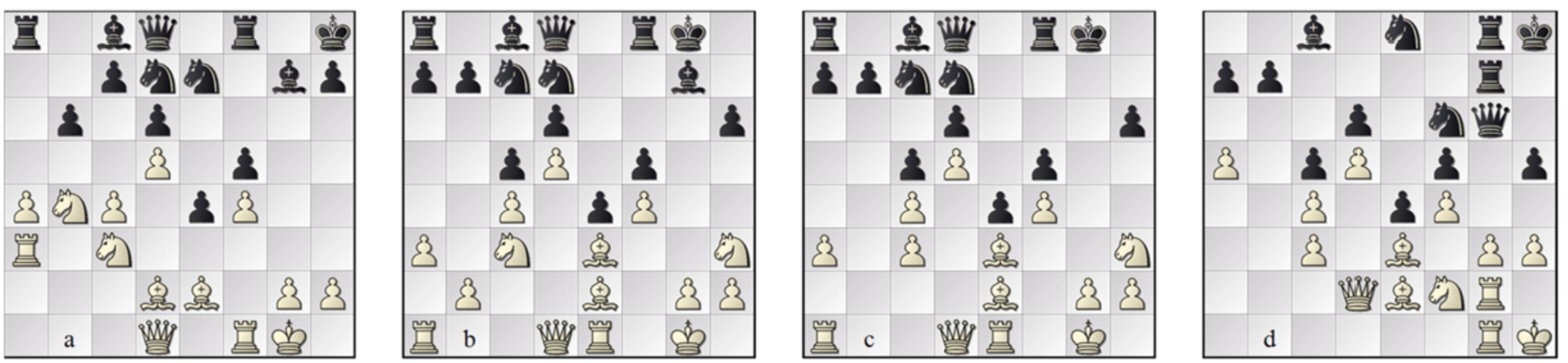
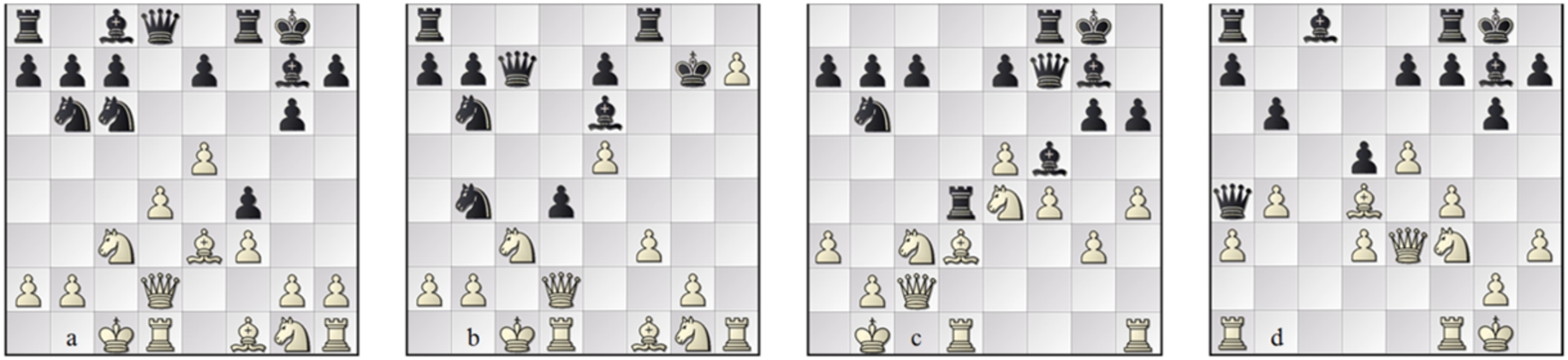
At Fig. 1a after move 19, despite the 0.00 evaluation from Stockfish, I would estimate that White has an extremely serious advantage. This type of King’s Indian structure with a blocked f5–e4 centre is only viable for Black if he has control of the d4-square (via a pawn on c5 rather than c7) and if White faces a struggle to open the queenside. Here White’s access to the d4 square (great square for a knight!) reinforces the value of the blockading square e3, while White’s a4–a5 break can be executed pretty much at will. By contrast, here is the classical example of a reasonable version of this structure from Bronstein–Petrosian, Candidates Tournament Amsterdam/Leeuwarden, r11, 16th April, 1956.
Fig. 1b (Chessgames, 2019): 17...Bxc3 18. bxc3, Fig. 1c. Black’s c5–pawn removes access to d4 from White’s pieces. The unexpected exchange on c3 ends any White hopes of breaking through on the queenside while shutting out the dark-squared bishop’s access to the a1–h8 diagonal. Magnus Carlsen repeated this same manoeuvre against Vincent Keymer at Grenke 2019.
(a) Game 3 position 20w; (b) Bronstein–Petrosian positions 17b, (c) 18b and (d) 30w.
Games 5 and 6: AllieStein–Stockfish and Stockfish–AllieStein [B48]
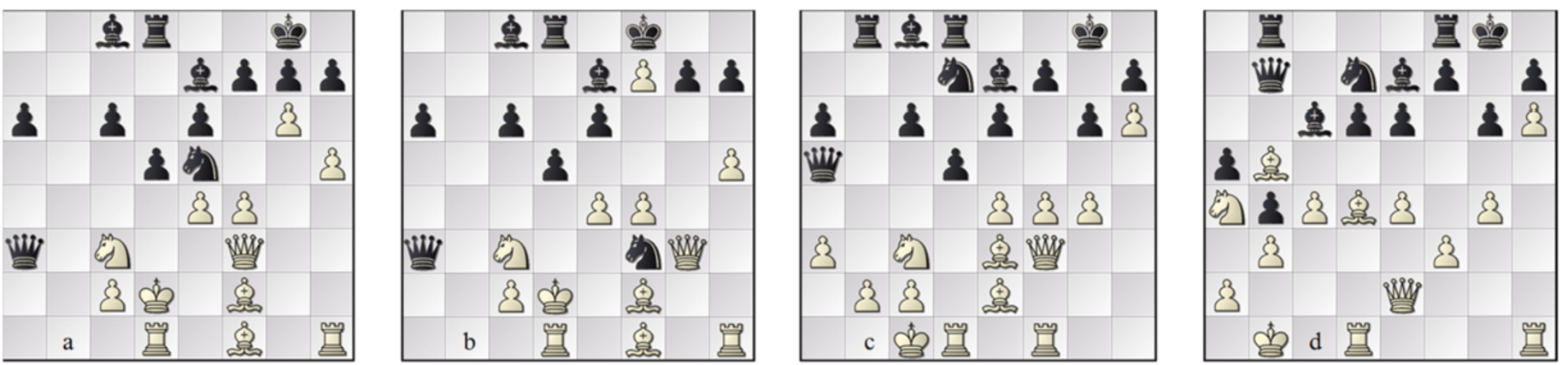
Stockfish started to show its teeth in the Open Sicilian with a fantastic tactical defence as Black, see Figs 2a and 2b. Then followed a convincing victory from the White side of the same opening. This featured a striking episode of play tweeted by Peter Heine Nielsen, Magnus Carlsen’s second.
Fig. 2c: 20. Bd4 c5 21. Bg7. This placement of the bishop on g7 is quite unusual in the context of the position: there is no immediate follow-up on the dark squares but the opponent’s king is simply completely restricted laying the basis for a future kingside attack (which certainly came later!). The only other example of this that came to mind was bizarrely enough from a game of the AlphaZero–Stockfish match, London, 2018, Fig. 2d: 21. Bg7.
AllieStein–Stockfish (a) game 5, pos. 24w and (b) 26w; (c) Stockfish–AllieStein game 6, pos. 20w and (d) AlphaZero–Stockfish, 2018 match, position 21w.
Game 14: Stockfish–AllieStein [C19]
The next notable game for me was the 14th game where, given free choice after the 7th move of a French Winawer, AllieStein repeated AlphaZero’s very interesting choice during its match against Stockfish, namely one of Bronstein’s unexplored ideas in the Poisoned Pawn, 12Na6 instead of the almost exclusively played 12...Nbc6.
This Stockfish preferred 13. Nd4 to 13. g3 but the games proceeded in a similar fashion, including the manoeuvre of the knight to e4 and doubled f-pawns after a later ...Nf5, Bxf5, see Fig. 3b, and the ...Nd2 idea as in Fig. 3c – until, in the position of Fig. 3d, AllieStein surprisingly blundered with 33Qc6, allowing a neat but not too difficult tactic. 33...Rd6 was recommended by both Leela and Stockfish and seems to hold the balance as Black is firmly entrenched on the light squares around White’s centre. 34. Bc5+ Nd6. 34...bxc5 35. Qd8+ Ke6 36. Qe8+ wins. 35. Bxd6+ Rxd6 36. Rxd6 Kxd6 37. Qh6+ Re6 38. Qf8+ Kd5 39. Qxf7 1–0.
Game 61, Stockfish–AllieStein game 14, positions (a) 13w, (b) 21b, (c) 23w and (d) 33b.
Such ‘unnecessary’ losses were another indication that AllieStein was indeed going to struggle but the match remained great fun and the game-pair 25–26 was also intriguing.
Game 26: Stockfish–AllieStein [E16]
(a) AlphaZero–Stockfish position 15b; (b) Stockfish–AllieStein game 26, positions 20b, (c) 25b and (d) 28b.
1. d4 Nf6 2. c4 e6 3. Nf3 b6 4. g3 Bb7 5. Bg2 Bb4+ 6. Bd2 Be7 7. Nc3 0–0 8. Qc2 Na6 9. a3 c5 10. d5 exd5 11. Ng5 Nc7. This opening occurred in an AlphaZero–Stockfish game which we featured in Game Changer (Sadler and Regan, 2019, p230). That game is worth showing here.
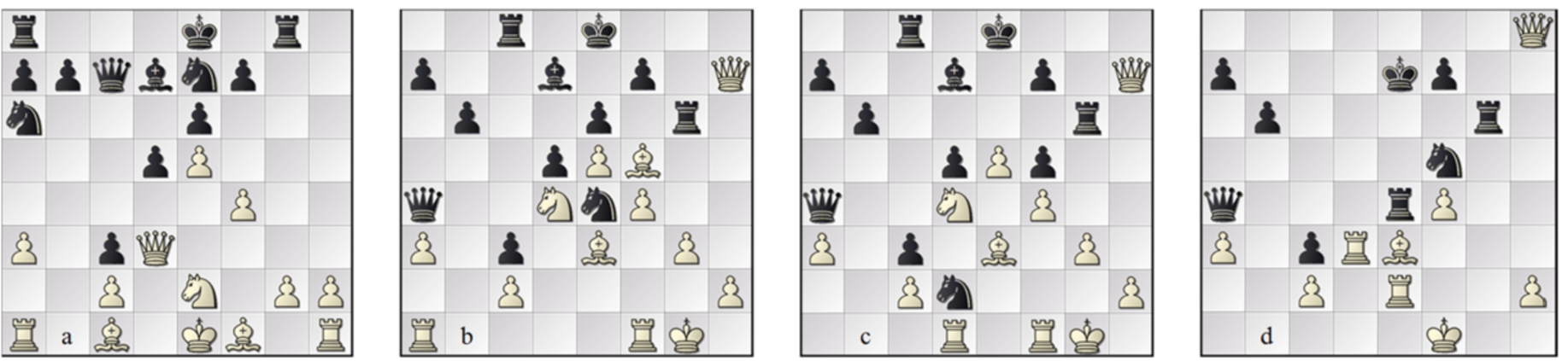
12. Nxd5. AlphaZero in 2018 found an exceptionally strong plan based around a rook swing along the 3rd rank: 12. h4 h6 13. Nxd5 Ncxd5 14. cxd5 d6 15. a4, see Fig. 4a. One of those AlphaZero moves that took me some quality time to understand, particularly as none of my engines were impressed! Here Stockfish played the unnatural 15...Qd7 but I was confused at first by what White might have in mind after the natural 15...a6. Then I saw it, and when I asked AlphaZero later, I turned out to be right! AlphaZero’s intention after this natural move was to play the powerful
16. Ra3 b5 17. g4 AlphaZero’s way, though the immediate 17. Rf3 also looked very strong. 17...c4 18. Rf3 Re8 19. Nxf7 Kxf7 20. g5 Kg8 21. Qg6 was AlphaZero’s main line with a huge 88.7% expected score!
The game continuation in 2018 was in fact 15...Qd7 16. Bc3 Rfe8 17. 0–0–0 Bd8 18. e4 Ng4 19. Bh3 hxg5 20. f3 f5 21. fxg4 fxg4 22. Bf1 gxh4 23. Bb5 Qf7 24. gxh4 Bf6 25. Rhf1 Rf8 26. Bxf6 gxf6 27. Rf4 which was very good for White, AlphaZero winning in 49 moves, 1–0.
There are many more amazing variations in Game Changer but I think you get the idea. To be honest, I felt this idea made Black’s position more or less unplayable but neither AllieStein nor Stockfish played it. AllieStein played a more sedate version of AlphaZero’s g4 idea and achieved relatively little. Stockfish played quite a traditional plan of pushing the central pawns – but it didn’t lead to a traditional game! No way!
14. e4 b5 15. f4 h6 16. h4 b4 17. axb4 cxb4 18. e5 dxe5 19. fxe5 Re8 20. Kd1, Fig. 4b. That is Stockfish on the loose! AllieStein’s defence looks very suspicious in principle – Black is setting up barriers on the light squares which are extremely porous – but the tactical refutation is magnificent!
20...hxg5 21. hxg5 Nh5 22. g6 Bxd5 23. Rxh5 Qd7 24. gxf7+ Kxf7 25. Ra6, Fig. 4c. Worth a few diagrams this game! Fantastic attacking vision using both rooks. AllieStein will have been rueing the sequence 16...b4 17. axb4 cxb4 which activated Stockfish’s hitherto passive rook on a1.
AllieStein hit back in the next game with a smooth win that again demonstrated a superior evaluation of a static pawn structure and in fact, the engines continued trading wins until the very interesting game-pair 41–42.
Game 42: Stockfish–AllieStein [D70]
This featured one of AlphaZero’s more astonishing opening discoveries.
1. d4 Nf6 2. c4 g6 3. f3 d5 4. cxd5 Nxd5 5. e4 Nb6 6. Nc3 Bg7 7. Be3 0–0 8. Qd2 Nc6 9. 0–0–0 f5 10.e5 f4, Fig. 5a, a fall-off-your-chair moment for me. I have studied the 3. f3 line in the Grünfeld very seriously but I never dreamt of this idea.
In fact, for quite some time I couldn’t decide whether this was AlphaZero hating its position and going all-in or whether it really was a viable idea. The fact that Magnus Carlsen later punted it against Wesley So (albeit in a blitz game) shows that it has some value at least. AllieStein followed AlphaZero’s recommendation – which had seemed the best to me – for a while before deviating with 18. Qg5+. AlphaZero’s 18. Qh6+ leads to a slightly unpleasant endgame for Black though one which I’m sure Stockfish would have had a decent go at holding! AllieStein’s choice led to a wild game in which Stockfish miraculously kept itself afloat!
11. Bxf4 Nb4. The prior game 41, AllieStein–Stockfish, went 11...Be6 12. h4 Nb4, transposing back into AlphaZero’s main line. 11...Nb4 and 11...Be6 were nearly equivalent moves for AlphaZero. 13. h5 c5 14. hxg6 Qc7 15. Bh6 cxd4 16. gxh7+ Kh8 17. Bxg7+ Kxg7, see Fig. 5b. 18. Qg5+ Kh8 19. Rxd4 Nxa2+ 20. Kd2 Rf5 21. Qh6 Rxe5 22. f4 Nc4+ 23. Bxc4 Qb6 24. Nce2 Qa5+ 25. Nc3 Qb6 26. fxe5 Qxd4+ 27. Ke1 Nxc3 28. Bxe6 Ne4 29. Qf4 Rd8 30. Bd7 Qb4+ 31. Ke2 Qxb2+ 32. Kf3 Nf2 33. Rh5 Nd3 34. Qe3 Rxd7 35. Ne2 Rd8 drawn in 167 moves.
12. a3 Nc6 13. g3. A major idea for White which I also analysed quite a bit. Stockfish’s earlier (natural) choice against AlphaZero led to an outburst of counterplay based around the weakening of the queenside provoked by the manoeuvre... Nb4–c6.
(a) Stockfish–AllieStein game 42 position 11w; (b) AllieStein–Stockfish game 41 position 18w; (c) Stockfish–AllieStein game 42, position 23b; (d) AllieStein–Stockfish game 75, position 18b.
13...Bf5 14. Ne4 Qd5 15. Ne2 Rad8 16. Qc2 h6 17. h4 Qa2 18. N2c3 Qf7 19. Be3 Na5 20. Bd3 Nb3+ 21. Kb1 Nxd4 22. Bxd4 Rxd4 23. f4, Fig. 5c. Although Black has regained the sacrificed pawn, the restricted position of the bishop on g7 gives Black a long-term headache and Stockfish exploited this advantage convincingly, winning in 64 moves.
Somehow, after this, the match seemed to run away from AllieStein as Stockfish scored a number of wins without response including a fine Bxh7+ sacrifice, move 23 of game 64, culminating in doubled rooks on the 8th rank tying down Black’s (extra) piece completely.
Game 75: AllieStein–Stockfish
Game 75 was notable for me as AlphaZero also scored many wins in this type of pawn structure and piece configuration (also often arising from Caro-Kanns or French Defences). Fig. 5d: 18...Be6.
This structure with B+N vs 2Bs, a kingside space advantage and an open file that is hard for Black to exploit in any useful way is one that Stockfish also drifted into against AlphaZero. AllieStein also exploits the advantage in typical fashion: a squeeze on the kingside (including the typical pawn on h6, restricting the opponent’s king movement while pinning the black h7–pawn as a future endgame weakness) followed by invasion on the file on the opposite side of the board that Black thought it had for itself!
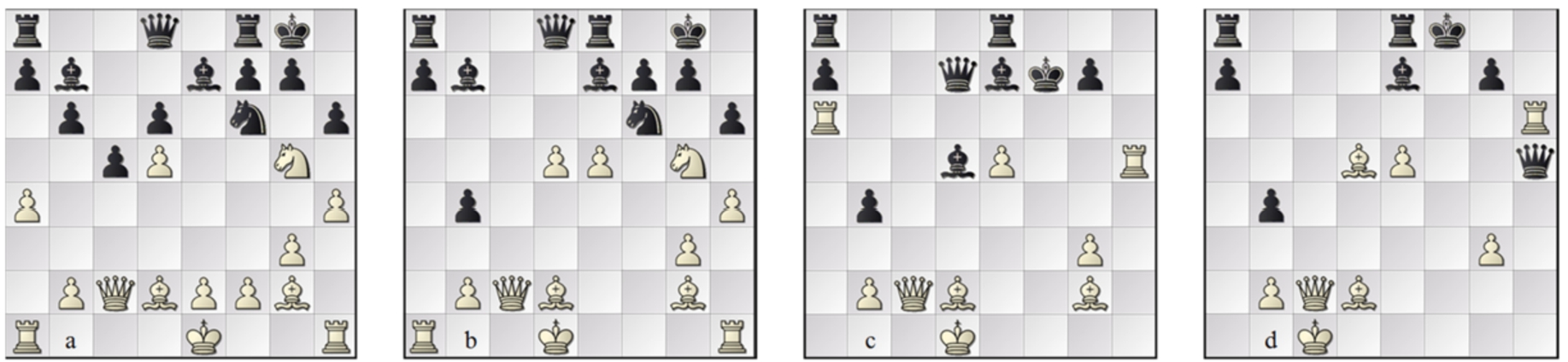
The final ended with a trade of wins in the Dragon with Stockfish’s amazing calculating prowess coming to the fore in the final game as AllieStein sought to advance its kingside pawns: the geometry of the final assault is quite dazzling! Look at that queen go!
Game 100: Stockfish–AllieStein [B35]
Stockfish–AllieStein game 100, positions (a) 44w, (b) 51b, (c) 55b, (d) 58b and (e) 61b.
A deserved victory for Stockfish and a very entertaining match – congratulations to both sides! And as always, a special round of applause for the TCEC for organising chess events of such astonishingly high quality. Let us hope for many more in the future!