



Abstract
Research in time series classification has shown that the one nearest neighbor with Dynamic Time Warping measure in most cases outperforms more advanced classification algorithms. Instance reduction is one of the approaches to improve time and space efficiency of nearest neighbor classifier for time series data. This approach reduces the size of the training set by selecting the best representative instances and uses only them during classification of new instances. In this work, we propose a novel approach for instance reduction in time series classification. Our method consists of two steps. First, we remove the unrepresentative instances in the training set, using data editing. In the second step, we compress the training set using the Minimum Description Length principle. The main idea behind our method is that if we can compress the two time series by the Minimum Description Length principle, we will combine them into one time series. By this way, the number of instances in the training set is reduced step by step, and we stop removing instances from the training set when reaching some required percentage of instances in the training set or when we can not find any pair of instances to compress. We empirically compare our proposed method with the two previous methods, INSIGHT and Naïve Rank Reduction, over a vast majority number of time series training sets. The experimental results show that our method can outperform INSIGHT and Naïve Rank Reduction in many datasets when the percentage of selected instances in the training set is not too small, about greater than 30%.
Keywords
Introduction
Time series data exists in several applications of our life, in a vast majority of fields such as finance, economy, medicine, environment, government, engineering or industry. There are many time series data mining tasks such as similarity search, motif discovery, anomaly detection, rule extraction, clustering, and classification. Among these tasks, classification problem is a traditional important problem. Time series classification is the theoretical background of many recognition tasks such as signature verification, speech, handwriting recognition. In medicine, time series classification can be applied in the analysis of images, brainwaves (EEG) and electrocardiograph (ECG) signals.
Although there has been much research on classification in general, the most classic machine learning and data mining algorithms do not work well for time series data due to their unique characteristics. In particular, the high dimensionality, very high feature correlation and the large amount of noise that characterize time series present a difficult challenge. There are a few classification methods that can be applied to time series data such as: Artificial Neural Network, Bayesian Network, Decision Tree, k-Nearest Neighbors. Among these methods, the simple approach, 1-Nearest Neighbor Classifier using Dynamic Time Warping (DTW) measure [5, 21] was considered that it is hard to beat [34].
There are four major approaches to enhance the efficiency of 1-Nearest Neighbor Classifier for time series data. One way to speed up 1-Nearest Neighbor Classifier is to use some indexing structures to support time series similarity search such as R-tree [12], R*-tree [3], M-tree [9], TS-tree [1]. A second way to improve the efficiency of 1-Nearest Neighbor Classifier for time series data is to reduce the dimensionality of time series by using some approximation methods such as PAA (Piecewise Aggregate Approximation) [19], PLA (Piecewise Linear Approximation) [20] or to transform into discrete symbols such as SAX (Symbolic Aggregate Approximation) [24]. Another way is to speed up the computation of the DTW distance function. One well-known technique to accelerate the computation of DTW is to use lower bounding techniques [21, 22, 23, 26]. Another direction to improve the efficiency of 1-Nearest Neighbor Classifier is reducing the number of instances in the training set. We can simply discard a fraction of the training data to improve the performance. It is well known that for general instance reduction, if we are careful in selecting which instances we discard, we can significantly reduce the classification time and the storage requirement of the training set while maintaining high accuracy.
For the last direction, while the idea of instance reduction for nearest neighbor classifiers has a long history, surprisingly there have been very few methods of this direction proposed for time series classification. So far, there are two instance reduction methods for time series: Naïve Rank Reduction, was proposed by Xi et al. [38], and INSIGHT, which is based on graph theory, was proposed by Buza et al. [7].
In this work, we propose a novel method to reduce the number of instances in the training set for time series classification which is based on the Minimum Description Length (MDL) principle. MDL has been widely used in bioinformatics, text mining, etc. yet it is still under-explored in time series domains. This is mainly because MDL is defined in discrete space. Some recent publications [14, 27] provide an in-depth analysis of the potential of applying MDL principle to real-valued time series data. Our proposed method, called IR_M (Instance Reduction based on MDL principle), is the first attempt to apply MDL in instance reduction for nearest-neighbor classification of time series. It consists of two steps: removing the unrepresentative instances and compressing the training set. In the first step, we remove the unrepresentative instances in the training set, which are the instances that their nearest neighbors in the training set belong to another class. After the first step, if the number of instances in the training set has not reached the required percentage of instances yet, we continue to the second step which is the main process in our method. In the second step, if any pairs of time series can be compressed by the MDL principle, they will be combined into one time series. Therefore, the number of instances in the training set is reduced step by step, and we stop removing instances when some required percentage of instances in the training set is reached or when we can not find any pair of instances to compress. Besides, we also propose a principled way to automatically determine the point at which the instance removal process should stop. That means our proposed method can be used as parameter-free or parametric.
We empirically compare the IR_M method with the two previous methods INSIGHT [7], and the Naïve Rank Reduction [38] over a collection of 44 publicly available datasets for time series classification. In most of the datasets, the experimental results reveal that IR_M can outperform INSIGHT method and Naïve Rank Reduction when the percentage of selected instances in the training set is not too small, about greater than 30% of the original training set.
The rest of this paper is organized as follows. Section 2 reviews some background on time series data and MDL principle. Section 3 reviews the two previous methods on instance reduction for time series classification. Section 4 gives details of our proposed method, and followed by a set of experiments in Section 5. Section 6 concludes the work and gives suggestions for future works.
Backgrounds
In this section, we introduce some background on time series classification, Dynamic Time Warping and the MDL principle for time series data.
Time series
A time series
1-Nearest Neighbor Classifier
In 1-Nearest Neighbor Classifier (1-NN), the data object is classified to the same class as its nearest object in the training set. The 1-NN combined with DTW has been approved hard-to-beat in classification of time series data among many other methods such as Artificial Neural Network (ANN), Bayesian Network, Decision Tree, etc. [34]. In this work, we use 1-NN to classify time series data and evaluate the error rate of this classifier on the reduced training set.
Distance measures on time series
Distance measure has a huge impact on several time series data mining tasks such as similarity search, classification, clustering, motif discovery, anomaly detection, rule extraction. All of these problems need a distance measure function to estimate the similarity between time series. There have been several distance functions proposed for time series, among them, Euclidean Distance and Dynamic Time Warping distance are the most widely used.
Dynamic Time Warping
Dynamic Time Warping (DTW) distance [5] aims to find the best matching between two time series. During that matching, it calculates the smallest distance between two time series. Such a best matching is also called the warping path. However, DTW incurs high computational complexity (i.e.,
A comparison of Euclidean Distance (a) and Dynamic Time Warping (b).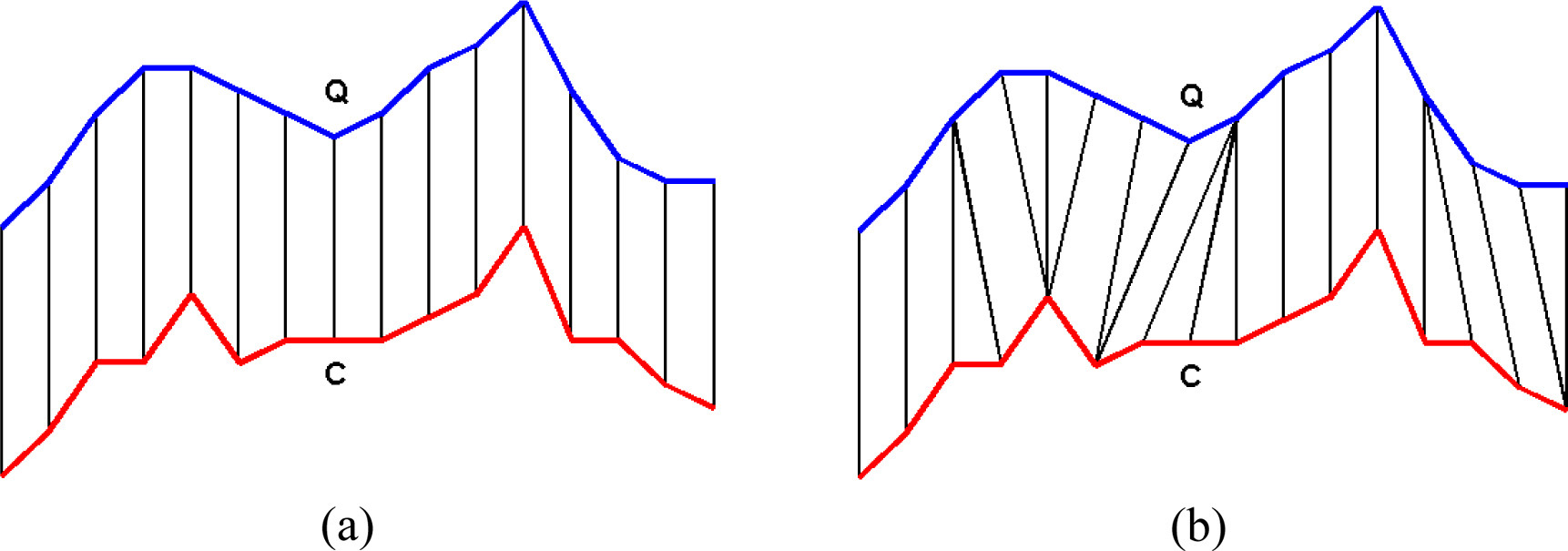
Given two time series
where
Next, we choose the optimal warping path which has minimum cumulative distance defined as:
where
For a more efficient DTW distance computation, some global constraints were suggested to DTW [15, 29]. A well-known constraint is Sakoe-Chiba band [29]. The Sakoe-Chiba band constrains the indices of the warping path
The Minimum Description Length principle is a formalization of Occam’s razor in which the best hypothesis for a given set of data is the one that leads to the best compression of the data. MDL was introduced by Rissanen [28]. This principle is a crucial concept in information theory and computational learning theory.
MDL has had a significant impact in bioinformatics and data mining of discrete objects but has yet failed to have significant impact on real-valued data mining. Recently, there have been some efforts to use MDL principle in time series data mining tasks. Tanaka et al. applied MDL in the EMD algorithm which discovers motifs in time series [31]. The EMD algorithm operates on a quantized representation of the data which has the disadvantages of requiring three parameters (cardinality, dimensionality, and window size). Begum et al. proposed a stopping criterion for semi-supervised time series classification based on MDL [4]. Rakthanmanon et al. developed an MDL-based method for time series clustering [27]. Shokooki-Yekta et al. applied MDL in time series rule discovery [30]. The three latter works follow a new framework of MDL approach which is effective, efficient and more suitable for time series data.
MDL is a principle; this means that there is no “single uniquely optimal MDL method/procedure/ algorithm” [11]. In some special situations, we can distinguish between good and not good versions of MDL principle [11].
In this work, we use a specific version of MDL principle for time series data which was used in some previous studies such as in [4, 27]. We choose this version of MDL principle because it is parameter-free, suitable for time series data, and it allows for a more intuitive explanation of our algorithms.
Discrete normalization function
The MDL technique that is at the heart of our work requires discrete data, but most time series dataset are real-valued. To overcome this problem, we cast the real-valued numbers into a reduced cardinality version by using the following discrete normalization function.
A discrete function Dis_Norm is the function to normalize a real-value subsequence
where min and max are the minimum and maximum value in
After casting the original real-valued data to discrete values, we are interested in determining how many bits are needed to store a particular time series
Entropy
Entropy can be understood as the average number of bits requires representing one element of a sequence. The entropy of a time series
where
For example,
Note that time series
Description length
A description length DL of a time series
where
The description length of a time series using entropy clearly depends on the data itself. For example, a constant line has a very low description length, whereas a random time series has a very high description length.
One of the key steps of designing our instance reduction method using the MDL technique is to find a representation or model of our data, and use this model to compress the data in a lossless fashion. We call this representation or model, a hypothesis.
Hypothesis
A hypothesis
Finally, we are interested in the description length of a time series
Conditional description length
A conditional description length of a time series
where
For example, given
The difference vector
If
Related works
The main goal of instance reduction is to reduce the computational cost of the k-NN classifier, the storage requirements of the training set and to make the k-NN classifier more tolerant to noise. Although there have been numerous instance reduction methods proposed to speed up nearest neighbor classification of conventional data, see e.g. [6, 10, 16, 17, 32, 35, 36, 37], due to the challenging characteristics of time series data, so far there has been only two works related to instance reduction for the case of time series data: Naïve Rank Reduction proposed by Xi et al. [38] and INSIGHT method proposed by Buza et al. [7]. In this section, we review the two previous instance reduction methods.
Naïve Rank Reduction
Naïve Rank Reduction for time series data was proposed by Xi et al. [38]. This method uses a ranking function which was developed from the ideas in the most referenced paper by Wilson and Martinez [36] for instance reduction in k-NN classification of ordinary data.
Naïve Rank Reduction method first assigns rank to each instance
where
where
One disadvantage of the Naïve Rank Reduction method is that it is parametric. The user must define the size of the condensed training set.
Instance Selection based on Graph-coverage and Hubness for Time series (INSIGHT) was proposed by Buza et al. [7]. In INSIGHT, in order to rank the time series in the training set, the authors proposed three score functions based on hubness property of time series [25]. This property states that for data with high (intrinsic) dimensionality, as most of the time series data, some objects tend to become nearest neighbors much more frequently than others. The term hubness is a phenomenon that the distribution of
There are three score functions that were proposed in INSIGHT as follows:
Good 1-occurrence score: Relative score: Xi’s score (this score function is based on the ranking criterion of Xi et al. [38]):
In the above score functions,
In the INSIGHT, the instance selection problem is cascaded as a graph-coverage problem. The algorithm of INSIGHT includes three steps as follows:
Calculate score function Sort all the time series in Select the top-ranked
where
The INSIGHT also has the same disadvantage of the Naïve Rank Reduction method: it is parametric. The user must define the size of the reduced training set.
Naïve Rank Reduction comes with a time series classification method called AWARD [38]. The AWARD method is an iterative procedure for reducing instances in the training set: in each iteration, the ranks of all the time series in the training set is calculated and the lowest ranked time series is discarded. Thus, each iteration corresponds to a particular number of kept time series. Xi et al. argue that the optimal Sakoe-Chiba band for DTW distance depends on the number of kept time series. Therefore, AWARD calculates the optimal warping window size for each number of kept time series.
In INSIGHT method, the authors just rank the instances in the training set and reduce the training set only once. This method does not include the second step to find the optimal Sakoe-Chiba band
Different from the AWARD method, in this work we focus on the instance reduction problem. We regard the whole training set as a data set and attempt to compress it as much as we can. Our method does not pay attention to finding Sakoe-Chiba band
IR_M: Reducing the training set based on MDL principle
In this section, first we explain a preprocessing step, called data editing, which can remove the unrepresentative instances from the training set. Then, we describe our instance reduction algorithm, IR_M, which is based on MDL principle. Besides, we also propose a method to determine the stopping point where the compression process in IR_M should stop.
Unrepresentative instances
The original training set may contain harmful and superfluous instances which can become the neighbors of the test pattern and they could lead to a wrong classification result. In this subsection, we give a definition of the unrepresentative instances and introduce the algorithm to remove them. Removing the unrepresentative instances is a pre-processing step for our main IR_M algorithm.
Definition of unrepresentative instance (UI)
An instance is considered unrepresentative if its one nearest neighbor belongs to the other class, i.e. time series
The idea of removing such unrepresentative instances in our work is similar in spirit to the Edited Nearest Neighbor (ENN) algorithm proposed by Wilson for instance reduction in nearest neighbor classification of conventional data [35]. The main idea of ENN is to remove given instances if its class does not agree with majority class of its neighbors. The correctness of the ENN algorithm has been proved formally in [35]; for more details, interested reader can refer to this seminal paper. This pre-processing step is also called data editing. It edits out noisy instance as well as close border cases, leaving smoother decision boundaries. However, data editing does not remove internal instances that do not necessarily contribute to the classification decision. Therefore, the editing routine should be applied before the application of the main instance reduction procedure.
Effects of unrepresentative instances
The unrepresentative instances can be viewed as the noisy instances that exist in their class or they can be the instances which were wrongly classified. Therefore, they do not contribute to the classification process or they can even cause negative effects on classification process.
For example, in Table 2 (of Appendix A) we present the error rate of 1-Nearest Neighbor Classifier with DTW distance of some datasets after removing the unrepresentative instances in the training set in comparison to the error rate of the classifier using the original training set. The datasets in Table 2 come from the UCR Time Series Classification Archive [8]. As we can see, after removing some Unrepresentative Instances (UI), the error rate does not change much in many datasets. On some datasets, the error rate even decrease such as in ECG200, Haptics, Lightning-7, Gun-Point, MoteStrain.
Removing the unrepresentative instances
There exist some unrepresentative instances in the training set, so we need to rank them before removing them from the training set. In order to rank the unrepresentative instances, we use the distances from them to their nearest neighbor. If they are very close to their nearest neighbor (in the other class) they need to be removed first. The removal process of unrepresentative instances consists of two phases. In step 1, we identify a set of unrepresentative instances
where ud
In step 2, we sort the set of unrepresentative instances
Removing unrepresentative instances in the training set.
In order to implement the above idea, we use a min-heap
The main purpose of data editing step in k-NN classification is to remove noisy instances or outliers from the training set. Therefore, besides using ENN rule, we may apply some clustering technique in order to detect the outliers in the training set and then discard them. There exist some cluster-based outlier detection methods available in literature, such as [18, 13]. However, due to the high computational complexity of these outlier detection methods, so far, to the best of our knowledge, there has not been any work to apply cluster-based outlier detection in data editing for classification of ordinary data as well as time series data. But applying cluster-based outlier detection in data editing for k-NN classification is still a new idea that should be studied.
Before describing our IR_M algorithm, we need to explain the new method to distinguish between similar and different instances in a set of time series.
Similar and different instances
Distinguishing between similar instances and different instances in a set of time series is the main part of the IR_M method. Similar instances can be understood as they are similar to each other. And different instances are not similar to each other.
In this work, we use MDL principle, a powerful tool to determine whether two time series are similar or not. The key idea behind our method is based on the compression rate between two time series which is defined as follows.
Given two time series
where
where
Now to determine whether the two time series
If the function SIM (similarity) return true, the two time series are considered similar; otherwise, they are considered different.
For example, given three discrete time series
Now we would like to determine whether
Because CR(
The similarity function SIM in Eq. 5 is a cornerstone in our instance reduction method which we will introduce in the next subsection.
Different from Naïve Rank Reduction and INSIGHT, our IR_M method is based on the rationale: “the similar instances in the training set can contribute the same effect to the classification of others instances”. Therefore, we can merge them into one instance in order to keep only the best representative instances. In Fig. 3, we give an example to illustrate how to reduce the number of instances in the training set. The combination process includes two steps. First we identify the two instances with lowest compression rate. Then, we combine them into one instance.
An example of the combination process on IR_M. At the beginning, there are 10 instances in the training set (a). The two instances with lowest compression rate are identified (b) and combined into one instance (c). The next two instances with lowest compression rate are identified (d) and combined in to one instance (e). The process is continued and stops when there are 5 instances in the training set (l).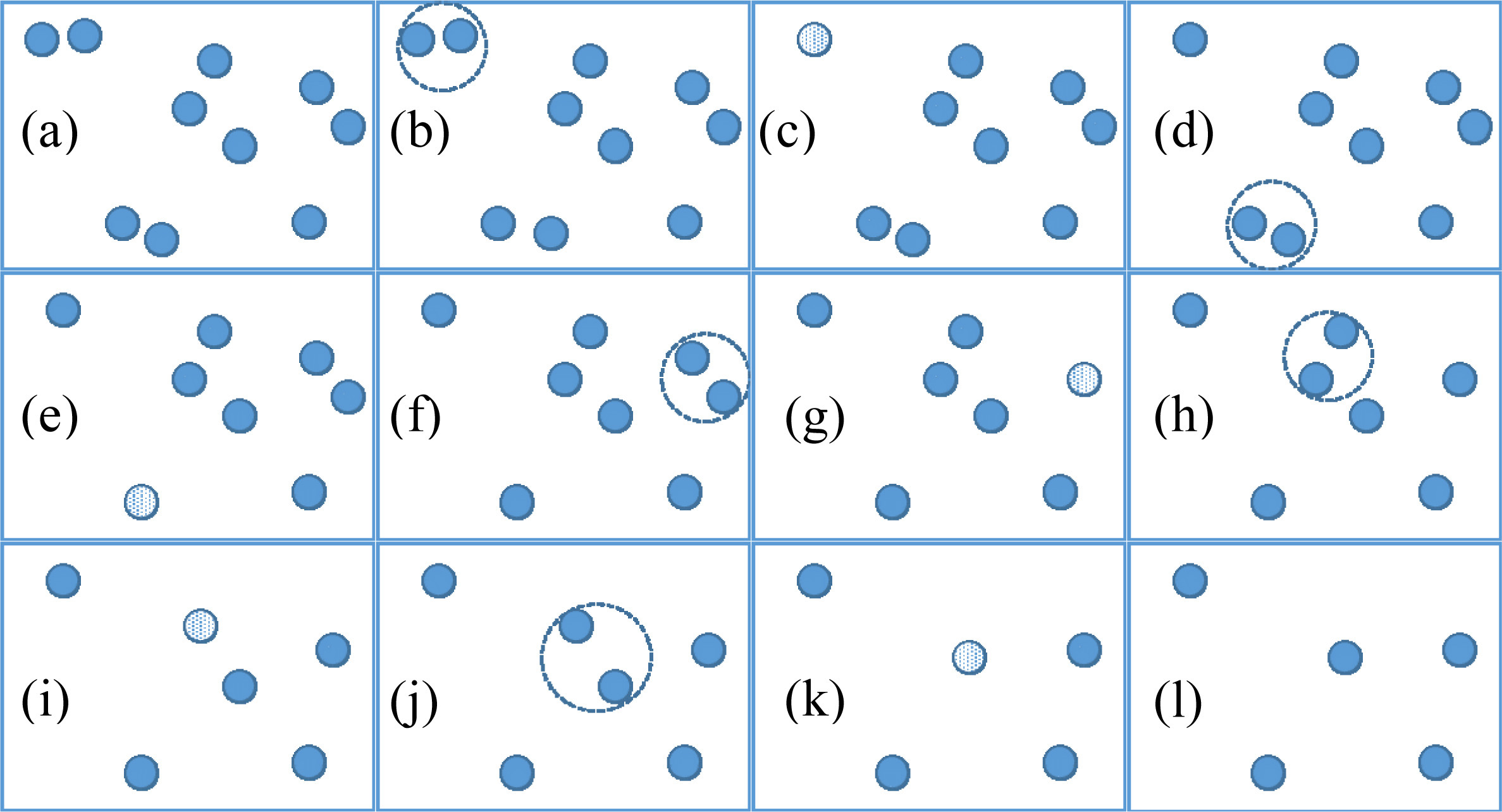
Figure 4 gives an outline of the IR_M algorithm. First the algorithm removes the unrepresentative instances from the training set (line 1). Then, it tries to find a pair of most similar instances in the training set in order to combine them into one instance. So, after each iteration, the number of instances in the training set decreases by one (line 3). There are two different ways to stop the iterative process in the IR_M algorithm. The algorithm repeats until it reaches to the required number of kept instances given by user, for example, 10%, 50%, or 60% of the total number of instances in the training set (Fig. 4) or the algorithm repeats until it can not find any pair of instances in the training set to combine (Fig. 5). So the IR_M algorithm can be used as parameter-free (Fig. 5) or with parameter (Fig. 4). This choice depends on whether the user really wants to control the number of kept instances in the training set or not. In some situations, the user has to work under some critical constraints on the available memory space or computational time. In that case, the parameter
The IR_M algorithm with the parameter
The IR_M algorithm without parameter
In the line 5 of the IR_M algorithm in Fig. 4, we need to combine two time series into one time series. We propose two different strategies to do this combination.
Strategy 1: Hybridization
In this strategy, we mix the two time series into one time series. A simple way to do this is to calculate an average time series
where
Strategy 2: Keep one time series and remove the other
In this strategy, we use the other instances in the training set to decide which one in the pair
The time series with a lower score is removed and the other one is kept in the training set. The rationale of Eq. 6 is that we would select the instances with higher contribution to the accurate classification of the other instances in the training set, i.e. for each time series
where CR is the compression rate as described in Section 4.2. We can see that score_2nd is always less than or equal to zero. The idea behind this formula is that it selects the instance with lower compression rate because this instance is more similar to the other instances. A rare but probable situation is that the two time series also have the same score_2nd. If this situation happens, then we randomly select one of them and remove the other from the training set.
The first strategy is similar in spirit to a Prototype Abstraction algorithm which generates new instance representatives by summarizing on similar training instances [30]. The second strategy is similar in spirit to a Prototype Selection algorithm which selects some training instances and uses them as representatives. Both Prototype Abstraction and Prototype Selection are commonly-used in instance reduction for nearest neighbor classification of conventional data. Our experiments revealed that both strategies used in the IR_M algorithm provide the same time series classification performance.
There is one question that the previous works have not tackled: how to determine a minimum percentage of the training set at which we should stop removing instances from it. Notice that while reducing the number of instances in the training set, the error rate of the classifier would increase. As our observation, there exists a special point at which the error rate begins to increase significantly. We call this point the Optimal Selection Percentage (OSP). This means that we should not reduce the number of instances in the training set to the point lower than the OSP point.
The ideal OSP point in 50 Words training set (a), and Swedish Leaf training set (b).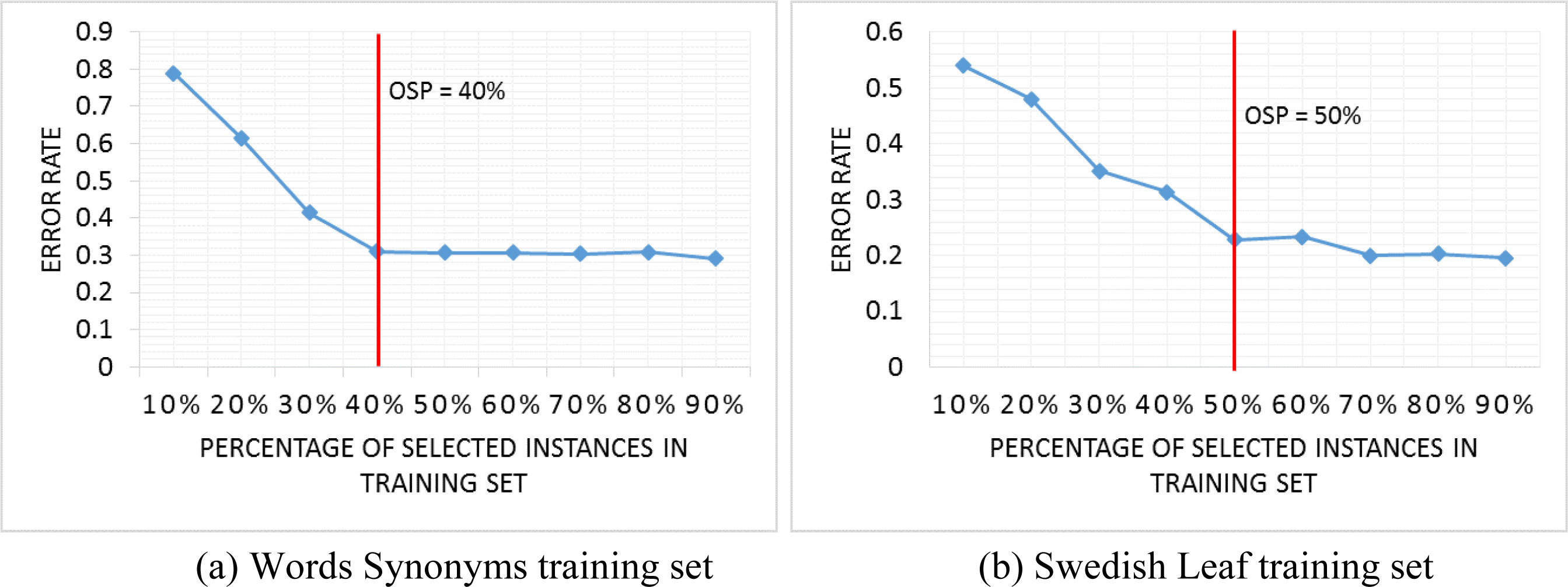
For example, in Fig. 6, we show the error rate over a range of the percentage of selected instances in the training set on two datasets: 50 Words and Swedish Leaf. These datasets also come from the UCR Time Series Classification Archive [8]. As we can see from Fig. 6, in Words Synonyms dataset, the error rate does not change much when we reduce the training set to the point greater than or equal to 40%. But when the training set is reduced to the point lower than 40% of the original training set, the error rate begins to rise significantly. This means that 40% is the point where we should stop removing any more instances. The same situation takes place on Swedish Leaf dataset, 50% is the point where we should stop removing instances from the training set.
In this work, we choose the OSP as the point at which we cannot find any pair of instances in the current training set which are similar, i.e. the compression rate of the two closest instances in the training set becomes greater than 1. This means that whenever the time series
The IR_M algorithm with OSP.
In our implementation of the RemoveUnrepresentativeInstances algorithm in Fig. 2, first we compute a matrix of size
In the IR_M algorithm in Fig. 7, first it performs the RemoveUnrepresentativeInstances algorithm. Then, we compute the distances from each instance to all the other instances in the same class and store them in a min-heap. For each iteration, the number of instances in the training set decreases by one, and the operation to find two closest instances of the same class (line 3) is also the operation of removing the smallest element from the min-heap, which complexity is
Experimental evaluation
We implemented our IR_M algorithm and the two previous methods Naïve Rank Reduction, and INSIGHT with Matlab 2012 and conducted the experiments on the Intel Core i7-740QM 1.73 GHz, 4 GB RAM PC. In the experiments, we compare the error rates of our method with those of Naïve Rank Reduction, and INSIGHT method in time series classification. We use each method to reduce the number of instances in the training set. Then, we test the reduced training set by using it to classify the unknown instances in the testing set. We compare the three methods via their error rates. The error rate is the ratio of the correctly classified instances on test data to the total number of tested instances. In general, the lower the error rate is, the better the method is.
Datasets
Our experiments were conducted over the datasets from the UCR Time Series Classification Archive [8]. There are 44 datasets used in these experiments. These datasets has been downloaded before summer 2015. Each dataset includes a training set and a testing set, and has about 2 to 50 classes. The length of each time series in each datasets is from 60 to 1882. Due to space limit, we do not show details of all the datasets. Interested reader can find more details about these datasets in [8]. Moreover, some details about datasets are also shown when we report the details of some experimental results in Tables 2 and 3 (of Appendix A). Table 2 shows the error rates of 1-Nearest Neighbor Classifier before removing unrepresentative instances (UI) and after removing unrepresentative instances on some datasets. Table 3 shows OSPs and error rates at the OSP point on 44 datasets by IR_M with two different strategies of combining instances.
Input parameters
For the convenience of comparison to the two previous methods, Naïve Rank Reduction and INSIGHT method, we set Sakoe-Chiba band
Overall experimental results on the 44 datasets
In this subsection, we report the overall comparison of IR_M with Naïve Rank Reduction and INSIGHT. For each datasets from 44 datasets [8], we apply the three methods on them; then, we test the output training set by applying 1-Nearest Neighbor Classifier on the testing part of the dataset. We record the error rates of the three methods on each dataset and compare them. The method with lower error rate is marked as winner. Figure 8 shows two area charts of the overall comparison of IR_M with the two pervious methods over the datasets.
In Fig. 8(a), we show the comparison of IR_M to Naïve Rank Reduction. As we can see from the area chart, IR_M outperforms Naïve Rank Reduction when we keep the number of selected instances greater than or equal to 40% of the original training set. At these percentages, on nearly two thirds of the training sets, IR_M method performs better than or equal to the pervious method. For example, when the number of selected instances is equal to 50% of the size of the training set, IR_M wins in 29 datasets, draws in 4 datasets and loses in 11 datasets. When the number of selected instances is equal to 75% of the size of the training set, IR_M wins in 32 datasets, draws in 6 datasets and loses in 6 datasets. When the number of selected instances is lower than 40%, Naïve Rank Reduction tends to performs better. For example, when the number of selected instances is equal to 10%, IR_M wins in 16 datasets, whereas Naïve Rank Reduction wins in 27 datasets, and they draw in 1 dataset.
Comparing the error rates of IR_M to Naïve Rank Reduction, and INSIGHT over the 44 datasets.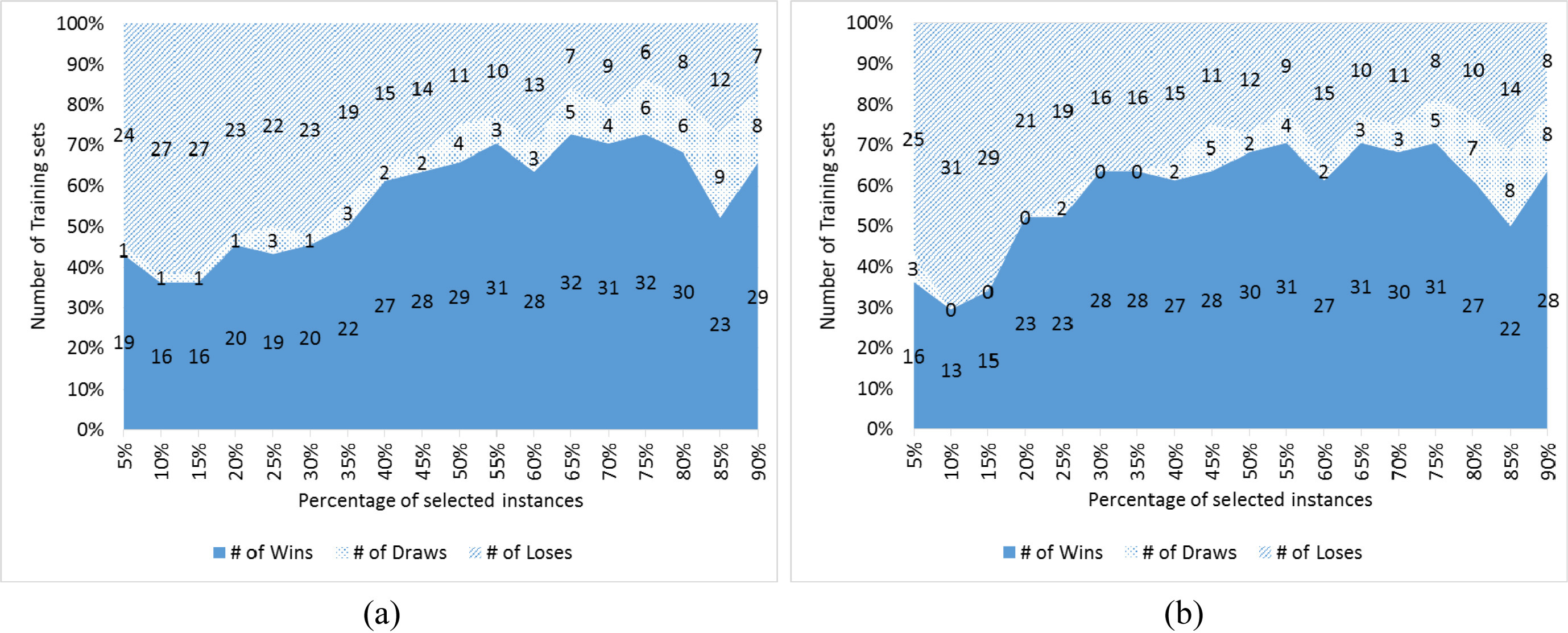
Figure 8(b) shows the comparison of IR_M to INSIGHT method. In general, IR_M outperforms INSIGHT when we keep the number of instances in the training set greater than or equal to 30% of the original training set. At these percentages, nearly two thirds of the training sets, IR_M method performs better or equal to the previous one. For example, at the reduction of 50%, IR_M performs better than INSIGHT in 30 datasets, draws in 2 datasets and loses in 12 datasets. When the number of selected instances is equal to 75% of the size of the training set, IR_M wins in 31 datasets, draws in 5 datasets and loses in 8 datasets. When the number of selected instances is lower than 30%, INSIGHT method performs better. For example, when the number of selected instances is equal to 10%, IR_M wins in 13 datasets, and INSIGHT wins in 31 datasets.
In the next subsection, we will show the details of the comparative experimental results on some datasets.
OSU leaf dataset
There are 6 classes in this dataset which includes two separate subsets: the training set and the testing set. The training set contains 200 time series and the testing set contains 242 time series. Each time series consists of 427 data points. Figure 9 shows the comparison of IR_M to the two previous methods Naïve Rank Reduction and INSIGHT. When the percentage of selected instances in the training set is greater than 50%, the error rate of IR_M method is lower than the Naïve Rank Reduction and INSIGHT; meanwhile, when the percentage is lower than 50%, they are nearly the same.
A comparison of IR_M to Naïve Rank and INSIGHT in OSU Leaf dataset when the reduction is greater than 50% instances (a) and lower than 50% instances (b).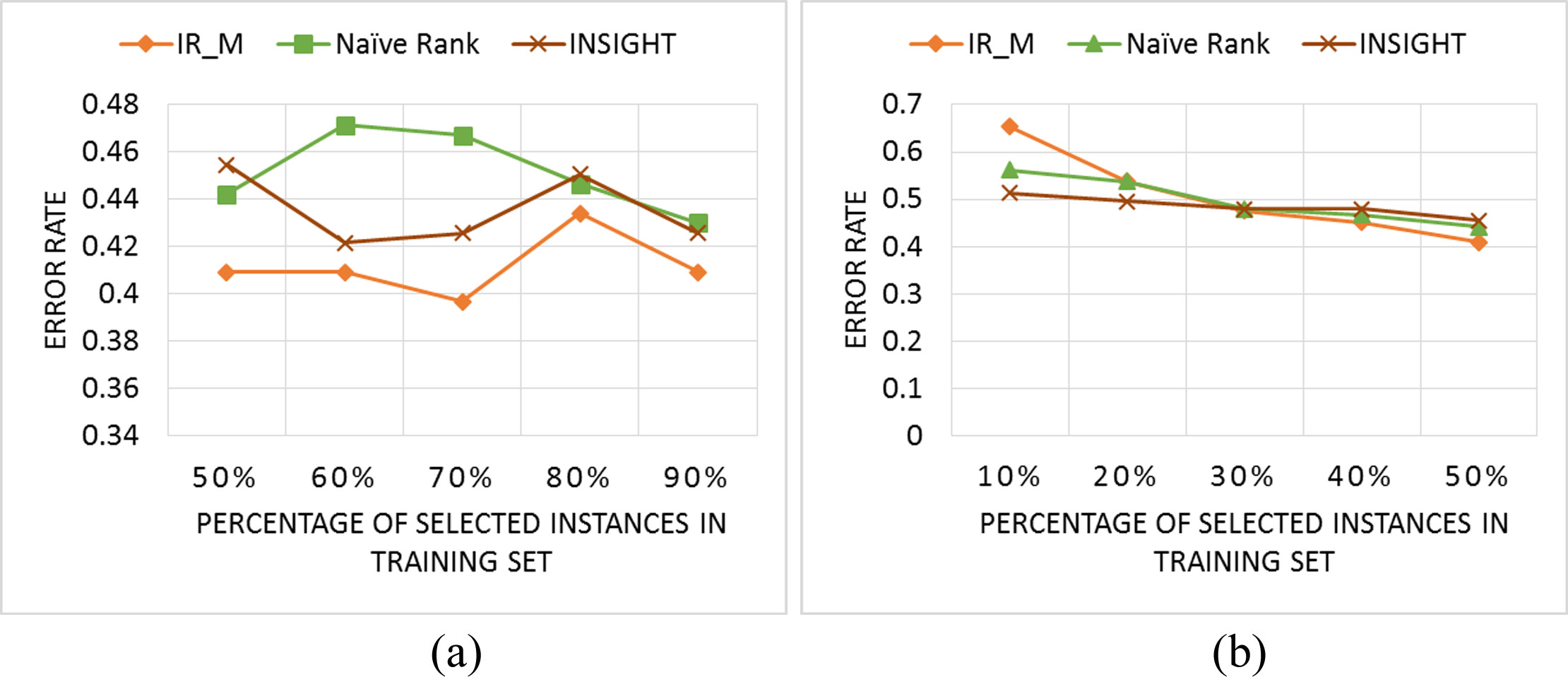
There are 10 classes in this dataset which includes two separate subsets: the training set and the testing set. The training set contains 381 time series and the testing set contains 760 time series. Each time series consists of 99 data points. Figure 10 shows the comparison of IR_M to the two previous methods Naïve Rank Reduction and INSIGHT. When the percentage of selected instances in the training set is greater than 30%, the error rates of IR_M are nearly the same, and they are both better than those of the Naïve Rank Reduction and INSIGHT method; meanwhile, when the percentage is lower than 30%, the INSIGHT seems to be the best method, next is IR_M, and Naïve Rank Reduction is the worst in this case.
A comparison of IR_M to Naïve Rank and INSIGHT in Medical Images dataset when the reduction is greater than 30% instances (a) and lower than 30% instances (b).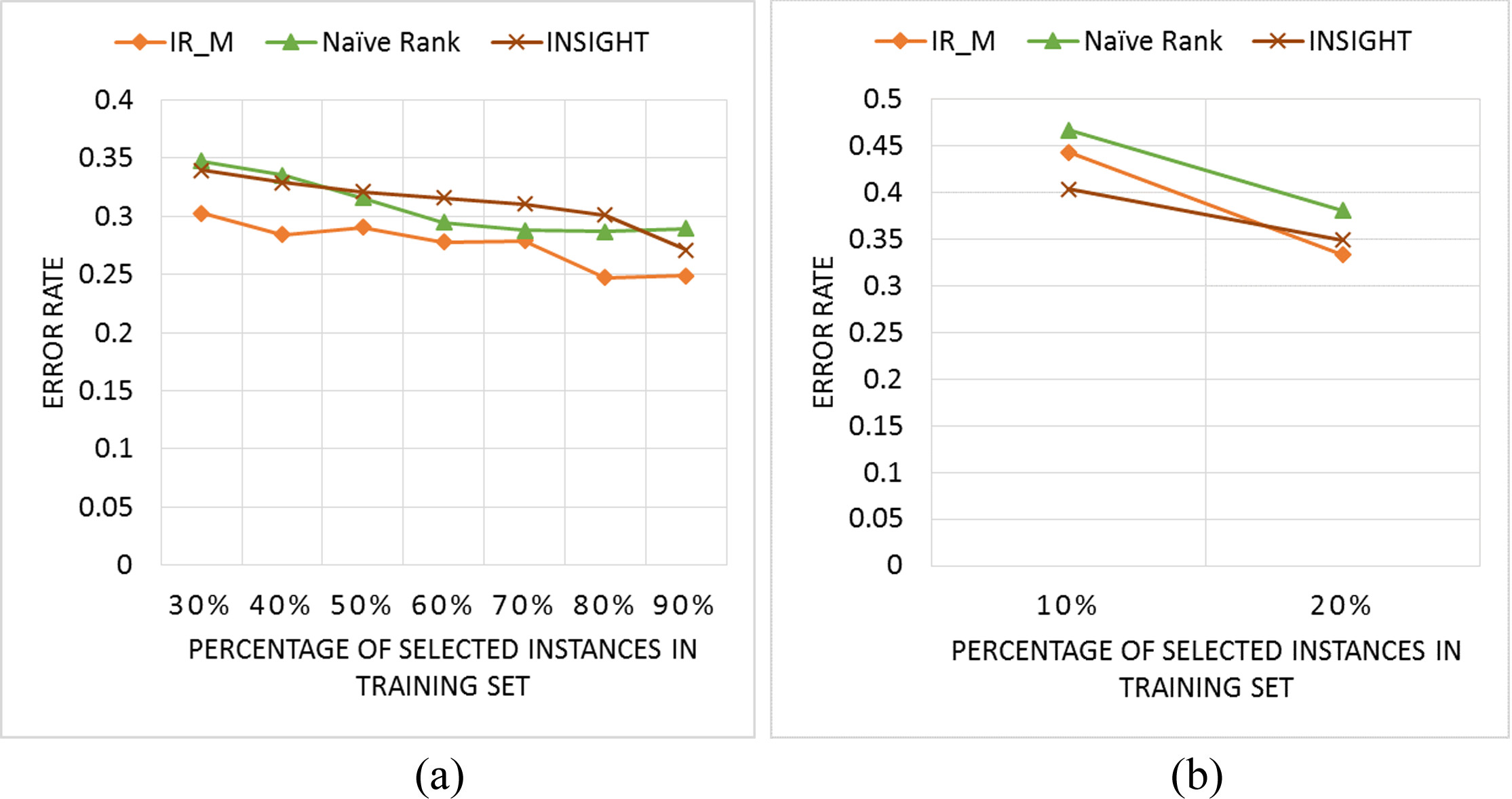
There are 2 classes in this dataset which includes two separate subsets: the training set and the testing set. The training set contains 50 time series and the testing set contains 150 time series. Each time series consists of 150 data points. Figure 11 shows the comparison of IR_M to the two previous methods Naïve Rank Reduction and INSIGHT. When the percentage of selected instances in the training set is greater than 50%, the error rate of IR_M method is lower than that of the Naïve Rank Reduction and INSIGHT; meanwhile, when the percentage is lower than 50%, the two pervious methods and IR_M are nearly the same, and when the percentage is lower than 30%, the IR_M is worse than the two previous methods.
A comparison of IR_M and Naïve Rank and INSIGHT in Gun Point dataset of selected greater than 50% instances (a) and lower than 50% instances (b).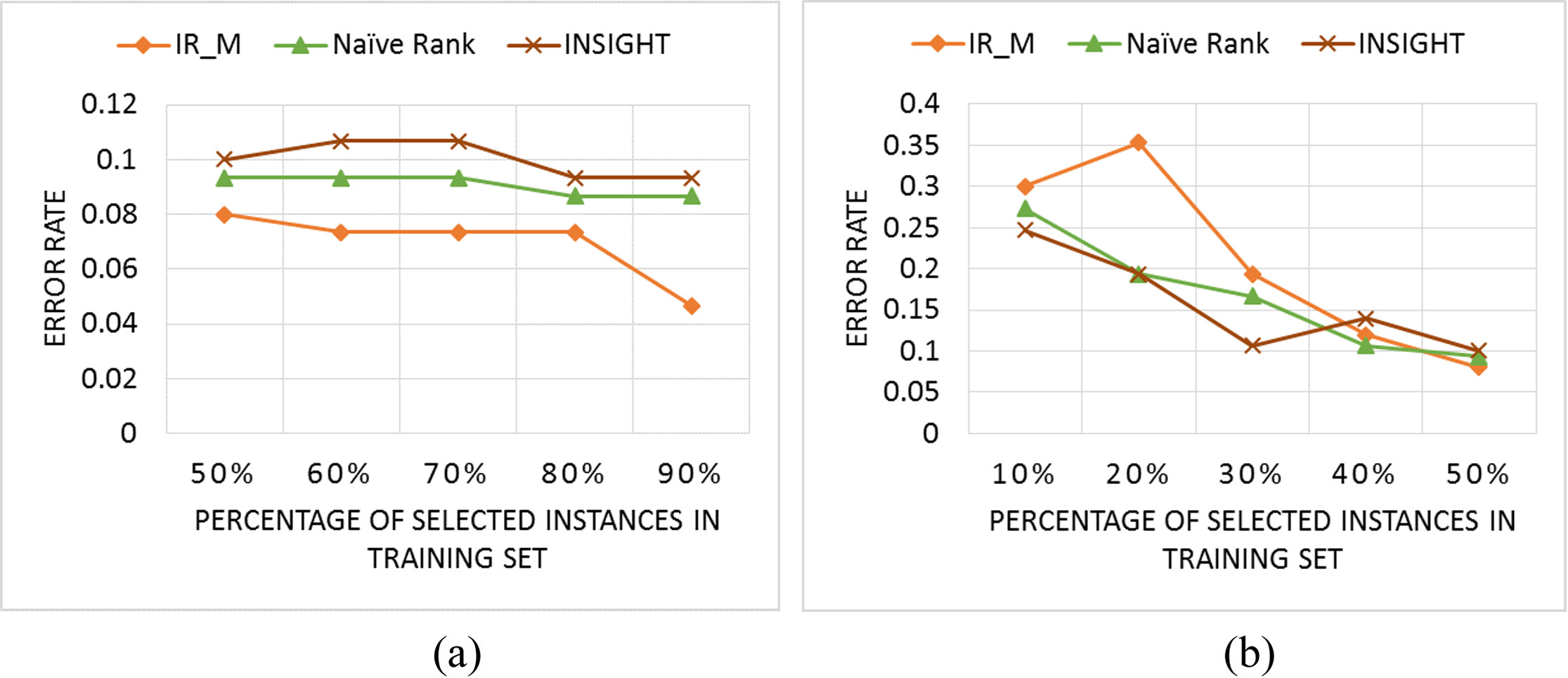
There are 4 classes in this dataset which includes two separate subsets: the training set and the testing set. The training set contains 24 time series and the testing set contains 88 time series. Each time series consists of 350 data points. Figure 12 shows the comparison of IR_M to two previous methods Naïve Rank Reduction and INSIGHT. As we can see from the figures, the error rate of IR_M method is lower than that of the Naïve Rank Reduction and INSIGHT.
A comparison of IR_M and Naïve Rank and INSIGHT in Face Four dataset with the reduction varying from 10% to 30%.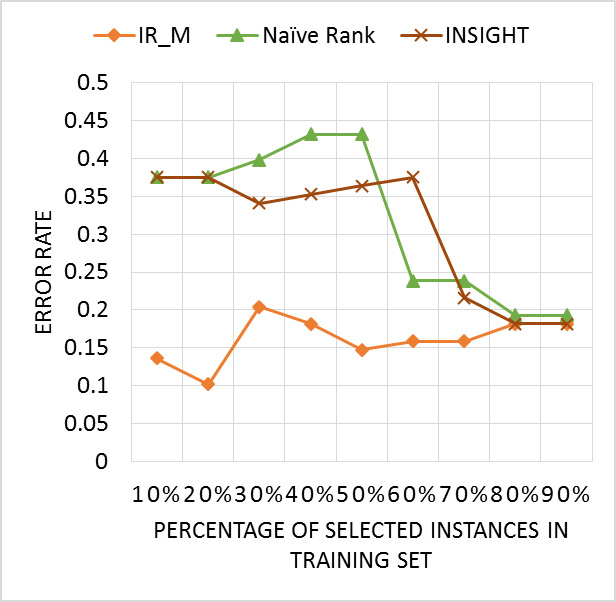
There are 3 classes in this dataset which includes two separate subsets: the training set and the testing set. The training set contains 30 time series and the testing set contains 900 time series. Each time series consists of 128 data points. Figure 13 shows the comparison of IR_M to the two previous methods Naïve Rank Reduction and INSIGHT. When the percentage of selected instances in the training set is greater than 30%, the error rate of IR_M method is lower than that of the Naïve Rank Reduction and INSIGHT; meanwhile, when the percentage is lower than 30%, IR_M and INSIGHT are nearly the same, and next is Naïve Rank Reduction.
A comparison of IR_M and Naïve Rank and INSIGHT in CBF dataset when the reduction is greater than 30% instances (a) and lower than 30% instances (b).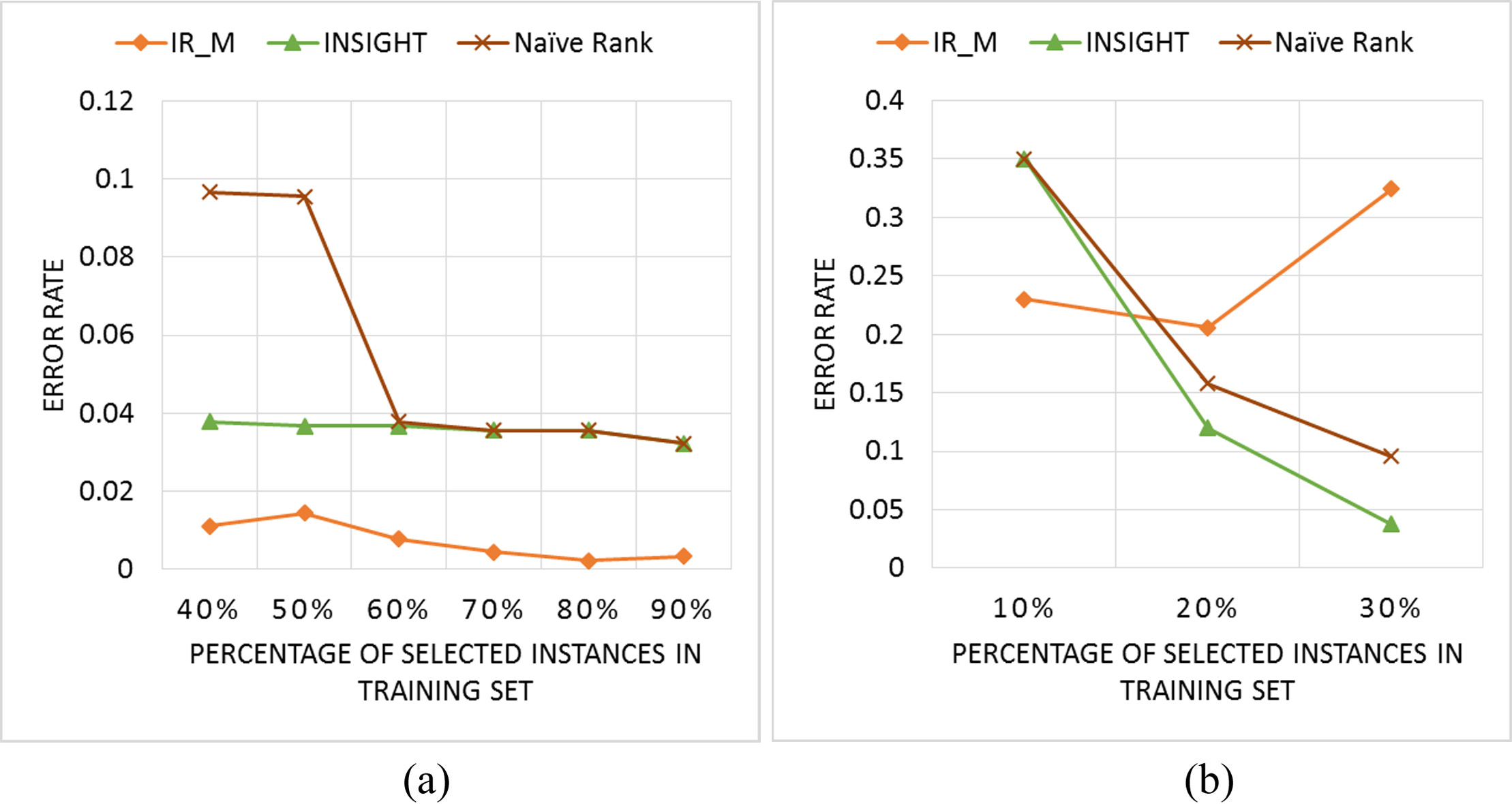
In the above experiments, we show that IR_M tends to be better than Naïve Rank Reduction and INSIGHT when the percentage of selected instances in the training set is about greater than 30%. This is not always true, but most of the datasets seem satisfying this rule. Now we would like to give some discussion on this observation.
The main idea behind the Naïve Rank Reduction and INSIGHT is to use statistics to decide “How good is an instance?” by measuring the contribution of that instance to classification of local training set, i.e. they use other instances in the training set to measure the impact of one instance in this training set. And this impact is supposed to be the same outside the training set.
OSP of Words Synonyms dataset of IR_M by strategy 1 (a) and strategy 2 (b).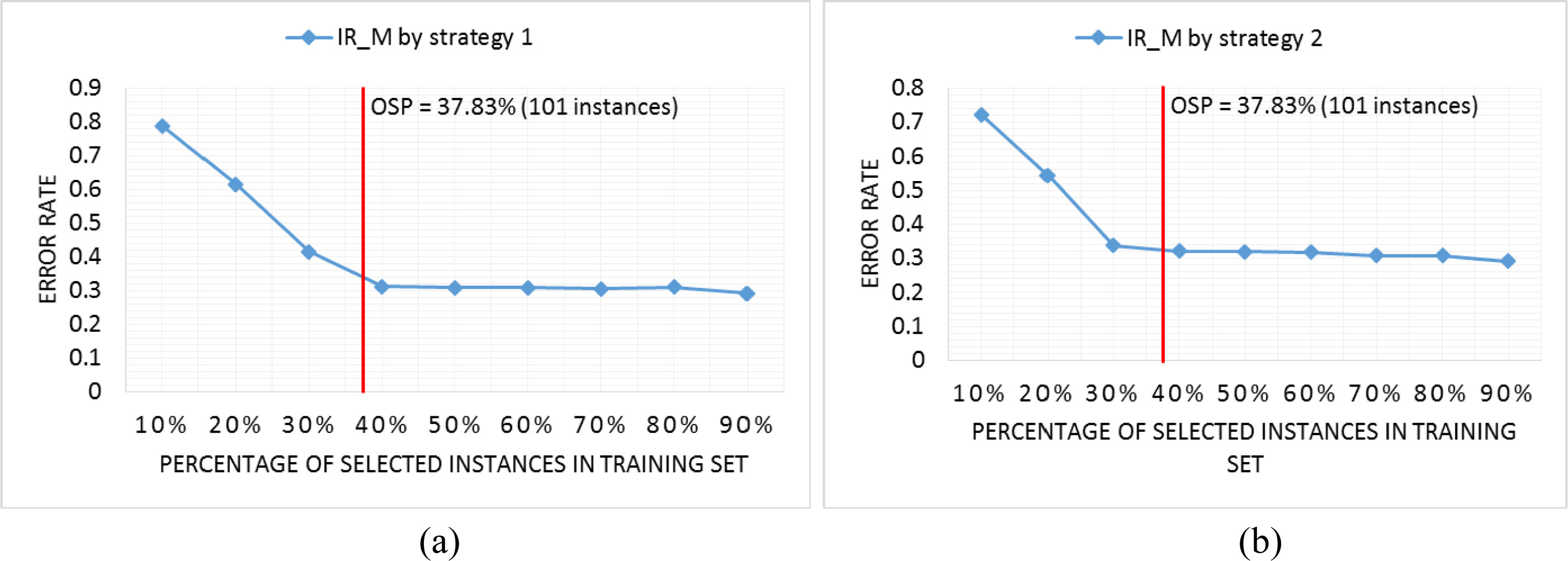
Our method IR_M is based on another perspective. We consider the whole training set as a data set, and we attempts to compress it as much as we can. To achieve this goal, at each iteration, we combine two instances with the same features into one instance. Thank to that, we can keep the best representative instances in the training set. However, when the training set has been reduced to some limit that we cannot find any pair of instances with the same features; if we continue to combine the instances, we will lose some of the representative instances. That is why when IR_M goes beyond some limit of the number of kept instances; it performs worse than the two pervious methods.
OSP of 50 Words dataset of IR_M by strategy 1 (a) and strategy 2 (b).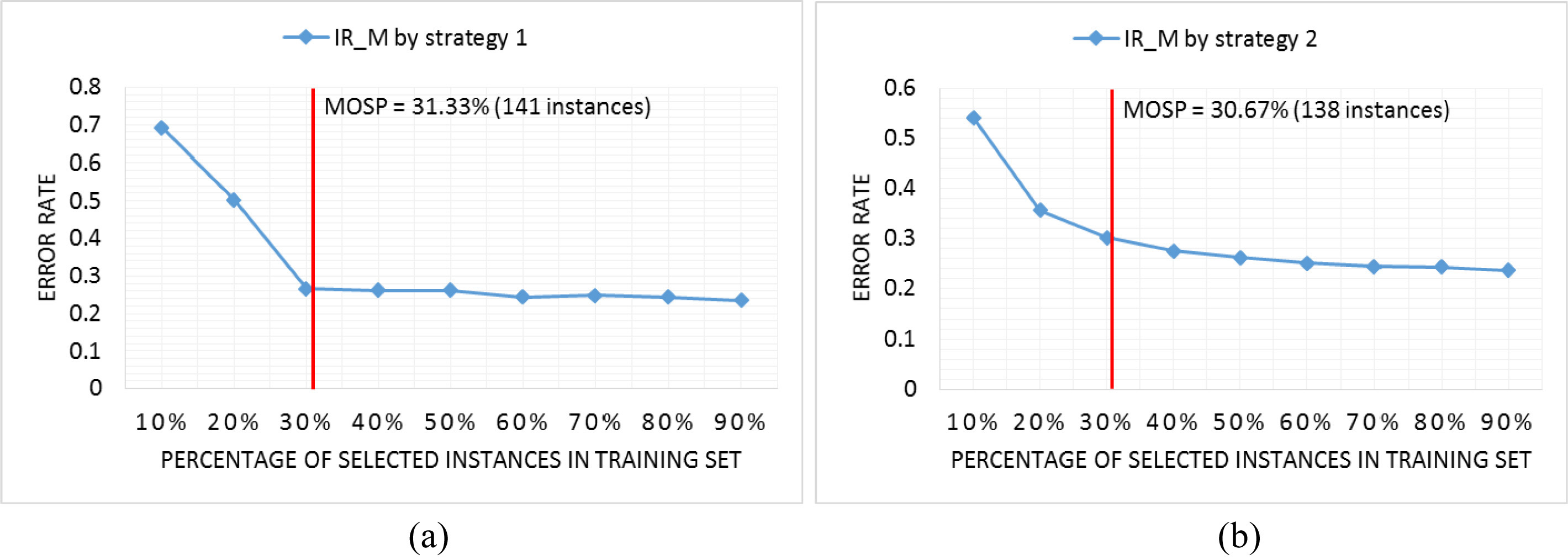
Now, we report some experiments on finding the OSP. Notice that the method of selecting OSP in our instance reduction algorithm is just a heuristic.
Figure 14 shows the OSP on Words Synonyms dataset. With this dataset, the OSP determined by IR_M is about 37.83%.
Figure 15 shows the OSP on 50 Words dataset. With this dataset, the OSP given by IR_M is about 31.33%. As we can see from Figs 14 and 15, the OSPs found on these datasets are the robust stopping points.
In addition, more experimental results about OSPs on the other datasets are re-ported in Table 3 (of Appendix A).
Table 1 reports the execution times (in seconds) needed to perform instance reduction with our IR_M, Naïve Rank Reduction and INSIGHT over 44 datasets. As expected, our method performs with the same time efficiency as those of the two previous methods. Among 44 datasets, for some datasets, our method runs faster than Naïve Rank Redution or INSIGHT, but for some other datasets, our method runs slower than Naïve Rank Redution or INSIGHT.
Running times (seconds) of 4 algorithms on 44 datasets
Running times (seconds) of 4 algorithms on 44 datasets
Now that the reader has gleaned some intuition of our instance reduction method for time series; we will briefly revisit a discussion of why MDL principle is our choice in this work.
We can use any distance function such as Euclidean Distance, Dynamic Time Warping or Complexity Invariant Distance [2], etc. to calculate the similarity between two time series. The distance between two time series is then compared with a pre-specified threshold
Conclusions and future works
In this paper, we propose a new MDL-based method, called IR_M, to reduce the number of instances in the training set for time series classification. In our method we regard the whole training set as a data set and attempt to compress it as much as we can. That means at each iteration in our IR_M algorithm if we can compress the two time series by the MDL principle, we combine them into one time series. To our knowledge, this is the first work addressing instance reduction for time series classification using MDL principle. Experimental results show that our method can outperform INSIGHT and Naïve Rank Reduction when the number of selected instances in the training set is not too small.
As for future work, we intend to apply some other distance measures for our instance reduction method such as Complexity-Invariant Distance [2] or Compression Rate Distance [33] because distance measure has a huge impact on time series classification problem. We also plan to combine our method with some features of the two previous methods INSIGHT and Naïve Rank Reduction since they can work together better with a very small number of kept instances in the training set.
Footnotes
Acknowledgments
We would like to thank Prof. Eamonn Keogh for kindly sharing the datasets which help us in constructing the experiments in this work.
Appendix A: More experimental results
The error rate of 1-nearest neighbor classifier before removing unrepresentative instances (UI) and after removing unrepresentative instances on some datasets
Datasets
Size of original
Number
Size of removed
Error rate before
Error rate after
training set
of UI
UI training set
remove UI
remove UI
50words
450
74
376
0.23956
0.24396
Beef
30
13
17
0.5
0.56667
ECG200
100
12
88
0.18
0.15
FaceAll
560
16
544
0.20947
0.21953
FISH
175
32
143
0.16
0.17143
Gun_Point
50
1
49
0.06
0.053333
Haptics
155
69
86
0.60065
0.57792
Lighting2
60
6
54
0.098361
0.16393
Lighting7
70
12
58
0.26027
0.23288
MoteStrain
20
3
17
0.13738
0.11502
OSULeaf
200
43
157
0.39669
0.43388
MedicalImages
381
98
283
0.25526
0.27895
WordsSynonyms
267
53
214
0.27273
0.30878
OSP and error rate at the OSP point on 44 datasets Note that some dataset names in Table 2 and Table 3 are originally as follows:
Datasets
Size of
IR_M_STR1
IR_M_STR2
original
Number of
OSP
Error
Number of
OSP
Error
training set
selected instances
rate
selected instances
rate
50words
450
141
31.33
0.27033
138
30.67
0.2967
Adiac
390
37
9.49
0.61637
37
9.49
0.60102
Beef
30
6
20
0.56667
7
23.33
0.56667
CBF
30
11
36.67
0.20667
13
43.33
0.013333
Chlorine
467
7
1.5
0.70573
9
1.93
0.59974
CinC_ECG
40
28
70
0.36957
28
70
0.36884
Coffee
28
2
7.14
0.32143
2
7.14
0.46429
Cricket_X
390
167
42.82
0.29744
165
42.31
0.24615
Cricket_Y
390
150
38.46
0.30513
156
40
0.25385
Cricket_Z
390
164
42.05
0.27949
169
43.33
0.24103
Diatom
16
4
25
0.21895
4
25
0.12418
ECG200
100
5
5
0.61
4
4
0.29
ECGFiveDays
23
10
43.48
0.34727
12
52.17
0.36121
FaceAll
560
116
20.71
0.18698
126
22.5
0.34142
FaceFour
24
7
29.17
0.14773
7
29.17
0.28409
FacesUCR
200
72
36
0.17707
78
39
0.21805
FISH
175
7
4
0.61714
7
4
0.49143
Gun_Point
50
6
12
0.3
6
12
0.3
Haptics
155
12
7.74
0.73377
14
9.03
0.69481
InlineSkate
100
16
16
0.73273
14
14
0.75636
ItalyPower
67
3
4.48
0.10982
3
4.48
0.40622
Lighting2
60
36
60
0.21311
37
61.67
0.18033
Lighting7
70
36
51.43
0.31507
42
60
0.21918
MALLAT
55
8
14.55
0.089552
8
14.55
0.14371
MedicalImages
381
57
14.96
0.39079
61
16.01
0.38289
MoteStrain
20
8
40
0.19728
8
40
0.1885
OliveOil
30
4
13.33
0.13333
4
13.33
0.6
OSULeaf
200
46
23
0.52893
48
24
0.47107
SonyII
27
8
29.63
0.18888
7
25.93
0.20147
Sony
20
3
15
0.32113
3
15
0.34775
SwedishLeaf
500
27
5.4
0.6064
22
4.4
0.4272
Symbols
25
8
32
0.11859
8
32
0.078392
synthetic_control
300
69
23
0.076667
67
22.33
0.063333
Trace
100
8
8
0.1
7
7
0.15
TwoLeadECG
23
2
8.7
0.30378
3
13.04
0.3626
Two_Patterns
1000
460
46
0.00075
443
44.3
0.0005
uWave_X
896
84
9.38
0.37912
84
9.38
0.38079
uWave_Y
896
65
7.25
0.3981
51
5.69
0.46036
uWave_Z
896
66
7.37
0.42518
68
7.59
0.41374
wafer
1000
42
4.2
0.10788
43
4.3
0.062622
WordsSynonyms
267
101
37.83
0.31661
101
37.83
0.32288
yoga
300
11
3.67
0.41367
10
3.33
0.45767
Thorax1
1800
45
2.5
0.51654
43
2.39
0.52316
Thorax2
1800
45
2.5
0.40509
43
2.39
0.41578