



Abstract
In this study, we propose a deep learning related framework to analyze S&P500 stocks using bi-dimensional histogram and autoencoder. The bi-dimensional histogram consisting of daily returns of stock price and stock trading volume is plotted for each stock. Autoencoder is applied to the bi-dimensional histogram to reduce data dimension and extract meaningful features of a stock. The histogram distance matrix for stocks are made of the extracted features of stocks, and stock market network is built by applying Planar Maximally Filtered Graph(PMFG) algorithm to the histogram distance matrix. The constructed stock market network represents the latent space of bi-dimensional histogram, and network analysis is performed to investigate the structural properties of the stock market. we discover that the structural properties of stock market network are related to the dispersion of bi-dimensional histogram. Also, we confirm that the autoencoder is effective in extracting the latent feature of the bi-dimensional histogram. Portfolios using the features of bi-dimensional histogram network are constructed and their investment performance is evaluated in comparison with other benchmark portfolios. We observe that the portfolio consisting of stocks corresponding to the peripheral nodes of bi-dimensional histogram network shows better investment performance than other benchmark stock portfolios.
Keywords
Introduction
Stock markets which fluctuate chaotically are modelled as complex networks formed through the interaction of individual factors [35]. Many studies have used network analysis to investigate the relationship between stocks [35, 53, 34, 20, 11, 23, 42, 19, 41, 40, 28, 16, 44, 29, 57, 26, 6, 24, 51, 52, 17, 13, 49, 37, 38]. Mantegna [34] analyzed stock markets through Minimum Spanning Tree (MST) network for the first time, observing the structure of Dow Jones stock market. MST is a filtered graph connecting all the
In defining interactions between stocks, many studies highlighted stock price time series. However, information on stocks is not only contained in the price, but also in various data such as trading volumes, volatility and accounting variables. In particular, we focus on trading volumes of stocks in addition to their prices. From a practical point of view, trading volumes have much significant information. For example, the increment of trading volume at the floor of stock price is regarded as a signal of upward conversion. Conversely, the decrement of trading volume at the ceiling of stock price is understood as a signal of a downward turn. As such, the trading volume could indicate the direction of stock price. Also, stock return and trading volume interact with each other in the stock market dynamics [27]. Various studies have been conducted to analyze the properties contained in trading volume and its relationship with stock price. As in stock prices, trading volume has multifractal behavior characteristics [3] and auto-correlation patterns [47]. Lee and Swaminathan [27] revealed that the trend of trading volume is related to the persistence of price momentum and magnitude. Chen et al. [7] confirmed that positive correlation exists between the trading volume and the absolute value of stock price return. Various studies have used the stock price and trading volume together to predict the stock price [55, 54, 9, 14, 33]. The positive correlation between the negative skewness of stock price returns and trading volume was verified through previous studies [15, 8]. Trading volume is correlated with the volatility of stock returns, return on equity (ROE) and return on investment (ROI) [45, 18, 12, 46, 22]. Bajo [4] revealed that the trading volume is an efficient proxy of stock information for market participants.
As described above, the trading volume is important to explain the properties of a stock and the stock market in addition to stock price. Our study attempts to analyze the stock market by considering both stock prices and stock trading volumes. Both of stock price and stock trading volume can be analyzed from a multivariate perspective through the RV coefficient, which is a multivariate generalization of the squared Pearson correlation coefficient. However, the RV coefficient has some drawbacks of difficulty in understanding and high computational cost [25]. In this study, we utilize a bi-dimensional histogram to intuitively represent stock trading volume information as well as stock price information.
As the size of bi-dimensional histogram is relatively large, we apply autoencoder to the bi-dimensional histogram for the latent feature extraction from the reduced bi-dimensional histogram data. Autoencoder (AE) is widely used for feature extraction as a method of deep learning [39, 10, 56, 2, 32, 30, 5, 36, 21]. AE, which consists of two neural networks called encoder and decoder, is a nonlinear dimension reduction methodology and an effective method for manifold learning. AE compresses and reproduces data through an encoder and decoder, and effectively extracts the features inherent in the data.
Based on the extracted features, we build the bi-dimensional histogram network of the stock market using the PMFG algorithm, and network analysis is performed to investigate the structural properties of the stock market. The novelty of our research is that we construct a stock market PMFG network using the latent features from autoencoder transformed information of bi-dimensional histogram based on stock prices and trading volumes.
The bi-dimensional histogram network is applied to construct stock investment portfolio. There are many studies incorporating the network topological property into the construction of stock portfolio [44, 58, 59, 31, 29]. Pozzi et al. [44] proposed a measure to quantify the level of the network periphery, and showed that the portfolio of stocks in the periphery of network performs better than that of stocks in the center of network. Based on this property, we investigate the usefulness of a histogram network in terms of portfolio selection.
The paper is organized as follows. Section 2 reviews previous studies of the stock market network, as well as studies of autoencoder in the stock market. Section 3 describes the data, bi-dimensional histogram, autoencoder, stock network, and portfolio application. Section 4 presents the result of our suggested method including the features of bi-dimensional histogram and network analysis. Finally, the summary of our research is provided in Section 5.
Related work
Stock market network
In econophysics, the stock market network plays an important role in analyzing the characteristics of financial markets. After Mantegna’s research [34], which first introduced the network concept through MST to analyze the stock market, many studies have used MST to analyze financial markets. Onnela et al. [42] constructed MST network of S&P500 stocks to study the dynamics of the stock market, finding that normalized tree length of the MST decreases and remains low during the financial crisis. Bonanno et al. [6] revealed that the MST of the stock market has a structured hierarchy. Jung et al. [24] studied the MST of the Korean stock market and found that the characteristics of the Korean stock market differ from that of the US market. However, the drawback of MST is that valuable information about the relationship between stocks is necessarily lost. To complement the drawback of MST, Tumminello et al. [51] proposed a stock market network using PMFG. PMFG is a graph using the planarity property, and loops and cliques are allowed, including MST in the graph. Various studies have demonstrated that PMFG has a more significant and richer structure, stronger robustness, and better dynamical stability than MST [51, 43, 13]. PMFG is a conventional method to build a stock market network and is used in various fields. Zhang and Zhuang [57] built a Chinese stock market network using PMFG and investigated the relationship between network stability and stock market volatility. Musmeci et al. [38] analyzed the NYSE stock market with PMFG. Musmeci et al.[38] investigated meaningful relationships between past changes in the network structure and future changes in the market volatility. Song et al. [50] confirmed that PMFG effectively extracts clusters and hierarchies from complex data sets. Lu et al. [31] proved that PMFG is also useful in portfolio investment.
Autoencoder in the stock market
In this study, we propose a framework for constructing a stock market network from a multivariate perspective using autoencoder and PMFG. As the dimension of the variable increases, the higher dimension variable can lead to redundancy of information and reduce the efficiency and accuracy of algorithms. In this context, autoencoder, a deep learning model, is a method that extracts meaningful features from high-dimensional variables and is also in the spotlight in the finance domain. Lv et al. [32] performed feature extraction of 44 technical indicators for stock using autoencoder and applied it to predicting trading signals. Bao et al. [5] extracted features by compressing daily trading data, technical indicators, and macroeconomic variables with an autoencoder. And [5] verified the usefulness of autoencoder by using compressed features for stock price prediction. Moews and Ibikunle [36] extracted latent features of high-frequency transaction data using autoencoder and used it for stock price movement prediction. Moews and Ibikunle [36] also demonstrated that this approach works even in highly volatile market conditions such as the financial crisis. Huh [21] applied autoencoder to predict the systematic risk of the stock market. In previous studies using autoencoder in the finance domain, features extracted through autoencoder are mainly used for prediction. In this study, we focus on structuring the stock market using features extracted through autoencoder. We transform the stock price and trading volume into a bi-dimensional histogram and perform feature extraction through an autoencoder. Then, we build a stock market network by applying the PMFG algorithm to the latent space of the extracted features. To the best of our knowledge, our approach is the first attempt to use the bi-dimensional histogram and autoencoder to construct the stock market network. Based on the stock market network constructed by our method, we perform network analysis to investigate the structural properties of the stock market. And we utilize the stock market network to construct a stock investment portfolio.
Data and methods
The data in this study is comprised of the daily adjusted stock prices and daily trading volumes of stocks included in S&P500 from January 3, 2006 to September 30, 2019, which amount to 3459 data points. Among the stocks that have been listed in S&P500 over the entire period, the top 400 stocks are selected on the market cap basis. The description of the stocks is provided in appendix. Table 1 is the result of classifying the stocks into 11 sectors according to the Global Industry Classification Standard (GICS) industry category system. Stocks are classified into 11 sectors, Financials (FINC), Industrials (INDS), Consumer Discretionary (COND), Information Technology (INFT), Health Care (HLCA), Consumer Staples (CONS), Real Estate (REES), Utilities (UTIL), Energy (ENRG), Material (MTRS), and Communication Services (CONS). The largest and the smallest industry sectors are the financial sector and the Communicaion Services sector, accounting for 59 stocks (14.75%) and 14 stocks (3.5%), respectively.
Summary of GICS industry classification of stocks
Summary of GICS industry classification of stocks
Bi-dimensional histogram maps pairs of two variables to bi-dimensional grid bins. Given the number of all observation pairs,
When denoting the closing price of
Based on the bin size set above,
Bi-dimensional histograms of AAPL, ETN and PG.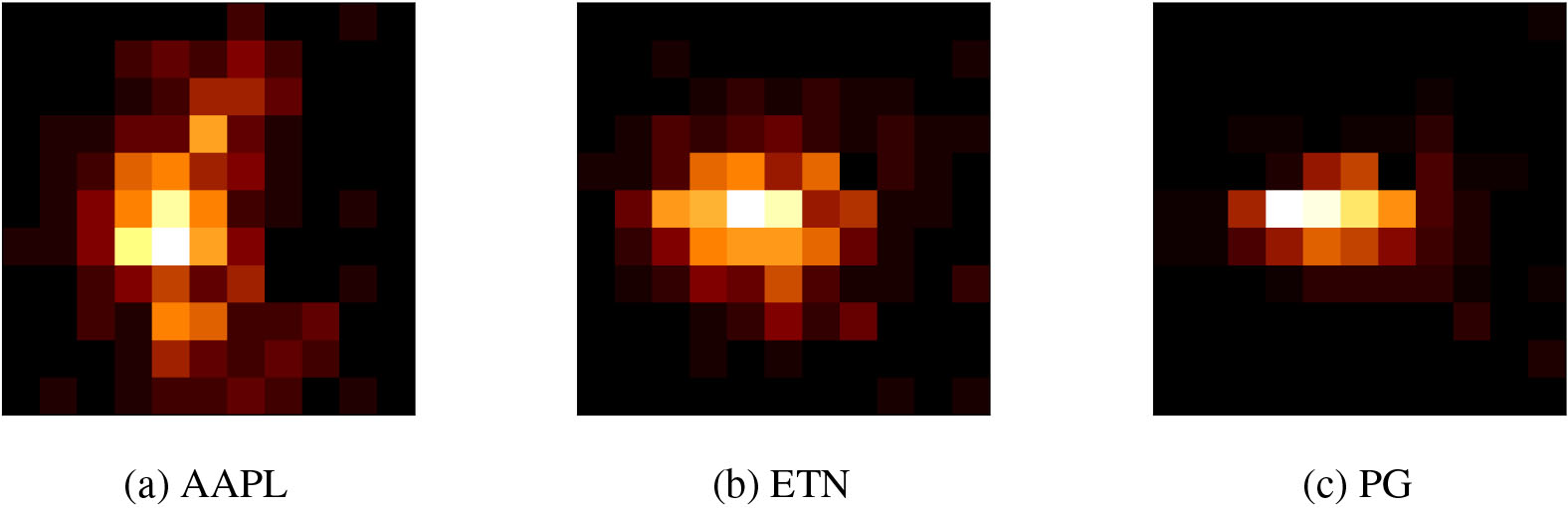
Figure 1 shows bi-dimensional histograms of AAPL, ETN and PG for the first observation period. We define dispersion
where
Bi-dimensional histograms sorted in ascending order of 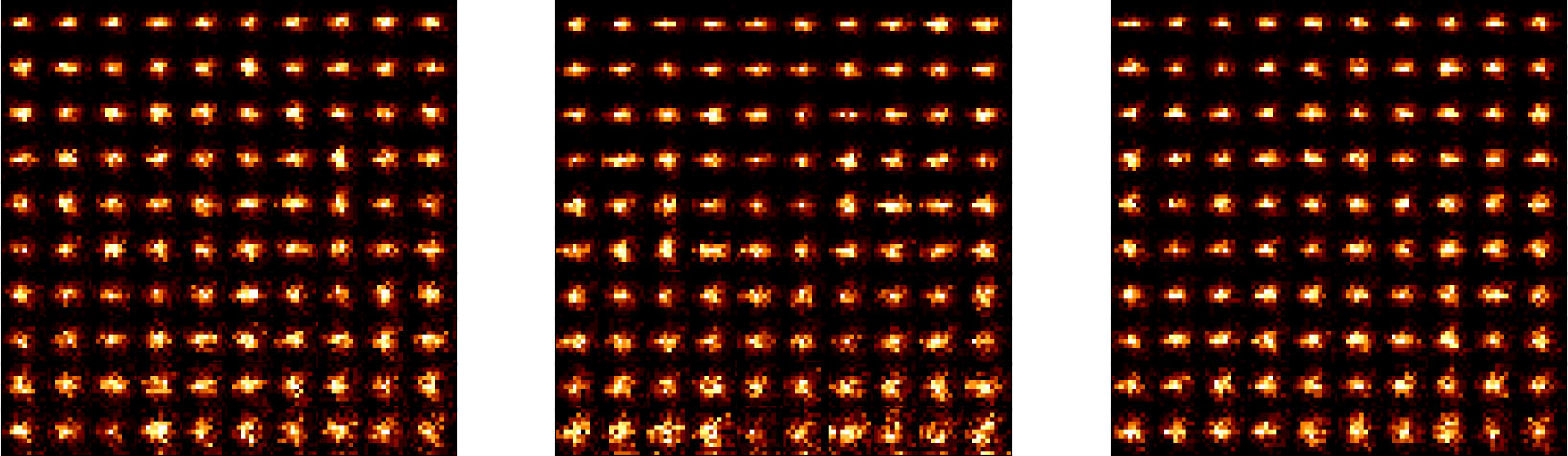
The main purpose of autoencoder (AE) in deep learning is to learn representation in a data set through unsupervised learning. This representation of the input data is depicted as an internal (hidden) layer or latent vector. AE consists of two parts: encoder and decoder. Encoder compresses input to the lower dimensional latent space. Conversely, decoder reconstructs the input. Through the compression and reconstruction process, most relevant aspects of data are contained in the latent space of the AE.
When denoting the input space as
where L is a loss function. As the dimension of
The purpose of the AE in this paper is to learn a bi-dimensional histogram as an input to obtain a latent vector that is a compressed representation of the histogram. The encoder and decoder of the AE are composed of four stages fully connected hidden layers and formulas of the encoder and decoder for the set of parameters
where
We select the set of parameters
Table 2 summarizes the dimensions of each layer constituting the AE model, and Fig. 3 is a schematic diagram of the autoencoder structure described in Table 2.
Dimensions of weight and bias of hidden layers in autoencoder
In this paper, the learning of AE is conducted on a bi-dimensional histogram. For each of 321 observation period, an AE model corresponding to the period is made. However, training a model using only 400 bi-dimensional histograms can cause over-fitting problems. To prevent this, augmentation is performed during data set construction. In each observation period, gaussian noises are added to price and volume series, and bi-dimensional histograms are constructed from the noisy series. For each stock, augmentation is performed 100 times using gaussian noise, and as a result, 40,000 bi-dimensional histograms are revised in the existing data set. We randomly select 80% of the data set for training and 20% for validation. In the training process, the dimension of the latent vector is set to 32 as above which the validation error does not significantly decrease. Also, the model training process proceeds to 250 epochs because the validation error tends to converge at the epoch. Table 3 compares the reconstruction errors between AE and Principal Component Analysis (PCA) which is a conventional method for dimensionality reduction. Reconstruction error is determined as mean squared error (MSE) between the original data and reconstructed data from the model. In our result, AE shows the better performance than PCA in terms of MSE.
Reconstruction error for different algorithms
Structure of autoencoder for feature extraction from bi-dimensional histogram.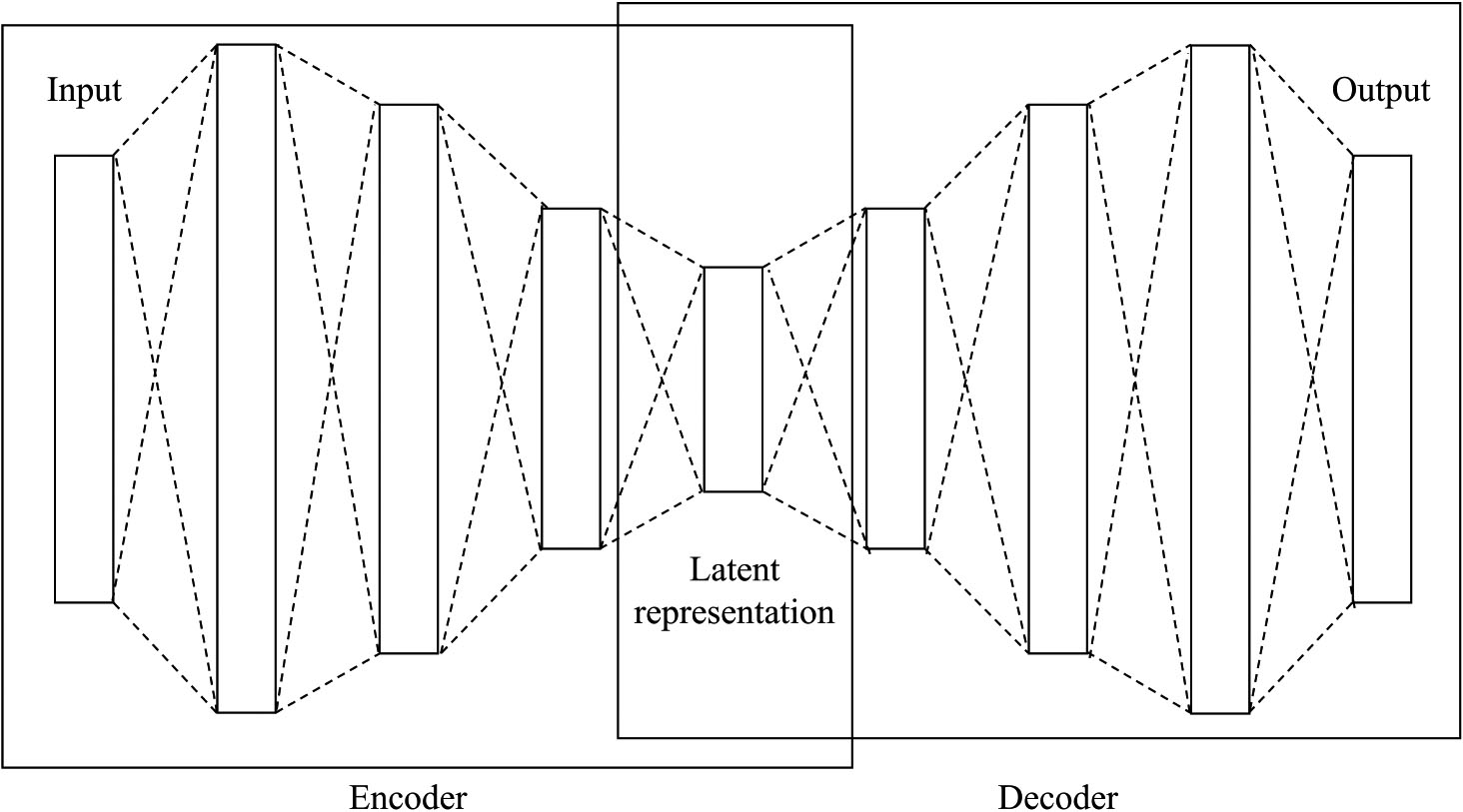
We transform the bi-dimensional histogram of each stock into a latent vector through the encoder. In each observation period, the latent vector of the
We define a histogram based distance matrix,
where
Network analysis is performed to identify useful topology information on stocks based on distance matrices
[h!] : PMFG algorithm
We build PMFGs from
The characteristics of individual stock in the network can be quantified in terms of network centrality. In graph theory, network centrality quantifies the relative importance of individual nodes of a network. The network centrality measures used in this paper are as follows. Degree centrality (DC) is the number of edges connected to the node. Betweenness centrality (BC) is the frequency that a node acts as a bridge in the shortest path between two other nodes. Eigenvector centrality (EC) of the
Pozzi et al. [44] proposed a hybrid centrality measure of a node in the network, peripherality (P), which consists of 5 centrality measures described in the above.
where
Constructing a portfolio using peripheral nodes in a price network has an advantage in portfolio performance [44, 29, 31]. Also in the histogram network, a portfolio consisting of peripheral nodes can have distinct features compared to those of central nodes in that peripheral nodes are less related with other nodes in the network. We examine the characteristics of the portfolio according to peripherality on a histogram network. We also investigate whether histogram networks have an advantage over the price network in terms of investment utilization.
The portfolio investment based on a histogram network is verified as follows. The investment period of 13 years from January 13, 2006 to September 30, 2019, and the same moving window method as in Section 3.1 is performed. For each observation period, AE is applied to the bi-dimensional histogram to extract meaningful features of stock. Then, matrices for histogram and price,
where
Expected Shortfall (ES) is an indicator of portfolio risk, and the average of losses that exceed a certain quantile.
where
For the evaluation of bi-dimensional histogram-based portfolio, we incorporate various benchmarks including network-based and non-network-based portfolios. As the bi-dimensional histogram-based portfolio uses stock trading volume data in addition to stock price data, two network based portfolios, one for stock price returns and the other for stock trading volume returns are included as benchmarks. The non-network-based benchmarks include a market portfolio consisting of uniform weights of all 400 stocks in this study, the mega-cap portfolio ($200 billion and greater) and S&P500 index.
The portfolios based on histogram network and price network are denoted as the histogram portfolio and the price portfolio, respectively. The portfolio based on the network using only volume data is called as the volume portfolio. The overall framework of the experiment is summarized in Fig. 4.
Procedure for the portfolio experiment using the histogram network.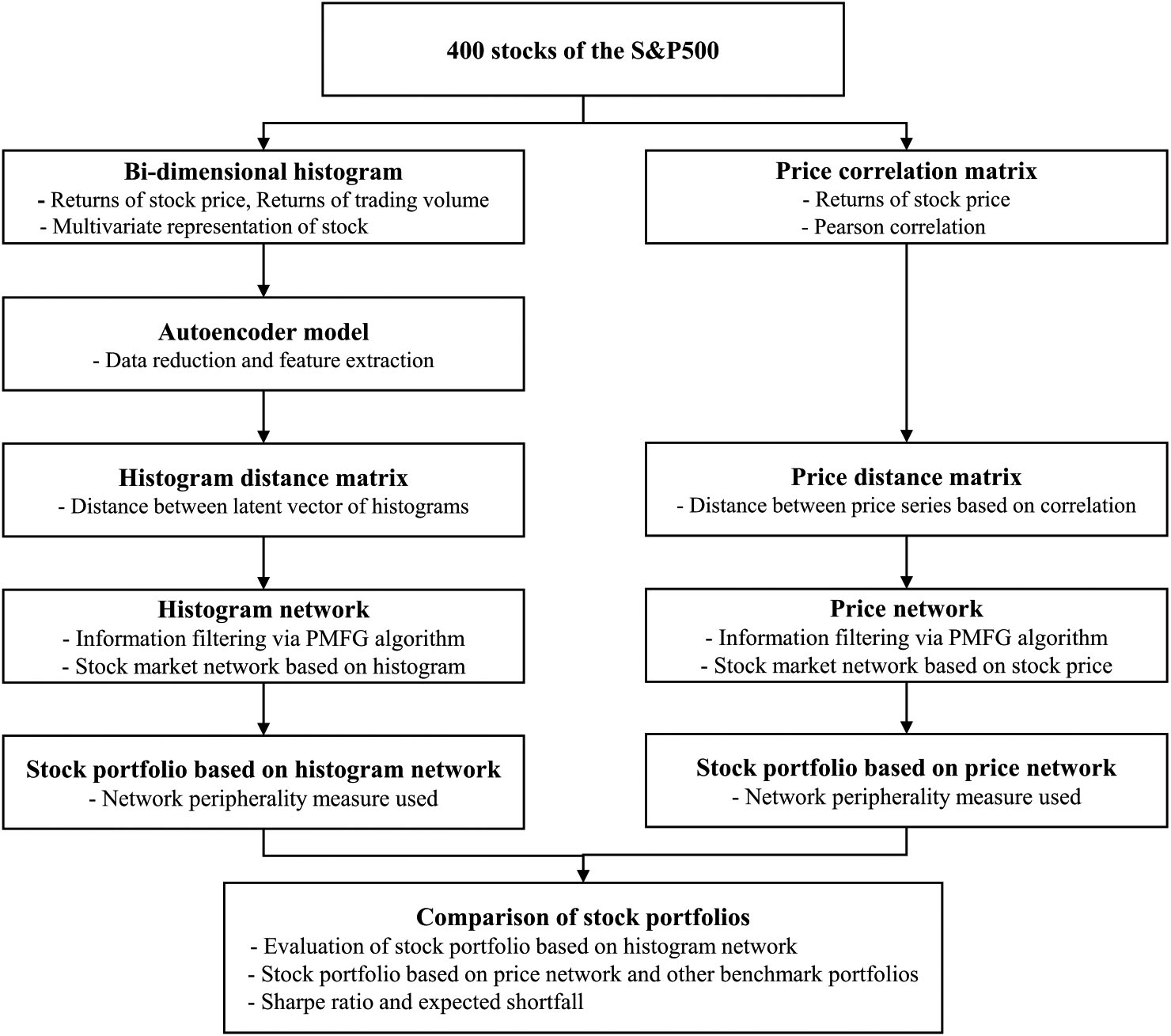
In this section, our experimental results are provided. The characteristics of bi-dimensional histogram for S&P500 stocks are studied. The network topologies are compared between the histogram network and the price network, and the investment usefulness of histogram network is examined.
Properties of bi-dimensional histogram
We analyze properties of the bi-dimensional histogram through
Table 4 presents the descriptive statistics of
Descriptive statistics of
for different periods
Descriptive statistics of
Distribution of 
For the analysis of
When focusing on the sub-prime mortgage crisis, the value of
Table 5 shows the correlation of
Evolution of the series of 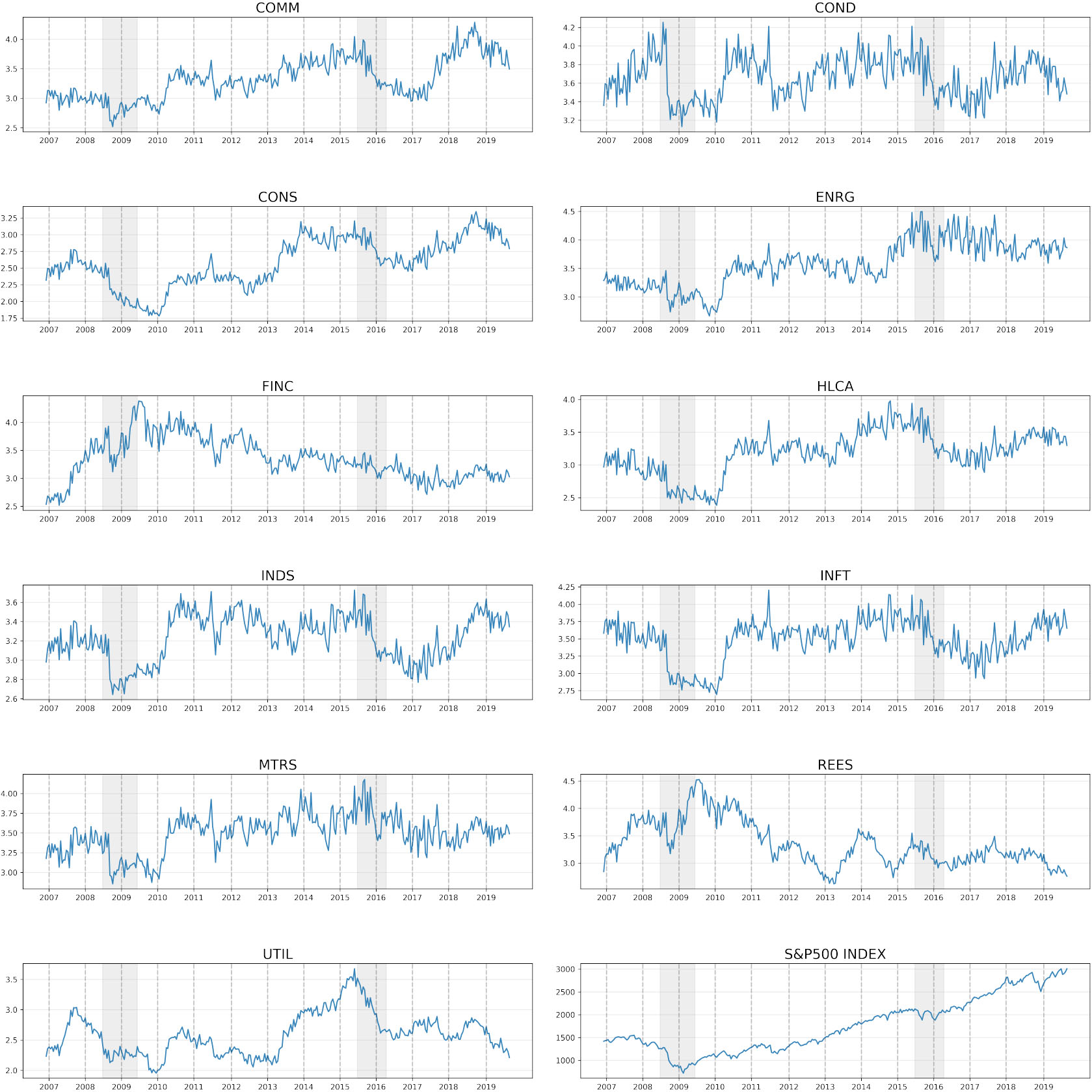
Correlation between
In this study, the Bi-dimensional histograms are 11 by 11 dimensions and have noise and missing values. Bi-dimensional histograms consist of 121 bins, and 50.7% of bins are empty. In addition, the bin whose frequency is less than 1% corresponds to 25% of the total. As such, the bi-dimensional histogram of stock has a large amount of noise. Therefore, we use an autoencoder to extract meaningful information from the bi-dimensional histogram. Figure 7 shows the bi-dimensional histogram of stocks and the reconstructed bi-dimensional histogram. The latent vector of the bi-dimensional histogram is 32 dimensions and has less noise and missing values compared to the bi-dimensional histogram. On average, 22% of the bins of the latent vector are noise. We calculate the distance matrix between latent vectors according to Eq. (6). And then, we apply the PMFG algorithm to the distance matrix to build a stock market network based on latent vector of bi-dimensional histogram. The experimental results for the properties of the bi-dimensional histogram network are continued in the next section.
The original histogram and reconstructed histogram.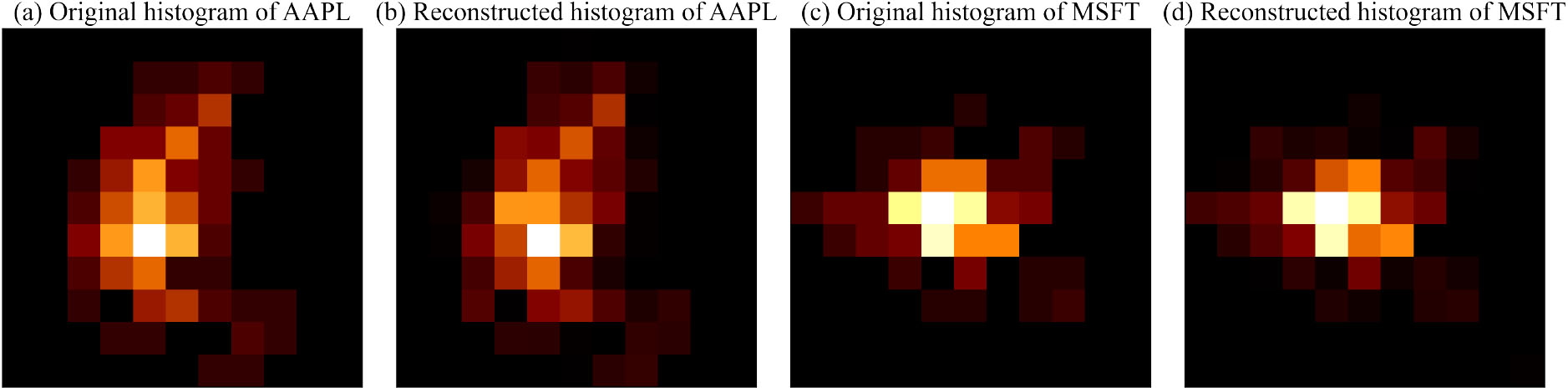
Latent vectors of bi-dimensional histograms for each stock are represented as nodes in the histogram network. Characteristics of each bi-dimensional histograms and their relationships are reflected in the topological structure of histogram network.
Classification of nodes in the histogram network according to the level of 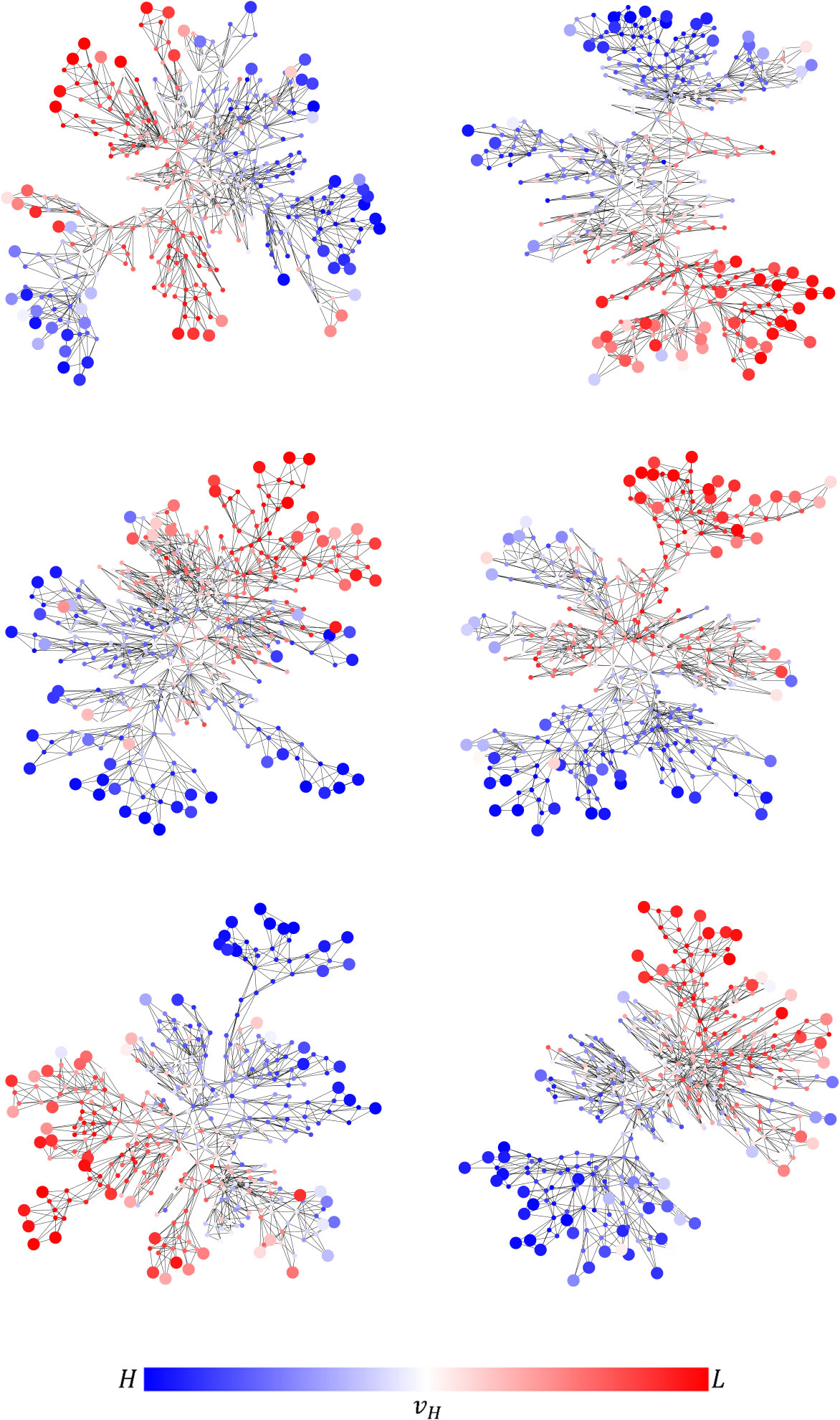
Figure 8 shows 6 snapshots of the histogram network. The colors of node changing from blue to red correspond to the descending values of
Figure 9 shows the result of correlation analysis between
Correlation between 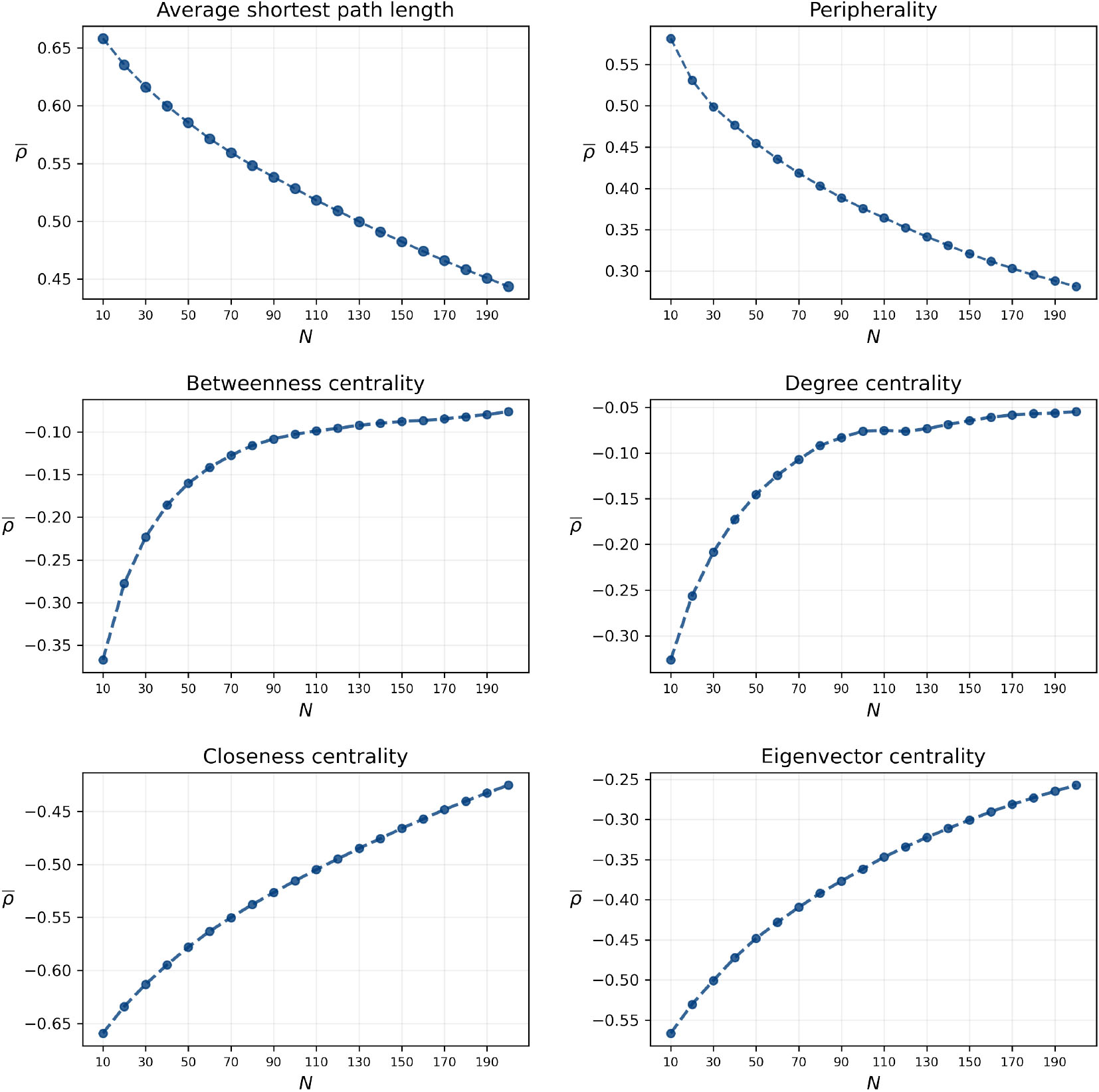
In Fig. 9 showing the variation of average of
Meanwhile, centrality measures including betweeness centrality (BC), degree centrality (DC), closeness centrality (CC), and eigenvector centrality (EC) are negatively correlated with
The top 20 and the bottom 20 nodes in each network according to peripherality.
This section compares the structural features of histogram network and price network. Figure 10 shows snapshots of histogram network and price network. The coloring nodes in the network indicate top 20 central nodes (circle shape) and top 20 peripheral nodes (rectangular shape), and each color of node refers to the corresponding industry sector. In price networks, the central nodes include FINC and INDS from 2006-01-03 to 2006-12-29 and INDS and INFT from 2008-09-16 to 2009-09-14, which corresponds to the financial crisis period. In the histogram network, the composition of central nodes and peripheral are more diverse than price network.
Table 6 presents the top 10 stock ranks based on the frequencies included in the top 10 central and peripheral nodes, respectively, over entire 321 observation periods. Stocks of the ENRG, INFT, and HLCA sectors are located in the periphery of histogram network mainly. Among them, AMD is most frequently located in the periphery of histogram network, with 53 times (17%). On the other hand, stocks of the UTIL, CONS, and ENRG industry sectors are located in the periphery of the price network.
NRG is most frequently located in the periphery of a price network, with 70 times (22%). In histogram networks, the frequency of a certain stock located in the periphery of network is much higher than that in the center of network. This implies that the characteristics of bi-dimensional histogram can be determined by the property of the peripheral nodes. The frequency that specific stocks are located in the center or periphery of network is much higher in price networks than histogram networks. Especially, the central nodes in price network have more tendency to belong to certain industry sectors. INDS and FINC sector are mainly located in the center of price networks, and ITW is located 92 times (29%) in the center.
The frequency for nodes located in the center and periphery of network
Table 7 presents descriptive statistics of histogram network and price network. The nodes having the most connectivity in histogram network and price network during the entire observation periods have 37 edges and 149 edges, respectively. The standard deviations of the degree of nodes are 3.52 for histogram network, and 5.87 for price network. This implies that a local cluster having the central hub node is more common in price network than histogram network.
For the diameter of the network, the longest path length between nodes, price network has the average diameter of 11.83 and bi-dimensional histogram network has the average diameter of 16.72 which is 41% larger than price network. Assortativity is an index for the network hub which is a node with many edges. If the assortativity of the network is positive, the hubs are clustered together. Conversely, the negative assortativity called a disassortative network means that nodes with few edges tend to be located around the hub. Both bi-dimensional histogram network and price network are disassortative networks, and price networks are more disassortative. According to the above results, the average shortest path length of price network is smaller than that of histogram network.
Descriptive statistics of network topology measure
The proportion of stocks remaining in periphery (a) and center (b) of network after the time interval 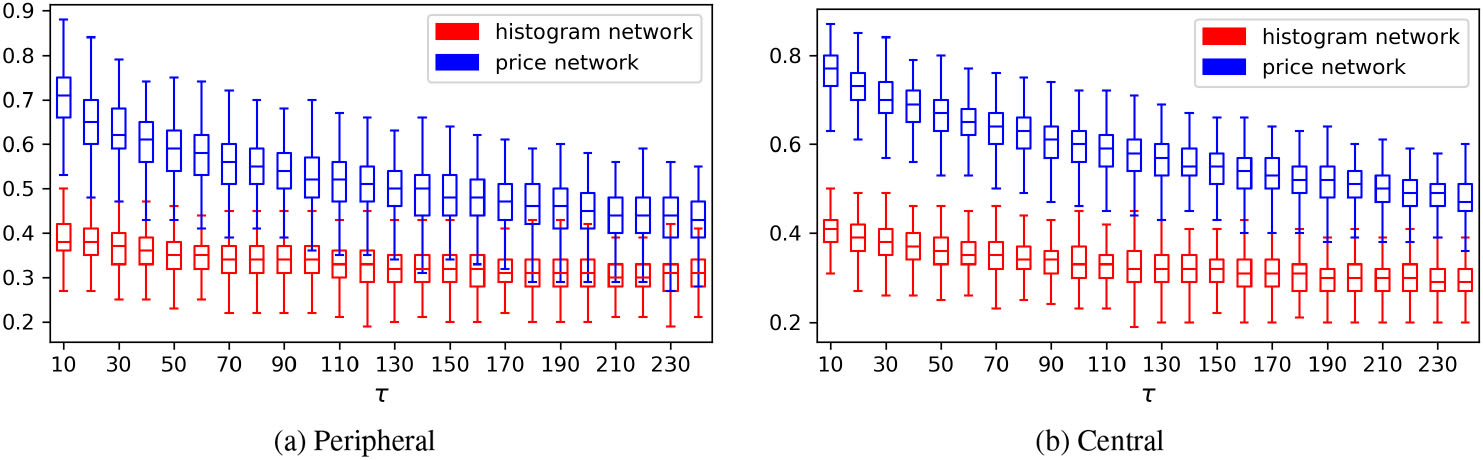
Figure 11 shows the proportion of stocks remaining in the top 100 central nodes and the top 100 peripheral nodes after time interval
In this section, we construct portfolios using stocks corresponding to peripheral nodes of network. For the examination of portfolio performance, we use measures introduced in Section 3.3. Detailed results of the portfolio experiment are described in appendix Appendix B. Portfolio experiment results.
Tables B.1 shows the sharpe ratio for each strategy according to the number of stocks in the portfolio and the holding period. In histogram network, a portfolio of peripheral nodes shows the higher sharpe ratio than that of central nodes. This implies that a portfolio consisting of stocks located in the periphery of histogram network can be effective in that stocks have not only high sharp ratio but also few dependency on other stocks. Previous studies [44, 29, 31] also conclude that forming a portfolio using peripheral node stocks is the better strategy than using the central ones for the price network case.
Figure 12 presents the average sharpe ratio in terms of number of stocks,
Sharpe ratio of various portfolios.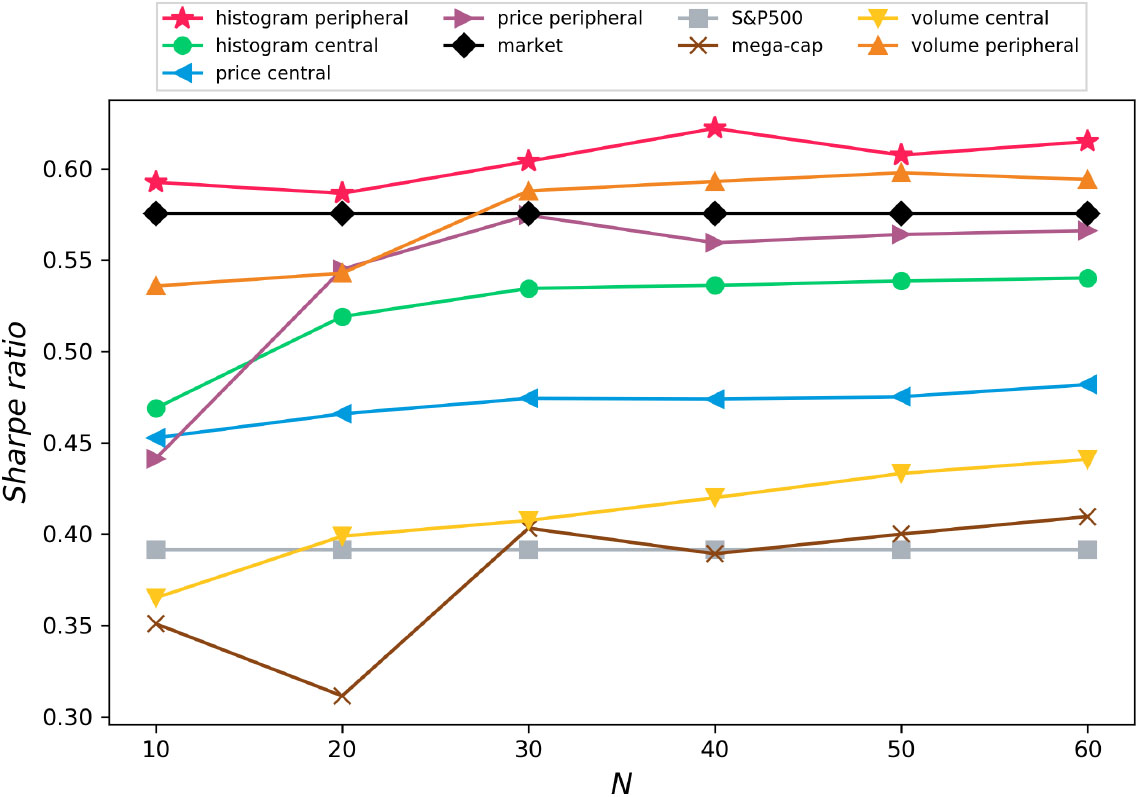
Cumulative return of various portfolios.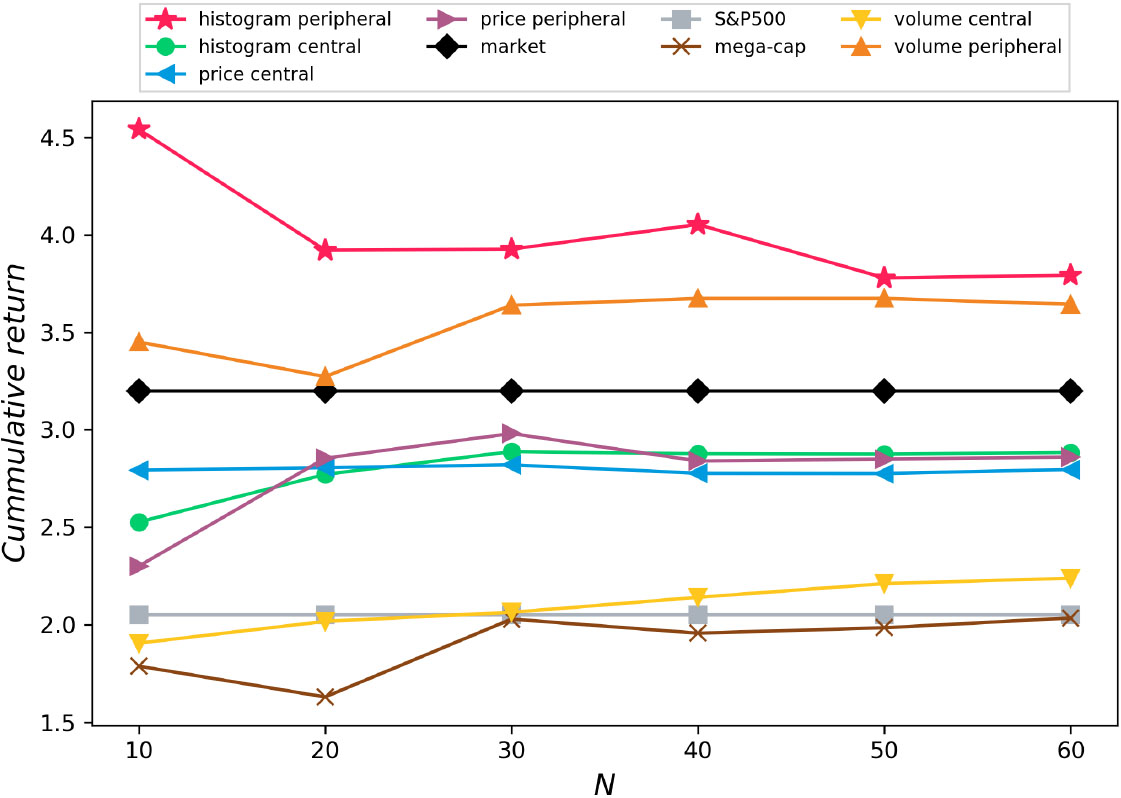
Table B.2 presents the result of cumulative return of portfolios for each strategy. For the cumulative return of portfolio based on histogram networks, cumulative return of portfolio using peripheral nodes is higher than that of portfolio using central nodes. On the other hand, for the cumulative return of portfolio based on price network, there is no significant difference between the portfolio using peripheral nodes and that using central nodes.
Figure 13 presents the average cumulative return of portfolios against the portfolio size,
1% Expected shortfall of various portfolios.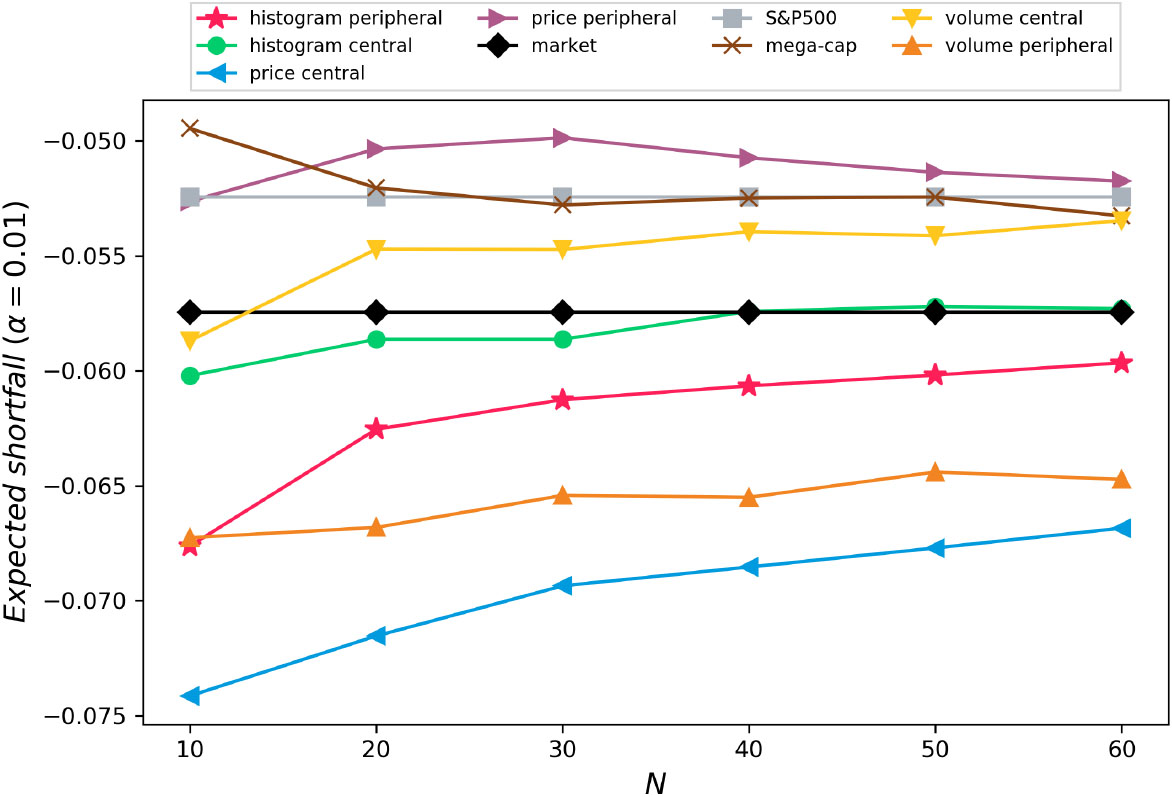
Finally, Table B.3 provides the results of 1% expected shortfall according to each portfolio strategy. When looking at the expected shortfall of portfolios in Fig. 14, the poorest portfolio in terms of risk is the portfolio of central nodes in price network. The portfolio of peripheral nodes in price network is the best strategy in terms of 1% expected shortfall. For histogram network portfolio, the portfolio of peripheral nodes in trading volume network is more risky than that of peripheral nodes in histogram network. Overall, the portfolio of peripheral nodes in histogram network is more risky in terms of 1% expected shortfall than the market portfolio and the portfolio of peripheral nodes in price network, but it has the best Sharpe ratio and cumulative return.
In this paper, we propose a deep learning related framework to analyze stock market with multidimensional data. We construct a bi-dimensional histogram using the returns of price and trading volume of stocks, and apply autoencoder to the bi-dimensional histogram to extract features, and build a stock market network using the PMFG algorithm. The proposed stock market network represents the latent space of bi-dimensional histogram of stock prices and trading volumes.
Our results show that stocks with larger or smaller histogram dispersion than usual are located in the periphery of histogram network, while stocks with moderate dispersion are located in the center of the network. The nodes of the histogram network are clustered according to the histogram dispersion, implying that the autoencoder is effective in extracting the latent feature of the bi-dimensional histogram.
The dispersion of the bi-dimensional histogram has properties related to market conditions, and tends to decrease when the diversity of stock movements decreases, for example the financial crisis. We examine time varying properties of bi-dimensional histogram of stocks categorized in 11 industry sectors based on GICS, and observe that the dispersion of histogram for each industry sector decreases during the crisis period. In detail, the dispersion of the histogram for stocks in the industry sensitive to economy condition rapidly decreases during the financial crisis period. The industry sector which is insensitive to the economy condition shows low level of dispersion compared to other industry sectors. The dispersion of histogram for stocks in FINC and REES industries are negatively correlated with the dispersion of other industries.
We observe clear structural differences between our suggested histogram network and conventional price network. Histogram network is relatively more assortative than price network. For the composition of stocks for peripheral and center nodes of network, histogram network is distinct from price network. In the price network, stocks of the industrial and financial industries are located in the center, and stocks of utilities, energy and consumer staples industries are located in the periphery. On the other hand, for histogram network stocks of health care and industrial industries are located in the center, and stocks of information technology and energy industries are located in the periphery.
We found that the usage of stock trading volume on top of stock price information can leads to the improvement of stock portfolio performance. The portfolio using the peripheral nodes of histogram network shows a higher Sharpe ratio than the portfolio based on central nodes of histogram network, the market portfolio and other benchmarks including the portfolio using price network. Overall, investment portfolio based on peripheral nodes of histogram network using stock prices and trading volumes outperforms other benchmarks.
As future work, we can extend the bi-dimensional histogram network into the higher dimensional histogram network using more information such as accounting variables in addition to stock price and stock trading volume. We expect that the inclusion of more information on stocks to our framework can improve the performance of stock portfolio based on multi-dimensional histogram network.
Footnotes
Acknowledgments
This work was supported by the National Research Foundation of Korea (NRF) grant funded by the Ministry of Science and ICT (No. 2018R1C1B5043835).
Credit authorship contribution statement
Sungyoun Choi designed the bi-dimensional histogram and developed the auto-encoder model. Choi constructed the bi-dimensional histogram network using histogram distance matrix and the stock portfolio based on the histogram network. Dongkyu Gwak computed the price correlation matrix and price distance matrix. Gwak built the price network and constructed the stock portfolio based on the price network. Jae Wook Song performed the comparison analysis between the stock portfolios. Woojin Chang advised the overall research and experiment procedures.
Appendix
Appendix A. Selected stocks for experiment
We select 400 stocks that have been fully listed in S&P500 from January 3, 2006 to September 30, 2019. The list of stocks selected for the experiment is summarized in Tables A.1 and A.2.
Stock list
GICS sector
Symbol
Security
GICS sector
Symbol
Security
GICS sector
Symbol
Security
Communication
ATVI
Activision Blizzard
Consumer
MO
Altria Group Inc
Financials
COF
Capital One Financial
Services
GOOGL
Alphabet Inc.
Staples
ADM
Archer-Daniels-Midland Co
SCHW
Charles Schwab Corporation
T
AT&T Inc.
BF.B
Brown-Forman Corp.
CB
Chubb Limited
CBS
CBS
CPB
Campbell Soup
CINF
Cincinnati Financial
CTL
CenturyLink Inc
CHD
Church & Dwight
C
Citigroup Inc.
CMCSA
Comcast Corp.
KO
Coca-Cola Company
CME
CME Group Inc.
DISCA
Discovery, Inc.
CL
Colgate-Palmolive
CMA
Comerica Inc.
DISH
Dish Network
CAG
Conagra Brands
ETFC
E*Trade
EA
Electronic Arts
STZ
Constellation Brands
RE
Everest Re Group Ltd.
IPG
Interpublic Group
COST
Costco Wholesale Corp.
FITB
Fifth Third Bancorp
OMC
Omnicom Group
EL
Este Lauder Companies
BEN
Franklin Resources
DIS
The Walt Disney Company
GIS
General Mills
GL
Globe Life Inc.
VZ
Verizon Communications
HRL
Hormel Foods Corp.
GS
Goldman Sachs Group
VIAB
Viacom
SJM
JM Smucker
HIG
Hartford Financial Svc.Gp.
Consumer
AAP
Advance Auto Parts
K
Kellogg Co.
HBAN
Huntington Bancshares
Discretionary
AMZN
Amazon.com Inc.
KMB
Kimberly-Clark
ICE
Intercontinental Exchange
AZO
AutoZone Inc
KR
Kroger Co.
JPM
JPMorgan Chase & Co.
BBY
Best Buy Co. Inc.
MKC
McCormick & Co.
KEY
KeyCorp
BWA
BorgWarner
TAP
Molson Coors Brewing Company
LNC
Lincoln National
KMX
Carmax Inc
MDLZ
Mondelez International
L
Loews Corp.
CCL
Carnival Corp.
MNST
Monster Beverage
MTB
M&T Bank Corp.
DHI
D. R. Horton
PEP
PepsiCo Inc.
MMC
Marsh & McLennan
DRI
Darden Restaurants
PG
Procter & Gamble
MET
MetLife Inc.
DLTR
Dollar Tree
SYY
Sysco Corp.
MCO
Moody’s Corp
EBAY
eBay Inc.
CLX
The Clorox Company
MS
Morgan Stanley
EXPE
Expedia Group
HSY
The Hershey Company
NDAQ
Nasdaq, Inc.
F
Ford Motor Company
TSN
Tyson Foods
NTRS
Northern Trust Corp.
GPS
Gap Inc.
WBA
Walgreens Boots Alliance
PBCT
People’s United Financial
GRMN
Garmin Ltd.
WMT
Walmart
PNC
PNC Financial Services
GPC
Genuine Parts
Energy
APA
Apache Corporation
PFG
Principal Financial Group
HRB
H&R Block
BHGE
BAKER HUGHES
PGR
Progressive Corp.
HOG
Harley-Davidson
COG
Cabot Oil & Gas
PRU
Prudential Financial
HAS
Hasbro Inc.
CVX
Chevron Corp.
RJF
Raymond James Financial Inc.
HD
Home Depot
XEC
Cimarex Energy
RF
Regions Financial Corp.
KSS
Kohl’s Corp.
COP
ConocoPhillips
SPGI
S&P Global, Inc.
LB
L Brands Inc.
DVN
Devon Energy
STT
State Street Corp.
LVS
Las Vegas Sands
EOG
EOG Resources
STI
SunTrust Banks
LEG
Leggett & Platt
XOM
Exxon Mobil Corp.
SIVB
SVB Financial
LEN
Lennar Corp.
HAL
Halliburton Co.
TROW
T. Rowe Price Group
LOW
Lowe’s Cos.
HES
Hess Corporation
BK
The Bank of New York Mellon
M
Macy’s, Inc.
HFC
HollyFrontier Corp
TRV
The Travelers Companies Inc.
MAR
Marriott Int’l.
HP
HP
USB
U.S. Bancorp
MCD
McDonald’s Corp.
MRO
Marathon Oil Corp.
UNM
Unum Group
MGM
MGM Resorts International
NOV
National Oilwell Varco Inc.
WFC
Wells Fargo
MHK
Mohawk Industries
NBL
Noble Energy Inc
WLTW
Willis Towers Watson
NWL
Newell Brands
OXY
Occidental Petroleum
ZION
Zions Bancorp
NKE
Nike
OKE
ONEOK
Health
ABT
Abbott Laboratories
JWN
Nordstrom
PXD
Pioneer Natural Resources
Care
A
Agilent Technologies Inc
NVR
NVR Inc
SLB
Schlumberger Ltd.
AGN
Allergan
ORLY
O’Reilly Automotive
VLO
Valero Energy
ABC
AmerisourceBergen Corp
PHM
PulteGroup
WMB
Williams Cos.
AMGN
Amgen Inc.
RL
Ralph Lauren Corporation
Financials
AFL
AFLAC Inc
ANTM
Anthem
ROST
Ross Stores
ALL
Allstate Corp
BAX
Baxter International Inc.
RCL
Royal Caribbean Cruises Ltd
AXP
American Express Co
BDX
Becton Dickinson
SBUX
Starbucks Corp.
AIG
American International Group
BIIB
Biogen Inc.
TPR
Tapestry, Inc.
AMP
Ameriprise Financial
BSX
Boston Scientific
TGT
Target Corp.
AMG
AMGEN
BMY
Bristol-Myers Squibb
TIF
Tiffany & Co.
AON
Aon plc
CAH
Cardinal Health Inc.
TJX
TJX Companies Inc.
AJG
Arthur J. Gallagher & Co.
CERN
Cerner
TSCO
Tractor Supply Company
AIZ
Assurant
CI
CIGNA Corp.
VFC
V.F. Corp.
BAC
Bank of America Corp
CVS
CVS Health
WHR
Whirlpool Corp.
BBT
BB&T
DHR
Danaher Corp.
WYNN
Wynn Resorts Ltd
BRK.B
Berkshire Hathaway
DVA
DaVita Inc.
YUM
Yum! Brands Inc
BLK
BlackRock
XRAY
Dentsply Sirona
Stock list (continued)
GICS sector
Symbol
Security
GICS sector
Symbol
Security
GICS sector
Symbol
Security
Health
EW
Edwards Lifesciences
Industrials
RSG
Republic Services Inc
Materials
FCX
Freeport-McMoRan Inc.
Care
GILD
Gilead Sciences
RHI
Robert Half International
IP
International Paper
HSIC
Henry Schein
ROK
Rockwell Automation Inc.
IFF
Intl Flavors & Fragrances
HOLX
Hologic
ROP
Roper Technologies
LIN
Linde plc
HUM
Humana Inc.
SNA
Snap-on
MLM
Martin Marietta Materials
IDXX
IDEXX Laboratories
LUV
Southwest Airlines
NEM
Newmont Corporation
ISRG
Intuitive Surgical Inc.
SWK
Stanley Black & Decker
NUE
Nucor Corp.
JNJ
Johnson & Johnson
TXT
Textron Inc.
PKG
Packaging Corporation of America
LH
Laboratory Corp. of America Holding
UNP
Union Pacific Corp
PPG
PPG Industries
LLY
Lilly (Eli) & Co.
UPS
United Parcel Service
SEE
Sealed Air
MCK
McKesson Corp.
URI
United Rentals, Inc.
SHW
Sherwin-Williams
MDT
Medtronic plc
UTX
UNITED TECHNOLOGIES
MOS
The Mosaic Company
MRK
Merck & Co.
WM
Waste Management Inc.
VMC
Vulcan Materials
MTD
Mettler Toledo
Information
ACN
Accenture plc
Real
ARE
Alexandria Real Estate Equities
MYL
Mylan N.V.
Technology
ADBE
Adobe Inc.
Estate
AMT
American Tower Corp.
PKI
PerkinElmer
AMD
Advanced Micro Devices Inc
AIV
Apartment Investment & Management
PFE
Pfizer Inc.
AKAM
Akamai Technologies Inc
AVB
AvalonBay Communities
DGX
Quest Diagnostics
ADS
Alliance Data Systems
BXP
Boston Properties
RMD
ResMed
APH
Amphenol Corp
CBRE
CBRE Group
SYK
Stryker Corp.
ADI
Analog Devices, Inc.
CCI
Crown Castle International Corp.
TFX
Teleflex
AAPL
Apple Inc.
DRE
Duke Realty Corp
COO
The Cooper Companies
AMAT
Applied Materials Inc.
EQR
Equity Residential
TMO
Thermo Fisher Scientific
ADSK
Autodesk Inc.
ESS
Essex Property Trust, Inc.
UNH
United Health Group Inc.
ADP
Automatic Data Processing
FRT
Federal Realty Investment Trust
UHS
Universal Health Services, Inc.
CDNS
Cadence Design Systems
HCP
HCP
VAR
Varian Medical Systems
CSCO
Cisco Systems
HST
Host Hotels & Resorts
VRTX
node Pharmaceuticals Inc
CTXS
Citrix Systems
IRM
Iron Mountain Incorporated
WAT
Waters Corporation
CTSH
Cognizant Technology Solutions
KIM
Kimco Realty
WCG
WELLCARE HEALTH PLANS
GLW
Corning Inc.
MAC
MACERICH
ZBH
Zimmer Biomet Holdings
DXC
DXC Technology
PLD
Prologis
CELG
CELGENE
FFIV
F5 Networks
PSA
Public Storage
Industrials
MMM
3M Company
FIS
Fidelity National Information Services
O
Realty Income Corporation
AME
AMETEK Inc.
FISV
Fiserv Inc
REG
Regency Centers Corporation
ARNC
ARCONIC
FLIR
FLIR Systems
SBAC
SBA Communications
BA
Boeing Company
GPN
Global Payments Inc.
SPG
Simon Property Group Inc
CHRW
C. H. Robinson Worldwide
HPQ
HP Inc.
SLG
SL Green Realty
CAT
Caterpillar Inc.
INTC
Intel Corp.
UDR
UDR, Inc.
CTAS
Cintas Corporation
IBM
International Business Machines
VTR
Ventas Inc
CPRT
Copart Inc
INTU
Intuit Inc.
VNO
Vornado Realty Trust
CSX
CSX Corp.
JKHY
Jack Henry & Associates
WELL
Welltower Inc.
CMI
Cummins Inc.
JNPR
Juniper Networks
WY
Weyerhaeuser
DE
Deere & Co.
KLAC
KLA Corporation
Utilities
AES
AES Corp
DOV
Dover Corporation
LRCX
Lam Research
LNT
Alliant Energy Corp
ETN
Eaton Corporation
MXIM
Maxim Integrated Products Inc
AEE
Ameren Corp
EMR
Emerson Electric Company
MCHP
Microchip Technology
AEP
American Electric Power
EFX
Equifax Inc.
MU
Micron Technology
ATO
Atmos Energy
EXPD
Expeditors
MSFT
Microsoft Corp.
CNP
CenterPoint Energy
FAST
Fastenal Co
MSI
Motorola Solutions Inc.
CMS
CMS Energy
FDX
FedEx Corporation
NTAP
NetApp
ED
Consolidated Edison
FLS
Flowserve Corporation
NVDA
Nvidia Corporation
D
Dominion Energy
GD
General Dynamics
ORCL
Oracle Corp.
DTE
DTE Energy Co.
GE
General Electric
PAYX
Paychex Inc.
DUK
Duke Energy
GWW
Grainger (W.W.) Inc.
QCOM
QUALCOMM Inc.
EIX
Edison Int’l
HON
Honeywell Int’l Inc.
CRM
Salesforce.com
ETR
Entergy Corp.
IEX
IDEX Corporation
STX
Seagate Technology
EVRG
Evergy
ITW
Illinois Tool Works
SYMC
SYMANTEC
ES
Eversource Energy
IR
Ingersoll Rand
SNPS
Synopsys Inc.
EXC
Exelon Corp.
JBHT
J. B. Hunt Transport Services
TXN
Texas Instruments
FE
FirstEnergy Corp
JEC
JACOBS ENGR
VRSN
Verisign Inc.
NEE
NextEra Energy
JCI
Johnson Controls International
WDC
Western Digital
NI
NiSource Inc.
KSU
Kansas City Southern
XRX
Xerox
NRG
NRG Energy
LHX
L3Harris Technologies
XLNX
Xilinx
PNW
Pinnacle West Capital
LMT
Lockheed Martin Corp.
Materials
APD
Air Products & Chemicals Inc
PPL
PPL Corp.
MAS
Masco Corp.
ALB
Albemarle Corp
PEG
Public Serv. Enterprise Inc.
NSC
Norfolk Southern Corp.
AVY
Avery Dennison Corp
SRE
Sempra Energy
NOC
Northrop Grumman
BLL
Ball Corp
SO
Southern Company
PCAR
PACCAR Inc.
CE
Celanese
WEC
WEC Energy Group
PH
Parker-Hannifin
EMN
Eastman Chemical
XEL
Xcel Energy Inc
PNR
Pentair plc
ECL
Ecolab Inc.
RTN
Raytheon Company
FMC
FMC Corporation
Appendix B. Portfolio experiment results
Sharpe Ratio of portfolios
Holding period
10
20
30
40
50
60
70
80
90
100
110
120
130
140
150
160
170
180
190
200
210
220
230
240
Mean
Hist peripheral
0.63
0.52
0.54
0.63
0.73
0.58
0.75
0.58
0.66
0.62
0.85
0.45
0.73
0.57
0.49
0.51
0.53
0.58
0.43
0.65
0.70
0.55
0.45
0.49
0.59
0.63
0.60
0.52
0.68
0.66
0.66
0.67
0.61
0.62
0.55
0.74
0.48
0.63
0.54
0.55
0.57
0.53
0.61
0.47
0.53
0.68
0.56
0.46
0.53
0.59
0.62
0.59
0.58
0.68
0.65
0.66
0.71
0.66
0.62
0.62
0.73
0.53
0.62
0.58
0.50
0.62
0.50
0.63
0.54
0.61
0.65
0.57
0.48
0.55
0.60
0.66
0.63
0.60
0.73
0.64
0.67
0.71
0.70
0.63
0.61
0.72
0.56
0.60
0.61
0.54
0.61
0.53
0.63
0.56
0.59
0.67
0.62
0.53
0.59
0.62
0.57
0.58
0.56
0.67
0.61
0.66
0.67
0.65
0.59
0.62
0.69
0.54
0.63
0.62
0.53
0.58
0.53
0.64
0.58
0.61
0.69
0.66
0.52
0.58
0.61
0.59
0.60
0.57
0.67
0.65
0.65
0.69
0.65
0.60
0.62
0.69
0.56
0.60
0.64
0.56
0.58
0.55
0.64
0.57
0.62
0.69
0.65
0.54
0.58
0.61
Hist central
0.50
0.44
0.48
0.34
0.36
0.49
0.45
0.36
0.53
0.48
0.46
0.57
0.51
0.46
0.45
0.39
0.50
0.57
0.62
0.52
0.47
0.35
0.49
0.47
0.47
0.50
0.51
0.49
0.51
0.46
0.43
0.53
0.42
0.57
0.57
0.53
0.56
0.60
0.50
0.50
0.47
0.52
0.56
0.57
0.61
0.54
0.52
0.46
0.54
0.52
0.56
0.55
0.56
0.54
0.46
0.51
0.56
0.48
0.52
0.56
0.49
0.57
0.54
0.54
0.45
0.56
0.54
0.51
0.57
0.61
0.55
0.55
0.44
0.60
0.53
0.54
0.54
0.57
0.51
0.45
0.52
0.55
0.43
0.55
0.53
0.50
0.57
0.56
0.56
0.50
0.50
0.56
0.52
0.57
0.58
0.56
0.58
0.48
0.62
0.54
0.53
0.53
0.56
0.50
0.47
0.50
0.55
0.44
0.55
0.52
0.53
0.56
0.54
0.57
0.53
0.52
0.61
0.50
0.56
0.56
0.56
0.60
0.52
0.61
0.54
0.54
0.54
0.55
0.51
0.46
0.51
0.53
0.45
0.55
0.55
0.52
0.56
0.56
0.57
0.53
0.55
0.60
0.49
0.55
0.57
0.56
0.59
0.51
0.60
0.54
Pearson peripheral
0.51
0.40
0.36
0.51
0.49
0.39
0.53
0.45
0.35
0.63
0.23
0.41
0.23
0.49
0.47
0.42
0.65
0.46
0.37
0.50
0.42
0.39
0.53
0.39
0.44
0.68
0.61
0.53
0.66
0.64
0.45
0.57
0.60
0.49
0.67
0.49
0.44
0.43
0.51
0.61
0.55
0.64
0.51
0.55
0.59
0.43
0.48
0.53
0.42
0.54
0.65
0.68
0.56
0.74
0.58
0.55
0.63
0.60
0.58
0.62
0.55
0.52
0.50
0.53
0.61
0.55
0.66
0.56
0.59
0.57
0.49
0.56
0.47
0.43
0.57
0.62
0.59
0.53
0.62
0.57
0.46
0.62
0.55
0.50
0.56
0.56
0.51
0.60
0.55
0.64
0.55
0.64
0.52
0.63
0.56
0.53
0.59
0.47
0.45
0.56
0.62
0.61
0.56
0.63
0.53
0.49
0.60
0.55
0.50
0.56
0.55
0.52
0.61
0.57
0.59
0.59
0.61
0.54
0.63
0.59
0.53
0.59
0.50
0.48
0.56
0.60
0.59
0.55
0.59
0.58
0.52
0.57
0.56
0.53
0.58
0.60
0.53
0.58
0.55
0.62
0.58
0.57
0.58
0.62
0.58
0.51
0.59
0.51
0.48
0.57
Pearson cental
0.50
0.54
0.56
0.48
0.53
0.43
0.50
0.42
0.46
0.41
0.43
0.39
0.35
0.41
0.54
0.52
0.39
0.35
0.34
0.40
0.45
0.51
0.49
0.47
0.45
0.52
0.51
0.53
0.50
0.50
0.42
0.53
0.45
0.47
0.43
0.46
0.42
0.44
0.42
0.51
0.51
0.41
0.39
0.40
0.46
0.45
0.49
0.45
0.51
0.47
0.55
0.53
0.52
0.50
0.52
0.44
0.52
0.48
0.49
0.47
0.42
0.45
0.44
0.42
0.51
0.52
0.45
0.43
0.40
0.46
0.47
0.43
0.49
0.49
0.47
0.53
0.50
0.52
0.46
0.51
0.47
0.50
0.48
0.48
0.47
0.41
0.46
0.44
0.42
0.50
0.51
0.47
0.41
0.42
0.46
0.50
0.42
0.52
0.50
0.47
0.54
0.51
0.51
0.47
0.52
0.47
0.51
0.47
0.47
0.48
0.42
0.47
0.46
0.44
0.47
0.51
0.47
0.43
0.43
0.47
0.49
0.39
0.50
0.50
0.48
0.51
0.50
0.50
0.48
0.52
0.48
0.50
0.49
0.48
0.50
0.42
0.50
0.47
0.47
0.47
0.51
0.47
0.45
0.44
0.48
0.50
0.42
0.50
0.51
0.48
Volume peripheral
0.71
0.55
0.44
0.44
0.51
0.44
0.53
0.50
0.71
0.52
0.53
0.46
0.63
0.50
0.59
0.43
0.70
0.69
0.62
0.50
0.55
0.41
0.50
0.39
0.54
0.66
0.49
0.48
0.46
0.56
0.49
0.53
0.41
0.60
0.58
0.49
0.58
0.66
0.54
0.56
0.38
0.65
0.56
0.65
0.52
0.58
0.50
0.54
0.52
0.54
0.64
0.53
0.52
0.55
0.60
0.56
0.51
0.48
0.69
0.61
0.56
0.61
0.68
0.54
0.65
0.47
0.66
0.67
0.62
0.62
0.60
0.57
0.65
0.53
0.59
0.61
0.53
0.54
0.54
0.56
0.58
0.51
0.51
0.68
0.60
0.56
0.63
0.64
0.55
0.65
0.51
0.67
0.69
0.65
0.62
0.60
0.55
0.66
0.58
0.59
0.61
0.58
0.54
0.55
0.55
0.57
0.55
0.56
0.66
0.63
0.53
0.67
0.60
0.56
0.59
0.55
0.67
0.67
0.66
0.65
0.59
0.53
0.67
0.60
0.60
0.57
0.58
0.51
0.55
0.56
0.58
0.54
0.57
0.64
0.60
0.55
0.67
0.59
0.53
0.57
0.56
0.69
0.68
0.65
0.65
0.57
0.56
0.68
0.64
0.59
Volume central
0.35
0.41
0.44
0.34
0.45
0.36
0.54
0.37
0.41
0.43
0.35
0.27
0.30
0.48
0.36
0.37
0.33
0.35
0.30
0.35
0.36
0.26
0.39
0.21
0.37
0.46
0.52
0.41
0.43
0.48
0.40
0.49
0.46
0.38
0.46
0.36
0.34
0.44
0.47
0.38
0.40
0.28
0.32
0.32
0.40
0.37
0.36
0.38
0.28
0.40
0.46
0.46
0.37
0.41
0.48
0.35
0.52
0.47
0.40
0.44
0.35
0.32
0.49
0.47
0.42
0.44
0.31
0.34
0.44
0.44
0.39
0.35
0.36
0.31
0.41
0.53
0.46
0.38
0.44
0.50
0.36
0.56
0.46
0.44
0.46
0.33
0.34
0.43
0.46
0.44
0.46
0.32
0.36
0.46
0.41
0.41
0.36
0.36
0.33
0.42
0.54
0.50
0.42
0.44
0.47
0.40
0.54
0.46
0.47
0.45
0.33
0.40
0.44
0.46
0.47
0.49
0.33
0.41
0.46
0.41
0.43
0.38
0.35
0.34
0.43
0.52
0.49
0.44
0.45
0.48
0.39
0.54
0.46
0.48
0.48
0.34
0.41
0.44
0.47
0.50
0.47
0.35
0.42
0.46
0.44
0.43
0.39
0.38
0.35
0.44
Market cap – mega
0.34
0.33
0.35
0.34
0.35
0.34
0.33
0.36
0.38
0.40
0.31
0.34
0.36
0.32
0.40
0.37
0.34
0.34
0.36
0.33
0.34
0.35
0.39
0.37
0.35
0.30
0.31
0.27
0.31
0.30
0.32
0.32
0.33
0.30
0.31
0.25
0.32
0.32
0.32
0.36
0.31
0.34
0.28
0.32
0.35
0.39
0.27
0.33
0.26
0.31
0.44
0.43
0.42
0.40
0.40
0.41
0.44
0.41
0.40
0.39
0.39
0.39
0.41
0.42
0.41
0.42
0.38
0.34
0.41
0.41
0.41
0.39
0.37
0.36
0.40
0.38
0.38
0.36
0.40
0.40
0.37
0.41
0.40
0.38
0.40
0.38
0.37
0.37
0.40
0.42
0.41
0.37
0.33
0.36
0.42
0.42
0.42
0.40
0.38
0.39
0.41
0.41
0.40
0.41
0.40
0.39
0.40
0.40
0.42
0.40
0.40
0.38
0.38
0.40
0.42
0.40
0.39
0.36
0.37
0.43
0.42
0.43
0.40
0.38
0.40
0.41
0.40
0.41
0.42
0.40
0.40
0.43
0.43
0.42
0.42
0.42
0.37
0.38
0.42
0.43
0.44
0.40
0.37
0.38
0.43
0.43
0.43
0.40
0.40
0.41
Market portfolio
0.58
0.58
0.57
0.58
0.58
0.57
0.58
0.58
0.58
0.58
0.57
0.57
0.57
0.57
0.58
0.58
0.57
0.57
0.56
0.58
0.58
0.57
0.57
0.57
0.58
S&P500 index
0.40
0.40
0.39
0.40
0.40
0.39
0.40
0.40
0.40
0.40
0.39
0.38
0.38
0.38
0.40
0.40
0.38
0.38
0.37
0.40
0.40
0.38
0.37
0.38
0.39
Cumulative return of portfolios
Holding period
10
20
30
40
50
60
70
80
90
100
110
120
130
140
150
160
170
180
190
200
210
220
230
240
Mean
Hist peripheral
5.22
3.65
4.07
5.00
8.37
4.88
7.16
4.33
5.77
4.42
8.15
2.70
5.94
3.74
2.81
3.07
3.15
3.90
2.92
4.86
6.09
2.99
2.26
3.53
4.54
4.53
4.08
3.36
5.17
5.68
5.22
4.73
4.35
4.41
3.41
5.51
2.84
4.27
3.19
3.04
3.23
3.00
4.14
2.84
3.16
4.71
3.08
2.60
3.59
3.92
4.21
3.92
3.98
4.95
5.20
4.98
4.95
4.69
4.43
4.03
4.88
3.14
4.05
3.36
2.59
3.77
2.60
4.40
3.37
3.63
4.07
2.93
2.60
3.52
3.93
4.68
4.34
4.09
5.61
4.80
4.98
4.91
5.09
4.42
3.82
4.73
3.36
3.69
3.71
2.91
3.70
2.93
4.24
3.36
3.42
4.32
3.21
3.04
3.94
4.05
3.59
3.76
3.59
4.75
4.07
4.67
4.37
4.38
3.93
3.74
4.34
3.15
3.98
3.73
2.77
3.34
2.87
4.28
3.42
3.54
4.35
3.48
2.86
3.74
3.78
3.68
3.86
3.59
4.67
4.52
4.36
4.58
4.30
3.89
3.72
4.38
3.25
3.64
3.90
3.03
3.29
2.96
4.13
3.36
3.48
4.35
3.39
2.94
3.74
3.79
Hist central
2.84
2.40
2.63
1.81
1.97
2.71
2.39
1.89
2.95
2.59
2.56
3.01
3.09
2.50
2.40
2.05
2.38
3.03
3.73
2.76
2.40
1.60
2.48
2.47
2.53
2.75
2.78
2.64
2.76
2.51
2.24
2.86
2.18
3.10
3.19
2.97
2.95
3.51
2.53
2.54
2.53
2.43
2.79
3.22
3.42
2.76
2.60
2.20
3.06
2.77
3.18
3.10
3.19
2.93
2.55
2.80
3.09
2.50
2.83
3.13
2.61
3.10
2.93
2.88
2.26
3.18
2.65
2.71
3.09
3.35
2.89
2.81
2.11
3.46
2.89
3.00
3.01
3.19
2.70
2.40
2.81
3.02
2.25
2.97
2.86
2.72
3.11
3.03
3.04
2.60
2.70
2.81
2.74
3.06
3.12
2.94
2.98
2.37
3.63
2.88
2.95
2.92
3.13
2.69
2.50
2.70
3.00
2.24
2.89
2.77
2.98
3.03
2.83
3.11
2.74
2.87
3.19
2.57
2.93
2.98
2.92
3.15
2.51
3.42
2.88
3.01
2.97
3.04
2.74
2.46
2.67
2.80
2.31
2.89
2.96
2.90
3.03
2.99
3.04
2.73
3.01
3.08
2.51
2.97
3.08
2.91
3.11
2.56
3.45
2.88
Pearson peripheral
2.58
2.02
1.92
2.57
2.56
2.11
2.81
2.36
1.77
3.49
1.38
2.29
1.29
2.40
2.44
2.16
3.77
2.40
1.79
2.47
2.02
1.87
2.61
2.15
2.30
3.83
3.23
2.74
3.53
4.13
2.46
3.10
3.19
2.43
3.57
2.70
2.22
2.11
2.56
3.40
2.78
3.24
2.76
2.90
2.93
2.07
2.07
2.45
2.10
2.85
3.67
3.75
3.09
4.30
3.32
3.09
3.43
3.11
3.04
3.09
2.87
2.62
2.47
2.64
3.23
2.68
3.19
3.16
3.13
2.70
2.35
2.44
2.09
2.10
2.98
3.34
3.06
2.89
3.15
3.29
2.49
3.34
2.79
2.53
2.63
3.02
2.50
3.04
2.78
3.22
2.67
3.09
2.83
3.52
2.62
2.61
2.57
2.07
2.09
2.84
3.29
3.19
3.04
3.26
2.94
2.57
3.23
2.73
2.47
2.65
2.90
2.56
3.04
2.96
2.95
3.07
2.80
2.83
3.40
2.81
2.51
2.65
2.23
2.32
2.85
3.18
3.07
2.94
3.01
3.30
2.82
3.03
2.84
2.63
2.82
3.19
2.62
2.90
2.80
3.06
2.97
2.61
3.02
3.31
2.78
2.46
2.68
2.29
2.35
2.86
Pearson cental
3.35
3.69
3.95
3.08
3.56
2.60
3.08
2.57
2.80
2.33
2.66
2.31
1.86
2.42
3.76
3.52
2.04
1.80
1.76
2.17
2.58
3.28
2.91
2.98
2.79
3.43
3.32
3.52
3.25
3.19
2.54
3.34
2.74
2.91
2.41
2.90
2.50
2.44
2.37
3.22
3.30
2.10
2.02
2.16
2.62
2.53
2.90
2.46
3.19
2.81
3.71
3.44
3.28
3.14
3.27
2.64
3.16
2.88
2.99
2.71
2.45
2.68
2.40
2.34
3.02
3.30
2.37
2.39
2.11
2.63
2.73
2.41
2.74
2.91
2.82
3.37
3.11
3.30
2.75
3.18
2.88
2.97
2.86
2.92
2.72
2.41
2.72
2.41
2.28
2.92
3.15
2.52
2.22
2.23
2.61
2.92
2.25
2.98
2.97
2.78
3.45
3.19
3.14
2.84
3.21
2.80
2.99
2.78
2.79
2.82
2.41
2.79
2.55
2.45
2.63
3.02
2.57
2.42
2.25
2.63
2.85
2.06
2.89
3.09
2.78
3.11
3.00
2.98
2.92
3.22
2.83
2.93
2.91
2.76
2.95
2.45
2.94
2.69
2.62
2.63
3.04
2.53
2.50
2.29
2.72
2.85
2.27
2.82
3.14
2.80
Volume peripheral
6.51
3.82
2.67
2.54
3.53
2.72
3.57
3.11
5.68
3.02
3.85
2.42
4.08
3.09
4.00
2.42
4.27
5.36
3.37
2.76
3.49
2.09
2.55
1.88
3.450
4.98
2.92
2.96
2.65
3.83
2.92
3.20
2.15
3.86
3.35
3.12
3.40
4.30
3.31
3.37
2.00
3.40
3.50
4.27
2.92
3.81
2.63
2.68
3.04
3.273
4.44
3.35
3.17
3.51
3.91
3.58
2.97
2.67
4.35
3.68
3.77
3.75
4.54
3.13
4.09
2.56
3.59
4.38
3.80
4.03
3.80
3.27
3.63
3.35
3.639
4.13
3.34
3.35
3.49
3.59
3.72
3.00
3.08
4.25
3.55
3.75
3.97
4.09
3.27
4.02
2.91
3.76
4.50
4.08
3.91
3.86
3.04
3.68
3.83
3.673
4.08
3.81
3.21
3.50
3.44
3.47
3.31
3.51
4.03
3.77
3.48
4.28
3.57
3.27
3.46
3.20
3.90
4.08
4.11
4.14
3.75
2.98
3.92
3.91
3.674
3.59
3.77
2.94
3.43
3.47
3.54
3.24
3.51
3.84
3.52
3.54
4.24
3.40
3.08
3.31
3.29
4.32
4.30
3.98
4.14
3.57
3.16
4.04
4.23
3.644
Volume central
1.89
2.25
2.43
1.90
2.41
1.99
2.95
1.94
2.15
2.13
1.91
1.44
1.59
2.39
1.79
1.77
1.65
1.84
1.44
1.70
1.80
1.31
1.90
1.16
1.905
2.47
2.84
2.15
2.27
2.47
2.11
2.49
2.38
1.91
2.26
1.84
1.73
2.18
2.24
1.80
1.95
1.43
1.71
1.56
1.91
1.86
1.68
1.79
1.38
2.018
2.45
2.42
1.98
2.13
2.47
1.83
2.70
2.38
2.07
2.19
1.79
1.63
2.40
2.21
2.04
2.16
1.56
1.81
2.33
2.12
1.88
1.64
1.78
1.56
2.064
2.98
2.40
1.99
2.30
2.55
1.84
2.98
2.34
2.30
2.29
1.72
1.73
2.15
2.24
2.14
2.30
1.60
1.87
2.55
2.01
1.94
1.74
1.77
1.64
2.141
3.02
2.62
2.18
2.32
2.38
2.06
2.83
2.35
2.48
2.24
1.72
2.00
2.19
2.23
2.34
2.44
1.63
2.15
2.52
2.01
2.05
1.82
1.77
1.72
2.211
2.87
2.59
2.29
2.33
2.46
2.01
2.83
2.33
2.49
2.44
1.74
2.04
2.16
2.29
2.57
2.35
1.71
2.18
2.44
2.13
2.05
1.83
1.86
1.77
2.239
Market cap – mega
1.71
1.67
1.74
1.76
1.78
1.75
1.69
1.86
1.93
1.95
1.71
1.79
1.81
1.67
1.96
1.96
1.70
1.77
1.81
1.69
1.70
1.72
1.85
1.95
1.79
1.57
1.62
1.49
1.63
1.60
1.65
1.66
1.68
1.65
1.59
1.48
1.63
1.64
1.65
1.76
1.69
1.65
1.56
1.63
1.74
1.89
1.43
1.70
1.53
1.63
2.19
2.17
2.10
2.05
2.07
2.07
2.19
2.09
2.08
1.96
2.08
1.96
2.04
2.06
2.04
2.13
1.90
1.90
1.95
2.05
2.00
1.93
1.82
1.89
2.03
1.91
1.93
1.83
1.99
2.03
1.89
2.05
2.00
1.95
2.02
2.00
1.85
1.91
1.96
2.09
2.06
1.84
1.81
1.77
2.08
2.10
2.03
1.95
1.93
1.96
2.04
2.04
2.00
2.03
2.01
2.00
1.98
1.98
2.15
1.99
2.06
1.88
1.94
1.95
2.05
1.98
1.88
1.91
1.79
2.05
2.05
2.03
1.92
1.92
1.98
2.05
2.02
2.02
2.09
2.04
2.03
2.11
2.12
2.16
2.09
2.16
1.89
1.95
2.02
2.08
2.18
1.94
1.97
1.84
2.09
2.09
2.03
1.91
1.99
2.04
Market portfolio
3.39
3.38
3.21
3.37
3.39
3.22
3.28
3.33
3.27
3.24
3.30
3.16
3.09
3.11
3.14
3.29
3.00
3.21
3.00
3.15
3.17
2.90
2.94
3.21
3.20
S&P500 index
2.12
2.12
2.05
2.12
2.12
2.05
2.10
2.12
2.10
2.12
2.07
1.99
1.99
1.99
2.10
2.12
1.96
1.96
1.89
2.12
2.10
1.99
1.91
1.99
2.05
1% expected shortfall of portfolios
Holding period
10
20
30
40
50
60
70
80
90
100
110
120
130
140
150
160
170
180
190
200
210
220
230
240
Mean
Hist
peripheral
Hist
central
Pearson
peripheral
Pearson
cental
Volume
peripheral
Volume
central
Market
cap –
mega
Market
portfolio
S&P500 index