



Abstract
Reaching the maximum number of customers at the right time to increase sales and profitability of the business is the primary goal of Electronic Commerce (E-Commerce). However, owing to the low-influenced product, the profitability of e-commerce has been drastically affected in recent years. Therefore, this work proposes an Empirical Probability assigned Satty’s method integrated Multicriteria Decision-Making model (EP-Satty-MCDM)-based business decision-making model for improving the sales of low-influenced products by advertising with celebrities. Primarily, the authenticated user securely downloaded the encrypted data using Armstrong number private key generated-Trident Curve-Cryptography (Arm-TCC) in the web application. After that, the data is cleansed and the attributes of review and behavior data are extracted. Then, by utilizing the Interval-valued Atanassov intuitionistic fuzzy-based Mann-Whitney U test (IAF-MWU), the correlation between the review and behavior data is evaluated. The correlated features under each user are mapped under the product, and semantic ontology is constructed, where the data is again mapped with the product’s subsections. Afterward, the domains are extracted. Thereafter, to identify whether the product is high-influenced or low-influenced, the obtained ratings from ontology and extracted domains are inputted into the Boosting Regression Tree-Recurrent Neural Network (BRT-RNN). Then, for the decision-making, the positively forecasted celebrities with their garment and low-influenced products are given as the input to EP-Satty-MCDM. The experimental outcomes exhibited that the proposed technique withstands maximum accuracy when contrasted with the existing methodologies.
Keywords
Introduction
In the past few years, online businesses have been consistently growing worldwide in which customers spend more time browsing, voicing their opinions on brands and their products, and comparing products along with their prices across websites [1]. Globally, e-commerce sales are rising quickly, which allows businesses and consumers to distribute, buy, sell, and market goods and services via advertising in electronic systems [2, 3]. Making the consumers to practice comfortability owing to changes in behavior patterns and also for practicing requirements owing to technological advances and information flows is the major drawback in such models [4]. Because of this dynamic nature of business, the business process efficiency in highly competitive industries is affected when they tend to evolve through growth, transformation, or expansion [5, 6]. Thus, for coping with such evolvements and for ensuring the speed and consistency of the community’s requirements, companies must transform into more modern technologies as well as information packaging in which decision-making plays a vital role in ensuring the company’s success [7, 8] Also, business leaders look for implementing new technologies so that they could efficiently manage risk and optimize their business performance [9].
The business workers’ lives are made easier to expedite the decision-making process by the emergence of data mining mechanisms and business intelligence systems [10]. They examine the change in human interaction owing to social network building that occurs generally via online as well as social media marketing themes [11, 12]. Artificial Intelligence (AI) is gaining popularity in supporting operational decision-making across numerous business domains like Amazon and Target, which utilizes Machine Learning (ML) for recommending products along with product categories grounded on insights from other customers’ purchase decision processes [13, 14]. Nevertheless, the most accurate decision could not be produced by the decision-maker devoid of a detailed analysis centered on the enormous data received [15]. Moreover, they concentrated less on moderating the consumers’ buying behavior when the product fails to attain a satisfactory number of transactions and/or unacceptable customer feedback. Hence, for predicting sales on those low-influenced products, business models must build and implement a system that analyses huge data.
Problem statement
The prevailing business decision-making approaches are inefficient in addressing some important issues like,
Earlier, the models did not concentrate on purchasing behavior, knowledge discovery, and image mining altogether for developing product recommendation models. The hedonic value of the social websites was considered very less as this might increase the moderating effect on buying behavior significantly. Considering purchasing behavior and leaving other factors, namely reviews given and contextual analysis, et cetera could affect decision-making in business models. The privacy of the recommender people was not considered, which may lead to business competitors raising an attack as well as sabotaging for recommender people. Over-specialization or diversity problems occur in recommendation systems as they were trained narrowly by sorting vast amounts of content and selecting them.
Therefore, the proposed recommendation system has the following contributions,
The model effectively integrated purchasing behavior, knowledge discovery, and image mining altogether to make the most accurate decision with detailed analysis. For the moderating effect on buying behavior, the information collection also contributed to the social media celebrity images. Important factors that influence product sales were considered along with behavioral data to improve effectiveness in decision-making. The Arm-TCC-based policy matching is introduced to minimize attacks and preserve the privacy of recommender people. To alleviate the diversity problems in the recommendation system, the model conducts two different types of classification using BRT-RNN.
The remaining paper is organized to analyze the existing literature in Section 2, explain the proposed technique in Section 3, assess the proposed model in Section 4, and wind up the paper in Section 5.
Related literature survey
Niu et al., concentrated on increasing organizational effectiveness by improving the decision-making analysis. Regarding business intelligence, the model utilized data analysis via Optimized Data Management-based Big Data Analytics (ODM-BDA) and improved the risk-taking ability and plan failure through the backtracking method. The framework’s reliability was proven by the simulation analysis. Owing to the low quality of data, the model accuracy was lower [16].
Lessmann et al., implemented profit analytics in marketing. By utilizing a Profit-Conscious Ensemble Selection (PCES) technique, which integrated business and statistical objectives to select responsive customers, the model planned to select a more profitable target group for the targeted profit of the marketing campaign. The outcomes revealed that the framework was more advantageous than several benchmarks. Nevertheless, the black box problem in PCES was not resolved, which limited the model in understanding the factors influencing customer characteristics [17].
Kumar et al., enriched the recommendation generation’s performance in the E-Commerce system. The model improved customer retention performance by generating the purchase pattern for customers with similar interests and identifying the high-frequency pattern for producing recommendations to the user. Even though the model supported recommendation generation in a higher ratio, they did not consider the recommender people’s privacy [18].
Hossen et al., enhanced the business performance in the online hotel booking system by the assessment of customer satisfaction. For this, by utilizing Gated Recurrent Unit (GRU) as well as Long Short-Term Memory (LSTM), the sentiment about the customer opinion was identified. The deep learning models were trained on the customer review data. As per the findings, the business site had been improved through the analysis of customer opinion. The model only utilized a limited set of features, which led to a focus on the most popular items only and increased overstocking of other products [19].
Zong et al., propounded an Operational Research-centric Intelligent Decision Support System (OR-IDSS) for e-commerce decision-making. The fuzzy logic theory was utilized for promoting price negotiation in e-commerce organizations by the recommendation of choices for the product’s online selection. The experimental results exposed that when contrasted with the prevailing techniques, the model had enhanced performance. The model can break down gradually as the fuzzy logic system fits to specific problem domain [20].
Sun et al., evaluated the sustainability vector for e-commerce business development. Correlation to determine the company performance in economic and environmental aspects, clustering to group similar functioning groups, and regression for determining the business model’s key areas to be enhanced were conducted by the model. As per the results, augmenting the sustainability vector brought a company nearby to the business sustainability benchmark. The system lacked consideration of the companies’ public information, which lowered the E-commerce model’s accuracy [21].
Li et al., supported user’s purchasing decisions utilizing the Review of the Helpfulness-based Recommendation Methodology (RHRM). The review semantics were learned by the hybrid neural network for the review helpfulness classification; also, for the item recommendation generation, the past interactions in user preferences were utilized. The experiments exposed that reviewing helpfulness information was advantageous in the recommender system. Nevertheless, the model’s performance was degraded by the ignorance of the purchase history of items [22].
Wazarkar and Keshavamurthy proffered an image mining methodology for decision-making in fashion industries. The model gathered social fashion images and grouped them utilizing the soft clustering technique for extracting attributes on the grouped data, which were then applied to the forecasting model. Even though the system was beneficial in fashion industries for uplifting their business, the exclusion of judgment and subjective factors resulted in incorrect business decisions [23].
Karthik and Ganapathy recommended a product recommendation system to predict relevant products under the user’s interests. The product user target category’s sentiment score was calculated by the model and the ontology assignment made the decision using the fuzzy rules as well as an ontology-centric recommendation system. When contrasted with the prevailing mechanisms, superior performance was shown by the recommendation system’s experimental outcomes. Yet, the computation complexity of the model was high since the fuzzy-based systems required regular updates of rules [24].
Pan et al., employed a text mining technology to conduct reliability analysis on online reviews. The failure-related customer knowledge was extracted by the model from the user’s online reviews for classifying the failure for every single component and analyzing the reliability. The results specified that the consideration of failure distribution effects had a higher impact on product reliability. Nevertheless, the model lacked proper mapping between the failure mode and failure component, which affected the reliability analysis [25].
Proposed methodology for business decision-making model
The proposed technique aims to maximize sales by advertising lower-influenced products with social media celebrities. The proposed system’s block diagram is displayed in Fig. 1.
Block Diagram of the proposed business decision-making model.
An e-commerce application allows users to browse product catalogs, add items to a cart, shop online, create wish lists, and complete purchases. Vast numbers of e-commerce web applications exist. Generally, many web applications exist. Among that, one web application
Here, the
(a) Data encryption: By performing malicious activities, the unsecuritized data in
The cryptographic key algorithm (Arm-TCC) defines the trident curve
Where,
The random number’s random initialization
Here,
Thereafter,
Here,
Subsequent to the data encryption, the authentication is performed to collect the data securely from
Here,
For the obtained authenticated user
Here,
Here, the collected data
Data cleansing
Data cleansing is performed after collecting the data
Here,
Following the data cleansing, the attributes of
Likewise, the behavior data, namely work status, no. of clicks, gender, views, marital status, wishlist, frequency of purchase, amount of purchase, age, et cetera are extracted, and these attributes are notated as
User attributes
The MWU is performed in 2 parts. The MWU’s main part is represented by the first part, whereas the second part is the computation of the median of every single group. The Analyze menu (attribute’s different category) opens first when the database to be processed is activated. The analyzed menu options
Here,
For encrypting the variable’s values, it is required to choose the Define Groups field. Numbers 1 and 2 are entered in the boxes adjacent to each group, correspondingly. The MWU field in the section Test Type is then validated before selecting the command Continue. Lastly, Options are chosen
If
Here, rand epitomizes the random number to avoid the attributes’ insufficiencies, and
Here, the membership degree is exemplified as
Thereafter, the Median switches from the Statistics field to the field of Cell Statistics. Also, the Mean and Standard Deviation switch from the field of Cell Statistics to the Statistics field. At last, the commands Continue and OK are given. Finally, the obtained correlated attributes of one user are expressed as,
Here,
From this constructed ontology, the review ratings are taken as the output, and it is represented as
Following the construction of ontology centered on the product’s characteristics (as the parent node), the semantic ontology is constructed here. By developing the child node (product’s sub-categories, such as size, cloth, design, et cetera), the semantic ontology over
Here,
Here, the link between the two nodes is considered an edge point
Here, for classifying high and low-influenced products of web applications, the evaluated rating
Structure of proposed SR-RNN.
Here, the rating of each product by users
Input layer: This layer is responsible to get the inputs and feed them to the hidden layer. This is represented as,
Hidden layer: This layer is activated by the sigmoid activation function and trains the input by aggregating it with weight value and bias value. The Hidden layer
Where,
By computing the weighted sum and further adding bias to it, the activation function decides whether a neuron should be activated or not. The BRT is evaluated as,
Here,
Output layer: Afterward, the outcome from the hidden layer is given to the output layer, which classifies the product as high-influenced or low-influenced. This output layer
Where,
Loss function: Thereafter, by computing the difference between the actual value
If the model’s loss value
Here, the number of different social media celebrity images
Wherein,
Here,
Here,
Here,
Here, to make the decision for improving sales by matching the celebrity with the product to advertise, the positively forecasted celebrity
In multicriteria decision-making, the rating prediction task
Where,
Two steps follow the assignment of the prediction task. The process of estimating the rating on every single criterion is referred to as both rating aggregations and multi-criteria rating predictions. The process of combining the predicted multi-criteria ratings for estimating the overall rating is referred to as rating aggregations. Grounded on these anticipated overall ratings, the recommended items will be created.
(a) Multi-Criteria Rating Predictions: Here, the multicriteria ratings between
Here,
Rating Aggregations: Once the multi-criteria ratings are predicted, they are aggregated together for predicting the overall rating for making the decision. The linear aggregation is epitomized as,
Here,
Here, the number of events performed is explicated as
Here, the proposed recommendation system’s efficacy in improving the business performance of the E-commerce system is evaluated by conducting numerous experiments in the working platform of PYTHON.
Performance analysis
This phase provides the experimental results along with performance analysis as well as a comparative analysis of different methods. Grounded on some quality metrics, the results attained for various stages of the system that use the methods, such as BRT-RNN, EP-Satty-MCDM, IAF-MWU, and Arm-TCC are evaluated.
Performance comparison of proposed EP-Satty-MCDM based on (a) Geometric average and (b) Net score.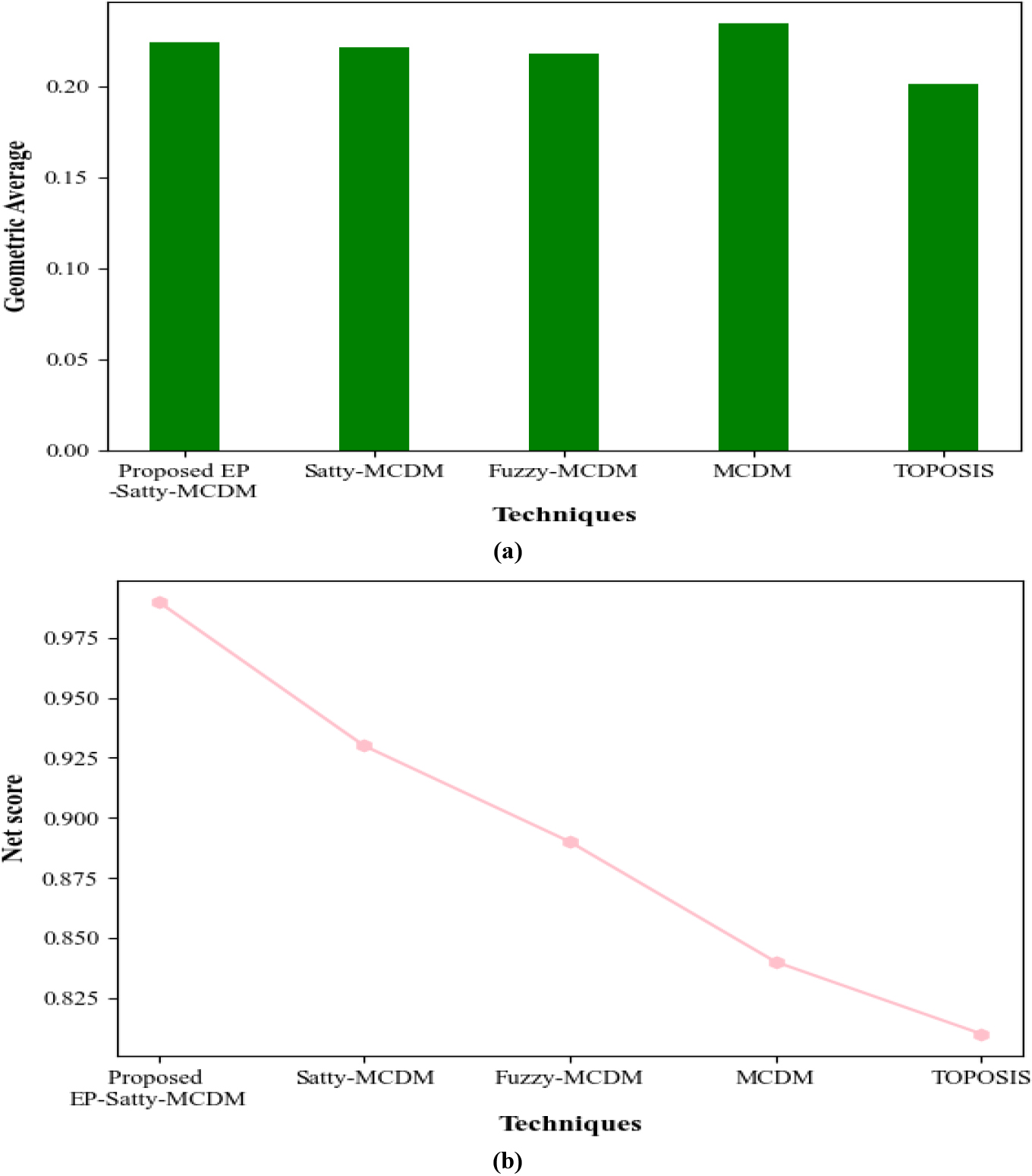
Regarding Geometric average and net score, the overall performance of the system by comparing the proposed EP-Satty-MCDM and existing Satty-MCDM, Fuzzy-MCDM, MCDM, and Technique for Order of Preference by Similarity to Ideal Solution (TOPSIS) is analyzed in Fig. 3. When contrasted with the prevailing techniques, the proposed technique has the highest performance for the global average (0.229343) and net score (0.99). This indicates that the EP-based weight assignment aided in the analytics of relevant data from large amounts of data for confident decision-making.
Performance comparison of proposed BRT-RNN
In Table 4, the accuracy of the proposed BRT-RNN and existing RNN, Convolution Neural Network (CNN), Deep Neural Network (DNN), and Artificial Neural Network (ANN) is compared for their ability to product classification and category influence classification. While comparing with the existing approaches, the accuracy attained by the proposed model is improved by 3% for product classification and 2% for category influence classification. This indicates that BRT explicitly fits parameters to direct the information flow and speeds up the process to make more accurate predictions.
Analyzing the performance of the proposed BRT-RNN.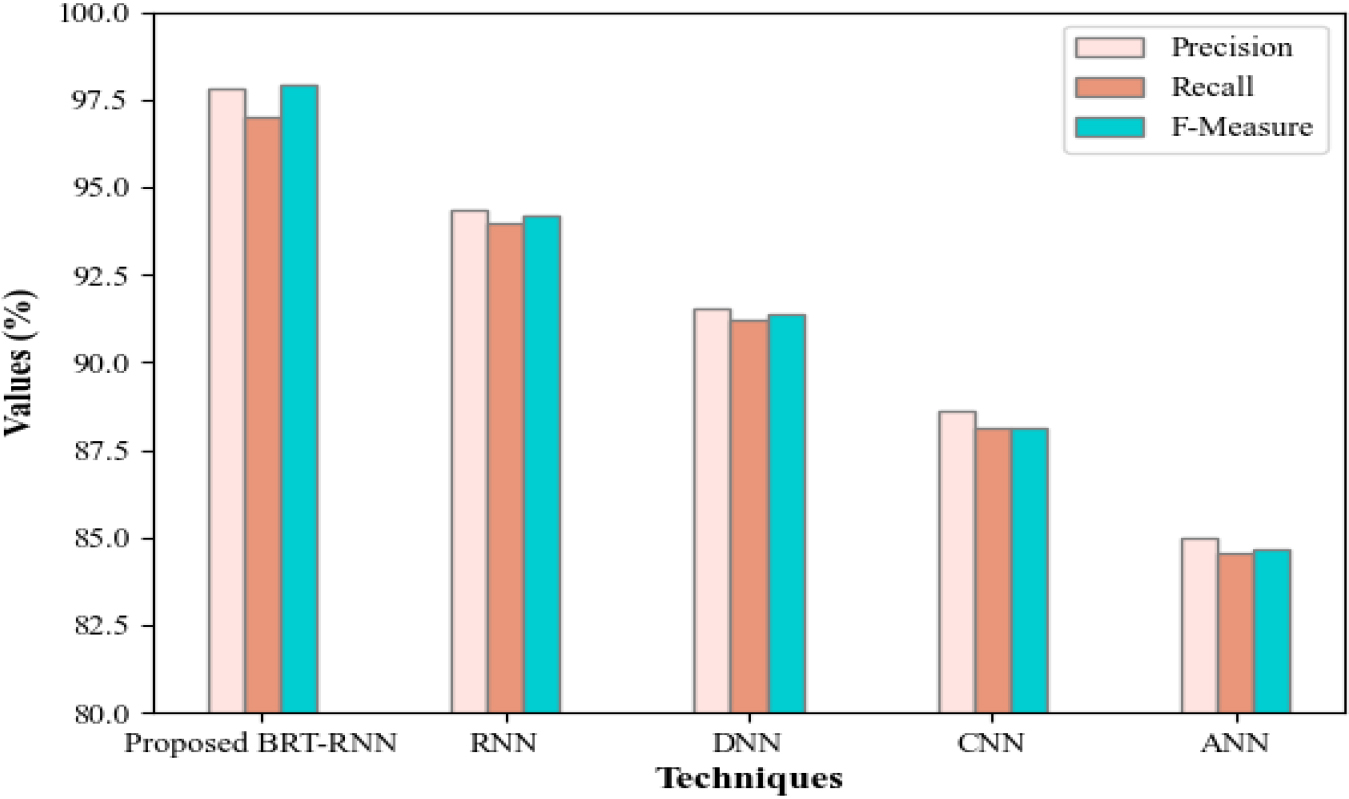
The F-measure, recall, and precision of the proposed BRT-RNN and existing systems are analyzed in Fig. 4. In comparison, the proposed system achieves higher values of precision (97.8%), recall (97%), and F-measure (97.9%) than the existing methods. Therefore, the BRT technique used in the model effectively defines the predictive attributes for accurate predictions. The analysis concludes that for product classification, the model remains more accurate.
Analysis of failure prediction
Encryption and decryption analysis
Analysis of forecasting accuracy.
Concerning the error metrics, namely Mean Absolute Error (MAE), Root Mean Square Error (RMSE), Mean Absolute Percentage Error (MAPE), and Normalized Mean Square Error (NMSE), the performance of proposed and existing approaches in forecasting the influence of category is analyzed in Fig. 5. Attaining minimum values of these metrics indicates improved performance of the model. By the way, the findings in Fig. 4 indicate the maximum performance of the proposed BRT-RNN by achieving minimum values of NMSE (3.3%), MAE (2.34%), MAPE (1.88%), and RMSE (1.52%). Therefore, BRT associated with the proposed technique significantly improved the prediction accuracy with minimum forecasting error.
Table 2 compares the failure proportions attained by the proposed and conventional techniques, which should be lower for better performance. The proposed mechanism has the highest performance than the existing methods. This is owing to the assistance of the BRT technique that effectively interprets and understands the non-linear relationship between the data for accurate predictions. Therefore, to support the improvement of decision-making performance, the predictions on product classification and category influence forecasting remain more accurate.
The encryption time and decryption time analysis of the proposed Arm-TCC and existing Rivest Shamir Adleman (RSA), Quantum dot Cellular Automata (QCA), ECC, and Advanced Encryption Standard (AES)methods are revealed in Table 3. The time taken by the proposed model is lower by 8 ms for encryption and 11 ms for decryption compared to the existing ECC. Hence, the selection of private keys using the Armstrong number requires more resources, time, and effort than the random selection. From the analysis, the proposed Arm-TCC is more highly secure in preserving the privacy of recommender people than the prevailing mechanisms.
AUC analysis
Execution time analysis.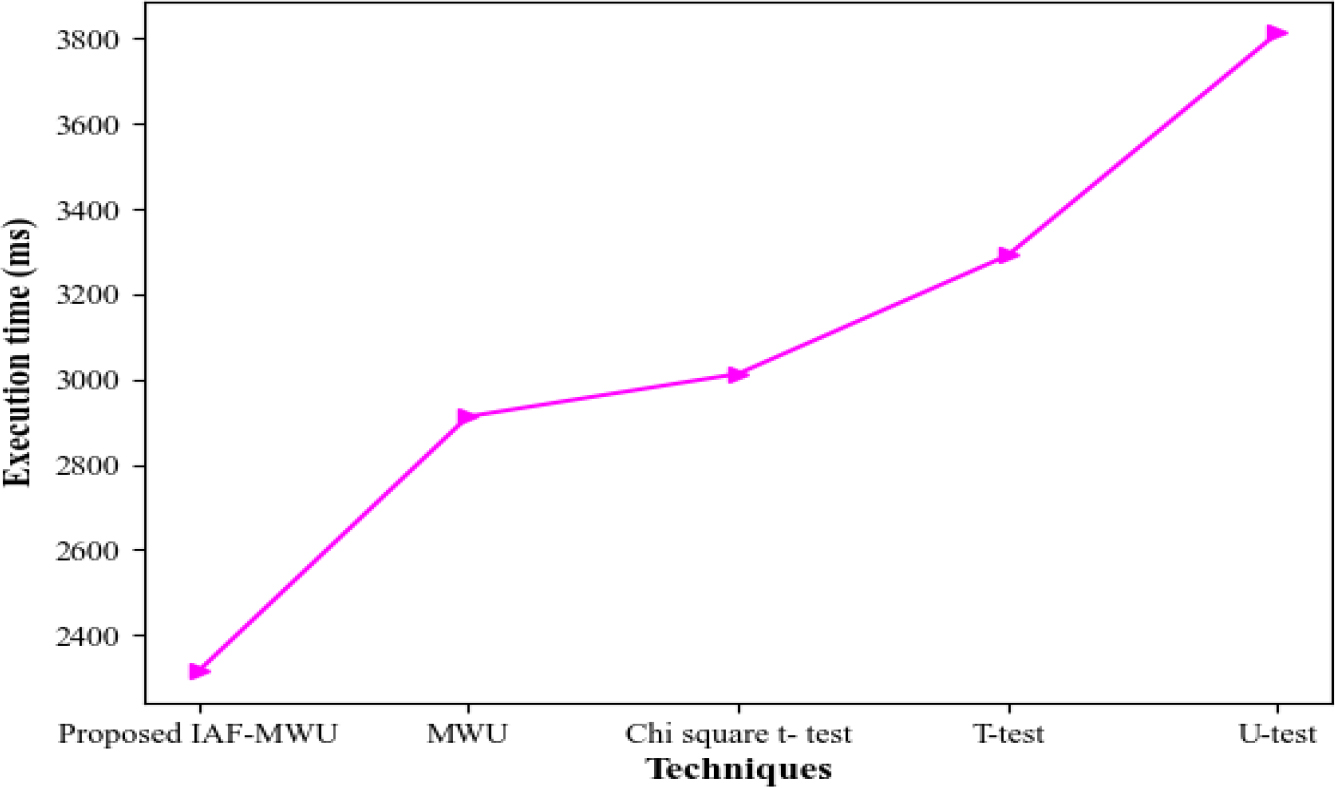
In Fig. 6, the execution time of the proposed IAF-MWU and the existing approaches estimated are displayed. The proposed technique’s execution time is much minimum by 598 ms than the existing MWU. The minimum execution time taken by the proposed system indicates that the reduction in null hypothesis calculations makes the model solve problems quicker than the existing approaches.
Concerning the Area Under Curve (AUC), the performance of the proposed IAF-MWU and existing MWU, Chi-square t-test, T-test, and U-test methods are analyzed in Table 4. The AUC attained by the proposed model is improved by 3.94%, 7.88%, 21.87%, and 23.94% than the existing methods. Therefore, the analysis states that the null value hypothesis under the IAF technique reduced the number of calculations to make the model more efficient than the existing techniques.
Comparative analysis.
In Fig. 7, the proposed BRT-RNN-based EP-Satty-MCDM (BR-ERSM) business decision-making model is compared with the existing LSTM, OR-IDSS, CNN-LSTM, and image mining techniques developed by [19, 20, 22, 23] in Section 2. The comparison was done based on the accuracy attained in improving their decision-making ability. Figure 7 exhibits that the accuracy attained by the proposed model is far superior to the prevailing method, which is 98%. This is owing to the detailed analysis of the proposed model by incorporating different types of data. The proposed model can benefit E-commerce systems in a high ratio by identifying failure products and recommending those for the users according to their purchase patterns and influencing capacity. Moreover, the recommendations from the proposed model were generated grounded on different analytical elements, namely data analysis, image mining, and knowledge recovery, which the existing methods failed to consider. Therefore, the proposed BR-ERSM model outperforms the existing methods.
By integrating data analysis, knowledge discovery, and image mining, this paper proposes a business decision-making model. Research on the issues of increase in moderating effect, the privacy of recommender people, and considering reviews and contextual analysis factors for informed decision-making aids the entire system to suit business platforms. The performance of the proposed EP-Satty-MCDM decision-making model and BRT-RNN-based classification techniques are compared with some prevailing techniques in the experimental evaluation. The proposed EP-Satty-MCDM yielded a Net score of 0.99, and the BRT-RNN method attained a classification accuracy of 98%. Hence, it is deduced from the outcomes that the proposed business decision-making model on an E-commerce system works well, and it is more efficient and faster for the optimized business performance. The image mining technique utilized in the proposed model concentrated only on the celebrity images grounded on their garments and influence but not on the advertisements they were involved in. Therefore, the work might be extended in the future to analyze the market value, advertising influence, and usage influence to improve the business model.