



Abstract
In the process of product ranking considering online reviews, they often are based on initial reviews and do not consider additional consumer reviews, but additional review information can sometimes directly affect consumers’ final decisions. To fully characterize the rich emotional preferences of consumers embedded in two-stage online customer reviews information, considering consumers’ individual preferences and product objective evaluation information, we construct a combination weighting method to calculate comprehensive weights of product attributes, and then exploit the sentiment analysis technique, interval-valued probabilistic linguistic term set (IVPLTS) and preference ranking organization method for enrichment evaluations (PROMETHEE) to establish a products ranking method based on compound reviews, and then we use it to identify the sentiment orientation of reviews and the results. Finally, a real-life case illustrates a real-world application of the proposed method.
Keywords
Introduction
With the rapid development of e-commerce, online sales channels have become the main channel for business sales [3]. When consumers purchase products, they usually browse review information about alternative products, which can finally influence their purchasing decision [10]. In 2014, a survey of 2,458 consumers of automobiles, beauty products, and smartphones by Google and Ogilvy showed that product word of mouth had the greatest influence on purchasing decisions, accounting for 74%. Consumers post a large amount of review information about products and services on shopping platforms. Most of these reviews are in the form of structured or unstructured text which is rich in valuable information, including consumers’ emotions, attitudes, and preferences. For platform merchants, focusing on points where consumers often complain about bad reviews can help them promptly identify consumer demands and weaknesses in their products and services. In addition, analysis of online customer reviews can also help companies with product owner identification and competitive analysis [24]. In particular, for service companies, mining customer demand contained in online customer reviews can help them optimize the configuration of their service elements [32]. For potential consumers, the information contained in online customer reviews from consumers who have already purchased can help them gain a more comprehensive and objective understanding of the products. Research on online customer reviews has rich theoretical value and practical significance. Mining information within online customer reviews has promoted the advancement of text analysis technology and driven the development of online customer reviews sentiment analysis technology, product feature extraction, product recommendation algorithms, and other technologies. Research on online customer reviews can help merchants manage reviews more appropriately, and research on product recommendation methods through online customer reviews can help consumers avoid browsing a lot of reviews but make faster, more rational purchasing decisions. The research on online customer reviews, especially the research on product recommendation methods through online customer reviews, has become a hot research topic for many scholars.
Thanks to the rapid development of communication technology, online customer reviews are published in a timely and convenient manner but this also causes redundancy of review information which will lead to information overload for the viewers of online customer reviews. Therefore, it is necessary for shopping platform companies, as management of online customer reviews, to effectively deal with review information and reduce the burden of potential consumers browsing too much review information during the shopping process. Shopping platform companies need to deeply analyze online customer reviews, explore consumers’ emotions and preference information contained within, and develop more reasonable, convenient, and effective product recommendation methods to help potential consumers make purchasing decisions that can reduce the cognitive dissonance caused by browsing too much review information. Therefore, how to rank products through online customer reviews has become a topic worthy of discussion.
At present, scholars’ research on product ranking methods based on online customer reviews is still relatively few. Existing research mainly focuses on the following two aspects: information description and fusion model based on online customer reviews and product ranking method through online customer reviews. The weighted averaging (WA) operator [9] and the ordered weighted averaging (OWA) operator [31] are the two most commonly used operators for information fusion in the early days. In later research, scholars have proposed many other operators based on these two operators, such as the intuitionistic fuzzy weighted averaging (IFWA) operator and an intuitionistic fuzzy ordered weighted averaging (IFOWA) operator [30], which overcome the information distortion caused by the first two operators in the operation process. Besides, the problem of ranking methods based on online customer reviews can be modeled as a multi-attribute decision making (MADM) problem. After online customer reviews are fused, this problem can be solved with many classical MCDM theories.
Currently, the information description and fusion model under online customer reviews for product ranking mainly include fusion model based on the construction of weighted directed graph and fusion model based on fuzzy set theory. In the aspect of online customer reviews information fusion based on fuzzy set theory, Liu et al. [18, 19] proposed a method based on the sentiment analysis technique and the intuitionistic fuzzy set theory to rank the products through online reviews. In their method, the performance of an alternative product is represented by intuitionistic fuzzy number and aggregated by intuitionistic fuzzy weighted averaging (IFWA). Bi et al. [2] considered the accuracy rates of sentiment analysis results of online customer reviews and used interval type-2 fuzzy numbers to represent the results. Peng et al. [22] proposed a fuzzy PROMETHEE to rank alternative products based on online customer reviews in which triangular fuzzy numbers are used to represent linguistic variables. Fu et al. [7] used interval-valued Pythagorean fuzzy (IVPF) to represent the interval-valued sentiment and proposed an IVPF-weighted Heronian mean operator to aggregate the attribute information. These information descriptions and fusion models can represent uncertain information well, but inevitably cause some emotional information loss during information fusion. For example, the method [18, 19] will cause the loss of neutral sentiment orientations when converting sentiment analysis results into intuitionistic fuzzy numbers. In the aspect of online customer reviews information description and fusion based on the construction of weighted directed graph, scholars have conducted many meaningful studies and explorations. Guo et al. [8] proposed a method to mine and integrate textual reviews and numerical information. In their method, the directed graph model is used for information fusion and improved PageRank method is deployed to calculate the node value. Li et al. [14] used a hierarchical structure-based model to propagate and reassign the aspect-based comparative opinions and applied graph-based ordering algorithms to get comparison results. Kpiebaareh et al. [11] proposed a generic graph-based opinion mining and analysis method for product design improvement based on online customer reviews. Zhang et al. [34] propose an improved label propagation algorithm with a propagation intensity and an automatic filtering mechanism to find candidate spammer groups based on the constructed reviewer relationship graph. The advantage of information fusion methods based on the construction of weighted directed graph is the ability to integrate heterogeneous information and intuitively reflect the comparative advantages among alternative products. [6] can intuitively reflect the comparative network and comparative advantages However, this kind of online customer reviews information description and fusion method cannot describe the sentiment orientation under each attribute of the product in detail.
In the aspect of product ranking methods based on online customer reviews, scholars have carried out much valuable and meaningful research. Li and Lai [14] proposed a social appraisal framework to support a user’s online purchase decisions in the micro-blogosphere that integrates the methodologies and techniques of social network analysis (SNA), intuitionistic fuzzy sets (IFSs), and the technique for order preference by similarity to the ideal solution (TOPSIS). Mi et al. [20] established grey 2-tuple linguistic model to combine online reviews with ratings. However, in this method, experts are required to evaluate greyness for each review, which seems to be difficult and time-consuming when faced with a large number of reviews. To make the tourism product selection process quicker, Liang et al. [15] proposed a novel distribution linguistic VIKOR (DL-VIKOR) method to solve the problem of selecting tourism products with online reviews through data processing technology. Compared to the previous models, the model processed the text data into distribution linguistic evaluation which can avoid information loss or distortion. Liu et al. [18] proposed a method based on the sentiment analysis technique and the intuitionistic fuzzy set theory to rank the products through online reviews. Taking the neutral sentiment orientations and the number of reviews of different products into consideration, Liu et al. [19] proposed another method for ranking products through online customer reviews based on sentiment classification and the interval-valued intuitionistic fuzzy Technique for Order Preference by Similarity to an Ideal Solution (TOPSIS). Wu et al. [27] proposed a novel group consensus-based travel destination evaluation method with online reviews to deal with the increasing tourism products and group tourists. The method used sentiment matrix with the percentage distribution to represent decision opinions and designed a minimum adjustment cost feedback mechanism to reach group consensus. Then, by aggregating the percentage distribution with the weight vector of attributes, the ranking of all alternatives can be obtained.
In general, previous studies either transformed the review information into fuzzy numbers or aggregated the review information with the help of graphs. Few studies have used probabilistic linguistic term sets (PLTS) to characterize review information. In addition, previous studies ignored the impact of additional review information on the final product ranking results and therefore did not consider additional reviews in the modeling process. However, this paper uses PLTS to characterize review information and consider the effect of additional reviews. Also, we propose a comprehensive weight determination method that considers both subjective weight information and objective weight information.
According to the above discussion and analysis, although they have proposed effective methods to solve relevant problems, there are still some limitations.
Most of the existing research on product ranking methods based on online customer reviews is based on initial reviews and does not take additional customer reviews into account which is not reasonable. This is because after using a product for a while, consumers have a deeper understanding of the product and give more comprehensive and objective information about the product, so it is very necessary to consider additional reviews for product recommendations. Some of the sentiment information has been lost in the process of quantifying consumer reviews in previous studies, so there is a need to propose a new way to quantify and characterize consumers’ emotional orientation embedded in Online customer reviews. In most of the existing studies, the weights of product feature either subjectively determined by consumers or determined by external evaluation information contained in Online customer reviews. But when a consumer wants to buy a product from several alternatives, the consumer may have personal preference for product features according to his/her subjective evaluation. And, because the consumer has limited knowledge of the product, he/she needs to browse and analyze the Online customer reviews of the product to help him/her determine the importance of each product feature. A single subjective or objective weight determination method cannot determine the optimal weight.
To address the problems of existing studies, we propose a novel IVPLTS-PROMETHEE method to solve the product ranking problem through online customer reviews. The main contribution of this paper can be concluded as follows:
This paper takes both initial and additional customer reviews into consideration and proposed a novel IVPLTS-PROMETHEE method to rank products. An interval-valued probabilistic linguistic term set is proposed to characterize the rich emotional orientation of consumers, and further give some of its properties. Considering consumers’ individual preferences and product objective evaluation information, a combination weighting method is proposed to calculate the comprehensive weights of product features that consider individual preferences and collective external evaluation simultaneously.
The remainder of this paper is organized as follows: Some concepts are introduced in Section 2. In Section 3, based on sentiment analysis of online customer reviews, IVPLTS is proposed to characterize two-stage online customer reviews, and then a combination weighting method is proposed. After that, a novel IVPLTS-PROMETHEE product selection method is proposed to determine the ranking of alternative products. A real-world case study is furnished in Section 4 to illustrate how the proposed method can be applied. The paper concludes with some remarks in Section 5.
Linguistic term sets (LTS)
To present the decision maker’s qualitative judgment about a decision event, Zadeh [33] first proposed the linguistic variable, after which two probabilistic linguistic sets (LTS).
The set is ordered: There is a negation operator:
Note: To prevent information loss in the operation process, Xu [29] extended the discrete LTS
Considering that humans may hesitate among several options in real decision-making situations, Rodrigue et al. [23] presented the concept of HFLTS.
Let
For an LTs,
However, HFLTS fails when people use a non-consecutive linguistic term set to describe the evaluation objects. To better handle this kind of uncertain situation, Wang [26] proposed the concept of EHFLTS.
Suppose that
It should be noted that HFLTS is a special case of EHFLTS and EHFLTS is a general form of the HFLTS. At the same time, EHFLTS can take all possible linguistic values into account during the process of information aggregation and model more complex decision-making problems.
In real-world decision-making situations, people may express their preferences in different linguistic terms and assign them to different degrees of importance. However, the HFLTS and EHFLTS models consider each linguistic term to be equally important and assign them with the same weight, which is not following reality. Therefore, for the above situation, Pang et al. [21] introduced the concept of PLTS.
Let

Where,
Let

It should be noted that assigning unknown probabilities to linguistic terms in an average way is the most common and primitive way.
Assume that there are two different normalized PLTS

Where,
Let

Where,
For two PLTSs

For two PLTSs
Pang et al. [21] first proposed the concept of the score of PLTS, Wu et al. [28] further introduced a fresh score function of PLTS and proved that the proposed score function is better than the previous score function. The score function is shown as follows.
Let

be a PLTS based on

Preference ranking organization method for enrichment evaluations (PROMETHEE) is a multi-attribute decision-making method based on the priority relationship [25]. Based on the pairwise comparison of the schemes, it fully considers the decision makers’ preference of all attributes, making the evaluation results more convincing. The main steps of the method are as follows: (1) Construct an evaluation function matrix. Let
An interval-valued probabilistic linguistic PROMETHEE method for products ranking
Considering that most existing studies do not take additional customer reviews into account, we propose a novel IVPLTs-PROMETHEE product ranking method through online customer reviews taking initial Online customer reviews and additional online customer reviews into consideration simultaneously. The proposed product ranking method has a clear decision-making process, shown in Figure 1. And the main steps of this method can be concluded as follows:
Step 1. Online review information acquisition; Step 2. Online review preprocessing and feature extraction; Step 3. Sentiment analysis and emotional information fusion; Step 4. Calculate comprehensive attribute weights; Step 5. Product ranking by IVPLTS-PROMETHEE method.
We’ll expand around these steps in more detail in the following sections.
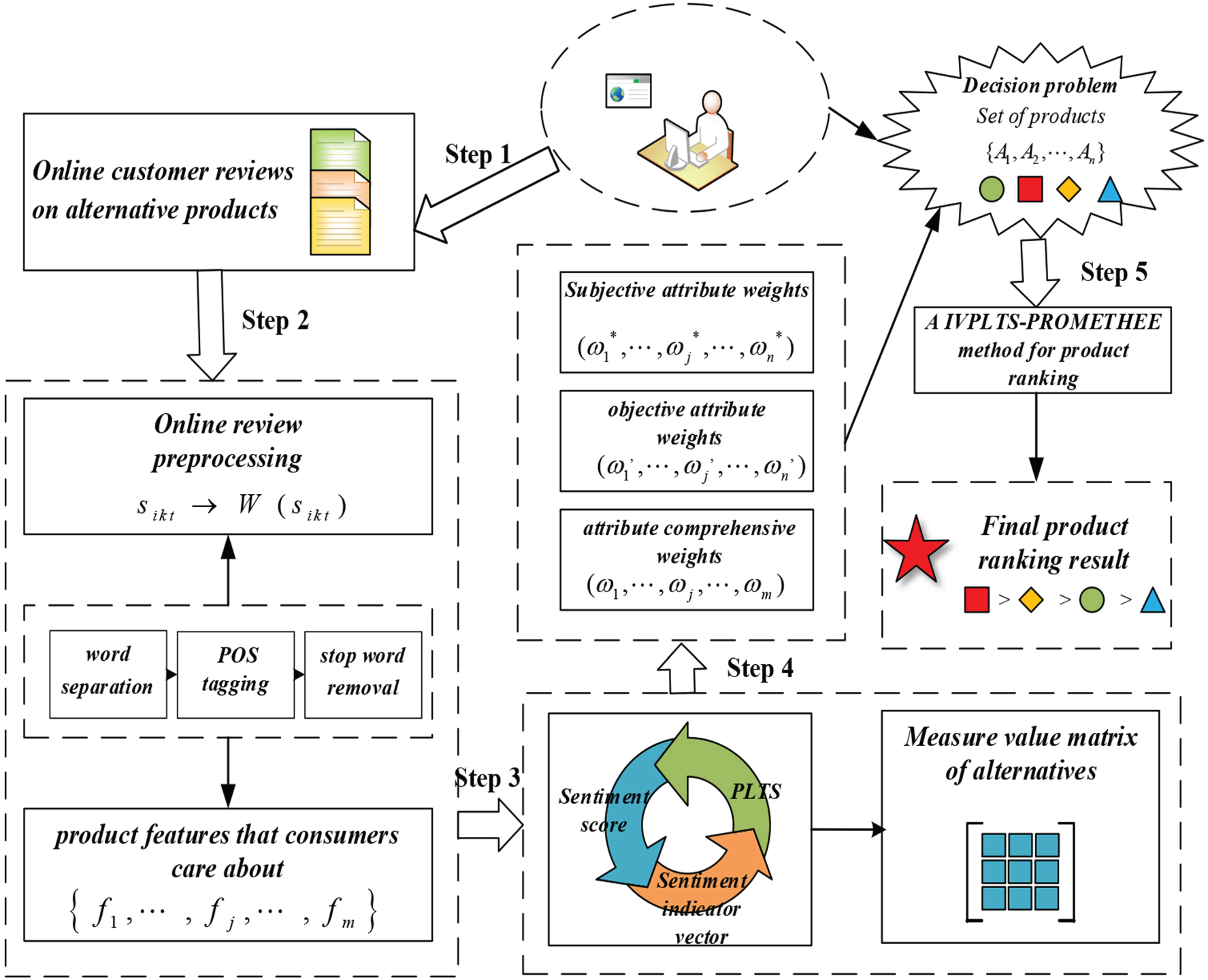
Flow chart of product selection method considering sentiment intensity of additional online reviews.
During the process of online shopping, it refers to the decision makers or buyers, alternative products, and Online customer reviews of the products containing product feature information. It is said that the product ranking problem is a typical multi-attribute decision problem (MADM) [17]. In this problem, there exist the elements of products, product features, and Online customer reviews on alternative products. Products are treated as alternatives and product key features are attributes. According to the above analysis, to describe the product ranking decision problem through Online customer reviews, some symbols and variables are shown below.
To solve the product ranking problem, the first step is to obtain and preprocess Online customer reviews information related to the alternative products. Next, product feature extraction technology is used to obtain product features that consumers care about. Then, we can further use sentiment analysis technology to obtain the sentiment score of each review.
(1) Online review prepossessing and product feature extraction
Obtaining reviews of relevant products is a fundamental task in conducting sentiment analysis. In this paper, we acquire review information through crawler software and then preprocess the review information, turning the initial qualitative Online customer reviews information into quantitative data that can be calculated. This process normally consists of three steps: word segmentation, part-of-speech (POS) tagging, and stopping word removal. We use ICTCLAS 2016 (a Chinese word separation system) and python programming to help us achieve the above operations. For example, “the phone is very nice” can get “phone/n very/d nice/a” after being processed, where “n”, “d” and “a” stand for nouns, adverbs, and adjectives, respectively. Then, we can obtain the set of preprocessed comment words for each review. Let
(2) Sentiment analysis
Considering that different products have different review contexts, to improve the accuracy of sentiment analysis, our paper uses a sentiment analysis method based on a sentiment dictionary to obtain consumers’ emotional orientation contained in each review. The main contribution of sentiment analysis can be concluded as follows:
① Establish the dictionary of sentiment intensity reference words. To improve the quality of sentiment intensity analysis, we establish the dictionary of sentiment intensity reference words, dictionaries of degree adverbs, and negatives based on the HowNet sentiment dictionary in advance. Then, the sentiment words extracted from the Online customer reviews are classified according to the pre-built sentiment intensity reference set following the principle of synonym grouping.
② Obtain the set of sentiment intensity levels dictionary of each product feature. We can obtain
③ Establish the dictionary of degree adverbs. In this paper, we divide the sentiment intensity into 5 levels. let

Where
In this section, the conversion of Online customer reviews information to PLTS will be introduced in detail. In 3.2, the sentiment score of each review can be obtained, based on which, we can further establish the sentiment indicator vector

From Eq. (8), the sentiment indication vector has five possible cases, which point to five different sentiment scores. From a statistical point of view, the frequency of occurrence of these five different sentiment scores can be transformed into the probability of their occurrence. Let

Let

The calculation steps of
After the above transformation, it is easy to get the probabilistic linguistic value
Usually, when consumers post an initial review of a purchased product, they will post additional reviews after a period of use. Additional comments tend to contain richer consumer emotion orientation and utility evaluation of products. To fully characterize the consumer’s two-stage Online customer reviews, the IVPLTS is proposed in this section.
Let

Where,
After proposing the concept of IVPLTS, we notice that in some cases the occurrence probabilities information of linguistic terms is incomplete owing to the lack of some people’s opinions or the divergence or the hesitance of people’s opinions. Incompleteness can be divided into two cases, the first is the lack of partial linguistic terms, and the second is the lack of information on the occurrence probability of linguistic terms. To solve this problem, we propose a method to maximize the accommodation of missing information. Assume that
Based on the proposed normalization method, we propose a conversion function to convert IVPLTS to PLTS. At the same time, a more intuitive and understandable IVPLTS comparison method is proposed.
Let

Where,
After applying transformation functions to the
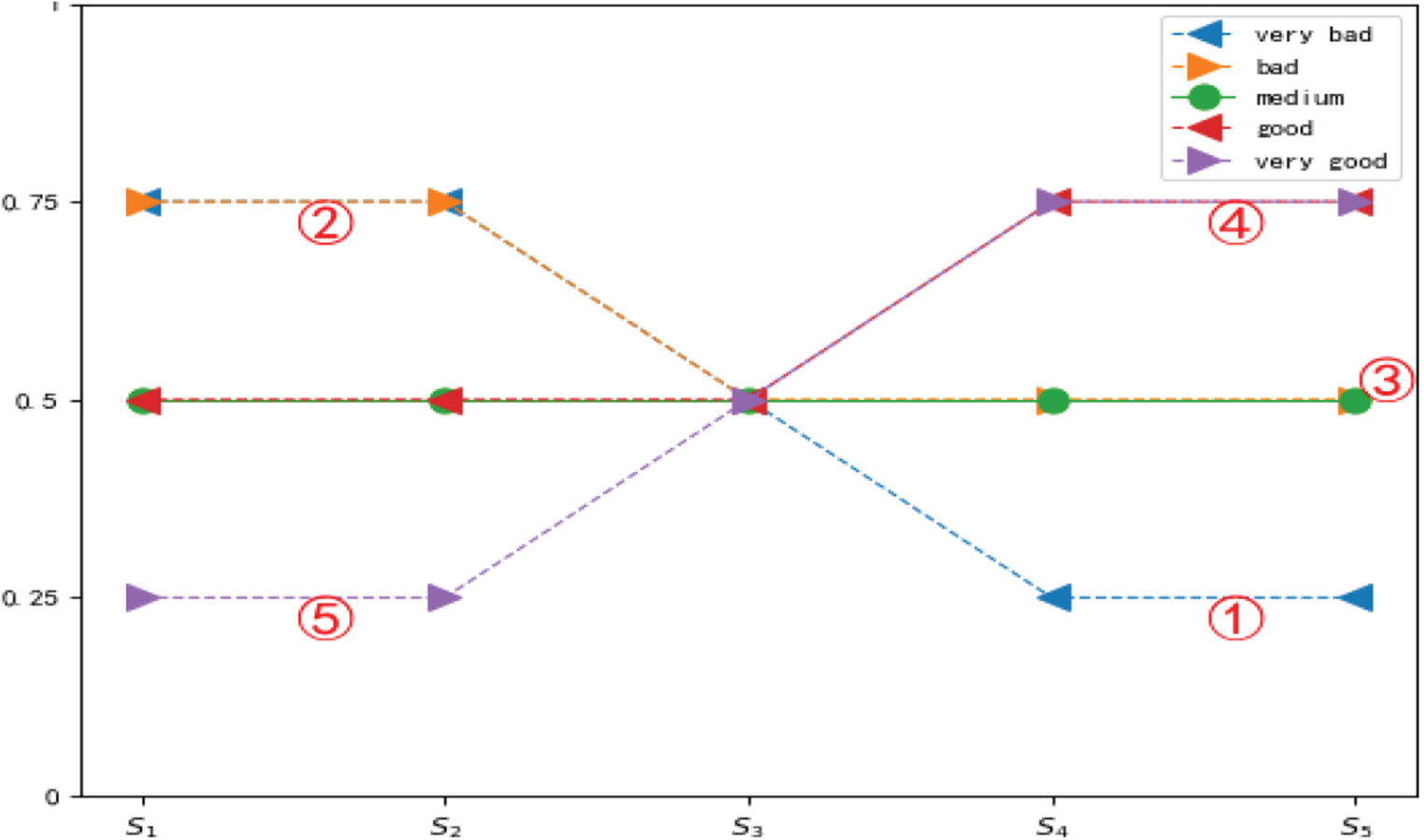
Five basic attitudes of decision makers present by broken lines.
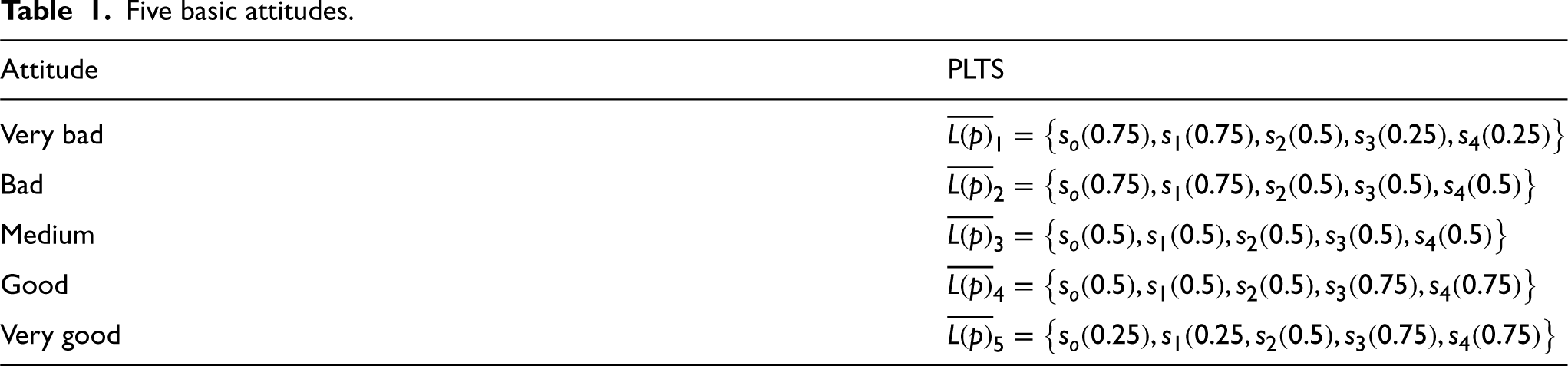
As shown in Figure 2, there are 5 broken lines in the figure, which can be used to represent the five basic attitudes of decision makers which can be seen in Table 1.
Five basic attitudes.
The relationship between them is that
Let
Let 

By transformation function
Let 


By Eq. (18), we can get the decision matrix composed of the expectation value of
After we give the concept of IVPLTS, we also propose the corresponding comparison method, operation rules, and expectation value calculation formula. More research on the properties of IVPLTS will be carried out in follow-up studies.
In the process of calculating product attribute weights, it is necessary to consider consumers’ individual preferences and product objective evaluation information from Online customer reviews simultaneously, and then obtain a comprehensive weight of product features. In this part, we calculate the objective weight of product attributes through the entropy weight method. Considering the product feature preference information given by the customer, we can finally get the comprehensive weight through maximizing deviation method. The specific calculation steps are as follows:
(1) Determine the subjective weights of product attributes
For customers, they usually hold a subjective preference for each attribute of products before making a choice. Based on this, different weights will be given to the product attributes according to the degree of importance. Therefore, we can obtain the weight information of each attribute of the products given by the customer in advance and let
(2) Determine the objective weights of product attributes
The entropy weight method is an objective weighting determination method which is often used in solving attribute weight solving problems. The method mainly includes five steps:
① Normalize the indicators. After converting the review information into IVPLTS and using the conversion function proposed in the paper to convert it into PLTS, then use Eq. (18) to calculate the expectation function value of product
② Calculate the proportion of each indicator value under each indicator. Use
③ Calculate the entropy value of each attribute. Let
④ Calculate the information entropy redundancy. Let
⑤ Calculate the weight of each indicator. Let
In decision-making problems, if all alternatives are undifferentiated with respect to an attribute, then this attribute should be given a small weight. If the alternatives show a large difference regarding an attribute, then that attribute will have an important role in the ranking of the alternatives and should be given a larger weight. Assume that the comprehensive weight vector of the attributes is 
Where,
Further, let 
To make the weights of each product attribute objectively reflect the importance of the product attribute to the consumer’s decision, the total deviation of all product attributes concerning each alternative product should be maximized under the weight vector
Then we use the Lagrange function to solve the model:

Where
Then we calculate the partial derivatives with respect to 
And then, we can get 
In contrast to the previous approach of considering only initial reviews, this paper considers both initial and additional Online customer reviews and proposes a composite review-based product selection method that takes the time of publication of the review into account. The language set used in this part is an LTS:
In the next section, we focus on the extended interval-valued probabilistic linguistic set PROMETHEE approach (IVPLTs-PROMETHEE). PROMETHEE uses the preference function
For two stages of evaluation content, there is inevitably an evaluation bias between the initial and additional reviews. The same attributes of the same product also differ between the two stages of evaluation. A variety of factors can cause evaluation bias. If a consumer buys a product and uses it for a period of time and finds that the product’s performance is temporarily superior and not as good as it actually is, then in his follow-up additional Online customer reviews, the consumer will describe more about the disadvantages of this attribute and the two-stage Online customer reviews of that attribute will inevitably be different. Let 


Then, we propose a new preference function 
Further 



Among,
At present, among several electronic products trading platforms in China, Jingdong Mall is one of the most popular platforms. Because it not only sells a wide range of electronic products online, but it also owns several physical shopping malls allowing consumers to purchase and experience offline. Jingdong Mall sells a variety of products by setting up its own flagship shops, so the quality of the products is guaranteed and consumers can effectively avoid buying fake products. At the same time, Jingdong Mall provides a convenient way for consumers to post reviews online. Because the Online customer reviews in Jingdong Mall is open source, so we can freely collect and mine Online customer reviews through crawler software or by writing crawler code. Mobile phones are an indispensable tool in today’s society and people’s demand for mobile phones is increasing. To meet the diverse needs of consumers, mobile phone manufacturers frequently launch new mobile phone products to cater to consumers. As a result, consumers are often faced with a hard decision-making situation where they don’t know which mobile phone to purchase. For that we extracted core information about alternative products from the huge number of online customer reviews. Then consumers can quickly have a comprehensive understanding of the alternative products and thus help them choose the best mobile phone more easily. Moreover it is of great relevance that will not only improve the shopping experience of consumers but also improve the effectiveness and user loyalty of Jingdong Mall.
Suppose a college student wants to purchase a mobile phone soon. Given his current financial situation, he has a budget for a phone between 4,000RMB to 5,000 RMB, and he doesn’t know much about mobile phone configurations. With so many mobile phone brands available, he is faced with a myriad of choices. Finally, he decides to choose from five familiar phone brands: Apple, Xiaomi, Huawei, OPPO, and vivo which are denoted as
Online customer reviews preprocessing
First, in order to facilitate access to online customer reviews data, this paper uses Octopus crawler software to crawl two-stage online customer reviews posted by consumers on Jingdong. Due to the limitations of software functions and shopping platform permissions, the amount of reviews data obtained at a time is limited. Therefore, from 2022 to 2023, we obtained more than 150,000 reviews data by obtaining reviews multiple times in time periods. Among them, the data of additional reviews accounted for 2.64% of the total reviews. It shows part of the initial reviews and additional reviews for a cell phone on the Jingdong website in Figure 3.
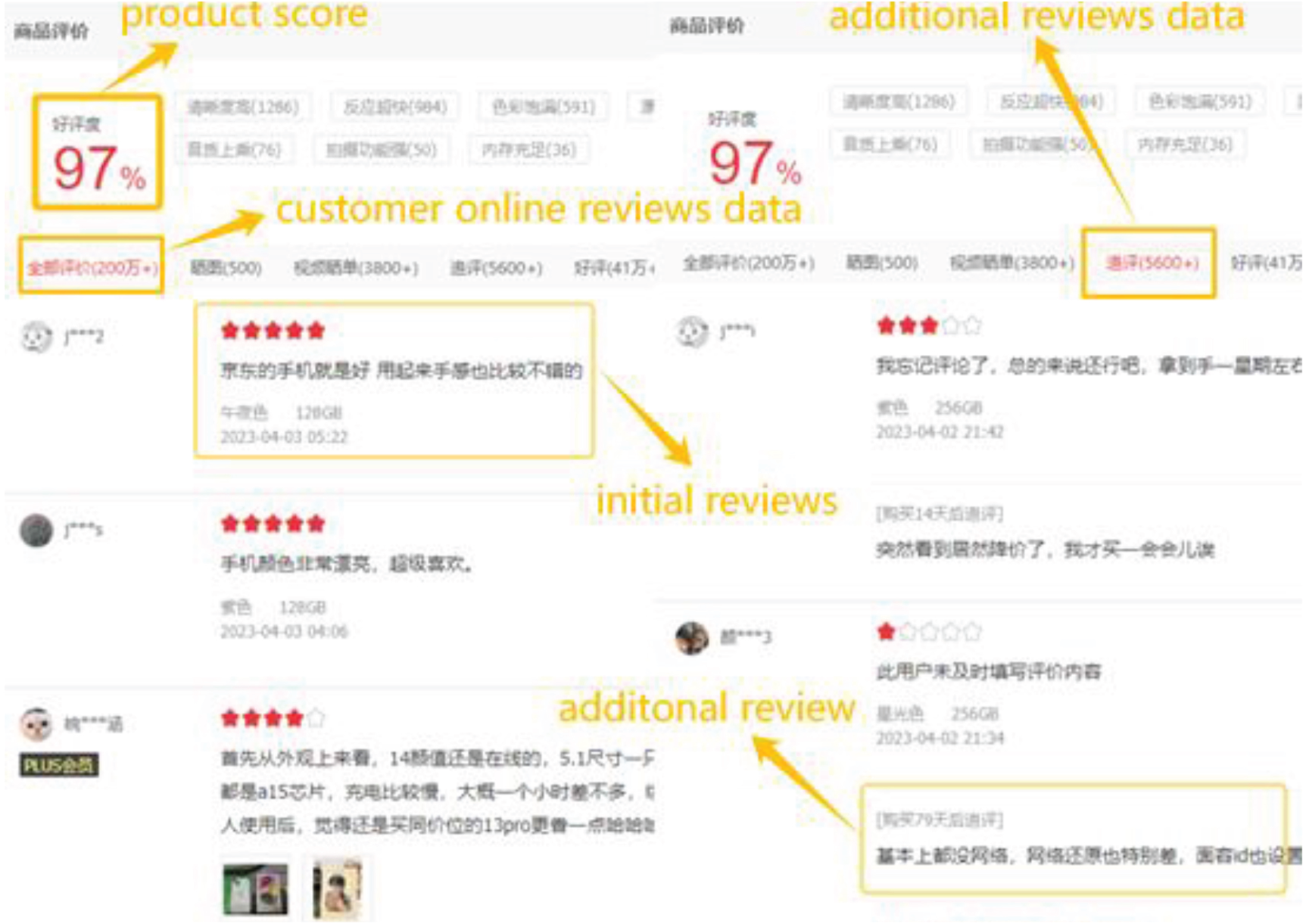
Display of initial and additional online reviews.
Second, the crawled review data is often in the form of text, which cannot be used directly for decision analysis (as shown in Figure 3), so the data needs to be cleaned first. The Online customer reviews preprocessing process generally includes word separation, POS tagging, stop word removal, and noise processing. This paper accomplishes the task of data cleaning with the help of python programming and ICTCLAS 2016.
Finally, we use Python software to construct LDA topic clustering model. And each topic represents a product attribute. Then we calculate the number of topics to obtain the relevant feature words of each topic (as shown in Figure 4). For some high-frequency product feature words that appear in the reviews but are not included under each topic, they are categorized under the corresponding topics by manual identification. Finally, we obtain the product attributes that consumers pay attention to. Based on this, we can obtain the product attributes:
After the review data has been acquired and cleaned, it needs to be further analyzed to transform the review text information into quantifiable and analyzable PLTS information that can be manipulated. In this process, we first build a feature-based sentiment dictionary based on the HowNet sentiment dictionary and sentiment words involved in all Online customer reviews. This sentiment dictionary contains positive, moderate, neutral, degree adverbs, and negatives. Then, we count the frequency of occurrence of each sentiment score and transform it into PLTS by using Eqs (8)–(10) and use it to characterize initial and additional Online customer reviews. Further, to characterize customers’ emotional orientations in all stages, we transform two-stage PLTS into IVPLTS by Eq. (11). The results are shown in the Table 2.
IVPLTS based on two-stage reviews.

IVPLTS based on two-stage reviews.
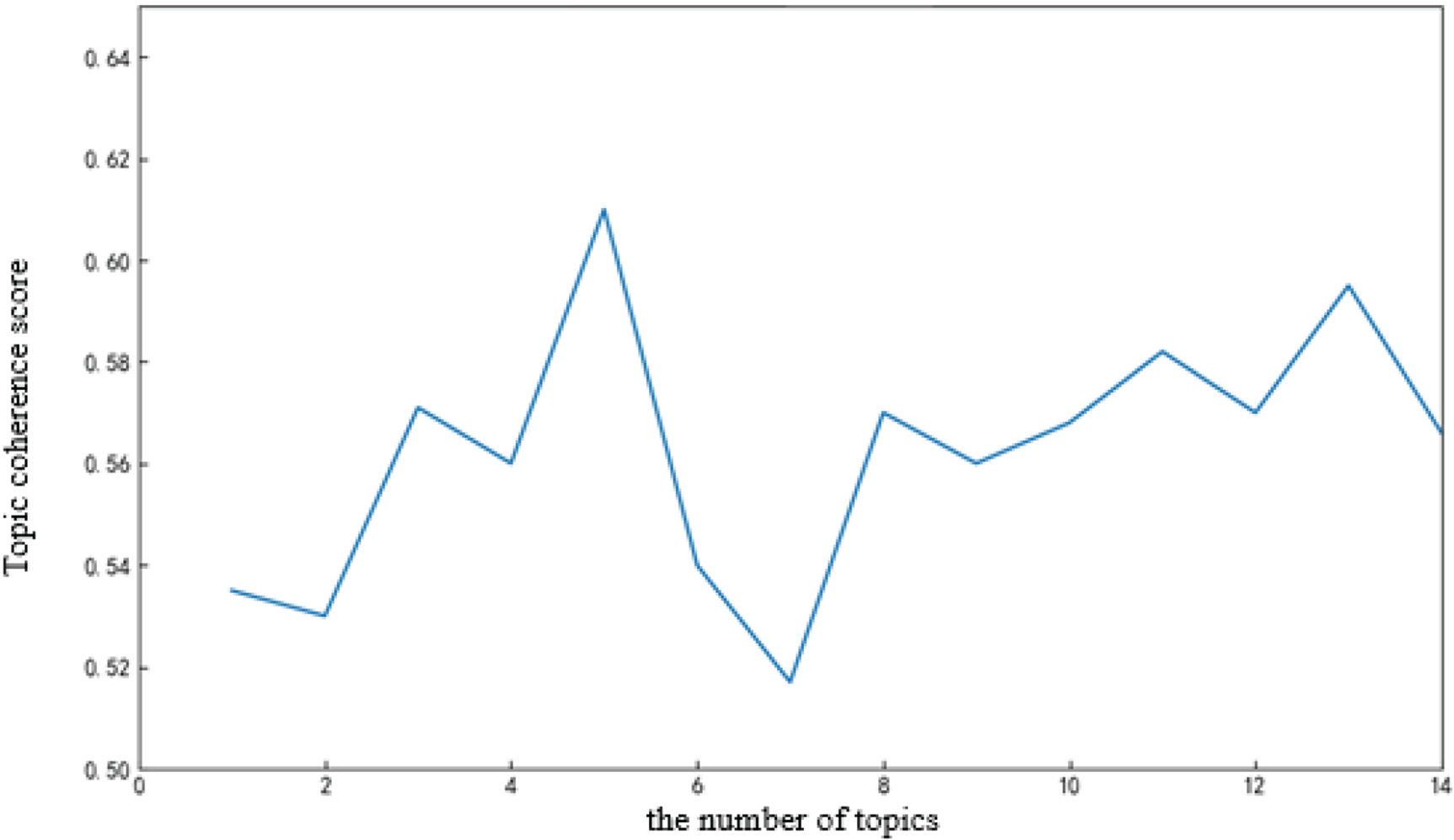
Topic coherent index change chart.
Further, we can get 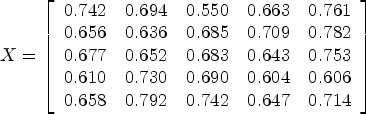
Next, we can calculate product attribute weights. And it is necessary to consider consumers’ individual preferences and product objective evaluation information from Online customer re-views simultaneously. On the one hand, this college has a high preference for the performance of the mobile phone, but not much preference for the photography of the mobile phone. So, in response to consumers’ different preferences for cell phone product attributes, we set consumers’ subjective weights of product attributes as
The value of outranking flow.

To well show the practicality of the method proposed in this paper, we not only compare the method proposed in this paper with those proposed in previous studies [18, 19, 1, 35, 13], but also with the method proposed in this paper without the additional reviews. Specifically, the method [18, 19] ranks products through online reviews based on sentiment classification and interval-valued intuitionistic fuzzy TOPSIS; the method [1] represents sentiment analysis results of online reviews using interval type-2 fuzzy numbers; the method [35] give a product purchasing recommendation ranking based on multi-attribute online ratings information; the method [13] is useful under probabilistic linguistic circumstances with unknown criteria weights for online customer reviews. It is worth noting that most of the previous studies did not consider the information of the two-stage Online customer reviews, so when comparing the methods, we will gather the information of the two phases with the help of IVPLTS and the expectation function value of PLTS. Usually, different methods could be comparable only if they are used to solve the same problem. However, in most of the existing studies, the product attributes and attribute weights are objectively determined based on online reviews or are subjectively determined by consumers. To compare the result obtained by the proposed method with the results obtained by the existing methods, it is considered that the weights of different attributes are equal, i.e.,
Comparison between methods.
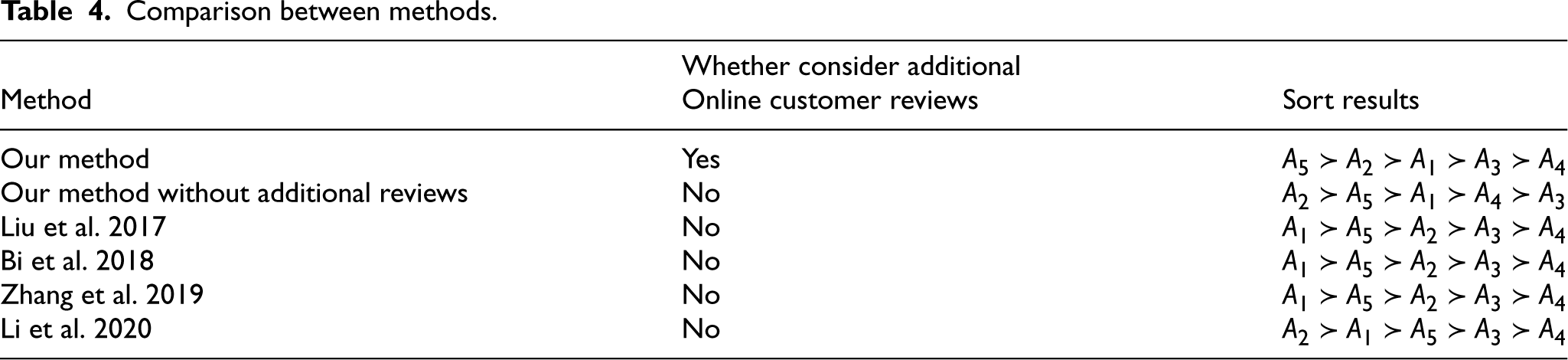
Comparison between methods.
According to the Table 4, the same or similar ranking results are obtained by different methods. Compared with other methods, our method considers vivo to be the most suitable phone for the college. The main possible reason is considering two-stage Online customer reviews. Our approach not only takes into account the time weight of Online customer reviews but also fully exploits the consumer preferences contained in reviews. And compared with our method without additional reviews, it shows that by combining information from initial and additional reviews, our approach highlights the value of consistent and contradictory evaluations. Because consumers tend to be more comprehensive and objective in the additional reviews they post after using a product for a period of time and having a better understanding of the product they purchased, and contradictory reviews have been shown to have a higher perception of usefulness. Therefore, the method in this paper is more realistic in reflecting the value of product attributes and provides a more favorable product selection method for consumers.
In this paper, we study the product selection problem in the context of Online customer reviews and propose an extended IVPLTS-PROMETHEE product ranking method. According to the model and case analysis, some conclusions are given as follows.
In the proposed method, to identify the positive, neutral, and negative sentiment orientations of Online customer reviews, an algorithm based on sentiment dictionary is proposed. The algorithm has a clear logic and is a valuable attempt at refining more valuable information for product ranking through Online customer reviews. Then, we introduce IVPLTSs to present the sentiment analysis result of Online customer reviews. It achieves the transformation of text information to interval probabilistic linguistic information and provides an effective tool to make use of two-stage Online customer reviews for product ranking. This paper provides a new method to deal with the product ranking problem through Online customer reviews. It applies a new combination weighting method to calculate attribute weights considering individual preferences and collective external evaluation simultaneously. We further establish a model to calculate the ideal expectation value of attributes and stage weights for final product ranking.
In the follow-up research, we will consider developing a support system based on the proposed method to improve consumers’ shopping experiences. Moreover, the deeper research on sentiment analysis and more properties of IVPLTS are also worth paying attention to.
Footnotes
Acknowledgments
This work is partially funded by the National Natural Science Foundation of China (71503103; 72372059); National Social Science Foundation of China (19FGLB031; 22AJL002); Outstanding Youth in Social Sciences of Jiangsu Province; Qinglan Project of Jiangsu Province, and the Fundamental Research Funds for the Central Universities (JUSRP622047; JUSRP321016), the Tender Project from Wuxi Federation of Philosophy and Social Sciences (WXSK24-A-05) and Engineering Research Center of Integration and Application of Digital Learning Technology, Ministry of Education (1321005) and Social Science Fund of Qinghai Province (23YQA-003) and Postgraduate Research & Practice Innovation Program of Jiangsu Province (KYCX24_2486). Even so, this work does not involve any conflict of interest.
Conflict of interest
We declare that we have no financial and personal relationships with other people or organizations that can inappropriately influence our work, there is no professional or other personal interest of any nature or kind in any product, service and/or company that could be construed as influencing the position presented in, or the review of, the manuscript entitled.
Data availability statement
The data used to support the findings of this study will be considered by the corresponding author.