



Abstract
Epilepsy patients who are presently refractory may be monitored using a seizure prediction Brain-Computer Interface (BCI), which uses electrodes strategically implanted in the brain to anticipate and regulate the onset and duration of a seizure. Real-time approaches to these technologies have challenges, as seen by seizures’ instantaneous electrographic activity. Electroencephalographic (EEG) signals are inherently non-stationary, which means that the regular and seizure signals differ significantly among people with epilepsy. Due to the restricted number of contacts on electrodes, dynamically processed and collected characteristics cannot be employed in a prediction function without causing significant processing delays. Big data can guarantee secure storage in these situations, and it has the maximum processing capability to identify, record, and analyze time in real-time to conduct the seizure event on the timetable. Seizure prediction and location for huge Scalp EEG recordings have been the focus of this study, which used wearable sensor data and deep learning to use cloud storage to develop the systems. A novel technique is suggested to avoid an epileptic seizure and discover the seizure origin from the utilized wearable sensors. Secondly, deep learning architectures called Clustered Autoencoder with Convolutional Neural Network (CAE-CNN), an expanded optimization methodology is presented based on the Principal Component Analysis (PCA), the Hierarchical Searching Algorithm (HSA), and the Medical Internet of Things (MIoT) has been established to define the suggested frameworks based on the collection of big data storage of the wearable sensors in real-time, automatic computation and storage. According to clinical trials, CAE-CNN outperforms the current wearable sensor-based treatment for unresolved chronic epilepsy patients.
Introduction to epilepsy and seizure prediction
Epilepsy is a chronic psychiatric condition marked by random seizures. Several cases are potentially difficult to resolve and may be performed surgery; while some can not reach a seizure-free outcome, others can be treated through the procedure [25]. The neurological condition epilepsy is characterised by aberrant brain activity that results in seizure or episodes of strange behaviour, feelings, as well as occasionally loss of consciousness, jerky, uncontrolled motions of the thighs and limbs. Lack of knowledge or concentration, emotional signs include worry, panic, or a sense of déjà vu. The new introduction of the closed-loop framework for monitoring and distributing stimuli offered greater opportunities for regulating the patient individually. At the same time, further approaches are required for better performance and increased living standards for these patients.
Computers are well-established to support doctors in procuring, handling, storing and recording EEG signals. In this respect, it is feasible to use a BCI for computer-detection applications [2]. Through device connected towards the forehead, an EEG captures the electromagnetic activities of the cortex. Outcomes from EEG tests reveal alterations in brain function that could be helpful in identifying various brain illnesses, particularly epileptic or other neurological diseases. To work effectively, a program of computational algorithms is developed for the growing likelihood of a forthcoming event. These pre-ictal intervals that differ in time may not require enough delay to provide adequate time for signals for current methodologies for signal delivery in all situations to gain power. The invention of a short time for the automated system can automate seizure management and improve quality of life [17, 12].
Technological advancement for epilepsy treatment through BCI shall identify the imminent onset of a seizure and the time limits imposed on a successful percentage of delivery. An automated BCI program has three big phases [10, 21]. Those involve collecting, analyzing machine data, and executing the required response. Time harmonic dispersion (TFD), fast Fourier transformation (FFT), eigenvector approaches (EM), discrete wavelet (WT), auto regressive technique (ARM), as well as other techniques have all lately become popular for extracting characteristics from EEG recordings. The EEG signal reflects the electromagnetic pulse in the brain and is spatially distributed across the scalp through several electrodes [23]. Sensors are affixed to the forehead during this examination using a paste-like material or cover. The brain’s electrical impulses are captured by the sensors. Regardless of whether you’re experiencing a seizure, it’s usual for people with epileptic to experience variations in their usual scenario of neural activity. The existence of epilepsy is therefore diagnosed and must be electrographically validated [14].
There can be four temporal patterns of brain function among seizures used for the baseline condition. Clinical seizures disorder precedes the preictal state [16]. The seizure condition describes the gap between tasks as an epileptic seizure shows more importance in epilepsy [18]. Epileptic seizures can be prevented by medicine with great success if they are predicted before they start. Electroencephalogram (EEG) data are designed to estimate epileptic fits using machine learning approaches or computing methodologies. As the brain follows a coordinated cycle of neuron operation, the seizure or epilepsy condition occurs [8], which may appear clinically in various forms, from incomplete or involuntary seizures to local electro graphical speech to regularly recurring seizures that are normal in both brains [15]. The highest severe kind of epileptic fits are tonic-clonic epilepsy, also referred to as grand mal seizure activity. They may result in an abrupt collapse of awareness, rigidity, and trembling. The predictor methodology of seizure must adequately differentiate the preictal state from other states and be time to submit a signal to disrupt the production of the ictus [9].
A seizure detection framework may be developed in real-time to pose many challenges. The technique of real-time data broadcasting & analysis primarily concentrates on the information recorded, received, or retained in a live setting. Statistics’ range might come from a variety of factors. The data can be imported or fetched, stored in a database, and subjected to information analytic methods. The difference between the individual’s preictal and interictal condition is troublesome during interictal monitoring artifactual features, which may resemble patterns. Non-epileptic convulsions, in contrast to epileptic fits, are not brought on by physiological problems with the mind. Instead, non-epileptic seizures may be brought on by upsetting emotional memories or unique pressures, perhaps even ones from the past that have been repressed. Cardiovascular, pulmonary, sweating, glossokinetic, eye gaze (blinks, rectus abdominis spiking from medial gaze), & muscular as well as motion abnormalities are a few examples of physiologic artefacts. There is no stationary signal in the EEG, and seizure patterns may differ across numerous persons [6]. As a result, in a community of epilepsy patients, a typical range of manual extraction features cannot scale well. Therefore, supervised extraction of features is not enough to understand algorithms. Another problem involves the electro graphical pattern’s spatial-time structure [3]. The direction from patient to the patient of these electrons usually differs. While it is necessary to obtain a large time-space resolution and secure electro-optical imaging over a short period, large amounts of spatially focused data create a big data issue. In this circumstance, a huge database must be preserved, and high computing resources are needed in real-time to process the records. Real-time data analysis entails gathering or consuming a collection of information from numerous information sources while simultaneously analyzing that information to derive knowledge & significance.
The criteria of a realistic application involve feedback, machine learning and electrographic neural state simulation in broad collections of data obtained in real-time from consumer populations. These networks of the next decade will be linked to high-performance database servers from the wearable sensors so that statistical models can be implemented and computations for massive incoming wearable sensor databases can be performed in real-time. Wearables, which come in the shape of wristbands, bracelets, or necklaces, are gadgets that keep track of the user’s activities and physiologic data like pulse rate or ambient temperature. The EEG transmitter mathematical qualities, such as average, maximum, volatility, sample variance, deviation, skewedness, or related terminology, are its most basic characteristics. Cloud storage in big data using MIoT is ideal for this function by offering convenient access across the global internet to servers and computing resources. The main advantage is the examination and learning of vast volumes of unlabelled data, which render a valuable tool for creating a real-time patient seizure and tracking program.
A MIoT-based framework approach using Big Data Epilepsy prediction is being developed to overcome the problems of forecasting seizure incidents. IoT systems can gatherings medical data from individuals who are not physically available in a health system, removing the requirement for clients to journey towards the physicians or for customers to gather it directly. These metrics include pulse rate, hypertension, warmth, and also more. Until enough products demand an internet connectivity, the chance of a breach rises. Connectivity seems to be another difficulty. IoT devices must be able to connect with one another and various teaching hospitals in order to be useful. A seizure prediction framework model and seizure target position from EEG are suggested Using a Principal Component Analysis and a Hierarchical Selection algorithm (DSA). The model introduced can gather and interpret data in a general manner that is beneficial to helping epilepsy patients in their daily lives. The device is analyzed and compared to other approaches on a comparison dataset to study precision and efficiency. In short, several of our initial contributions to this analysis have been validated. Further, it has been built based on MIoT architecture for Interface, a cloud-based platform. Secondly, do a review survey using the perspectives on big data processing and modern computer simulation methods based on fundamental learning systems through deep learning systems. Thus, Prototype databases have been developed to build a new paradigm for biomedical big data analytics known as a forecast for epileptic seizures. Here to build current deep learning frameworks, the following novel strategies are being developed for such contributions:
Implement a cloud-powered network such as the Medical Internet of Things (MIoT) for high-quality computation tools and secure storage for implanted electrodes by big data issues. An expanded CNN framework with an enhancement platform to derive features from big data without being monitored. An expanded Clustered Auto-encoder framework with an optimization module to retrieve and interpret Big Data without any monitoring. EEG data are placed for estimating seizures, and the seizure focus is a process model.
The paper structure as follows
The rest of the article is structured accordingly. In Section 2, the study of literature is provided. Section 3 proposes a Cloud Computing platform as medical IoT (MIoT) with big data analytics. In Section 4, our method for predicting seizures of broad EEG data is provided as accompanied by an expanded methodology for the abstraction and classification of functions. In Section 5, the Seizure Prediction experiment is addressed, and the outcome is provided. Section 6 concludes the study.
This section reviews earlier work on seizure detection systems and large-scale epilepsy control. A Support Vector Machine (SVM) algorithm was used to describe and classify the preictal condition from a continuous EEG with a normal Epilepsia. It has been further analyzed based on the filter with input to Support Vector Machine (SVM) classification by utilizing an efficient percentage of EEG datasets. The authors [24] used a system for elimination-based function selection to enhance effectiveness by reducing redundancy and increasing processing time. Finally, the usage of preictal and interictal EEG-free artefacts defined by regional connectivity descriptors has been further enhanced.
An optimized system with a BCI has been implemented for the more efficient recovery of upper muscle limbs. The authors [7] used a BCI method for neural-delay sequence prediction analysis through a quicker learning algorithm for self-organizing fuzzy neural network training (SOFNN). A way to differentiate irregular EEG signs, i.e. epileptogenic, from regular brain function by incorporating Neural networks and time-series studies, as defined by authors of [5].
To classify multiclass motor vision as an interface, a network was suggested. Further, classification techniques to differentiate EEG and classify epilepsy features were established in. The latest research centred on general without considering various networks and large-scale data. The present research was focused on the early findings of the multidimensional directed coherence (MDC) and cloud computing multi-distributed application architectures to help identify seizures in real-time [19]. Greater versatility and dependability, improved productivity and productivity, and a reduction in IT expenditures are all provided by the cloud. Additionally, it enhances innovation, enabling businesses to cut down on time to marketplace and include application instances for AI and machine intelligence into existing plans.
The layers were stacked to build a Deep belief (DBN) network for analyzing motor representations and adaptive EEG tests using a softmax regression. Regression model, multilayer perceptron, fully convolutional classifiers, as well as deep neural networks are used in the categorization of EEG signals. On each EEG channel and combined tests with AdaBoost, Deep Belief networks may be educated [13]. DBN was used to evaluate EEG data similarity and performance similar to PCA. Throughout recent research, a cloud-based, deep-learning system has been implemented to solve the issue of epilepsy through large data processing [26]. If various scalings are attempted, they ought to be documented. Using PCA, you may easily explore the information to comprehend its significant variables and detect anomalies. PCA is a method for determining the major planes of variation inside a given dataset. It demonstrates how to layer illumination effects for higher results and how Shadowgun’s designers used high-contrast texturing with baked-in illumination to create a stunning gameplay.
Cloud storage provides an infinite range of processing resources that can be made accessible on request via the Internet. Microsoft, Twitter and Amazon use cloud usage, which was extended via Amazon Cloud, commonly referred to as Amazon Web Services (AWS), for this analysis despite the previously demonstrated usefulness of large-scale production. The cloud was typically classified into three levels depending on the software delivered: Cloud Infrastructure (CI), System Infrastructure (SI) and Software Infrastructure (SI). These three layers are both built to support BCI architecture [20].
Cloud Infrastructure provides control, networking, data, computer instigators and systems. A BCI program that manages massive volumes of data collected from dispersed electrodes needs storage which was timely mining to build information sources in the form of patterns, forecasts, and recommendations. The BCI device will operate over a teraflop capability per second, allowing real-time performance, where the broad data entry was reported in [11, 22]. The requirements allow service companies to meet specific guidelines on the security of patient records. The Health Insurance Act and its regulations to administer the systems include the authorization and usage of compliant [22]. System Infrastructure uses open sourcing to allow developers from various jurisdictions to utilize the BCI to continually build modules and adapt the technology to their local setting [1, 4].
Software Infrastructure sets a BCI cloud-based program that renders accessible and spreads a large deal of computing capacity worldwide with less dependence on the robust local network to fill in predictions. In executing research, high-end processes can be implemented from lightweight software systems like mobile apps, aside from regular EEG monitoring devices and other specialist detection methods.
EEG seizure prediction for chronic epilepsy from wearable sensors using big data assisted medical internet of things
This study presents the Medical Internet of Things (MIoT) for chronic epilepsy detection using wearable sensors and Big data with Cloud Computing. In deep brain activation, sensors are surgically implanted into a particular region of the brain, usually the hypothalamus. A device that is inserted in the chests is attached towards the sensors. A protected automated device can be introduced in two separate measures.
MIoT for seizure prediction.
First, an Interface is being developed to anticipate seizure initiation, and second, a suitable trigger for seizure abortion. In the first case, a specific predictive seizure activation mechanism is required. Menstrual cycle, missing medicine, sleep deprivation, anxiety, drinking, and other factors are only a few of the numerous causes. Though it happens much less frequently than you’d think, certain individuals may have convulsions when they see lights flashing. The suggested system provides for the processing and review of EEG telemetry results. Video telemetry, often known as video EEG, is a unique form of EEG in which you are being observed as an EEG recorded is being made. This can assist reveal more details about the functioning of the body. Typically, the testing is run across few more occasions whereas the patient is accommodated in a specially designed medical unit. Telemetry is a tracking device that dispenses with the need to be connected to a baseline cardiac monitor and ensures consistent ECG, RR, and SpO2 tracking whereas the person is moving around. Cup-shaped golden electrode with just an opening tip, to that which electrolytes fluid can be introduced to enhance connectivity, are frequently employed for EEG observations. Sensors that don’t need an environment are known as dry conductors. The MIoT Architecture is linked to a collection of elements of the Big data cloud storage services. Simple storage offers a reliable and long-term cloud infrastructure that is highly scalable. It enables EEG streaming data which needs to be handled on a wide scale in real-time. An electroencephalogram (EEG) is a procedure that employs tiny, metal discs (electrodes) connected towards the skull to assess a person’s brain’s electromagnetic activity. In reaction to incidents, parameter enables a deep learning method which needs to be run on virtual servers of Elastic resized Calculated Cloud. Besides, the Easy Notification System provides an option for the customer, physicians or emergency departments to deliver alerts. Through supplying a velocity number, we can attempt to keep the gradient descent from becoming trapped in a global minimum. Therefore, it gives the loss functional a fundamental push in a particular direction and aids in preventing narrower or smaller global minimum. Stochastic gradient reduction should be used.
The components of the suggested MIoT areas as shown in Fig. 1. Encryption and validation to protect the device to gain its importance. The gateway for safe contact between MIoT and computers has been analyzed. The rules framework for EEG data analysis and deep learning execution. Events clouds report for implementation of the latest state of EEG research. Deep learning is especially helpful to information researchers because it streamlines and expedites the method of collecting, processing, and understanding huge amounts of information.
Steps followed in CAE-CNN.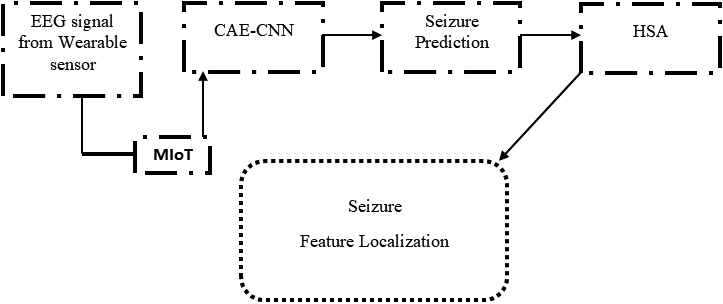
A seizure prediction algorithm is created for big-data analysis of MIoT EEG records of wearable sensors, which is suitable for real-time cloud-based service implementation. The four steps of seizure feature localization are postictal, early ictal, prodromal, besides ictal. Four steps are taken, as shown in Fig. 2, for the proposed solution. It describes the time and frequency properties of pre-processing and extraction, and deep learning structures are presented for high-level extraction. The proposed framework for optimizing deep learning architectures will be discussed. Eventually, the analytical phase for extracting functions is discussed.
A. Preprocessing and spatiotemporal features
A Butterworth bandpass filter (0.5–150 Hz) is used to pre-process MIoT, where the EEG results are acquired sing Big data cloud computing. A notch filter of 60 Hz is used to eliminate any unnecessary frequencies. In the next stage, a forward and backward filter is used to cancel the distortion of the phase. According to the time variability of the EEG signalling characteristic of the wavelet transitions, epileptic bursts were detected, and the rhythmic essence of the seizures was captured. Moreover, wavelet transformations will detect and monitor transient EEG features of the MIoT data of the wearable sensors in the spatiotemporal domain. To reduce the transmitter dimensionality, the EEG information is first divided into wavelet transform utilizing the wavelet-based method and db3 (level 3). Such decomposition values are applied to characterize the data using characteristics. Segmentation is completed when the EEG signal’s characteristics have been extracted. Wavelet transform makes utilisation frames with varying sizes and a waveform algorithm. Continuous Wavelet Analysis (CWT) & Discrete Wavelet Transformation are the two typical applications of wavelet analysis (DWT). For time data, CWT creates a scalogram, which is akin to a spectrum analyzer, using a waveform feature called
B. Extracting features using deep learning
Significant characteristics and trends are derived from broad EEG data of wearable sensors of MIoT for optimal data analysis and interpretation. Deep mathematical learning with statistical approaches, data integration, and machine learning has recently been advanced. The hierarchy of multi-level learning constructs is used to derive relevant indications from initial data. This function enables the DL to examine big data. Nonetheless, some drawbacks can arise with certain applications, including signal extraction, minimum local block, poor efficiency, and high computational time. Therefore, a new model is suggested to obtain adequate maximization algorithms to identify the best findings from deep architectures. Modern deep learning needs a large number of data since learning becomes inefficient with a limited amount of data from preparation. Therefore, a refinement of established pre-trained networks was performed in this analysis for the seizure prediction challenge rather than creating a new network. This method is regarded as to exchange learning, which offers a faster training service with a limited volume of marked wearable sensor data from MIoT and appropriate outcomes.
C. CAE-CNN
A multi-layer framework is used in the integrated CAE-CN, and the input dimensions of the first layer are described based on the layer of pooling, where a single source is subsequently sampled for the tiny rectangular blocks of the convolutional layer. The last layer is eventually configured for the classification of completely linked and the layer of SoftMax, as shown in Fig. 2.
The proposed system has been initiated as an issue with the classification of preictal and non-preictal. Every layer reacts to the wearable sensor EEG signal from MIoT as feedback uses a few layers which can be extracted, and the first layer of CAE-CNN is simple to function training filters. The basic characteristics are stored in layers to establish higher characteristics. The determined Features are removed directly from the layer since deep layers incorporate all basic functions to offer a more comprehensive representation of the signal. Algorithm 1 displays the pseudocode for the propagations in both forward and backward manner.
The CAE-CNN carries forward and backward propagation algorithms to predict the errors and boost the error. Here, the variable
As shown in Eq. (1), where
Algorithm 1 measures the loss function for network parameter weight optimization. If the error function
Through this, the gradient is calculated as in Eq. (4)
To calculate the weights, the estimated error propagated again back to the subsequent by the sequence law. So,
As inferred from Eq. (5), where
The clustered encoder is a subset of deep neural networks with multi-encrypted layers. The primary feature of a Clustered Autoencoder CNN (CAE-CNN) is the elimination of a range of unsorted information, which results in the big data issue. Unmonitored methods for secret layers are independently educated. Testing details without marking are used to replicate the input from the output during the training period. The effect of sparsity is managed to restrict the sparsity of the hidden layer performance. The first CAE needs to know the primary characteristics of raw EEG data. The second command function is removed by inserting the initial features into the second hidden layer. Here, the DL layer is equipped and is connected to build primary characteristics based on the end time. Algorithm 2 reveals the pseudocode of the system of classification.
The established network consists of several non-linear layers of transformation to reflect a non-linear structure of the EEG results derived from wearable sensors using MIoT. For each layer input, there is a non-linear transformation given in the output. Therefore, manual development techniques for each individual do not remove EEG functionality. The final layer uses a SoftMax-level as a normalizer of the distribution of numerical likelihood. This classifies EEG into preictal and non-preictal as non-linear inputs to forecast a network. The layer called SoftMax functions like as in Eq. (6),
As discussed in Eq. (6), where
D. Optimized CAE-CNN
Although DL offers a powerful and efficient means of solving various problems, there are still several shortcomings. The key challenge in DL is the appropriate and local minimum issues. Deep learning contributes to poorer output and larger computing time when such problems arise. The optimization algorithm may be considered to solve the restrictions in the deep learning process.
The optimization was rendered using a system based on Principle component analysis and HSA to increase efficiencies and automate the extraction of complicated large-scale data sets to construct deep learning, as shown in Fig. 3. Principle component analysis has been analyzed based on the EEG data, and the residual reliance on higher-order is isolated by an integrated method. HSA has been used by automated search space for the area of the minimum to find the optimum solution.
Optimization of CNN-CAE.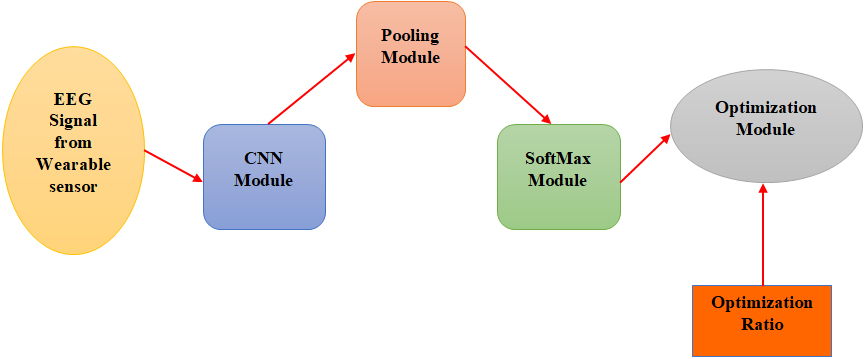
The key component analysis creates a directional regression coefficients matrix. Every parameter is transformed such that the matrix of covariation correlates to the matrix of identity with a transformation. It removes low trailing interest and decreases code complexity by reducing pair dependency. Take an EEG data matrix P from the wearable sensor with an objective column-specific mean of zero, in which each n line represents a certain period, and each column indicates a certain path. The Order is as follows in Eq. (7).
As shown in Eq. (7), where
As inferred from Eq. (8), where
As found in Eq. (9), where
Confidential source Z of CAE-CNN.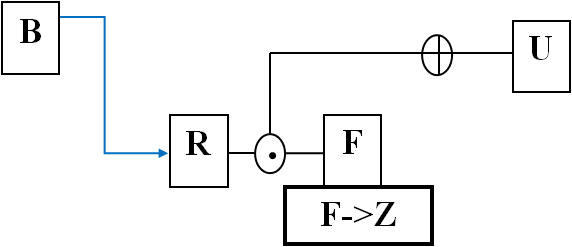
As shown in Eq. (10) and Fig. 4, where
This is elaborated as,
As inferred from Eqs (11) and (12), where
For
As discussed in Eqs (13) and (14), where
In brief, the principal component analysis applies EEG raw information from wearable sensors to various orthogonal elements, offering optimum signal decoration. It enables the noise subspace to be isolated from EEG results. Thus, the current hybrid PCA with HSA in CAE-CNN means that large data is decreased dimensionality and sparsely shows raw data. This sparsity allows deep learning architectures to remove unmonitored functions more effectively.
HSA is a novel, powerful evolutionary algorithm developed to automate the resolution of computational problems for a specific meaning. Spontaneous movement influences this algorithm. Here, HSA is better than other standard approaches to solving numerical optimization problems. For a global minimum, The HSA explores the search space, consequently, based on the architectures for deep learning, which do not capture local rates and improved efficiency and processing time. The major challenges in deep learning applications are make use of information safety protocols that preserve confidentiality, possess ample and pertinent classification model, prioritize conventional interpretable systems over DL, besides based on the number or complexity of the DL simulations optimize the processing expenditures. Results show that the optimization model proposed with deep learning approaches results in a better quality of training and seizure prediction of epilepsy as discussed as follows,
There has been a recorded improvement in the functional interictal phase. This paper shows differences between interictal epileptiform discharges and non-interictal epileptiform discharge cycles of functioning brain integration. Substantial periodic electrical disturbances are seen among seizures in epileptic individuals characterized as interictal epileptogenic displays (IEDs), commonly referred to as interictal spiking. IEDs are far less researched than convulsions, so it is still unknown how they are related to seizure activity while occurring much more frequently. A differential communication map is generated to describe the variations. It is usual to attribute increased excitation connections within glutamatergic neural systems as the cause of interictal epileptogenic displays (IEDs), which are produced in incomplete neurological conditions. Nevertheless, latest information back up the notion that inhibiting circuits do have a significant impact. Because the main interictal epileptiform discharge regions contribute to the zone with the dispersed interictal discharge regions, the guided DCM are determined and defined by information release steps for specific frequency bands. The value of all Directed DCM nodes in any frequency band is used to evaluate the multi-objective optimization approach. This study utilized the dataset
Training classification efficiency.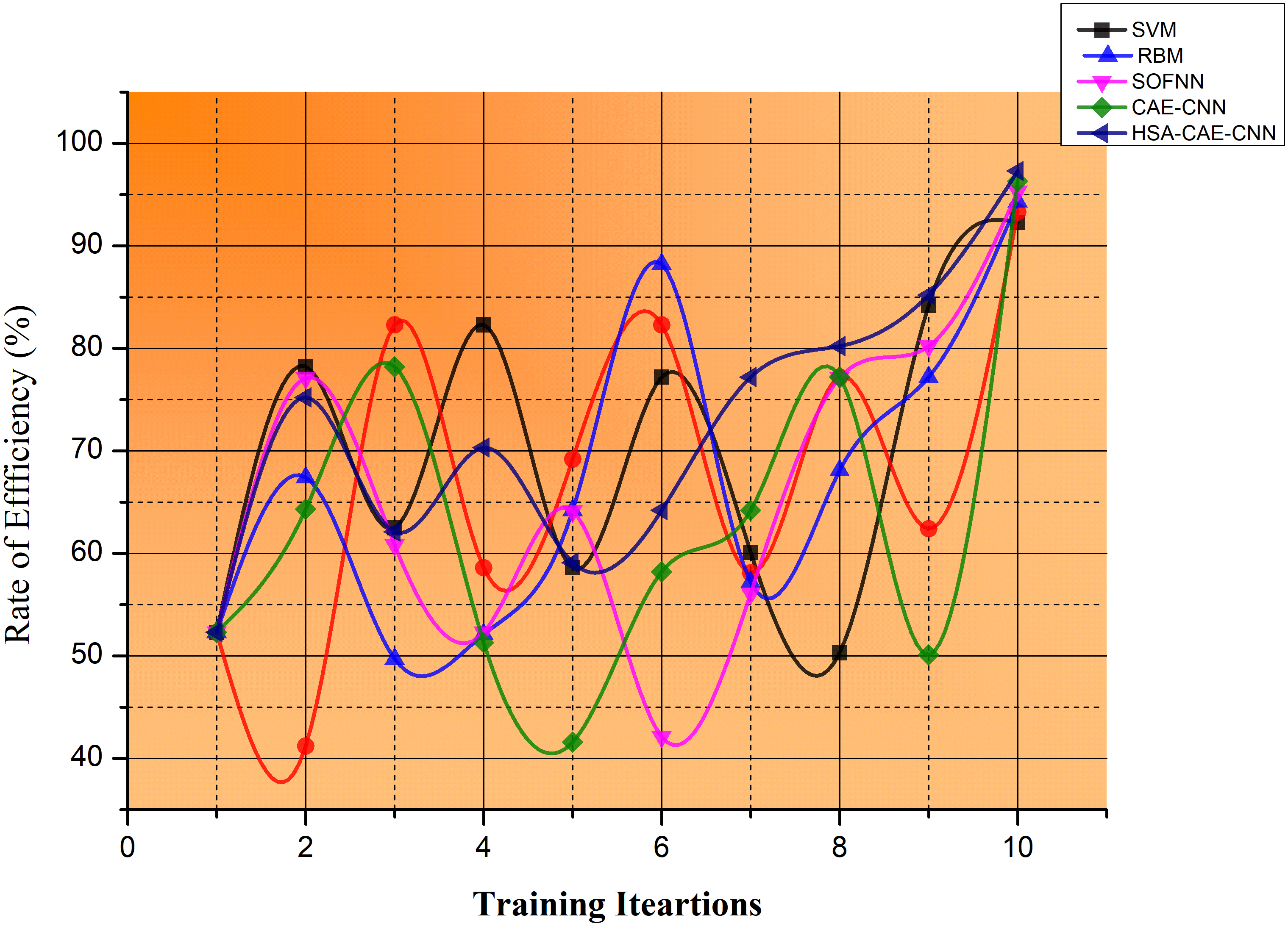
For classifying extracted features, a CAE-CNN with an HSA is used. The parameters of the Gaussian kernel are configured by optimizing the classic separation criterion as the basis of the diffusion ratio to maximize the performance. The Gaussian blur method, to describe it simply, is the method for executing a weighted function on the image sequence. Every pixel’s frequency is determined by weighted mean its own as well as adjacent outfield gray levels. The newly formulated decomposition criteria are then used using a pseudo-Newton algorithm. Figure 5 shows the CAE-CNN classifications for sub-spaces of the extracted features. It shows the maximization of the effective classification of the training set compared to other pre-availed models.
Testing classification efficiency.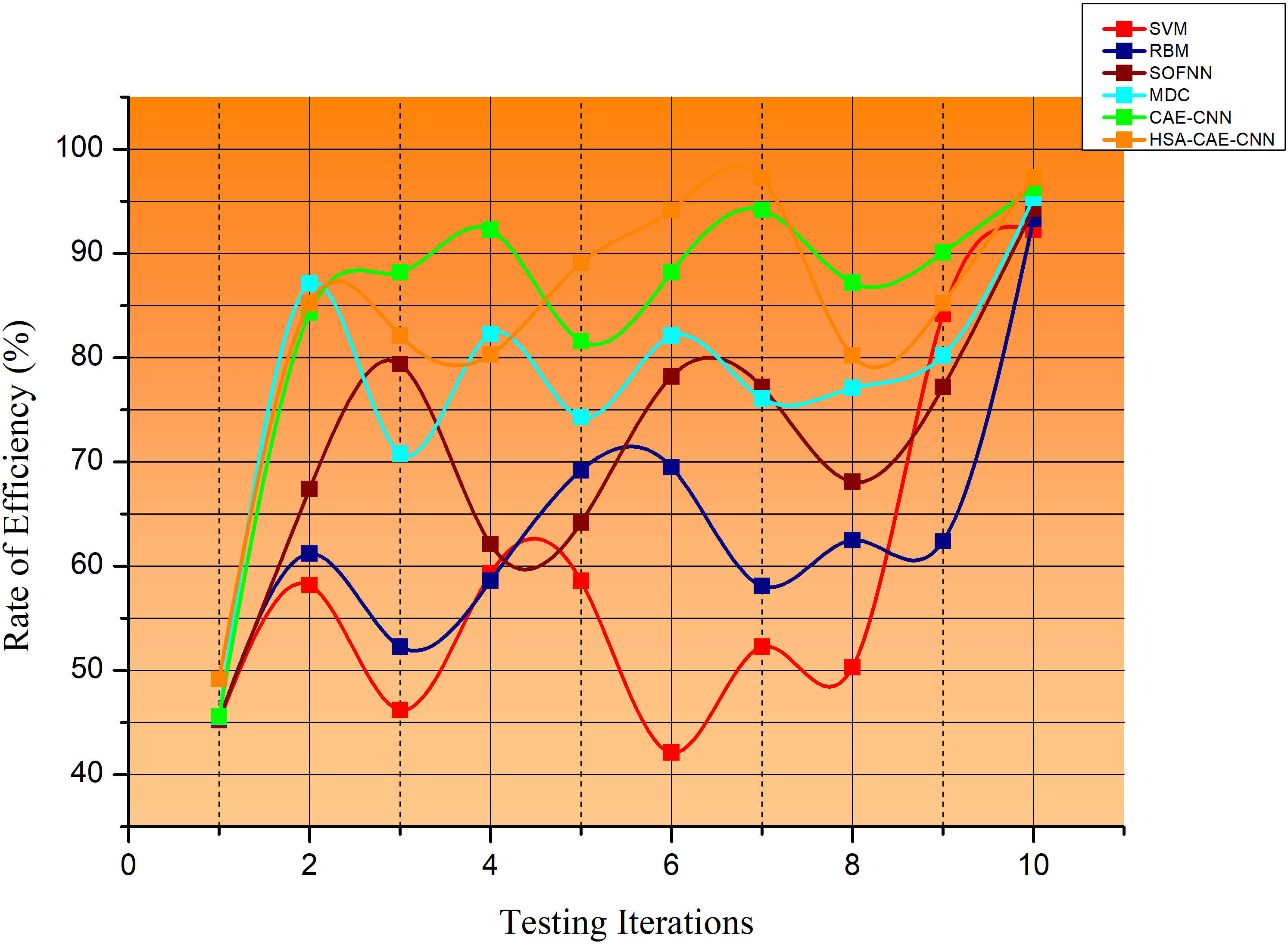
A theoretical method attempts mathematical relations over a wide number of cycles over wearable sensor data from MIoT using Big data Fig. 6 demonstrates non-linear CAE-CNN classification tests. This defines the relations between that are shift dramatically. This method reduces the influence of popular data such as background behaviour between a multi-permutation calculation which shows the distribution of the study statistics of the null pattern from various data and uses the outcome to pick meaningful relations with higher efficiency. Evaluate the quantity of choices available for every occurrence then multiplied it by itself X amount, wherein X is the total number of incidents in the series, to figure out how many of combinations. Further, it is mandatory to continue with building a CAE-CNN that involves data recognition and a coupling measurement calculation.
A prototype for the proposed CAE-CNN was created. For this research, an EEG speech benchmarking dataset of various wearable sensors and a mega cluster of Big data and MIoT provide cloud computing services with a pretrained EEG dataset network in the Proposed model.
The dataset contains many individual cases with a big data issue. Such algorithms will not be overfitted. If the product works well enough on the learning algorithm but poorly on the assessment results, then system is oversampling the training examples. This happens why the system can’t generalise to situations it hasn’t encountered as it is memorising the information it has already observed. There are several possible ways to assemble, however the two most popular ones are as follows: Bagging aims to lower the likelihood of complicated models being overfit. It simultaneously trains a massive quantity of strong students. A system that is largely unstructured is a powerful learning. The suggested solution randomly eliminates the functionality and reduces the possibility of over-structure. The basic principle behind the resampling approach known as cross-validation is to divide the information into learning or testing information. The system is trained using training data, and predictions are made using test data that hasn’t been seen. Besides, a leaving-on-out method is used as a comprehensive cross-validation technique on topics to determine the generality of tests. This methodology is used to modify the model to patient subsets and assess the consistency of the CAE and CNN models from the retained sample.
Most EEG patterns are not consistent with psychiatric disorders. Several instances of such shapes involve short sharp points, spike points, incredible waves, and rhythmic discharges. Because seizure diagnosis and estimation are scientifically independent of these characteristics, typical epileptiform variants are often named. Such characteristics are one of the key explanations for automated seizure identification. Figure 7 represents the recognition testing efficiency. The training conditioned the deep networks to identify them as usual models.
Accuracy rate of classifiers
Testing recognition efficiency.
The mean square error in the first hidden layer of Stacked CAE using computational complexity is seen in Fig. 8, where 0.08 at epoch 100 is the highest training accomplishment. Table 1 displays the alternative approach’s accuracy structure with CAE- CNN. The CAE-CNN carries forward and backward propagation algorithms to predict the errors and boost the error. Here, the variable
Segments finding accuracy
Mean square error rate.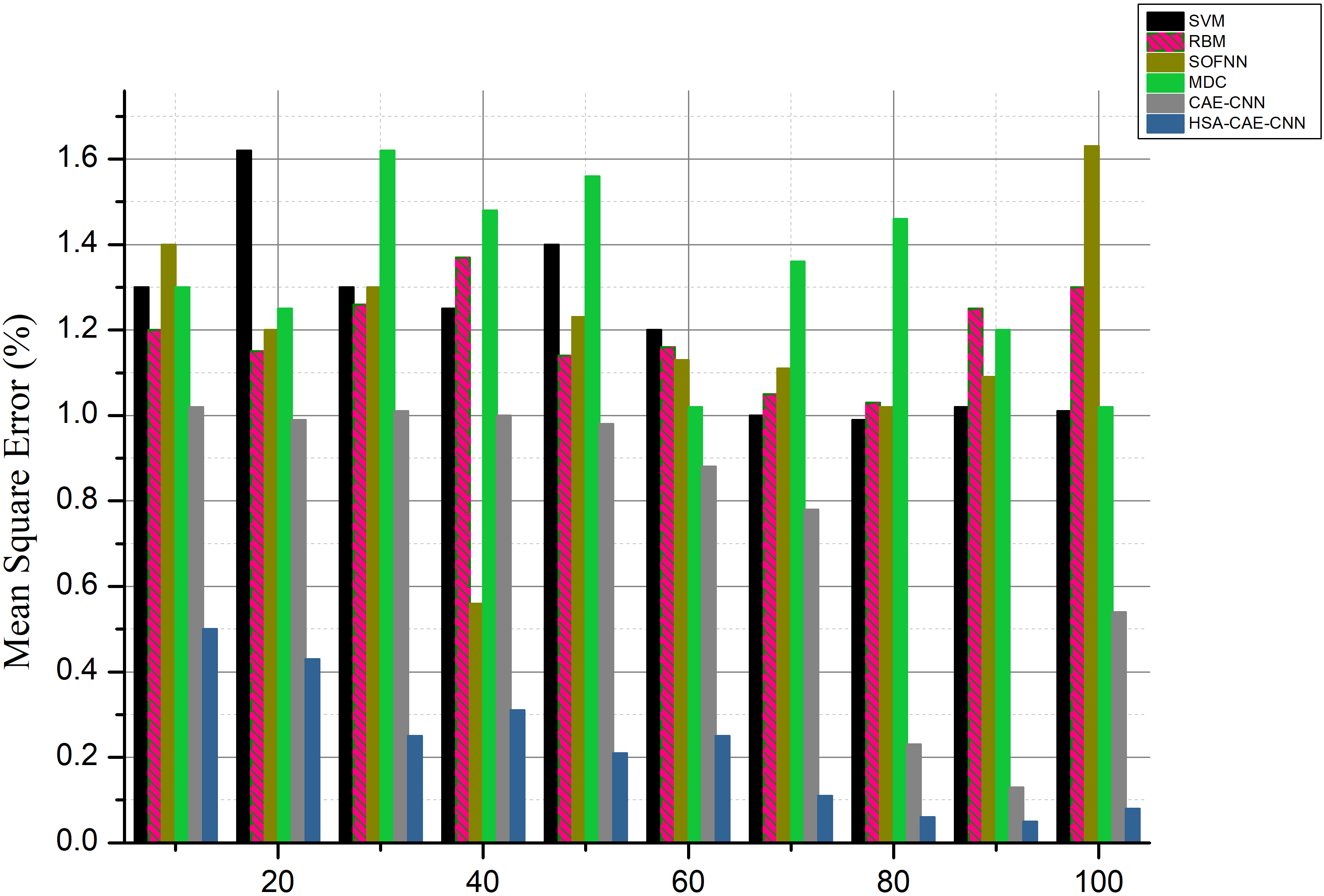
The EEG feature collected using MIoT is extracted by certain classifying methods for classification to determine the capability of the controlled feature extraction and segment classification. The derived characteristics are based on the rapid transformation of Fourier, over time average energy and strength for any channel, strength, spectral similarity, density coefficients, partial directed coefficient accuracy, and strip control for each channel in specific frequency bands. Figure 9 displays the various models’ interictal and seizure segments function in the ratio manner. CAE-CNN Neural networks are used to identify these derived features. Table 2 findings from the trial reveal that EEG seizure prediction in the current deep learning approaches is easier than in the prior approaches.
Classification of seizure and preictal segments.
Cloud servers assess the viability of utilizing cloud computing through network latency. The roundup period is computed with the loop order for server EEG segments. The proposed system collects MIoT EEG information. Following the message on a subject, the message will be forwarded to the Message Logger and all subscribing clients. This contact has secured data for the analyst. The system register stores wearable sensor details to protect connectivity between sensors and big data. The product of deep network computation is derived from the Rule Engine. The state details are then recovered with the System of MIoT.
Big data storage and analysis are relevant in effectively monitoring and treating complicated medical issues. It is demonstrated by potentially intractable epilepsy and the usage of embedded electrodes to reach various regions of epilepsy strategically. The specifications for secure and safe storage and huge computing sources must consider the broad range of models characterized by signal amplitude and frequency. In the optimization, as a layer in deep learning using CAE-CNN, power and data processing time while maintaining classification decreased. The advantage is the quick processing and understanding large quantities of unsupervised data. The success of this safe and effective system shall be determined by a sudden combination of feasible extraction and efficient implementation. Future work will include a system that will be implanted and used to determine its usefulness in the future. An additional study is worthy of further learning how an EEG variance estimation can be used to provide guidance.
Funding
No funds, grants were received by any of the authors.
Data availability
All data generated or analysed during this study are included in the manuscript.
Footnotes
Conflict of interest
There is no conflict of interest among the authors.