



Abstract
Flexible flow shop is becoming more interested and applied in industries due to its impact from higher workloads. Flexible flow shop scheduling problem is focused to minimize the makespan. A metaheuristic model based on Hybrid Tabu Search is developed to overcome this problem. Firstly, Hybrid Tabu Search is modelled based on the factory data. The Earliest Due Date rule is used as the scheduling method for the current status. FlexSim simulation software is used to evaluate the Hybrid Tabu Search model. The outcome is validated with two different basic heuristic solutions; Campbell, Dudek and Smith’s and Gupta’s heuristics. It is found that the proposed model can improve the job sequence based on makespan criteria.
Introduction
Automotive part manufacturing industry has developed due to the high competition. Many manufacturing companies are required to reduce their completion time. The time reduction influences many advantages such as lower cost, higher utilization, higher output, and lesser inventory [1]. This may need an efficient system that could be quickly designed, planned or scheduled to achieve the target. The solution for managing the production time is presented using some effective scheduling methods [2, 3]. In automotive part manufacturing, many companies try to produce a product that meets customer demand. Thus, the production needs to be more flexible with several machines in one stage. This condition is called Flexible Flow Shop (FFS) [4, 5]. Indeed, the sequence of the jobs affects the total time of a process due to cleaning, adjusting tool, change raw materials, fixing or changing tool on a machine. Therefore, the flexible flow shop with sequence-dependent setup time is needed.
Target and actual output per day between July and December 2019
Target and actual output per day between July and December 2019
Layout of production line 4 in automotive part company.
A popular scheduling type for automotive part manufacturers is determined by using flow-shop scheduling. In this
The present research used an automotive part company, located in Rayong, Thailand as a case study. This company manufactures automotive belts and hoses, such as; timing belts, Mivro-V belts, V-belts, fuel hose, pulley, etc. The production output of this company cannot reach to the targeted 175 units per day. The production output between July and December 2019 are shown in Table 1. The amount of output is always lower than the target within these months. The company cannot work to achieve the target and delivery products reach to their customer demand. This research focuses on production line 4 that have high processing time in the curing process, as shown in Fig. 1.
In the present research, a meta-heuristic model based on Hybrid Tabu Search is developed to solve the Flexible flow shop scheduling problem with sequence-dependent setup time. The aim is to minimize the makespan or competition time of the process. The Hybrid Tabu Search is modelled based on data collected from the factory. The outcome is validated with two different basic heuristic solutions; Campbell, Dudek and Smith’s and Gupta’s heuristics. Consequently, the model is applied to the company to compare the performance between the conventional method. Due date-time is very important in planning to fulfil the customer needs. The Earliest Due Date rule is used as the scheduling method for the current status. FlexSim simulation software is used to evaluate the Hybrid Tabu Search model. It is found that the proposed Hybrid Tabu model can improve the job sequence based on makespan criteria when compared with Campbell, Dudek and Smith’s and Gupta’s heuristics. Based on the result found it can be concluded that the application of Hybrid Tabu Search can solve the company problem in terms of efficiency and time.
The rest of the paper is arranged as follows: Section 2 contains the related work. The FlexSim simulation software is discussed in Section 3. The description of the hybrid Tabu-Search is presented in Section 4. This includes the objective function used. Section 5 presents the results and discussion. This section comprises of Experiment data verification and validation, Equivalence Test with Paired Data, An appropriate scheduling method and Efficiency evaluation the of Metaheuristic model by using FlexSim simulation. Section 6 contains conclusions.
Main components of the FlexSim software.
Model flow item in the real life of automotive part company.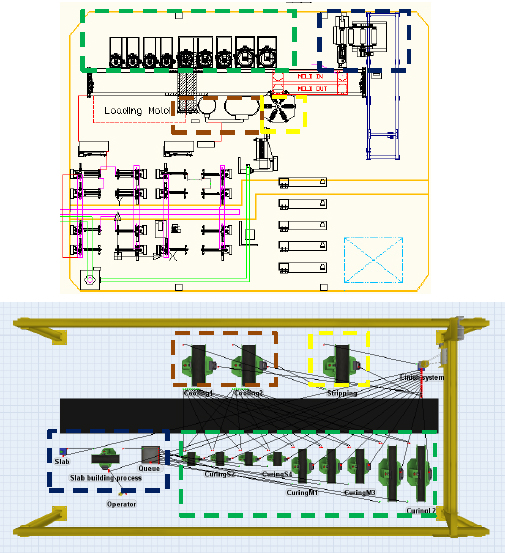
Model flow item with an explanation of the connection.
A few years ago have seen a renaissance of interest in assembly flow shop scheduling as demonstrated by the growing number of published articles in this field [15]. Assembly flow shop scheduling problem has several interesting derivatives and applications in various manufacturing and service industries. A basic assembly flow shop comprises of two types of stages: machining stage or fabrication and assembly stage. These stages are composed of one or a set of machines that are working in parallel. End products have ordered assembly structure with many components and assembly operations. The components required to be processed in the machining stages and then assembled based on hierarchical assembly structure. The aim is to discover the sequence of jobs that optimises certain objectives. This section presented some related research in this domain of research.
The apply ontologies and event-driven concept to Job-Shop scheduling problem are introduced in [16]. The dynamic information of the workshop can be found via the inference of ontology models. The optimization of the job shop scheduling problem is performed using the rule engine by matching the event patterns. The problem of sequencing and scheduling of two-stage assembly-type flexible flow shop with dedicated assembly lines is investigated in [17]. The assembly lines produce diverse products based on requested demand in the planning horizon. The main aim is for minimizing the maximum completion time of products. The authors developed a novel mathematical model in a flexible flow shop scheduling problem. The hybridization of simulated annealing and imperialist competitive algorithms is proposed. A Petri net-based adaptive scheduling model for reducing the complexity and simplifying the qualitative analysis of the production system is introduced in [18]. Resource-oriented Petri Net is employed to create the relation in terms of behaviours and logics of various resources. A real-life multifaceted two-stage hybrid flow shop scheduling problem which is challenged during the manufacturing of complex aerospace components is investigated in [19]. Many constraints have been taken into consideration in the investigated hybrid flow shop. A discrete-time mixed-integer linear programming model with an underlying branch and bound algorithm is used to solve small- and medium-size problems (up to 100 jobs). A Genetic Algorithm (GA) with a novel crossover operator is developed to solve the large instances of the problem (up to 300 jobs). The obtained results indicate the high level of accuracy and computational efficiency of the proposed GA compared with the optimal solutions found from the mathematical model.
The Hybrid Stage Shop Scheduling (HSSS) which formally encompasses diverse shop scheduling (a combination of flowshop and open shop), can model routing flexibility, and hybrid shop scheduling to established the resource flexibility. The HSSS is proposed in [20]. The proposed model integrates group shop scheduling and process planning. A theory based on disjunctive graphs and a mixed-integer linear programming model is used to discover the composite relations between nodes involving immaterial relations and deploying their routing rules. The flow-shop sequence-dependent group scheduling problem is solved with the aim to minimize the makespan [21]. The combination of the random sampling search and GA methods are used to efficiently handle the issue at hand. A matrix encoding that can simultaneously manage the arrangement of jobs in each group and the order of groups to be processed along the flow-shop manufacturing system was used. The mathematical model for integrated scheduling and lot-sizing in a multi-period multi-product capacitated flexible flow shop with sequence-dependent setups is developed in [22]. A comparison between the proposed model and the former models was presented in terms of complexity and performance. It has been shown that the proposed method is easy to solve with superiority performance. This is based on the problems of different scales.
FlexSim simulation
FlexSim software is the tools to help engineers and planners to make their decision in terms of design and planner of the system. The advantage features of FlexSim are that to be built in a 3-dimensional model, to construct by copying the real life of the system, then study with shorter time and less cost with the actual system [23].
There are three main problems can be solved by using FlexSim; service problems such as to reach to the minimize of possible cost or the maximum level of customer satisfaction, manufacturing problems which to be made the right product as the right time with the lowest cost, and logistic problems as also to find out as the minimization of possible costing under the right product to the right place situation [24].
FlexSim simulation is classified as the discrete-event simulation software program. In this work, the real-life company has applied the data to be constructed as the model in FlexSim software. The procedure for this model is explained below;
(i) To create the layout; Flowitem flow of the system is constructed in this step. This model classified into 6 sections; the source of slab, slab building process with an operator, curing process, then cooling process, stripping process and sent to sink as the output step. The objects are dragged from the library and drop into the model view window as in Fig. 2.
The edition of objects.
In the layout (See Fig. 3), this system comprises 4 main steps. The first step is to build on the slab with 1 machine. Then the slab building will push as the product to a curing process, which has to depend on the type of product. There are 3 different sizes of machines studies on the criteria; small, medium and large. After that, the item flows into the cooling process for a while, and finally, it is sent to the stripping process for taking off the mould and case before sending to the next station.
(ii) To Make port connections (See Fig. 4); port connections are made between the objects which can be classified into 2 types. The first is that output/input ports are offered to the fixed resources object. And the second type is centre ports, which referencing to use with TaskExecuter objects such as Forklift, operator and crane.
(iii) Edit the objects (see Fig. 5); this step is to edit all info of objects, whether general or specific behavior. For instance, the sizes, location of objects, statistic info, etc.
The result from the FlexSim simulation is to be verified and validated with Hybrid Tabu Search model based on completed time or makespan as the objective function. Even though, the model and program are verified by taking off some of the samples in the experiment data and manually calculate. However, it is more protective and reliable to use FlexSim to analyse the model.
The basic structure of a Tabu search consists of 3 sections; initialization, iteration and stopping rule. The flow chart of this Hybrid Tabu Search is shown in Fig. 6.
Concept of Hybrid Tabu Search.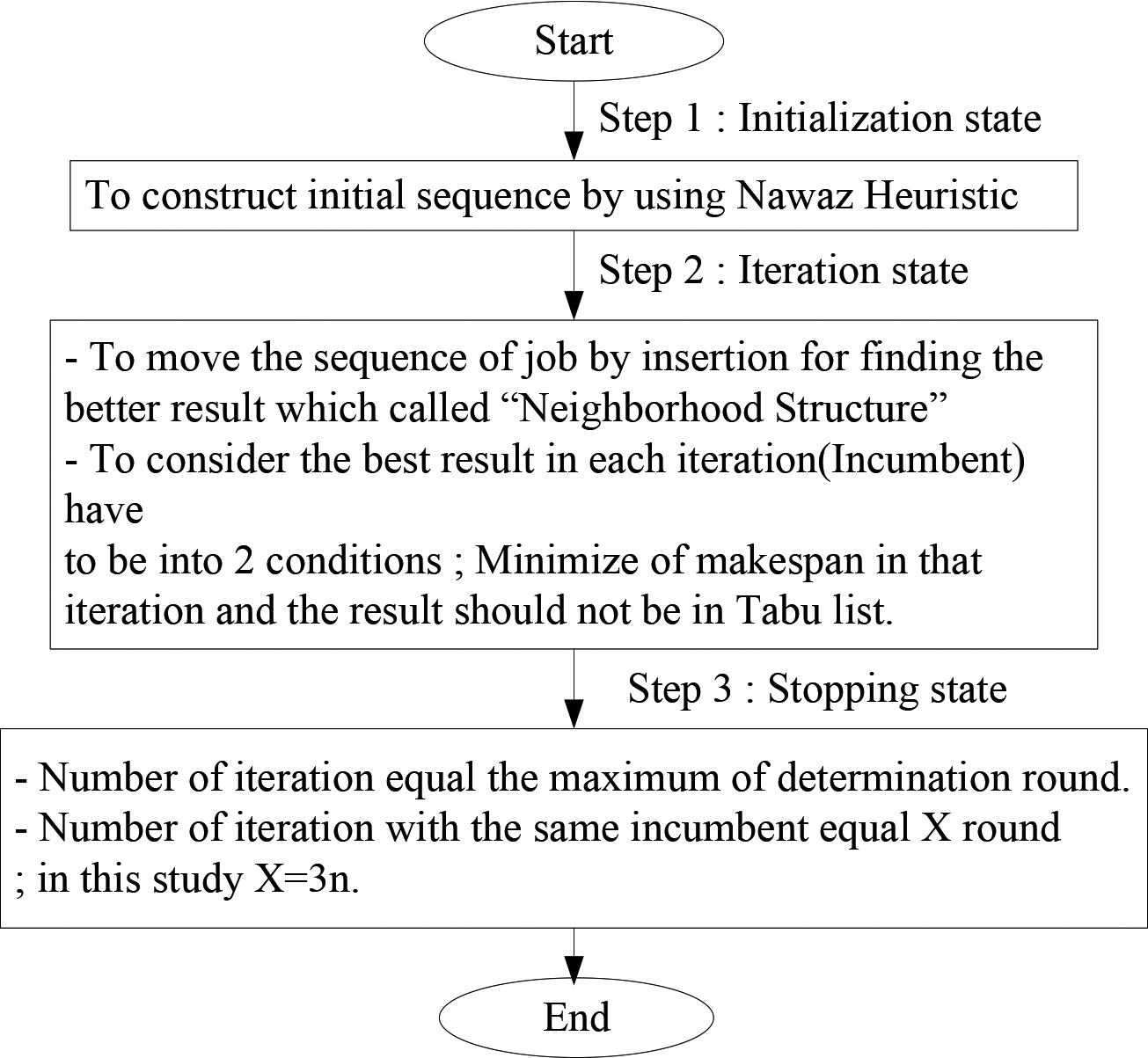
In this study, insertion scheme with systematic is used to find out the new neighbourhood. The systematic is considered from the job with a maximum value of idle time. Then the job inserts at the front or behind of the other with all the possible position. Figure 7 presents a description of this systematic insertion.
Insertion scheme of neighbourhood structure.
As we can see from Fig. 7, the system has 6 jobs. The initial sequence is listed of the first row and the rest is the new sequences scheduled by using the systematic way. The maximum idle time job is number 3. The job number 3 is inserted to in front of the job number 1, 2 and behind job 4, 5 and 6. Therefore, iteration shows 5 new sequences. The makespan is proportional to total idle time, which the total idle time in the system can be reduced to decrease the makespan. It is assumed the number of jobs
Sample for proving the total idle time principle.
The sequence is the factor that affects the makespan. The total idle time also represents the trending decrease or increase of the makespan. The significantly meaning of idle time can explain more detail by using Eq. (1). Equation (2) is the total idle time of the system and Eq. (3) is the idle time in each job ith in that stage jth, which clarify the component of makespan between processing time and setup time.
Selection of best neighbour in sequence can be done by using 2 criteria. The first is considered the objective function of study: minimize makespan. Also, the result should not be in the Tabu list. In terms of the Tabu list, the size can be either fixed or variable. For this study, the size of the Tabu list is fixed at 5 moves, which the Tabu list determines five prohibited moves. Thus, the net result is called incumbent which to improve the current solution.
Minimized
The objective function is shown in Eq. (4) which is meant that makespan can be compiled by considering the highest value of complete-time in the last job at the last stage. Total time as processing time plus setup time of each job at any stage and machine is set on 1 part and another part is set for idle time. All of the results are combined as shown in Eq. (5). The constraints for this objective function are located in Eqs (6)–(8). Equation (6) connotes that the completion time of the current job should be more than the previous job in the same stage and machine. The maximum completion time supposed to be more than the completion time of any jobs as Eq. (7). Finally, Eq. (8) is the completion time of
The main structure is the Hybrid Tabu Search is specified into 3 sections; initial scheme, iteration scheme and stopping rule. While loop is used which the evaluation will proceed until it goes out from the condition.
Stage I: Initial solution by using Nawaz heuristic is 5-3-2-4-7-6-1 and incumbent 7353 seconds.
Stage II: Iteration by focusing on a maximum of idle time. It is focused that the maximum idle time in each machine is jobs no. 6, 7 and 3,
Iteration for searching neighbourhood result in the first round
Table 2 presents the first iteration by inserting the job, which is the maximum of idle time in each machine. Then, the result for the first iteration can be shown below; Iteration
Incumbent
Tabu list
Experiment data verification and validation
The one solution for verifying and validating Hybrid Tabu Search is using experimental data of OR-Library [25]. In this study, 10 samples from OR-Library is selected and calculated by using two basic heuristic methods and Hybrid Tabu Search as shown in Table 5.
From Table 5, the Hybrid Tabu Search is the most effective compared with CDS and Gupta’s heuristics based on makespan. In terms of total idle time, Hybrid Tabu Search also has shown the minimize trend with the other two methods. Moreover, verification and validation are performed by using a manual calculation. In this study, the manual calculation of CDS algorithm compares with the VBA program by focusing on Carlire 7 is shown in Table 3.
Manual calculation of instance Carlier 7 (7
7)
Manual calculation of instance Carlier 7 (7
Sub-problem or auxiliary plan for CDS algorithm
Makespan of experiment data from OR-Library 10 samples
Table 4 shows the minimize makespan is in sub-problem number 4 with 7439 seconds. In Table 5, for instance, Carlier 7, the manual calculation for makespan is the same as the previous report. Moreover, the LEKIN Scheduler program also shows the same result. Thus, the VBA program is presented to be corrected to construct method.
From Table 5 represents that Makespan of Hybrid Tabu Search is less than the other, which means that the result from the Hybrid Tabu Search is better than the other ones. To calculate the percentage of makespan by using Eq. (9), the result shows that makespan for CDS and Gupta’s algorithm are greater than Hybrid Tabu Search with 6.27% and 10.50%, respectively.
To total idle time, the percentage of CDS and Gupta are larger than Hybrid Tabu Search with 36.38% and 41.17%.
Figure 9a and b connote the differential between Hybrid Tabu Search and all basic heuristic algorithms with Makespan and Total idle time. The result shows that almost of all experiment samples is better than the other ones.
Experiment data from OR-library 10 samples.
Equivalence test between Hybrid Tabu Search and Gupta.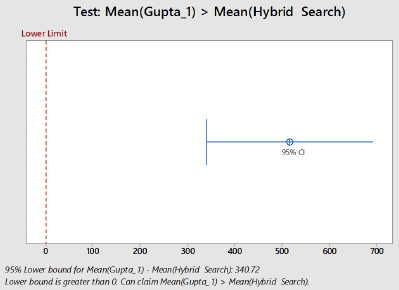
Hypothesis test by using
In Table 6, the result for makespan of all algorithms is studied. The Hybrid Tabu Search method should be the best among all algorithms in this study. Thus, hypothesis
Hypothesis
The result from MINITAB
95% lower bound for mean difference: 340.7.
From the result of the MINITAB program, The
Test mean
The reference mean
Descriptive statistics
Descriptive statistics
Lower Bound
Lower bound is greater than 0. Can claim Mean (Gupta_1)
Null hypothesis: Mean (Gupta_1)
Alternative hypothesis: Mean (Gupta_1)
DF
From the equivalence test, it can be approved that the results from the Hybrid Tabu Search are better than Gupta heuristic as shown in Fig. 10. However, the rest comparing between each method is computed in the same. And the conclusion shows in Table 6 above.
According to the process of this solution, the simulation by using the program in the computer is applied that including the CPU time.
CPU time running VBA
Current data (case study) in terms of makespan and CPU time
In Table 9, the CPU time of the Hybrid Tabu Search is the highest from other ones because of the complex calculation method. Moreover, Hybrid Tabu Search need more time to find out from local results to global optimization.
In Table 10, the output of the Hybrid Tabu Search (recommendation algorithm) is 15.32% better than the EDD method (Current method). Besides, it also is better than two other heuristic methods. The sequence for this case study is generated by VBA and shown in the table.
Efficiency evaluation the of Metaheuristic model by using FlexSim simulation
FlexSim simulation is presented in chapter 3 as the tool to validate the model. The Flexsim is compiled and viewed the results; after the model is constructed until completed. All of the simulation model should be followed these step; reset, run and stop steps. Finally, the programmer can view the results whatever they want. In this case study, the interest is focused on makespan or completed the time of running. In this case study, verification and validation of the Hybrid Tabu Search model are done by FlexSim simulation. Section 4.3 shows the result of makespan in the real-life system by using Hybrid Tabu Search on VBA Microsoft office excels.
Table 10 shows the makespan from VBA program in terms of EDD algorithm and then compared with the result from FlexSim based on the same algorithm. The results for both methods are similar to each other. This means that the model in the VBA program is feasible to apply with the real situation in the company.
Flowitem in FlexSim with 3-dimension.
The result of the actual data from the company using Hybrid Tabu Search method recorded the makespan of 15258 minutes and 15699 minutes for VBA Microsoft office excel and FlexSim simulation, respectively. The different is 441 minutes or 2.89% based on VBA Result
Another advantage of FlexSim simulation is that 3-dimension view (See Fig. 11). During the simulation is shown the flow of item between up-stream and down-stream stage. From this point of view, user can classify that which station is the critical point with high work in process, a high percentage of using utilization and so on. Anyway, during running time, a programmer can be controlled speed of simulation.
Based on the result, Hybrid Tabu Search model has conducted as the solution for Flexible flow shop scheduling to minimize makespan. This model is constructed to solve planning and scheduling problem. Scheduling problem samples are selected from a library that comprises the number of jobs, number of machines and processing time. The result of this model should be feasible in flexible flow shop scheduling. It is shown that the output represents that makespan from Hybrid Tabu Search algorithm is better than CDS and Gupta’s heuristics with 6.27% and 10.50%, respectively.
The comparing of these methods are used experiment data based on OR-library 10 samples to be generated in the VBA program. The results are proved by using the hypothesis test (
The model is tested with real-life data from the company after the model is developed by using experimental data. The main propose of this stage is to improve the completed time or makespan of scheduling by using Hybrid Tabu Search. The final result from Hybrid Tabu Search shows improvement compared to the current method as EDD rule (Earliest due date).
Hybrid Tabu Search connotes that the makespan is less than EDD rule with 15.32%, which the Hybrid Tabu Search is more suitable than the current method. Data from the company is input into the FlexSim as the model for this system. The 100 jobs are sequenced based on Hybrid Tabu Search algorithms for testing. The result of the completed time in FlexSim program shows small variation compared to Hybrid Tabu Search in VBA program, which is 2.89%. Thus, it supports that Hybrid Tabu Search model is suitable and feasible to be applied in the company.
Conclusion
The present study is focused on an Automotive part company in Thailand that produce varieties of belts. The production line 4 is studied because of the scheduling and bottleneck problems. The company cannot achieve its target and customer satisfaction are affected. It was found that the main issue of this problem is concerned with the inefficiency of schedule. Thus, the planning is based on due date without looking at the higher setup time when the change of models. So the total time will be increased because of the changing of setup time. Therefore, the appropriate scheduling method is proposed to improve this situation by using Hybrid Tabu Search.
The overview of the Hybrid Tabu Search can be explained with 3 steps. The first is the initial solution which the process of starting the model by using Nawaz heuristic. Nawaz algorithm is one of the methods to find out with minimizing makespan; the generation of initial 2 jobs is conducted, then iteration of insertion the next job with all possibly sequence to look at the minimum of makespan in that iteration until the last job is inserted to the sequence. Therefore, this heuristic is connoted the significant advantage of makespan.
The second step is the iteration or neighbourhood structure. Iteration is repeating time of searching that focus on the global result. The answer will reach to the optimization compare to searching method with finding local area. The solution of searching is about insertion technique to all the possibilities of position based on total idle time. This concept is attempted to reduce idle time related to the total completion time. Also, if the total idle times in those stages are reduced, the completed time of system should be reduced.
Finally, the stopping rule is used to stop the model. The objectives of this study comprise to validate the metaheuristic for flexible flow shop scheduling by using experiment data, then use the metaheuristic (Hybrid Tabu Search) to develop the output of the system based on makespan or completed time. Furthermore, FlexSim software is applied by proposing to evaluate the model.
There are 10 examples are taken from OR-Library as experiment data. The validation is done by comparing the Hybrid Tabu Search and two basic heuristic algorithms. Hybrid Tabu Search model is better than CDS heuristic with 6.27% and 10.50% better compare to Gupta’s heuristic. Therefore, the results from the Hybrid Tabu Search are better than both basic algorithms to ensured with hypothesis
This study chooses 100 models or jobs from the master data of the company, then all the jobs are scheduled by using Hybrid Tabu Search. The result from Hybrid Tabu Search is compared with the current method as EDD rule. The makespan value is calculated by using the Hybrid Tabu Search is less than EDD rule with 15.32%.