



Abstract
Machine learning algorithms have been widely used in risk prediction management systems for financial data. Early warning and control of financial risks are important areas of corporate investment decision-making, which can effectively reduce investment risks and ensure companies’ stable development. With the development of the Internet of Things, enterprises’ financial information is obtained through various intelligent devices in the enterprise financial system. Big data provides high-quality services for the economy and society in the high-tech era of information. However, the amount of financial data is large, complex and variable, so the analysis of financial data has huge difficulties, and with the in-depth application of machine learning algorithms, its shortcomings are gradually exposed. To this end, this paper collects the financial data of a listed group from 2005 to 2020, and conducts data preprocessing and Feature selection, including removing missing values, Outlier and unrelated items. Next, these data are divided into a training set and a testing set, where the training set data is used for model training and the testing set data is used to evaluate the performance of the model. Three methods are used to build and compare data control models, which are based on machine learning algorithm, based on deep learning network and the model based on artificial intelligence and Big data technology proposed in this paper. In terms of risk event prediction comparison, this paper selects two indicators to measure the performance of the model: accuracy and Mean squared error (MSE). Accuracy reflects the predictive ability of the model, which is the proportion of all correctly predicted samples to the total sample size. Mean squared error is used to evaluate the accuracy and error of the model, that is, the square of the Average absolute deviation between the predicted value and the true value. In this paper, the prediction results of the three methods are compared with the actual values, and their accuracy and Mean squared error are obtained and compared. The experimental results show that the model based on artificial intelligence and Big data technology proposed in this paper has higher accuracy and smaller Mean squared error than the other two models, and can achieve 90% accuracy in risk event prediction, which proves that it has higher ability in controlling financial data risk.
Keywords
Introduction
Financial management and control is an important issue in the field of enterprise financial management and investment decision-making, and its essence is the forecast and classification of the future financial development of an enterprise [1]. At present, machine learning algorithms have been used in the management and control of financial data, but with the in-depth application of machine learning in financial management and control, it is found that the financial risk prediction model based on machine learning algorithm has problems of overfitting and non-sparse model coefficients for the analysis of financial data, making the analysis of financial data inaccurate, which in turn leads to deviations in the prediction of financial risks [2]. It also reduces the processing efficiency of corporate financial data, the analysis of financial situation is not thorough enough. It is difficult for companies to formulate financial control measures in a timely manner, and risk aversion also increases certain difficulties. The use of Internet of Things technology can ensure the collection and analysis of a large amount of bank data. Banks learn more about their customers by collecting data from IoT devices, so as to improve their internal decision-making processes in service delivery, product strategy and investment. Therefore, more detailed analysis of financial data is carried out to improve the accuracy of financial management and control based on machine learning algorithms. Using the machine learning algorithm of the Internet of Things technology to control financial Big data can effectively improve the efficiency and accuracy of financial business, reduce maintenance and management costs, and further promote the Digital transformation and development of the financial industry.
We describe machine learning as a way to implement artificial intelligence. At its most basic, machine learning uses algorithms to parse and learn from data, and then make decisions or predictions in a similar context. The use of artificial intelligence technology to make the analysis of financial data more thorough can promote the effectiveness of machine learning algorithms for financial risk management and control, thereby improving the usefulness of enterprises to avoid risks, so that enterprises can pay more attention to potential risks while pursuing investment returns, enhance risk awareness, reduce losses due to improper investment, and promote the smooth operation of enterprise development. The Internet of Things for financial data based on artificial intelligence can help financial institutions keep a leading position, so that financial institutions can better understand the overall situation in other fields. There are various practical applications of the Internet of Things in the banking environment. For example, biometrics and location sensors are installed in the banking offices and equipped with cameras, so that customers can be identified when they enter the bank. By analyzing the sensor information on the ATM, the best area to install the device can be determined. AI-based financial data analysis provides a set of effective modeling methods for financial crisis early warning, which can significantly improve the prediction accuracy and generalization ability of the model. The early warning results can timely adjust the business strategy of the enterprise, improve the financial situation of the enterprise, and avoid financial crisis happening. The use of big data and artificial intelligence technology can timely and completely collect various data in the process of enterprise operation, extract useful information from a large amount of financial data, and give full play to the important role of financial data in financial management and control.
Because financial management and control plays an important role in the development of enterprises, many scholars have explored financial management and control technologies. Among them, Zhang analyzed the application of the support vector machine method based on machine learning in the multi-classification problem of financial data, which provided a certain theoretical basis for the application of machine learning and other methods in financial data analysis [3]. Hou et al. proposed an online client algorithm for IoT unstructured big data analysis based on machine learning algorithm, and applied it to other big data analysis scenarios, and verified its efficiency through machine learning algorithms such as K-nearest neighbor algorithm [4]. In order to successfully develop and execute ML efficiently, Khan A utilized a recommendation engine to develop a tool M capable of handling large amounts of data, and further introduced several ML tools and their properties, as well as the use of desired applications in related fields [5]. Kang proposed a financial risk assessment model based on big data, which used big data fusion and clustering algorithms for financial risk assessment [6]. Wei et al. studied the construction strategy of cloud accounting and financial sharing management model under the background of big data, and constructed an accounting and financial sharing management model based on hash tree algorithm, which provided a reference for improving the level of financial management and competitiveness of Chinese enterprises [7]. Zhang et al. proposed a financial management application based on the big data platform, and expounded the impact of big data on financial management [8]. Wang et al. constructed a new system for evaluating supply chain financial indicators based on the improved fuzzy language PROMETHEE method, and verified the effectiveness and superiority of the model through an example [9]. The research of these scholars has certain reference value for financial data and management and control.
However, from the research of the above scholars, it can be found that there are still many defects in the analysis technology of financial data. Some scholars have the problem that the analysis technology of financial data is not thorough enough and in-depth, and cannot deeply discover the hidden risks reflected in the financial data. The prediction of financial risks can only predict the relatively obvious surface risks. Moreover, some scholars’ research on financial management and control only stays in theoretical research, without conducting field inspections, and cannot prove the effectiveness of theory for financial management and control. Some studies lack strong data and specific theoretical support for the study of financial management and control, and their persuasiveness is not very strong, nor can they prove that the financial management and control model they study has a high and accurate ability to identify financial risks.
Based on the machine learning algorithm for financial management and control, this paper used artificial intelligence to analyze financial data in depth, so that financial data could be analyzed more thoroughly, and financial risk prediction could be provided with stronger financial data support. The model research on financial management and control has the following innovations: (1) On the basis of machine learning algorithms, artificial intelligence is introduced to analyze financial data, which is more scientific and rigorous than previous financial management and control models. Financial data is endowed with intelligence, which is more in line with the needs of the company. (2) This paper verifies the practicability of the research system in this paper by comparing it with other financial big data management and control systems, and finds that artificial intelligence analysis can make up for the shortcomings of machine learning algorithms, thereby improving the performance of financial big data management and control systems.
Methods of financial big data management and control
Internet of Things and machine learning algorithm
The Internet of Things is an indispensable part of modern information technology, and a new technology derived from Internet technology. This technology can realize the information exchange between things, connect all intelligent things together, and form a complete and systematic information network. People can know the properties of things and the relationship between things through the network, and further improve the development level of modern society.
With the continuous development of society and the continuous improvement of science and technology, the Internet of Things technology has been widely used in the financial field, and has become an important power source to promote social development. You can use IoT devices to obtain financial data in all aspects, and upload the data to the cloud to realize the management and control of financial data.
Machine learning algorithms are the core of artificial intelligence and the fundamental way to make computers have artificial intelligence. In the management and control of financial big data, it is necessary to use the neural network in machine learning to build a management and control model [10]. Machine learning algorithms include naive Bayesian classification and support vector machines. When using neural networks to build models, machine learning algorithms are also required to classify financial data. To use the support vector machine in the machine learning algorithm in financial management and control, it is first necessary to classify the financial data, that is, use the naive Bayesian classification algorithm to classify the financial data. Assuming that there is a training sample set of financial data
And in the sample data, the number of financial data samples of various categories is
So each sample has an
Then giving a sample to be determined:
By calculating the probability to determine the category of financial data, the naive Bayesian classification model is shown in Fig. 1.
Naive Bayes classification model.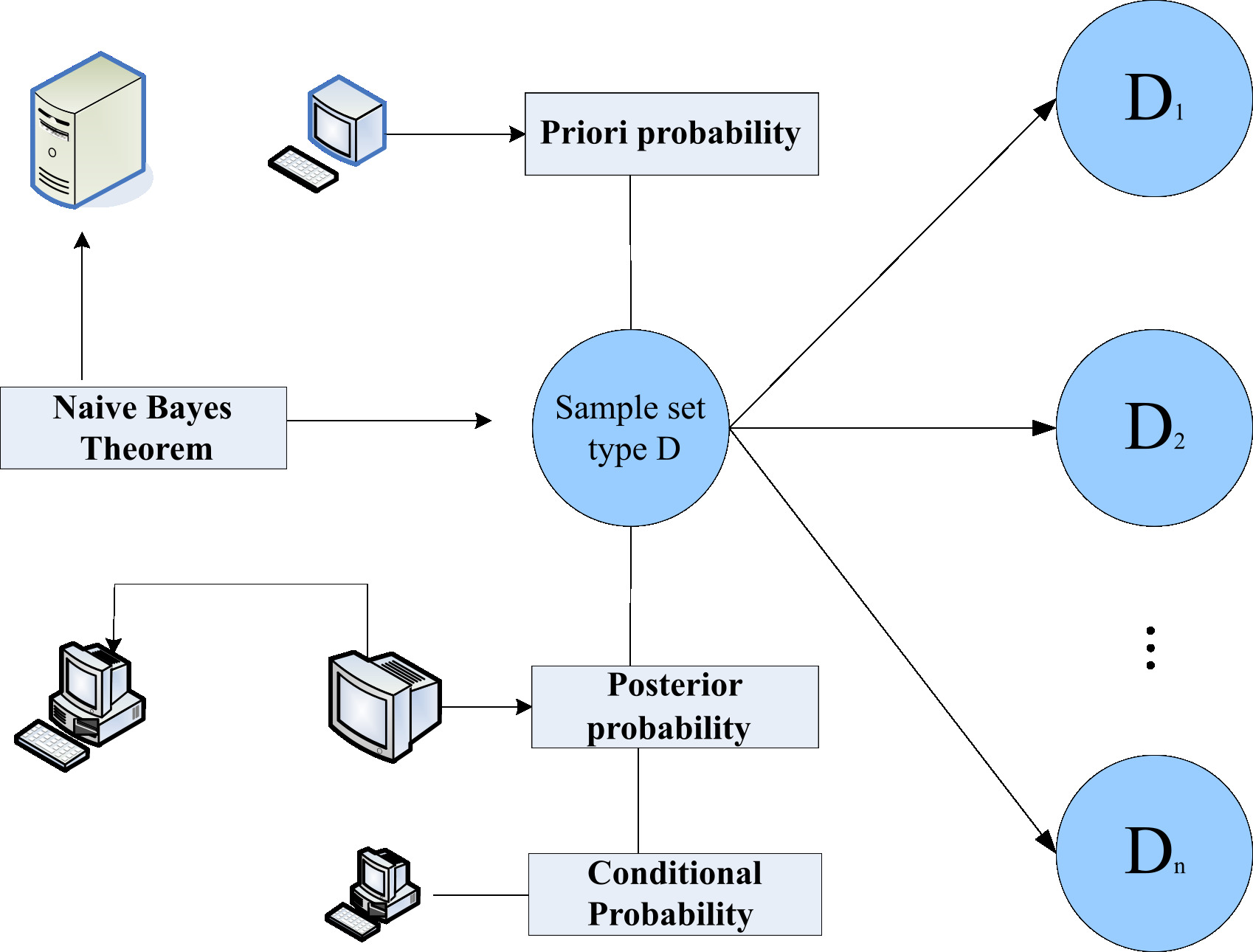
From Fig. 1, under the given conditions, each type of financial data in financial data set
Therefore, after classifying the financial data by using the Naive Bayesian classification model, the support vector machine can be used to analyze and mine the financial data. The occurrence of risk in the past of an enterprise’s operation is a probabilistic issue, so financial management and control need to analyze all financial data and predict the risk-prone places from it, and adjust measures in advance to prevent the occurrence of such risks [11]. Then use the support vector machine to analyze the financial data to find the anomalies in the financial data. Because the financial data has been classified by the naive Bayesian classification model, it needs to be analyzed according to the classified categories in the support vector machine. Then in the support vector machine, it can be analyzed by the following optimization problem with equality constraints:
Among them, e represents the classification error of financial data. Through the above formula, the sparsity of financial data is enhanced, in order to find a more accurate place, Eq. (6) is limited by Eq. (7):
In Eq. (7),
When analyzing the samples of financial data, it is necessary to make all kinds of financial data more balanced in the system. Therefore, for the analysis of financial data, the following formulas need to be satisfied:
After careful analysis of the financial data by the support vector machine, it will keeping finding abnormal financial data areas until it finds the most likely place of risk. The principle of support vector machine is shown in Fig. 2.
Principle of support vector machine.
From Fig. 2, the support vector machine to determine financial anomalies can only detect anomalies in a part of the data, and cannot accurately lock a certain position, so the machine learning algorithm still has certain loopholes, and its accuracy is not very high. Therefore, there are still many loopholes in the management and control of financial big data based on machine learning algorithms.
With the advent of the information age, the types of data have increased, and data analysis has become more arduous. In particular, the increasing business development direction of enterprises has made financial data more complicated, and also prompted data processing and analysis to become the main function of financial personnel. Therefore, accountants must not only master accounting knowledge, but also need to have strong management capabilities [12]. Detailed analysis of financial data is an important part of enterprise development. Only by attracting more investment from investors through financial data can an enterprise better ensure the development of the enterprise [13]. Therefore, the management and control of financial data is very important, especially the management and control of financial risks is a top priority. The role of financial analysis is shown in Fig. 3.
The role of financial analysis.
There are various sources of financial risk, which can be mainly divided into two aspects: the uncertainty of the external business environment of the enterprise and the uncertainty of the enterprise’s own internal business activities. The natural environment, political environment, economic environment, technological environment and social environment constitute the financial management environment of the enterprise. When these environments change, the enterprise will be directly or indirectly affected. Enterprises living in the big environment cannot change the macro environment by their own power, and can only adapt to the new environmental changes by adjusting their own structure. There is uncertainty about business activities within the enterprise, because the production activities of the enterprise are affected by the economic environment, especially the impact of changes in the market environment, so the production activities in the enterprise need to conduct market research, in addition to the need for the enterprise’s production activities. The financial situation is analyzed, and then a reasonable enterprise production activity plan is formulated [14].
Enterprise financial work includes financing process, investment process and capital recovery process, and each process can be subdivided, so financial work has great complexity. And in the context of big data, financial data is becoming more and more complex, which brings great difficulties to financial personnel [15]. The financial management project is shown in Fig. 4.
Financial management engineering.
In financial management, it is necessary to apply statistical analysis and other operations. If there is an error in the financial data analysis, it will bring immeasurable losses to the company. Therefore, it is necessary to conduct a detailed analysis of the financial data. For the data that causes financial risks in the financial analysis, the company will adopt certain policies to manage the upcoming financial risks [16]. There are many ways for enterprises to manage and control financial risks. One is risk aversion, which is to take corresponding measures for the predicted risks and change the conditions for the risks to occur, so as to protect the enterprise from the impact of risk events. The second is risk transfer. Through finance, insurance and diversification, risks that are difficult to avoid and control are transferred to ensure the minimum loss of corporate interests [17]. The last one is risk retention. If the risk cannot be avoided and transferred, the enterprise needs to choose the measures that have the least impact on the future development of the enterprise from the perspective of long-term interests to reduce the impact of the risk on the enterprise [18]. Therefore, financial management and control can ensure the long-term development of the enterprise and the interests of the enterprise.
The development of big data and artificial intelligence has also provided new intelligent processing methods for the processing of financial data. This paper relies on the deep learning algorithm in artificial intelligence to enable financial data to be effectively analyzed [19, 20]. When a sample of financial data enters the deep learning network, the deep learning network will dig deeper. The financial data analysis process is shown in Fig. 5.
Financial data analysis process.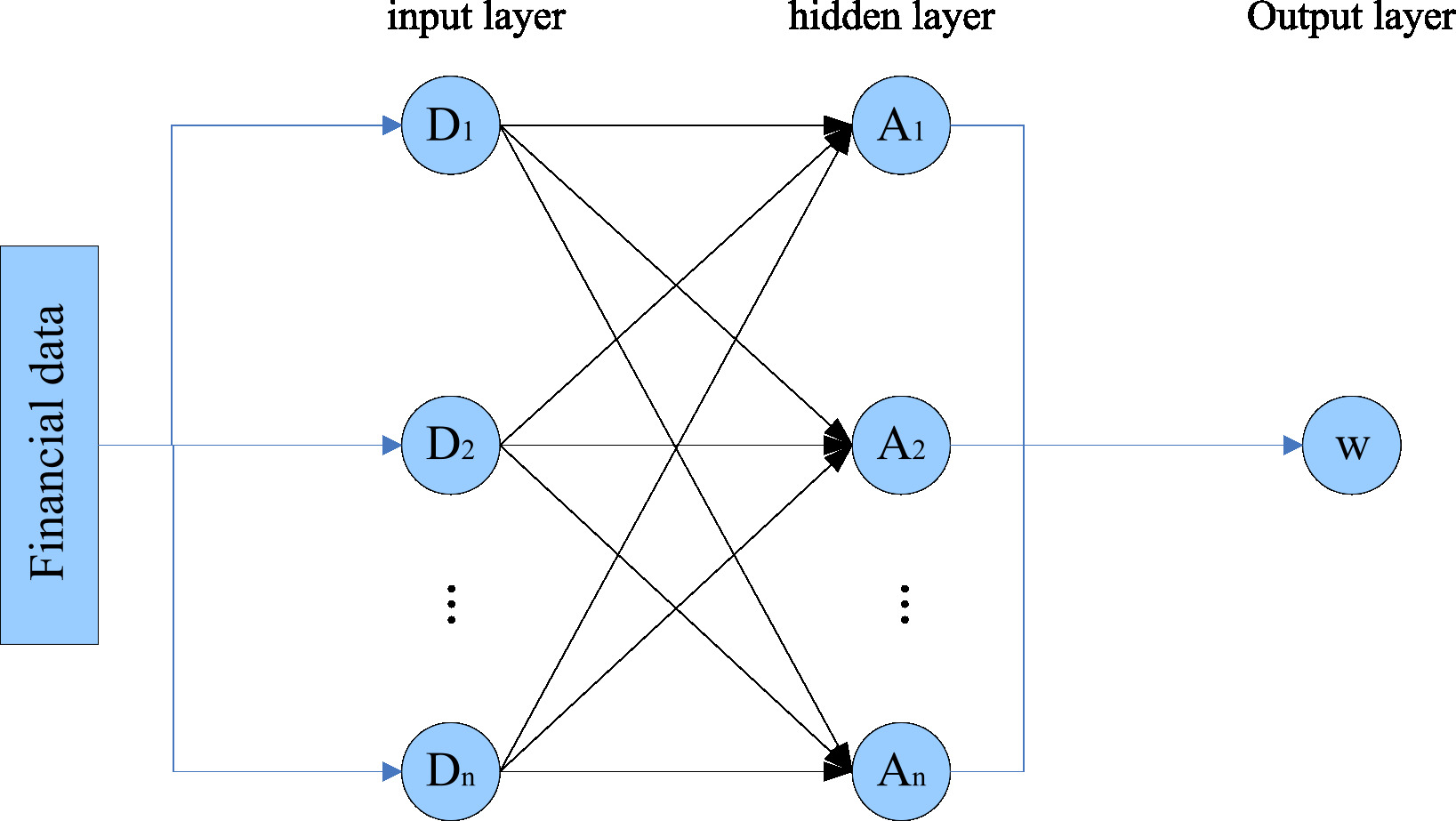
Then, when the financial data enters the deep learning network, it will be divided for detailed analysis. Assuming that the number of input financial data samples is
Among them,
The above equation represents the process of transmitting information from the input layer to the hidden layer in a deep learning network.
The above equation represents the process of transmitting information from the hidden layer to the output layer.
Among them,
In the above formula,
After that, the samples of the output financial data will be entered into the machine learning algorithm for re-analysis. After analyzing the financial data samples, learning and continuous training, the internal adjustment of the network is carried out according to the sample data, and the management and control model of financial big data is constructed. The financial data analysis process is shown in Fig. 6.
Financial data analysis process.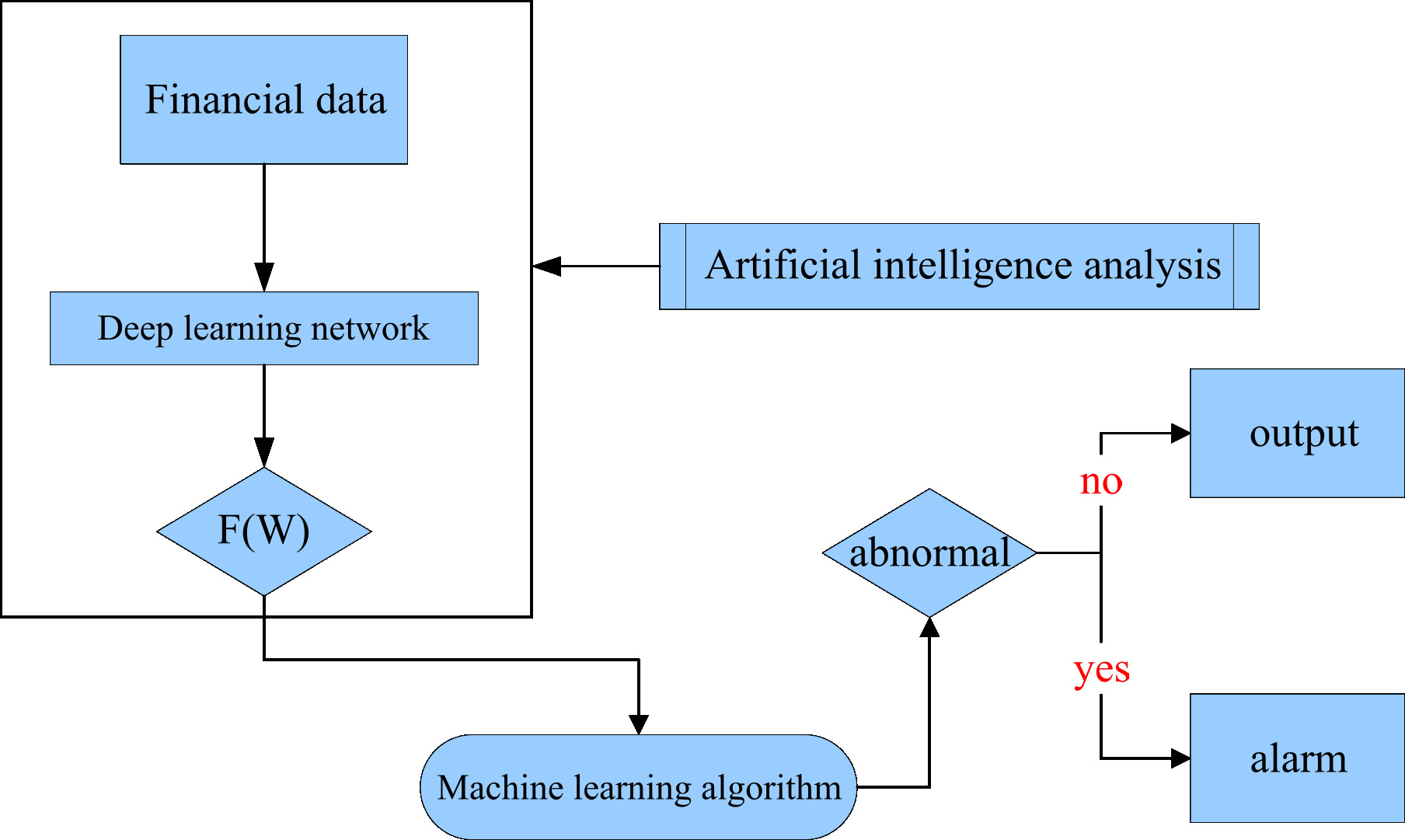
After the artificial intelligence analyzes the data, the machine learning algorithm will further analyze the data, find out abnormal data, and analyze the current development status of the company through the past financial data, and predict the future development situation of the company according to the current development status [21, 22]. In addition, it is also possible to discover internal problems of the company through data anomalies, make timely adjustments to avoid financial risks, and conduct more precise control of financial data. In addition, a financial early warning system is added to the financial analysis system to analyze specific accounting indicators to find out the risks existing in the enterprise, and the enterprise makes corresponding policy adjustments according to the predicted risks to ensure the smooth operation of the entire company. The financial Big data management and control system model is a computer system model used to process financial data. It includes data collection, Data cleansing, data storage, data analysis, Data and information visualization, decision support and other links. It aims to carry out detailed management and control of financial data and improve the accuracy and efficiency of financial data analysis [23]. This system is mainly aimed at enterprises and institutions with large-scale financial data needs, and its core goal is to achieve automatic acquisition, processing, analysis, presentation, and decision support of enterprise financial data. At the same time, the system utilizes technologies such as artificial intelligence and machine learning to continuously optimize system performance, improve the accuracy and efficiency of data mining and analysis, and provide better services for enterprises.
Accuracy experiment of financial big data management and control system
This experiment analyzes and forecasts the financial data of a listed group. First, it makes overall plans for the group’s development from 2005 to 2020, especially the group’s annual economic development. The test of this system is to use the data of the first five years to predict the development status of the next year, and to determine the feasibility of the financial big data management and control system of this article based on the accuracy of the system’s prediction of the development direction of the enterprise and the accuracy of the risk prediction. The economic development of the group from 2005 to 2020 is shown in Table 1.
Economic development of the group from 2005 to 2020 (unit: US$ 100 million)
Economic development of the group from 2005 to 2020 (unit: US$ 100 million)
From Table 1, the overall economic development of the group showed an upward trend, but it declined after 2014. After that, the economy began to grow, and the economy also began to decline in 2020, indicating that the company has experienced financial risk events in recent years. To this end, this experiment also counted the number of risk events that occurred in the group from 2005 to 2020, as shown in Table 2.
Number of risk events in the group from 2005 to 2020
From Table 2, it can be seen that from 2005 to 2020, avoidable risks, transferable risks and unavoidable and transferable risk events occurred in the group, and these risks had a certain impact on the development of the company. With comparable data, this experiment judged the feasibility of the management and control system in this article by comparing the economic forecast of the group with the management and control system in this article, the financial data management and control system based on machine learning algorithms, and the financial data management and control system based on deep learning. Then Fig. 7 shows the group economic forecast for 2011–2020 derived by these three systems based on the financial data from 2005–2010.
Comparison of forecast data for different systems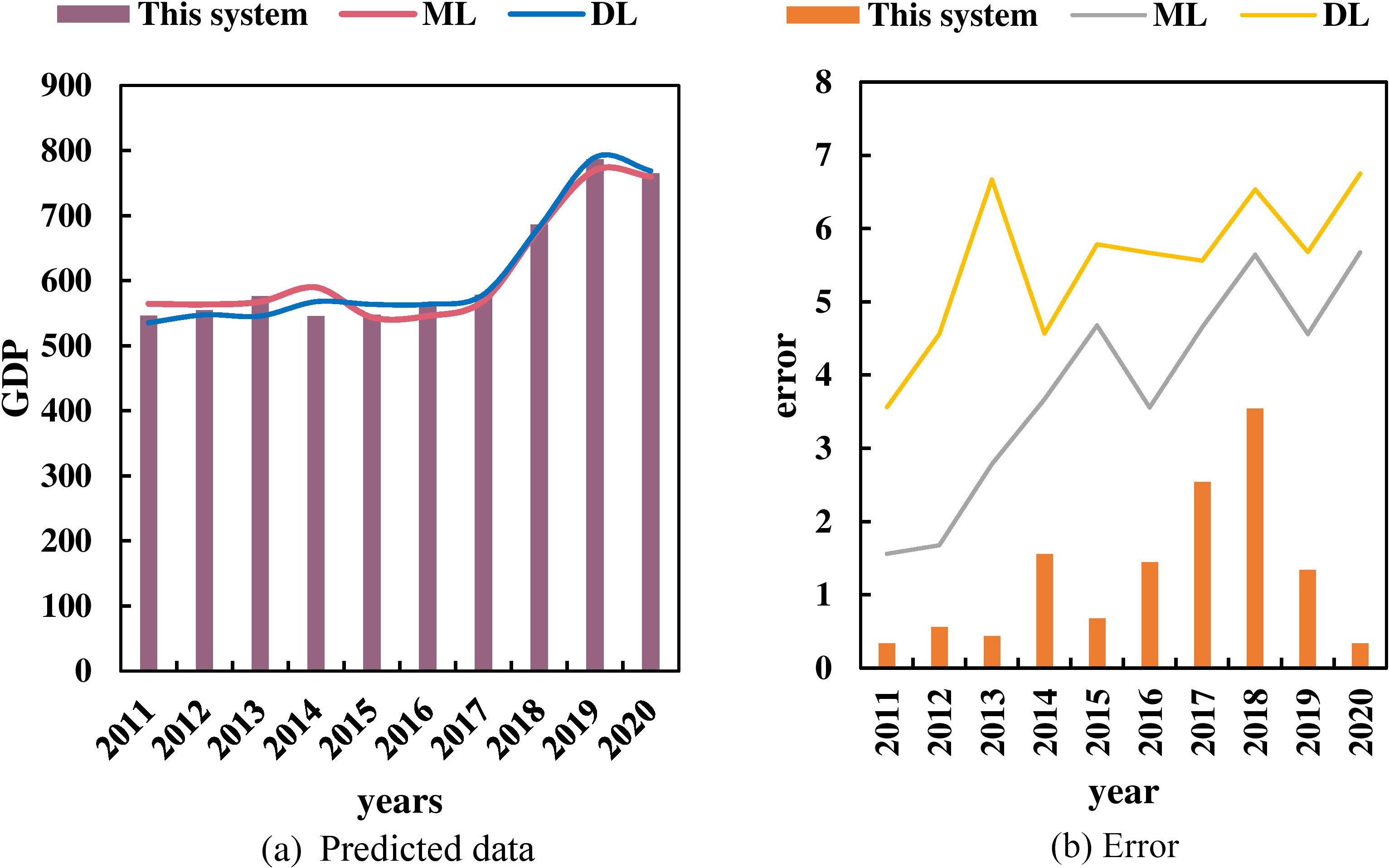
Comparison of risk event forecasts
In Fig. 7, ML represents the machine learning algorithm system, and DL represents the deep learning system. From Fig. 7, the system in this paper has high accuracy in predicting the economic data of the group. For example, in 2014, the actual economic growth of the group was 54.6678 billion US dollars, while the prediction data of the system in this paper was 545.89, and the data predicted by the machine learning system was 589.76. It can be clearly seen that the data predicted by the system in this paper is closer to the actual economic growth. And from the perspective of error, the error of the system in this article is between 0.34 and 3.56, while the error of the deep learning system is between 3.56 and 6.67, and the error of the machine learning algorithm is between 1.56 and 5.67. It can be found that error of the control system in this paper is the smallest. The model based on artificial intelligence and Big data technology is more accurate in forecasting the group’s economic data, and has less error. This indicates that the control model proposed in this article can provide more precise control of financial data risks and is expected to play a greater role in practical applications.
In addition, the risk prediction ability of the three systems is also tested, and the test data is compared with the actual data to judge the risk prediction ability of the system in this paper, as shown in Fig. 8.
From Fig. 8, (a) is the situation of the risk prediction of the system in this paper. The predicted number of the avoided risk prediction by the system in this paper was 156, which was the same as the actual number,while the number of predictions made by the machine learning system for avoidable risks was 147. It can be seen that the system in this paper has high accuracy in predicting risk events. Therefore, the financial data management and control system in this paper has high accuracy for financial risk prediction, and its accuracy can reach 90%.
In this experiment, the financial big data system of this paper was investigated in the use of the group, and the financial department of the group was tested. At the same time, the systems for trial operation with the system in this paper also included systems based on machine learning algorithms and systems based on deep learning networks. It monitored whether the analysis of the financial data of the three systems was in place, and asked the five financial personnel of the group to score. During the scoring period, the five financial personnel could not know the score of the other party, so the objectivity of the system scoring could be achieved. The recorded results are shown in Fig. 9.
System evaluation.
From Fig. 9a, each financial officer had different scores for the three systems, but in terms of scores, the score of the system in this paper was basically above 90, while the scores of the other two financial control systems were less than 90 points, so the system in this paper was more superior; and from Fig. 9b, the efficiency of the system in this paper was significantly higher than the other two systems. In general, the system in this paper has the highest practicability.
From the above experiments, the financial big data management and control system combined with artificial intelligence and machine algorithms in this paper is obviously more superior than the traditional financial data management and control system, and it is more accurate in risk prediction and enterprise development prediction. Its accuracy can reach 90%, and the efficiency and comprehensive score during use are also high, so it has high practicability.
Discussion
In terms of research, machine learning algorithms still have certain shortcomings in analyzing enterprise financial data, especially being prone to significant errors. The combination of artificial intelligence methods and machine learning algorithms used in this article precisely compensates for the shortcomings of machine learning algorithms in financial data analysis, and improves the performance of financial data management and control systems from multiple aspects. In future research, this article will delve deeper into how to improve this system, including conducting more detailed analysis from its profitability, development ability, cash flow, and other aspects, and improving accuracy to further enhance the practicality of this system and better assist the development of enterprises.
In terms of theoretical contributions, this paper mainly discusses the application of machine learning algorithm based on Internet of Things technology to control financial Big data. The research results of this paper will help promote the Digital transformation and development of the financial industry, improve the efficiency and accuracy of financial business, and reduce maintenance and management costs. Meanwhile, this study can also provide similar ideas and methods for other industries to improve the accuracy and efficiency of data management and control.
In terms of management enlightenment, the financial industry needs to constantly strengthen investment and research on Big data processing and management. Using Internet of Things technology and machine learning algorithm to control financial Big data can achieve all-round monitoring and rapid response to business, further improve the accuracy and response speed of business management, reduce risks, and promote the development of enterprises.
In terms of limitations, this study still has certain limitations. Firstly, the sample size used in this article is limited, and more data needs to be added for analysis in the future. Secondly, although the combination of artificial intelligence methods and machine learning algorithms in this article can improve the performance of financial data management and control systems, further comparison and evaluation of the advantages and disadvantages of different algorithms are still needed. Finally, the financial data control system studied in this article mainly focuses on controlling internal financial data of enterprises, and may not fully cover all data types in the financial industry.
In future research, this article will further explore how to utilize technologies and methods from other fields, such as blockchain and deep learning, to optimize and improve financial data management and control systems. At the same time, further research will be conducted on how to apply these technologies and methods to achieve more application scenarios to meet the needs of different industries and fields.
Conclusions
This paper studies a financial Big data control system based on artificial intelligence and machine algorithms. This system evaluates its feasibility and effectiveness by analyzing and predicting the financial data of a listed group. The experiment is divided into two parts, namely accuracy experiment and feasibility experiment. In the accuracy experiment, this article made an overall plan for the development of the group from 2005 to 2020. By predicting data from the first five years, the accuracy of economic development prediction and risk prediction between the proposed system and the other two systems were compared. The experimental results show that the system proposed in this paper can achieve an accuracy of 90% in economic and risk prediction, with small errors. Compared with the other two systems, the system proposed in this article has more advantages. In the feasibility experiment, this article investigated the financial data of the group and tested the financial department. At the same time, the three systems tested also include systems based on machine learning algorithms and systems based on deep learning networks. By comparing the ratings and efficiency of financial personnel, the system score in this article is above 90 points, proving that the system in this article is more superior in practicality. In general, the financial Big data control system based on artificial intelligence and machine algorithms proposed in this paper has higher accuracy, higher feasibility and higher practicability in economic prediction and risk prediction. This system can not only play an important role in predicting and preventing financial risks in a company, but also provide more information and support for decision-makers. Therefore, this system has broad application prospects and will be increasingly widely used in the future.
Footnotes
Funding
This research is supproted by Achievements in the funding of Yongjiang young talents in social sciences.