



Abstract
The scale of e-commerce in China continues to expand, and it has a relatively good development prospect. However, there are many problems in cost control in the development of e-commerce in our country. E-commerce companies have many problems in terms of promotion costs, warehousing costs, and operating costs. Although predecessors have made great achievements in this field and helped e-commerce companies solve problems related to cost control, there are still many problems in e-commerce companies. Question. This article starts with big data and Internet of Things technology, and focuses on storage costs and transportation costs to solve the problems of cost control in e-commerce companies. The problems existing in the development of e-commerce enterprises are: (1) The cost control system is not mature enough, the business scope is not clear, the cost control lacks innovative awareness, the logistics cost remains high, and the logistics management model is unreasonable. In order to solve these problems, we built a transportation cost optimization model and an operation cost optimization model based on big data and Internet of Things technology. Transportation cost and operation cost are two important components of the cost of e-commerce enterprises in my country. The model has been verified to effectively reduce transportation costs and operating costs, which is of great significance to reducing the cost of e-commerce enterprises in my country, can solve the problems of e-commerce enterprise development, and promote the development of e-commerce in my country. Finally, according to the model constructed by the questionnaire survey and the article, we put forward corresponding suggestions (1) optimize customer relationship, improve the enterprise model (2) promote enterprise innovation, and promote the transformation of marketing costs (3) improve the degree of informatization of e-commerce enterprises.
Introduction
With the rapid development of the Internet and social economy, e-commerce companies have gained a huge momentum for development. The development of the Internet provides technical support for e-commerce, and the development of social economy promotes the improvement of people’s willingness to consume. In this context, e-commerce has developed rapidly. At the same time, due to the increase of people’s work pressure and the advantages of online shopping prices, e-commerce has become a popular consumption method for the new generation. According to reliable sources, the overall scale of China’s e-commerce companies will increase by 8% year-on-year in 2022, and the scale of the e-commerce market will reach 32.6 trillion yuan by the end of 2022. Judging from this trend, the scale of e-commerce in my country continues to expand and has a relatively good development prospect [1, 2].
However, there are many problems in cost control in the development of e-commerce in our country. The cost management of e-commerce involves many links and is relatively complicated. Cost is the price paid for a given quantity of goods and services, measured in money. From the perspective of resource supply, we can divide resources into unlimited resources and limited resources. In practical applications, resources with unlimited use are generally cheap, and resources with limited use are generally expensive. A major problem in cost control in e-commerce is the allocation and use of resources. Cost management refers to the process of accomplishing a certain purpose through coordinating various links under the premise of a certain budget. In order to promote the further development of e-commerce enterprises, we must start from the cost, classify resources, implement cost planning, estimate, and finally control the cost of the project. The cost structure of e-commerce is shown in Fig. 1 [3, 4].
Cost composition of e-commerce.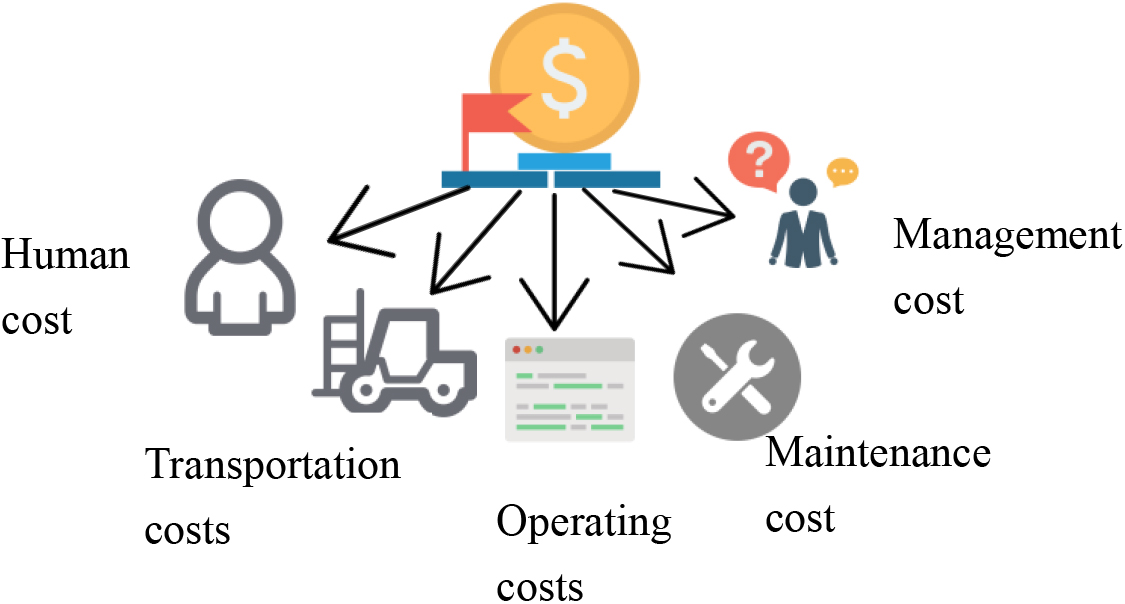
With the rapid development of information technology, big data and the Internet of Things came into being. The two complement each other and serve as the premise of each other, and jointly promote the rapid development of the information technology industry. E-commerce companies are also affected by big data and the Internet of Things.
The impact of the third industrial wave represented by network technology. The fast generation of big data can satisfy the demand for real-time data in all links of the e-commerce logistics supply chain has increased the sustainability and reliability of e-commerce business operations. The electronic tracking system of the Internet of Things can track the status of "orders" in real time, improving the e-commerce enterprises’ ability to control the flow of goods in the logistics supply chain. Big data and the Internet of Things play an important role in the development of e-commerce companies. Technologies such as the Internet of Things in the era of big data are closely related to industrial transformation and industrial optimization. Society values and relies on the overall use of information more than ever before. The essence of big data is the aggregation of complex data. Its basic mode of operation is the collection and processing of information, and processing of massive data sets through analysis and processing operations. The Internet of Things technology has great advantages in the interconnection of all things and information communication. Using the advantages of big data technology in data collection, data collation, and data analysis and utilization, and the advantages of the Internet of Things in real-time monitoring and timely feedback of terminal information, the electronic The combination of cost control and information technology of commercial enterprises can promote the optimization of logistics supply chain of e-commerce enterprises, reduce the cost of each link, and discover the disadvantages of the original model of e-commerce enterprises. The application mode of data and Internet of Things in e-commerce is shown in Fig. 2 [5, 6].
The application model of big data and Internet of Things in e-commerce.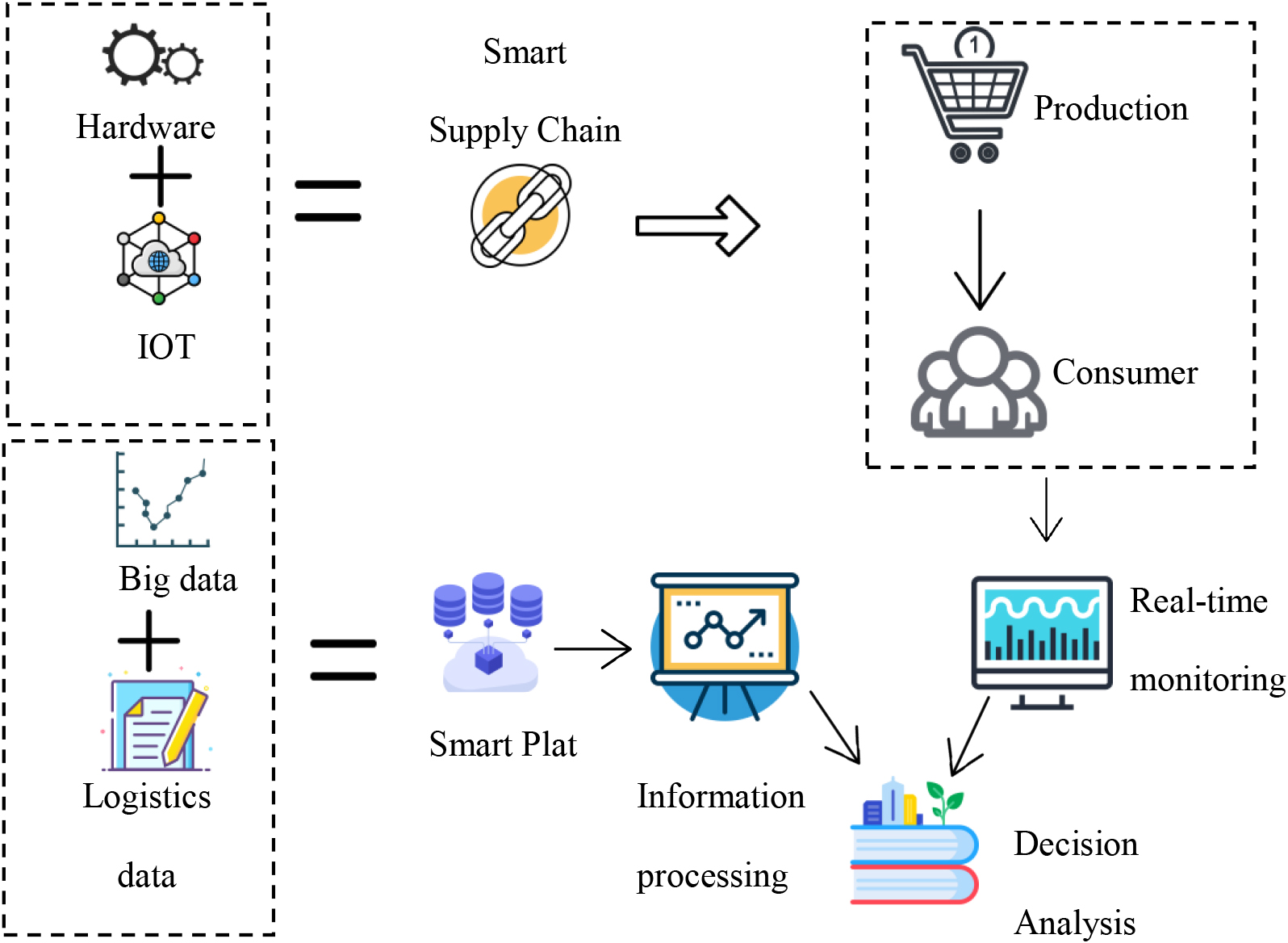
E-commerce companies have many problems in terms of promotion costs, warehousing costs, and operating costs. Although predecessors have made great achievements in this field and helped e-commerce companies solve cost control-related problems, e-commerce companies still exist many questions. This article starts with big data and Internet of Things technology, and focuses on storage costs and transportation costs to solve the problems of cost control in e-commerce companies [7, 8].
The main purpose of this paper is to explore how to further promote the development of e-commerce companies by utilizing big data and Internet of Things technologies to optimize cost control of e-commerce companies. With this goal in mind, this paper will answer the following core research questions: (1) How can big data and iot technologies improve the cost management of e-commerce companies? (2) How can these technologies be applied to the control of warehousing costs and transportation costs? (3) How to effectively use these technologies to achieve the cost optimization of e-commerce companies?
Survey
In order to deeply understand the problems existing in the cost control of e-commerce enterprises, we selected the main e-commerce enterprises in city a for investigation. The cost control of e-commerce enterprises mainly involves warehousing, transportation, and human and material resources. By means of questionnaire survey, the opinions and suggestions of the management and employees of e-commerce enterprises on cost control are collected. At the same time, they also collected their views on logistics, transportation and human and material costs. After investigating and analyzing the relevant data of these enterprises, the final summary results are shown in Fig. 3. It can be seen from Fig. 3 that the overall logistics costs of logistics enterprises in my country are increasing year by year, among which transportation costs account for the highest proportion [9, 10]. This is due to the high demand for logistics transportation of e-commerce companies, and the efficiency of the transportation link has not been fully improved. In addition, the cooperation mode with logistics enterprises, the immaturity of the cost control system, the unclear business scope and the lack of innovation consciousness, as well as the unreasonable logistics management mode have also brought serious challenges to the cost control of e-commerce companies. These findings provide important implications for our further study of how e-commerce companies can optimize cost control by leveraging big data and iot technologies.
Cost changes of nine e-commerce companies.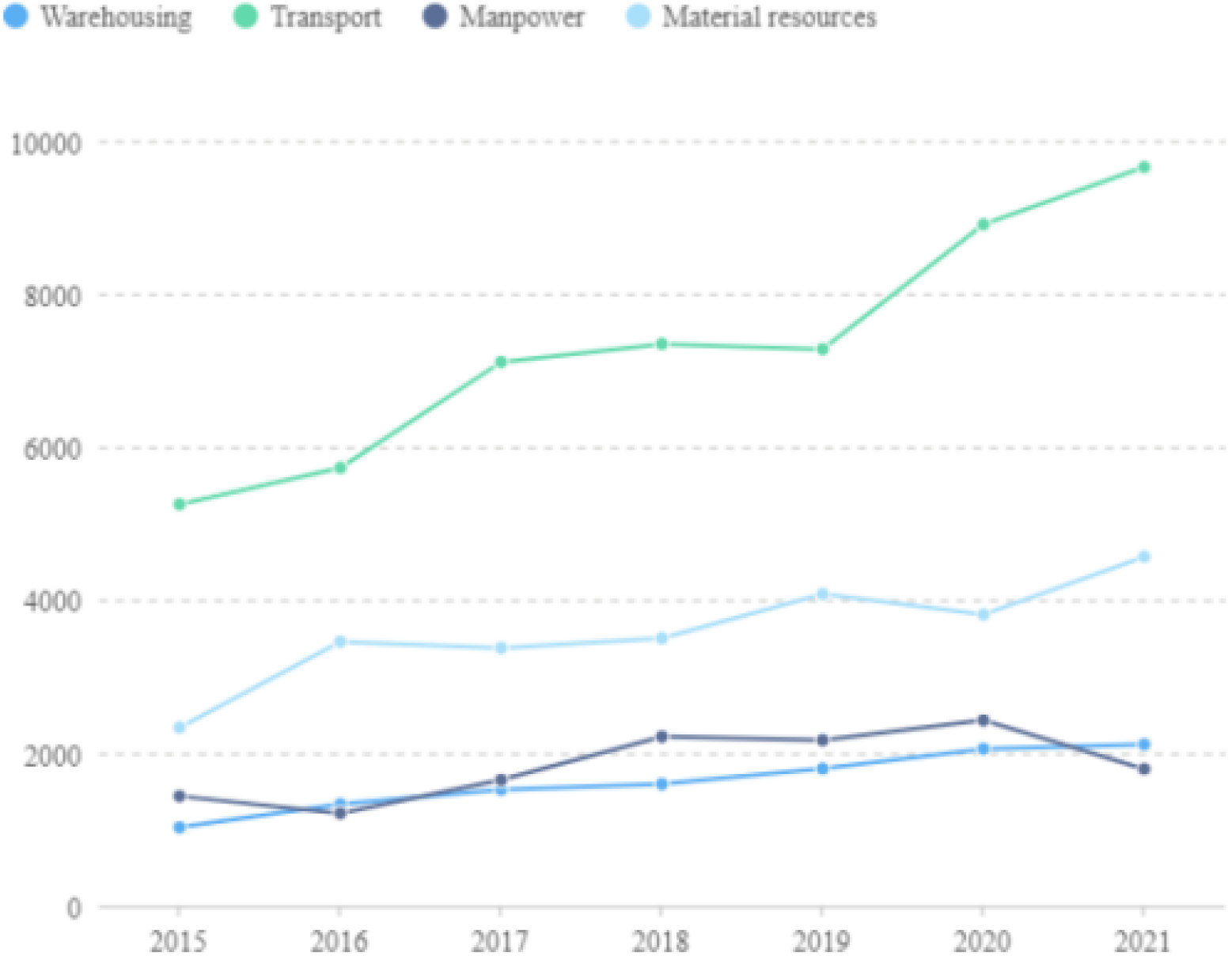
The cost control system is not mature enough
In recent years, although the scale of e-commerce enterprises has continued to expand, the profits of e-commerce enterprises have been decreasing year by year. This is because the operating costs of all aspects of e-commerce have increased. Logistics transportation is an important part of e-commerce. E-commerce products have the characteristics of a wide variety, short delivery cycle, and small occupancy. This leads to huge costs in packaging and logistics transportation for e-commerce products. Effectively reduce this part of the cost. Moreover, most of the small e-commerce enterprises in our country are still in their infancy, and the enterprises themselves are not strong enough, so they can only cooperate with logistics enterprises to outsource their own goods delivery. This has great disadvantages. On the one hand, outsourcing logistics cannot guarantee the timeliness of product transportation. On the other hand, high outsourcing costs also lead to high costs for e-commerce companies [11, 12].
The business scope is not clear, and the cost control lacks innovation awareness
The cost control of e-commerce is closely related to the services and products supplied by e-commerce enterprises. Due to the particularity of the way of e-commerce, he must use logistics to transport products to consumers, which leads to the limited products of e-commerce enterprises. Since the products provided by e-commerce enterprises are limited, the idea of cost control of e-commerce enterprises is limited to reducing service costs and commodity value, which is not conducive to the development of enterprises themselves. At the same time, the cost control of e-commerce companies lacks innovation, the construction of portal websites is stereotyped, and the services and products provided are mostly the same, which cannot attract consumers’ attention. Due to the lack of innovation awareness, the operation mode of e-commerce enterprises is also relatively backward, unable to achieve sustainable development [13, 14].
Logistics costs remain high and the logistics management model is unreasonable
The common supply chain modes of my country’s logistics transportation are shown in Fig. 4, and there are mainly four types as shown in Fig. 4, but these four supply chain modes all have certain deficiencies in some aspects. For example, logistics and transportation costs are high and transportation efficiency is low. The disadvantage of the enterprise’s open logistics model is that the enterprise’s own warehouse is high in cost and requires managers with high logistics supply chain management capabilities. The joint distribution logistics model relies too much on the distribution center. Once the distribution center is paralyzed, the entire logistics system will collapse. It can be seen from Fig. 4 that the logistics distribution mode of most e-commerce enterprises in my country is unreasonable, which is the reason for the high logistics and transportation costs. The cost of logistics and transportation is an important part of the cost of e-commerce enterprises, and it is also the most important part. In the logistics and transportation of e-commerce enterprises in my country, there will be low logistics efficiency and order errors, which will further increase the logistics and transportation costs. The irrationality of the logistics system leads to the irrationality of the logistics transportation mode, and the irrationality of the logistics transportation mode further aggravates the high cost of logistics transportation [15, 16].
Common logistics and transportation models.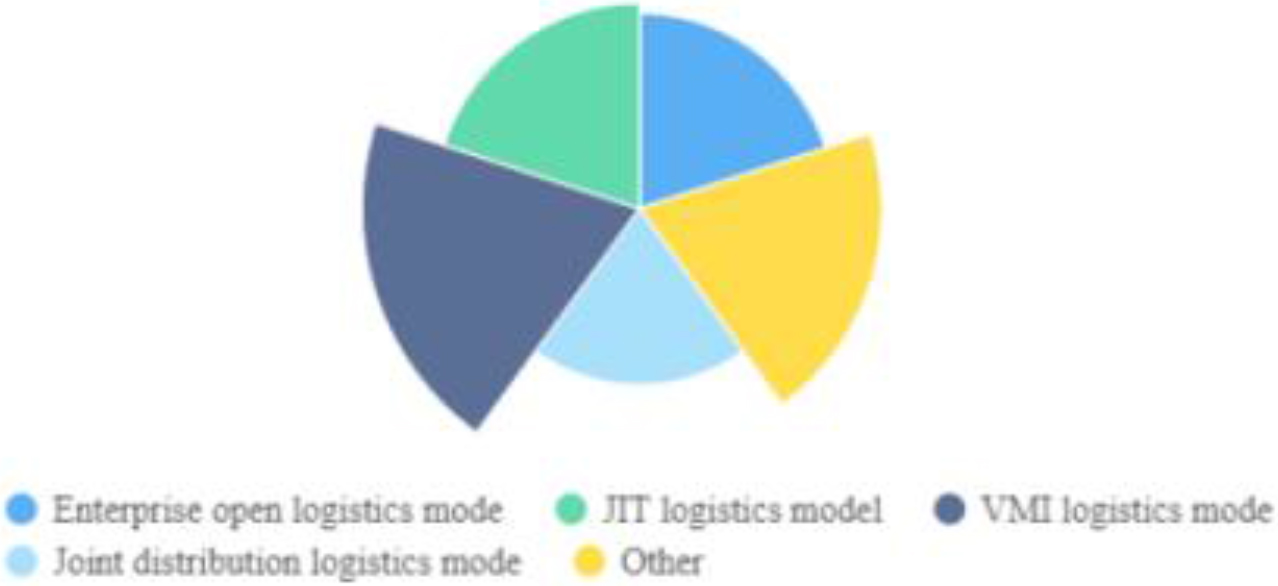
Model analysis
It can be seen from Table 1 that the transportation cost accounts for the highest proportion in the cost composition of e-commerce enterprises in my country, which also corresponds to the overall situation of the development of my country’s logistics industry. My country’s logistics cost lags behind western developed countries, and there is a significant difference in the empty vehicle rate of logistics transportation. The empty vehicle rate of my country’s logistics transportation is three times that of Western countries. On the other hand, my country’s logistics route planning is also one of the obstacles that hinder the reduction of logistics transportation costs. Big hindrance. The second is operating costs, accounting for 25%, which reflects the backwardness of the business model of e-commerce enterprises in my country. This article will start from the main factors to control the cost of e-commerce enterprises. Firstly, the transportation cost optimization model of e-commerce enterprises is constructed based on big data and Internet of Things technology. Secondly, the operating cost optimization model of e-commerce enterprises is constructed based on big data and Internet of Things technology to solve the two major cost components of e-commerce enterprises. Reduce costs for e-commerce businesses [17, 18].
Cost composition of e-commerce enterprises in my country
Cost composition of e-commerce enterprises in my country
After the above research, the logistics and transportation costs are abstracted into warehouse management costs, order processing costs, transportation costs, system usage costs, and labor costs. Using big data and Internet of Things technology to realize the entire process of the entire logistics supply chain, through big data and IoT-related algorithms optimize all aspects of the logistics link. The Internet of Things can perceive the data of each link through sensors, and then quickly transmit it to the data processing center. Through the analysis and processing of big data technology, it can provide effective information to decision makers, improve the feasibility of logistics and transportation route selection for e-commerce enterprises, and warehouse location selection. Effectiveness, etc., thereby fundamentally reducing logistics and transportation costs. Warehouse management costs, order processing costs, transportation costs, system usage costs, and labor costs are expressed as, respectively,
Each individual item can be divided into several sub-items, and the specific representation of S is shown in Table 2.
The specific composition of logistics transportation costs
In each item s, there are several influencing factors {a1, a2, a3.an}, how to realize cost optimization under the premise of considering these factors is the problem we consider. First of all, we need to use the Internet of Things technology to obtain the main data of the physical terminal, which mainly includes the length of commodity transportation, the nature of the commodity, and the special requirements of commodity transportation. These are important factors affecting each sub-item. First of all, we need to preprocess the data to remove useless data and duplicate data. The specific data is shown in Eqs (2)–(4), where r is the correlation analysis formula to determine the correlation between a1 and other variables in each item. And record the related relationship in the local database. Equations (3) and (4) further screen the acquired data to remove duplicate and incomplete data.
In order to ensure the optimal cost of logistics and transportation, we use big data analysis technology to further operate the data. Big data plays an important role in the analysis and processing of massive data. We integrate the idea of Dijkstra’s algorithm into the process of big data analysis. The specific formulas are shown in Eqs (5) and (6). Where
Through the operation of Eqs (5) and (6), we can get the optimal path for implementing each project S. Through this optimal path, in order to further determine the feasibility of this route, we evaluate it from two angles, K1 is evaluated from the perspective of human cost, K2 is evaluated from the perspective of resource cost, and it is the evaluation of human cost
The basic idea of the algorithm is as above. Through the above ideas, we can determine the optimal value in each item S, so as to determine the entire logistics transportation plan.
The core component of the operating cost of e-commerce is the marketing cost, which is the cost of publicity activities to increase the popularity of the product and the company, mainly including promotion costs and warehouse storage costs. To reduce marketing costs, it is necessary to select a suitable marketing plan, choose a cost-effective and effective marketing plan, and generate a creative marketing plan that can be remembered by consumers. Starting from the business model can also reduce the marketing cost of the enterprise, and by optimizing the business model of the enterprise, the marketing cost of the enterprise can be reduced [23].
This model optimizes the marketing plan of e-commerce enterprises based on big data and Internet of Things technology to reduce the marketing cost of enterprises. Creative marketing schemes often come from users. In order to analyze user data in detail, we use big data technology. We first use web mining mode to mine data. The specific process of mining is shown in Eqs (9) and (10), which
The results of web mining are analyzed with big data to obtain the user’s preferred elements, which are weighted and combined with human control, where W represents the results of web mining, and B represents human subjective intervention. Specifically, it is shown in Eq. (11).
To ensure the validity of model evaluation, we need to evaluate the model. This model uses a combination of subjective evaluation and human evaluation. The advantages of this evaluation are (1) more objective and real (2) More convincing (3) The evaluation method is more comprehensive. The specific model is shown in Fig. 5, and the evaluation results are shown in Table 3.
Artificial neural network evaluation model.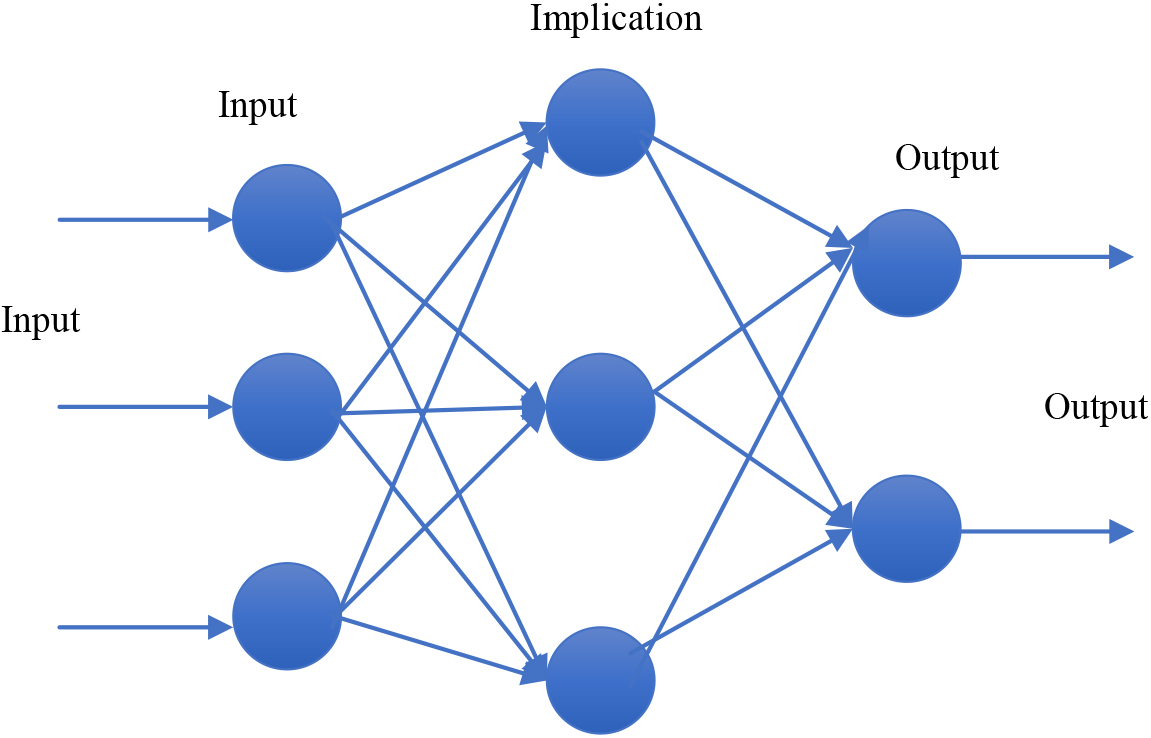
As shown in Table 3, after testing, the test results show that the transportation cost, operating cost, service quality, product quality, brand effect, and customer attitude all decreased, so this model has a good effect. Among them, A
Evaluation results
The model builds a transportation cost optimization model and an operating cost optimization model based on big data and Internet of Things technologies. Transportation costs and operating costs are two important components of the cost of e-commerce companies in my country. The model has been verified to effectively reduce transportation costs and operating costs, which is of great significance to reducing the cost of e-commerce enterprises in my country, can solve the problems of e-commerce enterprise development, and promote the development of e-commerce in my country.
Suggestions for e-commerce cost control
Optimize customer relationship and improve enterprise model
The premise of sustainable development of e-commerce enterprises is to have a stable customer base, which can help enterprises establish a stable industrial model, thereby reducing the cost of enterprise operation. To establish a stable customer relationship, we need to start from the customer’s needs, formulate a series of strategic goals that can meet the customer’s needs, and constantly change the internal structure of the enterprise toward these strategic goals until a stable customer relationship is formed. At the same time, e-commerce companies also need to control the quality of their products and provide customers with high-quality services. On the basis of establishing a good customer relationship, we can reduce the cost of e-commerce by streamlining the industrial structure and improving the efficiency of industrial operation, thereby improving the economic benefits of the enterprise.
Promoting enterprise innovation and promoting the transformation of marketing costs
Enterprise marketing is a necessary part of enterprise development, and marketing cost is also a major part of enterprise. The cost of mobile e-commerce companies also needs to start with marketing costs. When choosing marketing, e-commerce enterprises need to comprehensively consider many issues such as marketing methods, target audiences, and marketing costs, and choose appropriate and innovative corporate marketing plans. The choice of enterprise marketing plan still considers users. Through technologies such as web mining, users’ usage information can be obtained, and user preferences can be obtained as reference data for marketing plan selection, which can effectively improve the accuracy of marketing plan selection. In this link, enterprise innovation is also essential. Innovation injects soul into the formulation of marketing plans and is the support for enterprises to formulate effective marketing plans.
Improve the informatization level of e-commerce enterprises
Enterprise informatization is a major trend in the development of e-commerce enterprises. E-commerce involves many links, including production, transportation, supply, warehousing and other links. If only relying on manpower management, the cost of manpower management will be high and the error rate will be high. Using advanced information equipment to store information in all links of the e-commerce supply chain in the database, and replacing manual management with machine management, can improve the accuracy and timeliness of management to a certain extent, and can also reduce the labor cost of enterprises. Big data and Internet of Things technology is the main technical support for enterprises to carry out informatization, which can realize the development of the collection, storage, transmission and utilization of enterprise information, reduce the labor cost of enterprises, and improve the economic benefits of enterprises.
In summary, the results of this study show that by optimizing customer relationship, promoting enterprise innovation and improving informatization level, e-commerce enterprises can effectively control costs, improve operational efficiency and economic benefits, and promote the sustainable development of enterprises. These findings have important implications for understanding the challenges and solutions of cost control in e-commerce enterprises, and provide practical guidance for e-commerce enterprises.
Conclusion
The development of e-commerce in my country is still on the rise. The problems existing in the development of e-commerce enterprises are: (1) The cost control system is not mature enough, the business scope is not clear, the cost control lacks innovative awareness, the logistics cost remains high, and the logistics management model is unreasonable. In order to solve these problems, we built a transportation cost optimization model and an operation cost optimization model based on big data and Internet of Things technology. Transportation cost and operation cost are two important components of the cost of e-commerce enterprises in my country. The model has been verified to effectively reduce transportation costs and operating costs, which is of great significance to reducing the cost of e-commerce enterprises in my country, can solve the problems of e-commerce enterprise development, and promote the development of e-commerce in my country. Finally, according to the model constructed by the questionnaire survey and the article, we put forward corresponding suggestions (1) optimize customer relationship, improve the enterprise model (2) promote enterprise innovation, and promote the transformation of marketing costs (3) improve the degree of informatization of e-commerce enterprises.
Innovation points: (1) Use big data and Internet of Things technology to solve the cost control problem of e-commerce enterprises, combine technology with economy and business, and have novel themes. (2) The article solves the cost control problem of e-commerce from two aspects of transportation cost and operating cost. (3) The article uses the artificial neural network evaluation method to evaluate the model constructed by the article.
Insufficient: (1) This article understands cost control as cost reduction. (2) The depth of research is not enough.