



Abstract
Establishing a management information system that adapts to the continuous development of agricultural production management today, adopting advanced 5G technology and means, and comprehensively managing the entire agricultural production is an inevitable trend in the development of agricultural production management. In order to improve the effect of agricultural production informatization management, this paper combines 5G (fifth-generation) network technology to construct agricultural production and informatization management models. In view of the massive dynamic agricultural production management data, this paper studies the efficient multi-copy management strategy, which can consider the two aspects of load balancing and energy efficiency at the same time, so as to achieve efficient data access and energy efficiency. Moreover, this paper introduces a time series-based file access heat calculation model. In terms of determining the number of copies of files, this paper proposes a copy factor allocation algorithm centered on the ranking of file access popularity, and gives a characteristic function. Through cluster analysis, it can be seen that the agricultural production informatization management model based on 5G technology proposed in this paper can effectively improve the efficiency of agricultural information management.
Introduction
The narrow definition of information resource management focuses on the effective management of information resources itself. It is generally believed that information resource management refers to the rationalization process of data management, agricultural production information file management and technical management of information resources. The main point of view in the narrow concept of information resource management is that information resource management is an information management idea and management model developed by human beings in the long development process under the background of high social and economic development and information becoming an important social development resource [1]. The broad definition of information resource management emphasizes the globality of management, the integration of functions and the diversity of means. Information resource management is the process of implementing decision-making, planning, organizing, coordinating and controlling all elements of the whole process of information exchange, so as to effectively meet the needs of social information.
Agricultural science and technology information design has many majors and a wide range of fields. Agriculture in a broad sense includes forestry, farming, animal husbandry, fishing, and post-harvest processing, with hundreds of subsystems. It also involves fields related to agriculture, such as biology, medicine, environmental science and so on. The breadth of agriculture determines the comprehensiveness of agricultural science and technology information. A large number of scattered scientific and technological information, only after analysis, research and synthesis can we see its level, dynamics and trends from an objective higher level [2]. In the agricultural system, various factors such as environment, biology, ecology, economy, technology, and society are intertwined, and the change of one link or factor will inevitably bring some changes and influences to other factors. Therefore, it is of great significance to conduct comprehensive research and analyze the dynamics and changes of various aspects and subsystems for formulating agricultural measures and countermeasures [3].
Traditional agricultural information file systems face capacity and performance bottlenecks when processing massive amounts of data. The prerequisite for effective statistical analysis and data mining of big data is to efficiently store these massive amounts of data, and ensure that data is not lost at low cost, ensuring data security and availability. The purpose of this article is to use an intelligent information processing system to quickly process agricultural information and make effective decisions, improving the efficiency of agricultural information processing and decision-making.
This paper combines 5G network technology to construct agricultural production and information management model, promote the intelligent management of agricultural production information, and improve the efficiency of modern agricultural production.
Related work
Agricultural technology diffusion
The general concept of information resource management mainly has the following viewpoints. Information resource management is the product of the combination of information theory and management theory triggered by the application of computers. It is objectively possible and subjectively necessary to strengthen the centralized and unified management of information resources in the period when information practice develops to information processing automation and information transmission network. New concepts and theories that emerge from time to time [4]. Some scholars believe that: information resource management is to ensure the effective and rational use of information resources, using modern information technology as a means to control and coordinate all information resources, organize plans, command budgets and other management activities [5].
Agricultural technology diffusion is an activity to educate and serve farmers, an important means to speed up the transformation of agricultural technology, and a way to modernize agricultural production by equipping agriculture with science and technology. The agricultural extension work has been carried out smoothly, the extension activities have been carried out continuously and stably, and the role of extension personnel has been continuously strengthened. Agricultural extension personnel play the role of middlemen in information exchange and dissemination. The continuous flow in the chain forms the so-called “information flow” [6]. Information exchange in the diffusion of agricultural technology is a scientific and technological phenomenon, which refers to a certain law that various scientific and technological information flows to the countryside through various “media” channels under certain social environmental conditions, and penetrates and interweaves with each other. The flow of sexuality and inclination, its formation includes five elements, namely subject, object, time, space, and flow. The subject refers to scientific and technological information, the objective refers to the object receiving information, time refers to the time when the subject flows, and space is the flow of information. It refers to the scope of the flow of the main body; the flow direction refers to the orientation and level of the flow of the main body. These five are interdependent and indispensable, and together constitute the basic content of information flow in agricultural extension. It comes fast, has a wide area, is complex and diverse, and mostly flows in a disorderly state. Therefore, it is worthy of careful study and management, and the use of various research methods. and methods to analyze the characteristics of information flow in each link of agricultural extension, and then develop to the purpose of comprehensive development and utilization [7].
The most basic function of extension activities is education and service, and it is an information exchange activity. “Agricultural extension is a dual process of communication and non-formal education, that is, on the one hand, dissemination of useful information to farmers, and on the other hand, helping farmers to acquire the necessary knowledge, skills and improved attitudes so that they can successfully solve their own problems. problem” [8]. Up to now, research on how to unblock information dissemination channels in the process of agricultural extension, speed up information dissemination, improve information dissemination benefits, and give full play to the role of information dissemination in agricultural innovation diffusion and agricultural extension work. Literature [9] believes that the transformation of agricultural economic growth mode must do a good job of rural economic information services. In the process of rural science and technology extension services, rural information channels should be restored and improved, information facilities should be well constructed, and a rural comprehensive information service network should be established. Literature [10] pointed out that the informatization of agriculture is the only way for future agricultural development. In the process of agricultural information flowing to the countryside, the circulation channels are not very smooth, mainly due to the constraints of the economic and agricultural development level of Chen Village, the constraints of the current rural and agricultural organizational system, the constraints of the imperfect agricultural information network, and the communication in rural areas. The facilities are outdated, the development of information products lacks planning and rules, false information is used to deceive farmers, the state lacks support for the flow of agricultural information to rural areas, the cultural quality of farmers is poor, and the awareness of information is weak. Literature [11] believes that agricultural information has a long-term low user acceptance rate, which restricts agricultural information from entering the market and hinders the process of agricultural information industrialization. There are many reasons for this situation, including agricultural information itself factors (information regionality, truth, authority), information system factors (information personnel quality, information resource status, information technology environment) information receiver factors (users). quality, geographical environment, mental performance, economic ability). Literature [12] starts from the theory of communication, analyzes five factors that affect the effect of agricultural information dissemination, and puts forward corresponding countermeasures from the perspective of library and information workers.
Agricultural information management
Agricultural science and technology information is an integral part of information, which belongs to the category of economic information, and refers to the representation of objective facts that reflect various aspects of agricultural science and technology. Agriculture is a complex social system. With the development of the commodity economy and the gradual formation of pre-, mid- and post-production integration and serialized services, agricultural production not only includes vertical systems such as agriculture, forestry, animal husbandry, sideline production, and fishing, but also It also includes horizontal systems related to agriculture, such as industry, commerce, and trade, which is a “cross-shaped” system with comprehensive development [13]. Therefore, the content of agricultural science and technology information is very extensive. Any information flow that communicates agricultural management, scientific research, teaching, promotion, production, supply, and marketing activities, and contacts with agricultural producers, belongs to the scope of agricultural science and technology information [14]. Agricultural scientific and technological information is agricultural scientific and technological knowledge and practical technical information, which can promote agricultural development and increase farmers’ income. Information and other information can meet the needs of agricultural practitioners (especially farmers), and exist in the form of voice, text, pictures, video and multimedia [15]. Agricultural science and technology information dissemination refers to the process of information management center disseminating and disseminating agricultural science and technology information to the vast agricultural user groups. The dissemination of agricultural science and technology information requires many material conditions, including some capital investment, such as equipment, technology and manpower, etc., so as to form an agricultural science and technology information dissemination system composed of disseminators, audiences, dissemination carriers, and information effects. Only by managing the resources of the information dissemination system can the information spread deeper and wider [16].
Although scholars have conducted research on load balancing and energy efficiency technologies for agricultural information replicas, there is a lack of research on efficient management of multiple replicas that simultaneously considers load balancing of replicas and proportional efficient utilization of energy. In terms of studying the proportional and efficient utilization of energy, there is relatively little research on utilizing the characteristic of multiple replicas of data. Even considering this characteristic, it is difficult to balance the load balancing of replicas and the efficient utilization of energy. Therefore, this paper focuses on the above issues.
Replica management strategy for adaptive load balancing
Copy factor decision-making algorithm centered on the ranking of agricultural production information files
When establishing a time-series-based calculation model of the access heat of agricultural production information files, it is necessary to assign different influence factors to the access volume of agricultural production information files in multiple sampling periods. Therefore, the more recent sampling period, the greater the proportion of the heat of agricultural production information files in the heat calculation formula. The longer the sampling period, the smaller the proportion of the heat of agricultural production information files in the heat calculation formula.
The following is a calculation model of the access heat of agricultural production information files based on time series. The following symbols need to be used in this calculation model:
At the end of the
The derivation process is as follows:
The access heat value of the agricultural production information file
The access heat value
Substituting Eq. (3) into Eq. (4), we get:
Substituting Eq. (2) into Eq. (6), we get:
By recursion, we can get:
That is:
Correspondence between the popularity ranking of agricultural production information files before a certain sampling period and specific agricultural production information files.
Figure 2 shows the correspondence between the popularity ranking of agricultural production information files and specific agricultural production information files after a certain sampling period. Because the popularity of each agricultural production information file has changed during the sampling period, it can be seen that their corresponding popularity rankings have also changed: The agricultural production information file heat ranking
Correspondence between the popularity ranking of agricultural production information files and specific agricultural production information files after a certain sampling period.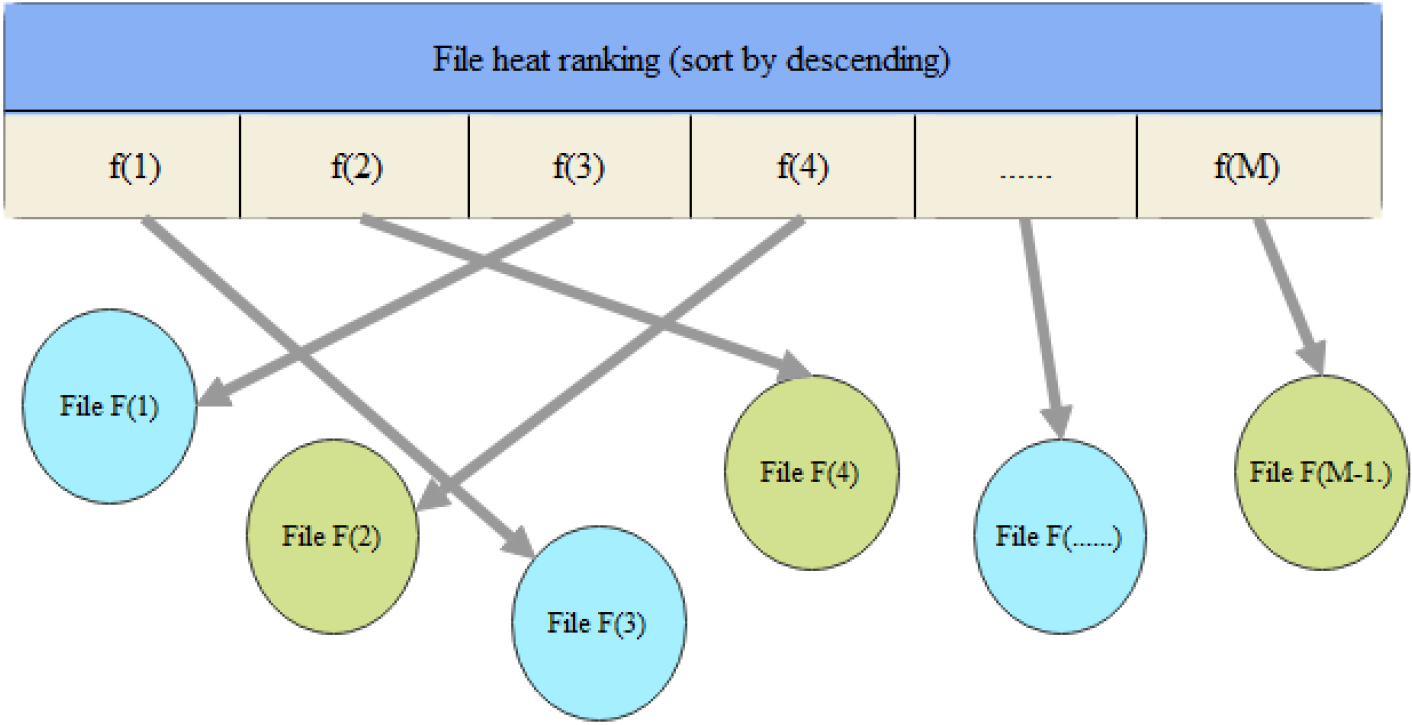
The function
When the total number
The replication factor assigned to all agricultural production information files in the sub-set
The system administrator can set the value of
So far, according to Eqs (6) and (7), the interval division of the independent variable
The replica factor assignment function
Popularity ranking and copy factor of agricultural production information files in a certain sampling period.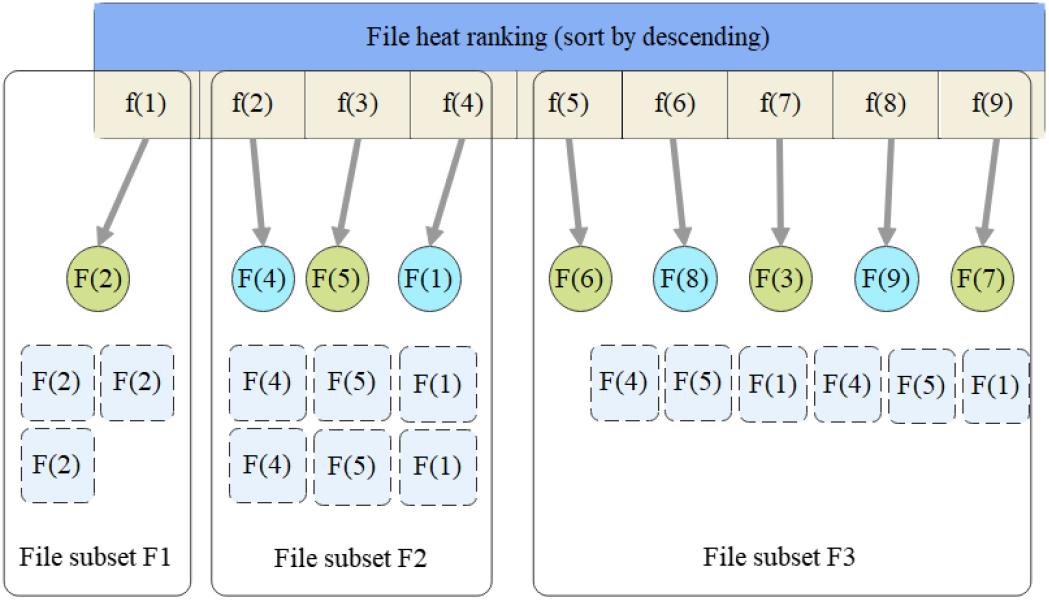
There are only two indicators used in this paper to measure the placement cost:
One is the access times of all data on the data node within the sampling period The second is the time taken by the data node to process each access within the sampling period
It can be seen from Eq. (9) that the placement cost of the replica is proportional to the total time spent by the data node to process the access request.
The network distance between the data node where the replica is located and the user requesting node can be used as an important reference factor for replica selection. The reason is that the network distance has a great impact on the delay and reliability of data transmission, which is directly related to the response time to user access requests.
For example, in a large Hadoop cluster, the NameNode configures the agricultural production information file through the network topology of the data node to obtain the RackID of each data node in the cluster. With RackID, NameNode can draw the data node network topology as shown in Fig. 4.
Topological structure of DataNode network.
We assume that when a user accesses an agricultural production information file, data copies of the agricultural production information file exist on m data nodes. Such data nodes become candidate nodes, and the specific calculation process of the weighted Euclidean distance is given below.
(1) The algorithm establishes a statistical matrix
Each row in the matrix represents the four evaluation factors for a candidate data node. The four evaluation factors from left to right are the network distance between the node where the data copy is located and the user access node, the disk
(2) Normalization of evaluation factors
This paper uses the normalization Eq. (11) to change each evaluation factor into a decimal between (0, 1).
(3) Weighted processing of evaluation factors
After normalizing each evaluation factor, the cluster administrator can assign different weights to each evaluation factor according to different practical application scenarios. For example, in the system where agricultural production information files are frequently read, the weight of disk
Weight values of evaluation factors
The matrix
Among them,
(4) Calculate the Euclidean distance
First, the algorithm selects the minimum value of each evaluation factor in the weighted evaluation matrix
The set
Then, the four evaluation factors of each data node are also formed into the corresponding set
The value of
Selection process of weighted Euclidean distance replicas.
From the perspective of the transmission cycle of agricultural information flow, agricultural information technology can include three technical processes: information collection technology, information processing technology, and information simulation technology, as well as two supporting technologies: information transmission technology and information storage technology. The emergence and development of agricultural information technology is inseparable from the support of modern computer technology, which is the basic development environment of the agricultural information technology system. The agricultural production information management system constructed in this paper combined with 5G technology is shown in Fig. 6.
Agricultural production informatization management model based on 5G technology.
As shown in Fig. 6, Agricultural information technology can include three technical processes: information collection technology, information processing technology, and information simulation technology, as well as two supporting technologies: information transmission technology and information storage technology. Information collection technology includes aerospace remote sensing technology, global positioning technology, and ground survey and automatic monitoring technology, including the rapid measurement technology currently applied in precision agriculture; Information processing technology mainly includes spatial analysis technology, artificial intelligence technology, and various professional modeling technologies provided by geographic information technology, which are used to analyze and reprocess various types of information; Information simulation technology mainly includes simulation modeling technology, virtual reality technology, and some auxiliary expression technologies (such as multimedia technology), used to establish “virtual farms”, “virtual greenhouses”, etc., to simulate and reproduce crop growth or agricultural production management. The two key supporting technologies in the technological system of agricultural information resource utilization and development are information transmission technology and information storage, such as the “conveyor belt” and “logistics distribution library” in industrial production. The utilization and development technology of agricultural information resources is regarded as a production line for analyzing and processing information flow.
The main key technologies in the system development process of this project include serial communication, image monitoring, GPS, network transmission, and multi-threaded programming.
Serial Communication is a communication method that transmits data through a serial interface. Serial communication uses a single transmission path for data transmission. Compared to parallel communication, serial communication only requires a small number of pins and occupies less hardware resources. Video surveillance is the real-time video monitoring and recording of designated areas or locations through the use of cameras and related technologies. Image monitoring systems are widely used in public safety, traffic management, commercial safety, industrial monitoring and other fields, aiming to provide real-time monitoring, event detection, safety warning, and evidence collection functions. GPS data reading can be achieved through communication between the GPS receiver and the serial port. The GPS receiver is connected to a computer or other device through the serial port and the data is read using serial communication protocols (such as RS-232 communication protocol). Serial communication libraries or APIs in C Network transmission is a communication method based on network sockets, used for data transmission and communication in computer networks. Socket is a programming interface that provides methods for sending and receiving data over a network. Socket network transmission provides a flexible and reliable method for achieving cross network data transmission and communication. Multithreaded programming technology refers to a programming model that executes multiple threads simultaneously in a program. Multithreaded programming can improve the concurrency and responsiveness of programs, fully utilizing the performance of multi-core processors and multitasking environments. A thread is the smallest unit of program execution, and each thread has its own execution path and context, which can independently execute code.
This paper uses OptorSim to evaluate the effect of adaptive load balancing copy management strategy in system load balancing. OptorSim provides a framework that can simulate a real grid environment and is used to test dynamic replication strategies in a data grid environment where various task execution situations may exist. The architecture of OptorSim is shown in Fig. 7. In OptorSim, input parameters can be controlled by setting some configuration files. The grid configuration file xxx grid. conf is used to describe the grid topology, available network resources for each node, and network connection status.
Architecture of OptorSim.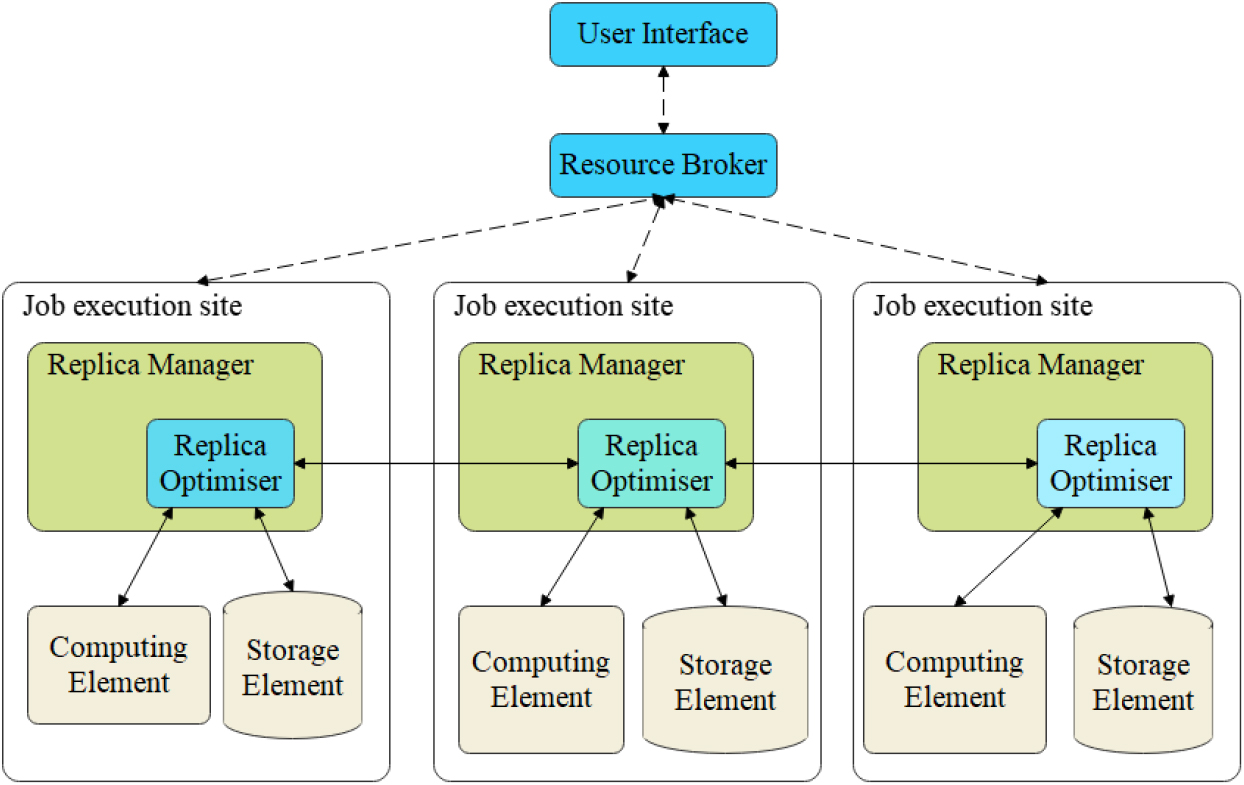
The system features of Optorsim are as follows:
Configure emulator parameters: OptorSim provides powerful data input capabilities for customizing various experimental cases. The input to OptorSim is three configuration files: Grid Configuration File, Job Configuration File, and Simulation Parameters.
Data statistics function: OptorSim provides very powerful data statistics and graphical display functions. It provides statistical data for various execution periods, providing great convenience for analyzing simulation experiment results.
Copy optimization algorithm: OptorSim provides optimization algorithms for use in the optor package [3]. Recently, the longest unused replica algorithm (LRU), least frequently used replica algorithm (LFU), binomial oracle function replica algorithm, etc. When using existing algorithms, simply change the value of “optimizer
Modular design: OptorSim adopts different replica optimization strategies and implements several different replica optimizers, mainly including SkelOptor module, SimpleOptimiser module, LfuOptimiser module, Copying Optimiser module, and LruOptimiser module.
Overall, the system characteristics of Optorsim have strong adaptability to the agricultural information system proposed in this article, making it very suitable for the system in this article.
Simulated network topology.
Because the network bandwidth is different between different areas (such as within a rack and between racks), the network bandwidth of the data nodes in the same area is set to 100M bandwidth. The network bandwidth of data nodes not in the same region is set to 10M bandwidth, which can better simulate region-based storage. The replica manager is set on the data node with the largest number of computing units in each region. Figure 8 is the network topology established according to the network configuration agricultural production information file. Each line in the configuration file describes the information of a node, with the following specific meanings: the first column represents the number of computing units (CE) of the node, representing its computing power; the second column represents the number of storage units (SE) of the node, representing its storage capacity; and the third column represents the storage capacity of the storage unit (in MB). The remaining columns in the configuration file are a network connection matrix, and the values in the connection matrix represent the given maximum bandwidth (in Mbps)
The method based on static data placement does not have the problem of data migration, but because the storage location of data is fixed when it is first placed and does not change during system operation, it has special requirements for the placement strategy, which can ensure the availability of all data when some data nodes are shut down or hibernated. For example, the replication factor of a cloud storage system is n, and replicas of the same data block are distributed on different data nodes. When the number of closed or dormant data nodes reaches n, it is possible that certain data blocks are unavailable. The energy efficiency technologies introduced above have a common drawback: although they achieve proportional energy consumption and can dynamically increase or decrease data nodes according to the current load of the system, they cannot support load balancing well. In order to pursue energy efficiency, data and data access requests are concentrated on some data nodes, thereby maximizing idle node shutdown or sleep time, reducing system energy consumption, but without paying attention to system load balancing. Therefore, this article conducts research on energy efficient technologies that have relatively less data migration and can support load balancing.
When a data node is switched back to normal power mode, there is a penalty for power consumption and switching time, so proportional power consumption is not something that can be done easily. Proportional energy consumption is only valid if the idle period meets the criteria shown in the formula.
The energy consumption calculation formula is as follows:
Among them,
Among them,
Build a testing platform under the simulation environment CloudSim for evaluation and comparison. CloudSim is a scalable generalized simulation framework that provides the characteristics of cloud computing, supports resource management and scheduling simulation of cloud computing, and realizes modeling, simulation, and testing of large-scale cloud computing infrastructure.
Combined with the above research, the effectiveness of the agricultural production information management model proposed in this paper is verified, and the experimental results are clustered, and the clustering results shown in Fig. 9 below are obtained.
Cluster analysis of agricultural production informatization management model based on 5G technology.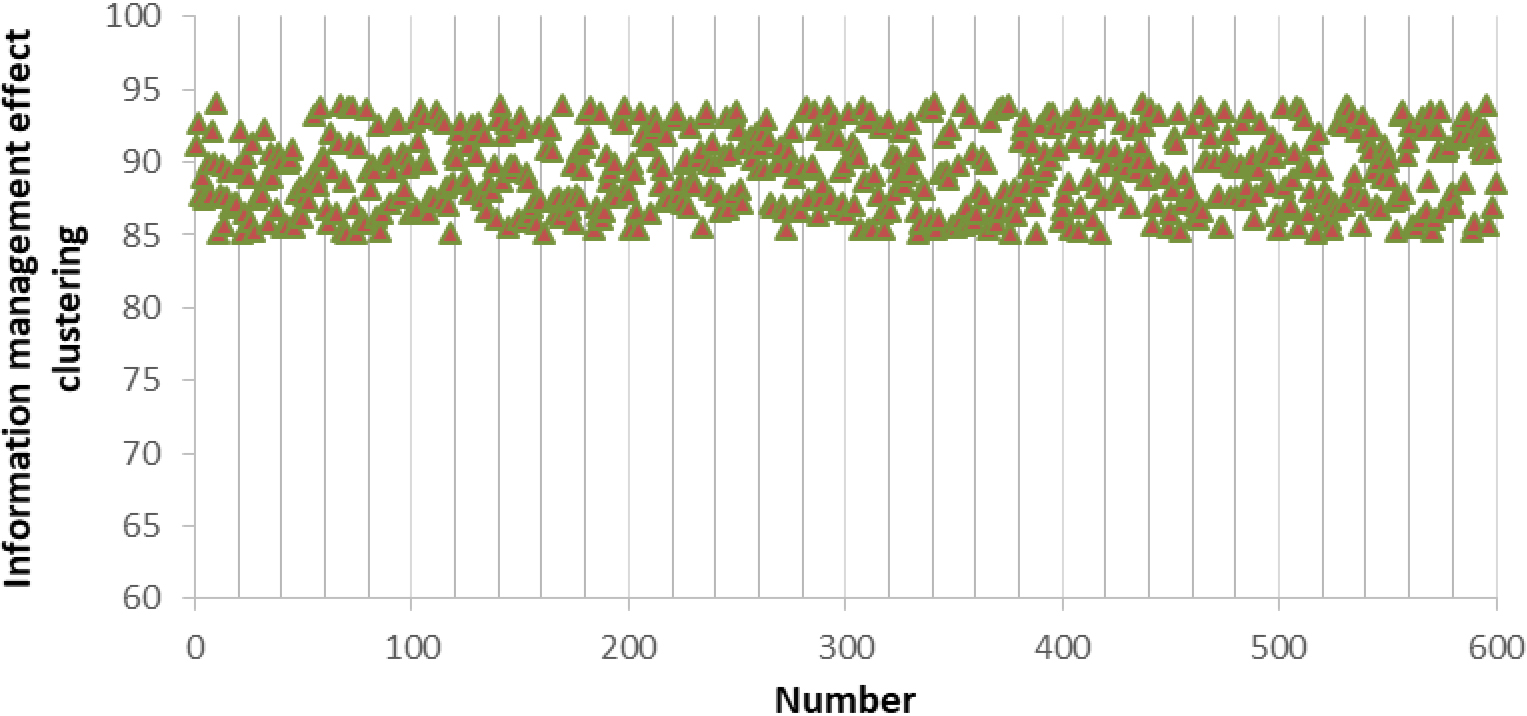
From Fig. 9, it can be seen that the evaluation results of the agricultural production informatization management model based on 5G technology proposed in this article are distributed between [85, 95], showing excellent performance and meeting the actual needs of agricultural production informatization management.
From the clustering results shown in Fig. 9, it can be seen that the agricultural production informatization management model based on 5G technology proposed in this paper can effectively improve the efficiency of agricultural information management.
This paper considers that existing research on agricultural information multi replica management strategies only focuses on achieving system load balancing, and rarely considers energy efficiency utilization simultaneously. Although research on energy efficient utilization has reduced the overall energy consumption of the system, it cannot effectively support load balancing of the system, and few studies can utilize the feature of multiple copies of data to achieve energy efficiency. Based on the above research objectives and current research status, this paper proposes a research on efficient multi replica management strategy for agricultural information, which can simultaneously balance load balancing and energy efficiency, achieving efficient data access and energy efficiency.
A real-time collection system based on 5G agricultural parameter information is designed using sensors, video capture, GPS positioning, and 5G mobile communication technology. This system can achieve rapid information collection and processing, make effective decisions in a timely manner, and improve the efficiency and effectiveness of agricultural information processing.
From the perspective of agricultural information application, the concept of information can be understood as the intelligence information exchanged between people, things and things, people and things, policies and regulations, plans, orders, secret orders, market prices, product marketing, thesis writing, investigation reports, as well as all information and signals such as spatial data, attribute data and electromagnetic wave signals of ground objects. Through the acquisition of information and exchange of thinking and processing, a lot of information and knowledge are generated and obtained. This new information can also correct the wrong understanding, and then obtain a new correct understanding, and then make a correct judgment on the development of things, and take targeted corresponding measures to achieve a variety of great social, economic and ecological benefits. This paper combines 5G network technology to construct agricultural production and information management models. Through cluster analysis, it can be seen that the agricultural production informatization management model based on 5G technology proposed in this paper can effectively improve the efficiency of agricultural information management.
The system can collect real-time environmental data such as soil temperature and humidity, pH value, nitrogen, phosphorus, potassium, and real-time images in farmland, and has the function of remote data transmission. The goal of real-time and reliable collection of key factors affecting soil moisture and fertility in farmland, such as water content, pH value, nitrogen, phosphorus, and potassium elements, has been achieved. This has improved the efficiency of soil condition detection and collection in farmland, played a certain significance for the development of soil condition detection and collection technology in farmland, and played a positive role in the future development of big data and intelligence in farmland. The subsequent research is to further verify the practical role of the system in agricultural production, in order to verify the effectiveness of the system.