



Abstract
Emotional feeling is a phase of neurobiological activity that plays an important role in cognitive thinking and learning, although largely overlooked in complex tutoring fields like Mathematics. This paper introduces an innovative e-learning Mathematics course integrating emojis as a feedback mechanism to express students’ emotional responses towards mathematical challenges. By providing a platform for intuitive emotional expression, this approach aims to strengthen engagement and comprehension. Through empirical investigation, emotional reactions of online mathematics students are explored, with attention to gender-related differences in emoji usage. A survey administered to 100 students prompts them to select emojis conveying their sentiments towards mathematical problems. Statistical analyses reveal that emojis effectively capture students’ emotions, with an emphasis on gender-based variations in selection. These insights illuminate the dynamics of emotional expression and hold implications for fostering comprehensive learning environments that mitigate negative emotions such as mathematical anxiety. By empowering educators to monitor students’ emotional reactions and adapt teaching strategies accordingly, this approach has the potential to cultivate confident and proficient learners essential for STEM (Science, Technology, Engineering, Mathematics) advancement.
Keywords
Introduction
Human emotions play an important role in how people think and learn. Emotional feeling is a phase of neurobiological activity, the key component of emotions, and emotion-cognition interactions, while emotions play a critical role in the evolution of consciousness and the operations of all mental processes [1]. In recent decades, the importance of emotions in the cognitive processes of humans and their role in affecting all mental processes has been acknowledged by many researchers in human-computer interaction working on deep representations of the user experience [2, 3, 4, 5, 6] and in recent advances of Artificial Intelligence (AI) [7, 8].
Education can be affected by human emotions which can play a significant role in the cognitive processes of all learners in all domains and more importantly in complex tutoring domains such as Mathematics. Mathematical proficiency correlates positively with success in our industrial and technological society [9] as STEM (Science, Technology, Engineering, Mathematics) advancements are based on Mathematics and in turn innovations in this field elevate the quality of our lives. Therefore, there is a growing interest in pursuing careers rooted in mathematics, such as those in the STEM fields [10].
Despite the undeniable impact of mathematical studies, mathematics has also been notorious due to what is termed as “mathematics anxiety.” Math anxiety refers to a range of negative emotional reactions to math-related information or activities [11, 12]. This phenomenon has been an important subject of study since at least the introduction of the concept of “number anxiety” by Dreger and Aiken in 1957, who highlighted that this issue has persisted for many centuries before the twentieth century [13]. Dowker and colleagues point out that mathematics anxiety has received increasing attention in recent years [14]. This is certainly the case since math anxiety among middle school students has been associated with interest in careers [15, 16] and the later pursuit of non-math-intensive careers [17].
Addressing math anxiety is essential to increase students’ motivation to pursue further studies in STEM-related fields. This research goal extends to investigating gender-based attitudes and emotions toward mathematics. Amato [10] provides insights into origins and effects of math anxiety as the reason females are less likely to choose (STEM) majors and related careers, while other studies show that females are underrepresented in STEM departments and careers, irrespective of their math competence [18]. Dowker and colleagues point out that understanding children’s and adults’ attitudes and emotions towards mathematics is crucial for removing barriers to learning and progress in this subject [14].
In light of these challenges, one promising avenue of research is affective computing, which explores the development of computer-based programs capable of recognizing, expressing, and responding to emotional information [19]. Affective computing holds the potential to enhance machines’ emotional intelligence, spanning interdisciplinary domains such as computer science, cognitive science, and social science [20]. It can be employed in user modelling to take into account users’ emotions and enhance user experience, including student experience in e-learning [21].
Considerable research has been conducted in affective computing to investigate how a computer can recognize emotions in the area of affect or emotion recognition. This is performed using several approaches, including, an affective visual approach for groups [22], or individuals [23], or a combined approach of a visual-facial affect recognition system with keyboard-stroke pattern information [24] or other modalities [25], such as visual-facial emotion recognition with audio-lingual and keyboard stroke pattern information [26] or an affective keystroke game-based approach [27] and many other approaches. Moreover, researchers have investigated how computers can interact with humans in an emotion-based manner in the field of emotion generation in computers, robots, or chatbots [28, 29]. A relevant area for affective systems is sentiment analysis, which usually refers to natural language processing (NLP) techniques that involve determining the sentiment expressed in a piece of text [30, 31].
In view of the aforementioned challenges, our research endeavors to address the need for innovative approaches to enhance student engagement and comprehension in digital mathematics classrooms by integrating affective communication through emojis. To this end, we have developed an educational tool – a special-purpose social network designed for computer-supported collaborative learning – that combines the social aspects of collaboration with robust educational tools capable of conveying a range of emotions through emojis. This represents the first instance of utilizing emojis for affect recognition in an educational context for students practicing mathematics.
Our study focuses on evaluating how this novel feature enriches students’ learning experiences by providing them with a platform to express their feelings while reacting to mathematical problems using emojis. Central to our research is an empirical study, which is gender-based and has been conducted with a sample group of 100 high school students enrolled in an online mathematics curriculum. This study highlights the significance of our sentiment-based approach and underscores the importance of further research to explore effective pedagogical strategies in digital classrooms.
The structure of the paper is organized as follows: Section 2 presents an overview of related work in affect perception and emojis. In Section 3, we describe the e-learning course in mathematics, detailing the facility for students to react to mathematical problems with emojis. Section 4 outlines the methodology employed in our empirical study, focusing on the use of emojis as reactions to mathematical problems. In Section 5, we present the results of the empirical study, followed by a discussion of these results in Section 6. Finally, Section 7 presents the conclusions drawn from our research and suggests directions for future investigation.
Related works in affect perception and emojis
Analyzing and understanding the sentiments of social media documents on Twitter, Facebook, and Instagram has become a very important task at present [32]. Both sentiment analysis and affect recognition involve the interpretation of human emotions expressed in text or speech; however, they differ in scope and application. While sentiment analysis focuses on classifying text into general sentiment categories, affect recognition performs a deeper analysis to identify and categorize specific emotions. In some cases, sentiment analysis can be considered a subset of affect recognition, as determining sentiment can be a part of recognizing affective states.
Sentiment analysis can be designed to include emojis as a part of the analysis process [33]. Emojis are graphical representations of emotions that can carry sentiments, adding a layer of complexity to the analysis. In social networks, users often employ emojis to express not only sentiments, but also a variation of emotions [34]. The capability to infer emotional insights from emojis found in social media has projected emoji analysis into the spotlight of current emoji-based research; for example, how emoji sequences improve sentiment cognition [35]. The analysis of emojis in this context may involve a combination of sentiment analysis and affect recognition to provide a more comprehensive understanding of user emotions and cognitive processes.
General research on emotions is often based on various theories of affect, such as a theory about the cognitive structure of emotions, named OCC theory [36], which has been used as the basis of many affect recognition systems [37] and affect generation systems [38], and other theories, such as the basic theory of emotions and its revisions [39, 40], cognitive theory of emotions [41], and social interactional theory of emotions [42].
Regarding education and emotions, recently Goleman presented a massive survey, which involved parents and teachers and revealed a worldwide trend for the present generation of children to be more troubled emotionally than the last generation, including more loneliness, depression, anger, unruliness, nervousness, and proneness to worry [43]. Goleman argues that, at present, we leave the emotional education of our children to chance, with ever more disastrous results, whereas one solution is a new vision of what schools can do to educate the whole student, bringing together mind and heart in the classroom. In line with Goleman’s vision of schools and education, and the wealth of research on affective computer systems, the role of these systems in the context of education has also been acknowledged by researchers who strive to incorporate them into educational software for the benefits of education and students [27, 44, 45, 46].
In educational contexts, prior studies indicate that incorporating emojis into classroom activities enhances students’ understanding of the material [47] and that it influences online trust among college students [48]. The utility of emojis in educational contexts has also been suggested by Suzuki and Choh [49], who advocate the use of them but with the restriction of some emojis, such as violent emojis, for the purposes of education. However, none of the prior studies, have used emojis for affect recognition as we do in our research, where we have selected a few emojis that convey the basic emotions that a student is experiencing while solving mathematical problems in class by using a class social network as a platform of social communication in the context of the educational objectives.
Emojis, an integral part of today’s digital social behavior, can be strategically utilized as indicators of emotion [50] and it may assist to maintain and strengthen social interactions [51]. Despite the lack of formal training, people incorporate numerous emojis into their daily communication [52]. These symbols have grown popular for expressing emotions within digital dialogues [53], offering insights into students’ emotional responses to online learning experiences [54]. Emojis, for example, can assist young children figure out abstract ideas like security, social interaction, while also improving their capacity to express themselves [55, 56].
People generally perceive emojis in a relatively uniform manner, associating them with specific feelings and emotions. This suggests that emojis offer a means of understanding thoughts by analyzing their comments [57]. Moreover, emojis not only provide language-independent indicators but also mitigate the risk of exposing private user information through text and metadata analysis [58].
The utilization of emojis appears to be influenced by variables such as gender, age, personality traits, and demographics, as for example women tend to use more emojis than men [59]. Also, emojis have been used extensively in social media such as Twitter and play a huge role in expressing emotions in communication [60]. Related studies have explored the relationship between the gender of the author and the type of blog [61] and have found that different genders not only use emojis at varying frequencies but also exhibit different preferences for choosing them [58].
Our empirical study aims to explore what specific emotions are experienced by students participating in virtual mathematics classes through their selection of emojis. A second research question that this study seeks to answer is whether there is a correlation between gender and emoji choice in student responses.
Our empirical study reveals the importance of understanding students’ emotions in online learning environments and emphasizes the need for research to investigate effective pedagogical approaches to support students in digital classrooms. Moreover, it contributes to the literature on the use of emojis in educational research and provides a framework for future research on students’ emotions in digital classrooms. Data was collected from a sample group consisting of 100 high school students enrolled in an online math curriculum.
E-learning course in mathematics with emotional expression through emojis
The e-learning course in Mathematics that we have developed introduces a novel feature allowing students to react to mathematical problems using emojis. This innovative sentiment-based approach aims to enhance student engagement and comprehension by providing a platform for expressing their feelings towards the exercises. Through this feature, students can convey their reactions in a more interactive and intuitive manner, potentially influencing their overall learning experience. This section explores the implementation and impact of integrating emojis as a feedback mechanism within the course, shedding light on its effectiveness in fostering student participation and understanding. The main features of the e-learning course are the following:
Course Materials and Curriculum: The teacher uploads the course materials, including lecture notes, textbooks, and supplementary resources, onto the e-class platform. These materials outline the curriculum for the course, including topics to be covered, learning objectives, and assignments.
Communication Tools: The e-class platform provides communication tools for students and teachers to interact effectively. This includes features such as discussion forums, messaging systems, and virtual classrooms for live lectures or tutorials.
Forum for Mathematical Problems: Within the e-class platform, there is a designated forum where the teacher posts mathematical problems for students to solve. These problems may vary in complexity and cover different areas of mathematics corresponding to the course curriculum.
Student Interaction: Students have the opportunity to engage with the mathematical problems posted by the teacher. They can comment on the problems, asking for clarification, sharing their approaches to solving them, or discussing related concepts. This fosters collaboration and peer learning among students.
Teacher Feedback and Support: The teacher actively monitors the forum discussions and provides feedback on students’ responses to the mathematical problems. They offer guidance, correct misconceptions, and encourage further exploration of mathematical concepts. Additionally, the teacher may also address any concerns or questions raised by students regarding the problems or the course content.
Assessment and Progress Tracking: The e-class platform includes features for assessing student progress and performance. This could involve quizzes, assignments, or exams administered online. The teacher utilizes these assessment tools to evaluate student understanding and track their academic progress throughout the course.
Emoji Reactions: To assess student sentiment towards the exercises, the e-class platform allows the incorporation of emoji reaction features. Students can react to the posted problems using emojis to express how they feel about the exercise. This functionality was restricted to the following emojis which represented a basic set of emotions for the students:
Cool emoji: happiness, positivity, confidence, enthusiasm, approval.
Fire emoji: strength, determination, excessive enthusiasm.
Mind-blown emoji: shocking moment, acceptance of an important challenge, amazing event.
Sleepy emoji: sleepiness, exhaustion, boredom, indifference, apathy, or no interest.
Panic emoji: fear, terror, negative emotions, sadness, and frustration at the impossible.
Angry emoji: anger, rage, indignation, irritation, upset, strong negative emotions.
Students were prompted to select an emoji that best represented their emotional state during class sessions similarly with prior work in [62]. An initial presentation of this work was performed in [63].
In the context of the e-learning course in Mathematics with emotional expression we conducted an empirical study. The goals of the empirical study focused on investigating the relationship between gender and the use of corresponding emojis, building upon existing research that has examined gender differences in emoji usage. While previous research suggested potential gender disparities in emoji usage patterns, this study aimed to explore whether such differences exist and to what extent. Additionally, the study aimed to provide detailed insights into how men and women use emojis in response to specific questions or prompts in the domain of Mathematics.
Specifically, the study sought to:
Investigate the relationship between gender and emoji usage: The study aimed to determine whether there are distinct patterns of emoji usage between men and women. Provide detailed findings: Rather than merely confirming previous research findings regarding gender differences in emoji usage, the study aimed to provide a detailed analysis of the specific emojis used by men and women in response to different questions or prompts. Explore similarities and differences: While acknowledging previous research indicating potential gender disparities, the study aimed to uncover both similarities and differences in emoji usage between genders. This approach allowed for a more comprehensive understanding of how men and women express themselves through emojis. Offer insights into gender-specific emoji preferences: By examining the emojis chosen by men and women in response to specific questions, the study aimed to identify any significant differences in emoji preferences based on gender.
Overall, the empirical study aimed to contribute to the existing body of knowledge on gender differences in emoji usage by providing detailed insights into the specific emojis chosen by men and women in response to various prompts. Through its analysis, the study aimed to deepen understanding of how gender influences emoji communication patterns.
The current research was designed to explore students’ emotional responses in a digital mathematics classroom by administering a questionnaire survey. The study involved a sample of 100 high school students who anonymously completed the research questionnaire in collaboration with their mathematics teacher.
Procedure
The survey was carried out using the Microsoft Forms online platform, which is a component of the Microsoft Office 365 suite and works well with other Microsoft applications, like Excel and PowerPoint.
The participants were requested to pick one emoji from a choice of six options, with the six emojis being carefully chosen to reflect the emotions that students may experience in a mathematics classroom [64]. Emojis are a valuable tool for increasing the impact of verbal communication and they also serve similar purposes as real-life non-verbal cues [65]. The questionnaire included a brief explanation of the emotions represented by the emojipedia emoji collection as an additional detail [63] concerning the Cool emoji, Fire emoji, Mind-blown emoji, Sleepy emoji, Panic emoji and Angry emoji.
Data analysis
A chi-square test was conducted to ascertain whether a significant association existed between the exercise categories and the distribution of emoji responses. This statistical test is useful for determining whether there is a significant difference between expected and observed frequencies in one or more categories. In this context, it helped to understand whether the type of exercise influenced the choice of emoji to express emotions. Chi-square tests were also conducted to examine whether the frequency of emoji responses differed by gender.
Ethical issues
To guarantee the confidentiality of participants’ responses, it was made clear to them that their data would be anonymous and that their participation in the survey was voluntary. Additionally, the teachers’ association at the schools where the students participated in the study was informed and provided their approval for the study to be carried out.
Results
Sample
A group of 100 students, which included 55 females and 45 males, participated in a survey.
Capturing emotions
Emojis are a valuable tool in effectively conveying emotions and reducing misunderstandings in written communication, while also adding a creative and innovative element to the interpretation of textual language [66].
Distribution of selected emojis by gender
Distribution of selected emojis by gender
Crosstabulation table between variables emojis of question 2 and gender
Bar chart of emoji frequencies in question 2.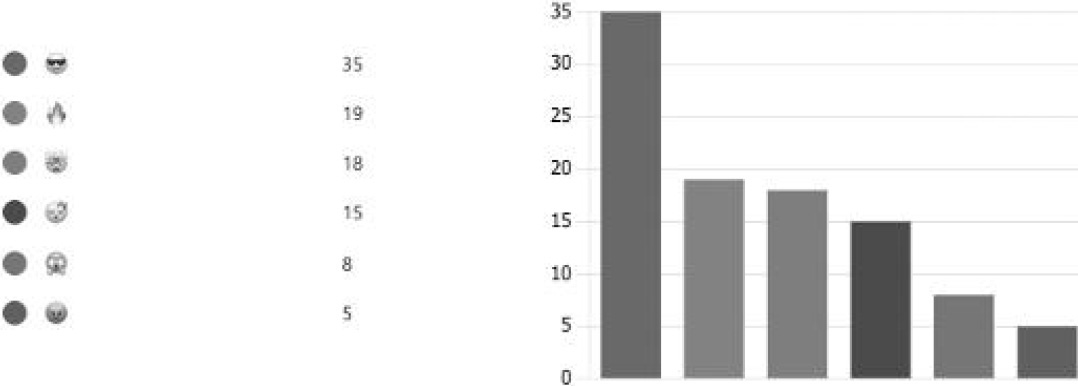
Equations
Question
Solve the following equations
In “(Table 2)” we observe that 37.8% of male students (17) and 32.7% of female students (18) chose the cool emoji. The fire emoji was chosen by 11 men (24.4%) and 8 women (14.5%). Regarding the mind-blown emoji, 15 (27.3%) women and only 3 (6.7%) men made this choice. The sleepy emoji was chosen by 10 (22.2%) men and 5 (9.1%) women, while the panic emoji was chosen by 6 (10.9%) women and only 2 (4.4%) men. The results of the chi-square test for question 2 show that there is a significant difference in the distribution of responses between genders (
Crosstabulation table between variables emojis of question 3 and gender
Bar chart of emoji frequencies in question 3.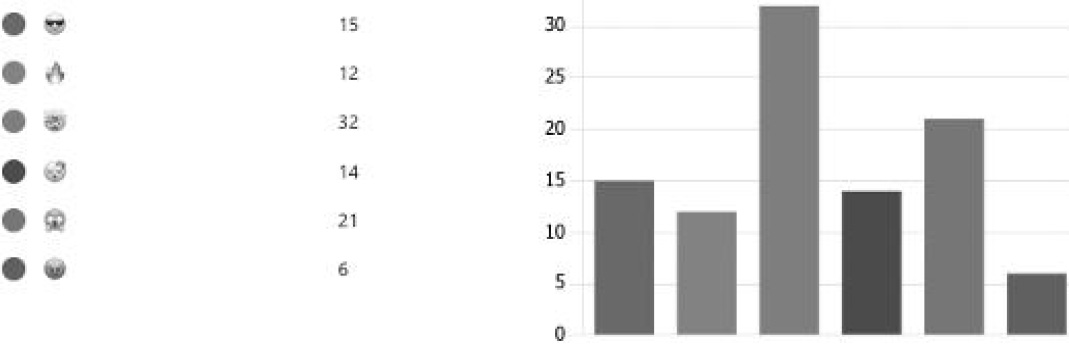
Question
Solve the numerical crossword:
Horizontally:
nonzero solution of the equation product of solutions of the equation sum of solutions of the equation 2 the greatest of solutions of the equation
Vertically:
solution of the equation fraction of solutions of the equation product of solutions of the equation negative solution of the equation
17.8% of male students chose the fire emoji in contrast to 7.3% of female students. The mind-blown emoji chose 10 male (22.2%) and 22 female students (40%). The sleepy emoji was chosen by 20% of male and 9.1% of female students. The results of the chi-square test show that there is no statistically significant association between gender and emoji use (
Question
Choose the correct answer:
The roots of a trinomial equation
A.
What does it mean if the discriminant of a trinomial equation is negative?
A. There are two real roots. B. There is one real root. C. There are no roots.
What does it mean if the discriminant of a trinomial equation is zero?
A. There are two real roots. B. There is one real root. C. There are no roots.
What does it mean if the discriminant of a trinomial equation is positive?
A. There are two real roots. B. There is one real root. C. There are no roots.
What is the discriminant of the trinomial equation
A.
Crosstabulation table between variables emojis of question 4 and gender
Crosstabulation table between variables emojis of question 4 and gender
Bar chart of emoji frequencies in question 4.
It is worth mentioning that 22.2% of male students chose the sleepy emoji in contrast to 14.5% of female students, who chose this emoji. The results of the chi-square test show that there is no significant correlation between gender and emoji use (
Question
Solve the problem:
The Maths teacher suggested that his students solve some exercises to consolidate the unit they were taught. When they asked him on which page the exercises are written, he replied: “If you open your book, the product of the numbers of the two opposite pages in which the exercises are written, is 506.” Can you find which pages the exercises are written on?
Crosstabulation table between variables emojis of question 8 and gender
Crosstabulation table between variables emojis of question 8 and gender
Bar chart of emoji frequencies in question 8.
The response rate for fire emoji by gender is 17.8% for men and 10.9% for women. Regarding the sleepy emoji, the percentage of responses based on gender is 8.9% for men and 18.2% for women in which we observe a substantial difference as for the panic emoji, chosen by 13.3% of male and 21.8% of female students. The results of the chi-square test indicate that there is no statistically significant association (
Question
If a, b are real numbers with a
a)
Crosstabulation table between variables emojis of question 9 and gender
Crosstabulation table between variables emojis of question 9 and gender
Bar chart of emoji frequencies in question 9.
The most frequent response overall was the panic emoji, with 8 males and 15 females emoji (27.3% of women vs. 17.8% of men) choosing this response. 7 men and 12 women chose the mind-blown emoji and 22.2% of men in contrast to 14.5% of women chose the fire emoji. Chi-square test results suggest that there is no significant correlation between gender and emoji selection.
The chi-square test was conducted to compare the categories of the exercises. Specifically, the results of the chi-square test between the categories of Equations – Problems, Equations – Numerical Crossword, and Parametric Equations – Problems are presented.
Bar chart of emoji frequencies between equations and problems.
Bar chart of emoji frequencies between equations and crossword.
Bar chart of emoji frequencies between parametric equations and problems.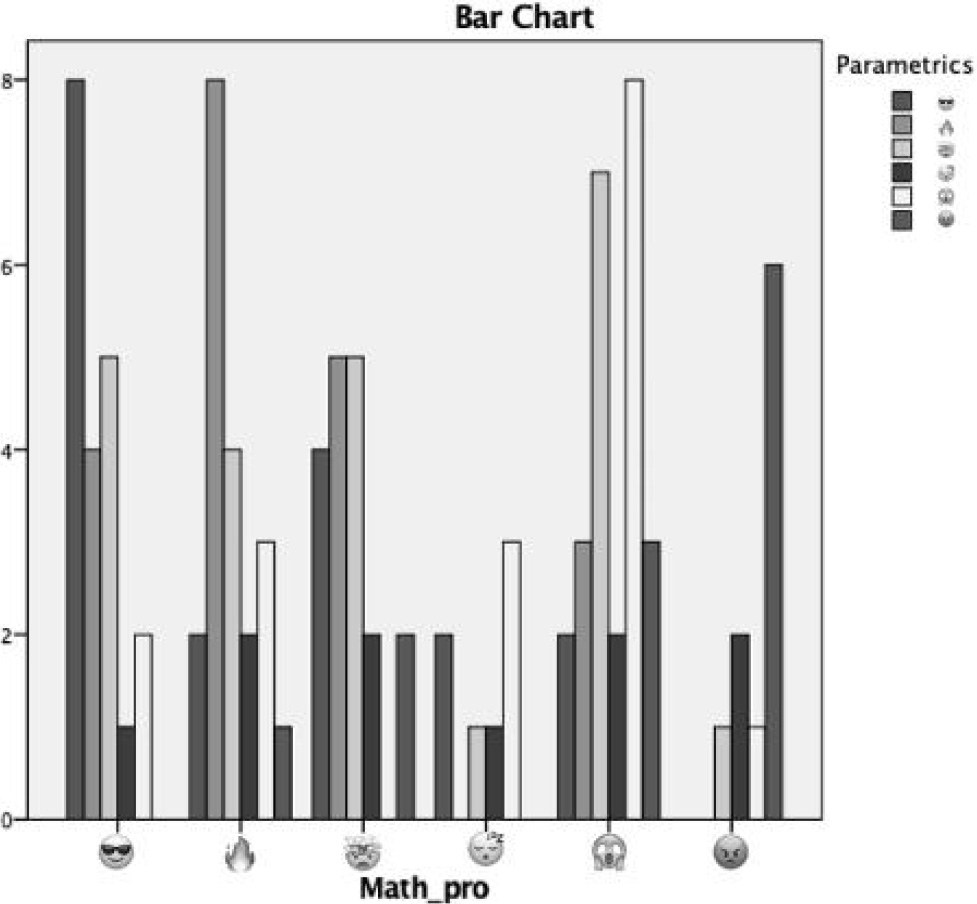
The results of the empirical study show that it is possible that there is a relationship between gender and the use of corresponding emojis, a fact that is confirmed by research that examines gender differences in the use of emojis [58, 59, 67]. However, in this study, the main finding was that there were many similarities in the use of emojis by men and women. In this section we present a detailed discussion of the results.
The resulted use of emojis in questions by men and women in the empirical study
In our research, women seem to use the cool emoji and mind-blown emoji, while men seem to use the cool and fire emoji. The angry emoji was used by a similar percentage between both genders. In more detail we can draw the following conclusions as significant differences between the two genders:
In the trinomial equation of question 1.51% of students selected the cool emoji, while 10% chose the sleepy emoji. The latter may suggest that these students found the question uninteresting or dull. We also notice that girls appear to be more bored than boys, choosing the sleepy emoji at a biggest rate. In the second question, fire and mind-blown emojis were frequently chosen. Interestingly, the percentage of students who selected sleepy and panic emojis increased from the first question, whereas the percentage of students who chose the angry emoji remained relatively low. The second question seemed to get boys more excited. At the same time, boys found this exercise more boring than girls. Also, girls seem to have been scared more than boys.
Upon examining the responses to question 3, we can see that 32 students selected the mind-blown emoji as their top choice. The panic emoji, which was chosen by 21 students, suggests that some students may have found the problem challenging and potentially stress-inducing. It seems that the numerical crossword puzzle presented varying levels of difficulty for different students, with some finding it engaging and challenging, while others found it frustrating or dominating. Question 3 seems to have excited boys more than girls, but it looks like girls was a significant challenge and shocking moment as girls chose the mind-blown emoji at a rate of 40% compared to 22.2% of boys. Finally, boys found the numerical crossword more boring than girls.
The majority of students appreciated Questions 4 and 5, which were multiple-choice and fill-in-the-blank exercises, as they opted for cool and fire emojis as their preferred choice. This suggests that some students may have found the problems challenging but ultimately rewarding to solve. It is worth noting that around 20% of students selected sleepy and panic emojis, indicating that a small number of students experienced frustration or anger while working on the problems. Boys found that exercises 4 and 5 were more boring than girls. A significant difference is the positive attitude of boys in question 5, since 62.2% stated that they felt more comfortable or excited than girls. Finally, in this question, more girls expressed fear than did boys.
In question 6, the mind-blown emoji garnered 24 responses, which surpassed the previous responses. Conversely, the angry emoji received 12 responses. This disparity can be attributed to the diverse nature of the questions and the possibility that students perceived the query as more difficult than preceding inquiries. Boys choose panic emoji with a highest rate, but girls seem to be angrier compared to boys.
Questions 7 and 8 required students to solve two problems. The most frequently selected emojis were the mind-blown and panic emojis, indicating that the problems might have been difficult or challenging for several students, leading to shock and fear as emotional reactions. The cool emoji was also a popular response, suggesting that some students felt happy. Girls feel more comfortable, but boys found the problem more shocking compared to their female classmates who were also more scared than the boys, something that happens again in question 8. So, it seems that girls are more scared when asked to solve problems but also more bored than boys.
In questions 9 and 10, where quadratic parametric equations are presented, it is revealed that happiness and anxiety are the most frequently expressed emotions. Additionally, a significant number of students report struggling with the equations, while others express intense frustration towards them. It appears that girls were more scared than boys.
The use of chi-square tests was employed to investigate the presence of a significant relationship between the exercise categories. The findings indicated that every chi-square test yielded a significant relationship between the categories (
Interpretation of the preference of emojis by men and women
Based on the results presented in the text, there are some consistent patterns and differences in emoji usage between men and women in response to different mathematical exercises:
Cool and Mind-Blown vs Cool and Fire Emojis:
Both men and women seem to commonly use the cool emoji. However, women tend to use the cool emoji along with the mind-blown emoji, while men tend to use the cool emoji along with the fire emoji.
Cool and Mind-Blown for women
The combination of the cool and mind-blown emojis suggests that women might express a combination of being laid-back or confident (“cool”) along with being amazed or astonished (“mind-blown”). This combination could indicate that women are capable of maintaining a calm exterior even in situations that genuinely surprise or impress them.
Cool and Fire for women
On the other hand, the combination of the cool and fire emojis among men suggests a different emotional tone. The cool emoji might convey a sense of being laid-back or confident, while the fire emoji is often associated with excitement, enthusiasm, or intensity. This combination could indicate that men express a more dynamic or fervent reaction when they want to convey both a steady manner and a high level of excitement or energy.
Sleepy Emoji:
The sleepy emoji is more frequently chosen by women, especially in response to the trinomial equation (Question 1). This suggests a potential difference in engagement or interest, with girls possibly finding certain questions less interesting or more boring.
Mind-Blown Emoji:
Women consistently show a higher preference for the mind-blown emoji across various questions, indicating that they may be more likely to express shock or amazement in response to challenging or surprising content.
Panic Emoji:
Men tend to choose the panic emoji more frequently, especially in response to questions involving quadratic parametric equations and problem-solving (Questions 6, 7, and 8). This suggests that men might experience higher stress levels or perceive certain exercises as more challenging.
The observed patterns in emoji usage between men and women in response to different mathematical exercises may offer insights into potential differences in emotional experiences or perceptions of these exercises based on gender. The following insights are grouped based on the emotions represented by the respective emojis that have been used in the empirical study:
Confidence and surprise vs confidence and excitement
The higher usage of the combination of the cool and mind-blown emojis by women suggesting that women might express a combination of confident (“cool”) along with being amazed or astonished (“mind-blown”) indicate that women are capable of maintaining a calm exterior even in situations that genuinely surprise or impress them. This is opposed to the higher usage of combination of the cool and fire emojis among men suggests which might convey a sense of also confident similarly with women, while the fire emoji is often associated with excitement, enthusiasm, or intensity. This combination could indicate that men express a more dynamic or fervent reaction when they want to convey both a steady manner and a high level of excitement or energy.
Engagement and Interest:
The higher usage of the sleepy emoji by women, particularly in response to the trinomial equation (Question 1), might suggest differences in engagement or interest. It’s possible that women find certain questions less interesting or engaging compared to men.
Challenges and Surprises:
The consistent preference for the mind-blown emoji by women across various questions may indicate that women are more likely to express astonishment or shock in response to challenging or surprising content. This could suggest that women may find certain aspects of the exercises more intellectually stimulating or unexpected.
Stress Levels:
The higher usage of the panic emoji by men, especially in response to questions involving quadratic parametric equations and problem-solving, may suggest that men experience higher stress levels or perceive certain exercises as more challenging. This could reflect differences in how men and women approach and cope with academic stress.
Positive attitudes:
The expression of more positive attitudes by boys, such as feeling more comfortable or excited in response to multiple-choice and fill-in-the-blank exercises, may indicate that boys generally approach these exercises with a more positive mindset compared to girls.
Fear and boredom:
The higher expression of fear and boredom by girls in specific situations, such as problem-solving exercises, could imply that girls may perceive certain tasks as more intimidating or less interesting. This might be linked to broader gender differences in how individuals approach and respond to challenges.
It is important to note that these interpretations are only providing insights, and individual variations within each gender group exist. The empirical study yields interesting patterns, but additional research and a deeper understanding of individual experiences and perceptions are needed to draw more definitive conclusions about the reasons behind these observed differences.
The empirical study that we conducted showed that mathematical problems in the context of the e-learning course are stimulating various emotions to students which can be expressed in text trough the emojis rendering the emojis as a language of communication of these emotions for their learning experience. This is in line with other previous studies such as that of Reeves and colleagues who analyze emojis as an emerging language in an online educational experience via WhatsApp [68]. Moreover, Danesi [52] has pointed out that the use of emojis in writing is often viewed as a form of visual and phonetic expression that can also be seen as a response to the power dynamics of print literacy. Concerning the underlying emotions represented by emojis, in our empirical study, upon analyzing the data, it becomes evident that the students exhibited a wide range of emotional responses.
Our study observed manifestations of math anxiety, a significant issue identified in prior research, through fear and panic emojis. While our study did not assess its severity, existing literature defines math anxiety as a profound problem. For instance, Lau and colleagues recently described it as a prevalent emotional disorder among students, marked by intrusive thoughts that hinder crucial cognitive abilities needed for solving math problems [69]. This anxiety commonly presents as fear or worry, significantly affecting students’ drive and achievement in mathematics [70].
Regarding the comparison between genders, our research underscores substantial similarities in the emotional responses between men and women when utilizing emojis. Notably, both genders exhibited common preferences by consistently using specific emojis representing anger, sadness, joy, surprise, and a neutral state. This shared pattern aligns with prior research, highlighting the universality of certain emojis across age and gender, as corroborated by studies such as [71]. The prevalence of happiness and excitement as frequently reported emotions further emphasizes the parallel emotional experiences shared by both genders. Additionally, the similar utilization of the angry emoji suggests a comparable expression of displeasure or frustration. These consistent preferences and emotional expressions indicate a substantial convergence in the way both men and women use emojis, underscoring the existence of commonalities in their digital communication styles. This insight prompts a reevaluation of traditional gender-related stereotypes and highlights the significance of acknowledging and embracing the diversity inherent in individual personalities when interpreting digital communication cues. The study implies that a more personalized understanding of communication styles, based on individual characteristics rather than generalized gender norms, is essential for accurately interpreting and responding to the plethora of emotions conveyed through emojis.
However, despite the majority of similarities there have also been some gentle differences in the selection of emojis. Although there are gentle variations, chi-square tests indicated a significant relationship between exercise categories and emoji selection, suggesting that the type of exercise may indeed influence emotional responses irrespective of gender.
Nevertheless, resulted differences, if taken into account they may reveal how gentle variances in emotions may lead to steady preferences or rejections of career paths related to Mathematics. The use of different emojis depending on the gender has been pointed out by previous research studies conducted by other researchers in other contexts by many means [67, 72, 73]. It should be noted though, given the very recent widespread use of emojis, such studies do not extend further earlier than the last five years or so.
For example, girls’ higher use of the cool and mind-blown emojis suggests they can maintain calmness and confidence even when genuinely surprised. In contrast, boys’ preference for the cool and fire emojis may indicate confidence coupled with a more dynamic or fervent expression of excitement or energy. These findings concerning the domain of mathematics can be explained and interrelated with other previous findings from other researchers.
According to Kloosterman and colleagues, girls often display a greater interest in performing well in math class compared to boys, which may be attributed to broader differences between the genders in mathematics classes [74]. In our research, this previous finding can explain the surprise (mind-blown emoji) in conjunction with calmness (cool), as girls want to maintain a predictable good performance and, in this pursuit, challenges may be perceived as a surprise for their desired predictability, although they keep calmness at the same time to strive for performing well.
Conversely, for boys, previously, some researchers have noted that boys tend to be more competitive than girls [75]. This can explain the higher usage of combination of the cool and fire emojis among men suggesting that men express a more dynamic or fervent reaction when they want to convey both a steady manner and a high level of excitement or energy. In this respect, boys may perceive challenges as a stimulating way of competing their peers with a desire to prevail over them in performance. Excitement is often linked with positive feelings and can be an encouraging factor for further exploration and engagement.
In the context of our study, girls express higher levels of boredom or fear in response to mathematical exercises. This may suggest a lack of interest or a perception of the subject as intimidating, possibly indicating a repulsive or negative reaction. Both boredom and fear can influence students’ attitudes and motivations toward a subject like mathematics. Our research suggests that certain students, particularly females, but not only them, seem to be more fearful than others when engaging in specific activities as problems and parametric equations. This phenomenon can be observed from a tender age [76, 77].
On the other hand, women in our study showed less usage of the panic emoji than men, particularly in response to questions involving quadratic parametric equations and problem-solving. This divergence brings to the forefront a valuable and perhaps underappreciated soft skill among women – the ability to maintain calmness in panicky situations while tackling complex mathematical problems. In the context of academic and professional endeavors, the capacity to stay calm under pressure is a highly esteemed soft skill, contributing significantly to effective problem-solving and decision-making. The lower prevalence of the panic emoji in women’s responses underscores their proficiency in navigating challenging scenarios with a composed demeanor. Recognizing and acknowledging this soft skill becomes important in the career decision-making process, as it sheds light on strengths that women possess and can use to excel in various domains. This observation suggests that women may possess a valuable soft skill – the ability to maintain composure in panicky situations while engaging in mathematical tasks. This skill, highly prized in academic and professional settings, contributes significantly to effective problem-solving and decision-making.
Recognizing and appreciating this ability to remain calm under pressure is crucial, especially in the context of addressing mathematical anxiety and promoting gender equality in STEM fields. By emphasizing the importance of this soft skill, we not only gain a deeper understanding of individuals’ capabilities but also highlight strengths that women possess and can employ for success in various domains.
The emotional responses could influence the academic paths that students are going to select. Positive feelings can become a starting point for fruitful careers in Mathematics-related and STEM professions and higher studies. On the other hand, negative feelings may show an underlying cause for students to perceive a reduced inclination to pursue mathematics further. This may be the case in the reduced number of women pursuing further studies and a career related to Mathematics as opposed to men, even if their academic performance of girls is no less to that of boys.
Overall, our research results show the importance of taking into account students’ emotions in Mathematics e-learning and analyze them to avoid augmenting emotional problems that could lead to the “Mathematics anxiety”. This is in accordance with other researchers such as Eidlin Levy and colleagues who note that it is crucial to identify young students experiencing math anxiety and provide appropriate reduction programs to mitigate its detrimental effects on academic achievement and career choice [78]. While other researchers suggest that interventions emphasizing the control of negative emotional responses to math stimuli, rather than solely providing additional math training, can effectively reveal a population of mathematically competent individuals who might otherwise remain undiscovered [79].
However, it should be noted that this study had a small sample size, which might restrict the broader applicability of its results. Furthermore, as this study was conducted online, it is possible that the findings may differ from face-to-face interactions.
Conclusions
By effectively incorporating emojis as a feedback mechanism in e-learning Mathematics courses, and performing affect recognition, this paper highlights a promising avenue to enhance student engagement and comprehension in a traditionally analytical field, such as Mathematics. Emotional interventions are particularly useful in addressing the pervasive issue of mathematical anxiety and intimidation among students, which often deters them from pursuing further studies in STEM (Science, Technology, Engineering, and Mathematics) fields. By fostering a more positive and emotionally supportive learning environment, this approach not only facilitates immediate improvements in student performance but also holds the potential to cultivate a generation of learners who are more confident and proficient in Mathematics, thus contributing to the advancement of major scientific disciplines reliant on mathematical foundations.
In particular, in our empirical study on the emotional responses of students to mathematical problems in an e-learning context, we found a notable prevalence of diverse emotions expressed through emojis, highlighting their role as a language of communication in the learning experience.
Our chi-square tests revealed a noteworthy connection between the emojis and exercises selected by the participants, suggesting that the choice of emoji may be influenced by the type of exercise. The collective data imply that students’ emotional responses to math problems are intricate and can depend on the nature and complexity of the problem. Different factors affected students’ emotions for each query, although they all involved solving equations. The findings suggest that some students might find certain problems more challenging than others, but the presence of favorable responses also implies that many students can overcome these obstacles and experience a sense of accomplishment and satisfaction when they are successful.
Our research revealed significant similarities in emotional responses between men and women, challenging traditional gender stereotypes. Both genders showed similar preferences in emoji usage, suggesting the universality of certain emotional expressions across age and gender. The findings of our study suggest that emotional responses can influence academic preferences, with positive feelings serving as a motivating factor for pursuing successful careers in mathematics-related fields. Conversely, negative emotions, regardless of academic performance, may deter students from considering further studies and careers in mathematics.
Regarding mathematics anxiety, our study identified some gender-related differences in emoji selection, suggesting that girls may experience more negative emotions compared to boys. However, there is also evidence that girls tend to remain calmer in panicky mathematical situations, indicating an important soft skill related to emotional resilience and combat to anxiety.
The study highlights the importance of recognizing and addressing individual emotions associated with mathematical skills and soft skills, with the aim of developing further students’ strengths while mitigating negative feelings through encouragement.
As a future direction, it is recommended that educators and curriculum developers consider the emotional well-being of students when designing mathematics problems that simultaneously challenge and engage them. The research also adds to the existing body of literature on the application of emojis in teacher-student communication within a digital classroom setting. However, additional research with larger and more diverse samples is necessary to either confirm or refute the results obtained.