



Abstract
Computers play a very important role in today’s life. A large amount of personal information exists in computers, so it is very important to protect the information security on computer networks. The development of information technology has brought a huge impact on human society, and the information security of its computer network has attracted more and more attention. Aiming at the needs of computer network information management in the age of big data, this paper has developed a special computer network information protection system to deal with various threats and constantly improve the protection system. Based on this, the concept and advantages of the 5G network are first expounded, and the management technology of the 5G network is briefly analyzed. Then the information security problems of computer networks in the 5G era are considered, and effective solutions to the information security problems are proposed. Through research and calculation, the new computer network security system can improve network information security by 13.4%.
Keywords
Introduction
The arrival of the 5G era can not only meet the basic functions of daily calls and Internet access but also make the network technology more intelligent and computerized. The more complex the communication system is, the more it faces the challenge of network information security. The characteristics of 5G technology such as high speed, large capacity, and low latency make the network face a wider and more complex attack surface, such as large-scale distributed denial of service attacks, privacy leaks, malware spread, etc. With the advent of the 5G era, it is imperative to protect network information security. Traditional network security technologies and methods can no longer cope with the new security threats in the 5G era.
To improve the protection of network information security, this paper conducts experimental verification of the information security algorithm based on orthogonal frequency division multiplexing. First, the simulation environment is established on the computer through simulation experiments to simulate the data transmission process and evaluate the performance of the algorithm. Then it is deployed to a real network environment to collect real data and analyze it. The performance difference between the algorithm and the existing methods is evaluated through comparison experiments. Experimental results show that OFDM-based information security algorithms have the potential to improve network security. It can significantly improve network information security, and gain user satisfaction.
Article contributions
This paper introduces an information security algorithm based on Orthogonal Frequency Division Multiplexing (OFDM) technology, which enhances the security of computer networks by utilizing OFDM technology commonly used in wireless communication systems. This paper studies the integration of the OFDM algorithm into computer network security. By incorporating OFDM-based information security algorithms into computer network security systems, a more powerful defense mechanism can be proposed to deal with various network threats and attacks popular in the 5G era. The experiment comprehensively evaluates the effectiveness of the proposed OFDM-based information security algorithm and new computer network security system. Results demonstrate superior performance it compared to baseline models and alternative approaches, highlighting its effectiveness in improving the accuracy and reliability of flow predictions and overall network security.
Article organization: The paper is organized as follows: Section 1 provides an introduction; Section 2 presents related work; Section 3 describes in detail the related formulations and applications of information security algorithms based on the OFDM techniques; Section 4 describes the experimental design steps and application results; Section 5 discusses the experimental results of this paper and the previous results; and Section 6 concludes.
A computer network is a communication network shared by nodes. In a computer network, the connections between nodes are interrelated. Upadhyay R K found that the Advanced Research Projects Agency began to implement a new computer communication project [1]. Yang L analyzed the feasibility of computer resources in sports [2]. Shandilya S K proposed a standard test platform, which helped finetune the proposed algorithm under observation while analyzing various parameters [3]. Kubo T developed a new computer network system. The server was connected to 2 hosts and 5 workstations through 2 Ethernet LANs, and transmitted compressed data via telephone [4]. Gao J analyzed the current computer network security problems and then elaborated on the common technologies and applications of computer network security from the aspects of data encryption, intrusion detection, virtual private networks, and firewalls. Finally, he proposed a network attack prevention model based on the support vector machine [5]. Yuan T believed that computer network security technology can play an important role in protecting massive data information [6]. Zhang X analyzed the network security problem and then proposed several methods [7]. The above interpretations of computer networks are more specific, but they are not related to information security issues, nor do they mention 5G networks.
Network security includes the security of equipment, information, and software. Some people known as network attackers paralyze online companies by attacking business competitors over the Internet. Network security is a measure to prevent this information from being stolen and attacked by business competitors. Burg A’s wireless sensors and actuators connected through the Internet of Things (IoT) were the core of advanced network physical system design [8]. Langer believed that medical centers should achieve the portability of patients’ medical records while protecting the confidentiality of patients [9]. Kumar V showed the concept of a body sensor system that could be widely used in healthcare applications. He studied the system and related applications of medical problems and discussed the important challenges and metrics of BSN [10]. Britton K E believed that data privacy and security protection were not sufficient to address privacy and security risks and hinder the current and future interests of communication platforms and applications [11]. Gupta B B provided a solution to computing problems. Cloud users could meet their needs for all hardware, operating systems, and software applications by using cloud services [12]. Abdulatif F A discussed network security issues and effectively explained how to select cloud providers [13]. Netware R provided the risk of protection issues, especially location privacy and record confidentiality, covering the way carrier companies and governments obtain customer information [14]. These researches on information security are relatively comprehensive, but they do not include computer networkrelated research.
Security of computer network information in the 5G Era
Network data security issues.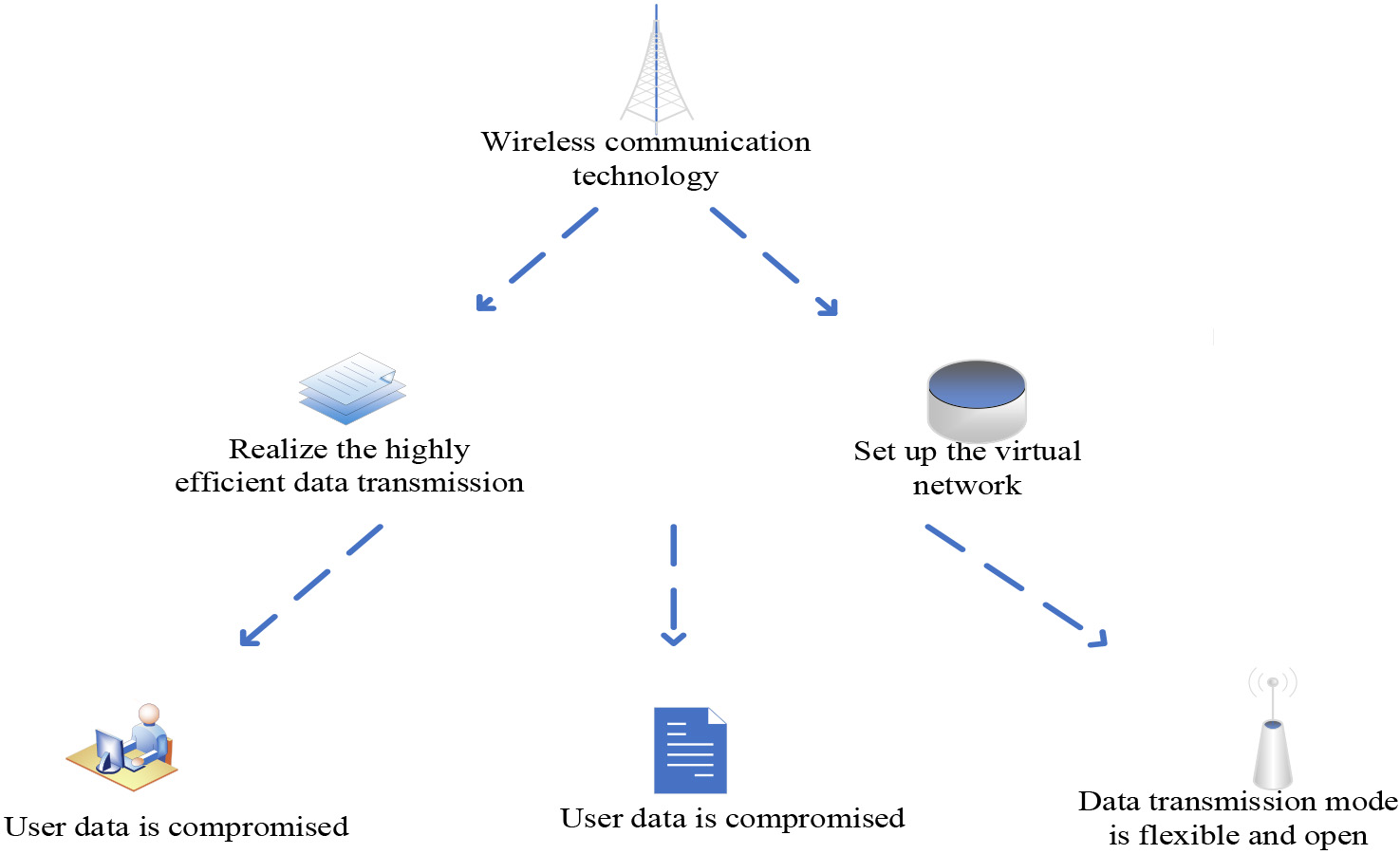
In the 5G network environment, the data transmission mode is flexible and open, and the security problems faced by the data are very serious. The data transmission speed in the 5G network area is getting faster and faster, which makes it difficult to trace the stolen data. With the development of 5G technology, this problem certainly arises, as shown in Fig. 1.
In the 4G network era, user privacy and security issues were raised [15, 16, 17]. With the emergence of the 5G network, access between groups and other users has become more and more common, and the number of connections is also increasing. It is very difficult to ensure the privacy and security of users. Meanwhile, the 5G network uses a highfrequency band to transmit information, which has the advantages of short waves and high power, but it requires very dense short-wave base stations to limit and provide signal width support. However, as the number of base stations increases, users can determine their exact location. If some cyber criminals use location data, their personal information may be damaged. In the Internet era, privacy has become more and more important. If it is used by criminals, it may cause great harm to individuals and the whole society. Therefore, relevant departments should take preventive measures against this danger.
5G has made breakthroughs in network security compared to 4G.
The high speed and large capacity of the 5G network allow more devices to be connected to the network and the data transmission speed is faster, but it also increases the attack surface faced by the network. The number of connected devices and data transmission speeds of 4G networks are relatively low, and network security threats are relatively few. The low-latency characteristics of 5G networks make real-time communications and applications possible, but they also increase the complexity of network security. Real-time communication places higher requirements on the stability and reliability of the network. Once the network is attacked or malfunctions, it may lead to serious consequences. The latency of the 4G network is relatively high, and there are fewer demands for real-time communication and applications, with relatively simple network security issues.
In summary, 5G networks have obvious advantages in terms of speed, capacity, and latency, but they also face more and more complex network security challenges. To ensure the security and stability of 5G networks, it is necessary to strengthen the management and monitoring of network security, adopt more advanced and effective security protection technologies, and establish a complete emergency response mechanism to respond to various security threats and risks promptly.
5G technology is a new technology. After the expansion and improvement of 4G technology, it has not been widely used. 5G technology is not yet mature, and network information security is the only problem found in the development and implementation of some regions. However, in the case of network information security problems in other aspects of 5G technology, many problems may not be found, which may affect the development and use of 5G technology in the future. 5G technology has been used for a short time, and various problems inevitably occur in the process of use. How to continuously develop 5G technology and predict and prevent network information security problems is the responsibility of the research and development department, as shown in Fig. 2.
5G technology’s defects.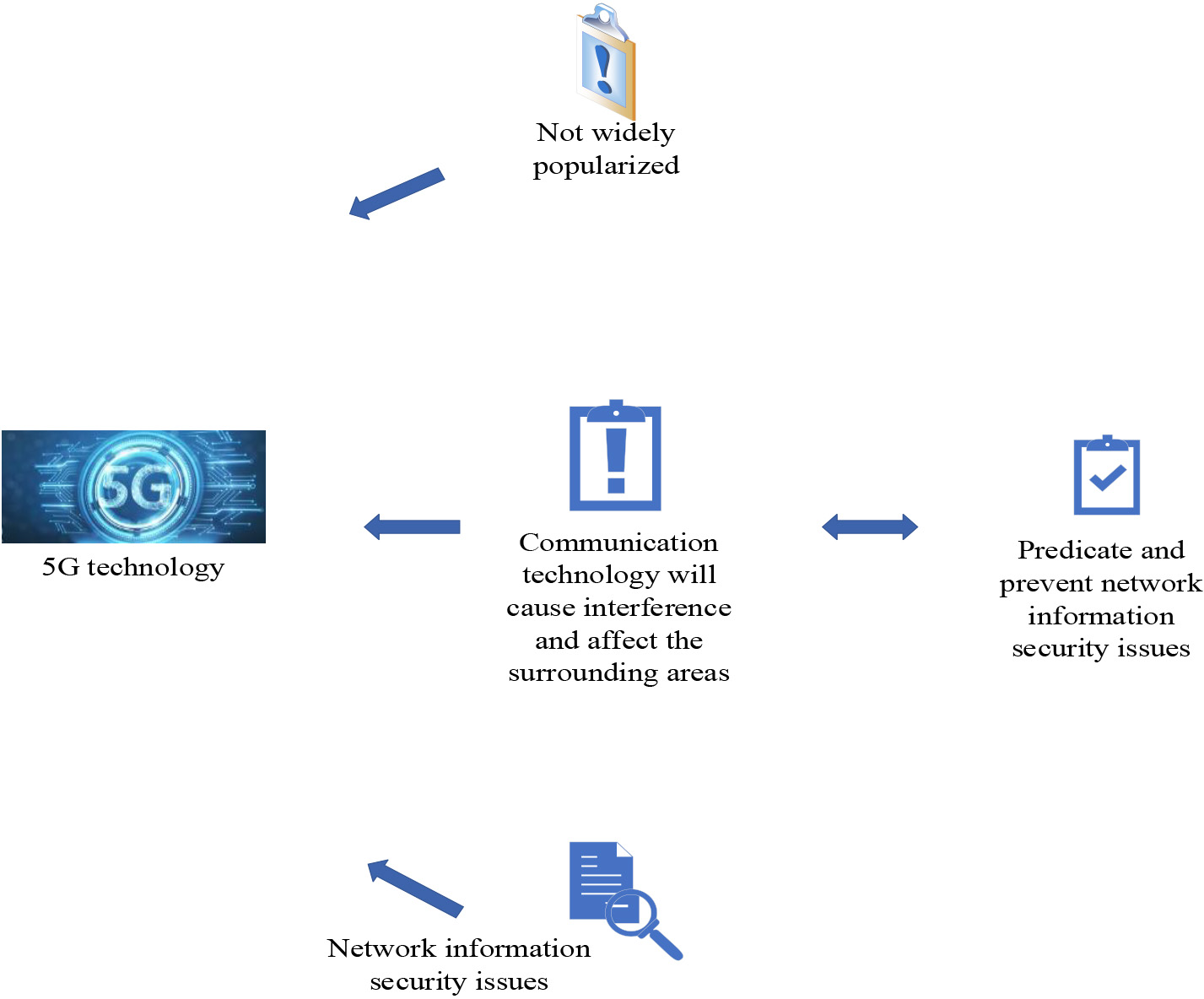
In response to threats to network information security, relevant departments can take a variety of preventive measures to reduce the risks faced by individuals and society as a whole. Here are some precautions:
Strengthen network security awareness education: improve the public’s understanding and awareness of network security by carrying out network security education and training, so that users can understand the existence of network threats and how to deal with them. Establish a complete network security laws, regulations, and policy system: formulate and implement relevant network security laws and regulations, standardize network behavior, clarify penalties and responsibilities for illegal activities, increase the cost of illegal activities, and thereby reduce the incidence of network crimes. Strengthen network monitoring and defense capabilities: establish and improve network security monitoring systems, promptly detect and prevent network attacks, and strengthen the construction and management of network firewalls, intrusion detection systems, and other security facilities. Use encryption technology to protect personal information: strengthen the encryption protection of sensitive personal information, including ID numbers, bank card information, etc., to prevent personal information from being stolen and used by criminals. Regularly update and maintain security software: update operating systems, applications, and security software promptly, patch known security vulnerabilities, and improve system security and stability. Strengthen identity authentication and access control: use multi-factor identity authentication, access control, and rights management mechanisms to limit user access rights and prevent unauthorized access and data leakage. Strengthen international cooperation and information exchange in the field of cybersecurity, combat transnational cybercrime and security threats, and jointly maintain global cybersecurity.
The open and adaptable data transfer mechanisms in 5G network systems make the data security challenges even more challenging. The following are some security issues that data in 5G networks may encounter:
Eavesdropping and information leakage: 5G networks often use wireless signals and transmit data at high speeds, so there is a risk of interception and eavesdropping. Data manipulation: in 5G networks, information may be tampered with, leading to the destruction of critical information. Malware and virus infections: these may take advantage of network vulnerabilities or user misbehavior to hack into devices and destroy or steal data.
Orthogonal frequency division multiplexing (OFDM) is a multi-channel modulation technology, which allows high-speed data transmission on frequencyselective channels. In the complex orthogonal frequency division system, the reduction method should be used. The intricate transverse frequency division system may be efficiently reduced with the matrix transformation approach. It can be established under normal settings and offer good performance prospects, which can be applied to baseband mapping and random modulation information encryption systems, in combination with the modulation and encryption processes of the orthogonal frequency division system.
First, a matrix
In Eq. (1), this matrix is used in the data modulation and encryption process in Orthogonal Frequency Division Multiplexing (OFDM) systems.
Next, a diagonal matrix is defined:
In Eqs (2) and (3), this matrix is a diagonal matrix used to perform reduction operations in orthogonal frequency division systems. Through the definition of a diagonal matrix, the complexity of the orthogonal frequency division system can be effectively reduced.
Finally, a permutation matrix is defined:
In Eq. (4), the matrix is a permutation matrix used to adjust the column positions in the matrix. The definition of the permutation matrix does not change the orthogonality of the original matrix and therefore can be used in the encryption process.
Assuming
Supposing that the number of subcarriers in the orthogonal frequency division multiplexing system is
Equation (6) can be obtained:
After transformation, Eqs (7) and (8) can be obtained:
The matrix used to reduce the peaktoaverage power ratio must meet the orthogonality condition, as shown in Eq. (9):
In Eq. (9),
The orthogonal matrix is multiplied by the identity matrix. The arranged matrix is still orthogonal, because the orthogonal matrix P satisfies:
It can be seen from Eq. (10) that the change in the position of the column in the matrix does not affect its orthogonality. The permutation matrix
In the information security algorithm and practical application experiments of orthogonal frequency division multiplexing (OFDM), the data sources are as follows: based on existing network models or self-designed network topology, data are generated through simulation generation methods. These data cover various communication scenarios and network environments, including different channel conditions, interference levels, and security threats. Experimental data is obtained through data collection in a real network environment, from existing network equipment, communication records, or data collection equipment specially set up in the experiment.
Assumptions
Network topology: it is assumed that the network consists of multiple nodes, and nodes communicate through wireless or wired connections. Security threats: it is assumed that there are potential security threats, which may include eavesdropping, data tampering, denial of service attacks, etc. Communication model: it is assumed that communication is affected by a certain degree of interference or noise, and there may be channel fading, multipath effects, etc.
Simulation experiment: test and evaluate the algorithm by building a simulation environment on the computer to simulate the data transmission process. Algorithm performance can be evaluated based on preset indicators (such as bit error rate, signal-to-noise ratio, etc.). Actual experiment: deploy the algorithm to a real network environment, collect actual data, and analyze it. The performance difference between the algorithm and existing methods can be evaluated through comparative experiments or control group experiments. At the same time, the feasibility and effectiveness of the algorithm in real scenarios can also be verified based on actual network operation conditions.
Students’ time of using the internet.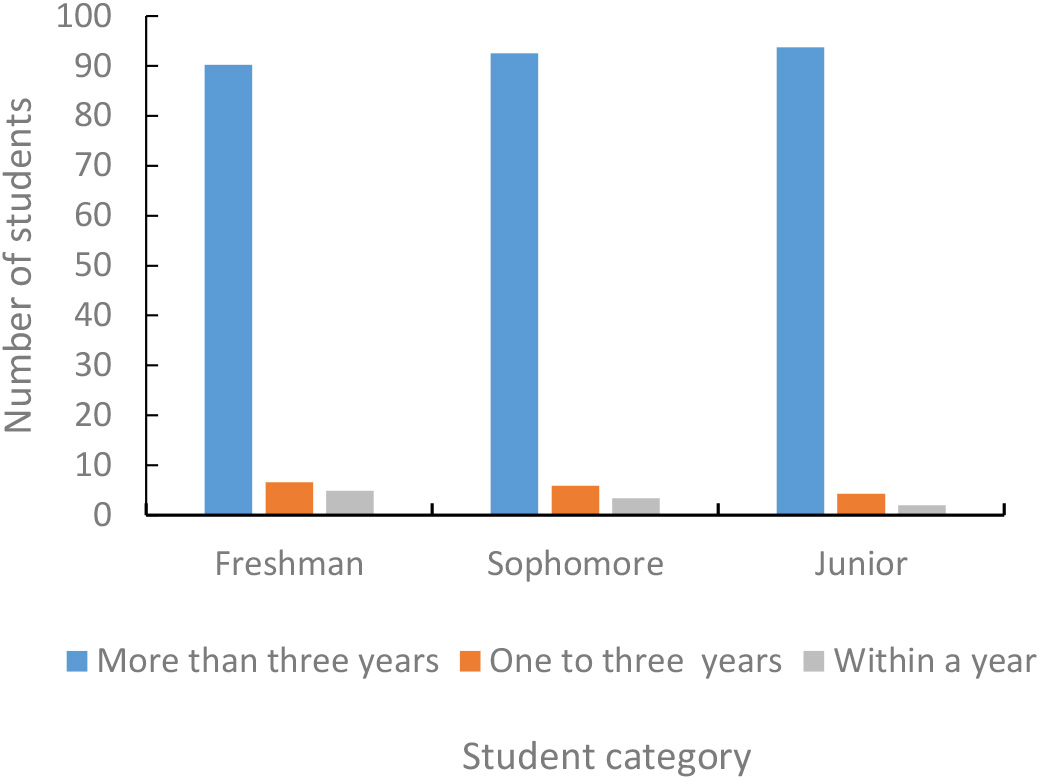
Whether they have encountered network insecurity.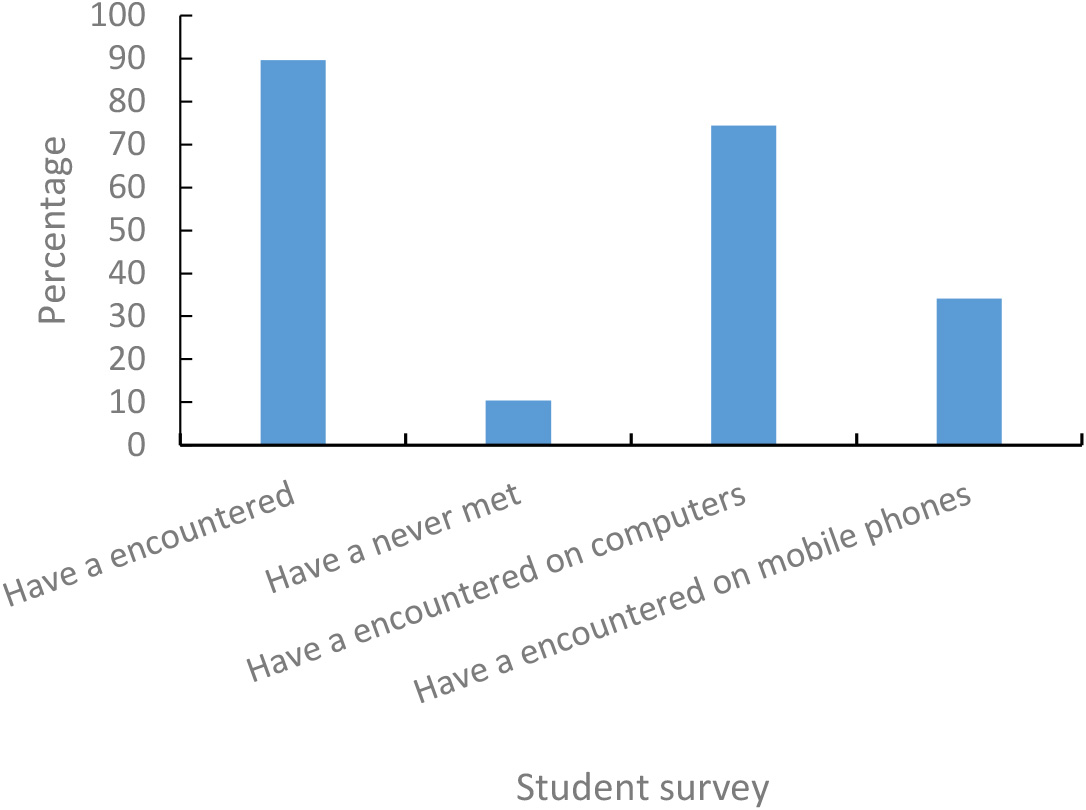
What type of software they have encountered network security problems.
To further study the security of computer network information in the 5G era, a questionnaire survey was conducted among current network users to investigate whether users had experienced the leakage or insecurity of networkwide information when using the network. While investigating students in a college, a total of 320 questionnaires were sent out and 312 were returned, among which 300 were valid. The investigated students majored in radio and television editing and directing, computer science, and journalism and communication. The reason for investigating the students of these three majors was that they had systematically accepted online courses, who often used the Internet for information dissemination activities, with high media literacy and a certain sensitivity to the situation of network information security. The students were freshmen, sophomores, and juniors. The survey mainly summarized four points, namely: use of network time, whether they have encountered network insecurity, and what type of software they have encountered network security problems. From these three points, the respondents’ opinions on current computer network information security were investigated. The investigation is shown in Figs 3, 4, and 5.
From the survey in Figs 3, 4, and 5, it can be seen from the collected questionnaire statistics that 93.7% of the students chose more than 3 years online, 4.3% of 1–3 years, and 2% of less than 1 year online. Most students have used the Internet for more than three years. When asked whether they had ever encountered network information security problems, 89.6% of the students had encountered network information security problems, and only 10.4% of the students had never encountered network information security problems. Among the students who have chosen to experience network information security, 74.4% of them have experienced it on computers and 34.12% have experienced it on mobile phones. It can be seen that the instability of network information often occurs. Most students have experienced the threat of network information, and most students are faced with the threat of network information on the computer. When asked what type of software caused network security problems (multiple choices), 73.9% of the students had problems downloading software; 36.4% chose online games; 27% chose online shopping and search engines, and 20% chose social software. It can be seen that students face many network security challenges, but the biggest threat comes from software downloading, and these network security challenges put forward high requirements for the ability to download security software.
Students’ satisfaction with the new computer network security system.
To enhance information security, the information security algorithm based on orthogonal frequency division multiplexing is introduced into the computer network information security. Using today’s developed science and technology, a more scientific and perfect defense system can be designed for computer network information security, and strengthen the protection of users’ information and privacy. To investigate the effect of the new computer network security system designed with the help of the OFDM information security algorithm, this paper investigated the above-mentioned respondents, with a sample number of 300. The students’ satisfaction with the new computer network security system was investigated, including information security, privacy security, communication security, and data security. The specific effects are shown in Fig. 6.
As shown in Fig. 6, among the 300 students surveyed, the satisfaction of the radio and television editing and directing major with information security, privacy security, communication security, and data security under the new computer network security system was 89%, 86%, 97%, and 83% respectively. The satisfaction of computer science majors with information security, privacy security, communication security, and data security under the new computer network security system was 91%, 96%, 89%, and 87% respectively. The satisfaction of the journalism and communication specialty with information security, privacy security, communication security, and data security under the new computer network security system was 94%, 91%, 86%, and 88% respectively.
Satisfaction with the new computer network security system
Satisfaction with the traditional computer network security system
According to the survey results of college students’ network information security, there is no timely and effective problemsolving mechanism and safeguard measures. To detect the difference between the new computer network security system designed with the help of the OFDM information security algorithm and the traditional computer network security system, the satisfaction of software developers, Internet users, and network businesses under the two computer network security systems was investigated. A total of 120 people were investigated. The survey results were satisfactory, good, average, and unsatisfactory, as shown in Tables 1 and 2.
It can be seen from Tables 1 and 2 that compared with the computer network security system, the traditional computer network security system mode was relatively old-fashioned, and the satisfaction of software developers, Internet users, and online businesses was 58%, 64%, and 51%. Under the new computer network security system, the satisfaction of software developers, Internet users, and online businesses was 81%, 83%, and 86%. By comprehensive comparison, the new computer network security system was more popular and more satisfying. Through research and calculation, the new computer network security system can improve network information security by 13.4%.
Through the experiments and methods of this paper an in-depth discussion of computer network information security issues in the 5G era is conducted, and a series of targeted security management and control methods are proposed. First of all, the information security algorithm based on orthogonal frequency division multiplexing (OFDM) proposed in this paper has demonstrated its potential in computer network information security in experiments. A survey of 320 college students showed that most students have encountered network insecurity problems when using the Internet, especially during the software download process. This shows that existing network security measures are still insufficient to a certain extent, and more effective methods are needed to deal with the increasing network security threats.
Secondly, the new computer network security system introduced in this paper has been generally recognized and satisfied by the interviewees, especially students majoring in journalism and communication. This shows that by introducing OFDM-based information security algorithms, the efficiency and user satisfaction of the network security system can be improved, and network information security protection can be further strengthened.
However, although the method proposed in this paper has shown good results in experiments, there are still some challenges and limitations. For example, the rapid development of 5G technology may lead to the emergence of new security vulnerabilities, requiring continuous improvement and improvement of network security systems. In addition, the experimental samples in this paper are mainly concentrated among college students, which may have certain limitations and fail to cover a wider range of user groups and network usage conditions. The algorithm in this paper has limited adaptability to specific types of attacks or network environment changes. In the real network environment, network attack methods emerge endlessly, and new attack methods or vulnerabilities may appear, making it difficult for existing security algorithms to effectively respond. The application and performance of OFDM-based information security techniques may be restricted by software and hardware platforms.
Future directions for research: (1) expanding the body of knowledge on algorithms, investigating more adaptable and sophisticated security algorithms, and enhancing the algorithms’ capacity to recognize and fend off various kinds of attacks; (2) enhancing the performance and applicability of algorithms across various devices, as well as improving the efficiency of software and hardware platforms. Safety algorithms can be made to more effectively adapt to different network settings and device situations through focused optimization and development; (3) promoting multidisciplinary collaboration and research in the area of network security while aggressively investigating novel security methods and technologies.
In summary, the OFDM-based information security algorithm and the new computer network security system proposed in this paper have good application prospects and development potential, but further research and improvement are still needed in practical applications to cope with the ever-changing network security challenges.
Conclusions
The 5G era provides new opportunities and challenges for the development of computer technology. It should be soberly noted that 5G technology is not yet fully mature, and there are still many potential security problems to pay attention to. The development of the times undoubtedly makes things more difficult to maintain. Therefore, it is necessary to quickly formulate network security management methods suitable for 5G technology, make full emergency preparations for possible problems, and strengthen the protection of 5G network information security as much as possible. This paper first analyzed and discussed the information security of computer networks in the 5G era, and then proposed security control methods, including establishing and improving the 5G security system, making emergency plans for network information security issues, and strengthening network security supervision and management to improve the security of network environment and ensure the security of network information.
Although this paper proposes a series of security control methods for computer network information security in the 5G era and demonstrates its potential to improve network security through survey experiments on college students, there are some flaws and limitations in the experiments, such as sample limitations and the subjectivity and incompleteness of the questionnaire require further research and improvement. Therefore, future research should consider expanding the sample size, optimizing the questionnaire design, and combining more data analysis methods to further verify and improve the security management and control methods proposed in this paper to cope with the challenges of computer network information security in the 5G era.
Footnotes
Funding
This study was supported by the 2022 Shaanxi Province Teacher Development Research Program Special Project (Project Number: SJS2022ZY009).