



Abstract
In modern supply chain management, it is crucial to be able to track the flow of goods in real-time and maintain data integrity. Research focuses on the transparency, security, and efficiency improvements brought about by blockchain technology, and how these improvements can help address information asymmetry issues in supply chain management and improve overall operational efficiency. At the same time, the study explored the working principle of the practical Byzantine fault-tolerant consensus mechanism, proposed relevant improvement measures, and analyzed how these improvements can be effectively applied in the scenario of supply chain information sharing to improve the stability and efficiency of the overall system. The research results show that the overall latency of improved PBFT is maintained at the millisecond level, while the latency of traditional PBFT can reach several seconds or exceed 10 seconds. In terms of CPU resource consumption, the demand for improving PBFT only shows linear growth, while the demand for traditional PBFT increases sharply. In addition, improving PBFT also has significant advantages in communication costs. In an 8-node network, the communication volume of improved PBFT is only 11.27 KB, while traditional PBFT is 43.67 KB. In terms of throughput and latency performance, the improved PBFT can handle over 16000 requests per second in a 16 node network, significantly better than the traditional PBFT’s approximately 8000 requests. Meanwhile, at 64 nodes, the improved version has a latency of 301.7 milliseconds, much lower than the traditional version’s 510.2 milliseconds. These improvements demonstrate the advantages of improving PBFT in enhancing supply chain transparency, security, and efficiency, providing effective technical support for the digitization and intelligence of supply chain management. We hope that research can promote the digitization and intelligence of supply chain management, and facilitate the efficient operation and optimization of the supply chain.
Keywords
Introduction
In the context of the accelerated globalization of the economy, the efficiency and security of supply chain management (SCM) have emerged as pivotal metrics for assessing the competitiveness of enterprises. In this context, traditional SCM methods rely on centralized data management systems, and their limitations in information sharing efficiency and transparency are becoming increasingly prominent [1, 2, 3]. Furthermore, centralized systems are susceptible to numerous security threats, including data manipulation, fraudulent activities, and network assaults. These challenges have the potential to significantly compromise the stability and dependability of the supply chain (SC) [4, 5]. To address these challenges, blockchain technology provides a new solution for SCM with its transparency, security, and immutability. Nevertheless, PBFT also encounters issues of insufficient scalability and performance degradation in practical applications, particularly when the number of nodes increases. Therefore, an innovative PBFT consensus mechanism has been designed specifically for the application of blockchain in supply chain management. This mechanism optimizes the consensus process, significantly improves information sharing efficiency, reduces transaction verification time, and enhances system security. The performance of improved PBFT was comprehensively evaluated through simulation experiments, and the results showed that it outperformed traditional PBFT in key performance indicators such as latency, CPU resource consumption, communication cost, and throughput. Especially when dealing with large-scale transactions and high concurrency requests, the performance advantages of improving PBFT are more pronounced. The study not only analyzed the improvement of PBFT in theory, but also verified its effectiveness in supply chain management through practice, providing a new solution to address the complexity and security challenges in the supply chain, and promoting the digitalization and intelligence process of supply chain management.
The study contains four parts. The first part is a review of related researches. The second part is a study on the innovative application of BC in SCM with CM method. The third part is a performance analysis and comparative study of SCIS system based on improved PBFT. The entire paper is summarized in the fourth section.
Related works
To address the scalability issue in large-scale systems, numerous specialists have improved the PBFT consensus algorithm (PBFT-CA) using a variety of techniques. Jin et al.’s study used a nonlinear autoregressive neural network model to predict the prices of four major energy commodities. The research results showed that the model exhibited high accuracy and reliability in predicting the prices of WTI crude oil, Brent crude oil, New York Harbor No.2 heating oil, and Henry Harbor natural gas [6]. In the field of intellectual property transactions, consensus nodes need to synchronously process similar transactions, resulting in insufficient efficiency, accuracy, and reliability of consensus, which restricts the development of intellectual property. Zhong W et al. proposed the ST-PBFT-CA within the consortium chain framework to improve the consensus performance in IP transaction scenarios. This algorithm employed the principle of consistent hashing to group consensus nodes, thereby reducing communication complexity. Transactions were processed in parallel to enhance throughput. Additionally, a node reputation evaluation model was introduced to prevent malicious nodes from repeatedly becoming the MN. The experimental results showed that the ST-PBFT algorithm significantly improves consensus efficiency and reliability, while reducing consensus latency [7]. Addressing the current problem of weak synchronization deficiency by PBFT, Coelho I M et al. provided a comprehensive introduction to the dBFT protocol in Neo BC, emphasizing its importance in BC research and current research trends. Solutions to the challenges of strong byzantine adversaries were explored in the research, which may involve weak synchronization issues and system robustness enhancement [8]. To improve the efficiency of PBFT-CA and cope with more consensus nodes and node mobility, Zhang X and other scholars designed a parallel CM. This mechanism combined PBFT-CA and network sharding techniques to improve efficiency and performance [9]. Yang J, in order to improve PBFT-CA for BC scenarios with high decentralization and fault-tolerance requirements, grouped the consensus nodes using a consistent hash algorithm to reduce communication between nodes [10].
The issue of SC efficiency and collaboration has been studied by many experts. To address the issue of applying TCE in the field of SCM, scholars such as Ketokivi M analyzed the relationship of TCE with other management and governance theories and paid special attention to its links with efficiency management and transactional relationship governance. The potential benefits of applying TCE in the field of SCM were discussed, as well as how SC efficiency can be improved [11]. To address the question of whether improved SC efficiency can incentivize firms to increase R&D investment, Pan X and other scholars selected core firms investing in P2P platforms as the research context, using data from Chinese firms. The association between the increase in SC efficiency, R&D spending, and innovation efficiency was investigated using system generalized moments estimation [12]. To utilize Big Data and SCM to improve efficiency in highspeed environments, scholars such as Lele V P conducted an extensive literature review to understand the application and benefits of Big Data and SCM in highspeed environments. To confirm the viability and efficacy of the suggested integration framework in actual situations, case studies were carried out. The study also conducted data analysis to quantify and evaluate the effectiveness and improvement after the implementation of the framework [13]. To understand whether the adoption of BC in food SC can improve sustainable food SCM, Duan J et al. suggested four potential benefits including improved food traceability, information transparency, recall efficiency, and integration with IoT to improve efficiency [14]. To improve the efficiency and competitiveness of SC collaboration, Ali N and his team members analyzed the key issues and challenges of SC collaboration and proposed the use of machine learning methods to address these issues. The study also conducted a study based on simulation, modeling and data analysis to evaluate the performance and effectiveness of SC collaboration models [15].
In summary, many experts have conducted research on PBFT consensus algorithm and supply chain management field. However, existing research still needs to be further explored in terms of integrating blockchain consensus algorithm into actual business processes, universality and flexibility in networks of different scales, and stability and reliability in high mobility node environments. In addition, there is still insufficient empirical research on the specific application effects of PBFT consensus algorithm in supply chain management, especially in improving supply chain transparency, security, and efficiency. Based on this, the study proposes an improved PBFT consensus mechanism based on blockchain, aiming to enhance the efficiency and security of supply chain management. Through theoretical analysis and simulation experiments, the advantages of improving PBFT in key performance indicators such as latency performance, CPU resource consumption, communication cost, and throughput were comprehensively evaluated, especially in handling large-scale transactions and high concurrency requests. The research results provide new technological support for the digitization and intelligence of supply chain management, promote the optimization and efficient operation of supply chain management, and fill the gap in existing literature.
Innovative application and consensus mechanism of blockchain in supply chain management
The study examines the innovative role of blockchain technology in the information sharing mechanism of the SC and how the improved PBFT consensus mechanism can enhance the efficiency of the SC. It also highlights the limitations of information sharing in the traditional SC. Blockchain technology enhances transparency and security of data through decentralized ledgers, while reducing transaction costs.
Study of SCIS mechanism under BCT innovation

Supply chain centralized trust organization.
In traditional supply chains, information typically flows laterally among entities, facilitating direct communication between nodes across upstream, midstream, and downstream segments [16]. However, this method has limitations, notably in information adaptability and processing flexibility. A delay or error at any node can rapidly affect the entire network, disrupting operations and potentially diminishing the overall efficiency and value creation of the supply chain. The centralized trust organization of the supply chain is shown in Fig. 1.
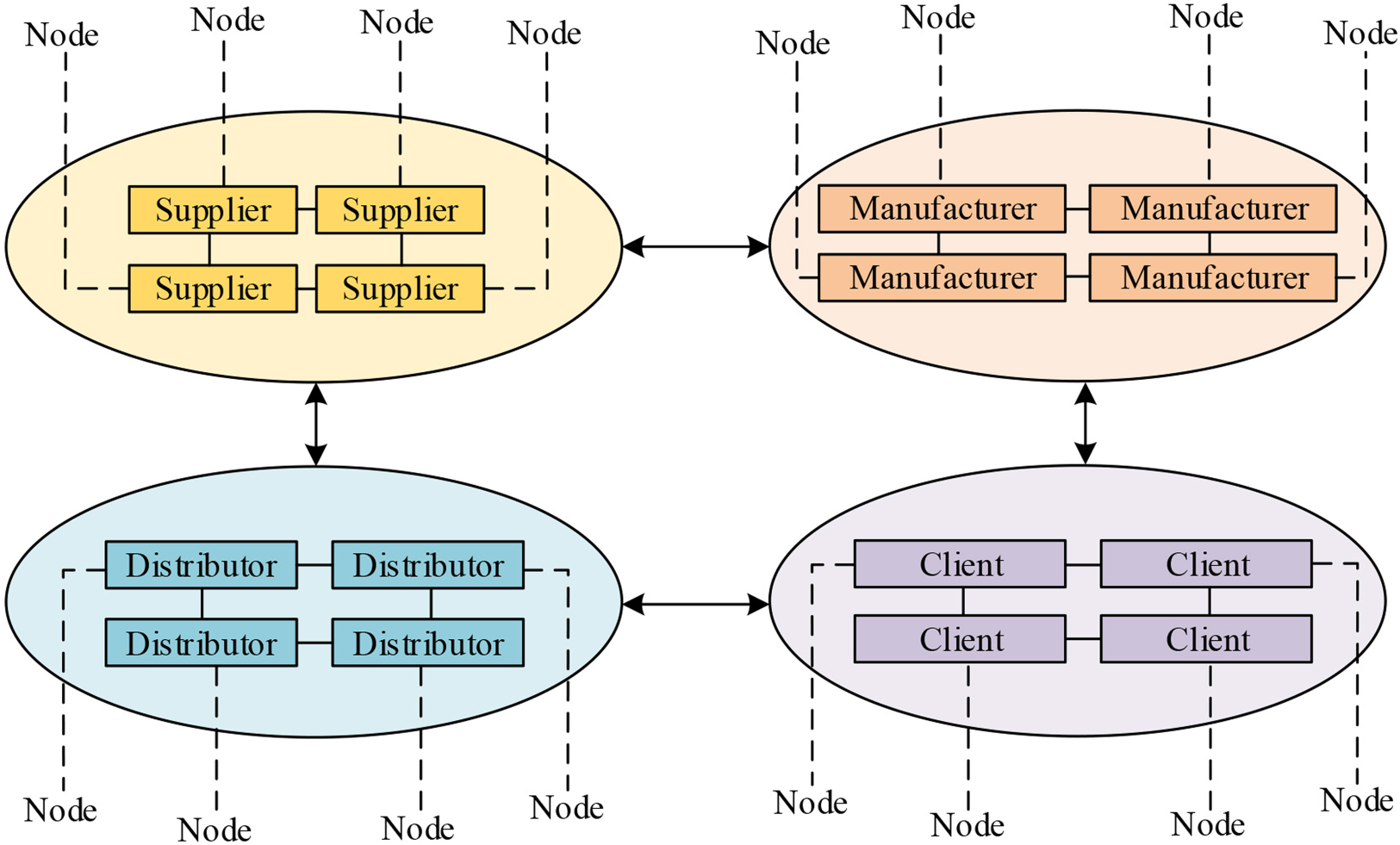
Supply chain under blockchain.
As shown in Fig. 1, significant issues surface when exploring the information flow sharing mechanism under the traditional SCM framework. One of the central concerns is the effective transfer of information flow through the various segments of SC [17]. SC extends from raw material suppliers to end customers with numerous participating entities, which results in information being prone to distortions and delays in the transmission process. In addition, the dynamic nature of the market environment further exacerbates the uncertainty of information transfer. As a result of poor information transmission between SC segments, raw demand signals are distorted step by step in the transmission process to the upstream, leading to significant differences between the order information received by upstream suppliers and the real demand of downstream customers. Further, information asymmetry raises the problem of trust deficit in SC. In the traditional SC structure, the trust mechanism usually relies on a centralized institution to guarantee the security and reliability of transactions [18]. This centralized trust mechanism, while alleviating the trust crisis triggered by information asymmetry to a certain extent, also brings high operation and maintenance costs. In addition, these centralized institutions face many restrictions in accessing the data of each node of the SC, thus increasing the trust cost of the whole SC. The supply chain under blockchain is shown in Fig. 2.
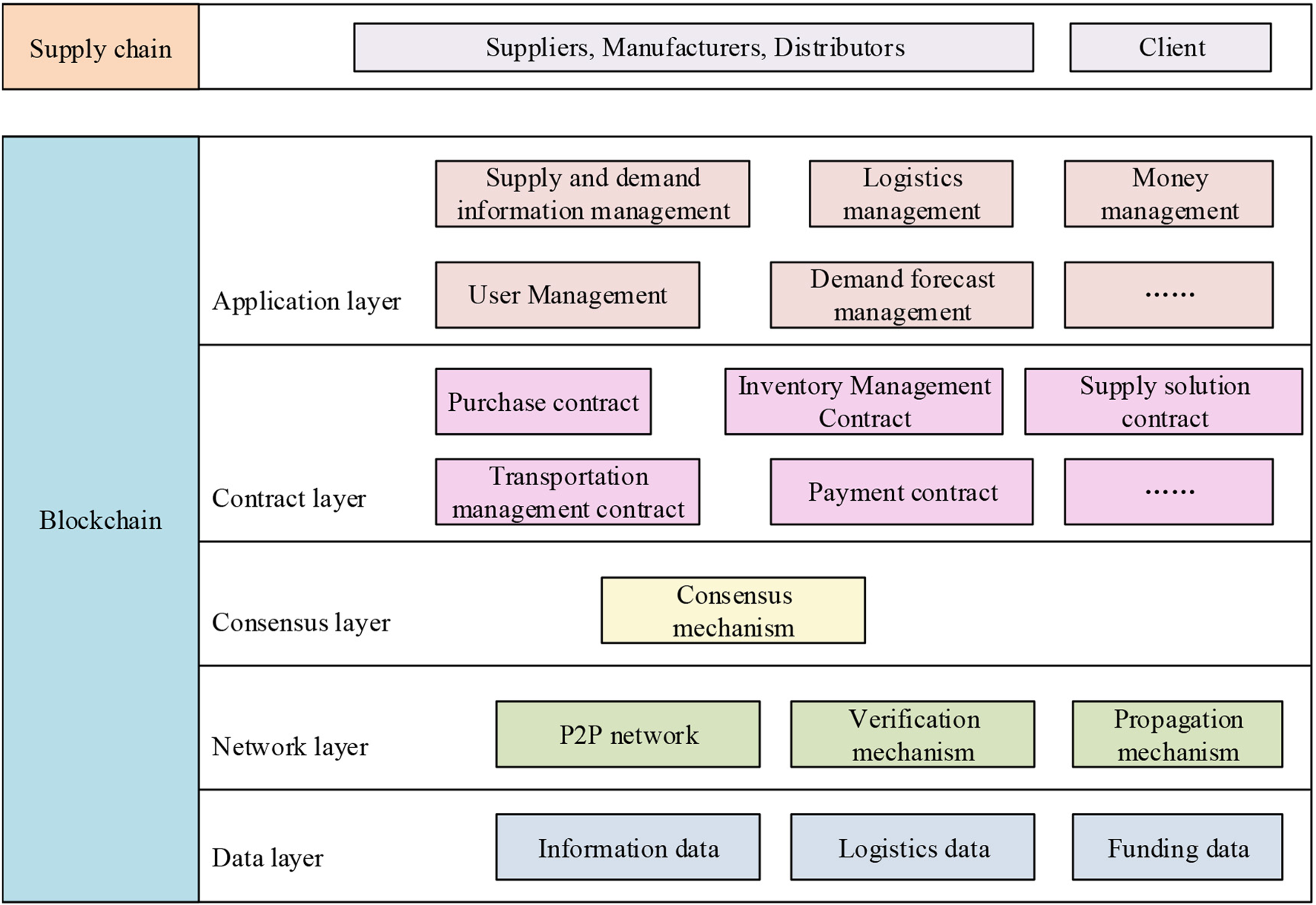
Blockchain – based supply chain information sharing technology architecture diagram.
As shown in Fig. 2, in the SCIS space, the introduction of BCT has significantly improved data transparency and accuracy. With this technology, all transaction and product information is recorded in a decentralized, tamper – proof ledger that ensures the openness and tamper – proof capability of the information. This approach enables customers to securely access their order information through their private keys, thus ensuring the transparency of the transaction process [19]. In the meantime, BC’s distinct CM offers a fresh approach to classic SC’s trust issue. This mechanism achieves authenticity verification of transactions through technical means, such as encryption and algorithms, without relying on a centralized certification authority, thus reducing transaction costs due to lack of trust. In addition, the high level of information security provided by BC makes it virtually impossible to change data once it has been successfully recorded, greatly reducing the risk of data being tampered with or subjected to hacking. Even in extreme cases where some nodes attempt to change information, other nodes in the network are able to quickly recognize inconsistencies, safeguarding the stability and integrity of the entire system [20]. The architecture diagram of blockchain based supply chain information sharing technology is shown in Fig. 3.
As shown in Fig. 3, in the data layer of BC, the information, logistics and financial records of SC are stored in a distributed manner. An endless chain is formed when every block is joined to the one before it. In order to tamper with any information, the attacker needs to change all the associated blocks, which is almost impossible in practice, thus ensuring the security and non – tamperability of the information. The network layer utilizes a P2P network to ensure efficient transmission of information between nodes. To guarantee the authenticity and security of data in the network, each node must first authenticate and obtain authorization before accepting new data. The consensus layer establishes a strong trust environment through various CMs, which changes the traditional centralized management. It ensures that the data information of all nodes in the SCIS system can reach consistency. Through the application of CM, a technology – based trust relationship is established between enterprises, effectively reducing information asymmetry and trust costs. The contract layer provides smart contracts and scripts to lay the foundation for the programmable features of BC. By writing and executing smart contracts, each link in SC can automatically run according to preset rules, transforming traditional interpersonal trust into trust in technology, while improving the execution efficiency and accuracy of each link in SC. The application layer covers a variety of practical application scenarios in SC sharing, helping enterprises to effectively manage information flow, logistics and capital flow.

Improved PBFT consensus process.
The PBFT consensus mechanism is an algorithm for solving the byzantine general problem in distributed systems. Its principle of operation is leader election to coordinate transaction requests between clients and servers. The system uses a client – server model to process transactions and a view – substitution mechanism to deal with MN failures or malicious behavior. The consensus process includes four stages: pre – prepare, prepare, submit, and reply to ensure the order and consistency of transaction requests. PBFT is fault – tolerant, allowing for up to 1/3 malicious or faulty nodes in the system. At the same time, digital signatures and message authentication codes are used to ensure the security and integrity of transactions. The improved PBFT – CM consists of seven phases: the Request phase initializes the request. Propose phase proposes the request proposal. Propose – Sign phase signs the proposal. The Prepare phase ensures that all nodes agree on the order of the request. The Prepare – Sign phase signs the readiness. The Commit phase guarantees a strict ordering of the submitted requests. The Reply phase completes the response to the request. In this flow, the Prepare and Commit phases guarantee the ordering of requests across views, while the Propose and Prepare phases cooperate to assure the consistency of the request order in the same view. Figure 4 depicts the updated PBFT consensus procedure.
In the Request phase, client

In Eq. (1),

In Eq. (2), op is the request execution operation, and

The parameter

In Eq. (4),

In Eq. (5), the

The aggregation signature is computationally generated according to Eq. (6), as shown in Eq. (7).

There are three conditions for the BN to receive the message PREPARE. First, the signature of the message PREPARE must be correct and the calculated result value is true. Second, the view number

During the preparation for signature phase, the BN

Such a message indicates that BN

In Eq. (10), the BN receives COMMIT message in the following cases: first, the signature of the message needs to be valid, i.e., the aggregated signature


Node type relationship diagram.
The message in Eq. (10) contains the request’s sequential position
For each EXECUTE message, the MN adds data to the Merkel tree as shown in Eq. (12).

Based on these data, the Prove function is used. The MN computes the Merkel tree proof proof, as shown in Eq. (13).

The proof of Eq. (13) contains the Merkel tree root root, proofIndex of the node

Once the BN

System configuration.
System configuration.

System latency performance under account creation transactions.
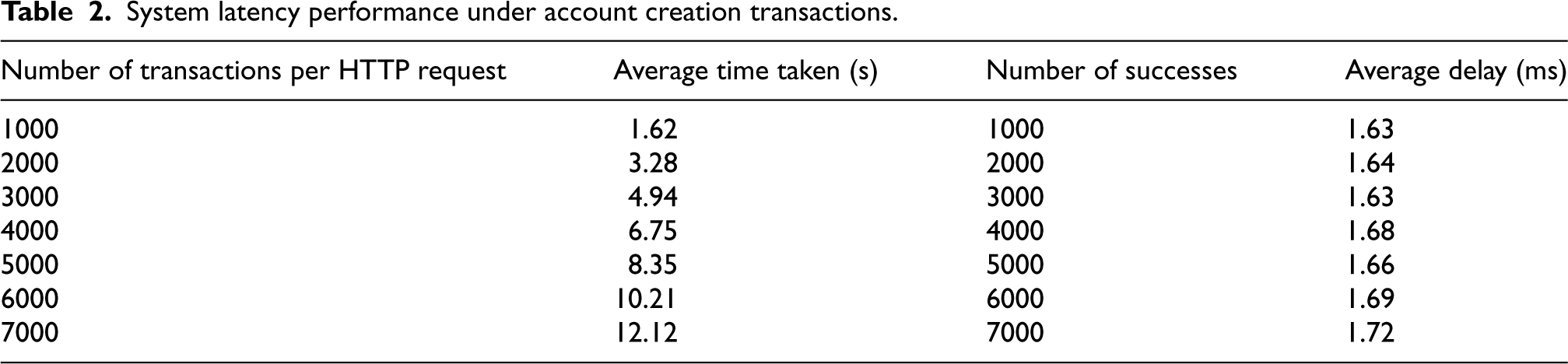
As shown in Table 1, the experimental environment used is Ubuntu 20.04.3 operating system in virtual machine VMware for the simulation experiments. The experiments use multi-threading of GO language to simulate the communication flow of consensus nodes in SCIS based on BC network. The experiment uses 4, 5, 6, 7, 8 and 9 nodes to simulate the communication flow of the CM. The system latency performance under account creation transaction processing is shown in Table 2.
As shown in Table 2, the improved BC model significantly outperforms the original model in terms of latency performance. The latency of the original model can be several seconds or even more than 10 seconds in processing certain transactions, which does not meet the high latency requirements of the application. The improved model, however, maintains the overall latency at milliseconds even when considering HTTP requests and inter-node communication latency during operations such as account creation, which significantly improves the performance. In the original paradigm, the delay increases exponentially with the number of nodes because every node participates in the consensus. Moreover, there is extra time that could be brought on by MN issues and communication breakdowns. The improved model effectively avoids these problems by performing consensus only among the elected representative nodes. Moreover, this benefit is more evident when there are a lot of nodes, which significantly enhances the system’s latency performance. The comparison between CPU resource utilization and node count is shown in Fig. 6.
Comparison of the link between CPU resource utilization and node count. Comparison of communication cost and communication time.

When processing the identical transaction workload with more nodes, the standard PBFT algorithm’s CPU resource requirements rise sharply as shown in Fig. 6(a). In contrast, the suggested improved approach performs better than the classic PBFT, showing just a linear increase. In Fig. 6(b), there is a notable improvement in the amount of communication under simulated settings with the upgraded PBFT method. When the nodes is 100, the communication volume of the traditional PBFT is about 2.038

Comparative analysis of throughput and latency performance.
Figure 7 demonstrates the comparison of communication cost between the improved PBFT and the conventional PBFT in processing requests. Figure 7(a) makes it evident that the enhanced PBFT offers a substantial cost advantage over other methods of communication. In the network with 8 nodes, the communication cost of the traditional PBFT is 43.67 KB, while the improved PBFT requires only 11.27 KB. Moreover, when the nodes increase to 32, the communication cost of the traditional PBFT is as high as 672.1 KB, while the improved PBFT requires only 54.92 KB, realizing a reduction of up to 91.8% in communication cost. Figure 7(b) further demonstrates the comparison of the communication cost of the two PBFTs when processing different numbers of requests with a fixed number of nodes. The communication cost of the upgraded PBFT is always less than that of the traditional PBFT, regardless of how many requests are made, further demonstrating the new PBFT’s efficacy in increasing efficiency. A comparison of the number of communication times is shown in Fig. 7(c). By utilizing the corrective deletion code technique and sending messages to the new MN, the improved PBFT lowers communication costs. Regardless of the volume of requests processed, its communication cost is always less than that of the traditional PBFT, demonstrating the optimization of the improved PBFT in terms of communication efficiency. The comparative analysis of throughput and latency performance is shown in Fig. 8.

Comparison of throughput changes under different numbers of bad pixels.
Figure 8 compares the performance of the improved PBFT with the traditional PBFT in terms of thro latency and throughput. When there are less than six nodes, as shown in Fig. 8(a), the throughput of the enhanced PBFT is marginally less than that of the conventional PBFT. The improved PBFT, however, performs better than the old version when there are more than six nodes. This is particularly true in networks with sixteen or thirty-two nodes, where the improved PBFT’s throughput is noticeably higher than the traditional PBFT’s. The performance of the two types of PBFTs with varying nodes is shown in Fig. 8(b) and 8(c), concerning the PBFT’s latency to process a single request and the latency to process varying block sizes under 20 nodes. The experimental findings demonstrate that, for small nodes, the latency of the improved PBFT is marginally higher than that of the conventional PBFT. Nonetheless, the enhanced PBFT outperforms the conventional PBFT in terms of latency performance as the node count rises. For example, at 64 nodes, the latency of the improved PBFT is 301.7 ms, while that of the traditional PBFT is 510.2 ms. At 100 nodes, the latency of the improved PBFT is 551.1 ms compared to 1115.8 ms for the traditional PBFT. The comparison of throughput changes under different numbers of bad pixels is shown in Fig. 9.

Comparative analysis of master node election and consensus efficiency.
Performance comparison analysis between improved PBFT and traditional PBFT.
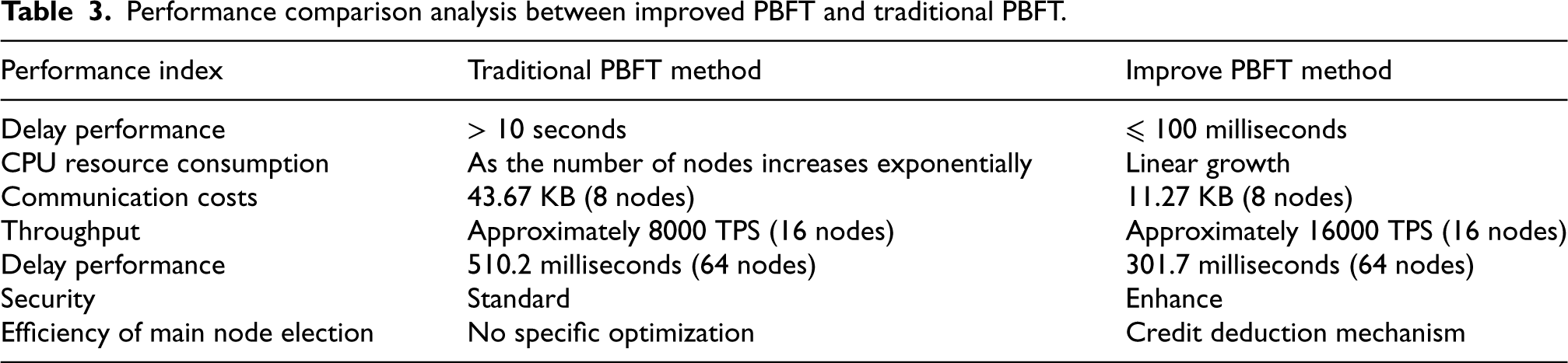
Figure 10(a) and 10(b) compare the performance of the original and improved PBFT. Figure 10(a) shows that the frequency of bad points acting as MNs in the original PBFT rises with the number of elections, while the improved PBFT effectively controls this phenomenon through the credit deduction mechanism. Figure 10(b) illustrates that the consensus completion time of the improved PBFT is shorter than that of the original version for the same number of byzantine nodes and consensus rounds, and the increase in time consumed is smaller as the consensus rounds increases. By reducing the chances of a bad point to become a MN, this mechanism effectively prevents possible malicious behaviors such as data tampering or denial-of-service attacks, thus improving the security of the whole network. The performance comparison analysis between improved PBFT and traditional PBFT is shown in Table 3.
Table 3 compares the application performance of traditional PBFT and improved PBFT in supply chain information sharing systems. Improved PBFT significantly reduces latency from over 10 seconds in traditional PBFT to the millisecond level, with a specific delay of only 301.7 milliseconds in a 64 node network. In terms of CPU resource consumption, improved PBFT shows linear growth, while traditional PBFT sharply increases with the number of nodes. The communication cost decreased from 43.67 KB to 11.27 KB in an 8-node network, and the throughput increased from approximately 8000 TPS to over 16000 TPS in a 16 node network. These numerical results highlight the significant improvement in efficiency and safety of improved PBFT.
The study presents a theoretical framework illustrating how blockchain addresses critical issues in supply chain information sharing, enhancing efficiency and trust. It comprehensively examines the improved PBFT consensus mechanism’s role in optimizing supply chain efficiency, supported by technical process analysis, algorithm application, and practical integration. The improved PBFT demonstrates superior latency, with millisecond-level response times compared to the original model’s seconds or more. CPU resource consumption increases linearly with the improved model, unlike the traditional model’s exponential growth. With a 16-node network, the improved PBFT processes over 16,000 transactions per second, exceeding the traditional PBFT’s 8,000. At 64 nodes, the improved PBFT achieves a delay of 301.7 ms, significantly lower than the traditional 510.2 ms. These results underscore the improved PBFT’s effectiveness in supply chain systems, offering robust support for blockchain technology applications. However, although the improved PBFT consensus mechanism in this study has demonstrated superior performance in theory, in practical applications, especially in large-scale network environments, processing speed and scalability may face challenges. These challenges may arise from the increased complexity of the network, the accumulation of communication delays between nodes, and the adaptability of algorithms under different network conditions. In addition, during actual deployment, it is necessary to consider the hardware heterogeneity of nodes, dynamic changes in the network, and potential security threats, all of which may affect the performance and stability of the consensus mechanism. Therefore, future research needs to further optimize algorithms to adapt to large-scale network environments, evaluate the robustness of algorithms through simulations of complex network environments, and conduct in-depth research on their performance and defense mechanisms in the face of diverse security threats. At the same time, the actual deployment and evaluation of improved PBFT performance in real supply chain environments, as well as exploring its potential applications in other fields such as financial services and the Internet of Things, will provide important basis for verifying its universality and promoting the widespread application of blockchain technology.
Footnotes
Fundings
The research is supported by: Key scientific research project of higher education institutions in Henan Province: Research and practice on new forms and models of cold chain logistics in Henan Province (No.24B630006).