



Abstract
BACKGROUND:
Although squat depth determines the weight that can be lifted while squatting, it is unclear whether the one-repetition maximum (1RM) at one squat depth can be used to estimate the 1RM at another squat depth.
OBJECTIVE:
To determine the correlations between 1RM weights at different back squat (BSQ) depths in frequently trained male collegiate athletes.
METHODS:
This cross-sectional study included 26 male collegiate athletes. Body composition, lower extremity length, and 1RM of BSQ were measured. 1RM of BSQ was measured at three positions (quarter, half and parallel positions), defined as 45 degrees of knee flexion (quarter, Q-SQ), 90 degrees of knee flexion (half, H-SQ), and femur parallel to the ground (parallel, P-SQ), respectively. All testing was conducted by a certified strength and conditioning specialist. Pearson’s correlation analysis and Spearman’s rank correlation were used to examine the correlation between 1RM at each squat depth.
RESULTS:
There was a significant correlation between 1RM in the H-SQ and P-SQ positions (
CONCLUSIONS:
Mutual estimation of the 1RM of H-SQ or P-SQ from the 1RM of the other squat position is possible. Estimation of the 1RM of Q-SQ from the 1RM of H-SQ or P-SQ is, however, difficult, and must be measured separately. Future studies should be conducted with larger sample sizes, in athletes of various sports, and in females.
Introduction
Resistance training is commonly used to improve athletic performance and health. One of the most common resistance training exercises is back squats (BSQs). BSQs, performed by carrying a barbell on the upper back and performing knee and hip flexion/extension exercises, are mainly used to strengthen the lower extremities. Many studies have been conducted on BSQ as a typical training exercise. Previous studies related to athletic performance have reported significant improvements in jumping, acceleration and change of direction ability following BSQ training [1, 2, 3, 4]. Therefore, BSQ training is frequently used in the field of sports. Squats are defined according to the degree of knee flexion as quarter squats (Q-SQ, 45 degrees of knee flexion), half squats (H-SQ, 90 degrees of knee flexion), parallel squats (P-SQ, femur parallel to the ground, 110–120 degrees of knee flexion), and deep squats (beyond parallel, 130–140 degrees of knee flexion) [5].
The choice of the optimal squat depth for training has been debated for decades and is still controversial. Increasing squat depth is considered more effective for inducing muscle hypertrophy, because muscle strength is required in a stretched muscle state [6]. Hartmann et al. [5] found positive adaptations in the squat jump and countermovement jump following deep squat training. Pallares et al. [7] reported that training in a full squat produced the greatest improvements in all athletic performance parameters (countermovement jump, 20-m sprint and Wingate tests) among the three squatting depths (full, parallel and half). Furthermore, intervention with the H-SQ produced the worst effect on improving athletic performance. Also, all three groups reported a moderate increase in pain perception scores following the 10-week resistance training program, although the H-SQ group experienced an acute increase in pain, stiffness and physical functional disability indices. On the other hand, shallow depth squats, such as quarter and half squats, are often selected to match competition movements, and transitioning the range of motion of training to match the competition season is an important technique in sports training. Rhea et al. [8] described greater athletic adaptations (i.e. squat jump and 40-yard sprint) in the Q-SQ group than H-SQ and full squat groups. Therefore, the squat depth selected for training should be based on the effects of different squat depths.
However, the one-repetition maximum (1RM) must be measured at each depth to ensure safety and to optimize training effectiveness when transitioning squat depths. This is a barrier to transitioning and is thought to consume more training sessions than necessary. Additionally, no studies have examined the relationship between squat depth and the respective 1RM.
This study aimed to determine correlations between 1RM weights at different BSQ depths in frequently-trained college athletes. Additionally, we attempted to estimate the 1RM of squatting at one depth from the 1RM of squatting at another depth.
Methods
Participants
Thirty male collegiate athletes agreed to participate in this cross-sectional study. However, four athletes dropped out of the study due to injuries unrelated to this study during the experimental period. The study thus included 26 male collegiate athletes for statistical analysis (mean
Procedures
Measurements were conducted on 3 days, with a minimum interval of 72 hours between successive measurements. Height, body composition, lower extremity length and 1RM in any one of the three BSQ positions were measured on day 1. On the second and third measurement days, only the 1RM of the other two BSQ positions were measured. Athletes were not restricted from training, except for during the measurements. A self-reported questionnaire was used to investigate participant age and training history.
Body Composition: To determine body composition, the participant’s body weight (BW) and body fat mass were measured using a body composition analyzer (Inbody 470, InBody Japan, Japan).
Lower extremity length: Length of the lower extremities was measured using a measuring tape, with the participant lying supine on the floor. A single examiner measured the length from the athlete’s greater trochanter to the lateral malleolus in both legs, and the average value of the two legs was used in the analysis.
Back Squat 1RM weight testing (Fig. 1): Measurements of BSQ 1RM were performed using the 1RM test protocol of the National Strength and Conditioning Association (NSCA) [9]. For warming up, each athlete performed one BSQ set with a load with which they could comfortably perform 5 to 10 repetitions, with the warm-up load allowing them to perform 3 to 5 repetitions without error, and near-maximal loads that allowed 2 to 5 repetitions without error. In consideration of safety, this was performed with a squat rack with safety bars that could catch the barbell if it dropped in a failed attempt. The examiner confirmed that the participant squatted to each position by observing that the participant touched his buttocks to a plastic bar (Fig. 1-⟀) that was positioned so that the knee was at 135 degrees for the Q-SQ, 90 degrees for the H-SQ, and the femur was parallel to the ground for the P-SQ [5]. The position of the plastic bar and the position at which the participant placed his feet when performing the squat were marked with tape (Fig. 1-⟁). The examiner was a certified strength and conditioning specialist. The squat depth when measuring the 1RM of the BSQ was fixed in random order. The BSQ exercise technique was conducted according to NSCA guidelines [9], as follows: The participant created a shelf over the trapezius muscle by adducting the scapulae with the elbows pointing backward, and the barbell was held on that shelf. The feet were placed shoulder width apart, with the toes pointing slightly outward. From the standing position, the participant lowered his buttocks until they touched the plastic bar, ensuring that the knees did not move forward ahead of the toes. Once the buttocks had been lowered to each position, the participant extended his knees to return to the standing position. The examiner at the side of the participant checked that the participants lowered their buttocks all the way to each position, and that their posture was successfully maintained.
Setting of the plastic bar during back squats for one-repetition maximum (1RM) testing: ⟀, plastic bar; ⟁, the position at which the participant placed his feet when performing the squat were marked with tape.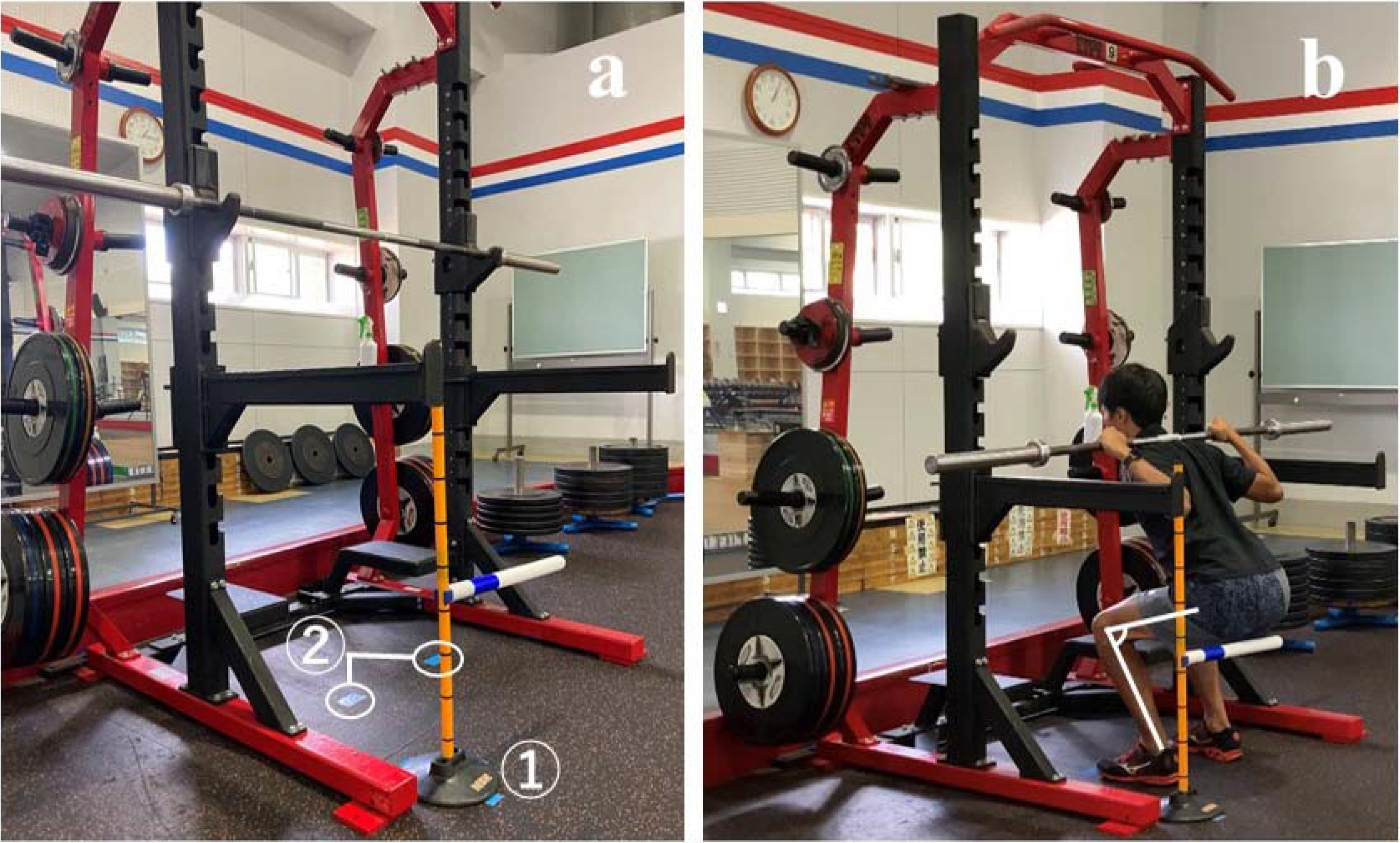
All data analyses were performed using SPSS version 26 (IBM Corp., Armonk, NY, USA). The normality of all data was analyzed using the Shapiro-Wilk test. Results were expressed as the mean
Results
Table 1 shows the mean, SD and 95% CIs of all variables. A significant correlation was found between the 1RM of H-SQ and P-SQ (
Normality of participant characteristics and the 1RM of each back squat position
Normality of participant characteristics and the 1RM of each back squat position
RM, repetition maximum; BSQ, back squat; BW, body weight;
Correlation between the 1RM of parallel squats (P-SQ) and half squats (H-SQ).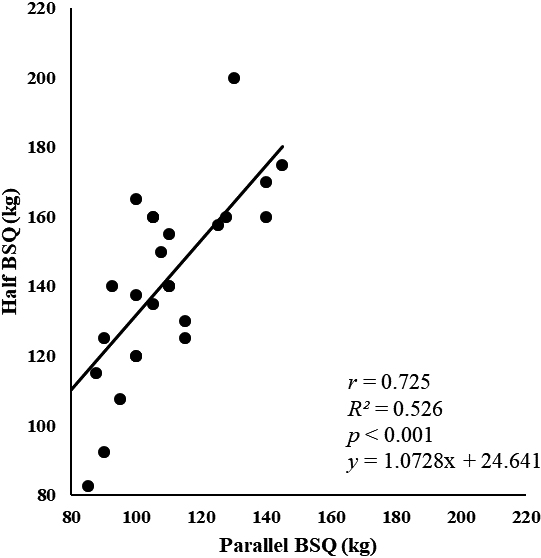
Correlation between height and one-repetition maximum per body weight (1RM/BW) of quarter squats (Q-SQ).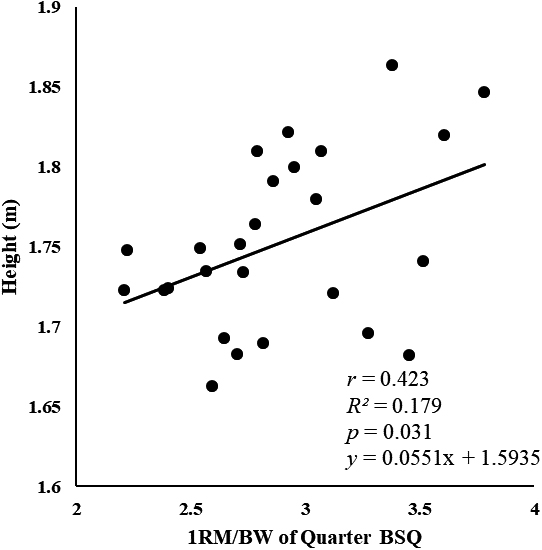
Correlation between lower extremity length and one-repetition maximum per body weight (1RM/BW) of quarter squats (Q-SQ).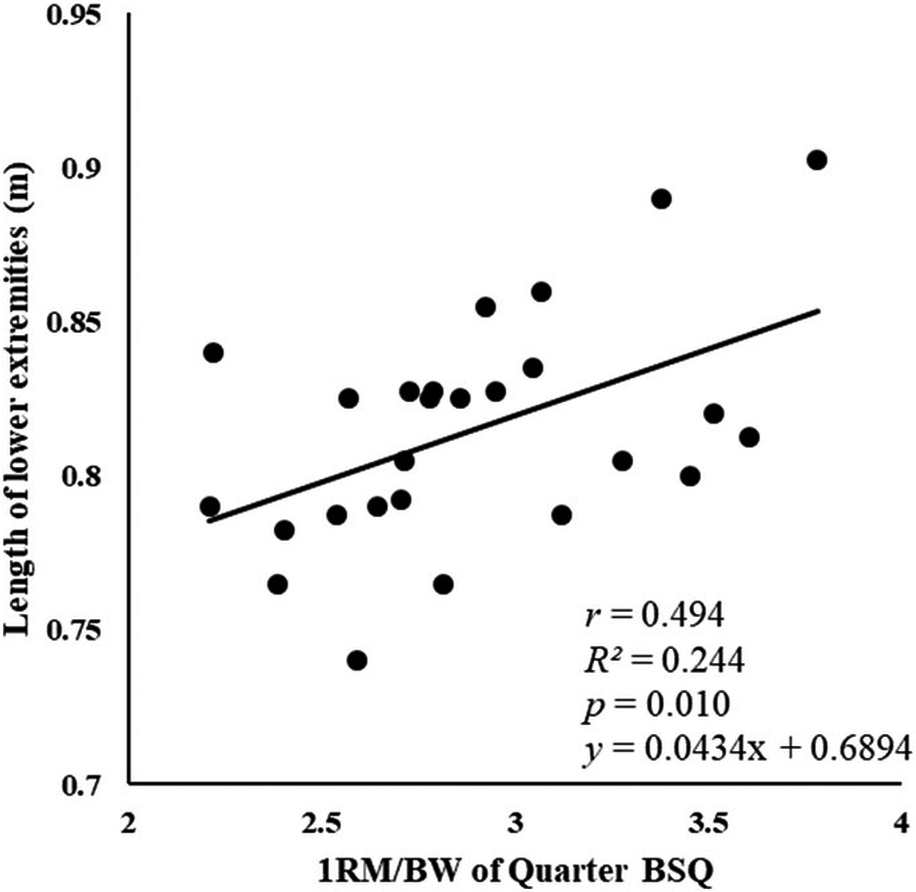
This cross-sectional study is the first to examine correlations between 1RM weights at each BSQ depth in frequently-training college athletes. A significant correlation was found between the 1RM weight of H-SQ and P-SQ.
Martinez-Cava et al. [10] reported the 1RM and 1RM/BW in half, parallel and full BSQs in the general population using a Smith machine. Their results showed that participants were able to lift 1.39 times the 1RM of parallel BSQ in half BSQ. In the present study as well, the average value of the 1RM of H-SQ was 1.30 times higher than that of P-SQ. This suggests that the rate of change of 1RM weights from P-SQ to H-SQ is similar in the general population and athletes. Additionally, there was a significant correlation between the 1RM of H-SQ and P-SQ in the present study. Therefore, this prediction equation (
The average
This study had several limitations. First, this study only included male collegiate athletes. Female collegiate athletes were excluded to avoid the effects of sex differences. Second, the knee and hip angles during 1RM measurements were unknown. However, the depth of the squat was checked at the beginning of the 1RM measurement, and the plastic bar was set accordingly. Nonetheless, it is noteworthy that this is the first study to examine the correlations between the 1RM of each BSQ depth.
Conclusions
We observed a significant correlation between the 1RM of H-SQs and P-SQs, which suggested that this prediction equation might be useful to estimate the 1RM of one squat depth from that of the other with moderate confidence. Future studies should be conducted in athletes of various sports and in females.
Author contributions
CONCEPTION: Shota Enoki
PERFORMANCE OF WORK: Shota Enoki, Taisei Hakozaki and Yuki Suzuki
INTERPRETATION OR ANALYSIS OF DATA: Shota Enoki
PREPARATION OF THE MANUSCRIPT: Shota Enoki
REVISION FOR IMPORTANT INTELLECTUAL CONTENT: Shota Enoki, Junpei Shiba, Taisei Hakozaki, Yuki Suzuki and Kenji Kuzuhara
SUPERVISION: Shota Enoki, Junpei Shiba and Kenji Kuzuhara
Ethical considerations
All participants provided written informed consent for study participation, and approval for the study was obtained from the Chukyo University Research Ethics Committee (approval number: No. 2021-10, dated Jun 6, 2021).
Funding
The authors report no funding.
Footnotes
Acknowledgments
The authors have no acknowledgments.
Conflict of interest
The authors have no conflicts of interest to report.