



Abstract
In this paper, we first introduce the notion of Stonean implicative filter in Hilbert algebra and study it in detail. Finally, we introduce a Stonean Hilbert algebra and investigate its properties, we prove that, H is a Stonean Hilbert algebra if and only if the set of all regular elements of H is a Stonean Hilbert algebra. By the diagrams, we summarize the results of this paper and give the relationships between all types of filters in a Hilbert algebra. Also, we give the relationships between Hilbert algebra and some of algebraic structures.
Introduction
The variety of Hilbert algebras is an important tool for investigations in intuitionistic logic and other non-classical logics. Hilbert algebras represent the algebraic counterpart of the implicative fragment of Intuitionistic Propositional Logic. The notion of a Hilbert algebra was studied by A. Diego [7] and developed by D. Busneag [1, 2], D. Buşneag and M. Ghita [3], S. A. Celani and D. Montangie [5], S. A. Celani [4], S. M. Hong and Y. B. Jun [10] and Figallo et al. [9]. Hilbert algebras with infimum are the algebraic counterpart of a propositional calculus weaker than the {→ , ∧}-fragment of the intuitionistic propositional calculus. The associated order of Hilbert algebras with infimum is a meet-semilattice. Also Hilbert algebras with supremum are Hilbert algebras in which the associated order is a join- semilattice. This class of algebras is a particular class of BCK-algebras with lattice operations and was studied by Idziak [11]. In continuing our study in Hilbert algebra, we define a Stonean Hilbert algebra as an algebraic structure which is weaker than Hilbert algebra and is a good step for better understanding this algebraic structure. The structure of the paper is as follows: in Section 2, some definitions and properties about Hilbert algebras are recalled. In Section 3, a Stonean implicative filter in Hilbert algebra is introduced and some of its properties are investigated. In Section 4, the notion of a Stonean Hilbert algebra is introduced and we have proved H is a Stonean Hilbert algebra if and only if R (H) is a Stonean Hilbert algebra. Also, we prove that F, is a Stonean implicative filter of the Hilbert algebra H if and only if H/F is a Stonean Hilbert algebra.
Preliminaries
We recall some basic definitions and results that are necessary for this paper.
A Hilbert algebra is an algebra (H, → , 1) of type (2, 0) such that the following axioms hold, for all x, y, z ∈ H [7] x → (y → x) =1; (x → (y → z)) → ((x → y) → (x → z)) =1; if x → y = y → x = 1, then x = y.
For a Hilbert algebra H, (H, ≤) is a poset by defining an order relation ≤ such that x ≤ y if and only if x → y = 1 (called the natural order on H), with respect to this order, 1 is the greatest element of H. If H has a smallest element 0, we say that H is bounded, in this case for x ∈ H we have x* = x → 0.
0* = 1, 1* = 0; x → y* = y → x*; x → x* = x*, x* → x = x**, x ≤ x**, x ≤ x* → y; x → y ≤ y* → x*; If x ≤ y, then y* ≤ x*; x*** = x*; (x → y) ** = x → y** = x** → y**; (y → x) * ≤ x → y.
(H, → , 1) is a Hilbert algebra; (H, ∨ , 1) is a join-semilattice with last element 1. For all a, b ∈ H, a → b = 1 if and only if a ∨ b = b.
A subset D of Hilbert algebra H is called a deductive system (or an implicative filter or simply filter) of H if: (i) 1 ∈ D, (ii) If x ∈ D and x → y ∈ D, then y ∈ D, for all x, y ∈ H.
Let D be a deductive system of a Hilbert algebra. If x ≤ y and x ∈ D, then y ∈ D. We denote Ds (H)= {D: D is a deductive system of H}. If H is bounded, then the deductive system D is proper if and only if 0 ∉ D.
We note that, in some papers the deductive system is called implicative filter too. We use implicative filter in this paper. An implicative filter F of a bounded Hilbert algebra H is a Boolean filter of the first kind if x** → x ∈ F, for all x ∈ H. Also an implicative filter F of H is called a Boolean filter of the second kind if x ∨ x* ∈ F, for all x ∈ H. An implicative filter F of a Hilbert algebra with supremum H is a prime filter of the first kind if x ∨ y ∈ F implies x ∈ F or y ∈ F. Also, an implicative filter F of a Hilbert algebra with supremum H is a prime filter of the second kind if x → y ∈ F or y → x ∈ F, for all x, y ∈ H. Also, an implicative filter F of a Hilbert algebra with supremum H is a prime filter of the third kind if (x → y) ∨ (y → x) ∈ F, for all x, y ∈ H. Let F be an implicative filter of a bounded Hilbert algebra H. Define: x ≡ F y if and only if x → y ∈ F and y → x ∈ F. Then ≡ F is a congruence relation on H. The set of all congruence classes is denoted by H/F, i.e, H/F : = {[x] : x ∈ H}, where [x] = {y ∈ H:x ≡ F y}. Define → on H/F as follows: [x] → [y] = [x → y], and 1 = 1/F = F.
Therefore (H/F, → , [1] , [0]) is a bounded Hilbert algebra with respect to F and the order relation on H/F is given by [x] ≤ [y] if and only if x → y ∈ F. Clearly, [x] = [1] if and only if x ∈ F.
x** = x, for every x ∈ H; H is a Boolean algebra relative to natural ordering, where x ∧ y = (x → y*) *, x ∨ y = x* → y.
H is Boolean algebra (relative to naturalordering); (x → y) → y = (y → x) → x; x* → y = y* → x; (x → y) → y = x ∨ y; x* → y = x ∨ y.
A positive implicative filter of H, if 1 ∈ F and x → ((y → z) → y) ∈ F and x ∈ F imply y ∈ F, for every x, y, z ∈ H. A fantastic filter of H, if 1 ∈ F and z → (y → x) ∈ F and z ∈ F imply ((x → y) → y) → x ∈ F, for every x, y, z ∈ H.
For any Hilbert algebra H, Max (H) denotes the set of all maximal implicative filters of H.
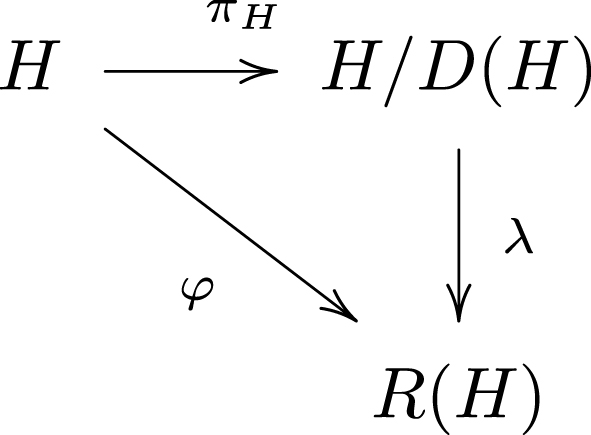
D (H) = {x ∈ H : x* = 0}; R (H) = {x ∈ H : x** = x}.
R (H) = {x* : x ∈ H} = {x** : x ∈ H}; (R (H) , → , 0, 1) is a bounded Hilbert algebra; φ : H → R (H), for all x ∈ H, φ (x) = x** is a surjective homomorphism of Hilbert algebras; Let λ : H/D (H) → R (H), for all x ∈ H, λ (x/D (H)) = x**. Then λ is an isomorphism of Hilbert algebras and the following diagram is commutative.
A Hilbert algebra is said to be local if and only if it has exactly one maximal filter [6].
((x → y) → x) → x ∈ F, for all x, y ∈ H such that y ≠ 0.
(If y = 0, then ((x → 0) → x) → x ∈ F, so (x* → x) → x = x** → x ∈ F. Thus F is a Boolean filter of the first kind of H.)
(I) (x → y) → x = x, for all x, y ∈ H such that y ≠ 0.
(If y = 0, then (x → 0) → x = x** = x. Thus H is a Boolean algebra.)
Stonean implicative filter
In this section, H is a bounded Hilbert algebra with supremum, unless otherwise is stated.
The following example shows that the notions of implicative filters and Stonean implicative filters are not the same.
Let H = {0, a, b, c, 1}, with 0 < a, b < c < 1, but a, b are incomparable. We define Let H = {a, b, c, d, 1}. Define Let H = {0, a, b, c, d, e, f, g, 1}, with 0 < a < b < e < 1, 0 < a < d < e < 1, 0 < a < d < g < 1, 0 < c < d < e < 1, 0 < c < d < g < 1, 0 < c < f < g < 1, but elements {a, c} , {b, d} , {d, f} , {e, g} and {b, f} are pairwise incomparable. Define (H, → , 0, 1) is a Hilbert algebra, F = {1} is a Stonean implicative filter.
If M is a maximal filter of H, then M is a Stonean implicative filter.
If H is a local Hilbert algebra, then H \ {0} and D (H) are Stonean implicative filters.
Let M be a maximal filter of H and x ∈ H. If x ∈ M, then x** ∈ M, since x ≤ x**. Therefore x* ∨ x** ∈ M. Thus M is a Stonean implicative filter. But if x ∉ M, then x* ∈ M. Thus x* ∨ x** ∈ M, for all x ∈ H. Hence M is a Stonean implicative filter. In a local Hilbert algebra H, we have D (H) = H \ {0} is maximal filter of H. Thus by (i), H \ {0} and D (H) are Stonean implicative filters.□
In the following example, we show that the converses of (i) and (ii) in the above theorem are not true.
Then (H, → , 0, 1) is a Hilbert algebra with supremum, but it is not local, because (a → b) * ≠ (b → a) *. The implicative filters {1} , {a, 1} , {b, 1} and {a, b, 1} are Stonean. We see that F = {1} is not a maximal filter of H. Also, H {0} = {a, b, 1} and D (H) = {1} are Stonean implicative filters but H is not a local Hilbert algebra.
The following example shows that the converse of the above proposition is not true.
Then (H, → , 0, 1) is a local Hilbert algebra with supremum. The implicative filter F = {1} is a Stonean implicative filter, since x* ∨ x** ∈ F, for all x ∈ H, but it is not a Boolean filter of the first kind of H.
In the following example, we show that the converse of Proposition 3.9 is not true.
The converse of Proposition 3.9 is true in particular condition.
Stonean Hilbert algebra
In this section, H is a Hilbert algebra with supremum, unless otherwise is stated.
Conversely, let every implicative filter F of H be a Stonean implicative filter of H. Then F = {1} is a Stonean implicative filter of H. Therefore x* ∨ x** = 1, for all x ∈ H. Hence H is a Stonean Hilbert algebra.
□
In Example 4.2, we showed that the converse of above theorem is not correct.
H/F is a Stonean Hilbert algebra, for every implicative filter F of H. H/D (H) is a Stonean Hilbert algebra.
In the following theorem we show the relationship between F and H/F.
In the following we show that the converse of above proposition is not correct.
Let x** → y** = y** → x**, for all x, y ∈ H \ {0, 1}. Then H is a Stonean Hilbert algebra. If x → y** = y → x**, for all 0 ≠ x, y ∈ H, then H is a Stonean Hilbert algebra.
(x → y) * = (x → y) *** = (x** → y**) * = (y** → x**) * = (y → x) *** = (y → x) *, for all 0 ≠ x, y ∈ H. For all x, y ∈ H \ {0, 1}, x** → y** = x → y** = y → x** = y** → x**.
□
In the following example we show that the converse of above corollary and Theorem 4.13 is not correct.
(a → b) * ≠ (b → a) *. Thus, the converse of Theorem 4.13 is not correct. b = a** → b** ≠ b** → a** = a. Therefore, the converse of Corollary 4.14 (i) is not correct. b = a → b** ≠ b → a** = a. Hence, the converse of Corollary 4.14 (ii) is not correct.
Conversely, let R (H) be a Stonean Hilbert algebra. Thus x** ∨ x*** = 1, for all x* ∈ R (H). Therefore x** ∨ x* = 1, for all x ∈ H. Hence H is a Stonean Hilbert algebra. □
In the following example, we show that the relation between an implication filter (implication algebra) and a Stonean implicative filter (Stonean Hilbert algebra).
In Example 3.2 (ii), F = {1} is an implication filter, thus H is an implication algebra. But, F = {1} is not a Stonean implicative filter, also H is not a Stonean Hilbert algebra. Define In Example 3.6, F = {1} is an implication filter, also it is a Stonean implicative filter. Thus H is an implication algebra, also it is a Stonean Hilbert algebra. In Example 3.2 (i), F = {1} is not an implication filter, thus H is not an implication algebra. Also, F = {1} is not a Stonean implicative filter, thus H is not a Stonean Hilbert algebra.
In [16] Hilbert algebra is called “positive implication algebra”.
In the following example, we show that the bounded condition in above theorem is essential.
Then (H, → , 1) is an implication algebra, since H is a Hilbert algebra such that (x → y) → x = x, for all x, y ∈ H. But it is not a Boolean algebra, since H is not bounded.
In ([9, 15]) A Hertz algebra is an algebra (A, → , ∧ , 1) of type (2, 2, 0) which satisfies the following axioms: (i) x → x = 1; (ii) (x → y) ∧ y = y; (iii) x ∧ (x → y) = x ∧ y; (iv) x → (y ∧ z) = (x → z) ∧ (x → b). In [8] it is proved for a Hilbert algebra H, H is a Hertz algebra if and only if H is a Hilbert algebra with infimum which verifies property (P), which (P): x ← (y ← (x ^ y))=1. .
Conclusion and future research
In this paper, we studied the Stonean implicative filter in a Hilbert algebra and investigated some of its properties. The notion of Stonean Hilbert algebra is introduced and we have proved theorems which determine some properties of this notion in Hilbert algebra. The results of this paper will be devoted to study of Hilbert algebra, intuitionistic,s logic which are different extensions of basic logic.
In the first diagram (Fig. 1) we summarize the results of this paper and the previous results in this field and give the relationships between all types of filters of Hilbert algebra. Also, in the second diagram (Fig. 2) we give the relationships between Hilbert algebra and other algebraic structures. By
Acknowledgments
The authors are extremely grateful to the referees for their valuable comments and helpful suggestions which helped to improve the presentation of this paper.