In this paper, first we introduce the concept of rough soft lattices and present some basic properties. Then, the notion of generalized fuzzy soft lattices is defined and some related properties are derived. Moreover, the lattice structure of generalized fuzzy soft lattices is discussed.
To solve complicated problems in economics, engineering, environmental science, sociology and medical science, we cannot successfully use classical methods because of various uncertainties typical for those problems. While probability theory, fuzzy sets [12], rough sets [19], soft set theory [11] and other mathematical tools are well-known and often useful approaches to describing uncertainty. Fuzzy set theory was initiated by Zadeh in 1965 [22]. In 1982, Pawlak [19] introduced the concept of rough sets. In 1999, Molodtsov [11] proposed the soft set theory as a new mathematical tool for dealing with uncertainties which is free from the difficulties affecting existing methods.
At present, work on the soft set theory is progressing rapidly. Maji et al. [15] describe the application of soft set theory to a decision-making problem. The same authors have also published a detailed theoretical study on soft sets [14]. Chen et al. [5] present a new definition of soft set parameterization reduction, and compare this definition to the related concept of attributes reduction in rough set theory. The algebraic structure of set theories dealing with uncertainties has also been studied by some authors. Maji et al. [13] presented the definition of fuzzy soft set, and they presented some applications of this notion to decision-making problems in [15]. Feng et al. [8] introduced rough soft set, soft rough set, soft rough fuzzy set and examined related properties. D. Meng et al. [18] proposed soft fuzzy rough set and surveyed their related properties.
Recently, the work introducing the soft set theory to lattice theory and the fuzzy set theory have initiate. Li [10] presented the notion of the soft lattice and gave the properties of the soft lattices and discussed the relation between the soft lattices and the fuzzy soft sets. Marudai and Rajendran [16] studied Molodtsov notion of soft set and fuzzy soft set considering the fact that the parameters are mostly fuzzy hedges or fuzzy parameters. They introduced the notion of fuzzy soft lattice on groups, homomorphic image, pre-image of fuzzy soft lattices, arbitrary family of fuzzy soft lattices and fuzzy normal soft lattices using T-norms. They also investigated the notion of sensible fuzzy soft lattices in groups and some related properties on it. Shao and Qin [20] introduced the notion of fuzzy soft lattice and derived some related properties. They also discussed the lattice structure of fuzzy soft lattices. In this paper, we deal with the algebraic structure of lattice by applying rough soft set theory and examine their properties with suitable examples. Then, we introduce the notion of generalized fuzzy soft lattice and derive some related properties. This paper is organized as follows: In Section 2, some preliminary definitions and results are given which will be used in the rest of the paper. In Section 3, we introduce the notion of rough soft lattice and focus on their algebraic properties with several illustrating examples. In Section 4, the notion of generalized fuzzy soft lattice is given and some related properties are derived, then the lattice structure of generalized fuzzy soft lattices is discussed. Section 5 concludes the paper.
Preliminaries
In this section, we recall some definitions and results which will be used in the sequel. Throughout the paper, we shall denote a lattice (L, ∨ , ∧ , 0, 1) by L with the least element 0 and the greatest element 1, where the join and meet operations are denoted by ∨ and ∧ in L, respectively. If L is a bounded lattice then we say y ∈ L is a complement of x ∈ L if x ∧ y = 0 and x ∨ y = 1. In this case we say that x is a complemented element of L, a lattice L is complemented if every element of L is complemented. We shall use the notation x′ to denote the unique complement of x. Let U be an initial universe set and R be a congruence relation on U, then (U, R) denotes a Pawlak approximation space and we write everywhere “Pawlak approximation space” with capital letter “P”.
Definition 2.1. [22] Let X be a nonempty set. A mapping A : X → [0, 1] is called a fuzzy subsetof X.
Definition 2.2. [1] Let A be a fuzzy subset in the lattice L. Then A is called a fuzzy sublattice of L if for all x, y ∈ L
(i) A (x ∧ y) ≥ A (x) ∧ A (y),
(ii) A (x ∨ y) ≥ A (x) ∧ A (y).
Definition 2.3. [11] Let U be an initial universal set and E be a set of parameters. Let be the power set of U. A pair (F, E) is called a soft set over U, where F is a mapping given by .
(i) The restricted-union of two soft sets (F, A) and (G, B) over a common universe U is defined as the soft set (H, C) = (F, A) ∪ (G, B), where C = A∩ B ≠ ∅, and H (ɛ) = F (ɛ) ∪ G (ɛ) for all ɛ ∈ C.
(ii) The extended-union of two soft sets (F, A) and (G, B) over a common universe U, where C = A ∪ B, and for all ɛ ∈ C,
(i) The restricted-intersection(or bi-intersection) of two soft sets (F, A) and (G, B) over a common universe U is defined as the soft set (H, C) = (F, A) ∩ (G, B), where C = A∩ B ≠ ∅, and H (ɛ) = F (ɛ) ∩ G (ɛ) for all ɛ ∈ C.
(ii) The extended intersection of two soft sets (F, A) and (G, B) over a common universe U is defined as , where C = A ∪ B, and for all ɛ ∈ C
(i) The ∧-intersection of two soft sets (F, A) and (G, B) over a common universe U is defined as the soft set , where C = A × B, and H (α, β) = F (α) ∩ G (β) for all (α, β) ∈ C;
(ii) The ∨-union of two soft sets (F, A) and (G, B) over a common universe U is defined as the soft set , where C = A × B, and H (α, β) = F (α) ∪ G (β) for all (α, β) ∈ C.
Definition 2.7. [14]For a soft set (F, A), the set Supp (F, A) = {x ∈ A : F (x) ≠ ∅} is called the support of the soft set (F, A). Thus the null soft set is a soft set with an empty support, and we say that soft set (F, A) is non-null if Supp (F, A)≠ ∅.
Theorem 2.8. [21]Let (F, A) and (G, B) be two soft lattices overL.
(i) IfA∩ B ≠ ∅, then the extended-unionis a soft lattice overL.
(ii) IfF (x) ⊆ G (x) orG (x) ⊆ F (x) for allA ∩ B, then the restricted-union (F, A) ∪ (G, B) is a soft lattice overL.
(iii) IfF (a) ⊆ G (b) orG (b) ⊆ F (a) for all (a, b) ∈ A × B, then the ∨-unionis a soft lattice overL.
(iv) The extended-intersectionis a soft lattice overL.
(v) The restricted-intersection (F, A) ∩ (G, B) withA∩ B ≠ ∅ is a soft lattice overL.
(vi) The ∧-intersectionis a soft lattice overL.
Definition 2.9. [13]U be an initial universal set and let E be a set of parameters. Let IU denote the power set of all fuzzy subsets of U, A ⊆ E, A pair (F, E) is called a fuzzy soft set over U, where F is a mapping given by F : A → IU.
Definition 2.10. [13]For two fuzzy soft sets (F, A) and (H, B) over a common universe U, we say that (F, A) is a fuzzy soft subset of (H, B) if (i) A ⊂ B, (ii) For any ɛ ∈ A; F (ɛ) is a fuzzy subset of H (ɛ). In this case, we write (F, A) ⊆ (H, B).
Definition 2.11. [13]Two fuzzy soft sets (F, A) and (H, B) over a common universe U are said to be fuzzy soft equal if (F, A) is a fuzzy soft subset of (H, B) and (H, B) is a fuzzy soft subset of (F, A).
Definition 2.12. [3]The intersection of two fuzzy soft sets (F, A) and (H, B) over a common universe U is the fuzzy soft set (H, C), where C = A ∩ B and which is defined by H (ɛ) = F (ɛ) ∩ H (ɛ), ∀ɛ ∈ C, denoted by .
Definition 2.13. [3]The union of two fuzzy soft sets (F, A) and (G, B) over the common U is the fuzzy soft set (H, C), where C = A ∪ B and ∀ɛ ∈ C,
This relationship is denoted by .
Definition 2.14. [8]Let (U, R) be P and Ω = (F, A) be soft set over U. The lower and upper approximations of Ω in (U, R) are denoted by R∗ (Ω) = (F∗, A) and R∗(Ω) = (F∗, A); which are soft sets over U with the set valued mapping given by:
F∗ (x) = R∗ (F (x)) = {y ∈ U : [y] R ⊆ F (x)} , F∗(x) = R∗(F (x)) = {y ∈ U : [y] R ∩ F (x) ≠ ∅} for all x ∈ A. The operators R∗ and R∗ are called the lower and upper rough approximation operators on soft sets. If R∗ (Ω) = R∗(Ω), the soft set Ω is said to be definable; otherwise Ω is called rough soft set.
Theorem 2.16.[8]Let (U, R) bePandΩ = (F, A) be soft set overU. Then we have (1)R∗ (Ω) ⊆ Ω ⊆ R∗(Ω) , (2)R∗ (R∗ (Ω)) = R∗ (Ω) , (3)R∗(R∗(Ω)) = R∗(Ω) .
Theorem 2.17.[9]Let (U, R) bePandΩ = (F, A) be soft set overU. Then we have (1) , (2) .
Definition 2.18. [17] Let U = {x1, x2, ⋯ , xn} be the universal set of elements and E = {e1, e2, ⋯ , em} be the universal set of parameters. The pair (U, E) will be called a soft universe. Let F : E → IUand μ be a fuzzy subset of E, where IU is the collection of all fuzzy subsets of U. Let Fμ be the mapping Fμ : E → IU× I be a function defined as follows: Fμ (e) = (F (e) , μ (e)), where F (e) ∈ IU. Then Fμ is called a generalized fuzzy soft set (GFSS in short) over the soft universe (U, E).
Rough soft lattices
In this section, R is a full congruence relation on a lattice L.
Definition 3.1. [21] Let (F, A) be a non null soft set over a lattice L. Then (F, A) is called a soft lattice over a lattice L if F (x) is a sublattice of L for all x ∈ Supp (F, A).
Example 3.2. Let L = A be a lattice. Consider the set-valued function given by F (x) = x ↓ = {y ∈ L ∣ y ≤ x} or F (x) = x ↑ = {y ∈ L ∣ y ≥ x}. Then (F, A) is a soft lattice over L.
Definition 3.3. [6]Let R be an equivalence relation on L. Then R is called a full congruence relation if (a, b) ∈ R implies that (a ∨ x, b ∨ x) ∈ R and (a ∧ x, b ∧ x) ∈ R for all x ∈ L and [x] R denotes the congruence class containing the element x ∈ L.
Definition 3.4. [6] Let R be a full congruence relation on L. Then
(1) R is called ∨-complete if [a] R ∨ [b] R = [a ∨ b] R for all a, b ∈ L,
(2) R is called ∧-complete if [a] R ∧ [b] R = [a ∧ b] R for all a, b ∈ L.
We say that R is complete if it satisfies (1) and (2) simultaneously, denote it C (R).
Definition 3.5. A non null soft set Ω = (F, A) over L is said to be an upper(lower) rough soft lattice over L if R∗(Ω)(R∗ (Ω)) is a soft lattice over L.
Theorem 3.6.Let (L, C (R)) be P. IfΩ = (F, A) is a soft lattice overL, thenΩis an upper rough soft lattice overL.
Proof. Since Ω = (F, A) is a soft lattice over L, then F (x) is a sublattice of L for all x ∈ Supp (F, A), by Definition 3.1. Now R∗(Ω) = (F∗, A), where ∀x ∈ A, F∗(x) = R∗(F (x)) = {y ∈ L : [y] R ∩ F (x) ≠ ∅}. Let a, b ∈ F∗(x), this implies [a] R∩ F (x) ≠ ∅ and [b] R∩ F (x) ≠ ∅. So there exist c ∈ [a] R ∩ F (x), d ∈ [b] R ∩ F (x). Since F (x) is a sublattice of L, so c ∧ d ∈ F (x). By Definition 3.4, we have c ∧ d ∈ [a] R ∧ [b] R = [a ∧ b] R. Hence [a∧ b] R ∩ F (x) ≠ ∅. This implies a ∧ b ∈ F∗(x). We can similarly get a ∨ b ∈ F∗(x). So, F∗(x) is a sublattice of L for all x ∈ Supp (F, A). Therefore R∗(Ω) is a soft lattice over L. Hence by Definition 3.5, Ω is an upper rough soft lattice over L. □
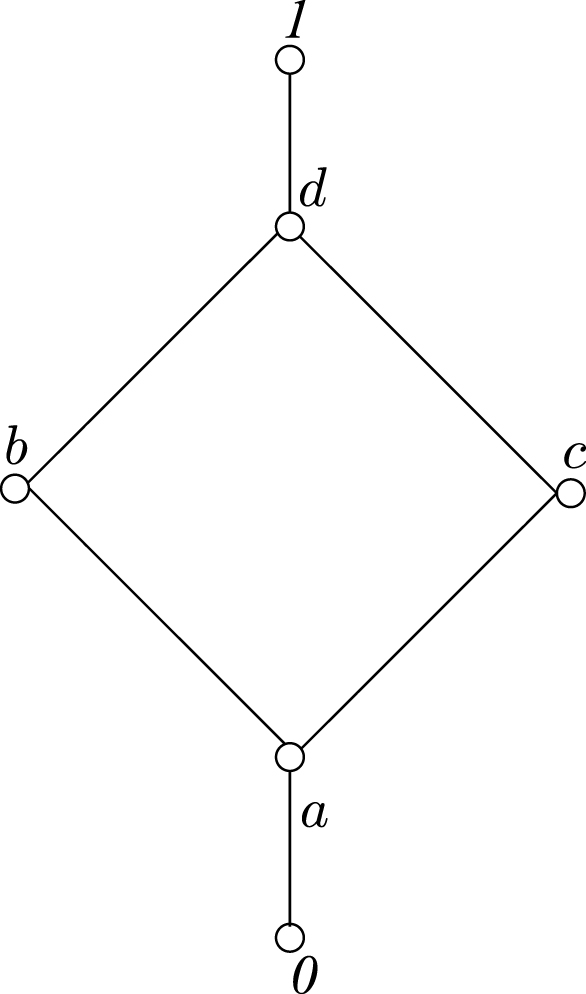
Example 3.7. Take L = {0, a, b, c, d, 1}. We define the binary relation ≤ on L in the following figure. It is easy to see that L is a lattice. Let R be a congruence relation on the lattice L with the following equivalence classes: [0] R = {0, a}; [b] R = {b}; [c] R = {c}; [1] R = {1, d}. Let Ω = (F, A) be a soft set over L, where A = {1, 2, 3} and F : A → P (L)
is a set valued function defined by F (x) = {y ∈ L ∣ (x, y) ∈ θ} for all x ∈ A, where θ = {(1, b) , (1, c) , (2, 0) , (2, a) , (2, c) , (3, c) , (3, c) , (3, d) , (3, 1)}. Then F (1) = {b, c}, F (2) = {0, a, c}, F (3) = {c, d, 1}, since F (1) = {b, c} is not a sublattice of L, so Ω = (F, A) is not a soft lattice over L. But by Definition 2.14, R∗(Ω) = (F∗, A), where ∀x ∈ A, F∗(x) = R∗(F (x)) = {y ∈ L : [y] R ∩ F (x) ≠ ∅} = {c}. So, F∗(x) is a sublattice of L, ∀x ∈ A. Hence R∗(Ω) is a soft lattice over L.
Theorem 3.8.Let (L, C (R)) be P andΩ = (F, A) be a soft lattice over a complemented latticeL. IfR∗ (Ω) is non null, thenR∗ (Ω) = Ω.
Proof. Clearly, by Theorem 2.2, R∗ (Ω) ⊆ Ω. To prove the theorem we have only to prove Ω ⊆ R∗ (Ω). Suppose R∗ (Ω) is non null. This implies Supp (F∗, A)≠ ∅. Let F∗ (x)≠ ∅, then there exists c ∈ F∗ (x). So [0] R = [c ∧ c′] R = [c] R ∧ [c′] R ⊆ F (x). Let a be an arbitrary element of F (x). Since F (x) is a sublattice of complemented lattice L, then y ∈ a ∨ [0] R = [a ∨ 0] R = [a] R. So, we get [a] R ⊆ F (x), which implies a ∈ F∗ (x). Therefore F (x) ⊆ F∗ (x) for all x ∈ Supp (F∗, A). Hence, Ω ⊆ R∗ (Ω). □
Definition 3.9. A non null soft set Ω = (F, A) over L is said to be a rough soft lattice over L if R∗ (Ω) and R∗(Ω) are both soft lattices over L.
Corollary 3.10.IfΩ = (F, A) is a soft lattice overLandR∗ (Ω) is non null, thenΩis a rough soft lattice overL.
Theorem 3.11.Let (U, R) bePandΩ = (F, A), Ψ = (H, B) be soft sets overLsuch thatR∗(Ω), R∗(Ψ) are soft lattices overL.
(i) IfR∗(Ω) ⊆ R∗(Ψ) orR∗(Ψ) ⊆ R∗(Ω), thenR∗(Ω ∪ Ψ) is a soft lattice overL.
(ii) IfA∩ B ≠ ∅ orR∗(Ω) ⊆ R∗(Ψ) orR∗(Ψ) ⊆ R∗(Ω), is a soft lattice overL.
(iii) IfA× B ≠ ∅ orR∗(Ω) ⊆ R∗(Ψ) orR∗(Ψ) ⊆ R∗(Ω), is a soft lattice overL.
Proof. (i) If R∗(Ω) ⊆ R∗(Ψ) or R∗(Ψ) ⊆ R∗(Ω), then by Theorem 2.7, R∗(Ψ) ∪ R∗(Ω) is a soft lattice over L. From Theorem 2.15, R∗(Ω ∪ Ψ) = R∗(Ω) ∪ R∗(Ψ), hence R∗(Ω ∪ Ψ) is a soft lattice over L.
(ii) If A∩ B ≠ ∅ or R∗(Ω) ⊆ R∗(Ψ) or R∗(Ψ) ⊆ R∗(Ω), then by Theorem 2.7, is a soft lattice over L. From Theorem 2.15, , hence is a soft latticeover L.
(iii) We can prove it similarly. □
Theorem 3.11 may not be true for lower rough approximation as seen in the following example.
Example 3.12. Consider the lattice L with the following diagram: Let R be a full congruence relation on the lattice L with the following equivalence classes: [0] R = {0, a}; [b] R = [c] R = {b, c}; [1] R = {1}. Let Ω = (F, A) and Ψ = (G, B) be two soft sets over L, where A = B = {1, 2, 3} and define θ1 = {(1, 0) , (1, a) , (1, b) , (2, 0) , (2, a) , (2, c) , (3, 0) , (3, a) , (3, 1)} . Then F (1) = {0, a, b}, F (2) = {0, a, c}, F (3) = {0, a, 1}. Also define θ2 = {(1, 0) , (1, a) , (1, c) , (2, 0) , (2, a) , (2, b) , (3, 0) , (3, a) , (3, b) , (3, c) , (3, 1)} , thenG (1) = {0, a, c}, G (2) = {0, a, b}, G (3) = {0, a, b, c, 1}. So Ω, Ψ are not soft lattice over L. Now from Definition 2.14, we can write R∗ (Ω) = (F∗, A) and R∗ (Ψ) = (G∗, B), where F∗ (x) = {0, a} ∀x ∈ A and G∗ (x) = {0, a} ∀x ∈ B. So R∗ (Ω) and R∗ (Ψ) are soft lattices over L. Also it can be shown from Theorem 2.8, R∗ (Ω) ∪ R∗ (Ψ) and are soft lattices over L. From Definition 2.4, we can write Ω ∪ Ψ = (H, C) where C = A ∩ B = {1, 2, 3} andH (1) = {0, a, b, c}, H (2) = {0, a, b, c}, H (3) = {0, a, b, c, 1}. From Definition 2.14, R∗ (Ω ∪ Ψ) = (H∗, C), where H∗ (1) = H∗ (2) = {0, a, b, c}, H∗ (3) = {0, a, b, c, 1}. Since H∗ (1), H∗ (2) are not sublattices of L, hence R∗ (Ω ∪ Ψ) is not a soft latticeover L.
Theorem 3.13.Let (L, C (R)) bePandΩ = (F, A), Ψ = (H, B) be soft sets overLsuch thatR∗ (Ω), R∗ (Ψ) are soft lattices overL.
(i) IfR∗ (Ω) ∩ R∗ (Ψ) is non null, thenR∗ (Ω ∩ Ψ) is a soft lattice overL.
(ii) Ifis non null, thenis a soft lattice overL.
Proof. (i) If R∗ (Ω) ∩ R∗ (Ψ) is non null, hence by Theorem 2.8 R∗ (Ω) ∩ R∗ (Ψ) is a soft lattice over L. From Theorem 2.15, R∗ (Ω ∩ Ψ) = R∗ (Ω) ∩ R∗ (Ψ), therefore R∗ (Ω ∩ Ψ) is a soft lattice over L.
(ii) We can prove it similarly. □
Theorem 3.13 may not be true for upper rough approximation as seen in the following example.
Example 3.14. Let (L, C (R)) be P and lattice L = {0, a, b, c, d, 1} as in Example 3.7, where R congr-uence classes are [0] R = {0, a}, [b] R = {b}, [c] R = {c}, [1] R = {1, d}. Let Ω = (F, A) and Ψ = (G, B)be two soft sets over L, where A = B = {1, 2, 3} anddefine θ1 = {(1, 0) , (1, b) , (1, c) , (2, a) , (2, b) , (2, d) , (3, a) , (3, b) , (3, 1)} . Then F (1) = {0, b, c}, F (2) = {a, b, d}, F (3) = {a, b, 1}. Also define θ2 = {(1, a) , (1, b) , (2, 0) , (2, b) , (2, 1) , (3, a) , (3, b) , (3, c) , (3, d)} , then G (1) = {a, b}, G (2) = {0, b, 1}, G (3) = {a, b, c, d}. So, Ω, Ψ are not soft sublattices over L. Nowfrom Definition 2.15, we can write R∗(Ω) = (F∗, A) and R∗(Ψ) = (G∗, B), where F∗(x) = {0, a, b} ∀x ∈ A and G∗(x) = {0, a} ∀x ∈ B. So R∗(Ω) andR∗(Ψ) are soft sublattices over L. Also it can be shown from Theorem 2.8, R∗(Ω) ∩ R∗(Ψ) and are soft sublattices over L. From Definition 2.4, we can write Ω ∩ Ψ = (H, C) where C = A ∩ B = {1, 2, 3} and H (1) = H (2) = H (3) {b}. From Definition 2.14, R∗(Ω ∩ Ψ) = (H∗, C), where H∗(1) = H∗(2) = H∗(3) = {b}. Since H∗(1), H∗(2) and H∗(3) are not sublattices of L, hence R∗(Ω ∩ Ψ) is not a soft sublattice over L.
Generalized fuzzy soft lattices
Definition 4.1. Let (F, A) be a fuzzy soft set over L and μ be a fuzzy subset of E. Then, (Fμ, A) is said to be a generalized fuzzy soft lattice over L if F (x) is a fuzzy sublattice of L and μ (x) is a fuzzy subset of E for all x ∈ A.
Example 4.2. Consider the lattice L = {0, 1, 2, 3} with the following Cayley tables:
Let A = {e1, e2, e3} be parameters set and be a set-valued function defined by F (e1) = {(0, 0.8) , (1, 0.6) , (2, 0.4) , (3, 0.6)}, F (e2) = {(0, 0.9) , (1, 0.7) , (2, 0.5) , (3, 0.7)}, F (e3) = {(0, 0.7) , (1, 0.6) , (2, 0.4) , (3, 0.7)}.
Obviously (F, A) is a fuzzy soft set over L. Also, we note that F (x) is a fuzzy sublattice of L for all x ∈ A. We define Fμ as follows: Fμ (e1) = ({(0, 0.8) , (1, 0.6) , (2, 0.4) , (3, 0.6)} , 0.1), Fμ (e2) = ({(0, 0.9) , (1, 0.7) , (2, 0.5) , (3, 0.7)} , 0.5), Fμ (e3) = ({(0, 0.7) , (1, 0.6) , (2, 0.4) , (3, 0.7)} , 0.2). So, (Fμ, A) is a generalized fuzzy soft latticeover L.
Definition 4.3.Let (Fμ, A) and (Gλ, B) be two generalized fuzzy soft lattices over L. We define (1) as follows: C = A ∪ B and for all e ∈ C
(2) (Fμ, A) ∪ (Gλ, B) = (Hν, C) as follows: C = A ∩ B and Hν (e) = (F (e) ∪ G (e) , μ (e) ∨ λ (e)) for all e ∈ C.
Definition 4.4. Let (Fμ, A) and (Gλ, B) be two generalized fuzzy soft lattices over L. We define (1) as follows: C = A ∪ B and for all e ∈ C
(2) (Fμ, A) ∩ (Gλ, B) = (Hν, C) as follows: C = A ∩ B and Hν (e) = (F (e) ∩ G (e) , μ (e) ∧ λ (e)) for all e ∈ C.
Proposition 4.5.Let (Fμ, A), (Gλ, B) and (Hν, C) be generalized fuzzy soft lattices overL. Then (1) , (2) (Fμ, A) ∪ (Fμ, A) = (Fμ, A), (3) , (4) (Fμ, A) ∪ (Gλ, B) = (Gλ, B) ∪ (Fμ, A), (5)
, (6) ((Fμ, A) ∪ (Gλ, B)) ∪ (Hν, C) = (Fμ, A)
∪ ((Gλ, B) ∪ (Hν, C)).
Proof. It is similar to the proof of Proposition 3.23 in [20]. □
Proposition 4.6.Let (Fμ, A), (Gλ, B) and (Hν, C) be generalized fuzzy soft lattices overL. Then (1) , (2) (Fμ, A) ∩ (Fμ, A) = (Fμ, A), (3) , (4) (Fμ, A) ∩ (Gλ, B) = (Gλ, B) ∩ (Fμ, A), (5) , (6) ((Fμ, A) ∩ (Gλ, B)) ∪ (Hν, C) = (Fμ, A) ∩ ((Gλ, B) ∩ (Hν, C)).
Proof. It is similar to the proof of Proposition 3.23 in [20]. □
Proposition 4.7.Let (Fμ, A) and (Gλ, B) be generalized fuzzy soft lattices overL. Then (1) is a generalized fuzzy soft lattice overL. (2) (Hν, C) = (Fμ, A) ∩ (Gλ, B) is a generalized fuzzy soft lattice overL.
Proof. It is immediate by Definition 4.4. □
Proposition 4.8.Let (Fμ, A) and (Gλ, B) be generalized fuzzy soft lattices overL. Then (1) is a generalized fuzzy soft lattice overL. (2) (Hν, C) = (Fμ, A) ∪ (Gλ, B) is a generalized fuzzy soft lattice overL.
Proof. It is immediate by Definition 4.3. □
Proposition 4.9.Let (Fμ, A) and (Gλ, B) be generalized fuzzy soft lattices overL. Then (1) , (2)
Proof. It is similar to the proof of Proposition 3.27 in [20]. □
Proposition 4.10Let (Fμ, A), (Gλ, B) and (Hν, C) be generalized fuzzy soft lattices overL. Then (1) ((Fμ, A) ∩ (Gλ, B)) ∪ (Hν, C) = ((Fμ, A) ∪ (Gλ, B)) ∩ ((Fμ, A) ∪ (Hν, C)), (2) ((Fμ, A) ∪ (Gλ, B)) ∩ (Hν, C) = ((Fμ, A) ∩ (Gλ, B)) ∪ ((Fμ, A) ∩ (Hν, C)).
Proof. (1) Let ((Fμ, A) ∩ (Gλ, B)) ∪ (Hν, C) = (Iρ, (A ∩ B) ∩ C)) and ((Fμ, A) ∪ (Hν, C)) ∩ ((Gλ, B)∪ (Hν, C)) = (Jσ, (A∩ C) ∩ (B ∩ C)) = (Jσ, (A ∩B ∩ C). For all e ∈ (A ∩ B) ∩ C, that is, e ∈ A,e ∈ B, e ∈ C, Iρ (e) = ((F (e) ∩ G (e)) ∪ H (e) , (μ (e)∧λ (e)) ∨ ν (e)) = ((F (e) ∪ H (e)) ∩ (G (e) ∪ H (e)) , (μ (e) ∨ λ (e)) ∧ (λ (e) ∨ ν (e)).
Therefore, ((Fμ, A) ∩ (Gλ, B)) ∪ (Hν, C) = ((Fμ, A) ∪ (Hν, C)) ∩ ((Gλ, B) ∪ (Hν, C)).
(2) The proof is similar to (1). □
Definition 4.11. Let Γ (L, E) = {(Fμ, A) |A ⊆ E, and (Fμ, A) is a generalized fuzzy soft lattice over L}, then Γ (L, E) is called a generalized fuzzy soft class.
Theorem 4.12. (Γ (L, E) , ∪ , ∩) is a distributive lattice.
Proof. It is immediate by Proposition 4.5, Proposition 4.6, Proposition 4.9 and Proposition 4.10. □
Theorem 4.13.is a lattice.
Proof. It is immediate by Proposition 4.5, Proposition 4.6 and Proposition 4.9. □
Conclusion
In this paper we have introduced the concept of rough soft lattices and generalized fuzzy soft lattices over a lattice and studied some of their related properties. And we discussed the lattice structure of generalized fuzzy soft lattices. Based on these results, we can further probe the applications of soft lattices.
Footnotes
Acknowledgments
The authors are highly grateful to the referees for their valuable comments and suggestions for improving this paper and acknowledge gratefully for the support from the Education Department Shaanxi Provincial Government Natural Science Foundation (No.14JK1535).
References
1.
AjmalN. and ThomasK.V., Fuzzy lattice, InformationScience79 (1994), 271–291.
2.
AcarU., KoyuncuF. and TanayB., Soft sets and soft rings, Comput Math Appl59 (2010), 3458–3463.
3.
AliM.I., FengF., LiuX., MinW.K. and ShabirM., On some new operations in soft set theory, Comput Math Appl57 (2009), 1547–1553.
4.
AliM.I., DavvazB. and ShabirM., Generalized fuzzy S-acts and their characterization by soft s-acts, Neural Computing and Application21(Suppl 1) (2012),S9–S17.
5.
ChenD., TsangE.C.C., YeungD.S. and WangX., The parameterization reduction of soft sets and its applications, Comput Math Appl49 (2005), 757–763.
6.
EstajiA.A., HooshmandaslM.R. and DavvazB., Rough set theory applied to lattice theory, Information Science200 (2012), 108–122.
7.
FengF., JunY.B. and ZhaoX., Soft irings, Comput Math Appl56 (2008), 2621–2628sem.
8.
FengF., LiC.X., DavvazB. and AliM.I., Soft sets combined with fuzzy sets and rough sets: A tentative approach, Soft Comput14 (2010), 899–911.
9.
GhoshJ. and SamantaT.K., Rough soft sets and rough soft group, Journal of Hyperstructures2 (2013), 18–29.
10.
LiF., Soft lattices, Global Journal of Science Frontier Research10 (2010), 157–159.
11.
MolodtsovD., Soft set theory-First results, Comput Math Appl37 (1999), 19–31.
12.
MolodtsovD., The Theory of Soft Sets (in Russian), URSS Publishers, Moscow, 2004.




 is a set valued function defined by F (x) = {y ∈ L ∣ (x, y) ∈ θ} for all x ∈ A, where θ = {(1, b) , (1, c) , (2, 0) , (2, a) , (2, c) , (3, c) , (3, c) , (3, d) , (3, 1)}. Then F (1) = {b, c}, F (2) = {0, a, c}, F (3) = {c, d, 1}, since F (1) = {b, c} is not a sublattice of L, so Ω = (F, A) is not a soft lattice over L. But by Definition 2.14, R∗(Ω) = (F∗, A), where ∀x ∈ A, F∗(x) = R∗(F (x)) = {y ∈ L : [y]
R
∩ F (x) ≠ ∅} = {c}. So, F∗(x) is a sublattice of L, ∀x ∈ A. Hence R∗(Ω) is a soft lattice over L.
is a set valued function defined by F (x) = {y ∈ L ∣ (x, y) ∈ θ} for all x ∈ A, where θ = {(1, b) , (1, c) , (2, 0) , (2, a) , (2, c) , (3, c) , (3, c) , (3, d) , (3, 1)}. Then F (1) = {b, c}, F (2) = {0, a, c}, F (3) = {c, d, 1}, since F (1) = {b, c} is not a sublattice of L, so Ω = (F, A) is not a soft lattice over L. But by Definition 2.14, R∗(Ω) = (F∗, A), where ∀x ∈ A, F∗(x) = R∗(F (x)) = {y ∈ L : [y]
R
∩ F (x) ≠ ∅} = {c}. So, F∗(x) is a sublattice of L, ∀x ∈ A. Hence R∗(Ω) is a soft lattice over L.