



Abstract
Local public administrations around the world are facing the challenge of introducing e-participation, but the cultural and institutional aspects of the e-participation innovation process have not been researched extensively. This dearth in research can inhibit our understanding of how and why e-participation succeeds, fails or develops in certain contexts. Thus, we apply two concepts from organizational institutionalism to determine how e-participation in local public administrations is influenced by and influences the organizational and institutional context. Institutional logics help us to describe and analyze the complex institutional context, and institutional work assists in focusing agency aimed at but also embedded in this institutional context. The research, which includes results of a multiple case study of three local German public administrations, finds that three role identities in regard to e-participation can be distinguished: entrepreneurs, pragmatists, and skeptics. These identities develop in relation to administrators’ positions in e-participation processes and evolve as actors engage strategically in the innovation process through institutional work on e-participation practices at the individual, project, and organizational level. We thereby generate insights into the specific perspective of central actors in the e-participation innovation process (i.e. administrators).
Keywords
Introduction
Government organizations around the world are increasingly using new forms of participation based on information and communication technologies (ICTs), also known as e-participation (Sæbø, Rose & Flak, 2008). They promise to facilitate greater openness of participation processes, top-down offers for joint decision-making, responsiveness of local governments (Macintosh, 2004; Sivarajah et al., 2015), or digital platforms for managing “wicked problems” in policy-making (Koliba et al., 2011). Academia and practice have started to discuss the potential of e-participation in addressing growing democratic deficits and decreasing trust in governments.
Local public administrations (PAs) are often responsible for organizing and realizing (e-)participation projects in the population’s day-to-day living environment, so they are an “important locus for democratic participation” (Peters, 2010, p. 10). This, however, might be in conflict with their ideal-typical bureaucratic neutrality and impartiality. E-participation emphasizes innovative practices: the use of new technologies in governments (e-government) (Alcaide-Muñoz et al., 2017) and the institutional reform goals of increasing participation and collaboration in policy-making (Sæbø et al., 2008, pp. 402–403; Sandoval-Almazan & Gil-Garcia, 2016). Hence, e-participation follows a specific rationale for using technologies in government contexts.2
We view e-participation primarily from the perspective of bureaucratic local PAs as central actors in this process. We acknowledge that e-participation can also include the use of ICTs in political participation “beyond bureaucracy” (Paulin & Anthopoulos, 2017) and that the broader e-democracy discourse, for instance, also includes formalized, direct participation like e-voting (e.g., Macintosh, 2004). However, this is not our focus.
Nevertheless, e-participation often failed to enable a more participatory process of policy making (Hepburn et al., 2013). Diffusion of innovations3
We broadly define innovation from diffusion literature as “an idea, practice, or object that is perceived as new” (Rogers, 2003, p. 12) and understand e-participation as an institutional (democratic innovation) and technological innovation (Bekkers & Homburg, 2005).
Empirical e-participation diffusion research has hardly addressed these complex processes in PA. In general, institutional and organizational characteristics, like institutional values, hierarchies, organizational culture, leadership support, resistance, or resources, have been identified as important factors that influence the diffusion and uptake of e-participation in PAs in a variety of studies (e.g., Andersen et al., 2007; Chadwick, 2011; Dekker & Bekkers, 2015; Panopoulou et al., 2014; Welch & Feeney, 2014). However, such factor approaches hardly acknowledge that democratic participation is only one rationale for using ICTs (Rose et al., 2015) and its diffusion will be actively shaped by administrators implementing them. Meijer (2015) highlighted the importance of strategic action related to approaching cultural barriers for participatory technology use. He used the concept of framing to describe the discursive strategies that are needed to address cultural or institutional barriers and tensions surrounding e-participation. However, institutional contexts are not only transmitted through symbolic interactions (e.g., discourses) but also through relations, routines, or artifacts (such as e-participation tools and practices) (Greenwood et al., 2017; Scott, 2014, p. 58). Thus, a detailed lens on the strategies of multiple actor groups in the enactment and translation (Kornberger et al., 2017) of e-participation inside the organizationally and institutionally complex context of PAs is still lacking.
E-government researchers highlight the need for more in-depth investigations of the complex organizational ecologies (Bekkers & Homburg, 2005), polity structures (Taylor & Lips, 2008) and core values (Lips, 2012), actors in PAs are embedded in and which make ICTs difficult to manage. For example, the technology enactment framework focuses on this ongoing interplay of innovations (e.g., ICTs), organizational structures, and institutional context in PAs and how its members deal with it (Fountain, 2001; Luna-Reyes & Gil-Garcia, 2014; Tassabehji et al., 2016). Thus, technology use can lead to complete failure or unintended consequences (Taylor & Lips, 2008). Nonetheless, in e-government literature such institutional arrangements have often been conceptualized as laws, regulations, or institutionalized routines, narrowly focusing on the structural, formalized elements of bureaucratic institutions (e.g., Fountain, 2009). Thus, Rose et al. (2015) highlighted the possibility and need to address PAs’ hybridity, which is a consequence of a series of public sector reforms. Nevertheless, research about agency as an important factor in the e-government innovation processes has been scarce (King & Kraemer, 2012; Lenk, 2012) and focused on technology experts (IT-manager or CIOs; e.g., Tassabehji et al., 2016).
To clarify why the adoption of e-participation often does not lead to the expected results, the aim of our study is to analyze the processes and strategies of enactment and institutionalization (agency) that influence how e-participation evolves in the specific institutional context (structure) of PAs. Thus, we turn to neo-institutional approaches that put emphasis on exactly the interplay of agency and hybrid institutional structures in such organizational innovation processes (Battilana et al., 2017; Coule & Patmore, 2013). To analyze this interplay of structures and agency (Giddens, 1984), we combine two prevailing concepts from organizational institutionalism (Scott, 2014): the institutional logics perspective (Thornton et al., 2012) that describes social structures for rational and legitimate action and the institutional work approach (Lawrence et al., 2009) highlighting that actors can strategically engage in the reproduction and change of these structures. We analyze PAs of three large municipalities in the West of Germany using an explorative, qualitative, multiple-case study design (Yin, 2009) to develop a more detailed understanding of the individual and organizational institutional context and strategies that influence the process of e-participation enactment and institutionalization.
Institutional logics and public administration
Institutional logics and public sector hybridity
Institutional logics are defined as “socially constructed, historical patterns of material practices, assumptions, values, beliefs, and rules by which individuals produce and reproduce their material subsistence, organize time and space, and provide meaning to their social reality” (Thornton & Ocasio, 1999, p. 804). Hence, institutional logics help in the analysis of the black-box of institutional complexity and hybridity in organizational settings through specifying the content of institutions (Battilana et al., 2017). Logics are ideal types (methodologic and linguistic tools) that summarize the socio-cultural, normative, and regulative patterns (e.g., market, state, or religion) that influence individual or collective actors, and their identities and behaviors by providing them with “ready-to-wear means-end prescriptions” (Pache & Santos, 2013, p. 6). Elements of a logic include core values, rationality, and sources of legitimacy that define which behavior is appropriate and which is not in a given situation (Thornton et al., 2012).
PA research has addressed institutional logics and hybridity as a result of reform processes in the past decades. Instead of superseding past institutional logics, studies showed that logics are layering on top of each other, which leads to an increasing number of rationales and core values available as a basis of administrative action (Christensen & Laegreid, 2012; Polzer et al., 2016). Hybridity between the ideal of traditional bureaucratic administration (state logic) and New Public Management (NPM; based in a market logic) reforms has been analyzed to some extent. Meyer, Hammerschmid and colleagues (Meyer et al., 2014; Meyer & Hammerschmid, 2006) developed a clear classification of the bureaucratic-legalistic and managerial institutional logics that we can adopt in this study. Other studies also included post-NPM approaches such as New Public Governance (NPG) or Public Value Management reforms (Osborne, 2006; Rose et al., 2015) associated to the network character of governance settings to analyze PAs’ hybridity more accurately (Coule & Patmore, 2013; Fossestol et al., 2015; Polzer et al., 2016).
However, these analyses of NPG reforms have been less clear about their relation to overarching societal institutional logics. They draw upon two rationalizations of why governance or networking are important. On the one hand studies argued that NPG reforms promote an increasing awareness that public services and goods are not produced by public administrations alone, but are co-produced in communities and “networks of organizations, government, and citizens” (Coule & Patmore, 2013, p. 982), with a focus on the shared responsibility for an area or collective goal. On the other hand, NPG has been associated to a democratic logic emphasizing that civic engagement in the work of public administration should follow democratic principles (focus on democratic legitimation (Polzer et al., 2016)). Thus, democratic values and goals (e.g., equality) do not necessarily have to be a part of networked governance approaches (Klijn & Skelcher, 2007). Additionally, ICTs are often seen as sources of administrative reform for example associated with open-government (Obama, 2009) or smart-city approaches (e.g., Meijer et al., 2016) that promote a diverse set of new governance forms and public values like transparency, participation, co-production or efficiency through using ICTs’ potential. Therefore, what researchers and administrators value the use of ICTs for can vary depending on their interpretation of NPG and needs detailed consideration.
The interplay of these logics can lead to competition and conflicts (institutional complexity; Greenwood et al., 2011). Administrative reform approaches increase the complexity of the value and belief systems through which existing bureaucratic practices are challenged (e.g., Emery & Giauque, 2014). However, although institutional logics tend to shape action by defining which behaviors and practices are legitimate, they can also enable agency and institutional change through productive tensions between logics (Battilana et al., 2015; Thornton et al., 2012, p. 77). Nevertheless, few studies exceed the analysis of stable cultural and institutional success factors that facilitate or barriers that hinder the implementation of e-participation in PA organizations (Rose et al., 2015, p. 553). The interaction between institutional changes and administrative reforms that are associated with e-participation practices and the PAs’ systems of meaning and values should be assessed in greater depth in order to follow the strategies that actors in PAs develop in situations of change (Chadwick, 2011; Peters, 2010; van Duivenboden & Thaens, 2008). Thus, the institutional logics approach also complements approaches from PA and e-government research that propose a public-values perspective (Bannister & Connolly, 2014; Cordella & Bonina, 2012; Harrison et al., 2012). Some of these studies summarize sets of public values related to administrative reform movements that similarly can be perceived as congruent or divergent (e.g., participation and co-production) and can lead to complex situations in innovation processes (Rose et al., 2015, p. 545). ICTs can be adapted to PAs’ needs, but they also have certain characteristics and possibilities. Thus, PAs face complex situations when they try to make use of ICTs (Janssen & Helbig, 2016; van Duivenboden & Thaens, 2008) and ICTs affect PAs’ system of public values (Bannister & Connolly, 2014; Harrison et al., 2012).
Following these descriptions, we build on Meyer et al.’s (Meyer et al., 2014) conceptualization and literature related to the two logics often combined under the umbrella of NPG to describe different administrative “frames of reference”: bureaucratic-legalistic, managerial, participation, and co-production (see Section 2.1.2–2.1.5).
Bureaucratic-legalistic logic
Weberian bureaucracy is the traditional logic of western states and PAs (Meyer & Hammerschmid, 2006; Weber, 1972), which are hierarchical organizations that are oriented toward the public interest and act according to goals and programs fixed in laws and regulations. Rules connect administrative organizations to the public interest formulated by citizens’ representatives in parliaments or city councils.
At the level of organizational forms and practices specialized departments secure the professional and rational execution of existing rules. Hierarchical structures and records guarantee that responsibilities are clear and accountable. Together, these organizational forms aim to ensure the provision of neutral and predictable services and results. PAs are characterized by core values like “neutrality and impartiality toward sovereign and citizen, legality of action, continuity against political changes, a great sense of duty combined with administrative expertise, equity and office secrecy, public interest, and the balancing of disparate societal interests” (Meyer & Hammerschmid, 2006, p. 1003). Ideally, public administrators can be objective and impartial because they decide based on fixed rules and their professional expertise (Kornberger et al., 2017).
The core values of these PAs relate to the key bureaucratic concepts of durability (neutral and reliable services), equity (impartial and fair provision of services), legality (strict compliance with laws), and accountability (strict hierarchy and documentation) (Rose et al., 2015, pp. 534–535).
Managerial logic
From the late 1980s an economic and managerial logic was introduced into PAs in the context of New Public Management (NPM) reforms. Growing critique emphasized the inefficiency, slowness, and lacking innovativeness of the Weberian model. The German model of the NPM aims at implementing managerial instruments and market mechanisms from business administration contexts to increase organizational efficiency, customer/user orientation, and strategic management (Kuhlmann et al., 2008; Möltgen & Pippke, 2009).
This logic introduces lean practices and organizational forms from the private sector such as more flexible management practices, competitive contractual arrangement, performance management and control, or downsizing that should improve bureaucratic routines (Hood, 1991). At the individual level NPM aims to change the role of public administrators through introducing greater managerial freedom in solving public problems or goal orientation instead of the impartial application of rules (Emery & Giauque, 2005; Meyer et al., 2014).
This logics’ central values come from the business administration context and focus on “performance and results, efficiency and effectiveness, and managerial competence and prudence” (Meyer & Hammerschmid, 2006, p. 1003).
Participation logic
Post-NPM reforms strongly draw on the idea of governance. One dimension of governance relates to democratic political competition and participation, which is the fundament of a participation logic (e.g., Friedland & Alford, 1991). It is the basic assumption that every member in a democracy should have an equal say in decision-making. The participation logic relates to the discourse that advocates expanding direct-democratic opportunities between formal elections in reaction to an observable decline in the legitimacy of the political-administrative system and the fragmentation of society (Arnstein, 1969; Fung, 2006; Tholen, 2015). There is a strong normative belief in theory and practice that citizens’ participation in policy-making is necessary to enhance the democratic control of administrations, make more representative decisions, and react to NPM’s reduction of citizens to the role of a customer or receiver of public services (Denhardt & Denhardt, 2015; Stoker, 2006).
Since the 1970s participation has grown in importance in Germany and large sets of practices and organizational forms have emerged under the umbrella of the participation logic. Local PAs in Germany experiment with executive departments that promote citizen participation (Netzwerk Bürgerbeteiligung, 2017) and with practices like consultations (e.g., collecting input regarding planning issues) or co-decision-making (e.g., some participatory budgets) (Geißel, 2009). In these processes, the individual civil servants ideally are seen as professional consultants who moderate and attend the policy-making process, rather than steering it or planning its results. This can challenge administrators because they potentially need to engage in complex political interactions with the public and need the willingness to share planning and decision-making power (Janssen & Helbig, 2016).
The democratic negotiation of the public interest in networks of diverse actors is at the core of this logic. Democratic participation relates to central values that can be summarized as democratic engagement and representativeness (inclusive and accessible processes), deliberative engagement (co-formulation and discussion of policies), and participative engagement (shared decision-making) (Rose et al., 2015, pp. 537–538).
Co-production logic
NPG and Open Government approaches also relate to the concepts of co-production that are not necessarily anchored in democratic processes (Emerson et al., 2011; Sørensen & Torfing, 2005). The idea of co-production is different from participation because it focuses the role of the PA as a member of a community in which social relationships, status, and trust (Almandoz et al., 2017) rather than democratic values define legitimate action (also see Brandsen et al., 2015). We argue that these discourses implicitly address a community logic based on shared goals, shared spaces, or both (e.g. local open source communities) (Almandoz et al., 2017). For instance, Bovaird defines co-production as “relationships between professionalized service providers (in any sector) and service users or other members of the community, where all parties make substantial resource contributions” (Bovaird, 2007, p. 847). Citizens are “valuable partners” (Voorberg et al., 2015, p. 1347) and should participate in the provision of public decisions and services based on their status as experts or the resources and community capital (‘wisdom of the crowd’ argument) they can contribute (Janssen & van der Voort, 2016; Millard, 2015; Noveck, 2009; Voorberg et al., 2015). This can enhance their capacity for information processing and problem solving to reach more creative, innovative and adaptive public services solutions (Janssen & van der Voort, 2016; Matei & Irimia, 2014).
Following the co-production logic has consequences for public administrations. At the level of organizational practices scholars argued that agile and adaptive governance mechanisms are necessary to position PAs as a reliable co-producer (Janssen & van der Voort, 2016). At the individual level new roles develop that can act inside and influence networks, manage interactive, agile processes, and understand the dynamic constellations of actors and their motivations to contribute to the community in order to foster co-production for effective problem solving (Pierre, 2009).
Although the field of co-production in PAs is highly dynamic, the dominant values of the co-production logic can be summed up as a focus on communities and their resources for high quality decisions and services in complex contexts (e.g., creativity, innovativeness, agility, adaptivity), and commitment to these communities which are the networks of actors and organizations in the municipality (e.g., responsiveness, interactivity, reputation, interest in a common cause, shared assets) (Janssen & van der Voort, 2016; Matei & Irimia, 2014; Millard, 2015; Rose et al., 2015).
A “work lens” on e-participation enactment
In this section, we will introduce the concept of institutional work. This approach helps us to conceptualize theoretically the emergent strategic responses (Oliver, 1991) regarding hybridity during the implementation and enactment of e-participation. The approach “describes the practices of individual and collective actors aimed at creating, maintaining, and disrupting institutions” (Lawrence et al., 2011, p. 52), so it shifts focus to embedded actors’ goal-directed efforts. This focus provides a lens for the analysis of notions of “effort in the face of resistance” (Cloutier et al., 2016, p. 262) – also a common source of failure of ICT projects in PAs – and the variety of individual actors (public managers and frontline workers) and organizational actors (departments, boards, or committees) who can influence for good and ill the process of institutional change (Cloutier et al., 2016; Wahid & Sein, 2014).
Our analysis focuses on how actors intentionally translate the institutional logics with which they are confronted to their specific organizational situations. In this context, public administrators’ construction of their social reality and identity in the complex environments of PA (identity work) and their treatment of e-participation practices (practice work), are of special interest.
Research model: Institutional logics and institutional work in the hybrid context of PA.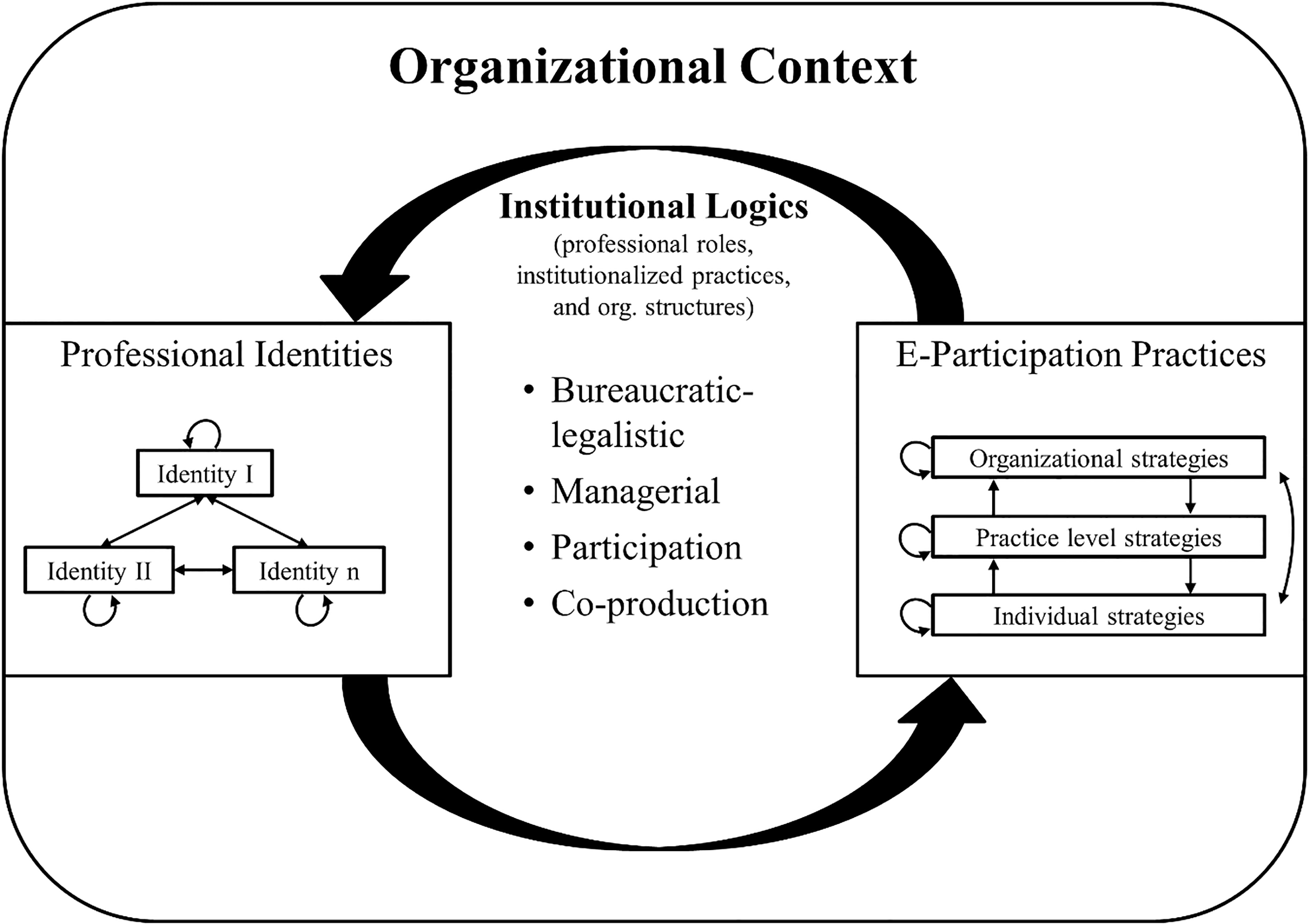
Identity work links the macro-institutional orders of logics that provide specific professional roles or identity scripts (Bévort & Suddaby, 2016; Dunn & Jones, 2010) with how actors make sense of and resolve conflicts between these orders regarding their position in a social group, profession, or organization and develop a certain role identity (Lok, 2010; Reay et al., 2017). “Role identity refers to seeing oneself as the holder of a particular role” (Bourgault & van Dorpe, 2013, p. 52). In hybrid contexts different strategies exist how to cope with multiple available roles or identity scripts at the individual level. Individuals might resist institutional demands from one logic through ignoring them or accepting that different identities exist in an organization. However, individuals may also develop hybrid role identities (e.g., through aggregating or blending aspects of logics or creating a new one) (Battilana & Lee, 2014, p. 404).
Practice work focuses on the organizations’ shared routines (Zietsma & Lawrence, 2010). It relates to the question concerning how individual actors develop strategies to deal with institutional complexity when they seek to influence the development of e-participation practices and how they maintain, create, or disrupt institutional values through their work. Practice work can range from everyday practices to the level of organizational strategies and aim at integrating e-participation into a PAs’ broader organizational and institutional structure. The notion of practice work can help in the analysis of e-participation’s strategic status in the organization (Phillips & Lawrence, 2012). Organizational actors continuously evaluate the interplay of logics when they experience conflicts between them in practice (Jay, 2013). Similar to the individual level, studies found different strategies, such as integrating approaches combining different logics in one practice (e.g., blending logics or assimilating elements of a new logic; Skelcher & Smith, 2015), separating approaches (e.g., segmenting practices to different spaces; Smets et al., 2015), or approaches in which institutional logics are used flexibly depending on the situation (McPherson & Sauder, 2013). The notion of practice work directs the analyses to the challenge of finding solutions for managing the complexity of institutional demands in e-participation practices.
Figure 1 shows an overview of this complex interplay of structures and agency indicating that institutional work in the e-participation diffusion is an ongoing process in PAs.
In the following section we develop an explorative research approach to capture this complexity of e-participation at the individual and organizational level and the strategies local PAs develop to cope with it.
Multiple case study approach: Local public administrations in Germany
Context: Municipalities in Germany (Kommunalverwaltungen)
Focusing on the local government level has a comparatively long tradition in e-participation research (e.g., Kearns et al., 2002) because the local government is the governmental unit closest to citizens (Bolívar, 2017), and it has a long tradition of public participation (Mossberger et al., 2013). While it is also the government level with most e-participation initiatives (31 percent) in Europe (Panopoulou et al., 2009), articles in international publications that focus on German municipalities are rare. This is surprising because, in 2009, Germany had the second-highest number of e-participation initiatives in Europe (Panopoulou et al., 2009) and due to this comparatively long experience German municipalities promise to be valuable sources for researching the e-participation innovation process.
Municipalities play an important role in the democratic system of the Federal Republic of Germany. Local self-administration is guaranteed in the country’s constitution, local governments employ a significant share of public employees (Kuhlmann et al., 2015), and most state financial investments are made at the local level (Bogumil & Holtkamp, 2013, p. 8). Local governments are responsible for the execution of several national and federal regulations and compulsory functions, but they can also make independent decisions in several areas, including organization, finances, and planning (Kramer, 2005, p. 87). In fact, many administrative reforms in Germany originate on the local level (Kuhlmann et al., 2008).
Germany’s municipalities consist of councils and professional, administrative organizations. The councils are formed by honorary elected representatives and act as parliaments but are formally part of the executive. The professional local PA, which is closely associated with the ideal type of bureaucratic organizing, is responsible for the preparation and execution of policy decisions made by the council (Bogumil & Holtkamp, 2013). Even though the tasks of the professional administration are set politically, its members have considerable leeway in making and executing policies (Bogumil, 2003) and influence how e-participation develops at the local level in this complex context.
Although, it should be kept in mind that public administrations in Germany are based on a continental European Rechtsstaat tradition with a specific focus on the administrative execution of laws (Meyer & Hammerschmid, 2006), a recent study indicates that this does not necessarily inhibit reform implementation (Bach et al., 2016). Furthermore, studies from Anglo-American contexts also indicate that bureaucratic administrations struggle with the complexity of implementing institutional and technological innovations (Norris & Reddick, 2013; Welch & Feeney, 2014). Thus, the study can provide meaningful insights for other PAs in western countries.
Case study approach
We adopt an explorative multiple case-study design (Yin, 2009) to compare how e-participation has developed in the practices of three German municipal PAs. Case studies are well suited for the analysis of organizational change processes and for answering the “how” and “why” questions that dominate our research (Yin, 2009, p. 29). Multiple case studies can provide in-depth insights into the situation and enactment of ICTs (Yin, 2009, p. 53).
We selected large municipalities (
We selected two literal cases that first adopted e-participation before 2010 (municipalities A & B) and one contrasting case that recently used e-participation for the first time (municipality C) based on a recent study (Gladitz et al., 2017). Thereby, we aimed to ensure comparability but also variance in data.
Data collection
We conducted a web-based search in May 2016 of municipal websites, municipal social media accounts, council information systems, and other sites. The search was continued until new search results produced no additional insights on the research questions (Yin, 2009, pp. 101–105). In the end, we collected 119 documents that were mainly used to provide an overview of which technologies were introduced at what point in time, how they were introduced in practice, and how they were supported by organizational structures or strategic documents (see Table 1) (e.g., Mergel, 2016).
Overview of municipalities’ organizational e-participation approaches
Overview of municipalities’ organizational e-participation approaches
We also conducted 21 semi-structured interviews with executives as well as non-executive administrators in several departments in each municipality between May and August 2016 (20 to 80 minutes; municipality A: 8 interviews; B: 9; C: 4). Interviews can reveal interviewees’ perceptions and how they construct their actions (Cunliffe, 2011). The vocabulary public administrators use also reflects certain institutional logics, so we can infer from the interview material how these actors linguistically frame themselves into one or more logics (Meyer et al., 2014, pp. 871–872). However, it should be noted that using such a “pattern matching” approach comparing ideal-types of logics with data tends to reproduce the theorized logics (Reay & Jones, 2016). Additionally, asking interviewees to reconstruct past processes is subject to retrospective bias (Zietsma & Lawrence, 2010) which we sought to reduce comparing data from interviews and our document analysis. Only interviewing civil servants restricts the analysis of e-participation to one perspective, excluding other relevant actor groups (e.g., citizens or politicians). However, it was exactly the institutional complexity experienced by members of public administrations we wanted to analyze.
We selected an initial list of interviewees based on identification in the documents retrieved from our web search and their employment in a variety of different hierarchical levels and departments. These first-round interviews then revealed conflicting parties, important coalitions, or other actors previously unknown to us who should be interviewed to increase our understanding of the processes (see Appendix A). Interview selection lead to only four interviews in municipality C. Nevertheless, we were able to conduct interviews with administrators in all relevant units, albeit no executives were willing to participate in an interview.
The interview guideline consists of three main blocks of open-ended questions directed at the main elements of our research model: (1) the interviewees’ overall attitudes about and perceptions of e-participation (identity construction and values), (2) the enactment (roles, practices and strategies) of e-participation in the specific administrative context, and (3) the assessment of the status and institutionalization of e-participation (see Appendix B). All interviews were tape-recorded and transcribed.
We used Saldañas (2016) approach to first- and second-cycle coding in analyzing the document and interview data. The first cycle openly approaches the data and structures the content for solidification in the second cycle, where the coded data from the first cycle is used to develop “broader categories, themes, concepts, and/or assertions” (p. 234).
In the first cycle, we combined three coding methods: descriptive coding to code passages that described the process of e-participation innovation objectively; value coding to establish an overview of institutional logics and related core values, attitudes, and beliefs; and process coding that used gerunds (“-ing” words) to code and identify the interviewees’ actions that helped to systematize their institutional work.
The first-cycle coding process led to a variety of codes that we used and abstracted to present our results. We used the value codes and how interviewees combined them to identify distinct groups of administrators’ role identities. During the interviews administrators were asked to express their thoughts about e-participation and their role in e-participation projects in order to help us determine how they conceptualize the interplay of different logics, which hint at different forms of identity work. To analyze the hybridity of institutional logics, we adapted two analytical categories of centrality and compatibility (Besharov & Smith, 2014): First, interviewees reflect the centrality of logics by describing whether they “are each treated as equally valid and relevant” (p. 369). Second, compatibility or incompatibility refers to consistency between the goals and means associated with the different logics. This process helped to explain how the individual actors made sense of their situations and their role by making recourses to values and rationalities that are based in various institutional logics. Regarding practice work, we used the process codes to analyze the actions administrators took related to the topic and practices of e-participation. Here, we focused on how institutional conflicts were handled. We also distinguished three levels of analysis (individual, practice, organization) that have been found to be relevant regarding organizational hybridity (Battilana et al., 2017).
Case descriptions
Municipality A
About ten years ago, Municipality A, a case with longer experience with e-participation processes, invested in e-participation projects and in its organizational implementation as part of a larger e-government strategy. Right from the start, a position that would be responsible for e-participation projects was implemented in the PA’s central e-government unit. At the same time, a participatory budgeting process that focused on e-participation was launched as a pilot project in order to learn and to develop an e-participation business model (clarifying roles, responsibilities, and processes between central/decentral administrative and political units). Besides the organizational framework, the central e-government department began building a central, flexible e-participation platform that technologically facilitated citizens’ digital engagement (posting, rating, commenting, and monitoring participation output). A mandatory participation process during the implementation of the EU environmental noise directive was the first and to date only case that used the business model in an area of application other than budgeting. Additionally, an open and responsive problem-reporting system was introduced and several online surveys consulted service users.
However, innovations in e-participation are still driven primarily by the participatory budgeting process. Despite initial successes and ongoing experimentation with several adaptations of the process and the participation platform, the concept of participatory budgeting is still under review by political bodies that have not fully committed to the process as a long-term solution (A1, A2; see appendix A for interview abbreviations). The PA is currently concentrating its forces on developing a participation guideline. In summary, we describe the approach of Municipality A as monolithic that focuses primarily on the deployment and adaptation of centrally developed technology and processes.
Municipality B
Municipality B is the smallest city in this study. Nevertheless, more than ten years ago, the municipality’s CIO (the mayor’s e-government advisor) began discussions about digital civic engagement during the implementation of the municipality’s website. An internet forum for open discussion offers low-threshold and informal forms of digital dialogue. This was followed by a phase of experimentation with e-participation, e.g., through a mayor’s blog or temporary experiments with participatory budgeting. As this municipality uses multiple social networking sites to engage with citizens, social media communication can also be understood as a permanent e-participation and digital co-production process.
Municipality B follows an incremental and evolutionary approach to the development of its e-participation practices. All measures were organized and conducted in-house and in cooperation with the departments concerned and other central units (e.g., the mayor’s office). Since about a year ago, the municipality has had an executive department, Stabsstelle, that is responsible for e-government topics (e.g., the municipality’s website, social media, open data, and e-participation; B1) and is led by the former advisor. Although this municipality has done a considerable amount of experimentation, the status of e-participation practices can still be described as “undefined” (B1, 61), and the strategic approach of Municipality B toward e-participation can be termed as integrated and flexible (situational, collaborative, and adaptive development of e-participation).
Municipality C
Municipality C is in a comparatively comfortable financial situation and, according to national e-government rankings, has been relatively successful in implementing e-government. Nevertheless, e-participation offers have been introduced only since 2014.
Municipality C has taken a rationalized approach to e-participation, as evidenced by the PAs’ IT strategy that leaves the topic largely on the sidelines and concentrates instead on optimizing managerial services for businesses and citizens through innovative digital services. Therefore, Municipality C’s strategic approach can be described as decentralized experimentation on a small scale by non-central actors and units.
An overview of the three municipal approaches to e-participation innovation is provided in Table 1.
Results
Identity work in the e-participation innovation process
Entrepreneurial identity
In our study, we find three types of identity workers: Entrepreneurial, pragmatic, and skeptic identities. The only constant is the centrality of bureaucratic-legalistic values in every interview we conducted.
Entrepreneurial actors are characterized by their relatively high valuation and perceived compatibility between all four logics that are relevant to e-participation. However, it is not only the central actors who are responsible for e-government (B1) and e-participation (A1) institutionalization who show entrepreneurial identities; non-central actors from the PAs’ finance (A2) and urban planning (C3) departments do as well. The entrepreneurial argumentation about e-participation positively combines the co-production logic (e.g., higher interaction/outreach, innovativeness and crowdsourcing A1, 30–32; A2, 17/23; B1, 9), the participation logic (e.g., engaging broader parts of society in democratic decision-making A2, 21/31; B1, 19), and the managerial logic (e.g., easy, structured, and efficient processes A1, 30; A2, 13; B1, 9). Nevertheless, e-participation is not interpreted as an end in itself but should always be oriented toward fulfilment of bureaucratic tasks (A1, 32; A2, 21), and actors are aware of the institutional conflicts that can arise from digital participatory practices in their organizations. As one interviewee explained, there are ‘diverse challenges, not only technological. They do not play such a big role, but more cultural: How do we make public servants adopt online dialogue, which is different from normal public administration talk toward citizens” (A1, 14)?4
Interviews were conducted in German and quotations were translated into English.
Thus, entrepreneurs see their role as a “consultant, motivator, and initiator of projects” (B1, 31). Their role identity is characterized through their ability and willingness to learn about and to address conflicts and hybridity between institutional logics as drivers of the e-participation innovation process (“Giving impetus: that surely is an important point” B1, 33). Such hybrid professionals can promote innovations due to their ability to bridge rationalities of different logics.
As these role identities are not necessarily stable constructs, those with longer experience with e-participation stated that their initially optimistic belief in the combination of co-production and participatory logics in a bureaucratic environment does not mean they are not struggling with the process. The entrepreneur from Municipality C, who started to engage with e-participation only recently, shows signs of techno-optimism (“An internet-based tool enables us to reach citizens [at any time who] we would not reach otherwise” C3, 21). Entrepreneurs with longer experience developed an awareness of the threats and opportunities ICT-based co-production and participation carry (A1; B1): “there are many unanswered questions in this game, and this set my euphoria back a little, but I still believe that many wonderful things can be achieved” (B1, 67).
This group of identity workers emphasized their openness toward ICT-based innovative practices but only if they are in line with their central logics. Under this condition, they actively and creatively think about options for e-participation implementation and how it could add value. They mostly see ICTs as neutral tools. All pragmatic identities are non-central actors who are confronted with a variety of tasks. They reflect differing approaches to e-participation, but they have in common a pragmatic role that translates the use of ICTs to their primary tasks and logics.
Pragmatists were legally obliged (A3; A4; A7) or felt normatively (C1) or cognitively (A8; B3; B8; B9) obliged to engage citizens during the fulfilment of their professional tasks. In one municipality, the legal requirement to engage all citizens led to the evaluation that using participatory and collaborative ICTs would be the most efficient and even the only way of meeting the requirement (A3, 9; A4). In another case, e-participation is perceived and treated as only one possible channel of participation, similar to other ways of communicating that can be added easily to the portfolio (broader mobilization; C1). For example, youth workers perceive participation as taken-for-granted. As these workers observe that social media is highly relevant to their target group, they perceive e-participation as central to their tasks. However, they also emphasize that e-participation is not compatible with their bureaucratic work practices, which tend to be hierarchical, slow, legalistic, focused on balancing interests, and so on. They highlight that they do not think e-participation “could be offered that fast for a target group, that is rather flexible and spontaneous” (A8, 15). Youth workers from Municipality B frequently use social media channels for bureaucratic top-down provision of information or co-production (e.g., when they needed help at one of their activities). However, although they also value political participation this happens only to a limited degree online, because citizens hardly use these channels to express their opinion but also because it is not actively forced through the administrators (B8; B9).
Pragmatic identities show a high level of ambiguity regarding the centrality and compatibility of the institutional logics when asked about e-participation. Nevertheless, administrators in this category express their general openness to experimenting with e-participation if it is relatively easy to use and compatible with their core values (the bureaucratic-legalistic and the participation logic in most cases). Thus, pragmatic role identities are hybrid as well. Nonetheless, e-participation is not a part of their everyday agenda, and pragmatists differ from entrepreneurs in their role conception, as they show no intention to develop, promote, and institutionalize e-participation as a broader organizational practice.
Skeptical identity
Administrators with a skeptic role identity toward e-participation concentrate their argumentation on the incompatibility of roles based on different institutional logics. They frequently express conflicts between the managerial goals of efficient and lean processes and the co-production logic (e.g., “There is always the hope for new ideas we hadn’t considered, but they did not come” B5; “This would implicate considerable administrative effort” C2, 32), between e-participation (co-production or participation logic) and bureaucratic fulfilment of tasks (e.g., some professional tasks like municipal budgeting are too complex or uninteresting, B2, 19; C2, 30), and between co-production ideals and equal participation (“representativity, well, was questionable” B2, 19; B4, 19/21; C2, 10/22).
These arguments express the attitude that e-participation or decision-making contexts are too complex, the cost-benefit-ratio is not good, or that a lack of knowledge about e-participation hinders further development and willingness to implement it. This attitude does not usually reflect a general skepticism toward e-participation. In some cases, disillusioning and delegitimizing experiences with e-participation – which nearly all interviewees report – can lead to identity work that focuses on maintaining known professional roles that are based on values anchored in bureaucratic, managerial, or participatory logics. However, these experiences were often delimited trials (“at least how we made it did not help” B2, 49) with no further testing and experimenting, which led them to stop engaging in digital-participation practices. This example also shows that identity work and practice work are closely linked. The use of e-participation depends on the translation and enactment of logics in specific situations, but practical experiences also influence identity work. For others, co-producing and participating via ICTs are hypothetical concepts, so they do not seek or think about e-participation actively during their everyday work (B6; B7).
In summary, most skeptical administrators focus on digital practices only with a focus on optimizing bureaucratic processes (managerial efficiency ideals; B2; B5; C2), or on traditional on-site participation alone (A5; B6; B7). Nevertheless, some skeptics still feel compelled to implement e-participation in the future: “Certainly, we will […] have to achieve a state that we can integrate such [e-participation] elements in the medium run” (A5, 53). Thus, also the skeptical identities are aware of the hybridity of the administrative context, but have not yet found solutions for managing demands from conflicting logics regarding e-participation.
Practice work in the e-participation innovation process
Interpersonal and individual strategies
Individual identity work and the social context (organizational structure, collaborative practices) in which it is performed are interrelated. Individual actors can influence their social context and can influence e-participation practices through a number of forms of institutional work.
For example, skepticism at the individual level can lead to maintaining known practices and ignoring the possibility of enacting participation or co-production logics in e-participation practices. Although there are few interviewees with skeptic identities who ignore e-participation practices in their work, nearly all other administrators report experiences with skeptical colleagues who ignore e-participation opportunities in their everyday work in order to maintain institutionalized work practices. Hence, this is a common tactic when there is a lack of resources (personal and monetary) or scarce interest among citizens to participate (e.g., B2, 33; C2, 22).
However, if administrators face up to e-participation practice work that aims at creating and institutionalizing participation and co-production logics through the use of ICTs, they follow several strategies. Framing is an important strategy on the individual level (see Meijer, 2015), but not the only one. Entrepreneurs and pragmatists are involved in all aspects of e-participation innovation. We identified four discursive framing practices that add to existing conceptualizations of framing.
First, awareness-raising, initiating, and motivating are important forms of framing in support of the broad adoption of e-participation practices. Examples are promotion and personal advocacy among administrators, especially at the leadership level (A1, 48) and toward political committees (A2, 59) or during the formulation of organizational strategy (A1, 88). Second, consulting is comprised of institutional work that relates to internal provision of advice before, during, and after enacting e-participation in the departments. This work is part of the job of central entrepreneurs (A1; B1). Third, discursive legitimizing e-participation supports e-participation innovation through the spread of argumentations about its positive value in the existing institutional context. Such legitimizing can be based on scientific evaluation reports, for example (A2). Others try to problematize e-participation by framing it as a problem – simply imposing costs without benefits (B5, 20) – or because the necessary expertise is lacking (A5, 9). Fourth, alleviating institutional conflicts relates to reducing the possible ramifications of e-participation projects in order to produce some scope for development in the strictly organized bureaucratic environment. Framing e-participation projects and attempts as experiments or research projects can initially help to “stay under the radar” (A7, 20) of critical leaders and develop e-participation step by step (B1, C3).
Beyond framing, learning is becoming an important strategy in the long run. Those who are interested in e-participation are confronted with technological, organizational, and institutional problems and uncertainties that they try to address by engaging in learning. This learning encompasses a broad range of activities, such as experimenting (learning through one’s own experiences), going to conferences, engaging in research projects, learning from scientific and economic consultancies (arranging internal seminars and workshops), cooperating with universities and students, or engaging in professional field-level workgroups. Only engagement with a variety of logics and experiences related to the practical implementation of a technology and process as well as the institutional and cultural conflicts can improve e-participation. Developing such expertise can be hard work, as the constant confrontation with the institutional and practical problems of e-participation can be frustrating (A1; A2; B1; B5; C3).
There are also questions that relate to the management of PAs’ internal and external relationships (generally with politics and citizens). Forming internal alliances with like-minded administrators and administrative leaders across bureaucratic silos (A1; A2; A3; A7; B1; B3; B5; C3) can help PAs develop shared understandings of e-participation. However, while e-participation changes the inner logics and practices of PAs, it also affects political bodies, the public, and the cooperation between them. The entrepreneurial identities, in particular, use strategies of boundary spanning (Levina & Vaast, 2005) and relational work (Cloutier et al., 2016), as they are in central positions to facilitate continuous discourses among the groups (A1; B1) and to advocate e-participation projects with political bodies (A2), or toward civic multipliers (external; A1; A2; B1; B5). These activities may help to institutionalize shared understandings of e-participation across the groups. Nevertheless, cooperation and coordination among individuals in all three groups appears to be scarce.
Practice level strategies
Projects are spaces for experimenting with e-participation at the level of practices. Experiments enable PAs to invest resources on a limited scale to test e-participation processes and technologies. Integrating available e-participation technologies and processes and their associated logics into the PA’s existing processes is an obvious approach to the enactment of e-participation projects (e.g., A3; A4). Thus, entrepreneurs and pragmatists continually develop e-participation projects to fit into existing processes (e.g., A1; A2; B1) and then evaluate and adapt them if necessary (A2, 31; A4). Nevertheless, integration can produce conflicts between institutional logics, and decoupling (Meyer & Rowan, 1977) can be an outcome. For example, legally or politically prescribed e-participation processes can be decoupled from the actual decision-making process. This can occur when standardized bureaucratic processes meant to prepare political decisions in the city council and e-participation processes are “out of step” such that their underlying logics do not fit. Administrators then perceive e-participation as “alibi-events” (B1, 47). This might happen because they know, when imposed by others, e-participation often does not fit their way of working. Or when digital co-production leads to an amount of information (e.g., through crowdsourcing noise problems) that integrating this information into a participatory decision-making process becomes very complex (A4). Separating logics is an extreme adaptation strategy on the project level to avoid or balance such institutional conflicts (Smets et al., 2015). E-participation can be separated internally such that, for example, the participatory budgeting process is separated from the formal municipal budgeting process by defining an amount of money from the overall budget that citizens can decide on in the course of a distinct e-participation process to reduce conflicts (A2). Alternatively, administrators can delegate the e-participation process to external civic multipliers that can organize online discourse and collaboration and then incorporate the results into the traditional participation process (A8).
Organizational strategies
The study also reveals some rare forms of practice work on the organizational level that relate to strategy development. Most important, Municipality A and Municipality B have resources for institutionalizing e-participation in their specific institutional contexts. Their central actors, with entrepreneurial identities, engage in developing central guidelines and business models for e-participation in general (A1) or for social media communication (B1). These guidelines and models can clarify rules, reduce uncertainty at the project and individual levels, and clarify the division of work between organizational units. They also frame e-participation or digital engagement as important organizational practices. However, interviewees also indicated that centrally organized guidelines and strategies can conflict with institutional logics and processes in the departments (A3; A5).
In Municipality A the business model’s high level of standardization tends to make e-participation opportunities at lower levels inflexible (A3, 39, A5). Therefore, ensuring that guidelines are flexible with regard to a variety of situations and institutional contexts is necessary in a specialized bureaucratic organization. Hence, non-central entrepreneurs are also important in institutionalizing e-participation because they can advocate for the continual use of e-participation in their departments and among important external peers like political boards (A2). In line with these results the CIO of Municipality B is working on a digital strategy to establish so-called scouts (experts) in each department who will systematically promote the positive aspects of ICTs for participation and co-production (B1, 25). This strategy can be interpreted as an attempt toward formalized internal boundary-spanning in order to overcome departmentalized structures and bureaucratic silos (Weerakkody et al., 2011). However, the focus is on positioning the administration as an interactive and responsive service provider (managerial
The practical efforts to implement organizational strategies in these three municipalities have not yet led to broad institutionalization of e-participation as a means for political participation, so its status is still open. This unsettled status again highlights the complexity of changing and adapting the rationalities of highly bureaucratic organizations (Kornberger et al., 2017), which happens only incrementally and which needs a fair amount of staying power.
Discussion and conclusion
The comparison of the three municipalities makes clear that they have had distinct experiences with e-participation innovation. While central strategic approaches to e-participation vary widely, the analysis showed that this variation does not necessarily influence the work of non-central departments and their members. For example, administrators in all three cases show similar role identities and strategies of institutional work.
Even the most experienced of the PAs, Municipality A, shows few signs of e-participation being spread throughout the organization as a taken-for-granted, everyday practice. However, if innovators (A1; A2), who are from different departments and in the necessary positions and situations, work together, they can keep e-participation processes like participatory budgeting running for a long time. Nevertheless, even the actors with entrepreneurial role identities are currently struggling to carve out the added value of available e-participation solutions for their PAs (A1; B1). Therefore, the e-participation innovation process is stagnating in both experienced municipalities (A & B). Despite their very different strategic approaches (monolithic vs. flexible), both have difficulties institutionalizing e-participation.
With regard to our research question, how the processes and strategies of enactment and institutionalization influence how e-participation evolves in the specific institutional context of PAs, we generate several new insights. We show in detail that institutionalizing e-participation is a significant task that has to address the views of diverse administrators with highly specific missions or profession-related perceptions of institutional logics that determine public value. We also show that certain forms of institutional work at individual, project, and organizational levels can help to promote e-participation and manage complexity in this highly-institutionalized field of action. Institutional structures are slowly changing toward an open and digital communication (B1, 25; A1, 142). Actors need time to resolve the conflicts that arise from the institutional complexity that e-participation innovations have introduced (Raaijmakers et al., 2015).
We make several contributions with this study in the field of e-government research. Through using theories from organizational institutionalism, we supplement e-participation and e-government research, which is currently discussing its theoretical foundations (Bannister & Connolly, 2015) by enriching the branch that is focusing on institutional theory (Sandoval-Almazan & Gil-Garcia, 2016). Regarding the individual level of e-participation innovation it deepens insights about framing and other institutional strategies in the e-participation innovation process (Meijer, 2015). The central role of entrepreneurs as brokers that combine a sense for all logics in their hybrid role identity and can thus engage in continuous learning, positively frame e-participation as a task for PA and contribute to the development of strategies at the organizational level. In addition, in the rare cases where institutional arrangements have been analyzed, most studies looked at IT-departments or CIOs (Luna-Reyes & Gil-Garcia, 2014; Rose et al., 2015; Tassabehji et al., 2016) so this study adds to the literature by analyzing other administrative actor groups and the enactment of their identities in e-participation practices. We show that entrepreneurial roles are not confined to central IT-focused actors but that non-central actors can also play a leading role in creating and institutionalizing e-participation. Especially the cooperation of central and decentral entrepreneurs seems to be beneficial (see the participatory budgeting project in municipality A). Furthermore, pragmatists can play an important role in the process of institutionalizing because their role conception is generally open towards implementing e-participation. Moreover, even though the category of skeptic role identities might seem to have a negative connotation, such should not be the case: The cognition of skeptics highlights the complexity of the e-participation innovation process. Understanding why administrators evaluate e-participation and related values as not helpful in their situations and how this view might be changed, could be part of further research.
On the level of practices our findings indicate that projects labeled as e-participation or other interactive applications of ICTs are not per se designed to support democratic participation but can also lead to co-production of helpful knowledge, for instance, about noise issues. This partly supports the critique that e-participation does not really lead to new opportunities for participation and therefore might not lead to the normatively desired positive effects on PA’s legitimacy (e.g., Norris & Reddick, 2013). Nevertheless, local public administrations also develop strategies that aim at more deliberative or direct opportunities for political participation through integrating or separating e-participation projects (see Section 4.2.2).
Making innovations like e-participation and open communication with citizens an everyday task of administrators is an already complex process that is further complicated by the ambiguous role of central organizational strategies. It is critical to find a strategy that allows exploration of new possibilities (experimenting) to be balanced with exploiting these learning experiences (institutionalization) (e.g., Janssen & van der Voort, 2016), such as Municipality A tried with its business model, although it was not successful on a larger scale.
Although not our primary focus, the study also contributes to the scientific debate about hybrid organizations in organization studies. It adds to the literature that focuses on institutional change in hybrid organizations. This approach enabled us to analyze the active interpretation and transformation of institutions and technologies when they enter an organization (e.g., Kraatz & Block, 2008) and the struggles of the “politics of open government” (Kornberger et al., 2017, p. 17) in bureaucratic PAs, while balancing the inherent institutional complexity (Smets et al., 2015). While other studies found that public administration reforms can lead to “robust combinations” of bureaucratic and reform logics at the level of organizational strategies (Polzer et al., 2016), we find that the e-participation innovation process is characterized through ongoing struggle in which reform logics related to e-participation are layering on top of the strongly institutionalized bureaucratic-legalistic logic. We also address hybridity of local public administrations and civil servants that have hardly been researched compared to other public sectors (e.g., health care; Cloutier et al., 2016). If and how a stable institutionalization of e-participation practices that support political participation (and co-production) is possible will need further investigation – for example how strategies like separating and integrating used in temporary projects can lead to more permanent solutions to find functioning institutional arrangements (Fountain, 2001).
Finally, our study offers opportunities for further research: We reviewed only one section of the e-participation innovation process, so future research should follow these developments over the long run in order to identify the strategic approaches and institutional arrangements that lead to successful implementation of e-participation. Research in the nature of paradox, that is a persistent existence of contradictory elements in an organization, could yield further insights in how organizational actors iteratively try to find strategies for innovating, face paradoxical outcomes, then try to make sense of these paradoxes and adapt or change strategies (Jay, 2013). Additionally, the explorative classification of the role identities of actors who are engaged in the e-participation innovation process is based on qualitative interviews in three case municipalities. Ethnographic studies might yield more detailed insights about how actors enact identities and behave in practice (Smets et al., 2015). A quantitative study that analyzes a larger group of local administrators’ perceptions of institutional complexity and how these perceptions influence their engagement in the e-participation innovation process could be another promising avenue of research.