




Abstract
In recent years there have been initiatives in many countries which seek to encourage and facilitate co-creation using Open Government Data (OGD). This article describes a research project whose objectives were to investigate the factors that contribute to creating a vibrant co-creation ecosystem built around the use of OGD and to build a model which participants can use as a framework for aiding in co-creation processes. To develop this model multiple case studies are used to investigate the nature of co-creation using OGD in the greater Dublin area. The different dimensions of OGD, as perceived by various stakeholders in co-creation projects, are explored with a view to establishing what facilitates co-creation activities. The stakeholders include the OGD publishers (in this case the four local authorities in the greater Dublin area) and various communities and community groups such as academics, volunteers, voluntary organizations as well as a number of government agencies and commercial organizations. Adopting a modified version of Activity Theory (AT) as a framework, the research uses a wide range of data sources including documents, analysis of web sites, participant observation and semi-structured interviews. Analysis of the latter is carried out using thematic analysis. From these, a model for encouraging, fostering and enabling the development of co-creation projects in local communities is proposed.
Keywords
Introduction
The use of Open Government Data (OGD) has been spreading globally as governments make more of their data available in electronically accessible formats for citizens and others to use and share [1]. One use of such data is for co-creation. To date, there has only been a modest amount of research into the use of OGD for this purpose and specifically research into how and to what extent OGD enables civil communities (as opposed to corporate entities) to participate in public life and to create public value (here meant in the sense defined by Moore [2]). Specifically, there has been no research into how to encourage and foster co-creation using OGD. There have been, and continue to be, numerous field experiments (including such things as hackathons and competitions), but there has been no systematic research into the factors that make for a vibrant and sustainable co-creation ecosystem. This research seeks to address this gap. To do this, a number of co-creation communities in the greater Dublin area in Ireland were investigated with the objective of gaining new insights into this phenomenon and in particular into how co-creation can be fostered and supported both by local government and by communities and other stakeholders. The output from this research is a model of factors that contribute to such co-operative activities and how they can be nurtured and supported.
This paper is organised as follows. First the relevant literature is reviewed; this includes reviews of a number of existing models. This is followed, in section three, by a brief description of the background and context. In section four the methodology is discussed. This includes a brief account of activity theory, the reasons for choosing it and how it was used as well as description of how the data were gathered and analysed. Section five contains the discussion and analysis and section six presents the model. A brief conclusion is presented in section seven.
Literature review: Definitions and concepts
Open data (OD)
Open data as a concept has attracted growing attention in recent years in diverse fields and contexts. There is, for example, much discussion of the role of OD in scientific research [3, 4] and in business [5, 6]. In the public sphere, which is the focus of this paper, various authors have looked at different aspects of its use including innovation [7], issues and policies [8], the relationship between OD and accountability [9] and barriers and problems (see below). According to Bertot et al. [8], “big and open” data have significant implications for the interactions between governments, citizens and the business sector. However, while OD (whether ‘big’ or not) can foster collaboration and create real-time solutions to challenges in different domains, it also gives rise to a number of policy challenges. The latter includes ease and equality of access, archiving/preservation of data and risks to privacy and security. Perspectives vary. Zuiderwijk et al. [7] state that OD holds out the promise of many potential benefits such as more innovation, stimulating citizen participation, stimulating economic growth and enhancing transparency (though in other papers, some of which are by the same authors, are more guarded – see below). Peixoto [9], on the other hand, takes a more cautious view arguing that merely putting OD in the public arena will not necessarily foster accountability. This requires both a free press and mechanisms by which citizens can hold rulers accountable.
So, while OD holds out much promise, several challenges and problems surround it. Common topics of debate (and sometimes controversy) include implementation challenges, barriers to its release, ‘dark sides’, licensing and formats [10, 11, 12, 13, 14]. All of the questions that arise with OD also arise with OGD and OGD brings with it a number of additional problems of its own. To deal with these challenges, some scholars have put forward tools to help. Zuiderwijk and Janssen [14] propose a framework for comparing the implementation and impact of OD policies; Kalampokis et al. [15] propose a four stage model for OGD development. A discussion of these tools is beyond the scope of this paper.
One feature of the literature is the variety of definitions of OD/OGD in circulation; something which is not uncommon in new fields. The common thread in these definitions is that such data should be freely available for use and reuse by the public (e.g. [16, 17, 18, 19]). Beyond this point of agreement, most definitions are broad, though some (e.g. [18]) try to be more specific as to what types of data OD encompasses. There are other more subtle differences in how different scholars define OD/OGD. Some scholars take a libertarian view of what ‘freely available’ means both in terms of types of data and licensing terms. Others, such as Barry [16], are more circumspect and even normative.
For the purposes of this research, the definition used will follow the model proposed by Klessmann et al. [19]. OGD is defined as referring to any data that are:
Collected and stored by government and/or its agencies, Made available online or in other processable forms, Made available by government or government-controlled agencies, Accessible by all citizens without the need for major investment in technology and, Made available with the minimum feasible restrictions (legal, financial or technological) on their use.
In addition, a number of desirable qualities of such data are listed below. Use of OGD is facilitated by data that:
Can be accessed without the need for a software license; Are complete except for sensitive personal data or data that could be used to identify individuals; Are timely (i.e. are released and updated in real (or near real) time); Are either free or accessible at minimal cost.
The latter four features facilitate the use of OGD efficiently, but are not part of the definition. The most important of these four points is the first one. What this implies is that a citizen should not have to pay for (say) Word or Oracle in order to access the data. This in turn implies that data should be available in open formats or formats such as .CSV or .RTF. It is stressed, however, that the qualities which make the data open are not their format, but their availability and usability without major cost.
There are differing views on how OGD can (or should) be used. Janssen et al. [20] refer to five myths of OD the first of which is that the publishing of data will automatically yield benefits, i.e. build it and they will come. Notwithstanding this warning, there is no shortage of optimism about the benefits of OGD. Opengovernmentdata.org, a working group within the Open Knowledge Foundation International (OKFI) [21], states on the front page of its website that there are three main benefits from OGD. The first is transparency meaning that citizens can find out what their government is doing by being able to access, use and share government data and information with other citizens. The second is realising social and commercial value. By opening up data, governments can incentivise the creation of new services that deliver social value. The third is participatory governance. Most citizens (in democratic states) only engage (if they engage at all) with the process of government in an election every four or five years. By opening up data it is claimed that citizens will be better able to engage with their governments and to do so on a more frequent basis not least because they will be better informed. Citizens will be able to engage in and contribute to governance. A slightly different view is presented by Huijboom and Van den Broek [22]. In a study of OGD strategies they suggest that there are three primary reasons for making data available: increasing democratic control and citizen participation, fostering product and service innovation and strengthening law enforcement.
Davies [23] takes a yet another view. He argues that the use of OGD on the data.gov.uk website is not simply a one-way process (such as browsing a bus timetable). He claims that usage falls into one of five distinct groups of processes shown in Fig. 1.
Processes of OGD use [23, p. 3].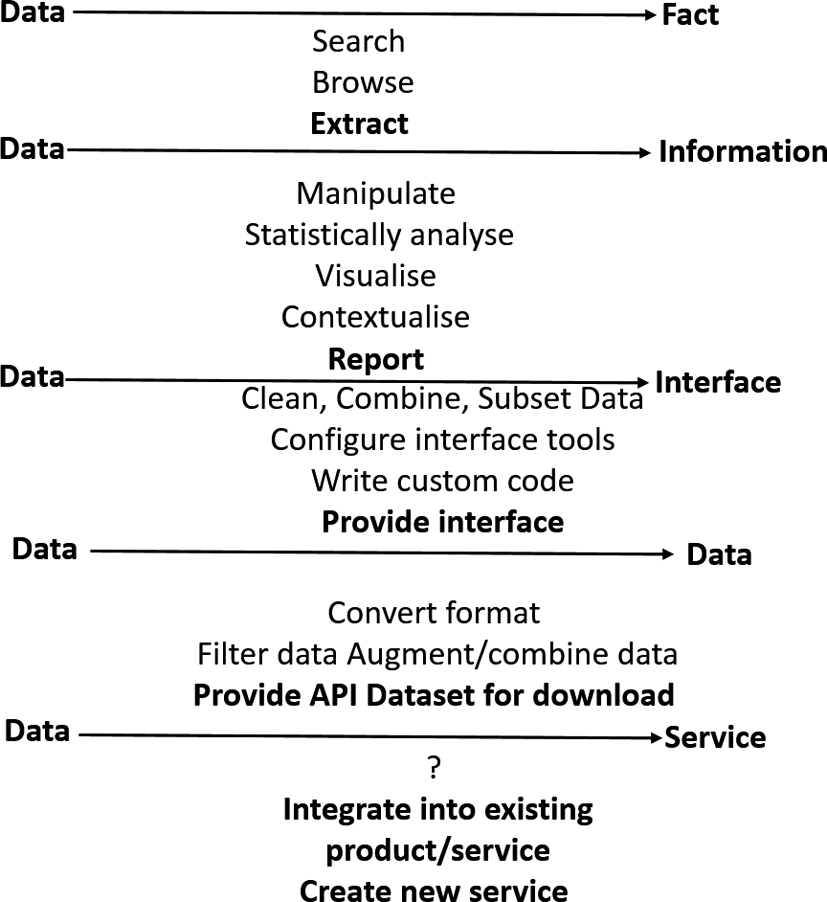
One of the cases studies in this research, Fingal Open Data, sets out objectives which are close to those of opengovernmentdata.org. Amongst its objectives are creating transparency by which is meant the ability of citizens to access and use government data for making decisions. A second objective is to foster citizens’ participation in local government, i.e. to encourage citizens to use the published data to analyse issues and to propose new ideas. A third objective is collaboration: where both citizens and businesses are encouraged to make suggestions about what applications or services could be built using these OGD. In Dublin, citizens and businesses are encouraged to turn OD into apps, websites or other useful products such as Fingal Day Tripper (an app that allows citizens to plan a day out in Fingal).
It is worth noting that when it comes to the objectives and benefits of OD/OGD there are subtle differences of emphasis between different scholars and between different continents. Ofe and Tinnsten [24] note that the European Commission places emphasis on using OGD and OD to generate economic growth whereas the USA places a greater emphasis on transparency. Whatever perspective is adopted, as is often the case with emerging technologies and ideas, expectations of what OGD can deliver are high and there is wide agreement that by involving more people in joint and cooperative actions public value can and will be created. It is essentially this conception of co-creation that is used in this research; however, the concept of co-creation itself first warrants some discussion.
Co-creation too can be viewed from different perspectives [25] and, as with OD, there are multiple definitions of the concept in circulation. As with OD, while there are subtle (and occasionally not so subtle) differences of emphasis, the core concept is co-operation in the production of a product or service whether that cooperation be between a business and its customers, a local authority and its citizens or a combination of several parties [26, 27, 28, 29]. In essence, the customer/citizen changes from being a passive recipient of a product/service to being an active participant in its creation, design and delivery. Witell et al. (2011), cited in Ind et al. [30, p. 5], describe co-creation as something that:
“Aims to provide an idea, share knowledge, or participate in the development of a product or service that can be of value for other customers.”
Such practices are not new. Companies such as Toyota and Boeing have long shared data with suppliers and customers with a view to improving supply chains and aiding in product design and development [28]. While there are obvious differences, there is much that the public sector has in common with the private sector in this respect. Brodie(2010)1
In this research co-creation is taken to mean the joint and cooperative actions of several parties to create public value (which can be a service, a product or even an idea or concept). It investigates one specific manifestation of co-creation, i.e. the co-creation process(es) between local authorities and other parties who are interested in using OGD. The latter include civil communities, non-governmental organizations (NGOs), developers and academics. Solli-Sæther and Flak [32] claim that there is limited understanding of co-creation processes and that “few if any” scholars have studied co-creation phenomenon from a process perspective. An objective of this research is to contribute towards overcoming this deficiency [33].
Of the broad objectives of OGD discussed above in Section 2.2, the creation of public value is the province of co-creation. Kassen [34, p. 512] suggests that:
“Open data creates a favourable environment for proactive civic engagement by providing a real opportunity for independent developers to create applications by using available datasets from the web-portal without any official permission.”
though whether, as noted above, availability alone is sufficient to create a “favourable environment” is open to question. Kassen goes on to claim that collecting citizens’ data for different purposes such as:
“…mapping, visualizations, ranking of transportation routes, building permissions, crime data, and environmental pollution…”
will eventually create a new environment for cooperation between local government and citizens. There is, as yet, limited empirical evidence to support this assertion. For the present, Kassen believes that co-creation between government and different communities (such as academics or NGOs) is more visible than co-creation between government and ordinary citizens or citizen groups. Nonetheless, as with OD, expectations are high. According to a survey carried out on the ‘data.gov.uk’ website, 31% of users agreed that OGD projects can make a direct impact on peoples’ lives while 36% agreed that the OGD projects can contribute to improve local and national democracy [23]. Although this survey focused on the social impact of OGD, it did not consider it as a co-creation; rather it suggested that OGD led to the co-production of planning and services due to its facilitation of collaborative community-based participation.
In the published academic research there remains a paucity of studies and findings examining the relationship between OGD and co-creation or the impact of OGD on co-creation. Addressing the Open Innovation 2.0 conference in 2014 and talking about London Smart City Mark Kleinman, head of the Mayor of London’s Economic and Business Policy team in the Greater London Authority, stated that in London local government uses OD to empower citizens. When asked if he had found any evidence of co-creation from citizens who use OD, Kleinman replied that in his experience only groups with high technological skills participated in co-creation. He believes that the next step for government is to enable and encourage ordinary citizens to participate and co-create as well, but he did not indicate what strategies might be used to achieve this.
Rationale for this research
In OD and OGD research many studies tend to focus on datasets and data architectures [35, 36, 37] rather than on use of the data. Larsson [11] suggests that more research is needed into how OD changes society. Fitzpatrick [38] states that, although a myriad of active initiatives using OGD are to be found around the world, most of them are “embryonic” in nature. There is, therefore, a gap in current research which opens up opportunities for scholars in this field. Ind et al. [30, p. 6] agree noting that:
“While significant research has been undertaken in the area of co-creation, there is not enough information on how participation emerges and develops once participants engage in a virtual co-creation community”.
In a similar vein, Durugbo and Pawar [27, p. 4374] state that:
“…co-creation as a research area is still at an early stage and there is a need to formalise the co-creation process.”
Some studies have explored the co-creation process, but in different contexts and with specific objectives. A number of studies have explored, inter alia, the value of co-creation in relationships between an ERP (Enterprise Resource Planning) vendor and its partners [26, 28, 39, 25, 37]. Others have proposed a unified model of the co-creation process for companies [27] or a theoretical model for co-creating IT value through the collaboration of organizations [40]. Karahasanovic et al. [41] investigate how best to enable participation among elderly citizens in co-creation.
However, to date, most studies of co-creation have been about commercial co-creation, i.e. between companies and their customers as opposed to between governments and citizens [26, 39, 42]. A review of the literature shows that there have been no studies to date examining the impact of OGD on the phenomenon of co-creation although a number of studies have discussed the link between the two (e.g. [43, 1]).
Two recent contributions to the field and which parallel in a way this research are worth noting. The first is by Foulonneau et al. [44] who propose nine actions to facilitate turning OGD into services as follows:
Facilitate the Reuse Conditions (open license); Make harmonized metadata to facilitate datasets discovery; Create a platform to support re-users and help them reuse the data; Create APIs in order to lower the technical barrier as well as the time required to develop a new service; Offer training material to help potential re-users in learning how to get data; Develop academic training focused on OD, as did the Open Data Institute and the University of Southampton, including a module named “Consuming open data” in 2012; Make the datasets known by announcing competitions to use OD for service creations; Introduce a survey to investigate potential re-users’ opinions; Include a section in the OGD portal to show services and applications that use the datasets. This will publicize services and encourage service usage.
The authors also suggest co-funding by government of OD projects as a possible solution.
The second is by Flak et al. [40] who propose a theoretical model for co-creating IT value through the collaboration of organizations (see Fig. 2).
Theoretical model for co-creating IT value (Flak et al. [40, p. 2]).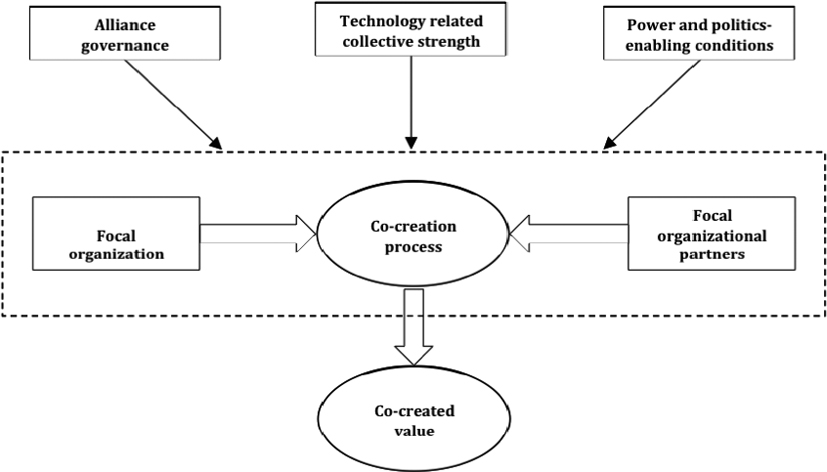
This model is still in need of development (the authors do not provide any details about any of the components). The model developed in this research contains elements of each of the above models, but is much more extensive.
This research was carried out in the greater Dublin area in Ireland. Dublin, the capital of Ireland, is Ireland’s principal port and a major industrial centre. Approximately 1.3 million people live in the greater Dublin area. Of these, about 527,000 live in what will be hereafter referred to as the city core or simply the city. Administratively, Dublin is divided into four local authority areas: Dublin City Council (DCC) which is responsible for the city core, South Dublin County Council (SDCC), which covers the south-west, Dublin Fingal which covers the north city and Dún Laoghaire-Rathdown (DLR) which covers the south-east. Both Dublin South and Fingal include extensive rural and farming areas. Figure 3 shows the four local authority areas on a map.
In Dublin, there are currently two OGD portals: Fingal Open Data and Dublinked. Dublinked is a partnership of the four Dublin local authorities (LAs), and Maynooth University. Table 1 shows the main groups of datasets currently available from these two sites.
Dublin open data portals; types of data available
Dublin open data portals; types of data available
Map of greater dublin area.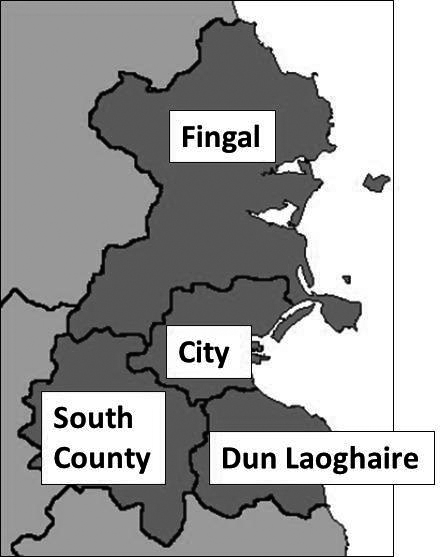
Traditionally local government in Ireland has been quite adventurous in its use of information and communications technology (ICT). As far back as 1975, the Irish local authorities set up a shared services operation, the Local Authority Computer Services Board (Irish Statute Book 1975),5
Now part of the Local Government Management Agency.
The Organisation for Economic Cooperation and Development.
Theoretical framework
The theoretical framework used in this research is a development of Activity Theory (AT). AT was initially chosen as a tentative framework as it appeared to provide a good fit to the nature of the phenomena under investigation. This initial view was confirmed as the research progressed, but as the research progressed it was found that a number of modifications to the theory were necessary. The resulting modified model (described below) provided a powerful lens for the research. A detailed discussion of AT and its development is beyond the scope of this paper, but an outline of the evolution of AT and a description of the modified version developed in this research follows.
AT proposes that human activity is directed towards an object, mediated by artefacts or instruments and socially constituted within the surrounding environment [45]. The first generation of AT is defined as ‘mediated action’, and was set out by Vygotsky [46]. During that period AT studies tended to focus on individuals. Figure 4 shows the first generation AT model.
First generation AT model.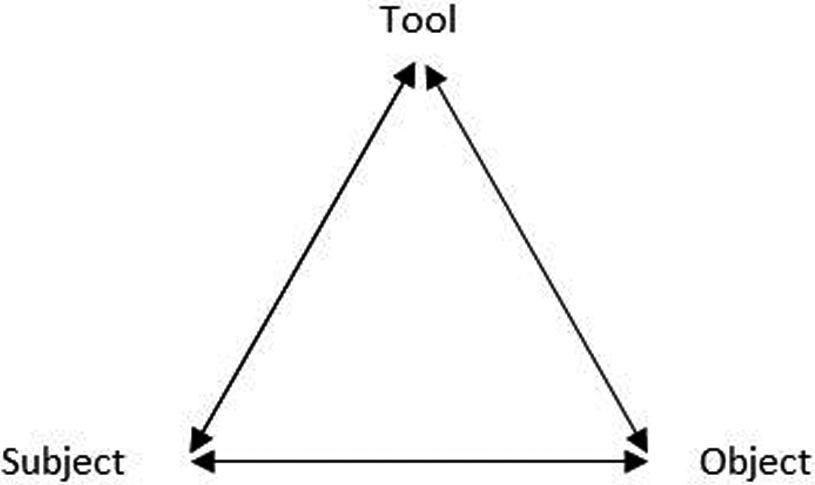
Engeström (1999) [47], as cited in Bakhurst [48], subsequently developed the model further by adding more elements and complexity to the basic structure. Engeström’s version of AT is referred to as the second generation AT model (see Fig. 5).
Second generation AT model.
The second generation AT model has been used as a framework for qualitative analysis in many research papers across different disciplines [16] and, according to Mwanza [49, p. 50]:
“Activity Theory is an inter-disciplinary philosophical framework for studying both individual and social aspects of human behavior.”
A third generation of AT was developed for applications of activity systems analysis where the researcher takes a participatory and interventionist role in the participants’ activity (see Fig. 6) [46].
Third-generation activity theory’s model of two interacting activity systems.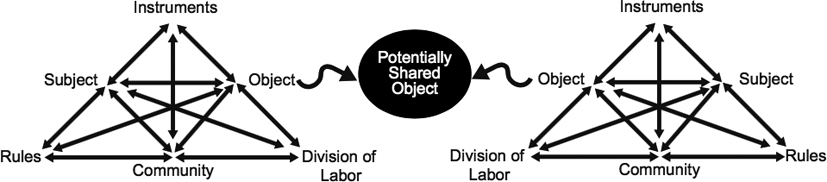
Other authors developed the second generation model in different ways. For example Allen et al. [50] introduced motivation as a component. As this research evolved three additional factors not included in any of the current AT models emerged from the NVivo coding and the thematic analysis of the interview data namely barriers, level of awareness and effectiveness. Interestingly, barriers was by far the most frequently mentioned factor to emerge from the thematic analysis and many respondents mentioned effectiveness in the context of being unsure of how to measure it.
Following the nVivo analysis, a new subject-centric version of the model was created by reverting to the original AT model (as in Fig. 4) and modifying it to incorporate the elements that had been added in a different and a more tractable and meaningful way. This model aligned with the focus on the fostering and encouraging of co-creation activity. This model is shown in Fig. 7.
Modified activity theory model.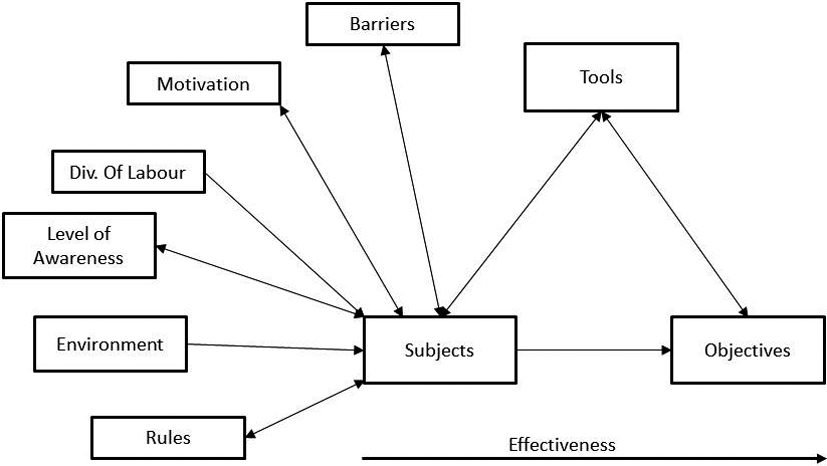
The ten components of AT in the extended model were used to understand how people (publishers and users) engage with OGD portals (tools) and co-create value as objectives or outcomes and how other components, namely motivations, barriers, rules, level of awareness, community, and division of labour affect the activity. Finally, the effectiveness of the overall activity was investigated. The modified AT model thus offered a contextual and holistic approach which supported the qualitative and interpretative nature of the research. AT was used as a lens for designing interview questions, carrying out data analysis, and structuring the findings.
Within the modified AT framework this research uses a multiple case study methodology with two principal cases and two supporting cases. Yin [51] states that the rationale for the multiple case study is to establish whether the findings of the first case occur in other cases. Shaw et al. [52]emphasize that multiple case studies add more value to the research since this allows comparisons, particularly in diverse settings. In this research both primary and secondary sources of data have been used. Of the six sources of evidence for case study research suggested by Yin, the primary sources in this research were interviews, documents, and artefacts (in the form of the apps and OGD sites). While there has also been a limited amount of participant and non-participant observation, neither of these was of significance as a data source though both proved valuable in gaining an understanding of the dynamics of the co-creation activity. As these are recent developments, there are no archival records available. For the interviews, some of the informants were selected by purposeful sampling because they are the key players in the publication of OGD in Dublin. These include the Senior Executive Officer at Dublin City Council and the IT manager of Fingal County Council (CoCo). The remainder of the informants for both data providers and co-creation communities was selected using snowball sampling.
As noted above, the research was carried out in the greater Dublin area and the research structure and approach were largely determined by the situation on the ground at the time. Of the four LAs in the greater Dublin area two, Dublin City Council and Fingal County Council, had functioning websites (Dublinked.ie and Data.Fingal.ie respectively). These became the two main case studies. Because, at the time the fieldwork was being undertaken, South Dublin and Dún Laoghaire-Rathdown County Councils did not have OGD websites up and running, they were used for supporting data (both councils were sharing their OGD on Dublinked). Currently Dublinked provides support with their data management to all of the other Dublin authorities. Maynooth University manages co-ordination between the four LAs. Support from the private sector is provided by IBM’s Dublin Research Centre. IBM supplies a platform which offers various open collaboration technologies and research tools to enable and facilitate publishing OD.
Empirical data was drawn from four groups of sources. The first sources were the four Dublin local authorities (LAs). The second source was interested communities. These included volunteers (such as the Code for Ireland community), developers of applications and academics. The third source was organizations that deal with OGD. A large number of these were examined including Open Knowledge Ireland, Open Street Map, the Central Statistics Office, the Institute of Public Health, the Marine Institute, IBM, the Digital Repository of Ireland, the Department of Public Expenditure & Reform and St. James Hospital (a major Dublin teaching hospital). Finally, a number of international experts including experts from the Worldwide Web Foundation were interviewed. Experts from several countries including the USA, Canada, the UK, Netherlands and Spain were interviewed. Interviews were semi-structured. A total of 48 interviews were undertaken. Participant observation was used in a number of cases including participation in meetings (e.g. ‘meet-up meetings’ which host a number of speakers to help inspire the OD community in Dublin) and attending relevant conferences (such as Open Innovation and the European Group of Public Administration). Secondary sources of data used include published materials such as websites and internal documents (see below). Google Alert was used to track daily news updates about OD and co-creation around the world.
As part of the research both of the main websites, Dublinked.ie and Data.fingal.ie, were examined in depth. This included examining datasets available, dataset formats, licensing terms and ease of access. Separately, the results and output of co-creation by different communities that are active in creating value from OGD were studied by analysing their blogs, applications and created services.
All interviews were recorded and transcribed. Transcriptions were sent to informants for validation before they were analysed. The analysis of the informants’ opinions was based on thematic analysis using NVivo software. The transcriptions were analysed in terms of the six categories drawn from activity theory and the four additional characteristics of the data described in Section 3.1.
Analysis and discussion
Co-creation takes many forms. The type of co-creation that emerged in this research can best be described as a type of ecosystem in which various members or stakeholders interact and interdepend in various ways. This conceptualisation is also proposed by Ding et al. [53] though in a much narrower way. In this system OGD acts as the food supply; it is the raw material from which the products, services and information generated within or by the ecosystem are created. For an ecosystem to survive and thrive it is not necessary that all of its elements share identical interests. There are many examples of ecosystems where components prey on and live off each other; but for the system to survive a careful balance of interests is required [54]. For an ecosystem to thrive it is necessary that there is both sufficient commonality in the objectives of different members of the system (survival being the most obvious one) and that there is sufficient compatibility between the objectives of different members (or, in AT parlance, subjects). Co-creation systems are, by definition, innovative; they create new things. The question of interest in this research is how to support and enable the ecosystem in both meeting its various objectives and in creating new things, i.e. to create a vibrant co-creation community.
Applying AT
In a co-creation system there will, by definition, be multiple subjects, something which is allowed for in the modified AT model. The subjects in this research can be divided into four groups: data providers, communities, businesses (corporate entities) and academics/experts.
The core common objective of all of these groups is creating value in some form. All subjects said that an important objective is creating public value, though the businesses had a wider value creation agenda. As noted by Ofe and Tinnsten [24] both economic growth and transparency are commonly identified as objectives and both were found in this research though each was much more in the forefront of thinking of some subjects than it was for others. Transparency is an objective that might not be uniformly viewed by different subjects as one person’s transparency can be another’s breach of privacy [55]. Interestingly, in all four case studies transparency was regarded as an objective by all subjects, albeit with different degrees of emphasis on its importance. Other objectives emerged and were stressed by particular subjects. For citizens and communities participation was an important objective. Citizens and communities wanted OGD to help them to analyse local issues in order to help them to propose new ideas both in terms of policy and services. All parties shared the objective of driving innovation in the development of new solutions to urban problems, informed decision making and improving the quality of life by the provision of better services. Some OGD specific objectives included searching for patterns for visualisation of information and business and even personal career purposes.
The rules component in AT manifested itself, particularly with users, as primarily being about licensing. A small number of authors has examined this question (e.g. [10, 11]). On close inspection, these authors argue, licensing turns out to be quite a complicated topic with many nuances which are not always well understood. This lack of understanding was verified in this research. When respondents were asked what the understood by “rules” in the co-creation process with OGD, the dominant response was licensing of OGD (and to a lesser extent licensing of products created). Most respondents admitted to being confused about this topic and uncomfortable speaking about it. A common response was words to the effect that “I am not a legal expert/lawyer”. Several respondents said that they found the so-called ‘fine print’ in the terms and conditions hard to understand and the terms sometimes seemed to them to be ambiguous.
As noted above, in their examination of the environment/community aspect of OGD, Ding et al. [53] also use the concept of an ecosystem though they do not discuss or attempt to explain the impact of the components of the ecosystem on publishing of OGD. This research suggests that several factors are of significance. The most important is the presence of a Champion or Leader. The development of OGD in Fingal can be viewed as a type of Skunk Works8
A Skunk Works project is a term used to describe an ‘unofficial’ or non-sanctioned piece of research and/or development carried out within an organisation. The term comes from the Lockheed Corporation Skunk Works plant in California.
One of the curious findings in this research was that the DCAT standard, which is now a recommendation by the European Commission for representing metadata on open data portals for all European member states, is based on the work of a student studying in one of the university participants in the Insight Institute.
The division of labour component turned out to be the least useful aspect of AT in analysing the four cases. This is largely because of the fluidity and informality of the activities in the system. While there are defined roles and responsibilities within the LAs, because of the “extracurricular” nature of the work on OGD, traditional roles and lines of command are often irrelevant. Communities also tend to have a fluid structure with people coming in and out of the process and contributing according to their skills and availability. Within communities it was found that there were no striking patterns when it came to age or gender though most of those involved were over 30 years old. Skills, too, varied. As much of this work is on a voluntary basis the division of labour element did not yield much by way of insight into the nature of the co-creation system.
Tools, by contrast, provided a powerful lens for looking at the system. Toolsets varied with subject. For publishers/providers tools included the front end portals [56, 57], though these were backed by a large number other tools including Extract Transform and Load (ETL) systems, a Feature Manipulation Engine (FME) to transform and publish it the data, CKAN (Comprehensive Knowledge Archive Network) a powerful data management system that makes data accessible by providing tools to streamline publishing, sharing, finding and using data and JSON (JavaScript Object Notation). Users also employed a surprisingly large toolkit including ROUTE-TO-PA (Raising Open and User-friendly Transparency-Enabling Technologies fOr Public Administrations), which has a Social Platform for Open Data (SPOD) that enables social interactions among citizens around open datasets coming from different sources (dataset providers). Other tools and techniques adopted by users included Google Analytics, educational training, meetings and Spark SQS (Simple Queue Service – a GitHub10
GitHub is a web-based Git or version control repository and Internet hosting service.
The modified AT model incorporates four additional components all of which were investigated. While it is important to know objectives, it is also of interest to examine motivations. These too varied from the frankly commercial to civic mindedness. As one might expect, each subject has its own mix of motivations and in communities in particular these motivations were quite varied. Some users were politically motivated (e.g. transparency, policy analysis and participation). Some were community oriented (better services, new services or features). Others said that they were motivated by more personal factors (such as enjoying working with others and the pleasure of creating new products or new challenges). The findings of this research are consistent with those of others [38, 44, 58, 59] who found that people are motivated to co-create for many reasons like economics, enjoyment, transparency, creating or enjoying new services, having fun and the social benefits of community.
Level of awareness turned out to be an important factor. Foulonneau et al. [44] suggest that raising the level of awareness of developers and service creators has the potential for the reuse of open datasets. Clearly those already engaged with using OGD for co-creation have a reasonable level of awareness (which ranges from moderate to high). However, informants from the LAs would like the level of awareness in their communities as a whole to be much higher. To this end a number of initiatives have been launched including open days, hackathons, competitions, supporting emergent groups wherever possible and so on. The consensus is that in Dublin (which is probably ahead of most of Ireland in this respect) awareness of OGD and its potential in co-creation remains low.
One of the most striking findings from the thematic analysis was the enormous emphasis places by several parties on barriers to co-creation. In the thematic analysis this was the word which came up most often (at 313 mentions, it was the most mentioned theme). There has been much discussion of barriers to OD and co-creation in the literature [20, 60, 61, 62, 63, 10] and most of the long list of barriers identified in the literature were mentioned by one or more informants. One barrier not (as far as we could ascertain) reported in the literature that was mentioned by several respondents in the user community and individual users was sustainability. People are reluctant to invest in developing products that depend on the continuing availability of data in the longer term without some assurance of continuity. This concern is heightened by the informal nature of the current OGD provision which, as noted, depends on champions and people working on OGD projects in their spare time. A key contribution to the success of co-creation that emerges from this research is the necessity for LAs to put their OGD on a formal and eventually on a statutory footing. Other barriers that were identified by respondents included the timeliness and latency of data. There can be long delays in data release and users are reluctant to rely on outdated data. Two further barriers mentioned by several respondents were psychological reluctance (fear of the technology or the scale of the task) and the need for standardisation.
The final component examined was effectiveness. Grover and Lyytinen [64] suggest that ‘effective’ means “any dimension of improvement in the human condition in which the uses of IT can be evaluated” (p. 272). As yet there do not yet appear to have been any studies that investigate the effectiveness of OGD in order to facilitate co-creation. In this research, views on effectiveness varied, but there was broad agreement that measuring effectiveness was problematic for a number of reasons including the lack of suitable metrics and a paucity of reliable data. Much of the comment on effectiveness by informants was anecdotal. In Dublin local government there remains an element in the approach (by the publishers) of ‘casting bread on the waters’ to see what happens. It may be that at this relatively early stage in the development of OGD based co-creation in Ireland, measuring effectiveness is premature. This is largely voluntary work and an element of ‘let’s see what happens if we try this’ rather than setting targets may be desirable. This is not to say that nothing tangible is happening. There are, as noted above, several new products and services now available and new ideas are continually being explored. Some projects that respondents judge as being effective are listed in Table 2.
Some effective co-creation products in the Dublin area
In summary, the modified AT provided a powerful tool for examining the phenomenon of co-creation with OGD in Dublin and for developing ways of fostering and supporting this activity. The latter are discussed in the following section.
Co-creation is about both participation and co-operation. From the AT analysis and the thematic analysis of the interviews, 24 actions/proposals for the encouragement and enablement of a vibrant co-creation ecosystem emerged. These are illustrated in the proposed model in Fig. 8. Some of these apply to more than one player, but one is identified as the primary member of the system with responsibility for each action. A number of these are discussed below.
Model of support structures and activities for promoting emergent co-creation.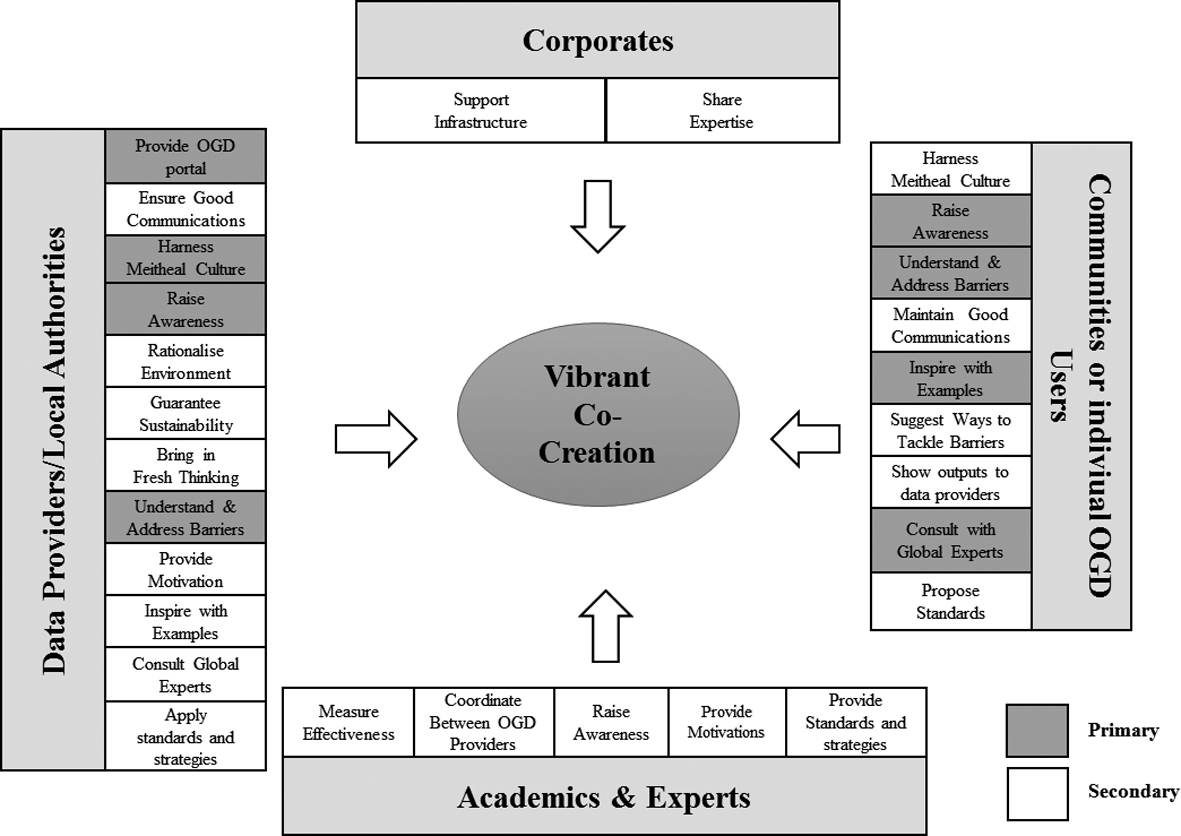
Raise awareness. Lack of awareness of the possibilities for co-creation of OGD (or even of the availability of OGD) was a common theme. This lack of awareness is one of the main contributors to the wider lack of interaction with OGD. Informants suggested that using diverse approaches to raise awareness of OGD will increase the probability of getting more citizens to interact with OGD and co-create value by proving feedback, generating ideas, creating applications and web services and all of the other benefits that can come from people’s creativity and innovation [1, 7]. Recommendations for raising awareness included use of mainstream and social media, competitions, hackathons, viral marketing and local liaison.
Rationalise environment. By this is meant rationalisation of data formats, licensing, metadata and communication channels [44]. A commonly expressed requirement was for clear licensing and standards. Informants realise that that they need to maintain data in different formats (such as .txt, CSV, etc.) to accommodate the differing needs of various user groups. Having data available in multiple formats leads to more engagement and greater value creation, though it was acknowledged that this comes with both a creation and maintenance overhead so a balance needs to be struck. Informants repeatedly emphasised the importance of metadata, i.e. data which explain what the base data are, where they come from, when they were collected, why they were collected and so on. Informants reported that good metadata helps users to understand the base data better and to make more effective use of it [44, 13]. A problem noted by a number of respondents was that when metadata is absent, base data may be effectively useless as it is not possible to use it reliably or even meaningfully.
Maintain good communications. Informants emphasized the crucial role of having good communication channels. Two-way channels help both sides (publishers and users) to exchange feedback and help publishers to be aware of which datasets people need and in what formats. Some informants suggested that contacts for specific data sets could be included as part of each dataset’s metadata [44].
Bring in fresh thinking. This comment was made by a number of informants, particularly amongst the publishers. Suggestions included encouraging school and university students to get engaged by making OGD part of their projects and assignments. This is already being tried by the Central Statistics Office which has run open completions such as Apps4gaps specifically targeted at students and designed to encourage them to be more creative using OGD.
Inspire with examples. Providing easy to replicate examples on hubs and portals is seen as valuable. A variety of approaches was suggested (some of which are already in use) including demonstration videos and e-demo videos. These can show not only what datasets are available, but how they are or might be used (in the same way as Davies [23] suggests different uses of OGD). The objective is to inspire people to be creative.
Consult global/international experts. Although this is a relatively new field, there is a growing base of expertise including international expertise. Interestingly, it was suggested by several informants that use of OGD could be much effective if the Irish government were to engage in more international consultation concerning the development of OGD in Ireland. Currently views tend to be insular not just in national terms, but in terms of a focus on benefits to the government per se rather than the wider community. Many informants sensed that government tends to regard co-creation initiatives as something that should benefit government. This in itself is not unreasonable, but ignoring the benefits or factors likely to motivate the community is not desirable for obvious reasons. Dublin and Galway are the two most active cities for developing OGD in Ireland, but according to informants mind-sets elsewhere need to be changed in order to have more openness in line with international OD policies. This can be done by consulting with experts in countries which are leading users of OD such as the USA as well as consulting national agencies such as the CSO and experts from the Programmable City project, the Digital Repository of Ireland, the All-Island Research Observatory, and the Dublin Dashboard. One initiative along these lines that is currently working well in Ireland is the use of international consultants in Code for Ireland which uses Code for America as its model.
Guarantee sustainability. This requires putting the provision of data on a formal and properly resourced basis. It was noted above that one of the main barriers to co-creation using OGD that users mention is uncertainty about the continuity of data availability. For their part, data publishers complain that one of the main headwinds that they face in the OD arena is that they do not have full-time employees who can work officially on developing OGD. Informants from the SDCC highlighted the importance of having properly budgeted and resourced initiatives including full time employees and to make OGD creation, provision and support part of organization’s normal functions. One informant in one of the LAs has a long term vision to make OGD sustainable and viable, but feared that unless this is included in formal organisation budgets it will not happen.
Harness the Meitheal culture. This research revealed another motivation that had not been evident in previous research, namely the Meitheal concept. This was described by the Fingal IT manager. He viewed co-creation as an evolution or modern version of this Irish tradition of working together and neighbours helping each other out. This tradition of working together is one of the motivations that could and should be protected and passed on to new generations for future co-creation with OGD. This finding concerning the Meitheal concept provoked a brief search of the literature of Irish folk traditions. O’Dowd [65] conducted a study of co-operative labour in rural Ireland and defined the Meitheal as “the term which accrues most frequently in connection with the co-operative work team” (p. 57). Meitheal culture is more recognised in rural counties than cities, but many Irish city dwellers have rural backgrounds and connections and would be aware of the concept. In our developed model we suggest that communities should take advantage of or create a Meitheal culture to promote co-creation. It was commented by several respondents that steps should be taken to encourage this culture and provide structures that might support it (such as having mechanisms for distributing knowledge of skills or expertise in communities).
Understand and address barriers This is essential for co-creation if it is to succeed in overcoming the barriers that can hinder people from engaging with OGD [10, 11, 12, 13, 14]. This research in line with Martin’s [66] belief that “the topic of barriers (although may be not as ‘glamorous’ as other areas of OD) was and remains an important area to explore.”11
Some factors are important, but are not matters over which participants have much control. Leadership is one such In the case of Fingal it is only a slight exaggeration to say that much of what has happened to date is thanks to the vision of one person. Technical expertise is another. While training and support can be provided [44], as work in community informatics has shown [67] the available of a technical specialist who is willing to put in time and effort can be the difference between an effective outcome or a non-event.
The approach in the research has been to take an open minded view of co-creation using OGD and to seek comments, ideas, suggestions and views from a broad range of experts, publishers and users. This is an emerging area; ideas remain fluid and are still evolving. There is much continuing experimentation to try to find out what works and what does not. The model that emerges from this research proposes a wide range of mechanisms which can foster vibrant and productive co-creation. The model is based on the results of the using AT and thematic analysis of the interviews, 24 actions for the encouragement and enablement of co-creation emerged. These are summarised as follows:
Provide a good OGD portal (data providers). Ensure and maintain good communications. Harness the Meitheal culture by data providers and communities. Raise awareness by data providers, academics and communities. Rationalise the datasets environment (data providers). Guarantee sustainability (data providers). Bring in fresh thinking. Understand, address and suggest ways to tackle barriers (data providers and communities). Provide motivations (data providers) and academics. Coordinate between OGD providers (academics). Inspire with examples (data providers and communities) and show outputs (communities). Consult with global experts (data providers and communities). Propose, provide and apply standards and strategies (data providers, academics and communities). Measure effectiveness (academics). Coordinate between data providers (academics). Support communities. Support infrastructure and sharing expertise (corporates).
There is no single silver bullet that will do lead to vibrant co-creation with OGD. However, it is hoped that by applying the insights and ideas in this model more community groups and individuals will be encouraged and inspired to take advantage of the increasing number of government datasets available and that this in turn will lead to more engagement, more innovation and greater creativity. There is scope for other models either based on the ecosystem approach or possibly Leydesdorff’s triple helix model [68, 69] or a variant thereof. For now, we believe that this model provides a useful framework for groups wishing to develop co-creation using OGD.
The results of this study based on a single city and, as is always the case in case study research of this nature, reflects local contextual factors (financial, legal, social, cultural and so on). There is clearly scope to repeat this work in other cities and on a regional or a national scale. While extensive efforts have been made in this research to obtain the view of international experts and to use available international evidence in order to make the findings of this research as general as possible, further research needs to be done to investigate the viability this model in different countries, contexts and settings.
Footnotes
Acknowledgment
Mashael Khayyat would like to thank King Abdulaziz University, Jeddah, Saudi Arabia for the full support.