



Abstract
Many governments now seek ways to generate ideas for public policies through online platforms. Although this concept is promising, further knowledge is needed to understand the factors associated with generating ideas within online communities in a public policy consultation setting. Building on existing theories and empirical findings, we empirically test how online interaction through commenting activities in the Open Government Dialogue might influence the likelihood of proposing accepted ideas. By crawling the interaction and contribution data from the online policy forum, our findings show that proposing accepted ideas is positively correlated with boundary-spanning activities and the receipt of feedback. In particular, for repeat contributors, the likelihood of proposing accepted ideas for government consultation is positively related to prior success but negatively related to the number of ideas posted. These findings provide implications for using commenting functions to facilitate usable and feasible ideas in the online public policy consultation setting.
Introduction
Governments have increasingly adopted online engagement platforms to generate ideas for public policies. Because citizens are empowered with knowledge about how policies might directly or indirectly affect their lives through various media channels, especially through the Internet [1, 2], there has been increasing public demand to participate in the policy-making process. Furthermore, on the supply side, citizens are motivated to contribute their time and ideas to improve policies [3], as seen in the 311 systems [4], e-rulemaking [5], and participatory budget [6]. In the past, government policies were drafted by experts, and public opinion was obtained later. An increasing number of governments consult with the public for ideas before they draft policies; such consultation programs include but are not limited to Open Government Dialogue, Future Melbourne, and Your Voice in Europe. Although the concept is promising, there is little evidence of how individuals contribute ideas to an online public engagement platform over time. Empirical tests of the factors in online interactions that generate repeated contributions from citizens to sustain the community are important.
Previous studies have found that implementing such online engagement enables a government to be more accountable and responsive [7, 8, 9], to transform public service to be more user-centric, proactive, automated, and self-sufficient [9], enhances civic education [10], and to improve decision-making processes by incorporating both expert knowledge and situated knowledge [11, 12, 13]. Earlier studies on the effects of online interactions on idea generation in the private setting [14, 15] have inspired this study to further examine whether online interaction in online communities truly influences policy idea generation in the public setting.
Other scholars have discussed the capacity, risk and management issues involved in online engagement and consider it difficult to predict crowd behaviors such as insufficient participation [16], slacktivism [17], amateur problems [18], and bombarding with inappropriate comments [19]. Although several studies have challenged the effectiveness and legitimacy of online engagement as a policy instrument [11, 16, 19], openness enables more collaborative online interaction when drafting public policy because the interactive online setting allows for the transparency of information, effectively attracts a diverse crowd, and facilitates social exchanges, communication, and consensus [20].
Therefore, the aim of this paper focuses on the interaction process of online idea generation for public policy. We examine whether online interaction is important for generating ideas that are aligned with public policy. This study attempts to address an important question: What factors are associated with ideas that are relevant to policies? More specifically, we empirically examine online interaction factors that influence people’s contribution of ideas to the Open Government Dialogue. Based on previous theories and findings, we test how boundary-spanning activities, which bridge different types of knowledge, and attention-receiving behaviors, which are motivated by feedback from others, might influence the contribution of accepted ideas. By understanding the associated factors that facilitate ideation efforts, policy makers and administrators can design appropriate incentives to engage the public more effectively.
We have organized the paper into the following sections. First, we discuss the theoretical framework applied to build our empirical model. Second, we introduce the implementation of the Open Government Dialogue and the idea-generation process. Third, we present the data and methods. Fourth, we examine the hypotheses developed in our theoretical session using a panel data set. This data set was constructed by examining the submitted ideas, votes, and comments on the Open Government Dialogue during a one-week public consultation. Fifth, we discuss our findings and results. Finally, recognizing the limitations of the study, we suggest some applications that governments or nonprofits can use in the future to implement idea generation through online communities.
Ideas in Open Government Dialogue
The Open Government Dialogue was established in May 2009 to solicit ideas from citizens about how to make the U.S. federal government more transparent, participatory, and collaborative [21]. The initiative was unique because ideas from citizens were sought before the policy was made [22]. After the Memorandum on Open Government was issued by President Obama on January 21, 2009, the Chief Technology Officer, the Office of Management and Budget and the General Services Administration recommended implementing Open Government Dialogue before drafting Open Government policies [23].
The Open Government Dialogue online brainstorm session was open to the public from May 21, 2009, to May 28, 2009. The consultation included three stages: brainstorming, discussion, and a wiki draft. During the online brainstorming session, citizens could search for, discuss, comment on and submit ideas for how to make the government more open and transparent. The most important themes and ideas that emerged from the brainstorming session would serve as the basis for two subsequent phases of the Open Government Dialogue, the Discussion Phase, consisting of an in-depth discussion about the compelling topics raised during the brainstorming period, and the Drafting Phase, when participants were asked to use a wiki to collaboratively draft recommendations [24].
During the online brainstorming session, participants contributed relevant ideas about (1) transparency, to make data accessible and manage records; (2) participation, to develop new strategies and techniques, new tools and technology, the Federal Advisory Committee and rulemaking; (3) collaboration, to understand how to work between federal agencies and between federal, state and local governments, public-private partnerships, and do-it-yourself government; (4) capacity, to build hiring and recruitment, performance and appraisal, training and development, communication strategies, strategic planning and budgeting; (5) legal and policy challenges; and (6) uncategorized issues [24].
Throughout the week-long brainstorming session, 4,205 suggestions were generated for making the government more transparent, participatory, and collaborative. Accepted ideas were included in the second phase of the Open Government Dialogue having been selected by both participants through voting and an expert panel [21]. The National Academy of Public Administration (NAPA) Advisory Board published an evaluation report documenting the criteria for selecting accepted ideas into the second phase discussion in the Open Government Dialogue. According to the internal analysis of the Open Government Brainstorm by the Deputy Chief of Technology Officer for Open Government Office of Science and Technology Policy [21], examples of selected ideas included the following: “create structured data that is easily consumable, e.g., require XML and pursue CRADA-like agreements” to make data more accessible; create a “MyGov.gov” customized RSS feed/alert system that reaches across all federal agencies; and create a “Citizens Portal” to make government more open. In the next section, this study discusses theories about how online interaction among participants is associated with their resulting contributions.
Theories of online interaction for idea generation
Recent studies of online idea generation arise out of studies that focus on how organizations outsource a task to a large crowd through an open call for contributions [14, 15, 25]. Studies have shown that a large, diverse group of individuals can collectively generate creative ideas for companies. Examples include Dell’s IdeaStorm [14] and MyStarbucksIdea [26] in the private sector and Ideas for Seattle [27] and Open Government Dialogue [28] in the public sector. Studies show how online idea generation is incorporated into the policy-making process by crowdsourcing ideas from citizens to enhance information about policy preference, policymaking, and policy feedback [27, 28].
Past summaries of online ideation research have concluded that online interaction has direct or indirect positive effects on the idea-generation process [14, 15]. In examining the literature, we find different factors that explain how online interaction among participants facilitates ideas. First, social interaction increases participants’ knowledge because they can either expand their perspectives through reading and exchanging with others who have different ideas [30] or obtain insightful knowledge from firm employees [31, 32]. Second, social interaction also facilitates social learning among the participants [15, 33, 34]. Jayanti and Singh [34] show that online interaction allows participants to mimic, reflect, and explore problem-solving skills or knowledge with the other members of a virtual community. Finally, participants in the ideation process form an identity (e.g. Frey et al. [35]) and obtain knowledge from either their peers or the platform host through feedback [36]. This suggests that social interaction taking place online either directly or indirectly influences idea generation from the participants, who interact with others to obtain new knowledge or information and receive information and feedback from others [15].
Empirical studies on idea generation also demonstrate the importance of online interaction, which is measured as different types of commenting activities. For instance, Bayus [14], in studying the idea-generation process in Dell’s IdeaStorm, shows that serial ideators and ideators who commented on different ideas are more likely to generate ideas that are valuable to the company. His study provides an empirical model to test the idea-generation process in the crowdsourcing setting and examines the effects of different online interaction activities (commenting on different ideas or receiving comments from others) on idea generation in a private online platform.
Boundary spanners
Kohn et al. [37] show that individuals who are capable of bridging different types of knowledge and professions play important roles in the knowledge-creation process, and are known as boundary spanners. Similarly, Osborn [38] shows that individuals can be stimulated to develop more sophisticated ideas by interacting with people who have different opinions in the brainstorming process. Obstfeld [12] finds that boundary spanners are cooperative and can encourage people to collaborate further. For instance, Barcellini et al. [39] examine a Python open source community and finds that boundary spanners bridge the gap between their own community and external contributors. A content analysis of discussions among member of the Python community reveals that they find boundary spanners are able to contribute distinctive and effective ideas because they obtain information from groups with different knowledge. Thus, boundary-spanning activities are important in the innovation process because they allow individuals to connect with professionals and others who have different pieces of information and thus to access new knowledge that should be included [14, 36].
Information on the backgrounds of the studies’ subjects, such as their work place or work industry, is required to define boundary spanners in those studies. However, in the context of online engagement communities, the backgrounds of the participants are not always publicly available. Thus, when the concept of boundary spanners is applied in online engagement communities, boundary spanners can be understood as participants who access information in different idea categories or discussion sections, which attracts people with different specialties or interests [14, 37]. Although the participants might not meet in person, they interact on the Internet by ranking, voting, reading, editing, or commenting on each other’s ideas. Figure 1 graphically illustrates how boundary spanners are defined in online engagement communities. Circles represent participants who contributed ideas or comments to the online community, whereas rectangles represent ideas or posts discussed by others. The linkages in the graph represent the actions of posting ideas or comments as knowledge exchanges. The left graph illustrates that participants exchange ideas with others by commenting on the same ideas. The right graph illustrates that a boundary spanners comment on ideas in different policies and exchanges ideas with other participants who have different policy interests.
Graphical illustration of boundary spanners in the Open Government Dialogue.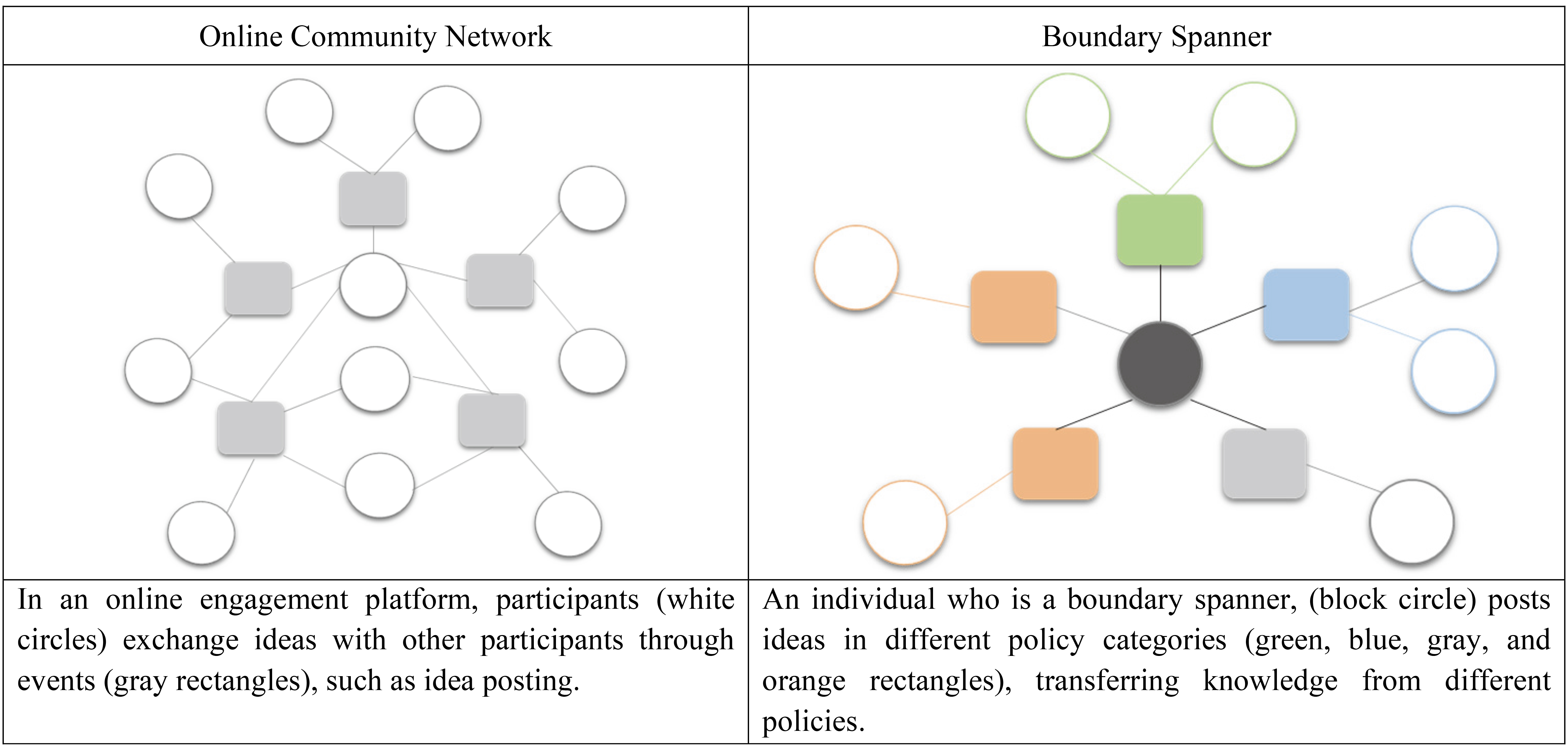
Because information is available on a participant’s comments, such as posting time and idea categories, this study utilizes information about individual commenting activities. Studies have found that individuals who actively interact with others take their contributions to the community seriously and feel a sense of belonging to the community [40]. However, Johnson et al. [41] find that boundary-spanning activities online might not be as important as ones in the organizational setting because all discussion/posts are visible to all participants in the communities. The ability of boundary spanners to obtain unique information is thus reduced. Other scholars who have studied boundary-spanning activities online argue that individuals who comment on ideas would likely also read those ideas before commenting [14, 42]. With this additional effort to learn others’ ideas through commenting activities, online boundary spanners can generate effective ideas in communities, such as the Open Government Dialogue.
Therefore, a boundary spanner in the Open Government Dialogue is defined as an individual who actively bridges ideas and knowledge by reading and exchanging ideas with others in various policy areas, including transparency, participation, collaboration, capacity building, and legal and policy challenges. Contributors to the Open Government Dialogue who visit the webpages of various policy categories and comment on others’ ideas in different policy areas should have better overall knowledge of open government policies and may in turn provide ideas that are aligned with the government’s policy goal [22]. Sharing the assumptions of the boundary-spanning theory, the following hypothesis is proposed:
Hypothesis 1: Likelihood that a participant’s proposed idea is accepted is positively associated with the participant’s boundary-spanning activities across different policy areas.
Alternatively, studies also suggest that feedback from the online community might influence participants’ contributions [43, 44, 45]. Based on previous studies, we define attention receivers as those whose contribution behavior is influenced by or motivated by comments or feedback received from other members of the online community [43, 44]. According to social influence [46] and social judgment [47] theories, participants in online communities are motivated to contribute their ideas because of feedback and comments provided by other members. Studies show that individuals tend to appreciate attention or approval from others by openly sharing their ideas [48, 49]. By receiving feedback and comments, individuals become aware of their influence on others [50, 51]. Thus, feedback through comments and voting are highly correlated with the generation of ideas applicable to the community [43, 50, 51]. Brzozowski et al. [43] argue that commenting activities are indispensable because comments provide guidance and direction. In their qualitative study, they state, “The way you know if anybody is reading it is if they take the trouble to reply. Without that you have no clue who people are…it’s largely unidirectional” [43, p. 69].
Furthermore, in an online community, online interaction and conformity become an important intrinsic motivation for contributors to make a continuous contribution to the community, especially when there are not monetary incentives [52]. A ranking system provides a measurement of participants’ reputations. For instance, Anderson et al. [53] show that commenting activities on posts in question answering sites generate a reputation pyramid in which participants with a higher reputation are likely to generate more comments, which signal their status to the community. Lampe and Johnston [45] show that commenting activity serves as feedback to new members of an online community and affects their contribution frequency. These studies also recognize that contributors could receive either positive or negative ratings or comments [53, 54]. Whereas Anderson et al. [53] argue that negative comments seem to be the reason for participants to improve their contributions, Lampe and Johnston [45] argue that negative comments might discourage new users from continuing to submit their ideas in the online communities. However, neither study showed significant effects from the negative comments or ratings.
In the context of the Open Government Dialogue community, in addition to submitting ideas about how to make governments more transparent, participatory, and collaborative, participants could comment on and rank ideas (either positively or negatively). Contributors who received the highest number of comments and those with the highest scores, including the difference between the sum of total scores from liking and the total scores from disliking, were featured by rank order on the “Leaderboard.” A ranking system with the intention of encouraging more contributions from members was established for the Open Government Dialogue based on the previous studies and theories [55, 56]. Given the theories and previous empirical findings, it is important to examine how commenting and feedback might influence participants’ contributions in the context of online engagement for public policy. In such a community, attention receivers also hope to attract views and comments from their members. The hypothesis is as follows:
Hypothesis 2: Likelihood that a participant’s proposed idea is accepted is positively associated with the comments received on the proposed idea.
Individual experiences
In addition to the boundary-spanning and attention-receiving activities included in the model, control variables were included to account for the potential effects of other factors. Previous studies show that prior contribution experiences, prior experiences of contributing ideas that were accepted and overall experiences in the community would affect the likelihood of proposing ideas that are accepted [14, 37, 44]. As mentioned earlier, online interaction can enhance participants’ knowledge [30, 31, 32]. In addition to boundary-spanning and attention-receiving activities, participants can read about others’ ideas or learn from their previous contributing experiences [14]. Previous studies show that participants experiencing the idea-generation process tend to obtain insightful knowledge about the hosting organizations [31]. Thus, we include individuals’ contribution experiences and days in the idea-generation process as control variables.
Data and methods
Open Government Dialogue
To gain a deeper understanding of individuals’ behaviors and efforts in an online public consultation community, we selected the Open Government Dialogue as our empirical case study. The Open Government Dialogue online brainstorming session was open to the public for a week-long online engagement from May 22–28, 2009. Because it is one of the earliest cases, few rules and regulations were adopted to govern the online community. Thus, the contributors’ natural behaviors can be observed. The design of the Open Government Dialogue allows us to empirically test our hypotheses about the effects of boundary-spanning and attention-seeking activities on contribution.
First, information about participants’ activities is publicly available. To participate in the Open Government Dialogue Page, an individual must first register with ideascale, the website administrator. Each member also has a member profile, which includes a member badge to indicate the participant’s status and an activity stream that outlines his or her activities. Second, ideas are classified into six general categories and eighteen sub-categories using idea tags. This classification scheme allows us to measure the knowledge diversity of participants who were interested in different policy areas. Third, in the Open Government Dialogue, participants could interact with each other by submitting ideas, commenting, or voting; a ranking system was in place to inform the participants.
Significantly, the idea-selection process was made transparent to the public, allowing us to examine the quality of participants’ contributions. The idea-selection process for the Open Government Initiative involved several steps. First, participants rated the entries, and entries were scored based on their public rating. Second, the NAPA Advisory Board made the final decisions regarding the potential topics that were included in the Phase II discussion. These topics and contents subsequently formed the basis for the second phase of the Open Government Initiative from June 3–26, 2009, and were later channeled to the third phase of the Open Government Initiative from June 22–July 6, 2009, which resulted in the Open Government Directive on December 8, 2009. Three main considerations were used to assess and select ideas [21]: (1) the representation of important themes, (2) the crafting of a potentially actionable policy, and (3) the receipt of favorable votes or comments by the community. The report, however, indicates that voting outcomes were considered but were not the sole or final factors [21].1
For instance, ideas for a specific agency that received high votes were not considered in the second round of discussion because the purpose of the exercise was to establish general guidelines for all government agencies at the federal and local levels [21].
The initiative has received a substantial amount of attention: it has received 113,648 page views, with the average visitor visiting 3 to 4 pages, at least 10 visitors from every U.S. state and territory and visitors from 123 foreign countries and territories. The week-long brainstorming session received 30,822 visits from 20,830 unique visitors, who each spent an average of five minutes and 31 seconds on the site [21]. Judging from the reported statistics on the website, the Open Government Dialogue gained a substantial amount of public attention. However, attracting the public to view the engagement initiative is different from having participants actually contribute to the brainstorming session because idea contribution requires time and effort. Liu [28] found that approximately 34% of the participants in the Open Government Dialogue contributed to nearly 73% of the ideas. Moreover, although the rating system of the Open Government Dialogue was intended to assist the participants in focusing on important and meaningful ideas, it was reportedly used to the advantage of special interest groups to promote their own political agendas unrelated to the original purposes of the policy consultation [28, 56]. To truly utilize the functions of online platforms for idea generation for public policies, it is important to understand the types of behaviors that are associated with meaningful idea contribution. Thus, this paper focuses on online interactions in online platforms for public policies, with the hope of understanding how to facilitate innovative ideas without noise.
This study utilizes publicly available information from the Open Government Dialogue website. The data were obtained in the form of an HTML page file through a web-crawling process of the Open Government [28]. Each data set tracks interactions among participants and the platform over the project period. The data retrieval process for the Open Government Dialogue project was performed over one to two days in early August 2011. These pages were transformed into text files containing information on the usernames and activities of users. We then built a panel data set for one week of consultation based on the contributors to the Open Government Dialogue over the course of 7 days (May 21, 2009, to May 28, 2009). We collected information on the ideas that were submitted between the website’s launch and May 28, 2009, during the official public consultation period. Over the one-week Open Government Dialogue consultation period, approximately 4,000 registered users2
Please see the National Academy of Public Administration report [21].
This number is based on the data downloaded from the Open Government Website in August 2011.
This number excludes self-commenting.
Dependent variable
The hypotheses of this study concern a contributor’s likelihood of posting an accepted idea. Therefore, a dummy variable was an appropriate dependent variable to measure whether ideas posted by contributor were accepted on day
Definitions and summaries of the variables
Definitions and summaries of the variables
Note:
A boundary spanner was defined as an individual who has engaged in online idea exchange activities within the Open Government Dialogue community by commenting on others’ ideas in different policy areas. A previous empirical study that investigated online interactions measured idea exchange by counting cross-commenting activities given the assumption that people read ideas before submitting comments about them [14, 37, 44]. Solving the sequential order of the events is essential to reflect the effects of cross-commenting activities on idea efforts. Given the information on the date and time when the comments were submitted, we can measure when a contributor made a comment or submitted a first idea. In other words, we can construct a variable that indicates ideas that were submitted after the contributors made comments, as shown in Bayus [14]. Thus, ideation might be correlated with idea exchange activities through commenting.
More specifically, to define the boundary spanner, as in other studies, we treated the eighteen policy areas as eighteen knowledge pools in the Open Government Dialogue. Participants with legal knowledge would properly comment in or contribute to the legal issue section, whereas those with a computer science background might comment in the technology section. We assume that by cross-commenting on different policy areas, boundary spanners can exchange information and knowledge. Hence, in this study, boundary-spanning activities were measured as commenting activities across different policy areas on the Open Government Dialogue for the purpose of this study. We adopted an entropy measure to capture diversity (also used in Bayus’s study, -
Attention-receiving activity was defined as activity by an individual who received comments from other members in the community on day
Control variables
In addition to the boundary-spanning and attention-receiving activities included in the model, control variables were included to account for the potential effects of other factors of individual experiences. Previous discussions show that prior contribution experiences, contributors’ prior experiences of contributing ideas that were accepted and overall experiences in the community affect the quality of idea generation [14, 37, 44]. Thus, we include a control of counting the number of ideas submitted to account for prior contribution experiences, a control of the number of prior accepted ideas, and a control of the days spent in the Open Government Dialogue community. Additionally, as seen from Fig. 2 later, there were variations in the numbers of ideas submitted. Thus, we also included a time dummy for each day, accounting for any other unobserved time-varying effects.
Analysis
This study tests the effects of boundary-spanning and attention-receiving activities on the likelihood that an individual will propose accepted ideas while controlling for past experience generating ideas, past success, age in the community, and time variances. We applied Bayus’ [14] model to investigate the effects of boundary-spanning activities and attention-receiving behaviors on contributors’ idea efforts. We first adopted a logistic fixed-effects model to estimate our binary dependent variable. The fixed-effects model was chosen over the random-effects model based on a Hausman-type test [57]. Then, a panel Poisson model was selected because the dependent variable is a count variable [58]. Our data are panel data in which the response of each participant is observed across time. Repeated observations of the same participant are typically correlated. Thus, we use panel logit models and panel Poisson models. Generally speaking, both are in the generalized estimating equation model family, which can address the correlated data issue [58].
Results
Figure 2 shows the daily counts of proposed ideas and accepted ideas. In the first day after the website was launched, fewer than 100 ideas were submitted. Starting on day 2, ideas increased rapidly, followed by a decline in activity for three days. Then, in the final two days, a rapid increase in activity occurred again. As shown, the trend line of the accepted ideas is closely associated with the trend line of the total number of ideas. The average total daily contribution is 134 or 93 when removing the two peak days. The average daily accepted idea contribution is 63 or 43 after removing the two peak days. The average daily number of active contributors is 82 or 59 after removing the two peak days.
Number of total posted ideas compared with number of accepted ideas by the NAPA expert panel.
Figure 3 shows descriptive information on the ideas classified by one-time contributors in comparison with repeat contributors and whether the ideas were accepted. Because idea development required time, we made a distinction between contributors who spent longer in the online community vs. those who contributed once throughout the entire consultation period. Thus, “one-time contributors” refers to contributors who contributed an idea or some ideas within one day and did not return to the community (92%;
Open Government Dialogue ideas and contributor population.
Figure 4 shows the ideation efforts and community participation and interaction. Of 591 participants, 285 (48%) participants submitted ideas that were accepted, 172 (29%) participants commented on ideas, and 404 (68%) participants received comments from others. The figure further shows the total number of commenting activities, including comments made and received by other one-time contributors or repeat contributor groups. Repeat contributors have higher percentage in commenting on others’ ideas (26% one-time contributors vs. 60% repeat contributors) and receiving comments from others. In particular, 93% of the repeat contributors received comments from others compared with only 66% of the one-time contributors. In agreement with the literature [43], receiving comments from others created incentives for a contributor to return and contribute more ideas.
Logistic regression with fixed effects for accepted ideas
Open Government Dialogue participants’ contributions and online interactions.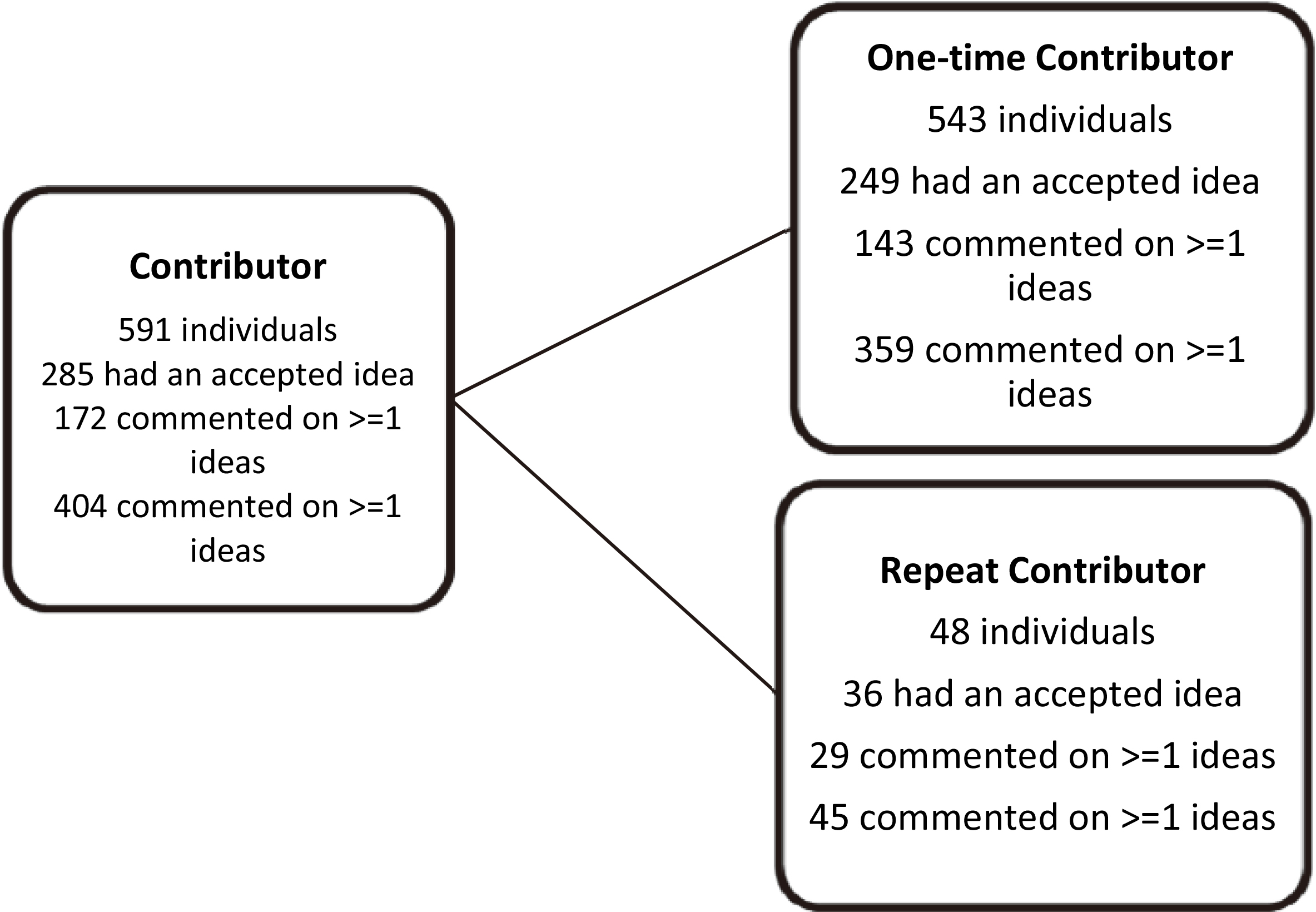
To understand how boundary-spanning and attention-receiving activities correlate with the likelihood of posting accepted ideas, we adopted a balanced panel logistic fixed-effects regression. As observed in Table 2, the overall model is statistically significant. Specifically, the results show that positive and statistically significant coefficients for both boundary-spanning and attention-receiving activities support H1 and H2. This result is consistent with theories in the idea-generation process that individuals who commented more on others’ ideas in the different policy areas and received more feedback from others were more likely to contribute ideas that were accepted in the Open Government Dialogue community.
Our controls for previously posted ideas (negatively), previously accepted ideas (positively), and age (negatively) were also statistically significant. This result indicates that individuals who have been a part of the community for a longer time and/or have contributed more ideas in the past have significantly lower chances of their ideas being accepted. This conclusion is contradicted by the literature finding that online experiences enhance participants’ experiences and knowledge related to the hosting organization [31]. One possible explanation is that the Open Government Dialogue did not provide substantial information about the policies or examples on their idea-generation forum. Few instructions or guidelines are given about the relevant policies on transparency, public participation, collaboration, or other relevant laws and regulations. Thus, in the Open Government Dialogue community, the contribution of more ideas did not guarantee the quality of the ideas. Our time dummy variables also showed that the ideas submitted earliest had a higher likelihood of being accepted.
Logistic regression with fixed effects for accepted ideas, repeat contributors
Table 3 presents the panel Logistic fixed-effects regression results restricted to only repeat contributors (
The differences in the findings of Tables 2 and 3 indicate that the factors influencing the overall and repeat contributors on the likelihood of posting accepted ideas might be different. Although boundary-spanning and attention-receiving activities influence idea quality, these activities do not have the same effects on increasing the likelihood of posting accepted ideas for the repeat contributors. From Table 3, given that the number of prior accepted ideas is statistically significant, these repeat contributors who contributed multiple accepted ideas might have insightful knowledge about the Open Government policies and thus, their own knowledge (i.e., the number of accepted ideas) increases the likelihood of posting accepted ideas.
Based on the pre-tests in the previous data section, a panel Poisson model was used to further verify whether attention-receiving and boundary-spanning activities are associated with the number of ideas accepted. The results are presented in Table 4, which includes all the contributors. The overall model is statistically significant and is a good fit to the Open Government Dialogue data. In Table 4, positive and statistically significant coefficients for boundary-spanning and attention-receiving activities support both H1 and H2. Our controls for previously posted ideas (negative), previously accepted ideas (positive), and number of days spent in the community (negative) were all statistically significant, as shown in Table 2. These results indicate that individuals who have posted more ideas and have been part of the community for a longer period have fewer posted ideas accepted. The time dummies of this model suggest that ideas posted on the first three days and the last day had a statistically significantly higher chance of being accepted. A separate analysis was performed to determine whether contributors systematically proposed more ideas on these four days, and such a pattern was not found (results available upon request).
Poisson regression with fixed effects for accepted ideas
Poisson regression with fixed effects for accepted ideas, repeat contributors
For the balanced panel Poisson fixed-effects regression, we restricted the model to repeat contributors (
Our model serves as one way to understand the behaviors of contributors to online engagement in the public sector both empirically and theoretically. Based on existing theories and findings, our research empirically investigated factors associated with an open idea-generation process over time in a public policy setting. As in other studied online communities, most participants in the Open Government Dialogue proposed ideas on only one day and did not return to post further ideas during the consultation period. Nearly 91.9% (543/591) of all contributors offered an idea only once throughout the entire period. However, both one-time contributors and repeat contributors generated accepted ideas for the consultation as measured by the percentage of accepted ideas by total posted ideas by each group (46% (389/846) vs. 50% (112/225), respectively). Furthermore, different factors are associated with different types of contributors. For one-time contributors, both boundary-spanning activities and receiving comments from others play an important role both in the likelihood that an individual will generate accepted ideas and in increasing the number of accepted ideas (Tables 2 and 4). For repeat contributors, previous successful experiences and receiving comments are associated both with the likelihood of generating accepted ideas and with increasing the number of accepted ideas (Tables 3 and 5). These contributors may generate accepted ideas by learning from their past experiences or success and feedback from others [14, 62]. For repeat contributors, past discussions and experiences that help to accumulate knowledge play a bigger role in facilitating quality and accepted ideas when controlling for all factors.
Theoretically, based on existing models [14], our study provides an initial empirical model to understand how online interactions might be associated with the quality of ideas in the online public policy consultation setting. Bayus [14] suggests that different online interaction designs and feedback systems of online idea generation embedded in different contexts and settings might also vary. Our empirical study further enhances existing theories by verifying different online interaction activities in the public policy setting. Our results reveal the importance of both boundary-spanning (i.e., posting comments in diverse policy categories) and attention-receiving (i.e., receiving comments from others) activities, particularly for one-time contributors. Feedback from community members encourages contributors both to return to the community and to contribute repeatedly. Additionally, the coefficient of past successful experiences is consistently statistically significant for both one-time contributors and repeat contributors.
Our findings on the patterns of online interactions and online idea generation for public policy also offers further recommendations for public policy engagement designs. First, online interaction is an important process for establishing a participant’s reputation [37, 44]. Future online idea-generation platforms for public policy should incorporate a reputation system to help contributors offer innovative ideas or constructive comments to earn credits. Previous studies show that documenting participants’ activities helps to profile experts in an online community [63, 64]. Niemann [64] argues that the status of expertise emerges from online interaction and depends on how peers view the knowledge of the contributors within the online community in addition to their backgrounds. Thus, identifying experts simply from their reported profiles is not sufficient. Participants in the community could judge the “expertise” of the contributors based only on participants’ previous activities, including idea contribution and commenting activities.
Second, governments have increasingly adopted similar cross-agency initiatives to incorporate the public’s ideas into public policies; one such example is regulations.gov in the U.S. [65]. Our findings showing the importance of different types of interaction activities through commenting indicate that comments from crowds also provide a useful selection mechanism. Schuurman et al. [66] find that crowd participants can select innovative ideas in the idea-generation forum for smart cities. They further recommend that organizers of the online idea-generation forum should create incentives for participants to comment about and review the posted ideas. Our findings on commenters’ efforts in the idea-generation process indicate that commenting on more diverse topics should be rewarded. Also, it is important to actively provide feedback so that contributors know which types of interaction activities are constructive.
The chosen Open Government Dialogue case limits generalization of the results. The Open Government Dialogue was one of the few collaborations to cut across multiple federal agencies. Most Open Government initiatives are based on specific agencies, but Open Government Dialogue attracted participants from a wide range of backgrounds. Thus, our findings might not be applicable to a population with a more homogenous background. In other words, different online idea-generation platforms might have different feedback and interaction designs and lead to different results. Further comparative studies across different platforms (e.g. Steils and Hanine [15]) will advance our understanding of online interaction in online idea generation.
Additionally, previous studies have found that constructive feedback and negative comments might constitute different behaviors online [60, 61]. However, due to data limitations we did not distinguish the content of the comments, and recognize that our model might suffer from omitted variable bias. In addition, we acknowledge that positive or negative feedback might have different effects on individuals’ motivation to contribute. Due to our data limitations, we were able to capture only the quantity of comments. Future studies could consider improving the measurements of boundary spanning and attention receiving variables to capture the complexity of the online interactions.
Conclusion
Our findings imply that providing constructive and immediate feedback is one of the key elements to facilitate effective ideas for public policies in the online setting. Administrators of online public policy consultation platforms could utilize commenting activities as an important tool to facilitate idea creation rather than treating commenting as a built-in function from the online platform. Liu [28] finds that Melbourne city officials would provide immediate feedback to resolve conflicts or facilitate discussion on the feasibility of implementing policy ideas from the participants in an idea-generation process for the city’s long-term strategic planning process. As previous studies have suggested, the idea-generation process also helps participants obtain inside knowledge about an organization [37]. Similarly, through timely feedback and comments, participants in an idea-generation process for public policy can also learn about the feasibility of their ideas and diverse views from the other participants, further facilitating consensus building.
Footnotes
Acknowledgments
The author would like to thank the anonymous reviewers and journal editor for their constructive comments. Special thanks to the participants and reviewers of the dg.o Conference in 2016 for their useful suggestions on an earlier draft of this paper. This research was funded by Seed Funding for Basic Research from the University of Hong Kong and Public Policy Research Fund from the Central Policy Unit (2016.A8.052.17A). The author would like to acknowledge the contributions made by the research assistants, Chih-Hao Pu, Celine, Cheung, Keith Lik Hang Tse and Able Yuen Kwan Au. This is an independent research project.