



Abstract
Blockchain technology has the potential to provide public services directly to the public. This challenges the need for public organizations, who traditionally provided these services. Much of the current work is focused on the technology, whereas the influence on public administration structure has gained less attention. The goal of this paper is to investigate the impact of blockchain technology on the governance of public service provision. For this, we performed a case study of an EU-wide system that monitors the movement of excise goods under duty suspension. We developed two scenarios for blockchain technology’s use based on a permissionless blockchain architecture on the one hand and a permissioned one on the other. The scenarios were evaluated based on their impact on transaction validation, data quality and governance. The findings show that blockchain technology alone cannot be an alternative for the current data quality controls, equal access assurances and adaptations to legislation conducted by public administrations. As such, governments will remain playing a key role in registration of documents and assets, however, the governance will likely change depending on the type of blockchain architecture.
Introduction
Developments in information and communication technology (ICT) have enabled governments to deliver services more efficient, effective and citizen centric (Scholl & Klischewski, 2007). The emergence of blockchain technology has emerged that opens up a world of possibilities for governments (Ølnes, 2015). Blockchain is a technology allowing actors in a system (called nodes) to transact digital assets using a peer-to-peer (P2P) network and storing these transactions in a distributed way across the network (Back et al., 2014). Each block contains a signature that is based on the exact content (string of data) of that block and is chained to the previous block up until the first block. Any participant with access rights can trace back a transactional event belonging to any participant at any point in its history. Blocks are recorded across a peer-to-peer network, using cryptographic trust and assurance mechanisms which makes them hard to mute (Warburg, 2016). In a blockchain both the transaction itself and the owners of the assets that are transacted can be registered. Every transaction is validated by the network by employing a ‘consensus mechanism’. This is a mechanism that allows users to validate the transactions and update the registry in the entire network (Warburg, 2016).
A number of researchers investigating the potential of blockchain in governments expect blockchain technology to lead to a changing role of public administrations in society. Davidson et al. (2016a) argued that this technology can reshape the way governments are able to interact with citizens, economic operators, and each other (Davidson et al., 2016b). This technology is considered to hold the fundamental promise of facilitating direct interaction between citizens, providing administration without a governmental administrator and tailoring services provided by governments (Alketbi et al., 2014). Shrier et al. (2016) stated that blockchain technology enables us to rethink the current institutions in society, especially as this technology can redefine the relationship between government and the citizen in terms of data sharing. They argue that the distributed nature of this technology can ensure the integrity of government records and services, without the need of a central administration (Shrier et al., 2016). Atzori (2015) concluded that blockchain can provide governmental services in a more efficient and decentralized way, allowing for a less hierarchical and more horizontal and distributed diffusion of authority. Full traceability and transparency of transactions on the ledger create an additional layer of algorithmic trust and algorithmic control over governmental organizations, which may shift the balance of power between administration and citizens (Meijer & Ubacht, 2018). While an increase in scientific research into this technology can be seen, research on blockchain in public administration remains scarce. In a literature review of blockchain for the public sector, Ølnes (2015, p. 10) concluded that there is little research in this area and proposes to “start researching ways this technology can be utilized by [the] public sector”.
Although e-government initiatives have tried to provide public services more directly, decentralized and tailored to the needs of the citizens (Molnar et al., 2015), the initiatives have never truly changed the role of public organizations in recordkeeping and administration. One of the key opportunities provided by blockchain technology is the possibility to facilitate direct interactions between public institutions, citizens and economic operators. Hence, blockchain technology can reshape the way governments interact with citizens and each other (Atzori, 2015), and forces public administrations to rethink their role in public service provision. The execution of public services can be governed by blockchain (governance by blockchain), whereas the development and evolution of blockchain services need also to be governed (governance of blockchain) (Ølnes et al., 2017). The latter becomes important, once blockchain technology is introduced in the public sector. Using this technology, governments could take on a supervisory role with regards to the transactions taking place in a blockchain-based infrastructure. Blockchain technology can take away a large part of the administrative roles that governments fulfil in society nowadays, which requires a change in the governance of the (public) service provision. This can alter the institutional structures, like legal institutions and public institutions like we known them today. The governance of public services provision will likely be changed caused by the use of blockchain technology and is hence the focus of this paper.
Current blockchain systems that are successful, like Bitcoin, do not require semantic data validation on top of the consensus mechanism. Given the relative simplicity of a payment system that includes one currency like Bitcoin, these systems can provide full data quality validation disintermediation. In these systems, the blockchain system can provide the data quality validation in a network setting. The way this works is, very simply put, that each transaction is validated if the following two conditions are met:
The sender has a sufficient amount of funds to send the amount of Bitcoins, and The sender knows the address of the receiver.
Looking at a more complex data or asset exchange system, in which also the semantics of the data is of value, there is still a need for an intermediary to provide this data quality check (Boucher et al., 2017). The verification on the blockchain is only done on the technical requirements of the protocol, so it records the time and details of the transaction. In current blockchain systems, if the transaction ticks all the technical requirement boxes, then the transaction will become part of the transaction history that is immutable (Warburg, 2016). The content of the transaction is not checked in this process (Boucher et al., 2017). Therefore, in more complex information exchange processes, such as e-government services, the quality of the data in the system cannot be verified with a blockchain system alone. This raises the issues of the consequences on the transaction content, how the data quality is safeguarded and how the governance in the system is structured to provide required safeguards in e-governments services. To explore these consequences of the implementation of blockchain, we performed a case study in which we analyse the impact of two different blockchain architectures on three governance aspects of public authorities (transaction content, data quality and governance structure) using Transaction Cost theory and Public Choice theory.
The main research question of this paper is: What are the consequences of blockchain technology for the governance role of public administrations for the EMCS system? We explore the consequences of two different blockchain architectures for the role of public administrations by investigating an in-depth case study. Adding to the analysis of different blockchain architectures within a case study should help to deepen the discussion on the impact of blockchain technology in government services. We investigated the Excise Movement and Control System (EMCS), which is a computerised system for monitoring the movement of excise goods under duty suspension in the EU. This case study was chosen since it has high levels of automation which makes the use of blockchain technology feasible. We investigated the consequences of the implementation of blockchain on the governance of public administrations for two main blockchain architectures: permissionless and permissioned blockchain systems. These two blockchain architectures differ significantly in the use of the technology and in the way they are governed. We use the Public Choice and Transaction Cost theory to analyse the impact on the governance. Public Choice theory reflects on the foundations of government and is used because it analyses why and how structures like intermediaries, bureaucracies and political behaviour emerge. The Transaction Cost theory is used because this theory uses the costs of interactions to explain the existence of certain types of organizational structures. An exploratory case study of an EU-wide system that monitors the movement of excise goods under duty suspension is used to develop two blockchain scenarios. The scenarios are evaluated to determine the consequences of using the two blockchain architectures for the governance of public administrations.
This paper is structured as follows: Section 2 provides an overview of the research approach. In Section 3 the theoretical background is outlined by discussing Public Choice and Transaction Cost theory to understand the government structures of public service provision and to explore the consequences of blockchain technology on these structures. Section 3 presents the exploratory case study where the different consequences of using the two blockchain architectures are demonstrated. Section 4 provides our conclusion, a reflection on the findings, and recommendations for future research.
In this paper, we employed case study research to analyse the potential of blockchain technology in governments. The case study was chosen to be able to illuminate the aspects of blockchain use in government of which little is known. We investigated the consequences of the implementation of different blockchain architectures for the governance role of public administrations using Public Choice and Transaction Cost perspectives. A case study approach is suitable for evaluation of the consequences of interventions and to explain the mechanisms at work (Yin, 2011).
Within the case study two scenarios are developed in which blockchain is used to evaluate the consequences for public administrations. This case study approach is used because it allows for the analysis of the differences between two scenarios for one existing system (Stake, 2005). The case study is investigated by studying reports and conducting 11 interviews. The interviewees were selected to ensure different perspective and different areas. The case study first outlines the current process, after which two scenarios with different blockchain architectures are explored for this process. The case study demonstrates the impact of two mayor blockchain architectures for the governance role of public administrations.
Theoretical background
In this section, literature on the implementation of blockchain technology in governments is introduced. First, a Public Choice perspective is used to explain the role of governments in society. Then, a Transaction Cost perspective is used to explain the role of public administrations in transactions.
Public Choice theories
Public Choice theory refers to the perspective of using “economic tools to deal with traditional problems of political science” (Tullock, 1987, p. 10). This theory postulates that the main reason why public administrations are originally created is to maximize some sort of welfare function for society (Tullock, 1987). Public administrations are created to warrant and protect social values, promote the common good and protect collective rights (Atzori, 2015; Green, 1991). Governments facilitate coordination in society to smoothen the tensions between the short term individual interest and the collective good and to find compromises between the two (Atzori, 2015; Dahl, 1989). To provide coordination in the most efficient way, public administrations have developed administrative organizations.
Bureaucracies, as introduced by Weber (1992), are administrative systems governing any large institution and are characterized by predefined processes and organized hierarchies to provide governmental services for citizens (Weber, 1992). Opponents of bureaucracies highlight the inefficiencies and limited flexibilities of these bureaucracies to provide services that are requested by civilians, leading to a gap between the governmental services that citizens desire and the governmental services that are provided (Atzori et al., 1994). The hierarchical structures of these bureaucracies are also argued to facilitate the centralization of power towards a few top civil servants, bringing about a lack of transparency, the possibility of corruption and the potential misuse of power (Antonopoulos, 2014). On the contrary, proponents argue that rational and systematic control is needed to facilitate coordination between humans (Weber, 1992). Weber (1992) argued that this is essential to avoid chaos in society and that using bureaucracies can avoid favouritism and enhance the efficiency of interactions in society. Various trends towards the decentralization of governments can be distinguished from this perspective, including Proudhon’s social contract, Marxism, Decentralization of the State and IT as source of governance decentralization, which outline why and how specific governance roles of public administrations arise.
Transaction cost theory
Another theory that can be used to explain the role of organizations in registration and information exchange processes is the Transaction Cost Theory (Malone et al., 1987; Sarkar et al., 1995). This perspective analyses the costs of transacting between two or more parties and the quality of the transaction that emerges. This perspective argues that transactions can occur when the cost of transacting is low. If these transaction costs are too high for a transaction to occur, then intermediaries can emerge to bring the parties together and lower the transactions costs. Throughout history, society has formed institutions like governments, banks and platforms to function as these kinds of intermediaries.
From a Transaction Cost perspective, blockchain technology can impact the governance role of public administrations. Public administrators traditionally take on the role of intermediaries in a network to lower transaction costs for transactions that governments deem important, like tax collection and land property trading. In these services, continuity is required as they are claimed to be critical for citizens’ rights, welfare and the common good. Public organizations facilitate coordination between citizens/economic operators, in order to protect the common good, reduce opportunism and avoid the abuse of the network (Atzori, 2015; Klievink & Janssen, 2008). The public administration is often not involved in the actual transaction of a real-life product, but can also just facilitate the market transaction by providing the registration or by assisting in the process of information exchange (Janssen & Sol, 2000). There are generally three governance roles of public administrations in the coordination between the providing citizen/economic operator and the receiving citizen/economic operator: as a complete intermediator, as a supervisor or no role in the coordination at all (Janssen & Sol, 2000). This is schematically presented in Fig. 1.
Levels of intermediation by public administrations (based on Janssen & Sol, 2000).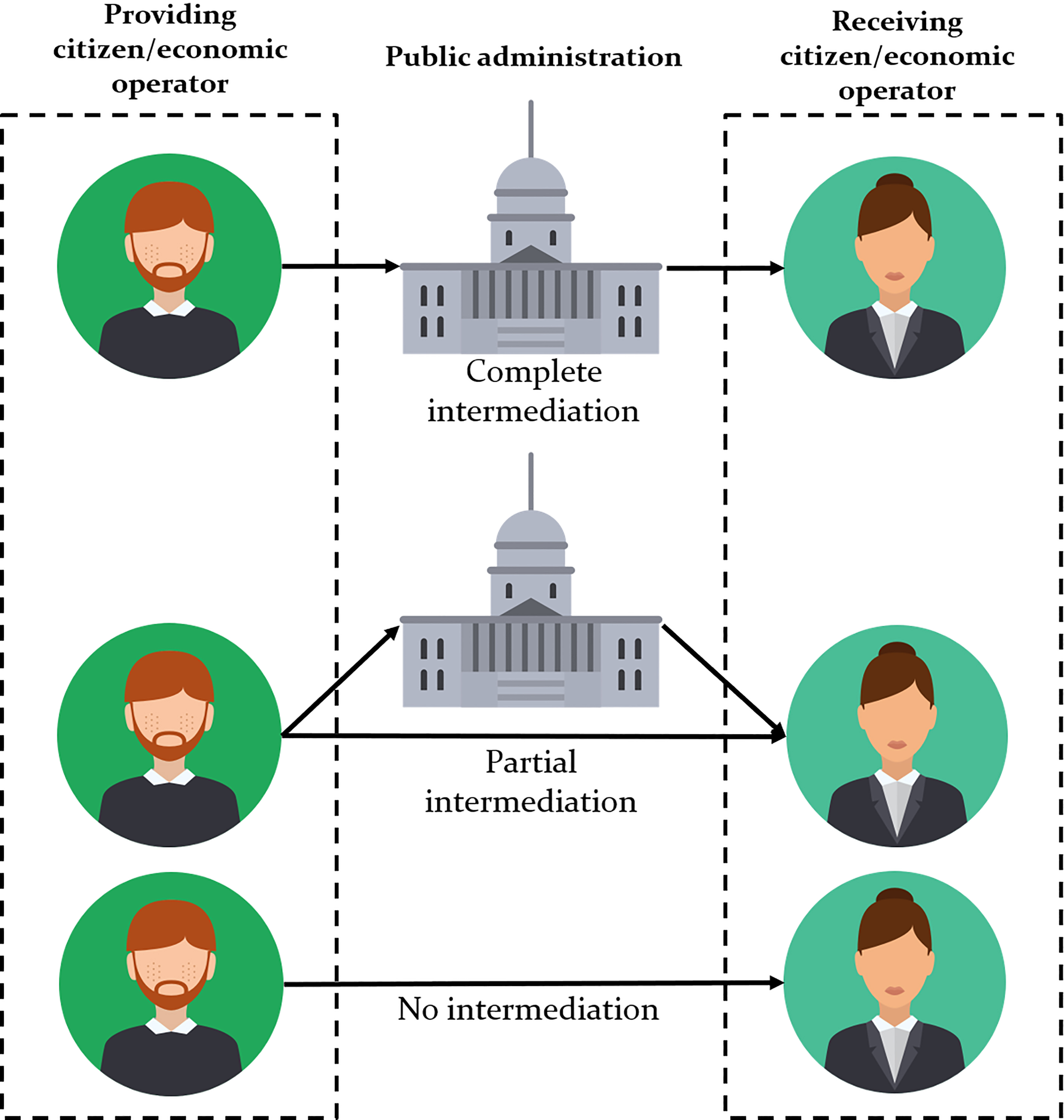
Based on the Public Choice and Transaction Cost perspectives, we follow the perspective that governments are created to protect the common good and facilitate interaction between citizens/economic operators and to enable consensus and coordination between heterogeneous or distant citizens/economic operators. Public administrations function as intermediaries to (1) provide this coordination as the transaction costs are too high to have direct transactions, and (2) to regulate networks to provide continuity of governmental services as they are critical to citizens’ rights, welfare and the common good. The theories suggest that the scenarios should be evaluated on transaction content, data quality (Transaction Cost theory) and Governance (Public Choice theory).
To explore the impact of two different blockchain architectures on governance aspects of public authorities, we performed a case study in which we compare two blockchain architectures for the governance role of (inter)national authorities. We present our analysis in next subsections, where we analyse the impact of the two scenarios on:
Transaction content (Transaction Cost theory) Data quality (Transaction Cost theory) Governance (Public Choice theory)
This case study investigates the consequences of the implementation of two scenarios for a system that monitors excise goods under duty suspension within the territory of the EU: the Excise Movement and Control System (EMCS). The two scenarios differ in terms of the blockchain architecture: permissionless versus a permissioned blockchain system. The impact on the transaction validation, data quality and governance in the network of the two scenarios is compared. First, the current EMCS is explained. Then, both the permissionless and the permissioned blockchain architectures are explored for this process. Last, an overview of the consequences of an EMCS using the two blockchain architectures is presented.
Currently, to facilitate information exchange between traders and national authorities in the countries of the trade, the Excise Movement and Control System (EMCS) workflow management system is used. It is used to complete a digital declaration form that moves from the trader in the country of dispatch, to a receiver in the country of destination. Each country currently has its own National Excise Application (NEA), in which the sender and receiver complete the dispatch data. The National Authority of each country must validate the data input in the transaction, after which the digital document is sent to the other National Authority. The current EMCS is a centralized system, but each transaction is validated by the two connected NEAs of the Member States. The content of the transaction is an overview of the content of the goods that are being sent, including the time and date of dispatch and arrival. The quality of data is ensured by manual validation at the authorities of each Member States in the NEA, which is only performed on a random basis. The governance is structured only at Member State level: the sender is responsible for declaring the right amount of goods and the Authority is responsible for validating the transaction. Figure 2 presents a simplified visualization of the EMCS that is used for cross-border trading of excise goods in the EU.
The current situation of the EMCS.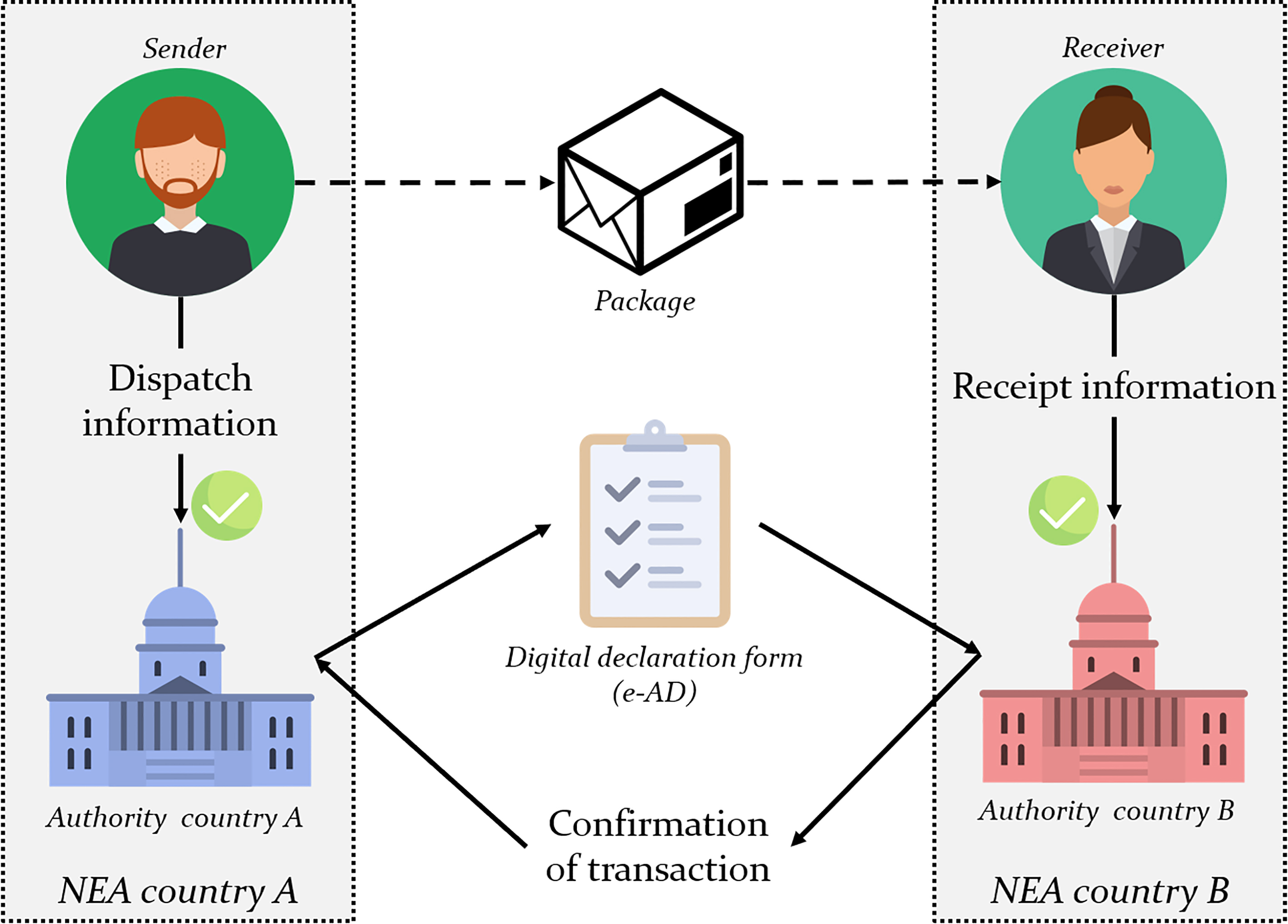
For the case two scenarios were developed based on permissionless and permissioned blockchains. The difference lies in the openness of participation in the consensus mechanism of the blockchain system. In other words, the blockchain types differ in who can participate in validating the transactions:
Permissionless blockchains allow all nodes to participate in the consensus mechanism; Permissioned blockchains have the transaction consensus mechanism performed by a given set of participating nodes, based on criteria determined by the architect of the permissioned blockchain.
To demonstrate the consequences of the implementation of these two blockchain architectures for public administrations, a real-life governmental information exchange process on both a permissionless and a permissioned blockchain is explored in the next section.
Looking at the consequences of a permissionless blockchain architecture for the EMCS system, the peer-to-peer transactions would reduce the effort for both the traders and the national authorities as data only should be entered once instead of multiple times. Consequently, it will also cause the system to be less human-error prone. However, permissionless blockchains would enable transactions to be validated without complying with regulations, as anyone can participate in the consensus mechanism. This consensus mechanism requires more than 50% of the nodes to confirm the transaction. Traders can for example pool together and combine for more than 50% of the verification power in the network, shifting the control to this group that might have malicious intentions. In addition, the reason why National Authorities are currently validating the data input in every transaction, is to make sure that all taxes are paid and thereby promoting the common good of tax collection. Shifting the validation control to the network, the majority of the traders are responsible for the correctness of the data input and thereby the fact that all taxes are paid. Traders are argued to be primarily economically driven, so it can hardly be expected that the whole network will feel responsible for making sure all taxes are collected and the common good is protected.
The content of the transactions will only include meta-details of the actual transaction, as the value of the goods will be declared but not the content of the transaction. The quality of the data is determined by data input of the sender, and the governance of the system is completely distributed. Therefore, the responsibility of the data quality in the system is completely distributed to the traders as well.
This permissionless blockchain system leads to the disintermediation of the public administrations at the technical validation level, which could increase the potential of fraud and present a threat to the common good. The National Authorities involved would be completely sidelined in terms of data quality safeguarding, as they will only be able to see the transaction log but not be able to provide any supervisory or facilitating role. Figure 3 presents a visualization of the EMCS system using a permissionless blockchain.
The EMCS using a permissionless blockchain.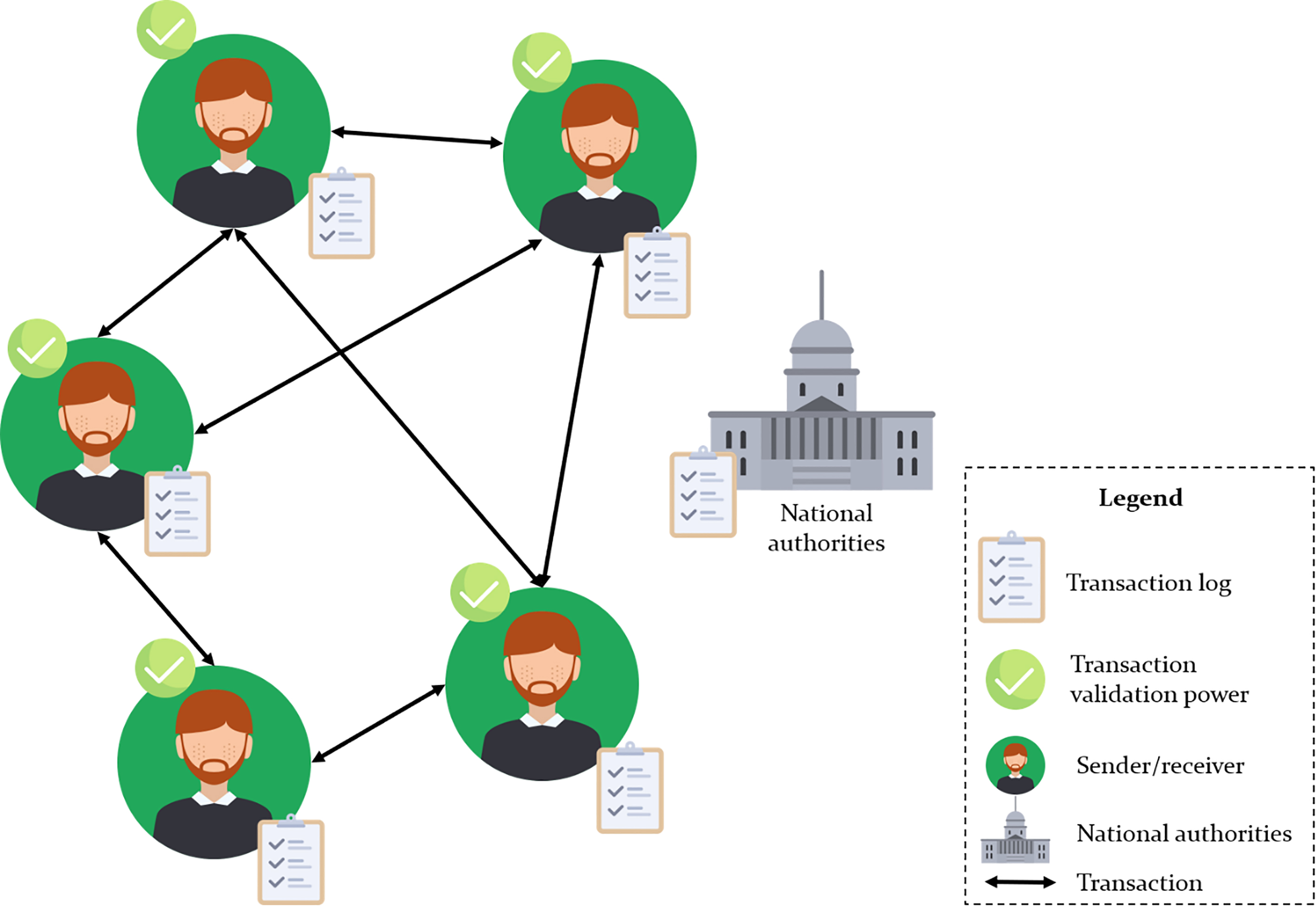
If the EMCS system would use a permissioned blockchain, the system could also benefit from the enhanced data integrity as is the case in the permissionless blockchain system. The architect of a permissioned blockchain system can however also regulate who can participate in the system and who can participate in the consensus mechanism. To ensure the right amount of tax collection and to reduce fraud, the system should ensure that traders provide the right data in the monitoring system. A permissioned blockchain system for this process would not completely remove the need for semantic validation by governmental authorities in the process, which can be provided if the validating nodes (the actors performing the consensus mechanism) are the National Authorities.
The content of the transactions of the blockchain would include the complete transaction details as permissioned blockchain system is less limited by scalability issues compared to permissioned systems. The data quality is still determined by the traders who provide the input in the system, but as the validating nodes will be the national authorities, the governance will not be completely distributed. The power to validate or alter wrongfully validated transactions will still be at the public organizations.
From a governance perspective, a permissioned blockchain architecture would still change the governance role of the National Authorities involved. They would move from being the facilitator of the data exchange process in every transaction (as is currently the case in the National Excise Applications), towards a role where they can check and control when necessary. This enables the regulation of the data input in the system, which leads to the appropriate amount of tax collection and thereby the promotion of the common good. This permissioned blockchain system leads to a changed governance role of the national authorities from a facilitator to a supervisor, as it would facilitate peer-to-peer transactions between the traders, while regulating the critical input in the system. Figure 4 presents a visualization EMCS using a permissioned blockchain system.
The EMCS using a permissioned blockchain.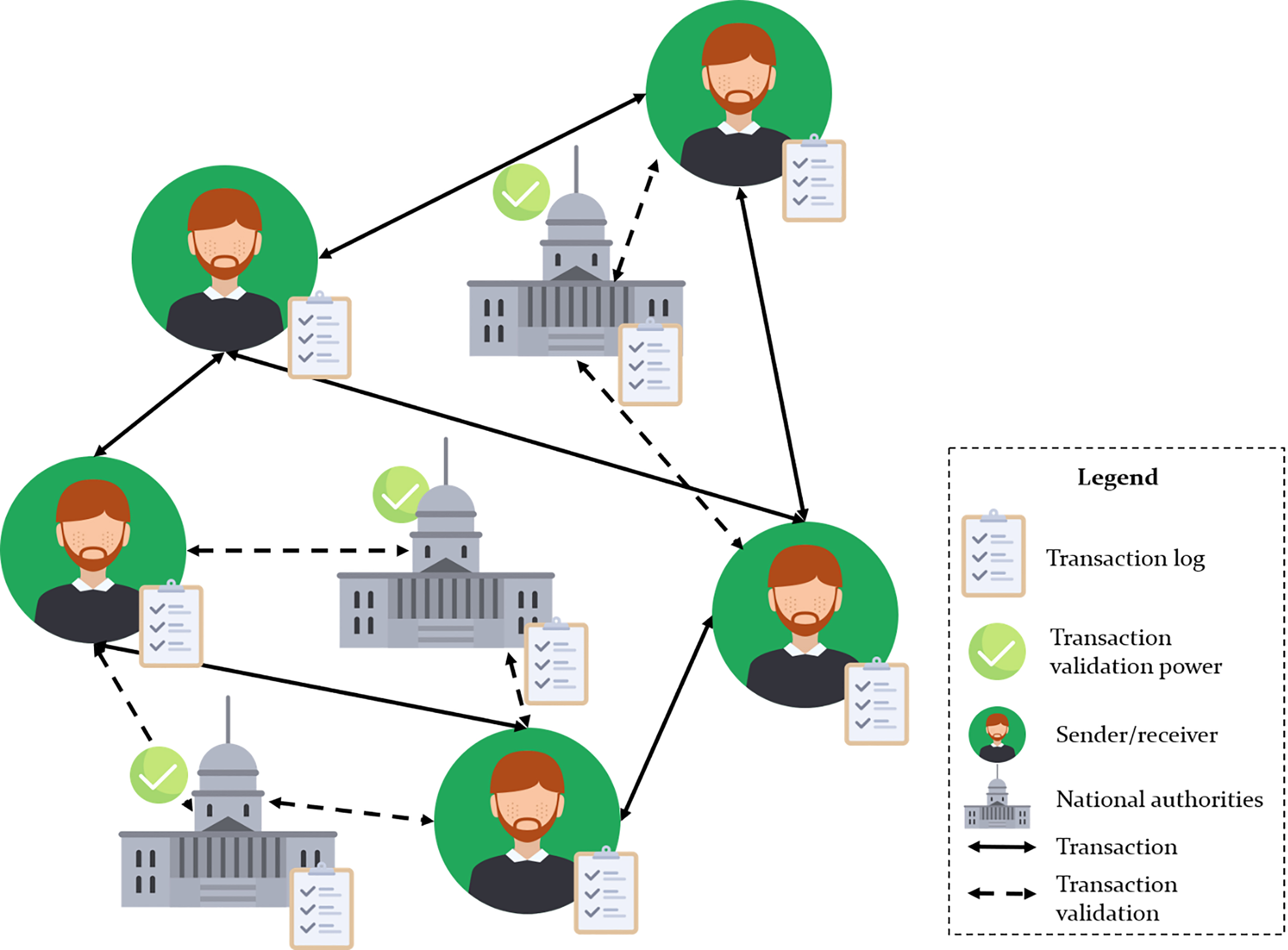
As can be seen in the two scenarios, there are consequences for the governance role of the public administration. The consequences vary based on the blockchain architecture that is used for the blockchain implementation. In the case of a permissionless excise duty system, this could lead to completely side-lined national authorities, increasing the potential of fraud and presenting a threat to the common good. In the case of a permissioned excise duty system, the governance role of public administrations could shift to a more supervisory role. The permissioned blockchain system would enable peer-to-peer transactions and enhance data integrity, while the national authorities would still be able to provide semantic validation and thereby regulating the infrastructure. An overview of consequences of blockchain architectures for the transaction content, the data quality and governance structure of public administrations in an EMCS system as presented in the two scenarios is displayed in Table 1. In scenario II governments play an important role in governing transactions. They should ensure the data quality and play a trusted role for ensuring this.
Overview of consequences of blockchain architectures for the governance role of public administrations in an EMCS system
Overview of consequences of blockchain architectures for the governance role of public administrations in an EMCS system
In the EMCS case study, it is displayed that permissionless blockchains present a complete disintermediation of public administrations in information exchange or registration processes, with limited ways of interfering in the process as a government. Even though they lower the transaction costs compared to the centralized EMCS system that is currently in place, the public sector is unable to guarantee the continuity of the service. The control of the governance in the network will be completely distributed and in the hands of the validating nodes in the network, giving them significant power over the governmental service. In many governmental services, continuity is required to protect the common good and facilitate interaction in society, which cannot be automatically guaranteed in permissionless blockchains.
On the contrary, permissioned blockchains enable a changing governance role of public administrations: from a facilitator towards a supervisor, presenting re-intermediation in public administrations. These blockchains are still somewhat centralized in terms of control, as they are closed systems and the architect of the system can impose participation rules, which is necessary to ensure the protection of the common good and facilitate interaction in society. The implementation of permissioned blockchains can allow public administrators to provide this level of trust and protect the common good while lowering transaction costs. Also, this allows public administration to deal with exceptions, as the assumption that every citizen can transact is not realistic. People might be illiterate or not digital savvy or simply do not fit the standards and norms. In current situation public organizations have the discretionary power to deal with exceptions. Permissioned blockchains allow for the necessary semantic data quality checks to ensure the appropriate data quality in the system as can be seen in Table 1, which is not provided by the blockchain technology itself.
Therefore, permissioned blockchains present the next step in e-government as they provide benefits to governments that were not feasible with traditional information technologies while ensuring continuity of governmental services. Blockchain can reduce the amount of human labour involved in the process and thereby reduce the chance of human errors. Also, as all actors in the network have a copy of the register, blockchain technology can increase transparency, auditability and automation. In an EMCS using a permissioned blockchain architecture, the traders do not need to trust the intermediary anymore to keep verify the right transactions, the traders just need to trust the technology and the mathematics of the blockchain. Therefore, using a permissioned blockchain architecture for the EMCS system can increase the trust of citizens and companies in governmental processes and recordkeeping.
Blockchain technology can be used to provide public services without the involvement of public organizations. In this way blockchain technology can lower the transactions costs and removes the roles of public organizations to validate transactions and provide services. However, public organizations conduct more activities than merely providing services. They ensure that public services are updated and modified, citizens are treated equally and fair, non-digital savvy citizens have access and warrant other public values. Furthermore, there might be exceptions that should be handled by the discretionary power of the public agency. Although blockchain can be used for the direct and distributed registration of documents and assets for public services, government organizations keep on playing a key role. The use of blockchain technology results in a shift from executing centralized registrations and public services, towards governing blockchain implementations by ensuring data quality, dealing with exceptional situations and adapting to changes in legislations.
The case study that explores the two blockchain architectures for the information exchange process facilitated by public administrations showed that the governance by public administrations will change when implementing a blockchain architecture. A permissionless blockchain architecture would distribute the responsibility for the data quality and transaction validation to the network. With this architecture, public administrations have no means to intervene or correct the transactions on the blockchain, limiting or even completely removing the governance role of public administrations in these networks. Yet there might be exceptions, like illiterate citizens in need of a service. A permissioned blockchain architecture enables the opportunity for public administrations to be the validating nodes in the blockchain system. This only partly distributes the responsibility for the data quality to the network, while keeping the ability to intervene and correct transactions. This changes the governance role of public administrations from a transaction facilitator towards an orchestrator in the network.
The case study scenarios also show that the architecture of the blockchain system must be carefully designed for governments to safeguard the public values that they deem important. The two scenarios display that the consequences of the implementation of blockchain technology for e-government services for the governance role of public administrations are dependent on the architecture of the blockchain system.
Blockchain is underexplored in government. Two major blockchain architectures were investigated in this research: permissionless and permissioned blockchains. The difference between the two types originates from the openness of the consensus mechanism within the blockchain architecture. However, many other variations of blockchain architectures exist. For example, there can be variation in the way the validating nodes are rewarded or the openness to external actors to view transaction logs. More research in these types of design is needed.
In this research we assumed that blockchain systems did not provide semantic checks for data input. This highlights the inability of fully distributing the control to the network in permissioned blockchain systems. Further research is suggested exploring the possibility of adding semantic validation by the network in these systems, moving away from technical validation alone. This would entail more research into both the technical details of this semantic validation by the network and into the governance structures of the network. This would pave the way for permissionless blockchains to provide governmental services as well.
Further research into the impact of these blockchain architectures on the intersection of the technology and the institutions is needed. Implementing blockchain technology for governmental services might not only present a changing governance role for public administrations, but could for example also present a loss of jobs and exacerbate the digital divide in society. Research into drawing up an inventory of these effects is recommended to avoid unintended consequences when implementing this technology in the public sector. Finally, research into the attitudes towards this technology within public administrations could accelerate blockchain adoption. Investigating the perceptions of public administrators towards blockchain technology could result in a mapping of the barriers for adoption in the public sectors and can be used as a departure point for removing these barriers and enabling large-scale blockchain adoption for e-government services.
Footnotes
Acknowledgments
Pictograms used in the visualization are designed by Freepik from Flaticon.