



Abstract
The digitalisation of political communication has played a crucial role in campaigns on both national and regional levels. For many political candidates in Poland, Facebook has become the primary tool for building a successful campaign. However, campaigns for elections to regional government bodies are often associated with traditional offline media, outdoor advertising and ubiquitous leaflets. The aim of this paper is to contribute to our knowledge of electoral communications in Poland from the regional perspective. Data gathered during the 2018 online campaign for the Lower Silesian Regional Assembly examined through a semiautomated content analysis uncovered the dynamics of the professionalisation of Polish political communication and identified predictors of Facebook adoption for electoral purposes among regional candidates. Furthermore, focusing solely on Facebook data, research revealed a tendency toward the normalisation of social media campaigning and a propensity for using mobilisation communication strategies. Taken together, this paper provides new insights into the study of political campaigning in Central and Eastern Europe on social media from the perspective of political actor.
Introduction
Digital political communication research has been developing on par with the newest technologies. Much time passed between the pioneering scholarly work done on the use of websites by political candidates (e.g. Ward & Gibson, 2003), O’Reilly’s (2005) famed article on Web 2.0 and early research on the use of social media in political communications (e.g. Effing et al., 2011). The patterns of communication within the social system have changed even more through the dynamic proliferation of the Internet and the development of social media. The new media have facilitated an easier and more dynamic flow of information between authorities and citizens (Perloff, 2013, p. 255). Over a decade after US President Barack Obama’s technologically groundbreaking 2008 presidential campaign, political marketing professionals and candidates themselves have seemingly embraced social media for good (Cogburn & Espinoza-Vasquez, 2011). Consequently, electoral communication patterns have drastically changed since then. As political actors have always shifted between available and emerging communication tools (Lilleker et al., 2017, p. 293), electoral campaign research in the digital age demands a constant update of knowledge about the contemporary media landscape and the new communication opportunities it provides.
The aim of this work is to contribute to the literature related to political communication in Poland employing various theoretical perspectives. Based on data gathered from the electoral campaign for the Lower Silesian Regional Assembly (LSRA), this investigation examined the professionalisation of political communication guided by research questions related to normalisation versus equalisation and predictors of the adoption of social media by regional political candidates. The professionalization in the context of political communication is a troublesome and equivocal term (Negrine & Lilleker, 2002). However, it is one further way of identifying the changes that have been associated with the dynamic development of the media sphere and its instrumentalization by politics and implies the ability to adapt to a new communicative situation. Facebook as a digital public sphere and a vehicle of political communication has been researched thoroughly by scholars, focusing on the progress and effectiveness of their digital campaigns (Bene, 2017; Borah, 2016; Enli & Skogerbø, 2013; Larsson, 2016; Stetka et al., 2019; Stier et al. 2018). The massive audience and relative cost-effectiveness of professional activity on social media may be a strong incentive for smaller parties to compensate for their absence in the traditional media, hence the equalisation of campaigning is an important factor for inter-party comparison, and has also been the subject of previous academic inquiry (e.g. Gainous et al., 2018; Larsson & Moe, 2014; Samuel-Azran et al., 2015; Yang & Kim, 2017). From the perspective of the electoral communication content, the structural division between mobilisation and information (e.g. Gibson & Ward, 2000; Schweitzer, 2011; Spierings & Jacobs, 2019) was introduced as particularly relevant due to the motivation of political actors to use social media in campaigning. Finally, inspired by the works by Williams & Gulati (2010; 2013a; 2013b), this paper also aims to apply the theory of diffusion of innovation to verify predictors in political communication at the regional level in Poland.
On 18 November 2018, regional elections initiated a two-year electoral cycle in which the Poles participated in European Parliament, national parliamentary and presidential elections. This appeared to diminish the importance of balloting for local political elections. The second-order character of regional elections is often described as ambiguous (e.g. Schakel & Jeffery, 2013), and for many years, Polish regional elections were considered less important than presidential and parliamentary elections (Wojtasik, 2010). Since 2010, when Smolensk air disaster deepened the bipolar political division in the country, a noticeable shift has taken place in the way regional elections are viewed, as citizens seem to have become more aware of the significance of selecting regional government representatives (Turska-Kawa, 2011, p. 15). Indeed, as the 2018 regional campaigns approached, survey results regarding the priority of elections in Poland (Gendźwiłł & Żerkowska-Białas, 2018, p. 5) identified regional elections as most important, exceeding in hierarchal order (respectively) parliamentary, presidential and European Parliament voting. During the regional elections, Poles voted for each of the following: city/municipality councillor, voivodeship councillor and mayor/town president. The current research focuses on the voivodeship perspective, as it allows for a broader view of the electoral campaign without limiting the perspective to large cities only. Lower Silesian Voivodeship in 2018 was inhabited by more than 2.7 million residents, of whom 2.27 million were eligible to vote. The LSRA is an important legislative body consisting of 36 councillors chosen through fully competitive elections. The LSRA manages an annual budget of more than one billion Polish Złoty (roughly over 220 million Euro; Portal Samorza̧dowy, 2019), passes statutes on the provincial level and often constitutes the deciding voice in large infrastructural projects. Thus, fully competitive regional elections comprise a vital element of Poland’s political landscape.
Political campaigning in Central and Eastern Europe is a constantly developing area of scholarly interest (Cutts & Haughton, 2020, p. 257). As noted by Stetka et al. (2019, p. 2), empirical research on political campaigning is conducted worldwide, yet the majority of results published internationally originate from the United States and Western/Northern European democracies. Therefore, a gap exists in the knowledge on political campaigning in the digital age in Central and Eastern Europe that needs to be filled, especially related to digital electoral campaigns.
The evolution of political campaigning in Poland
Political communication scholars have consistently attempted to apply certain theoretical frames to the progression of campaigning. It has been twenty years since Farrell et al. (2001) discussed campaigning professionalisation in the digital age. The Internet and social media are now immanent elements of media landscapes around the world. This notion was explicitly visible in Blumer’s works on the fourth age of political communication (2015, 2016) and vastly applied in research on political campaigning on Facebook (e.g. Magin et al., 2017) and Twitter (e.g. Bracciale & Martella, 2017). A different approach to changing the communication environment of political campaigns was introduced by Norris (2000), who assumed the existence of three models of communication in the electoral period: pre-modern, modern and post-modern. Each responds to the current status of technology in terms of media use, placing the media in the centre of the shifts in the evolution of campaigning. According to Lilleker (2014, p. 21), although this concept is debated mostly due to its overgeneralisation, it is, nevertheless, cognitively valuable. The pre-modern campaign style was mostly associated with interpersonal communications and the printed press (Norris, 2000, p. 137), while the modern campaign model introduced professional media management and television. Because television was the dominating medium for many years, the Polish news consumption pattern was named ‘television centric’ (Pfetsch & Esser, 2016, p. 21). However, Reuters Institute Digital News Report for 2018 (Newman et al., 2018, p. 95) reported that the focus on television as a main news source had decreased, replaced by online media (including social media) as Polish citizens’ leading source of information. Norris referred to the ‘postmodernity’ of campaigning as the professional adoption by political actors of the newest communication tools available (2000, p. 147). However, few studies have examined the degree to which Polish political campaigns have advanced specifically regarding the media used for communication. A scholarly analysis by the Author of the 2014 LSRA campaign placed the evolution of regional campaigning at the early post-modern level (Baranowski, 2015, p. 42), with websites still serving as a popular and widely used tool for electoral communication but social media receiving slightly more favour. In countrywide studies, other scholars have found that Poland demonstrated a visible post-modern campaigning mechanism during the 2015 parliamentary elections (Dobek-Ostrowska, 2017, p. 377) and highlighted the professionalisation of political campaigns by the extensive use of social media (Adamik-Szysiak, 2019). Cwalina and Drzewiecka stressed the growing importance of new technologies in political marketing in Poland on the state level (2019, p. 140) but described campaigning at the regional level as significantly less professional. Since previous analyses have been conducted primarily on the 2015 electoral campaigns, the advancement of political communication during the 2018–2020 electoral cycle remains mostly unexplored; as such, this study aims to address the readiness of political actors to use post-modern online tools in their 2018 LSRA campaigns. Considering this background information, the first research question is dedicated to the evolution of regional campaigning: RQ1: To what extent did social media strategies in the online campaigns for the 2018 LSRA elections develop beyond those used during the 2014 campaign?
The adaptation of technological progress is driven by multiple factors. One theory that explains variations in the implementation of innovation is the diffusion of innovations theory popularised by Rogers (2010, originally in 1962). According to this author, new ideas are introduced by innovators and later are embraced by early adopters, and then an early majority, followed by a late majority and, finally, laggards at the end of the progression. Although this idea was not limited to the media and technology, the revolution brought by the Internet provided fertile ground for further research on the adoption of ICTs using this theory. The application of the diffusion of innovation theory to political campaigning has considered such factors as constituency and political differences (Williams & Gulati, 2013a, p. 54). For example, rational political actors are aware of their electoral environment and do not invest resources unless those investments are justified by data. Commonly applied politically driven independent variables included party identification, party status or status of the seat (Williams et al., 2013). To analyse the 2018 LSRA political campaign, the main focus was placed on the political factors, such as party or candidate status. Evidence has documented that 80.6% of the residents of Lower Silesia use the Internet (Statistics Poland, 2018) and 59% of Poles use social media for news consumption (Newman et al., 2018); therefore, constituency factors were not addressed. Modern candidates have more opportunities to reach voters than ever before. However, new tools also demand new skills among both candidates and voters. Technological literacy, as stressed by Williams (2009, p. 251), was especially important in the era of Web 2.0. Previous research indicates that age often proves to be a determinant variable in the late adoption of innovations (e.g. Matilla et al., 2003) and has too been used as such in studies on political communication (Gulati & Williams, 2013b). Therefore, the age of the candidate will be also used as a predictor for social media adoption. In view of the theory of the diffusion of innovation, the second research question is: RQ2: What were the predictors of Facebook implementation among the candidates during the 2018 LSRA online campaign?
The normalisation and equalisation hypotheses are still gaining attention in online political communication studies. In this context, equalisation means that online tools, such as websites and social media, can help to bridge the gap in traditional media coverage between major and marginal political actors. The normalisation of online campaigning, on the other hand, assumes the domination of major parties, as occurs with campaigns conducted using traditional media. The overwhelming majority of studies in this field have reported the predominance of major parties in web campaigning; hence, more evidence supports the normalisation of power in political communication online (e.g. Gibson et al., 2003; Koc-Michalska et al., 2016; Lev-On & Haleva-Amir, 2018; Stetka et al., 2018). However, the equalisation theory has not been abandoned. For example, Gainous et al. (2018) indicated that the democratisation of campaigns conducted on the Internet is possible and social media has got the potential to serve as a ‘great equaliser’ of communication power between political parties. In the context of Poland, campaigning in the digital sphere before the 2014 regional elections showed clear signs of division between major and minor parties, leaning more toward the normalisation of campaigns (Baranowski, 2015, p. 42). Consequently, the third research question addresses the normalisation versus equalisation concept: RQ3: Did the use of online media in major political parties’ candidate strategies indicate a normalisation of the 2018 LSRA campaign?
Facebook and other social media platforms can be powerful mobilising factors for both candidates and users. The possibility of turning followers into voters by mobilising them to take offline action is one of the incentives for adopting Facebook. As such, candidates use specific content strategies oscillating around the information-mobilisation axis. The scholarly analysis of content published by political actors on social media has provided evidence that both mobilisation (Enli & Skogerbø, 2013, p. 770; Gerodimos & Justinussen, 2015, p. 124) and information (e.g. Klinger, 2013) strategies are effectively used by candidates. The analysis of political communication on Facebook before the 2015 Polish parliamentary elections by Stetka et al. (2019, p. 9) showed that information strategies were used more frequently. Hence, the fourth and final research question for this study is: RQ4: Was information the main theme of political campaigns on Facebook prior to the 2018 LSRA elections?
Data and method
This research covers the ‘old’ electoral communication tools, such as websites, as well as not-so-new social media platforms, more specifically, Facebook and Twitter, which have been thoroughly researched and deemed valuable for communication with potential voters, remaining in the lead of most popular social networking services in Poland. To answer the research questions, the author analysed quantitative (number of ICT tools used by the candidates and social media numerical measurement) and qualitative (the content of the politicians’ Facebook ‘fan pages’) data gathered before the 2018 LSRA elections using content analysis (Krippendorf, 2018).
Data collection. This paper is focused on the communication aspect of the 2018 LSRA electoral campaign from the perspective of political actor. Candidates represented 12 parties from the region, rooted in major, nationwide organisations, in minor electoral committees and in regional political bodies gathered for electoral purposes. Each party listed candidates (10 on average) with 5 constituencies in the Lower Silesian Voivodeship. Considering minor differences in the list and candidate counts, the total number of candidates amounted to 517. Personal data on the candidates, such as age, constituency and party (used later in the research as dependent variables), were publicly available and gathered from the National Electoral Commission of Poland. The described candidate data was downloaded into a spreadsheet and formed the core of the dataset essential for this study. The next step in the research was to analyse the candidates’ overall use of communication tools during the 2018 LSRA campaign. To verify website usage, each candidate’s name and political party was googled, and the first two pages of search results were browsed. Social media platforms, at this point of the study, served as personal data search engines. Using the ‘search’ functions on Facebook and Twitter allowed the researcher to construct the list of candidates using each platform. Since only official profiles were considered, the number of fan pages is provided, not the number of private accounts. Through this process, 187 active online communication tools were identified that were used by the candidates, including 104 Facebook fan pages (of which 101 were actively managed during the election campaign). That data was incorporated into a previously created database. As Pfetsch and Bennet (2018, p. 250) emphasised, along with the change of contemporary media spheres, research methods must also transition, as conventional sampling and content analysis are difficult to apply. In the era of big data and datafication of users’ social media activity (van Dijck & Poell, 2013, pp. 9–10), a pressing need to adapt formerly used methods by automatising data collection and analysis has emerged. Considering the nature of the empirical material gathered for this study, some aspects of the analysis could not be supported by the software. For instance, verification of the websites and social media accounts used was performed by hand. However, after gathering the research sample, the scraping of the Facebook data was supported by the Netvizz application (Rieder, 2013). The empirical material collected was also manually cleansed and combined with the candidates’ data gleaned from the National Electoral Commission of Poland website. To demonstrate the dynamics of change, the author used the dataset from his own research conducted to analyse the 2014 LSRA campaign as a benchmark point for comparison.
Content analysis. The analysis approach employed for this research combined the actor-based approach of quantitative analysis of gathered data (both attention-related, like e.g. number of likes and general number of ICT tools used) and topic-related content analysis (Stieglitz & Dang-Xuan, 2013) using author’s codebook. Given that Facebook has emerged as a major electoral communication tool during the 2018 LSRA campaign, qualitative content analysis was conducted on data collected from 101 previously identified fan pages. Hence, the unit of analysis was defined as candidate’s official fan page with all entries from a one-month period prior to the election. In addition to semi-automatically collected quantitative data, the manual content analysis of Facebook data was performed using a codebook inspecting both formal, quantitative aspects of fan pages, such as likes, shares and numbers of posts, as well as comments and other qualitative variables regarding the use of specific campaign techniques. To specifically address the research questions, the author used variables concerning the character of the campaign, assuming the presence of content pertaining to policy, agitations and private lives during the research period. All of these were binary coded with ‘1’ representing the existence of a certain topic during the analysed period and ‘0’ representing its absence. As noted, for every analysed unit (candidate ‘fan page’), the visible entries (posts) were coded during a one-month period before the election (21 September-21 October 2018). The time selected represented a peak time for campaign activities and has often been used by researchers analysing electoral communications (e.g. Larsson & Moe, 2013, p. 76). As the coding was carried out individually by the author, no intercoder reliability was conducted. The research material gathered was coded, incorporated into candidates’ database and statistically processed (descriptive statistics and regression analysis) using jamovi (The jamovi project, 2019), which is a graphical user interface for R programming language.
Results
A comparison of the dynamics of the adoption of ICTs by political candidates during the regional elections in 2014 and in 2018 may clear up the uncertainty expressed in the title of this paper as to whether politics in Poland are leaning toward social media-based campaigning. The overall number of websites used by all candidates dropped significantly from 46 during the 2014 campaign to only 28 just four years later (see Table 1). The distribution of websites among parties during both electoral campaigns reveals a possible strategy for using this particular ICT. Experienced in the regional political arena, the nonpartisan local government activists party doubled their website numbers, whereas other major actors either significantly reduced (Civic Platform, Democratic Left Alliance, Polish People’s Party) or maintained the same level of (Law and Justice) website use. A comparison of major and minor political parties’ website use during the 2014 and the 2018 campaigns shows that while large parties noticeably employed this tool, the minor parties used it only marginally.
Analysing the quantity of Facebook pages used by the candidates during both elections provides even more evidence that Polish campaigns are, indeed, leaning toward social media. The increase in candidates’ Facebook fan pages before the 2018 election is notable, with particularly strong growth evident among the candidates of the major political parties. The candidates from challenging and minor parties who participated in regional elections for the first time also made use of fan pages but to a lesser extent. On the other hand, the minor National Movement party seemingly abandoned its Facebook campaign.
As stressed by Matuszewski and Szabó (2019, p. 4), Twitter is not particularly well known in Central and Eastern Europe as a source for political information. In fact, Twitter use in Poland heavily lags behind Facebook use, with only 28% of web users reportedly using it compared to 85% using Zuckerberg’s platform (Kemp, 2019). This can be explained by the relatively high skill threshold needed to join Twitter discourse (Yadron, 2016); another possibility is that the multiple shortcuts and acronyms the Twitter community uses due to the limited text allowed in a tweet may confuse new users. Despite the general consensus that Twitter is used mainly by politicians and journalists in Poland (Woźniak, 2015), only 55 candidates for the LSRA election (Table 1) used Twitter for electoral campaigning purposes, which represents only a slight increase from previous elections. An analysis of the distribution of Twitter use among competing parties uncovered an evident disproportion. In general, candidates from major electoral committees, especially those with representatives in national and regional assemblies, used this platform more often, with the exception of candidates from the minor leftist party Razem, which hosted eight identified Twitter accounts.
Dynamics of ICT adoption among LSRA election candidates in 2014 and 2018 (by percentage of candidates using)
Dynamics of ICT adoption among LSRA election candidates in 2014 and 2018 (by percentage of candidates using)
*Minor electoral committees. **Electoral committees that had no representatives in legislatures until 2019. ***National Movement had a single Member of Parliament during 2018 regional elections. Source: Author.
As expected, the level at which social media was adopted as a form of electoral communication differed among participating candidates. A logistic model was created to present and explain the factors influencing the implementation of Facebook during the 2018 LSRA campaign (see Table 2). The results suggest that the candidates who were first on the electoral list had the highest likelihood (OR
Predictors of Facebook implementation during 2018 LSRA campaign (regression analysis)
Predictors of Facebook implementation during 2018 LSRA campaign (regression analysis)
Note:
To investigate age as a predictor of social media adoption before the 2018 LSRA campaign, candidates were divided into three age groups: 18–35, 36–50 and 51 and older. The estimated model showed significant differences regarding the likelihood of adopting ‘fan pages’ between the youngest and the middle candidate age groups (OR
The quantitative aspect of a successfully conducted Facebook campaign is reflected in the numbers of posts, ‘likes’, ‘reactions’ and comments. Facebook’s digital architecture with its newsfeed, liking and commenting features is meaningful for scholars focused on digital political communication. As noted by Gerodimos and Justinussen (2015, p. 5), users’ involvement in digital campaigning requires different levels of commitment. ‘Liking’ or leaving a ‘reaction’ demands a single click, whereas commenting requires concentration, typing and sending messages, which are considered user generated content. Due to the highly skewed distribution of the indicators mentioned previously, the mean of the central tendency in the analysis of the Facebook quantitative data is expressed as the median value. Table 3 presents the median values of all posts, ‘reactions’ and ‘comments’ included on candidates’ Facebook pages during a one-month period before the elections.
Facebook quantitative data (median)
Facebook quantitative data (median)
*Minor electoral committees. Source: Author.
The average amount of posts candidates received during the month before the campaign under analysis was 17 (see Table 3), with an average of 279 fan page likes for candidate profiles. During the research period, an average candidate gathered 293 reactions (median
Focusing on the quantitative data from the perspective of normalisation versus equalisation, obvious differences were apparent in terms of posting strategies between the candidates from major and minor political parties (see Table 3). Representatives of major electoral committees with substantial organisational backgrounds (especially representatives in national parliaments like the Polish People’s Party, Civic Coalition and Law and Justice) tended to post surprisingly similar numbers of posts, fluctuating around 20 during the researched period. Challengers from minor committees apparently did not have a consistent posting strategy, as they posted with little intensity (Razem: median
Reactions as the simplest form of feedback that a candidate can receive from Facebook users indicated higher activity among users following major parties’ candidates. Challengers Razem and the Greens received substantially fewer reactions than incumbent representatives. However, it is worth noting that one of the candidates representing the minor National Movement party held an office as an Member of Parliament (obtained from Kukiz’15 party list in 2015) and was considered highly popular among Facebook users. Hence, the candidates from this party received noticeably higher rates of likes and reactions than any other candidate in the sample. The median of ‘fan page’ likes also reflects the extremely outlying values of the National Movement party (Table 3).
Commenting requires more commitment on the user side and occurs noticeably less frequently than leaving a reaction. During the one-month period before the 2018 LSRA elections under analysis, candidates from major parties gathered more comments on their entries than representatives from challenging parties. Results indicate that apart from the outlying National Movement, much less interaction was observed on the profiles of candidates from minor electoral committees. The main reason for this is their low activity. According to expectations, the higher the post count, the more ‘reactions’ (Spearman’s rho
Candidates running their campaigns on Facebook could create electoral communication counting on the beneficial effects of reciprocal relationships with potential voters via social media. However, the proportions of information, mobilisation and private content during the electoral period may vary and can indicate the selected campaign strategy. Mobilisation of Facebook users by calling them to action (e.g. with direct agitation) provides a unique opportunity to stimulate offline political participation (Koc-Michalska & Lilleker, 2017) and is a strong incentive for adopting a ‘fan page’. On the other hand, when using an information strategy, political actors address their followers or the general public in a top-down manner (Magin et al., 2017, p. 1702). The personalisation of politics on Facebook can be perceived as part of an information strategy; however, candidates’ intentions behind exposing their private lives can include creating a more personal link with Facebook users, boosting the profile’s popularity with reactions and comments and enhancing its ‘marketing’ capabilities (Enli & Skogerbø, 2013, p. 763).
Campaign theme** on Facebook by party (count) *Minor electoral committees. **Categories are not mutually exclusive; candidates could have used more than one strategy during research period (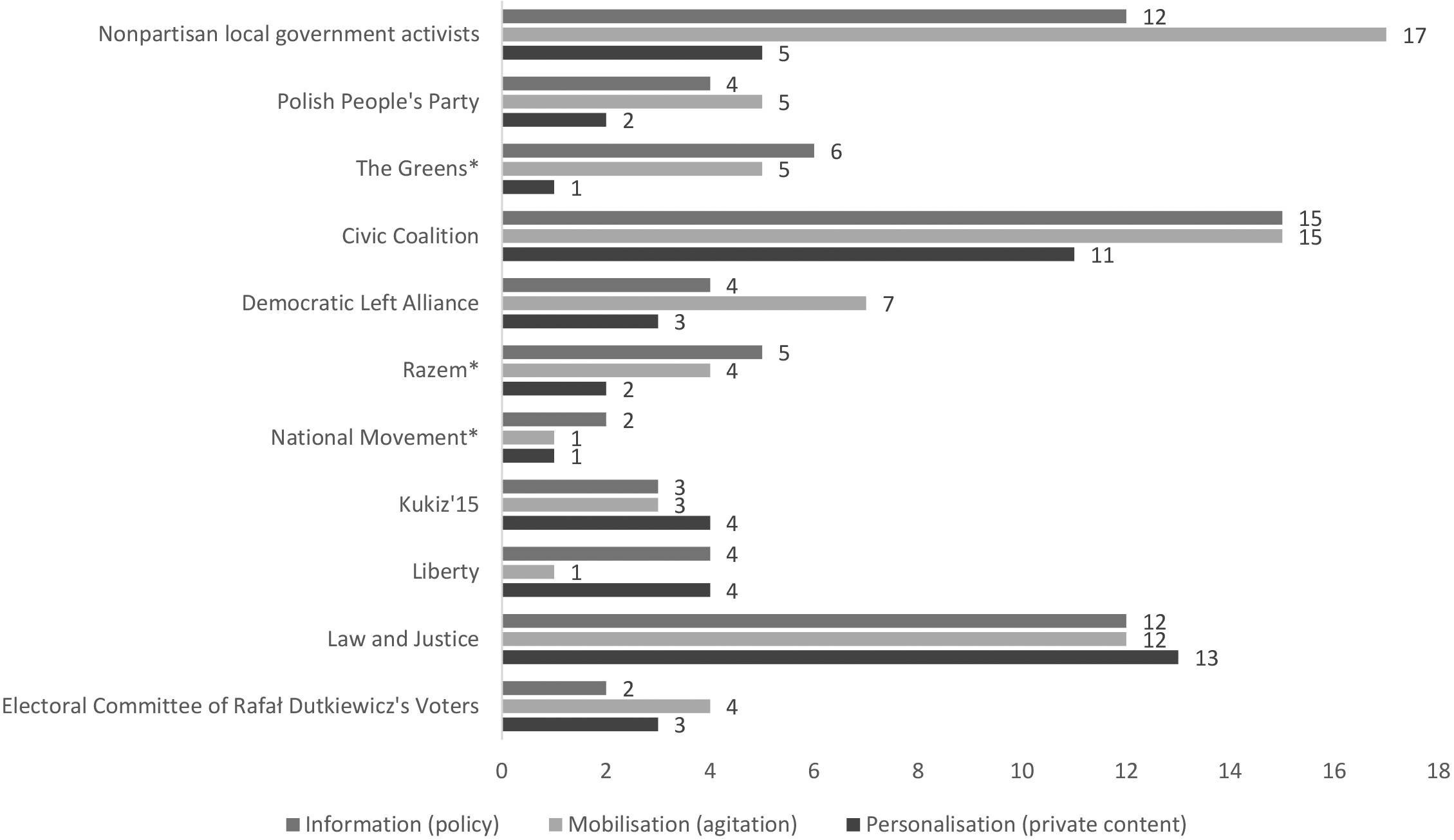
Categorising and analysing the content of posts during the electoral period before the 2018 LSRA elections illustrated that mobilisation, which was used by 74 candidates, was the most commonly used communication strategy. These results are contrary to the findings of Stetka et al. (2019, p. 9), who reported the advantage of an information strategy in the 2015 Polish parliamentary campaign on Facebook. The top-down information approach was slightly less popular but also intensively applied by candidates in 64 cases. The strategy of campaign personalisation (privatisation) was used least often but still to a noticeable extent (49 candidates). From the perspective of political parties, minor electoral committees tended to inform rather than mobilise (see Fig. 1). Major political actors predominantly used mobilisation strategies, but candidates from three parties in the sample utilised mobilisation strategies to the same extent. Interestingly, candidates from the Law and Justice party made the most use of personalisation.
The starting point of this research was the aim of identifying changes in Polish political campaigning, which is becoming more and more visible on social media. Facebook as the most frequently used tool for electoral communication was employed during the 2018 campaign analysed by 20% of candidates, compared to 15% in 2014, whereas webpages were used by merely 5% (compared to 9% during the 2014 campaign). With the reduction in websites and significant increase in the use of ‘fan pages’ during campaign period, the data demonstrate that the point of balance in digital electoral communication, indeed, has shifted to social media, mostly to Facebook. The pattern found in this study corresponds to that of Larsson & Skogerbø (2018), who observed the exceptional relevance of Facebook in the communication of Norwegian local politicians. Therefore, while addressing the first formulated research question, it should be emphasised that the results of the study indicate that websites are gradually losing their importance as an electoral communication tool. Hence, with professionalization perceived as adaptability to new communication tools, it can be concluded that Polish political campaigns are becoming increasingly professional, which is in line with research by Adamik-Szysiak (2019, p. 11).
Social media, as indicated in the title of this paper, played the most important role in the 2018 LSRA online campaign. Candidates who used Facebook for campaigning purposes represented various age groups and electoral committees and had different statuses and positions on the electoral lists. These features were used as predictors of Facebook implementation to answer RQ2. The regression analysis conducted revealed that the most likely to adopt a ‘fan page’ for electoral purposes were incumbent candidates who were first on the electoral lists and represented major political parties. The age factor was also related to Facebook adoption, with candidates from the youngest age group using this platform more frequently. The data showed a trend different from the one observed in Czechia, where, according to Mackova & Stetka’s study (2016), neither candidate or party status, nor sociodemographic had a significant impact on Facebook adoption by Czech parliamentarians. However, referring to research on the diffusion of innovation in political communication in the US, the results of this study are consistent with the analysis by Gulati and Williams (2013a) in relation to candidate status and age.
From the perspective of normalisation versus equalisation, differences in the use of Facebook in electoral communications were visible. A significant gap existed in both identified websites and social media profiles in favour of major parties. This was also confirmed by the results of regression models as noted. The analysis conducted on Facebook quantitative data indicated that major electoral committees were more active during electoral period and amassed more user feedback in the form of ‘reactions’ and ‘comments’. In conclusion, the analysis provided an answer to RQ3, clearly demonstrating that the 2018 LSRA online campaign provided more evidence for normalisation, which reinforce previous findings by Stetka et al. (2019) in view of the predominance of the major parties in the Polish electoral campaigns. Moreover, the results resonate with manifestations of normalizing of political campaigning on social media, as outlined, among others, by Keller & Kleinen-von Königslöw (2018) in case of the Swiss politicians on Facebook.
Finally, the main theme of the Facebook campaign was analysed from the perspective of the communication strategy applied distinguishing between information, mobilisation and personalisation approaches. The analysis of the content published on candidates’ ‘fan pages’ suggests that campaigns aimed slightly more at mobilisation than information; however, informing was also a vastly common practice, which responds to RQ4. The results are overall consistent with the work by Magin et al. (2017) demonstrating the significant use of the informational function by the Austrian and German parties and Garcia et al. (2020), who highlighted the effectiveness of this technique in regional elections in Valencia. Personalisation as a communication strategy to expose private content that proved to be prominent in electoral campaigns before (e.g. Metz et al., 2019) was used by 49% of all candidates during the research period.
The findings of this study have several implications for the Polish political communication sphere and provides important insights on the increased salience of social media in campaigning in Central and Eastern Europe, as stipulated by Cutts & Haughton (2020, p. 257). Analysis of the data gathered during one month of the electoral period for the 2018 Lower Silesia Regional Assembly campaign supports the conclusion that campaigning has taken another step into the postmodern stage as understood by Norris (2000). As a general consensus, regional electoral communication online has shifted to social media, with websites losing their importance as conventionally used ICT tools. The campaign was dominated by the candidates from major parties and was mainly focused on calling to action to their social media followers by mobilising them to vote and informing them on their political plans and beliefs. This study has provided the evidence of campaign normalisation in the previously unresearched aspect of regional political communication in the Central and Eastern Europe and has widened the understanding of campaign strategies validating the ongoing professionalization. However, this study has limitations that should be addressed in future scholarly endeavours. Considering the fact that analysis was limited to a single voivodeship during the electoral campaign before the 2018 regional elections in order to avoid overgeneralisation, further research including all constituencies is needed. Moreover, further analyses should extend the methodological approach by also including candidates’ Facebook posts as the unit of analysis, which would allow for more robust findings. Additionally, it can be said with a high degree of probability that future Polish electoral campaigns will increasingly use social media, potentially not limited to Facebook. The extended use of platforms like Instagram or attempts to colonise TikTok in political communication could also be fruitful areas for further study on political campaigning in Poland.
Footnotes
Conflict of interest
No potential conflict of interest was reported by the author.