



Abstract
Social media institutionalization in public administrations has been conceptualized as the final stage of the adoption process. However, an understanding of organizational models for social media institutionalization in public administration is lacking. This exploratory study of Dutch local governments contributes to the literature by identifying how governments organize social media institutionalization. Drawing on an original questionnaire on social media adoption, two advanced cases were selected based on their high level of social media institutionalization: Utrecht and Eindhoven. For each case, in-depth semi structured interviews were carried out aiming at detecting institutionalization patterns. Our study highlights that, in contrast with the literature on stages of technological maturity, social media institutionalization shows two different organizational models: a centralized model, based on trust, with highly structured and formalized policy guides, low experimentation, formal training and evaluation supported by standardized reports; and a distributed model, based on control, with simple guiding principles, higher levels of experimentation, training build on a “learn by doing” basis, and individual evaluation mechanisms. These results enrich current academic understanding of social media institutionalization and may guide public officials involved in social media institutionalization practices.
Keywords
Introduction
During the last decade, social media has become a widespread technology within public administrations and its use varies considerably depending on the organizational contexts and particular needs (Faber et al., 2020; Falco & Kleinhans, 2018; Criado et al., 2017; Lin et al., 2016; Mergel, 2013). Some public administrations have managed to standardize social media use within their organizational practices, making these technologies evolve from a mere set of driven market “individual technologies” into “organizational technologies” (Bretschneider & Parker, 2016). This has been labelled by literature as social media institutionalization and can be defined as a process that comprises the formal decision to gradually integrate social media inside the organization routines and procedures (Mergel, 2016). Social media institutionalization is usually studied as the final part of a broader adoption process (Bretschneider & Parker, 2016; Mergel & Bretschneider, 2013). By social media adoption we mean a pathway that starts with the informal introduction of social media by some public employees inside the organization and that ends with its formalization (Bretschneider & Parker, 2016; Mergel & Bretschneider, 2013). The objective of this study is to understand how public administrations organize internally the institutionalization of social media by identifying different models.
There are several gaps in the study of social media institutionalization inside public administrations that require our attention. On the one hand, social media institutionalization has often been seen as part of a broad process of technology adoption, focusing on the individual decisions to adopt (Eom et al., 2018; Harrison & Johnson, 2018; Zavattaro et al., 2015; Ellison & Hardey, 2014), as well as on the elements and factors that could affect this process (Lev-On & Steinfield, 2015; Reddick & Norris, 2013; Bonsón et al., 2012). On the other hand, another way of approaching this phenomenon is based on how this process occurs (Bretschneider & Parker, 2016; Mergel & Bretschneider, 2013), a perspective that has usually been based upon diffusion of innovation models (Rogers, 2003). However, for both perspectives, we have identified a lack of studies on the specific organizational dynamics that entail the social media institutionalization phase (Medaglia & Zheng, 2017; Mergel, 2016; Bretschneider & Parker, 2016).
A shortcoming is found in the fact that the adoption of innovation approach has envisioned one single path towards social media institutionalization. Pioneering work by Mergel and Bretschneider (2013) builds upon the literature on technology adoption (Coursey & Norris, 2008; Nolan, 1973) and has resulted in a conceptual understanding of social media institutionalization as the final phase of an innovation process. As it happened with previous explanatory models of e-government adoption based on stages (e.g. Andersen & Henriksen, 2006; Layne & Lee, 2001), these kind of approaches have often been criticized for an excessive linearity (Bannister, 2007), which does not correspond with the variety of uses and ways of managing social media that are being developed by public administrations (Wukich, 2021; Criado & Villodre, 2020; DePaula et al., 2018; Edlins & Brainard, 2016; Bonsón et al., 2015; Mergel, 2013; Meijer & Thaens, 2013). Accordingly, we highlight that there is more than one way in which social media institutionalization happens.
This article explores organizational models for social media institutionalization based on a study of Dutch local governments. The research question that has guided this work is: how do public administrations organize social media institutionalization? We focused our exploratory analysis on advanced practices of social media institutionalization. The first phase of our research was the identification of Dutch local governments with a high degree of social media institutionalization. To do so, we conducted a questionnaire on social media adoption aimed at Dutch municipalities with more than 50.000 inhabitants. The second phase was the analysis of the organizational features of local governments with a high degree of social media institutionalization. For that purpose, we selected two cities with a high level of social media institutionalization, Utrecht and Eindhoven, and we analyzed their institutionalization patterns based on in-depth semi structured interviews.
The main contribution of our exploratory study is the identification of two distinct organizational models of social media institutionalization. These models show how this institutionalization process follows different paths. With this, we may improve our understanding by identifying models that can help practitioners to correctly embed, standardize and formalize social media inside their organizations. It also provides scholars with a theoretical starting point from which to study social media institutionalization and leverage empirical research.
This article is structured as follows. After this introduction, we present a literature review aimed at establishing the features of social media institutionalization. The methodological section shows two research stages and the operationalization of the variables regarding institutionalization features. After that, we present our results in two parts: first, we offer an overview of the institutionalization results for the Dutch municipalities to identify advanced practices. Then, we show the results of our exploratory study of the institutionalization patterns at Utrecht and Eindhoven. The discussion section shows two distinctive models of social media institutionalization. Finally, conclusions present some limitations and future avenues for social media institutionalization research in public administration.
Social media institutionalization as the final stage of social media adoption
The literature on social media adoption processes in the public sector has focused on decisions and motivations to adopt (Eom et al., 2018; Harrison & Johnson, 2018; Zavattaro et al., 2015; Ellison & Hardey, 2014), as well as on the factors that affect these decisions and social media usage (Criado et al., 2018; Lev-On & Steinfield, 2015; Reddick & Norris, 2013; Bonsón et al., 2012). However, the attention given to the institutionalization of social media is limited. In this section, we build upon this limited literature to develop a conceptual understanding of social media institutionalization in the public sector.
Different motivations for social media institutionalization have been identified in the literature. Bretschneider and Parker (2016) presents three potential drivers for social media institutionalization: a) reduce the uncertainty generated by these technologies thanks to regulations that guide their use (Chen et al., 2016; Hrdinová et al., 2010); b) reduce the likelihood of organizational crises caused by a misuse of these technologies; and c) start a social media “socialization” process inside the organization, that facilitates the incorporation of these technologies in sub-units that may have not been involved in the initial entrepreneurial process.
Social media institutionalization is often conceptualized as a “phase” of the technology adoption process. Pioneering work on social media adoption in the public sector builds on innovation adoption theories to propose a stage-model for describing and analyzing differences in the maturity of social media use between organizations. This model conceptualizes social media adoption as a process with three consecutive “stages” or “phases” (Bretschneider & Parker, 2016; Mergel & Bretschneider, 2013). As the authors note, it is likely that some public administrations will not go through all the stages. Moreover, some public administrations may advance from one stage to another at different rates of motion, and other organizations may get stuck at one stage (Mergel & Bretschneider, 2013).
The first stage is called “decentralized, informal early experimentation by social media mavericks” (Mergel & Bretschneider, 2013), and is based on the idea that a group of “entrepreneurial” public employees will introduce social media inside their units based on their individual perceptions and particular visions of the advantages of these technologies for the organization.
The second stage is called “coordinated chaos” (Mergel & Bretschneider, 2013). During the informal experimentation processes that occurred during the first stage, multiple visions about social media may have developed throughout the organization. Social media use is not standardized, and this causes different ways of addressing audiences, and even potential conflicts based on a variety of ways of pushing information. Top management becomes aware of this situation and begins to implement measures to coordinate overlapping visions.
The third stage of this model is known as “institutionalization and consolidation of behaviors and norms” and refers to a point at which social media has been “institutionalized” within the public organization. Social media institutionalization can be defined as a process that comprises the formal decision to gradually integrate social media inside the organization routines and procedures (Mergel, 2016). Within this stage of the adoption process, public administrations adopt clear norms and guidelines that govern the social media strategy inside the organization (Chen et al., 2016; Yi et al., 2013; Hrdinová et al., 2010) and regulate its coordination. Social media rules can provide a general context for interactions between public administrations and audiences, or even complete instructions on how information production and information-vetting should occur, scheduling posts, establishing evaluation mechanisms, and indicating how innovative adaptations in sub-units needs to be deployed (Mergel & Bretschneider, 2013), among others.
Social media institutionalization could also imply transformative changes inside the organization. As a result of the institutionalization process, new roles, positions and sub-units can appear to control and coordinate the social media strategy (e.g. social media director) (Mergel & Bretschneider, 2013). It is also possible that legal, strategic and policy changes occur, especially inside the organization’s communication plans (Criado et al., 2018). These changes will be mostly aimed at aligning the use of these technologies with the mission and vision of the organization (Chen et al., 2016). However, sometimes new established protocols can be excessively strict and inflexible. In these cases, it is possible to find the so called “red-tape effect” (Bozeman & Feeney, 2011), whereby new protocols are “sacralized” to such an extent that they become completely unable to adapt to any change.
This approach to social media institutionalization encounters some limitations. First, the characterization that has been given to the social media institutionalization stage does not include specific features that allow its appropriate measurement or study. Therefore, it is necessary to learn more about the organization features framing institutionalization processes. Second, the stage model for social media adoption, as it also happens with other stage models in the e-government literature (Andersen & Henriksen, 2006; Layne & Lee, 2001), assumes a linear unidirectional progression (Bannister, 2007). Organizations advance through phases at different rates but are assumed to have similar results when they reach the final stage. We criticize this assumption – which is common among theories of technology adoption (Coursey & Norris, 2008; Nolan, 1973) – as it seems counter-intuitive with the variety of uses and ways of managing social media (Wukich, 2021; Criado & Villodre, 2020; DePaula et al., 2018; Edlins & Brainard, 2016; Bonsón et al., 2015; Mergel, 2013; Meijer & Thaens, 2013). Our expectation is that the institutionalization process can result in different organizational models.
Organizational features of social media institutionalization
From this previous review, we have explored in the literature organization features that may comply the social media institutionalization process. For doing so, we have based our selection in relation to three theoretical points of view.
From a rational organization logic, the institutionalization of social media will produce a need for coordination, guidance and evaluation. This will be so, as different organizational structures will appear to reflect new rationalized institutionalized rules and practices (Meyer & Rowan, 1977). The appearance of rules and procedures help the organization to keep stability and legitimacy, while ensuring technological disruptions are controlled and serve the purpose of the organization (Peltonen, 2016; Currie, 2011). On the other hand, coordination will ensure day-to-day conflict resolutions and uncertainty management (Peltonen, 2016). Finally, organizational learning should occur (Cyert & March, 1963), leading to possible adaptations in the decision making about social media strategy. To facilitate this learning and adaptation, evaluation processes will be established allowing decision-makers to get feedback.
From a human resources perspective, social media institutionalization should mean that public employees in charge of managing social media must be prepared to do so. A human resource approach “involves management decisions related to policies and practices that together shape the employment relationship and are aimed at achieving certain goals“ (Boselie et al., 2021: 484). To meet the objectives that the organization has set, it is important that employees have the necessary skills and training to accomplish such goals (Boselie et al., 2021).
Finally, and based on a resource dependency theory, when approaching social media institutionalization, we must never lose sight of the fact that public administrations operate in politicized environments. In that sense, and as a part of political exchanges (Casciaro & Piskorski, 2005; Bryson, 2004), public managers in charge of coordinating social media may have to gain political support to increase autonomy and guarantee that the social media strategy meets institutional needs.
In the following paragraphs, we describe each of the organizational features of social media institutionalization that we have summarized in Fig. 1.
Organization features of social media institutionalization.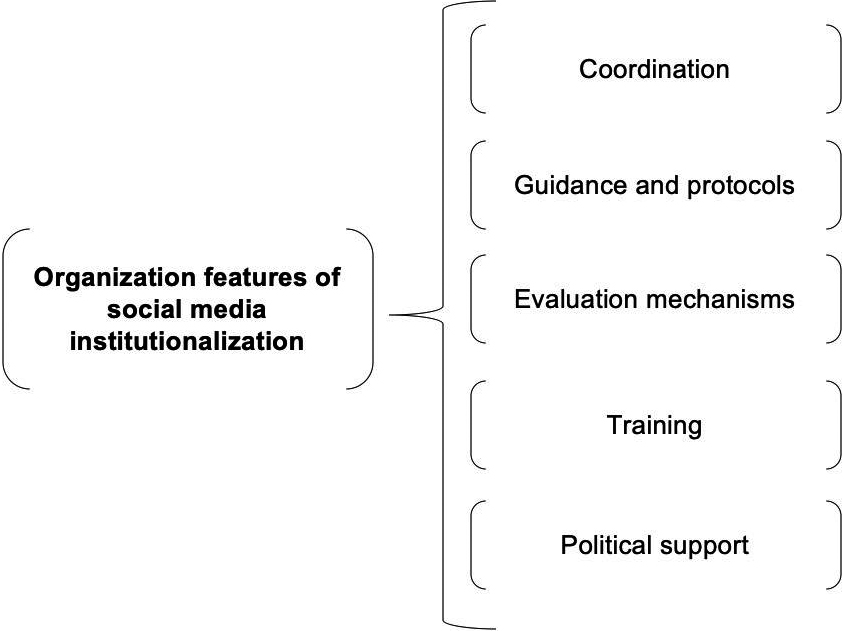
Social media institutionalization means that different visions of social media that initially coexisted or competed in the organization are integrated, or one dominant approach is selected. For this to occur, it is essential that some control is exercised. Coordination refers to how control occurs, how social media is organized, and which departments, units or groups lead this process (Criado et al., 2018; Mergel, 2016; Zheng, 2013). The most important part in terms of control is that there should be an optimal information flow in decision-making between departments and units (Zheng, 2013). Good coordination is also essential to integrate more complex uses of social media within the organization (Lee & Kwak, 2012).
Guidance and protocols
For institutionalization to take place, protocols and rules must be established within the organization. The most common form is the use of social media policy guides (Chen et al., 2016; Yi et al., 2013; Hrdinová et al., 2010). Social media policy guides are documents that may contain principles, procedures and guidance to be taken in the use of social media (Chen et al., 2016; Yi et al., 2013). These guides specify how a new social media account should be opened and maintained in a unit or department, how linguistic criteria should be managed, how the relationship with the citizen should be established, and what kind of recommendations should be followed for dynamization, among others.
Evaluation mechanisms
Once social media has been formalized, one of the ways that public administrations could have to check if objectives are being achieved is through evaluation mechanisms. The most common social media evaluation mechanism is the so called “performance evaluation”, which is related to the use of quantitative and qualitative metrics that check social media effects and usage (Chen et al., 2016). Another form of evaluation mechanism is “social media monitoring” (Loukis et al., 2017; Bekkers et al., 2013). These types of techniques aim to continuously analyze the contents and behaviors of the community that exist around the public organization, so that external knowledge can be extracted for the improvement of internal processes, policies and services.
Training
Social media institutionalization should imply appropriately trained public employees to fulfill their duties as “community managers”. Sometimes, this learning process could be formal, and it is given as part of a specific course or program within the organization (Zheng, 2013; Meijer & Thaens, 2013; Kavanaugh et al., 2012). It can also be part of an informal learning process pursued by the individual or group that coordinates social media activities within the public organization (Voß et al., 2018; Galanis et al., 2016). In any case, social media is in constant development, which probably requires a mixture of both perspectives.
Political support
The introduction and coordination of social media strategies must be accepted – or, at least, tolerated – by the political level for social media institutionalization to take place. Political leaders and policymakers usually want to play a leadership role in the implementation of social media strategies (Rodríguez-Bolivar & Alcaide, 2018). Public employees will always try to take steps with the support/consent of these leaders to guarantee a successful implementation (Criado et al., 2018; Criado et al., 2017). Without political support, it could be difficult to make modifications or changes to integrate social media practices into organizational routines.
These features will be used to analyze social media institutionalization across Dutch municipalities and select public administrations that have reached a high level of social media institutionalization. They will also serve to investigate how Dutch local governments have organized social media institutionalization. We offer more information about the construction of these variables in the methods section.
Methods
The purpose of this article is to understand how public administrations organize social media institutionalization. For doing so, we analyzed advanced practices of social media institutionalization of local governments in the Netherlands.1
There are three levels of government in the Netherlands: 1 national government, 12 provincial governments and 352 local governments. The number of local governments has been reduced drastically over the past decades by merging different towns, villages and cities in single local government entities which we refer to as municipalities.
Our research consists of two phases: (1) the identification of advanced cases and (2) the exploratory analysis of social media institutionalization in these cases. The first phase of the research aims at identifying Dutch local governments with a high level of social media institutionalization by studying organization features aggregately. The second phase comprises the analysis of the organizational features of local governments with a high degree of social media institutionalization. Here, we have selected two cities with the highest levels of social media institutionalization (Utrecht and Eindhoven), based on previous aggregated results, and analyzing their social media institutionalization patterns, we identify potential differences among them. This section explains these two research phases.
During the first research phase, we tried to get a broad view of social media institutionalization in Dutch municipalities, with the aim of identifying local governments with high level of social media institutionalization. For this purpose, we conducted an original questionnaire. The questionnaire consisted of 22 questions related to different topics on social media use by local governments, including utilization, risks and barriers, adoption, and institutionalization, among others. The questions encompassing the survey were informed by previous studies, such as Bailey’s and Singleton’s (2010) “National Survey of Social Media Use”, and Hrdinová et al. (2010) work. Also, it has been already used by some of the authors’ previous published research in other administrative contexts. For the design of the questionnaire, no filter questions were established and respondents had to go through all the questions (although they were not required to answer all of them).
The questionnaire was distributed during 2017 via e-mail to public officials in charge of the social media strategy for the selected municipalities. Data collection took place over the whole year, from January 2017 to December 2017. For gathering responses, we relied on Google Forms. Two researchers from the same institution worked on the gathering process, contacting public employees and managing the questionnaire responses.
Sample selection for the questionnaire took into account the size of the municipality. This design decision is consistent with the proposition that larger municipalities tend to have a greater capacity to introduce and use technologies. In that sense, and after a previous study of the local governments’ composition, the Dutch municipalities with more than 50,000 inhabitants that have created a profile on social media (mainly Twitter and Facebook) were selected. In total, 77 municipalities were incorporated as a part of the survey. We were able to obtain a response from 31 of them, achieving a response rate of 40%.
For this study we are only considering the survey questions related to the five social media organization features that have been specified in the previous section. Our objective was not just to obtain a general idea on how social media were being institutionalized, but also to identify cases in which the degree of institutionalization was already high. Table 1 shows the social media institutionalization features that were previously defined, and how they were operationalized in relation to our survey questions. Note that the initial nomenclatures (Q+number) refer to the position of the question inside the survey page.
Organization features of social media institutionalization and questionnaire variables
Organization features of social media institutionalization and questionnaire variables
Source: own elaboration.
To identify the municipalities with the highest scores in social media institutionalization, an original index was developed. This index measures the level of social media institutionalization of municipalities based on previous features and the corresponding questionnaire variables. Our index ranges from a value of “0” (social media has not been institutionalized within the organization) to “5” (social media is fully institutionalized within the organization). The index is based on previous attempts to measure the level of social media institutionalization (Villodre & Criado, 2020).
To design this index, some steps were carried out. Each of the questionnaire variables present in Table 1 received a unified weight (between 0 and 1). These values were assigned depending on the source variable. For Q17 (coordination) and Q12 (political support), which were originally based on a Likert scale (from 1 to 5), index weights were assigned in a phased manner, from least to greatest: “1”, corresponded with a weight of “0” in the index; “2”, corresponded with a weight of “0.25” in the index; “3”, corresponded with a weight of “0.5” in the index; “4”, with a weight of “0.75” in the index; and “5”, corresponded with a full point “1” in the index. For Q4 (evaluation mechanisms) and Q11 (training), based on dichotomous values (1-Yes, 2; No), weights were assigned as a full point “1” in the index when the value was “1, Yes” in the questionnaire, and no point “0”, when the value was “2, No” in the questionnaire. Finally, for Q3 (guidance and protocols), a value of “1” was assigned in the index when questionnaire value was “1, Yes”, and no point “0” was assigned in the index for the other options.
These results were processed using statistical software. Descriptive statistics with STATA (percentages, means, standard deviations, maximum and minimum) were used for the analysis of each of the variables that composed the index. To summarize the index, Microsoft Excel was used, which allowed classifying the index composition results and detecting the cases with the highest level of social media institutionalization. Based on these data, Utrecht and Eindhoven were selected as cases studies.
At this point, some limitations regarding the questions used in the study should be pointed out. As can be seen, some questions such as Q4 (evaluation mechanisms) and Q11 (social media training) offer few nuances about how the evaluation process and the social media training will occur. To highlight some differences and dig deeper in this regard, this study relies on the qualitative design that is presented below.
The second research phase entails the analysis of Dutch local governments with a high level of social media institutionalization. The objective of this phase is to explore different patterns of institutionalization. For doing so, our work conducts in depth semi-structured interviews for Utrecht and Eindhoven. Thanks to the interviews we have been able to delve into the social media institutionalization process of these two cases to further investigate questionnaire responses in relation to our social media institutionalization features.
The interviews followed the chain sampling technique (Guest et al., 2006): first interviewees recommended other relevant public officials in charge of social media managers. In total, six in-depth interviews were conducted: three in Utrecht and three in Eindhoven. The interviews were targeted at public employees responsible for social media strategy as well as at some public employees in charge of daily social media management and were carried out throughout November 2017. Although it may seem a small number of interviews for two large cities, the interviews entailed the staff that had been directly involved in the social media adoption and institutionalization process. Hence, they have been able to provide us with a privileged vision in relation to each of the social media institutionalization features.
The interviews contained a total of 15 questions about social media adoption and institutionalization patterns in the public sector. The interview protocol was inspired by the work of Gil-García (2012), linked to the study of e-government. It was adapted by the authors to the concrete study of social media. For this article we have selected only those questions related to the process of social media institutionalization. Table 2 shows the relationship between the organization features of social media institutionalization and the interviews questions/topic list.
Organization features of social media institutionalization and guiding questions for interviews
Organization features of social media institutionalization and guiding questions for interviews
Source: own elaboration.
The interviews were recorded in English and manually transcribed by the researchers. For its analysis, no specific software was used. Coding was primarily based on the social media institutionalization features described during the literature review. The information obtained in the interviews for both cases has allowed us to develop two different models/types of social media institutionalization, which are presented in the discussion section.
In this section we present the results of our study. These results are shown following the research phase scheme specified during the methods section. Firstly, we review the aggregate institutionalization indicators for the 31 Dutch municipalities that responded to the social media adoption questionnaire, in relation to the organization features of social media institutionalization. Secondly, we study specific social media institutionalization patterns for Utrecht and Eindhoven to develop an understanding of different models of social media institutionalization.
Social media institutionalization in Dutch local governments
During the first research phase, our aim was to measure the level of social media institutionalization in Dutch municipalities. We present these results based on the organization features of social media institutionalization and its associated variables in the questionnaire. Table 3 shows some descriptive statistics for the 31 Dutch municipalities that answered our questionnaire.
Statistics for questionnaire results on social media institutionalization (based on 31 Dutch city councils)
Statistics for questionnaire results on social media institutionalization (based on 31 Dutch city councils)
Source: own elaboration.
A first feature refers to how social media coordination is taking place inside the local government and how this is perceived by public managers. On the one hand, Dutch local governments share a decentralized style for social media management: many municipalities responded that a variety of departments or all departments are involved in the coordination of social media (54.8% of cases and 12.9%, respectively). However, a second logic is observed: another part of the municipalities seems to have adopted a more centralized perspective. This coordination would be mainly carried out by the communication departments (32.2%). This communication-oriented perspective is consistent with previous studies highlighting the strong orientation of social media towards institutional communication and public marketing (DePaula et al., 2018; Criado et al., 2018; Bonsón et al., 2015). On the other hand, public managers seem to perceive that the development of social media in their organizations is relatively high (an average of 3.5 on the Likert scale). This may imply that they feel that social media management and coordination is being carried out appropriately. Or that, at least, it is being carried out in the best possible way, so that social media adapts to the organization’s needs.
A second organization feature refers to the presence of guides and protocols that standardize the use of social media in the organization. More than half of the Dutch municipalities that responded to the questionnaire (54.8% of the sample) claim to have developed social media policy guides. And, therefore, they have deployed one of the fundamental instruments detected by the literature for social media institutionalization. Furthermore, 19.3% of the cases indicated that, although they did not have guidelines at the time of responding, they were planning to develop them soon. However, a relatively high number of municipalities indicated not having this type of documents (25.8%), with no apparent intention for developing them.
In relation to the presence of mechanisms to evaluate social media results, and the existence of training on social media, results are quite clear. A broad majority of our sample claimed to have institutionalized the use of mechanisms to measure social media results (90.3% of the municipalities that responded to our survey), relying on internal platform functionalities and even on external software. This implies that these public administrations are concerned with evaluating their performance in the use of social media, and that they will probably use these results to improve their social media strategy or the public services it affects. On the other hand, a large majority of surveyed public managers in charge of social media declared that some type of social media training has been offered in their organizations (93.5% of cases). Thus, they are more prepared to face and adapt to the capabilities and opportunities of these technologies.
Our final organization feature for social media institutionalization, political support, presents more moderated levels. On average, survey results showed that the perception of leadership has a mean of 3.3 (on a Likert scale). This implies that an important part of city councils has some tacit or explicit support for the adoption and institutionalization of social media, which probably reduces the difficulties to institutionalize these platforms.
In short, we are dealing with local governments that have advanced enough in the adoption process to achieve social media institutionalization. Our institutionalization index shows an average score of 3.5, which reflects a medium-high level of institutionalization within this group of cities. We selected two cases in the cities of Utrecht (4.2/5 points on the institutionalization index) and Eindhoven (4.7/5 points on the institutionalization index), for their high level of social media institutionalization (according to our index), to explore the organizational models.
Starting with the “coordination” feature, Utrecht seems to be moving towards a more centralized strategy. The interviewees suggested that an effort was taking place to centralize social media management around the communication department. This department oversaw coordinating the digital strategy, commanding the institutionalization process across departments. In the same way, the communication department would oversee approving content and verifying that the organization’s strategy is consistent. As one of the interviewees comments:
“We are now in a transition as an organization to make sure we will do that from only one department in the future, so that means that all project managers of any kind of projects, whether is housing or something else, will first have to go through the communication department to check the content that will be put on social media” (Interview 2).
In relation to the second organizational feature for social media institutionalization, “guidance and protocols”, Utrecht has developed a formalized social media policy guide, which specifies a variety of protocols for social media management. The interviewees put a special focus on privacy regulation and data protection. Here, after the training and the establishment of the digital strategy, the level of experimentation of public employees in charge of social media have dropped significantly, as a part of an effort to avoid a communication crisis.
The third organization feature is the presence of mechanisms for measuring and evaluating social media results. Utrecht has established an external tool for managing these processes called “Obi4wan”. Through this software, an analyst checks social media usage metrics. This social media monitoring occurs in relation to received mentions and open interactions with citizens. This allows the city council to establish response priorities. As one of the interviewees explains:
“We use a program that is called obi4wan and it will provide us all the messages that are sent to the City of Utrecht whether is on Twitter, Facebook or Whatsapp. It actually checks the urgencies of the messages, if there was an incident because it was cold and slippery on the road that’s the first thing we will respond to, instead of to somebody who says: “well my garbage hasn’t been picked up today”. We are in close contact with the analyst, the person in the Newsroom who checks what is going on with messages and checks also what the advertisements of the City of Utrecht are doing on Facebook, whether they are being shared, how many times they are being shared” (Interview 2).
As a result, an evaluation report based on standardized metrics is regularly generated and presented to the rest of the organization. This report allows the organization to have an idea on how the digital strategy is being deployed and make necessary adjustments. As one of the interviewees comments:
“In the report we can see how many answers the Webcare has given to the citizens, on what device: was it on Twitter, Facebook or Whatsapp; how many interactions, the time and you can see when are the most questions: was it in the morning, in the afternoon or in the evening. And we are working in the evening because we were thinking that it was important not to stop at 5 in the afternoon, but to work until 9 because most of the people in Twitter, specially, are tweeting in the evening” (Interview 1).
One of the initial concerns in Utrecht when social media institutionalization began was training public employees. Interviewees disclosed that public employees who were managing digital profiles or wanted to open a social media profile for their department did not know how to properly manage these platforms. As a result, an important emphasis was placed on initiating a formal internal training process for public employees, so that they would know how to use social media according to the organization needs:
“But the first thing we did were about the platforms and the strategy, training other colleagues how to use social media, because a lot of our colleagues didn’t have a clue what to do, what platforms our department was active on, so that was the first year and a half” (Interview 3).
Finally, the last feature of social media institutionalization refers to political support. Although the political level has been critical with the social media strategies deployed by the city council (specially with the ones focused on stablishing direct citizen interaction), it has given public employees the freedom to develop the digital strategy without posing great difficulties. This is so because political leaders have considered that the civil servants had a remarkable professional experience. Therefore, they have placed their trust in them. As one of the interviewees indicates:
“They don’t interfere on how we do it, or on which platforms we are active on, which tone we use, we all decide for ourselves, they say you are the expert on this one, so you decide what the city needs” (Interview 3).
The case of Eindhoven
Eindhoven also showed high levels of social media institutionalization. However, the institutionalization process seems to have occurred in a different way in comparison to the case of Utrecht. Regarding the first feature of social media institutionalization, Eindhoven stands out for having developed a more distributed model of coordination. Here it does not seem to be a department that governs the strategy for the use of social media in the organization. Rather, decision-making is “distributed” among different actors across the city government structure. These actors are part of a specific team created to manage social media. They make decisions regarding social media in a joint manner, guided by a peer logic. As one of the interviewees says:
“There is no leader. When we have questions, when we are in doubts, “how should I do it?” we talk to each other and there is no one who makes the decision, we do it as a group. […] Since a couple of months we have a special team sitting together, the media team […] We sit together and we look at what the news are, what are we gonna put out, on which channels we will put it out. So it’s a daily team that talks about what’s in the news, what are we gonna do and how are we gonna do it” (Interview 4).
In relation to the guides and protocols, Eindhoven has also developed its own internal policy guides. However, this guidance is based on a series of “guiding principles” that should govern the daily use of social media. That is, this guide does not specify precisely how the profiles should be managed. But it gives “general” patterns for social media use. All this allows public employees to maintain a high degree of experimentation when using these platforms, allowing them to better adapt to technological changes. As one of the interviewees claims:
“Our guidelines: we are not insulting. So, we have some regulation we put on our Facebook page and we respect those as well. And I have a lot of colleagues here to help me if I find it difficult to write something or if I am having doubts, can I do this? I also find important to experiment a bit because you are having conversation with someone you don’t see, you don’t know, you don’t know what their feelings are, how they are going to react to what you are answering, people think of it as: I have a problem you have to help me, so you better be kind to me and I will, but you have to be kind as well, it’s a matter of respect” (Interview 6).
Other differences can be seen with respect to Utrecht in relation to the mechanisms for evaluating social media results. The interviewees informed us that they have been using a specific software called “Coosto”. Using this software, they can do several things, ranging from posting to generating different usage metrics. Sometimes reports are generated for the political level. However, in most cases, a general formalized report is not shared within the organization, and evaluation becomes a more “individual” activity. These types of statistics help public employees to know more about social media results, as a part of trial-error learning process:
“We have statistics because we have a piece of software to manage all the accounts; […] It’s called Coosto, it has been developed here. […] It’s for everything, it’s also my writer, I can see messages, people write on the website, if they don’t address us directly but they mention city of Eindhoven I can read it and think: oh I have to react to that or not. Just to be informed about it, some monitoring servers as well but also statistics. In a way of statistics, we do have them and I do once in a while, see that, I just want … to know if the lines are going up, it’s not like I am doing scientific research, for me it’s more like try error more than scientific approach to the statistic we have” (Interview 6).
Training on social media also seems to be different. In Eindhoven, the learning process on how to use social media appears to be informal. Learning takes place in some sort of trial-error process, which allows the organization to accumulate knowledge cooperatively. Public managers are constantly testing each platform’s affordances. And they even teach each other based on what they have learnt. In other words, public employees “learn by doing”. As one of the interviewees points out:
“We had so much freedom in experimenting on social media and we always, we have a lot of discussion between the two of us about how to do it. We learnt by doing it, especially on Facebook, we learnt what type of the content worked very well and what type of content did not work at all. […] So, it is this kind of experience and doing and then you get experienced colleague, and we can advise other people” (Interview 4).
Finally, as in the case of Utrecht, the institutionalization of social media has received strong political support. In Eindhoven this support has been based, in part, on trust. But it has had some kind of “control” component, as certain political figures were involved within the social media team, such as the spokesman or an alderman. In the same way, they make certain specific reports for decision-makers on how the strategy is going on.
Organizational models of social media institutionalization
Organizational models of social media institutionalization
Source: own elaboration.
Our survey results and interviews for the two case studies have allowed us to identify two different patterns of social media institutionalization. In this section, we detail both models and we discuss their contribution to the study of social media institutionalization in the public sector. These models are summarized in Table 4.
The first pattern (model 1) that we have extracted from results is a “centralized” model of institutionalization. In this type of institutionalization, the public organization decides to centralize the coordination of social media in a single department, which acts as the center of the social media strategy. In the case of Utrecht, this department is the communication department. Coordination is based on “top-down” decision-making flows, where the central department or unit informs the rest of the organization on how to act in each situation. Quite linked to this could be the strong preference towards formal regulation. This implies the development of detailed social media policy guides, which usually specify objectives, protocols to request new initiatives and digital profiles, rules for citizen interaction, linguistic criteria, data protection and privacy regulations, as well as a detailed way of managing social media filtered by platform and situations. This can dramatically reduce the level of experimentation of public employees with these platforms. Within this model, there is usually a strong focus on formal learning. This learning usually occurs through formal courses. The model incorporates a collectivist view for the evaluation and monitoring of social media results, with standardized reports that inform the departments on how they are performing on these platforms. Finally, political support is medium-high, and is fundamentally based on trust: the political level trusts the professionalism of the public manager as an expert trained social media manager and communicator. This trust can be closely linked to the fact that social media coordination is primarily situated in communication departments, usually close to political appointees.
A second pattern (model 2) can be seen as a more “distributed” approach. Unlike the previous one, coordination is mostly decentralized. The team that coordinates social media management and strategy is usually inter-departmental, forming a specific team for daily management and problem solving based on more informal relationships. The decision-making flow is peer-to-peer and tends to be transversal to the entire organization, distributing power among different actors. This philosophy is also related to the presence of social media policy guides that are usually based on guiding principles. The fact that public employees are guided by generic principles can generate higher levels of experimentation and innovation within technology, which may favor greater adaptation in changing organizational and technological contexts. The orientation of social media training is more informal, based on an “learn by doing” basis: public employees test what works and what does not base on trial and error. Unfortunately, this can increase the likelihood of communication crises in the organization. On the other hand, this model incorporates a more individualized view of the evaluation of social media results, which is linked to the individual learning process of each public employee. Regarding political support, this is usually high and based on control: the team in charge of social media strategy may include politically trusted staff or even politicians, which may get involved in social media decision-making processes. Likewise, the political level can demand accountability from public employees in charge of social media through individual reports around specific strategic topics or concrete messages sent through social media platforms.
A key finding is that our research suggests that a decentralized model is not, as Mergel and Bretschneider (2013) argue, an immature stage of the adoption process of social media which will eventually, in the phase of institutionalization, result in a centralized organizational model. The case of Eindhoven shows that this local government has a concrete digital strategy and protocols-rules that have routinized the use of social media inside the organization. Eindhoven scores high compared to other local governments in the Netherlands and even has an institutionalization score that is higher than Utrecht on the five organizational features. These findings thus provide support for Mergel’s (2016: 144–145) indication that there can also be a decentralized model of institutionalization. Our contribution shows that once local governments have reached the stage in which social media has been integrated into the routines of the organization different paths can be developed: a decentralized model can therefore also be a model for institutionalizing the usage of social media in local government.
Theoretically, the development of these two organizational models of social media institutionalization paths validates our assumption that social media institutionalization may take place in different ways. Even if social media adoption occurs in a phased, staged manner (Bretschneider & Parker, 2016; Mergel & Bretschneider, 2013), the reality is that each stage can lead to a great myriad of results. Having a high level of social media institutionalization does not necessarily imply the same model social media management. These findings confirm that there is no “one-best way” to institutionalize social media, supporting the criticisms shown towards some of these models (Bannister, 2007). Our study reveals at least two different pathways. Although potentially there could be even more, considering the limitations of our study that we present in the conclusions.
The consideration of these two models may have practical implications for public officials in charge of coordinating the social media strategy. Firstly, an understanding on how social media institutionalization works could help public officials to make adequate decisions, leading to the promotion of a formalization process that fits organizational needs. For instance, it might help considering whether it is necessary to create a specialized group to coordinate social media or to determine how different administrative units will be involved in the social media strategy, among many other decisions. Secondly, appropriate knowledge of the organizational features for social media institutionalization might support public officials to prevent some risks associated with the use of social media and to take advantage of its affordances. Finally, it can guide public officials to identify flaws in the institutionalization process and address them by fostering certain features. For example, it can be useful for detecting problems related to employees’ skills, allowing decision makers to promote a concrete training model.
Conclusions
This article has focused on explaining how public administrations organize social media institutionalization. For doing so, the article is based on the study of social media institutionalization patterns on Dutch local governments (using a survey used in the largest city councils), and with the case studies of Utrecht and Eindhoven (using semi-structured interviews). Our exploratory study has resulted in the identification of two different patterns of social media institutionalization: a centralized model with highly structured and formalized policy guides, low degree of experimentation, formal training and evaluation supported by standardized reports and with political support based on trust; and a distributed model, with simple guiding principles, higher degree of experimentation, training build on informal “learn by doing” basis, individual evaluation mechanisms and with political support based on control.
The formulation of these models result from exploratory research in a specific administrative context. They do not pretend to represent all possible organizational models but in view of their ideal-typical character, they can be of great help to understand a particular phenomenon. In that sense, the categorization shown in this article should not be understood as exhaustive nor is it intended to identify whether one model is better than another. The value of these models lies in their potential to study reality by reducing complexity and generating new ideas. In this sense, it is likely that future studies might find hybrid models that combine some of the features of social media institutionalization that we have discussed.
A limitation of our exploratory study is that social media institutionalization has only been investigated in one specific country. Our models have been drawn from a political context and a specific administrative tradition and therefore additional research is needed to check whether these two organizational models of social media institutionalization are reproduced in other countries with different political-administrative situations.
This article has intended to identify varieties of social media institutionalization and to confirm the surmise about the existence of different patterns in these processes. Future research should evaluate what factors could affect institutionalization results and organizations decisions to opt for different models of social media institutionalization.