



Abstract
Given the various benefits of social media for governments, municipalities are increasingly attempting to institutionalize their use of social media. This article looks at the use of middleware that is observed on municipal Twitter accounts in Dutch municipalities in 2018 and 2021 (
Keywords
Introduction
Social media has the potential to improve public sector information dissemination, interaction, transactions, and government process transformation (Mergel, 2012). Given these possibilities, the past decade has seen a growth in efforts to structurally embed social media in government (Criado & Villodre, 2022; Mergel, 2016). Recent years have seen more scholarly attention paid to the process of institutionalizing social media use (Bretschneider & Parker, 2016; Criado & Villodre, 2022; Villodre et al., 2021).
The adoption and use of social media in local government has received a lot of attention. At the same time, it is worth noting that the features, architecture, and affordances of social media platforms are not well-studied (see e.g., Medaglia & Zheng, 2017). Aside from that, most research is based on small samples and is limited to cities and densely populated areas, as well as cities known for their innovative practices (Manoharan & Ingrams, 2018). Finally, while research into the factors associated with social media institutionalization is ongoing (Criado & Villodre, 2022), to the best of our knowledge, no research into factors associated with municipal adaption for specific forms of social media institutionalization, such as distributed and centralized models, exists (Villodre et al., 2021).
This article proposes to measure the models of social media institutionalization by looking at the use of Twitter by all Dutch municipalities that had an account on the platform in 2018 and 2021. Building on recent insights into social media institutionalization in local government (Villodre et al., 2021) it studies the factors associated with three models of social media institutionalization: informal experimentation, centralization, and distribution. Twitter’s database interactions are enabled and managed by middleware, utilities “used to post a Tweet” (Twitter, 2022) that specify input and output modalities (Gerlitz & Rieder, 2018). Although Twitter only captures a part of our social media ecology, it provides a particularly suitable context for this analysis, as its API is open to third-party development, allowing for a great variety of applications and clients that are observable for every tweet that is sent (Makice, 2009). As the types of middleware used on Twitter could tell us more about the inner workings of social media institutionalization in the municipality, we look at patterns and developments in the use of various types of middleware by municipalities.
This article is structured as follows. A set of research questions is developed after an overview of the relevant literature. The research questions are followed by a description of the materials and methods used in order to address the research questions, and the research findings are addressed in the results section. Finally, the discussion and conclusion reflect on the most relevant empirical findings, theoretical and practical implications, limitations of the study and suggestions for future research.
Literature review
Social media institutionalization
Social media platforms are increasingly being used by public-sector organizations around the world for stakeholder communication and service delivery (Sb, Rose, & Flak, 2008; Steinbach & Süß, 2018).Specifically, in the context of municipalities, social media such as Twitter have proven to be an important communication tool for government-related issues and responding to stakeholder needs (see e.g., Bonsón et al., 2020).
Because of the increased and intensified use of social media by public organizations, scholarly attention has shifted in recent years to the process of institutionalizing social media use (Bretschneider & Parker, 2016; Mergel, 2012; Mergel & Bretschneider, 2013).Institutionalization within organizations can be seen as a set of practices, rules, routines, and processes to improve their legitimacy (March & Olsen, 1996). Institutional and organizational factors are considered important in the process of embedding and structuring social media use into government (Criado et al., 2017; Gil-García, 2012). As a result, social media institutionalization is frequently regarded as the most advanced stage of social media adoption and use in government organizations (Criado & Villodre, 2022).
Mergel (2012) provides an early description of the general social media institutionalization process in public organizations. This starts with several social media initiatives, born out of an open innovation approach and early experimentation by government agencies. After this, so-called intrapreneurs create accounts on social networking platforms outside of the formal ICT infrastructure (Ibid.). This is followed by social media policies and guidelines being created, retroactively correcting for unsanctioned innovations.
Several authors (Bretschneider & Parker, 2016; Mergel & Bretschneider, 2013) further developed these concepts and formulated three stages for social media institutionalization in public organizations. The first stage is referred to as intrapreneurship and experimentation and is based on the idea that a group of entrepreneurial government employees will introduce social media into their units based on their personal perceptions and visions of the benefits of these technologies to the organization (Mergel & Bretschneider, 2013). As it is relatively easy for public agencies to open social media profiles (Wukich, 2021), this suggests a low threshold for public organizations to enter this stage.
This stage is followed by order from chaos: multiple visions on social media may have developed throughout the organization during the informal experimentation processes (Mergel & Bretschneider, 2013). Because social media usage is not standardized, it leads to a variety of approaches to reaching out to audiences, as well as potential conflicts as a result of the various methods of disseminating information. This stage resembles Steinbach & Süß’s (2018) finding that social media innovation in public sector organizations is characterized by an ongoing struggle in which reform logics related to social media are layered on top of the strongly institutionalized bureaucratic-legalistic logic.
Third, the institutionalization and consolidation of behaviors and norms stage refers to the point at which social media has been “institutionalized” within the public sector, entailing that there is a formal decision to gradually integrate social media into organizational routines and procedures (Mergel, 2016).
At the same time, there are several driving forces and barriers to this process. In their literature review, Falco & Kleinhans (2018) observed various challenges for municipalities in using digital platforms for citizen engagement. They grouped these challenges into three main aspects: technological, organizational, and contextual. Criado & Villodre (2022) recently described a constellation of factors that could be important in the context of institutionalizing social media in the public sector, including social media policy normalization, political leadership, perceived leadership from political appointees, social media training, evaluation mechanisms, and self-perception of social media development.
Patterns of social media institutionalization
Social media institutionalization occurs within existing power structures and institutional arrangements that are complex (Savoldelli et al., 2014; van Duivenboden & Thaens, 2008). In line with this, Villodre et al. (2021) claim that a linear view of social media institutionalization would not correspond with the variety of uses and ways of managing social media that are being developed by public administrations (see also DePaula et al., 2018; Edlins & Brainard, 2016; Bonsón et al., 2015; Meijer & Thaens, 2013; Wukich, 2021).
In their study of social media institutionalization in Dutch municipalities, Villodre et al. (2021) conducted a qualitative analysis of two more advanced cases. Based on the results, they propose that the social media institutionalization process in public organizations could result in two models. They describe the first as a centralized institutionalization model, in which a public organization decides to centralize social media coordination in a single department, such as the communication department, which serves as the social media strategy’s focal point. The strong preference for formal regulation could be linked to this. This necessitates the creation of detailed social media policy guides. In this model, formal learning is usually emphasized heavily. It also includes a collectivist perspective for evaluating and monitoring social media results, as well as standardized reports that inform departments about their performance on these platforms.
Secondly, Villodre et al. (2021) propose the distributed model. Most coordination in this model happens on a decentralized basis. The team that coordinates social media management and strategy is usually cross-functional, with a dedicated team for day-to-day management and problem-solving based on more informal relationships. The decision-making flow is peer-to-peer and tends to be cross-organizational, distributing power among various actors. This philosophy is also linked to the existence of social media policy guides, which are typically built around guiding principles. The fact that government employees are guided by generic principles can lead to more technological experimentation and innovation, which could lead to greater adaptability in changing organizational and technological contexts. The focus of social media training is more informal, with a “learning by doing” approach in which government employees test what works and what doesn’t through trial and error. Unfortunately, this can increase the likelihood of organizational communication crises. This model, on the other hand, incorporates a more individualized approach to evaluating social media results, which is linked to each public employee’s individual learning process.
More and more empirical studies are being conducted on public sector social media institutionalization (see e.g., Criado, Rojas-Martín, & Gil-García, 2017; Criado & Villodre, 2022; Mergel, 2016; Villodre et al., 2021). As cities and densely populated areas are commonly viewed as e-government adoption centers (Manoharan & Ingrams, 2018), most research is concentrated on this area, as well as on cities specifically known for their innovative praxis. Although early adopters can be decisive for the successful introduction of a new technology (Rogers, 1983), assessing institutionalization more comprehensively could provide insight into nation-wide adoption and use of social media. Furthermore, while there is research into the factors that contribute to social media institutionalization (Criado & Villodre, 2022), no studies that use quantitative analysis of empirical data to examine the factors that contribute to municipal adaptation for specific types of social media institutionalization, such as distributed and centralized models (Villodre et al., 2021).
Twitter middleware as a lens for social media institutionalization
In the past decade, the adoption and use of Twitter in local government has been extensively researched. At the same time, it has been observed that the features, architecture, and affordances of social media platforms are under-researched (see e.g., Medaglia & Zheng, 2017). The use of analytics tools must therefore be studied, as well as the practices and discourses that influence or are likely to influence it. In the context of information architecture, Gerlitz & Rieder (2018) have proposed a new research approach in which they look at middleware on Twitter. They describe Twitter as a central database that defines several entities (e.g., users and tweets), their properties (e.g., a tweet has an ID, some text, and a post date), certain relationships between them (e.g., users post tweets), and a set of possible actions (e.g., writing tweets, following accounts). All database interactions within Twitter are enabled and governed by middleware, which provides a set of APIs that define input and output modalities (see also Bakken, 2001). Users interact with the platform through a variety of interfaces that use these APIs to read, write, or both read and write tweets from the backend (Gerlitz & Rieder, 2018).
In this respect, literature from various contexts has discerned at least four types of middleware on Twitter. Basic web clients denote the most widespread, general, public-oriented middleware, mostly for individual use (Gerlitz & Rieder, 2018). Mobile clients such as Twitter for Android are middleware intended for use on mobile phones and similarly, mostly for individual and personal use (Gerlitz & Rieder, 2018; Han et al., 2017). Furthermore, two groups of middleware can be observed that are designed specifically with the aim of customer relationship management (CRM), the process in which organizations administer interactions with customers (Castronovo & Huang, 2012). Free CRM tools such as Tweetdeck, Hootsuite, and Echofon are dedicated clients that are generally free of charge. They allow multiple employees to take on the task of updating the Twitter feed (Sump-Crethar, 2012). Additionally, Paid CRM tools such as Coosto and OBI4WAN are tailored, mostly subscription-based tools for online media monitoring, webcare, data analysis, social analytics, and content publishing (Versteegh, 2019; Villodre et al., 2021). These services are commonly not free of charge, and they provide an integrated overview of social media messaging, together with other online sources.
As Fountain (2006, p. 7) emphasizes, it is crucial to distinguish between “objective technology,” or “the way that hardware, software, telecommunication, and other material systems …exist apart from the ways in which people use them,” and “enacted technology,” or “the way that a system is actually used by actors in an organization.” Therefore, taking inspiration from Lee & Kwak (2012), one earlier study (Faber et al., 2019) suggested looking at the use of Twitter middleware through the Open Government Maturity Model and suggested a three-stage process that moved from basic Twitter clients through generic Twitter management tools toward specialized social media management tools. However, as argued before, the assumed linearity of such an approach fails to account for the multitude of possible approaches and stances by public organizations towards social media use and institutionalization.
Building on recent insights into social media institutionalization (Bretschneider & Parker, 2016; Villodre et al., 2021), we propose that middleware could form an adequate proxy to study the factors that could be associated with the three models of social media institutionalization: informal experimentation, centralization, and distribution. First, the informal experimentation model1
Villodre et al. (2021) only provide a detailed address of the centralized and distributed models of social media institution. Taking inspiration from the first phase of institutionalization as described by Bretschneider & Parker (2016), we consider this as a separate model that could be discerned through the lens of Twitter middleware.
Second, in the centralized model, social media coordination is generally centralized in a single department, such as the communication department (Villodre et al., 2021). It also includes a collectivist perspective for evaluating and monitoring social media results, as well as standardized reports that inform departments about their performance on these platforms. We argue that in the centralized model, municipalities will predominantly make use of paid CRM tools for their Twitter communication. Developed mostly in a corporate context (van Es et al., 2021) and also mostly deployed in communication departments (van Noort et al., 2015), these tools provide the ability to respond to messages (which in a corporate context is frequently described as webcare), but also provide functionalities to analyze social media messages (Versteegh, 2019).
Finally, in the distributed model of social media institutionalization, the decision-making flow tends to be cross-organizational and distributed among various actors (Villodre et al., 2021). This is somewhat related to Bretschneider & Parker’s (2016) description of order from chaos. They describe how multiple visions on social media may have developed throughout the organization while still experimenting, leading to a variety of approaches for stakeholder communication. Looking at Twitter middleware, we argue that the distributed model could be observed when municipalities use a larger number of different types of middleware on a municipal Twitter account. The use of many different clients would then suggest the assumed variety of approaches within the municipality, as well as the lack of one social media hub, as is the case in the centralized model.
As there is not much known about the use of middleware by Dutch municipalities on social media, the empirical section is aimed at exploring the middleware landscape, guided by the following research questions (RQs):
How is Twitter middleware being used by Dutch municipalities? How has Twitter middleware use by Dutch municipalities changed between 2018 and 2021? Which technological, organizational, and contextual factors are associated with types of middleware use in Dutch municipalities?
In order to answer RQ3, some of the factors that could influence social media institutionalization process in municipalities are discussed below. In line with Falco & Kleinhans’ (2018) observation that researchers should look beyond technology to find the root causes of limited or ineffective local government initiatives in social media use, we also take into consideration some organizational and contextual factors (see also Criado & Villodre, 2022; Picazo-Vela et al., 2012).
With the increasing importance of digitalization of government and the growing requirements for municipalities on the plane of ICT implementation, it is important for municipalities to keep up with new technologies (Budding et al., 2018). However, the complexity and high speed of technological change are an important challenge (Falco & Kleinhans, 2018). The centralized and distributed MSMI both suggest that at least some degree of technological advancement is required (Villodre et al., 2021). However, path dependence and soft determinism theory suggest that “one historical event did not rigidly prescribe certain subsequent technological developments, but at least made sequences of technological improvements in one direction easier” (Rosenberg, 1994). In our context, it could be argued that as soon as social media policy is centralized within the organization, this might limit the organization’s ability to adapt to newer forms of technological change. Therefore, we only expect to find a relationship between a distributed MSMI and the advancement of digitalization.
Organizational factors
Resource mobilization theory suggests that the availability of resources could be associated with municipalities to advance the social media institutionalization process (McCarthy & Zald, 1977; Nah & Saxton, 2013). Authors have suggested that although creating social media accounts is free of charge, effective management and monitoring of those accounts necessitates time and well-trained employees, emphasizing the need for resources to make proper use of social media (Edlins & Brainard, 2016; Faber et al.
Research suggests that municipalities that operate a social media account for a longer time tend to exploit its interactive functions (Faber et al., 2020), and more experienced social media users apply stakeholder differentiation in their messaging (Andersson & Wikstrom, 2017). Given prior (positive) experiences with social media, this might also lower the managerial threshold to invest in social media institutionalization in terms of capacity and resources.
Contextual factors
There is a long-standing tradition that there is a link between organizational size and the ability to innovate (see e.g., Rogers, 1983). It serves as an indicator of impetuses for innovation, such as resources, technical expertise and information disclosure. Prior research in the field of e-government points in the same direction (Budding et al., 2018; Guillamón et al., 2016; Ruano De La Fuente, 2014). It is likely that a similar pattern could be observed with respect to social media institutionalization: smaller municipalities will be more likely to use informal experimentation MSMI, whereas larger municipalities are better equipped, and therefore more likely to have institutionalized their social media use.
Prior research suggests that municipal urbanization grade is related to e-government adoption (Ruano De La Fuente, 2014). In addition, urbanized municipalities are more likely to use social media than those in rural areas, as urban areas are said to have more engaged residents (Cassell & Mullaly, 2012; Gao & Lee, 2017). In our setting, we assume that less urbanized municipalities are more likely to be found with informal experimentation. Furthermore, for more densely populated municipalities, the intuition is that the centralization MSMI might be better suited than the distributed MSMI from an economy of scale standpoint, as it allows for more standardized work processes (Guillamón et al., 2016; Villodre et al., 2021).
As public organizations must be politically legitimate, this necessitates that they follow social norms regarding organizational structure and function (DiMaggio & Powell, 1983; Frumkin & Galaskiewicz, 2004). As stakeholders with a better socioeconomic position use the Internet more frequently and seek higher-quality public services, they might be more inclined to support ICT advances (Yera et al., 2020). Recent studies also show that sophisticated social media use is likely to be found in municipalities with a larger presence of people with higher education levels (see e.g., Faber et al., 2020; Gao & Lee, 2017; Metallo et al., 2020).
Because of their professional background, IT professionals may have more positive intentions towards using e-government services, as new innovations are easily compatible with their existing values, beliefs, experiences, and needs (see e.g., Bélanger & Carter, 2008; Detlor et al., 2013; Faber et al., 2020). IT professionals are already accustomed to using digital devices and incorporating technology into their daily routines. In our setting, it could be reasoned that a presence of more IT professionals among inhabitants lowers the threshold for municipalities to further institutionalize their social media.
Materials and method
This study was conducted on two years of analysis (2018 and 2021), and data was collected in two separate phases (May 2018 and December 2021).2
Social media data for the years between the phases of data collection (2019 and 2020) could not be retrieved retroactively. The business model of social media platforms such as Twitter is to build databases for business-oriented objectives, such as targeted advertising and population profiling. As a result, Twitter has restricted historical data access and use, and only provides a small portion of the current data (see also Sinott et al., 2021).
Based on the types of clients that were observed in the existing literature, middleware was initially subdivided into five groups (see Appendix A for a full list of the identified middleware and the assigned group):
Basic web clients. An example of this is the Twitter Web Client.
Mobile clients. Examples include Twitter for iPhone and Twitter for Android.
Free CRM tools. Examples include Tweetdeck, Hootsuite, and Echofon.
Paid CRM tools. Examples include Coosto and OBI4WAN.
Other. This means all remaining middleware that could not be assigned to the remaining groups.
This study assumes that Twitter middleware forms an adequate proxy to study three models of social media institutionalization: informal experimentation, centralization, and distribution. The primary middleware of a municipality is assumed to be the middleware from which the largest share of messages are sent by a municipality. The informal experimentation MSMI is evidenced by municipalities that primarily use Twitter’s Web client or mobile applications. In the centralized MSMI, municipalities are assumed to primarily make use of paid CRM. Assumptions for a distributed MSMI are made differently: this is evidenced by the use of a larger number of different middleware clients on a municipal Twitter account. Even if a municipality uses a larger variety of middleware clients, it is still possible that either the web and mobile clients or the paid CRM clients are primarily used by this municipality. Thus, there is some overlap between municipalities under the distributed model and municipalities under the models of informal experimentation and centralization.
To model heterogeneity among the two different years (2018 and 2021), logistic regressions with random effects were introduced (Cameron & Trivedi, 2010). Correlated binary data frequently occur in several fields of research (Larsen et al., 2000). In order to get the correct estimates and draw proper conclusions, this correlation must be incorporated in our model, justifying the choice for a random-effects model above OLS. Specifically for the distributive model, random-effects ordered logistic regressions were conducted. Likelihood-ratio tests confirmed that there was enough variability between the years to favor a random-effects ordered logistic regression over a standard ordered logit.3
The results of the likelihood-ratio tests are available on request.
The data for 2018 does not provide data if municipal use exceeds four types of middleware. Although the 2021 data allowed for more differentiation above 4 clients, this was incompatible with the 2018 data. Therefore, for both years the group ‘4 or more clients’ is considered the maximum number of clients.
Table 1 summarizes the research approach for the statistical analysis of social media institutionalization in Dutch municipalities.
Research approach for the statistical analysis of social media institutionalization
Before assessing the independent variables, it was ensured that data was available for both years of analysis (i.e., data for 2018 and data for 2021). Data for technological advancement and the share of overhead costs could be collected from the website waarstaatjegemeente.nl (VNG, 2021). In order to assess municipal technological advancement, a 7-point scale index was constructed that measured the municipal adoption of six ICT facilities that are offered at the national level. The six services that were used to formulate this index are MijnOverheid Berichtenbox (Personal mailbox for electronic messages from the government), Feedback BRP and Feedback HR (contact points for possible errors in the Registry of Persons and the Commercial Register), Digimelding (contact point for possible errors in several records), GovRoam (secure WiFi roaming service), and IPv6 (communications protocol providing an identification and location system for computers on networks and routing traffic across the Internet). Adoption of all six ICT facilities gives the municipality a score of 7, adoption of none gives a score of 1. Data for financial health (the level of debt per inhabitant per 1 January) was collected from the Ministry of Interior Affairs and Kingdom Relations (2021). Twitter longevity is expressed as the number of days since the registration of an account, offset to the first account registration of a municipality on Twitter. These datasets were also acquired using Foller.me (Khovshenin, 2021). Data for the contextual factors were retrieved from Statistics Netherlands (2021). Urbanization was operationalized as the number of inhabitants per km
Exploring the use of Twitter middleware by Dutch municipalities
Figure 1 provides the share of municipalities using specific types of middleware. This shows that the uptake of both basic web clients and mobile clients was large in 2018, and has even grown further in 2021, with almost 95.1% of all municipalities making use of the basic Twitter client and 84.7% using mobile clients. At the same time, paid CRM use has grown considerably (from 77.5% of the municipalities in 2018 to 84.7% in 2021), whereas the use of free CRM nearly halved in this timeframe: from 30.7% to 17.1%. Furthermore, the largest inflow in 2021 towards paid CRM appears to come from municipalities who before made use of the web and mobile clients (see Appendix B for an alluvial diagram of client use in 2018 and 2021).
Total share of municipalities using middleware in 2018 (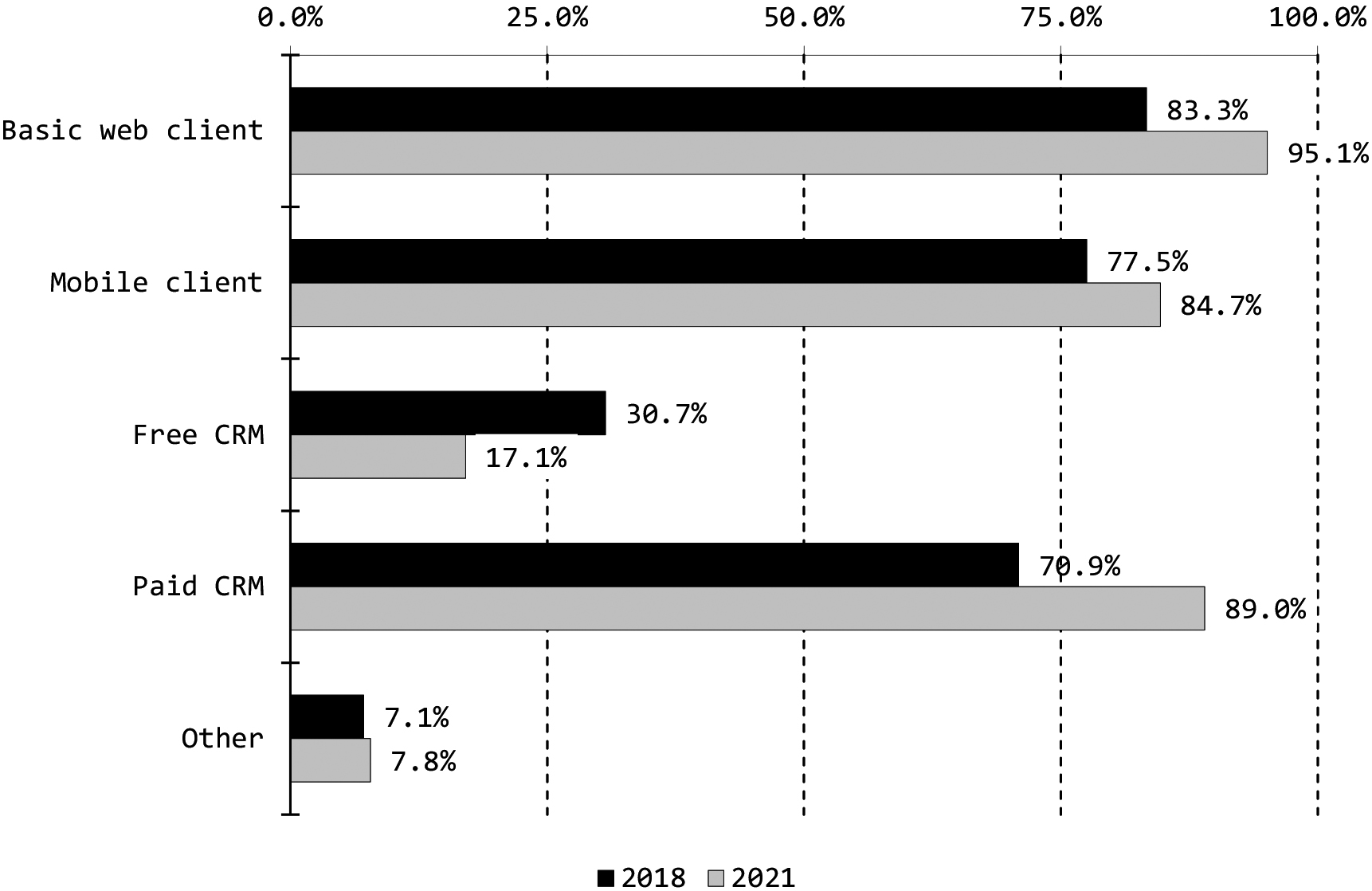
Next, Fig. 2 shows the absolute number of middleware clients used on Twitter by Dutch municipalities. In 2018, more than half (59.0%) of Dutch municipalities on Twitter were observed to use 4 or more types of middleware on their account, whereas this share dropped with 24.0% in 2021. In 2021, the largest proportion of municipalities uses 3 types of middleware for their Twitter account (48.6%).
Absolute number of different middleware clients used by municipalities in 2018 (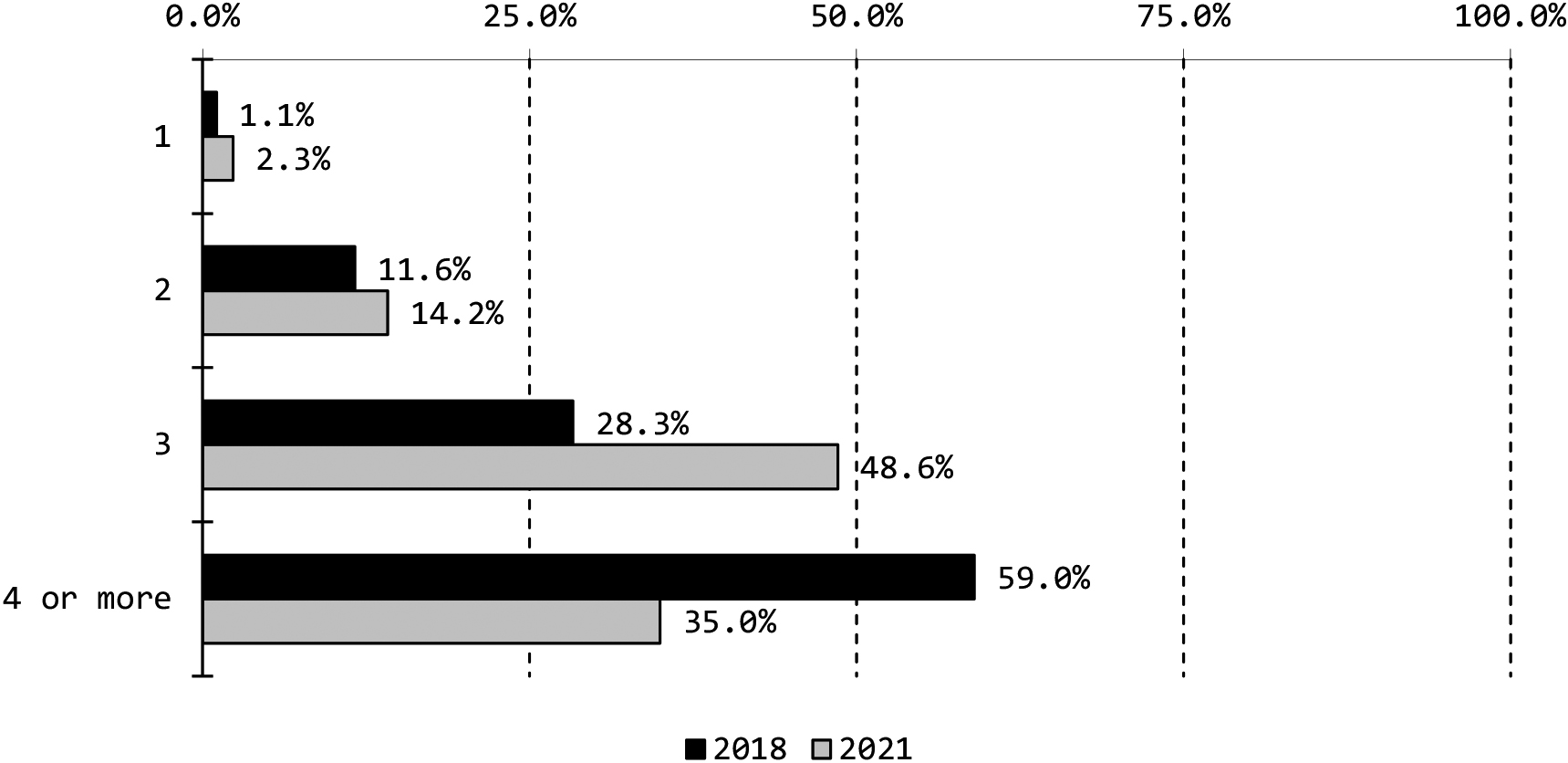
After this, Table 2, Panel A shows the types of middleware that are used by municipalities that primarily use BWC (i.e., assumed to belong to the informal experimentation model) and paid CRM (i.e., assumed to belong to the centralized model). Here we see again that the primary use of BWC has dropped slightly (from 32.5% to 27.7% of municipalities primarily using BWC), and paid CRM has grown (from 53.0% to 69.1% of municipalities primarily using paid CRM). At the same time, almost all municipalities using paid CRM are observed to continue their use of BWC, and the same counts for municipalities primarily use BWC. This suggest that for municipalities, the choice for one type of middleware or the other is not a question of either-or. Finally, Table 2, Panel B shows types of middleware broken down by the numbers of clients used by municipalities, as it is assumed that municipalities using a larger number of clients could belong to the distributed model. Although the number of municipalities using 4 or more clients drops in 2021, this provides further support that many municipalities are combining different middleware types. With respect to the overlap of the different types of middleware use, it should be noted that 34.0% (2018) and 26.1% (2021) of the municipalities with 4 or more clients primarily use BWC, and 54.4% (2018) and 70.2% (2021) primarily use paid CRM.
Total share of municipalities using middleware in 2018 (
Table 3 provides the descriptive statistics of the variables that were entered into the regression models.
Absolute number of different middleware clients used by municipalities in 2018 (
378) and 2021 (
346)
Absolute number of different middleware clients used by municipalities in 2018 (
All variables were tested for normality, which showed that the variables Overhead, Twitter longevity, Population size, Urbanization, and Higher education had to be converted into their natural log form. Table 4 presents the random-effects multinomial logistic regressions of primary middleware use.
Number and share of municipalities using types of middleware in 2018 (
The strongest effects were observed for population size in both models. Furthermore, strong effects were observed for IT professionals in municipalities primarily using paid CRM. A smaller negative effect was observed for IT professionals in municipalities primarily using BWC. No effects were found for the remaining variables.
Finally, Table 5 presents the random-effects ordered logistic regression for the number of Twitter middleware clients used by municipalities.
Descriptive statistics
A strong effect could be observed for technological advancement of the municipality. Additionally, a strong positive effect could be seen for population size and a negative effect for urbanization. The model shows no significance for the other variables.
This study was aimed at studying possible explanations for the adoption of various forms of social media institutionalization in local government: the formal decision to incorporate or routinize social media technologies into organizational processes (Criado & Villodre, 2022; Mergel, 2016). Building on these insights, we assessed the use of Twitter middleware by Dutch municipalities to study factors that possibly influence three models of social media institutionalization: informal experimentation, centralization, and distribution (Mergel & Bretschneider, 2016; Villodre et al., 2021). The empirical section started addressing the following two RQs.
How is Twitter middleware being used by Dutch municipalities? How has Twitter middleware use by Dutch municipalities changed between 2018 and 2021?
It was observed that the uptake of both basic web clients and mobile clients is substantial, and the largest part of the Dutch municipalities was observed to make use of web and mobile middleware in 2021. This is not surprising as they are the most widespread, general public-oriented middleware (Gerlitz & Rieder, 2018). At the same time, one could ask if middleware intended for individual and personal use is appropriate for the context of municipal work. Paid CRM use has grown considerably in three years’ time to 89.0% of municipalities using one form or another of it in 2021, whereas the use of free CRM tools such as Tweetdeck, Hootsuite, and Echofon nearly halved to 17.1%. Although it remains an open question if the impact of the COVID-19 pandemic might have accelerated social media institutionalization (cf., Gabryelczyk, 2020), these findings still suggest a strong move by municipalities toward professionalization of webcare (van Noort et al., 2015) – which also entails making available resources –, as well as a large uptake of social media management tools developed mostly in a corporate context (van Es et al., 2021).
Which technological, organizational, and contextual factors are associated with types of middleware use in Dutch municipalities?
The results from the models show that municipalities with a distributed model of social media institutionalization were larger, but generally less urbanized. It could be reasoned that the centralization model is better equipped to provide more densely populated municipalities with economies of scale, as it allows for better standardization (Guillamón et al., 2016; Villodre et al., 2021). Furthermore, technologically advanced municipalities were only observed to make more use of the distributed model. Although some technological advancement seems to be required for social media institutionalization to take place at all, the distributed model might have more room for technological experimentation and innovation (Villodre et al., 2021).
Municipalities in the informal experimentation model were observed to be smaller, and generally had fewer IT professionals in their constituency. The reverse was true for municipalities for whom a centralized model of institutionalization could be observed: they were mostly larger and were characterized by more IT professionals. These findings are in line with prior e-government research on organizational size (see e.g., Budding et al., 2018; Guillamón et al., 2016; Ruano de la Fuente, 2014). Next to this, IT professionals may have more positive intentions for the adaptation of a centralized model of social media institutionalization by their local government, as they are already accustomed to ICT standardization in their own work (Detlor et al., 2013; Faber et al., 2020). Finally, no support was found in any of the models for the availability of financial resources, more experience with social media, or the presence of higher-educated people.
This study has contributed to the extant literature in multiple ways. First, it uses Twitter middleware as a proxy for social media institutionalization, and thus addresses calls to conduct more research on the features, architecture, and affordances of social media platforms (see e.g., Medaglia & Zheng, 2017). Second, it provides an assessment of institutionalization practices that analyzes the entire population of municipalities using Twitter. Third, it explores what factors could influence municipalities for opting for specific forms of institutionalization such as distributed and centralized models (Villodre et al., 2021).
The findings in this study have at least two practical implications. First, they give an insight into how widespread different forms of middleware have become in local government. Although the conversation might be centered around the content of social media messages, this study highlights the growing dominance of subscription-based middleware. Second, it provides further evidence of the existence of different social media institutionalization practices, in which it emphasizes that there is not a single best way in which institutionalization takes place and different formalization processes might fit different organizational needs.
This study is subject to some limitations. First, although there is value in analyzing municipalities’ revealed preferences through the lens of social media middleware use, it could provide an incomplete picture of institutionalization models. Therefore, triangulation with other types of research, such as questionnaires and case studies, is necessary to corroborate the results in this study. More research is also needed in order to isolate the effects especially of the distributed model, as some overlap could be observed between the different types of middleware use, most notably between municipalities using the distributed model and municipalities using the centralized model.
Moreover, because this research only looks at Twitter, it runs the risk of focusing on only one aspect within an increasingly complex media ecology of many different social media platforms (see e.g., Faber, 2021). Future research could adapt the research strategy that was followed for this study in the context of Meta or Facebook, for example, using the Graph API (see e.g., Weaver & Tarjan, 2013). Furthermore, the study only considers Dutch municipalities; more research is needed to see if similar findings can be observed on different social media platforms and in countries with different political-administrative traditions. Furthermore, this study has only looked at a limited array of factors, excluding purportedly important factors for institutionalization such as culture, social media policy normalization, and political leadership (Criado & Villodre, 2022; Villodre et al., 2021). Future research needs to address the broader scope of factors for various forms of social media institutionalization.
Footnotes
Acknowledgments
Omitted for peer review.
Author biography
Bram Faber is a postdoctoral researcher at the Ethics, Governance, and Society department of the Vrije Universiteit Amsterdam, The Netherlands. His research interests include innovation in public accountability and ICT use for public sector financial reporting, service delivery, and citizen engagement. He has published in journals such as Government Information Quarterly, Local Government Studies, and Public Money & Management.
Appendix A. List of observed Twitter clients used by Dutch municipalities in 2018 and 2021 and the assigned type of middle ware
BWC
Name
Type
N
OBI4wan
PCRM
417
Twitter for iPhone
MC
414
Twitter Web Client
BWC
329
Twitter Web App
BWC
327
Twitter for Android
MC
205
Coosto
PCRM
135
Twitter for iPad
MC
78
TweetDeck
FCRM
72
Hootsuite
FCRM
54
SIMsite
PCRM
34
dlvr.it
FCRM
25
Burgernet Retweet Koppeling
O
24
Hootsuite Inc.
FCRM
17
Twitter Lite
MC
15
IFTTT
FCRM
10
Instagram
O
7
Echofon
FCRM
6
Smartsite CMS Haaksbergen
PCRM
3
Twitter for Windows
BWC
3
Mobile Web (M2)
MC
2
Sitebox CMS
FCRM
2
tjilp.communited.nl
O
2
TweetCaster for Android
MC
2
Twitter Media Studio
O
2
Winter-Controle
O
2
Gemeente Voorschoten
O
1
Tweetbot for i
S
MC
1
Twitter Ads
O
1
Twitter for Advertisers
O
1
Twitter SMS
MC
1
Vimeo
O
1
Zapier.com
FCRM
1
Microsoft Power Platform
FCRM
1
Appendix B. Alluvial diagram of primary middleware uses by Dutch municipalities in 2018 and 2021 ( N = 336)