




Abstract
The intangible and (often) young nature of socio-technical phenomena makes them difficult to understand and communicate. Researchers and practitioners have responded by applying metaphors, prescribing an epistemological structure to these phenomena. While metaphors are frequently applied, researchers have paid limited attention to their applications and limitations. To address this gap, we applied a mixed-method approach, exploring the communities’ applications of metaphors for the conceptual development of socio-technical phenomena, using two communities: Open Government Data and IT Development and Maintenance. We synthesised 21 articles and two books into an emergent analytical framework, Communities’ Applications Of Metaphors (CAOM). We collected empirical material for each community’s academic and practical sides between 2015–2020, resulting in 100 articles and 263 documents. We conducted a word frequency analysis and an in-depth analysis of the empirical material, drawing on CAOM. The contributions are the emergent CAOM framework with the key concepts of metaphors’ usage, expression, and assemblages of metaphors. We conclude that the application of metaphors in communities is influenced by community type and metaphors’ role, while the topic influences metaphor selection. Metaphors are combined to create new ways of reasoning. We recommend that governments draw on action-oriented metaphors when writing policies for socio-technical phenomena, while digital government researchers should include action-oriented elements when they develop metaphors, which can help practitioners put new knowledge into practice.
Keywords
Introduction
People’s continual work with and research of digital government bring about new intangible socio-technical phenomena (e.g., open government data and technical debt), requiring new vocabulary and thinking to collectively comprehend these young phenomena. However, people have a limited vocabulary and need to be economic in their usage of words (Ogden & Richards, 1923). An approach is to apply metaphors in the communication about socio-technical phenomena where an existing vocabulary and thinking are extended to encompass the young phenomena (e.g., archive, trash can, and desktop are office metaphors used for computers (Izwaini, 2003)). The application of metaphors has been common within research disciplines, such as information systems, management, and IT Development and Maintenance (e.g., Kendall & Kendall, 1993; Magnusson, Juiz, Gomez, & Bermejo, 2018; Morgan, 1998). For example, LNyhlen and Gidlund (2021) apply ‘Narratives’ as a syntax to examine policy documents, more precisely, government’s visions for digitization; Schedler, Guenduez, and Frischknecht (2019) apply ‘Smart’ as a frame to describe new digital governmental initiatives based on AI, IoT, big data analytic, and sensor systems; and Gerrits (2021) apply ‘Soul’ in the title as a rhetorical device to capture the receivers’ attention for the black-box of self-learning algorithms. While the above examples cover researchers, metaphors are also applied by practitioners (e.g., Accenture Federal Services, 2018; Carrara, Chan, Fischer, & Steenbergen, 2015; ODI, 2019).
A metaphor is an implicit or explicit assertion that something is like something else, bringing a specific structure to thinking (Lakoff & Johnson, 2008a; Morgan, 1998). Metaphors can help enrich communication by extending the vocabulary (Black, 1955; Lakoff & Johnson, 2008b) and can be viewed “as essential to human understanding and as a mechanism for creating new meaning and new realities in our lives” Lakoff and Johnson (2008b, p. 196). They can enable researchers and practitioners to understand and address phenomena with their preceding thinking (Mészáros, 1966). As a result, the application of metaphors can be beneficial for the conceptual development of new phenomena. On the other hand, the application of metaphors has some limitations. It is important to share sufficient knowledge to avoid misunderstanding the metaphors (Glucksberg, 1989; Ortony, 1975). The application of metaphors in ambiguous and knowledge-intensive situations with unclear purposes can hinder learning and lead to confusion (Hekkala, Stein, & Rossi, 2018). For example, ’Technical Debt’ explains the impact of suboptimal solutions made during the development of IT systems due to cuts in costs or time (Cunningham, 1992). It is a metaphor that describes a socio-technical phenomenon and the name of the said phenomenon, which has created confusion in the related conceptual development (Fairbanks, 2020). Metaphors can also strongly influence how people conceptualize and approach problems. People tend to search for information that confirms their metaphorical framing while seldom recognising the metaphors’ influence on their behaviours (Thibodeau & Boroditsky, 2011). Unsuccessful metaphors can generate confusion and despair (Ortony, 1975), while inappropriate metaphors can constrain thinking along undesirable lines. These metaphors embedded in formal communication may mislead or inhibit the learning of receivers (Hamilton, 2000). While previous digital government research has applied metaphors for conceptual development (e.g., Custers & Bachlechner, 2017; Smith & Sandberg, 2018; Zuiderwijk, Janssen, Van De Kaa, & Poulis, 2016), we lack knowledge about the said application of metaphors in communities of researchers and practitioners in the field of digital government. Hekkala et al. (2018) made a longitudinal study, illustrating how inappropriate applications of metaphors in an IS project led to problems, such as creating considerable uncertainty instead of order and hindering the learning of practitioners. As a result, we lack insights into if these digital government communities are reaping the benefits of metaphors in their conceptual developments, or if it limits them. A first step towards filling this knowledge gap is to explore the application of metaphors within these communities. This knowledge acts as a basis for future studies and debates concerning metaphors. It also provides researchers and practitioners with alternative ways they can apply metaphors in their conceptual developments.
The purpose of this article is to explore conceptual development in communities by studying researchers’ and practitioners’ applications of metaphors concerning socio-technical phenomena in their communication. We based our research on meme theory. This theory describes how concepts or ideas spread amongst people through imitation (Dawkins, 2016). Therefore, we synthesise literature on metaphors into an emergent analytical framework, which we call the ’Communities Application of Metaphors’ framework (CAOM framework). We select the Open Government Data (OGD) and Technical Debt (TD) communities as they are contemporary and active communities within research and practice, which are also available for us as researchers to investigate (see Subsubsection 3.2.1). OGD is data shared by public organisations for anyone to reuse without restrictions (Handbook, 2015). We study the communities over a period of five years and develop an emergent analytical framework based on meme theory (see Section 4). Our research was guided by the following research questions:
How have the OGD and TD communities applied metaphors in their conceptual development between 2015 and 2020, and why in this manner? What are the lesson learned from analysing the application of metaphors in the OGD and TD communities?
The article starts with an overview of previous research and our research approach, then we present the CAOM framework. It continues by giving the quantitative and qualitative findings (in a section for each). We discuss the findings as the application of metaphors, studying metaphors, and the implications for researchers and practitioners. The article ends by presenting the conclusions with limitations and future research.
This section presents the theoretical grounding for the emergent analytical framework synthesised in this research. It starts by explaining metaphors and then giving an approach to understanding how they spread within a community.
Metaphors
Information polity, digital government, and information system communities, in general, apply metaphors frequently to comprehend and communicate socio-technical phenomena. The anatomy of a metaphor is displayed in Fig. 1, where a
An anatomy of a metaphor.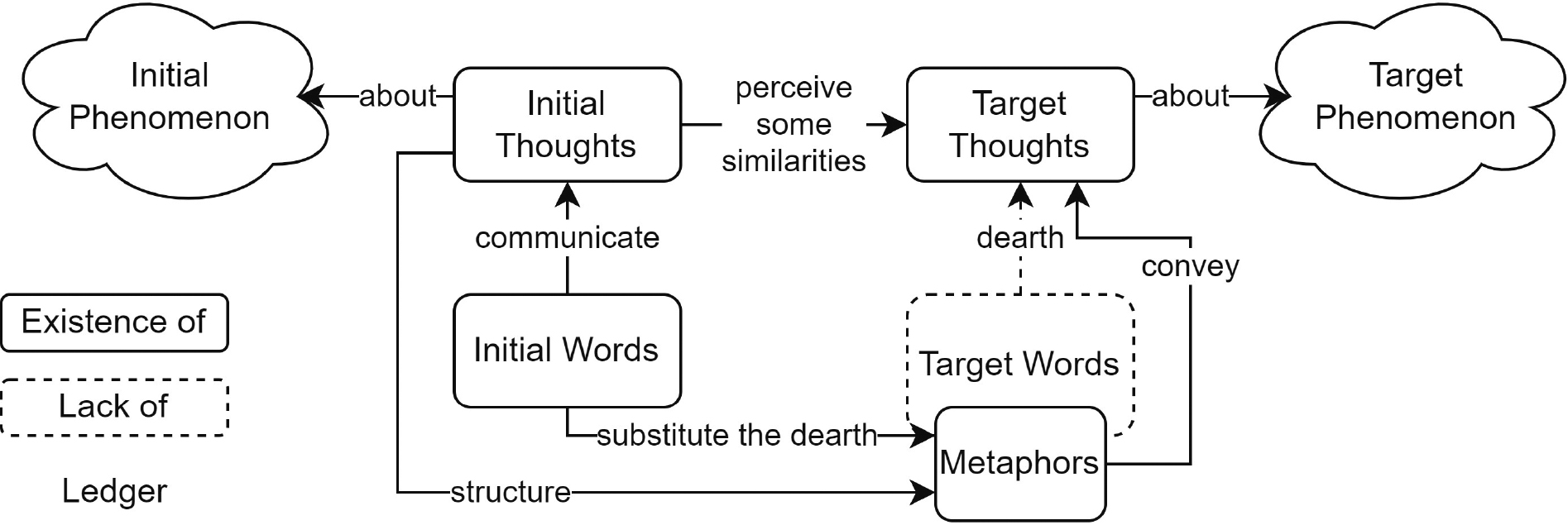
The sender borrows initial words to apply as target words (
However, some similarities may only be superficial, which can make a metaphor misleading (Mars, Bronstein, & Lusch, 2012). A metaphor aids by providing a specific perspective on a target phenomenon. However, the receiver’s understanding of a metaphor depends on his experiences with the initial phenomenon (Lakoff & Johnson, 2008a). A metaphor implies a way of thinking as it brings a specific structure to target thoughts based on initial thoughts and a way of understanding the world (Lakoff & Johnson, 2008a; Morgan, 1998). For example, technical debt refers to a debt that should be repaid; however, this is not always the case for technical debt. As a result, a sender and a receiver can evaluate a metaphor as beneficial or disadvantageous based on how well it conveys target thoughts about the target phenomenon.
The application of metaphors in a community can be understood from the meme perspective (Dawkins, 2016). A meme is a convenient unit of cultural transmission (e.g., an idea or a tune) that can jump from one sender to another receiver through a process of imitation. A meme can be a metaphor, which we presume in this article. A metaphor spreads from sender to receiver through imitations where the metaphor can mutate or blend with other ideas (or metaphors). A metaphor spreads based on whether the receiver perceives the metaphor as having utility and appeal (Dawkins, 2016). A metaphor’s appeal relates to how well it can communicate a target phenomenon. The metaphor borrows the structure of the initial phenomenon to apply to the target phenomenon initially, and the focus is on the similarities between the initial phenomenon and the target phenomenon (Glucksberg, 1989; Lakoff & Johnson, 2008a; Ogden & Richards, 1923). A high-appeal metaphor entails being a well-known initial phenomenon and where the similarities between the initial and target phenomena are easily identified. The metaphor loses its appeal if the dissimilarities between the initial and target phenomenon create more problems than the similarities provide understanding. For example, the ‘e’ (electronic) is slowly dying as digital, online, and virtual is taking over (e.g., the eGovernment is becoming Digital Government). A beneficial and high-appeal metaphor can be characterised as self-explanatory (Ortony, 1975), while a low-appeal metaphor can generate confusion and despair (Ortony, 1975). However, a metaphor can have high appeal but also be disadvantageous, as such spreading quickly with consequences. On the other hand, a metaphor can lie dormant for years in various mediums (Dawkins, 2016), such as the metaphor “Technical debt”, which was first introduced in 1992 by Cunningham. It took a decade before it was picked up and discussed in the academic community (Tom, Aybuke, & Richard, 2012). A metaphor can co-adapt to ideas and other metaphors in its environment where associations are entrenched. It grows interdependent on other ideas and metaphors and can no longer exist without them. Possibly, they self-reinforce each other. This situation can lead to stable structures of assemblages of metaphors,1
Originally, Dawkins (2016) called it complexes, but for clarity, we changed it to assemblages.
Our study used a mixed-method approach to explore the application of metaphors within communities (see Creswell & Creswell, 2017). The mixed-method approach enables us to capture the applications of metaphors in different communities and to display the nuances of these applications and any related conceptual developments (Creswell & Creswell, 2017). It followed three phases: (1) we synthesised an analytical framework from previous research, (2) we chose and collected empirical material about two communities, and (3) we analysed the empirical material with word frequency analysis and then in-depth analysis based on the emergent analytical framework. Figure 2 presents an overview of our study.
The research process.
We used a hermeneutic literature review with citation tracking and citation analysis (Boell & Cecez-Kecmanovic, 2014) to review previous metaphor research. We combined the keywords “metaphor” or “metaphor development” with “communities” or “organisations” in Google Scholar. We skimmed titles, abstracts, and if they were relevant also the content. Then, we determined whether it would enable us to understand metaphors and their development. We classified relevant literature following title, purpose, research problem, keywords, limitations, implications, explanatory power, and interesting statements. In total, we classified 21 articles and 2 books.
We synthesised an emergent analytical framework based on the relevant literature. Its purpose is to analyse the application of metaphors by senders. An analytical framework, like a theoretical framework, draws concepts from a theory to shed light on a phenomenon Imenda (2014). We understand that an analytical framework leaves certain concepts open to be filled with empirical material and, as such, allows for the generation of new explanations and insights. The analytical framework guided and enabled us in explaining and interpreting the empirical material Imenda (2014). Moreover, the method of synthesis was concept mapping where we defined concepts and their relationships (Maxwell, 2012). This part of the phase started with an online discussion where we compared the relevant literature to identify concepts and relationships. This discussion was supported by a cloud-based diagram software where we could represent the framework. We continued to develop the framework drawing on the literature and when needed, we arranged for new discussions. In this process, several tentative frameworks were developed and discarded or merged based on perceived utility. We iterated between synthesis, data collection, and data analysis, allowing the final analytical framework to emerge over time. The outcome was the emergent analytical framework labelled the CAOM framework (see Section 4).
Phase 2: Data collection
We selected OGD and TD communities because of our existing knowledge of the two communities, and their accessibility. Additionally, these communities are interesting because of their differences in community characteristics, their active metaphor usage for a present socio-technical phenomenon, and the communities containing a mix of researchers and practitioners.
Introduction to the OGD and TD communities
We decided to study the OGD and TD communities because the communities are active both within research and practice and both want to communicate about a young, intangible socio-technical phenomenon. Thus, these communities enable us to study how metaphors have been applied (and help answer our research question) and explore their conceptual development (the purpose of this article). The OGD community is public, with key actors, and expresses itself abundantly on the Internet, while TD is less prominent on the Internet, contextually bound to the IT system, and local practitioners. They differ in the level of analysis: OGD contains a system perspective and focuses on actors and their interactions, whereas TD focuses on a local phenomenon related to a specific IT system. OGD has been understood as ecosystems (e.g., Dawes, Vidiasova, & Parkhimovich, 2016; Pollock, 2011), lifecycles (e.g., Attard, Orlandi, Scerri, & Auer, 2015; Folmer, Reuvers, Quak, van den Broek, & van Veenstra, 2011), and chains (e.g., Albano, 2013; Carrara, Chan, et al., 2015), while TD has been understood as loan (Kruchten, Nord, & Ozkaya, 2012), investments (Guo & Seaman, 2011), and shortcuts (Cunningham, 1992). The communities also apply a mix of metaphors. For example, in OGD, Davies (2011) applies ecosystem and infrastructure, Lindman, Kinnari, and Rossi (2015) apply ecosystem, network, and chain, and Harrison, Pardo, and Cook (2012) apply ecosystem, platform, network, and market metaphors. On the other hand, in TD, Kruchten et al. (2012) apply loan, evolution, landscape, and development, Cunningham (1992) apply shortcut, and Guo and Seaman (2011) apply investment metaphors.
Data collection in the communities
Our data collection was divided into researchers’ and practitioners’ communities. Figures 7 and 8 present a summary of the number of empirical documents over time collected in our study.
The number of articles in the selected outlets from the OGD and TD communities
The number of articles in the selected outlets from the OGD and TD communities
Selection criteria for practical literature
Our metaphor group dictionary
Our metaphor group dictionary
We first analysed the empirical material in MaxQDA using a word frequency analysis and then in-depth based on the CAOM framework (see Section 4). Both methods used metaphor density to inform us about possible shifts in the communities’ application of metaphors. Density was calculated per metaphor for each year by summing metaphor applications in the year and dividing this amount by the number of documents for that year.
The Communities’ Application Of Metaphors (CAOM) Framework is a final product and contribution of this article (see Walsham, 1995). It can be iteratively used to analyse the application of metaphors within a community’s communication. It assumes the application of metaphors happens in the community’s conceptual development to understand socio-technical phenomena. The framework follows a quantitative and a qualitative approach.
The quantitative approach provides high-level insights into how the application of metaphors in a community develops over time. The framework conceptualises this communication as a stream of messages containing metaphors. The continued application of metaphors forms
A metaphor’s copying-fidelity, referring to the senders’ ability to accurately replicate the metaphor (Dawkins, 2016), requires a study of changes and blends in the application of this metaphor. The qualitative approach employs us to analyse the community’s application of a metaphor in detail. Specifically, we analyse the application of a metaphor through its usage, expression, and assemblage.
Overview of patterns in the metaphor frequency analysis for the OGD and TD communities
Overview of patterns in the metaphor frequency analysis for the OGD and TD communities
In this section, we explore the application of metaphors through the density of estimated metaphor usage and identify patterns through the period 2015–2020 for the OGD and TD communities.
Six metaphor groups were analysed for the OGD community: ‘Ecosystem’, ‘Silo’, ‘Creature’, ‘Market’, ‘Industry’, and ‘Adventure’ (Table 4). No clear common pattern is visible. The metaphor density of the OGD researchers (see Fig. 4) is first stable with few fluctuations, ending with a sharp increase in density between 2019 and 2020. On the other hand, for OGD practitioners (see Fig. 3), the metaphor density fluctuates following a decreasing trend.
Practitioners use of metaphors within the OGD community.
Researchers use of metaphors within the OGD community.
The TD community’s six metaphor groups were: ‘Economics’, ‘Emotion’, ‘Loan’, ‘Person’, ‘Purchase’, and ‘Repair’ (Table 4). Similar to the OGD community, no clear common pattern is visible. For TD researchers (see Fig. 6), the metaphor density first fluctuates, followed by a sharp increase of all metaphor groups between 2019 and 2020. The metaphor density of the TD practitioners (see Fig. 5) is first stable, then expresses a sharp increase followed by a lower metaphor density for all metaphor groups.
Practitioners use of metaphors within the TD community.
Researchers use of metaphors within the TD community.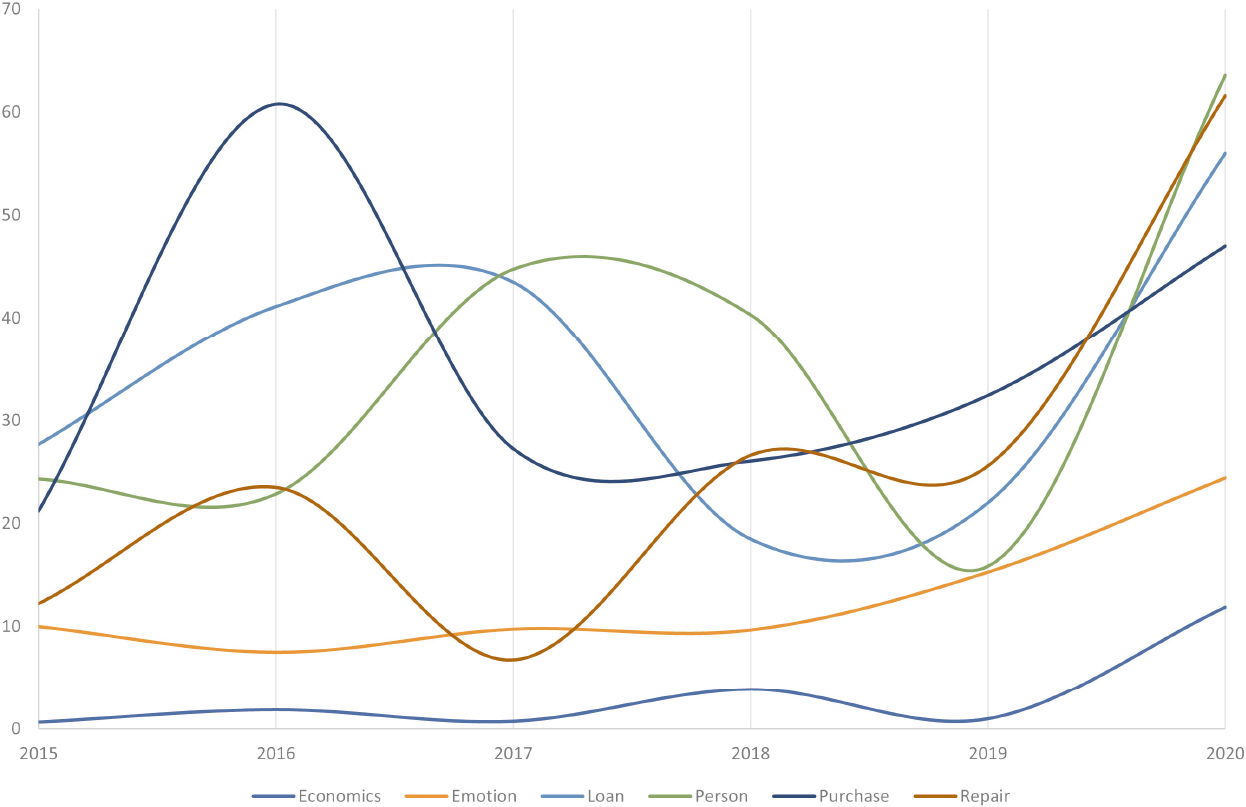
In the metaphor frequency analysis, six common patterns were identified for the OGD and TD communities. First, the
Documents per actor over year for the OGD community.
Documents per actor over year for the TD community.
Table 4 gives an overview of the identified patterns for the OGD and TD communities. The researchers’ communities have a higher metaphor density than the practitioners’ communities. This difference is possibly a consequence of researchers’ focus on concept development, while practitioners’ focus could be on using the metaphor. In addition, only the researchers’ communities contain the rocket pattern. Likewise, the waver pattern is only apparent in the practitioners’ communities. Whereas the Bumper pattern is not visible in the TD researchers’ community, but it appears in the remaining communities. Thus, there are similarities in patterns within the researchers’ communities and practitioners’ communities but not within the OGD community or the TD community. This result indicates the community’s application of metaphors is more aligned between practitioners and between researchers than between the community topic. Furthermore, in a cross-comparison, the TD researchers and OGD practitioners fluctuate in density. They are likely experimenting with metaphors or at least discussing them. A possible explanation is that a useful assemblage of metaphors has not been generated. On the other hand, the OGD researchers and TD practitioners seem stable. They have likely found a working assemblage of metaphors or do not need metaphors to describe the target phenomenon. This similarity could mean that different communities can express similar behaviours using metaphors for conceptual development. The two communities lack clear common patterns, which requires an in-depth analysis.
In this section, we apply the CAOM-Framework (see Section 4) on the empirical material.
“Thus, this work contributes to the effort in building a formal theory about TD and provides directions to assist the work of developers/managers who intend to identify and monitor TD items in their projects, given the practical nature of this study.” (Siebra et al., 2016, p. 219).
Overview of the in-depth qualitative analysis of the ecosystem and technical debt metaphors
Overview of the in-depth qualitative analysis of the ecosystem and technical debt metaphors
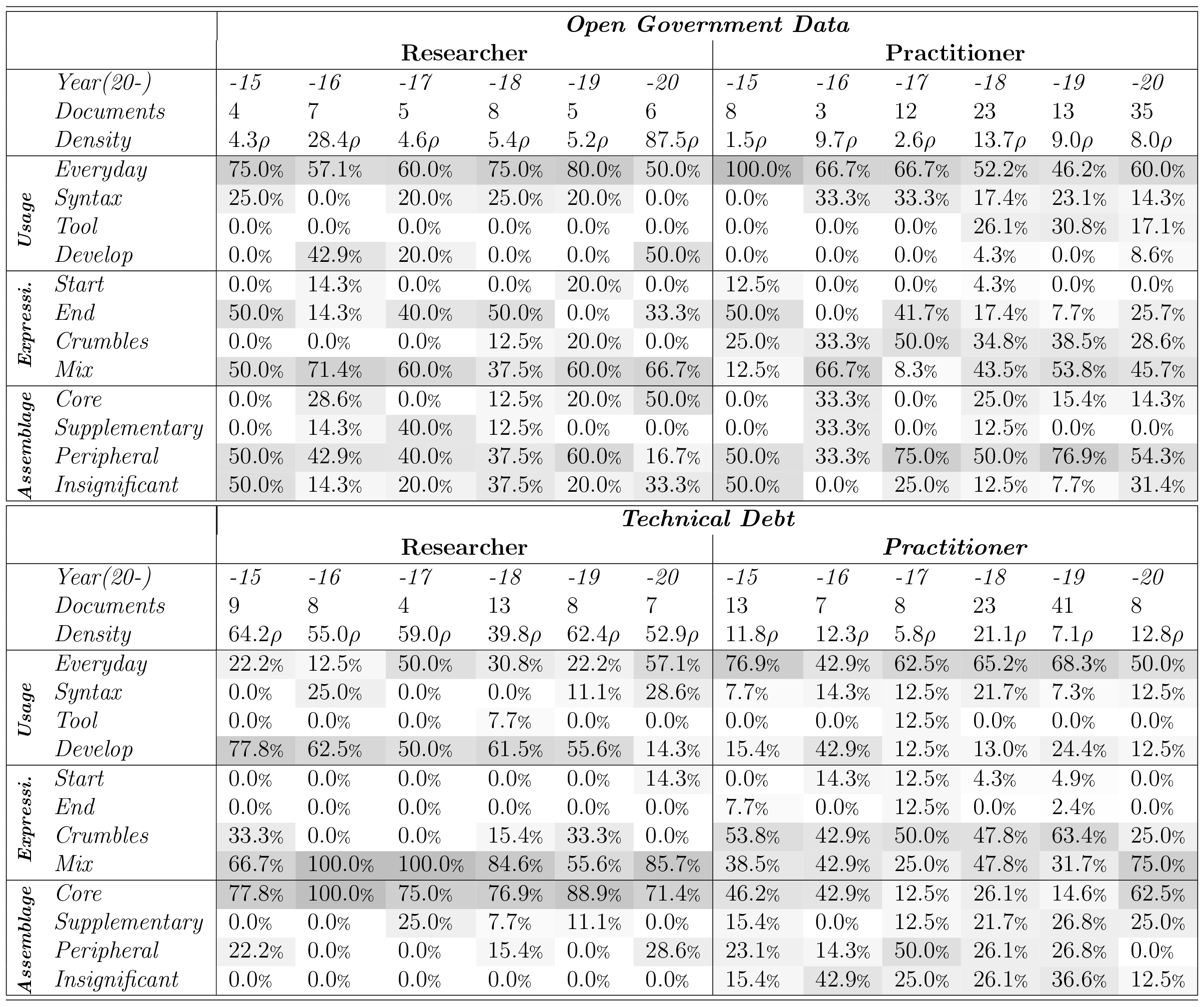
Table 5 gives an overview of the in-depth analysis of the application of the ‘Ecosystem’ and ‘Technical Debt’ metaphors, drawing on the above dimensions. The in-depth analysis highlights that ‘Ecosystem’ is often used in an everyday manner where researchers develop the metaphor while practitioners used it as a tool. Its role is often insignificant or peripheral, with some instances of taking a core role. In comparison, ‘Technical Debt’ tends to be developed by researchers, and it has everyday usage by practitioners. Its role is often core within research, while it varies for practitioners.
This research has explored the conceptual development of the OGD and TD communities by studying researchers’ and practitioners’ application of metaphors about socio-technical phenomena in their communities. While previous research tends to focus on a metaphor and its related target phenomenon (e.g., Glucksberg, 1989; Hamilton, 2000; Ogden & Richards, 1923; Ortony, 1975; Thibodeau & Boroditsky, 2011), our study broaden this research by using meme theory to perceive metaphors as part of a community’s conceptual development for a socio-technical phenomenon (see Section 4). The CAOM framework combines previous research about metaphors with a meme perspective, resulting in an original approach to understanding and studying metaphors. This section discusses the application of metaphors within the OGD and TD communities, our used research approach for studying metaphors, and implications for practice and research.
The application of metaphors
In this section, we focus on the identified patterns and assemblage of metaphors in the communities (see Sections 5 and 6). Our findings show that researchers discuss, share, and apply metaphors for conceptual developments, whereas practitioners primarily apply metaphors. Researchers display a higher metaphor density than practitioners and cite previous research. It is, as such, easier to trace the development and changes of metaphors in the research part of the communities. This difference is most likely a reflection of the researchers developing knowledge about less known socio-technical phenomena while practitioners are encountering or creating these phenomena (Matthiasen & Nielsen, 2008; Van De Ven, 2007).
The communities apply several metaphors each playing a specific role within an assemblage. OGD is a name for the core socio-technical phenomenon (the data that are published and reused following certain principles (Attard et al., 2015) but needs metaphors to be further developed and give context. For example, ‘Ecosystem’, ‘Market’, and ‘Industry’ give terms to describe the larger systems of actors and interactions surrounding OGD. On the other hand, ‘Technical Debt’ is both a developing metaphor, but also the everyday name for a specific socio-technical phenomenon. TD community develops more the metaphor compared to OGD because TD is the core of the TD field. While the socio-technical phenomenon influences what metaphors senders decide to apply in their conceptual development (see Section 2), we see no clear relationship between a socio-technical phenomenon and how senders apply metaphors in their conceptual development. An outliner is that OGD researchers never applied the Ecosystem metaphor as a tool within the explored time period, but we know from previous OGD research that it has been used as a tool (e.g., Harrison et al., 2012). Rather, we propose that the significance of a metaphor’s role in its assemblage influences how senders apply metaphors. The findings show that a peripheral or insignificant role tends to come with high everyday usage. While it is consistent for 19 of 24 years, there are some negative cases: 2016 for OGD practitioners, 2015 and 2020 for TD practitioners, and 2017 and 2020 for TD researchers. These negative cases cannot be explained by the used research approach, as such opening new research avenues.
Additionally, the OGD and TD communities vary further in community type. OGD is an open public community with more complex interactions, making it challenging to separate concepts and metaphors. We expected that this openness would have contributed to a higher degree of development for the Ecosystem metaphor, as ideas and knowledge can easily flow in and out of the community. However, this was not the case. Instead, they had high usage of various metaphors. On the other hand, TD is a semi-private community, with a strong core of researchers and software developers who are developing the metaphor. They appear to take ownership of the socio-technical phenomenon and try to solve the challenges it poses. The phenomenon is expanding to other communities (e.g., engineering) and other job functions (e.g., management). A surprising insight is that an open community applies more peripheral metaphors through an everyday usage, while closed communities developed more core metaphors.
As an answer to the ‘why’-question, we propose that while the socio-technical phenomenon influences what metaphors senders apply in their conceptual development, the metaphors’ role within an assemblage and community type influence how senders apply them in their conceptual development. Thus, we expand on Lakoff and Johnson (2008a) arguments that metaphors structure our thinking and are influenced by how we perceive their origin.
Studying metaphors
To our knowledge, other researchers have not studied the application of metaphors in relation to conceptual development using an approach similar to ours. Thus, our findings provide guidance to future research of interesting topics to explore further using similar methods to this article.
The study of metaphors in a community is complicated as several senders can participate in the communication through various outlets. Some senders explain their metaphors, while other senders assume the receivers will spring to the right spontaneous conclusions (Ogden & Richards, 1923). In addition, the application of metaphors can differ in usage, expression, and assemblage where they are sometimes not applied as metaphors or at least border between being a metaphor and being everyday language or an unfettered concept. Therefore, it can be difficult to determine the exact meaning of a metaphor. We can draw some lessons learned about researching metaphors related to the OGD and TD community characteristics, the emergent CAOM framework, the patterns in the application of metaphors, and understanding the application of metaphors from a COAM framework lens.
Implications
Our research has some implications for practitioners’ and researchers’ application of metaphors in conceptual developments. They can actively experiment with assemblages of metaphors to create new logical syntax and meanings, considering the potential impacts metaphors could have on each other. Inter-metaphorical emergence can be beneficial but could lead to metaphorical fallacies or nonsensical communication. They should be aware that assemblages of metaphors can cause unwanted associations for receivers, as they are the catalyst who interpret the metaphor and its assemblage. As such, it is important for senders to be clear when communicating original assemblages of metaphors, highlighting important similarities and dissimilarities for the receivers. This approach could help to increase the benefits gained from conceptual developments using metaphors.
Conclusion
Our study aimed to explore conceptual development in communities by studying researchers’ and practitioners’ application of metaphors about socio-technical phenomena in their communications. We employed a mixed-method approach, analysing the application of metaphors between 2015 and 2020, focusing on the TD and OGD communities. We use meme theory and synthesise metaphor literature into the emergent CAOM analytical framework with the key concepts of metaphors’ usage, expression, and assemblages of metaphors (applications), which is a contribution of our study (see Section 4). Our study was guided by two research questions, which it answered:
First, how have the OGD and TD communities applied metaphors in their conceptual development between 2015 and 2020, and why in this manner?
The OGD community applies metaphors to supplement the main concept, while the TD community applies TD as a syntax to develop the main metaphor further. Practitioners combine metaphors and concepts, focusing on action, while researchers expand upon metaphors and concepts with other metaphors and concepts, focusing on knowledge development. Generally, researchers and practitioners blend metaphors to create new ways of reasoning and understanding. Some combined metaphors could be understood as incompatible if literally compared to each other. Our findings also show that metaphors are part of ever-evolving processes following similar patterns even between communities and socio-technical phenomena. We propose that while a socio-technical phenomenon influences what metaphors senders apply in their conceptual development, how the metaphors are applied is influenced by community type (e.g., researcher or practitioner; open or semi-private) and metaphors’ role (e.g., core or peripheral).
Second, what are the lessons learned for analysing the application of metaphors for the OGD and TD communities?
The boundary between metaphor and concept is blurry where some terms could be both, making them challenging to capture in both quantitative and qualitative analysis. The community characteristics influence how senders communicate to receivers but also act as an entry barrier for newcomers to the community. The emergent CAOM framework provides analytical dimensions, enabling the exploration of metaphors’ application in communal communication. It helped us bridge the use of quantitative and qualitative analysis. The quantitative analysis revealed when a metaphor had a high potential to influence the conceptual development of a community but also when it could have limited potential. The qualitative analysis explained the application and trends of metaphors within the two communities. It was an essential part of understanding assemblages of metaphors.
Our research has some limitations and opens new avenues for future research. In our research, we followed the suggestions of Mays and Pope (2000) to improve our research’s validity. We have used methodological triangulation, fair dealings, attention to negative cases, and lastly, a clear exposition of methods of data collection and analysis. We also followed Creswell and Creswell (2017); Myers (2013); Saunders and Lewis (2012) to further ensure research quality. Our synthesis of the emergent CAOM framework focused on understanding, as such it is possible that further previous research could be used to enhance the framework. We believe the framework gives sufficient understanding to analyse the application of metaphors. However, our research has mainly focused on public empirical sources (e.g., blogs and reports) with some interviews from the TD community. This approach excludes forums and events where practitioners and researchers could meet to discuss and develop metaphors. It is possible that these social gatherings are important locations for the application of metaphors. On the other hand, if so, their output should sooner or later be expressed in the texts we have analysed; allowing us to identify them indirectly. Moreover, we used word frequency analysis (WFA) and then a qualitative analysis (QA). WFA is limited in its ability to capture the context of used words. We revisited the instances with high frequency to ensure it was used metaphorically. QA should have offset some of these problems by allowing us to study the metaphors in their context, but this correction is not included in the statistics. We believe the combination of WFA and QA has mitigated some limitations of each other and contributed to a better validity of our research. In the end, we believe our research to have good quality, but is one step towards understanding the development of metaphors. It has opened for future research about (1) the application and combination of metaphors, (2) comparative, longitudinal studies for the application of metaphors in communities, and (3) metaphors as a method for knowledge development about socio-technical phenomena between practitioners and researchers.
Footnotes
Author biographies
Mille Edith Kjærsgaard Hansen has recently been awarded a Ph.D. for her research on technical debt management. She has published in the Government Information Quarterly journal and in the conferences: EGOV-CeDEM-EPART and ICEGOV. She has previously worked at the IT department at the Danish Business Authority and is currently working as an IT consultant.
Jonathan Crusoe is a Ph.D. in Information Systems at the University of Borås, Sweden, and Postdoctor at the University of Gothenburg. His research focuses on open government data as reform and ecosystem, which his recently defended doctoral thesis covers. His research is often multi-disciplinary with international collaborations. Recently, he published and presented three articles about open data at the EGOV-CeDEM-EPART conferance and has published in the journal of Transforming Government – People, Process and Policy.
Ulf Melin, Professor in Information Systems, Linköping University, Sweden. His research is focused on public sector digitalization. Ulf has published in e.g. Government Information Quarterly, Transforming Government – People, Process and Policy, International Journal of Electronic Governance, International Journal of Public Information Systems; and is active in several IS conferences.