



Abstract
E-government transformation requires a deeper understanding of contextual factors, including prevailing challenges. Significantly, few studies have raised that e-government challenges are not independent and that their interdependencies warrant further investigations. This study aims to analyse the interdependencies of e-government challenges using qualitative and quantitative methods – PESTELMO (Political, Economic, Socio-cultural, Technological, Environmental, Legal, Managerial and Organisational) analysis method and DEMATEL (Decision-Making Trial and Evaluation Laboratory) and ANP (Analytic Network Process) respectively. PESTELMO analysis method categorised 27 e-government challenges in Tanzania, which were then subjected to DEMATEL. DEMATEL results show that net causes are political, economic and legal challenges, while net receivers are sociocultural, technological, environmental, managerial and organisational challenges. The ANP results reveal that economic challenges are the most significant among the net causes. Hence, e-government policy and strategy makers may want to prioritise economic challenges to propagate beneficial results. This is the first study that analyses, visualises and attempts to measure the interdependencies among e-government challenges in Tanzania. The contributions of this paper lie in the empirical analysis of e-government challenges. The results provide insights to practitioners and researchers of e-government in Tanzania on the most critical challenges/hurdles to focus on for successful e-government transformation.
Introduction
E-government has undoubtedly become one of the critical instruments in fostering economic growth. Over the years, e-government transformation has promoted innovative public governance using modern tools and technologies in delivering public services, for example, artificial intelligence, augmented reality, virtual reality, big, open and linked data (BOLD) analytics, open innovation, et cetera. Emerging strategies indicate dedicated governments’ efforts to keep up with technological evolutions. For instance, “the UAE has developed the UAE Strategy for Artificial Intelligence and Emirates Blockchain Strategy 2021 (United Nations, 2020). “Bahrain implemented Legislative Decree No. 54/2018 for the Issuance of Letters and Electronic Transactions, which provides a legal framework for using new technologies such as blockchain for government services” (Ibid.). In another example, the Republic of Korea has developed several strategies in response to emerging technologies, including the Intelligent Government Master Plan, Data and Artificial Intelligence Economy Facilitation Plan, Master Plan for Blockchain Industry Development, and the Smart City Implementation Strategy (Ibid.).
Numerous factors continue to drive considerable investments in e-government. To date, governments still strive to reduce administrative burdens, increase the effectiveness and efficiency of the public sector, increase government responsiveness, facilitate citizen-centred and user-friendly delivery of public services, et cetera (United Nations, 2020). E-government is also justified as it strengthens the capacity of the public sector and facilitates the creation of knowledge-based governments. For instance, in the period 2012/2013–2016/2017, the Tanzanian e-Government Agency provided e-government technical training in areas of network management to 240 institutions, Government Mailing System to 359 institutions, provision of e-services to 76 institutions and website management to 411 institutions (eGovernment Agency, 2017). Bangladesh is commended in the 2020 United Nations E-Government Survey for strengthening the capacity of public sector employees through government-created open-learning platforms (United Nations, 2020).
Notwithstanding the profound benefits of e-government, significant challenges are encountered in implementation. E-government challenges that are highlighted in the literature include a lack of e-government legal frameworks, a lack of interoperability frameworks/standards, insufficient financial resources (especially in developing countries), administrative bureaucracies in implementing e-government projects, a lack of sustainability frameworks, insufficient ICT skills capacity in the public sector, digital divides, corruption, a lack of political drive/support, and insufficient ICT infrastructure to mention a few (Angelopoulos et al., 2010; Belachew, 2010; Bhuiyan, 2010; Sæbø, 2012; Asogwa, 2013; Nkohkwo & Islam, 2013; Anthopoulos et al., 2016; United Nations, 2020).
Persisting e-government challenges pose significant concerns in designing sustainable strategies and ensuring return on investments-tangible and intangible. Concerns arise as to which extent interdependencies among e-government challenges are known, examined and evaluated and whether such knowledge can contribute to developing sound e-government policies, strategies and action plans for successful transformation. The extended and holistic analysis of e-government challenges is still not widely considered in existing literature, and even much less on the application of such knowledge by governments and the public sector. Studies that have introduced methods for extended analysis of e-government challenges have not been exemplified in case studies; hence, there is insufficient knowledge of their applications. In this view, this paper argues that in addition to governments being aware of e-government challenges and (well-documented) solutions/success factors, it is imperative to take a step further to analyse, visualise and measure interdependencies among the challenges. Furthermore, this paper calls for researchers to investigate e-government challenges deeply to inform practice. Therefore, the objectives of this study are as follows: (1) to investigate causal relationships among the categories of e-government challenges and (2) to examine the interdependencies among the identified categories of challenges using the DEMATEL and ANP methods. The contributions of this paper lie in the empirical analysis of e-government challenges. The results provide insights to practitioners and researchers of e-government in Tanzania on the most critical challenges/hurdles to focus on for successful e-government transformation. This study is significant in Tanzania and other developing countries with scarce resources to support e-government programmes.
This paper is structured as follows. In the next section, related work is further presented, followed by the methodology. Then, the methods PESTELMO, DEMATEL and ANP are empirically applied, followed by a discussion of the results. Finally, conclusions are provided, as well as future research directions.
Setting the grounds and related work
A review of studies on e-government challenges done between 2017–2021 reveals different depths of analysis. For the review, leading online databases of e-government research, including the Digital Government Reference Library v16.6 (DGRL), Elsevier, Emerald and ACM, were consulted. The scope of the review included articles that focus on identifying, consolidating or analysing e-government challenges.
Table 1 illustrates e-government challenges from fifteen (15) articles considered in the review’s scope.
Overview of categorisation of e-government challenges in literature (with modifications from (Mkude & Wimmer, 2016))
Overview of categorisation of e-government challenges in literature (with modifications from (Mkude & Wimmer, 2016))
Out of sixteen (16) articles presented in Table 1, four (4) articles identified e-government challenges, while twelve (12) articles further categorised the challenges into different categories. Furthermore, studies that have categorised e-government challenges portray different categories, whereas some categories of challenges, such as political, technological, financial and legal, have been featured in most studies. None of the studies has performed any further analysis of e-government challenges. This limited trend of presenting e-government challenges is seen in several other studies (for instance (Abusamhadana, 2021; Renteria et al., 2019). Further review reveals that very few studies have attempted to raise the need to analyse e-government challenges to unveil any possible ranking and interdependencies. Even fewer studies have highlighted that such an analysis is essential if governments seek to develop sustainable e-government policies/strategies and action plans. For instance, Mustafa and colleagues have ranked e-government adoption challenges by highlighting the most important ones, such as trust, security, privacy, and awareness (Mustafa et al., 2020). However, the authors failed to mention any interdependencies that might exist among the challenges. A brief insight is also provided by Twizeyimana and colleagues, who argue that e-government implementation challenges “should not be taken as of the same extent, nor their degree of mitigation […] as they influence and are influenced by various factors” (Twizeyimana et al., 2018). However, the authors fail to illustrate how such an analysis can be undertaken. From these gaps in the literature, Mkude and Wimmer (2016) proposed a methodical mix of qualitative and quantitative methods for scientific analysis of e-government challenges. However, the application of the proposed methods has not been exemplified, and possible contributions of the results to successful e-government transformation have not been identified. This study addresses the methodological gap by exemplifying the proposed methods to analyse e-government challenges in Tanzania. No study has attempted this perspective in Tanzania.
The proposed methods for analysing e-government challenges in Tanzania are presented in the next section, followed by the empirical application of the methods.
This section presents the methods used to analyse e-government challenges in Tanzania. The methods include the PESTELMO analysis method for qualitative analysis and DEMATEL and ANP for quantitative analysis.
Qualitative analysis
The PESTELMO analysis method is a qualitative method for analysing factors that might impact the performance and operations of organisations. PESTELMO stems from PESTEL, which has been presented in different variations since its introduction by Aguilar in 1967 as ETPS (economic, technical, political, and social) (Aguilar, 1967). PESTELMO is selected based on three key characteristics:
An integrated approach to analysing the external and internal environment of an organisation (Yüksel, 2012); A suitable method for analysing dynamic political, economic, sociocultural, technological, environmental and legal parameters in long-term planning (Mkude, 2016); A holistic approach to assessing relations, interactions and interdependences among the PESTELMO factors and sub-factors (Mkude, 2016).
PESTEL analysis has long been applied in different fields. In e-government, PESTEL has been used in analysing e-government in Iran (Rezazadeh et al., 2011); in conducting a risk study of e-governance implementation (Yingfa & Hong, 2010); in reviewing and evaluating e-government in Singapore (Huong & Ken, 2008); in studying e-government readiness in Ghana (Andoh-Baidoo et al., 2012); in (Mkude & Wimmer, 2015), PESTEL was applied to identify interdependencies among e-government challenges; the authors (Abdoh et al., 2020) developed a PESTLE model to investigate e-government adoption factors in Jordan. In another study in Uganda, PESTEL was used as a tool to formulate the eHealth Readiness Assessment Framework (Kiberu et al., 2021). To reflect the multidisciplinary nature of e-government, PESTEL was modified to PESTELMO “to include the managerial and organisational aspects […]” (Mkude, 2016).
PESTELMO analysis is carried out in the following three steps (Mkude & Wimmer, 2016):
Identify e-government challenges. Research methods such as interviews, surveys and desk research are used to identify the challenges.
Categorise the challenges into PESTELMO (if not yet categorised in step 1).
Form a hierarchical model of PESTELMO to depict the challenges along the PESTELMO’s categories as shown in Fig. 1. The first level of the model contains a title of the model (the decision makers specify in (N) the name of a country or an organisation). The second level of the model contains the main categories of PESTELMO. The third level contains the challenges identified in step 1. This level graphically depicts the work done in step 2.
PESTELMO hierarchical model of e-government challenges (Mkude & Wimmer, 2016).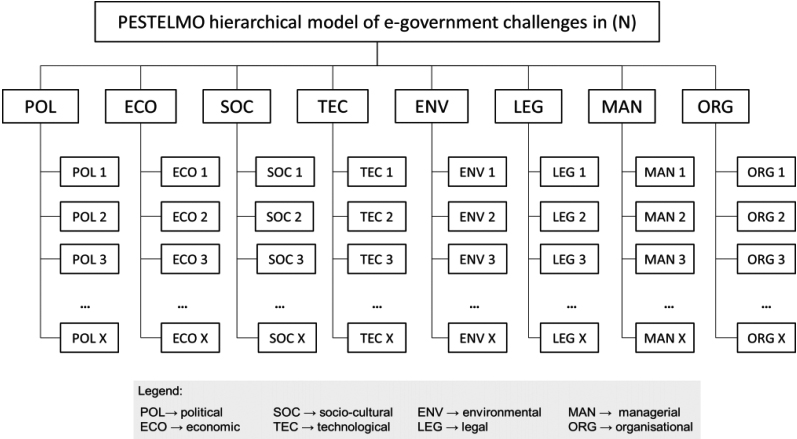
Quantitative analysis examines existing interdependencies among e-government challenges and their weights. For the analysis, DEMATEL and ANP are applied.
In this study, DEMATEL and ANP were deemed more appropriate to its objectives: identifying and weighing the interdependencies among e-government challenges. DEMATEL was used to identify the interdependencies among the challenges through a causal diagram, and ANP was used to analyse the interdependencies. The significance of DEMATEL and ANP in this study lies in the following:
DEMATEL is the most recommended method for identifying interdependencies and interrelations among the criteria/alternatives being studied through a causal diagram and determining the degree of influence of the criteria (Tzeng et al., 2007; Yang et al., 2008). DEMATEL provides a visual structural model that examines inner dependencies within a set of criteria (Tzeng et al., 2007; Wu, 2008). ANP analyses dependencies among different criteria/alternatives (Saaty, 1996, cited in Yüksel, 2012).
Multi-Criteria Decision Making (MCDM) models/approaches – DEMATEL (Decision-Making Trial and Evaluation Laboratory), AHP (Analytic Hierarchy Process), ANP (Analytic Network Process), VIKOR (Višekriterijumsko Kompromisno Rangiranje) and so on – have been applied by several researchers in studying diverse issues in e-government. Kubler et al. used AHP to assess and rank the metadata quality metrics in Open Data portals (Kubler et al., 2018). Burmaoglu and Kazancoglu used AHP and VIKOR to compare and rank e-government portals (Burmaoglu & Kazancoglu, 2012). AHP was used to compare and prioritise factors influencing employee adoption of e-government (Gupta et al., 2017).
The steps followed in DEMATEL are as follows (Yüksel, 2012; Mkude & Wimmer, 2016):
Calculate the initial average matrix. This step requires an evaluation by experts of the degree of direct influence between the identified e-government challenges on a scale of 0–4, where the higher value indicates a more significant influence. The results from each respondent then produce a matrix stated as
Calculate the normalised initial direct-relation matrix. The initial direct matrix
Where
Derive the direct and indirect influence matrix
Where
Set a threshold value to obtain a digraph. Matrix A threshold value
The steps followed in ANP are as follows (Yüksel, 2012; Mkude & Wimmer, 2016):
Determine the local weights of the independent PESTELMO categories by forming a pairwise comparison matrix. Based on independence among the challenges, the comparison is done by e-government experts by evaluating the challenges pairwise. The experts respond to the question: “Which challenge is more important than the other, and how much more”. The responses are evaluated using Saaty’s 1–9 scale, illustrated in Table 2. After that, the local weight vector
Saaty’s 1–9 scale (Saaty, 1996; cited in (Yüksel, 2012))
Where,
Determine the inner dependence matrix (IDM) of PESTELMO’s main categories based on the digraph derived using DEMATEL (see step 4 above). The inner dependence matrix of PESTELMO’s main categories is then formed according to the weights of the inner dependence of the factors.
Calculate the interdependence weights of the PESTELMO categories by multiplying the local weights calculated in step 1 by the inner dependence matrix from step 2.
The following section presents e-government challenges, and the methodical mix of PESTELMO, DEMATEL and ANP is applied.
PESTELMO analysis method
1. Identify e-government challenges.
The challenges were identified based on results from a case study conducted in Tanzania in 2016 (Mkude, 2016). Tanzania is a developing country in eastern Africa. The Tanzanian government published its first e-government strategy in 2004 to provide a broader awareness and understanding of e-government among public sector officials. The second e-government strategy published in 2009 aimed to institutionalise e-government in the country, whereas an e-Government Agency was formed in 2012. The third e-government strategy published in 2013 consolidated the previous efforts and most crucially led to the development of the E-government Act and the establishment of the E-government Authority in 2019.
The case study of e-government challenges in Tanzania identified and categorised 32 challenges (Mkude, 2016). However, considering recent e-government developments in Tanzania, a re-evaluation of the challenges was necessary. Document analysis and interviews were used to confirm the validity of each challenge. For document analysis, critical documents used include the e-Government Strategic Plan of 2021/2022–2025/2026 (e-Government Authority, 2021), the e-Government Act 2019 and Bank of Tanzania’s 2017/18, 2018/19 and 2019/20 reports. The interview involved seven e-government experts from the Ministry of Public Service Management and Good Governance (the ministry overseeing e-government adoption at the national level) and the eGovernment Authority. The experts were presented with the e-government challenges identified in (Mkude, 2016) for validation. Accordingly, five (5) challenges have been omitted in this study as follows:
Lack of collective acceptance of e-government-related policies. This challenge is omitted because of performance and achievements in the e-Government Strategic Plan of 2021/2022–2025/2026 (e-Government Authority, 2021). The plan provides an overview of the national perspective and acceptance of e-government-related policies such as the Tanzania Development Vision 2025, the Ruling Party Election Manifesto (2020), and the Third National Five Years Development Plan 2021/22–2025/26. In the SWOC analysis reported in the Plan, the opportunities stated include the existence of e-government legislation, political will in enforcing e-government initiatives, and Government commitment to using ICT to improve public service delivery. National poverty. Despite the stretched availability of funds, the growth of the Tanzanian economy has been consistently reported in the Bank of Tanzania’s 2017/18, 2018/19 and 2019/20 reports.1
Accessed through
Lack of e-government legal framework. This challenge has been omitted because the e-Government Act 2019 was not established when the case study was conducted in 2016.
Lack of government-wide e-government procurement processes. This challenge has been omitted because, since 2016, the government has streamlined the procurement processes in e-government, including the launch of the e-procurement system in March 2018.2
Lack of government-wide standardisation and interoperability frameworks. The Strategic Plan 2021/22–2025/26 lists e-government standards and guidelines for Public Institutions as one of the greatest strengths in its SWOC analysis. Between 2017 and 2018, the then e-Government Agency developed various guidelines, standards, and frameworks to streamline e-government implementation across the public sector.
The revised 27 categorised challenges are presented as follows:
Political challenges (POL)
Biased decisions that undermine the role of research in implementing e-government (POL 1). Public officials’ reluctance to adopt e-government because of transparency in e-government processes and closed loopholes for corruption (POL 2). Corruption hinders the effective use of donor funds for e-government initiatives (POL 3).
Economic Challenges (ECO)
Stretched availability of national funds due to overarching development agendas (ECO 1). Poor allocation of funds for better provision of ICT education (ECO 2). High cost of suitable ICT devices (ECO 3). Low pace to cope with the rapid rate of technological obsolescence (ECO 4). High costs of reliable internet connectivity (ECO 5).
Socio-cultural challenges (SOC)
Poor IT skills of citizens (SOC 1). Low public trust in e-government (SOC 2). ICT-related courses are not offered in the local language (SOC 3).
Technological challenges (TEC)
Inconsistency in ICT applications and business processes due to vendor-locked systems, which are difficult to integrate at technical and organisational levels (TEC 1). The back-office reorganisation requirements of legacy systems which are isolated and not interoperable (TEC 2). Insufficient measures to ensure security and privacy (TEC 3). Poor availability of reliable network connectivity (TEC 4).
Environmental challenges (ENV)
Scarce availability of reliable electrical power, particularly in remote areas (ENV 1). Inadequate government-wide electronic waste (e-waste) handling mechanisms (ENV 2).
Legal challenges (LEG)
Insufficient government-wide laws and regulations that describe acceptable standards when procuring ICT (LEG 1). Insufficient laws and regulations to ensure sustainable use of technologies in the public sector (LEG 2).
Managerial and Organizational challenges (MO)
Insufficient committed organisational leadership in public sectors (MO 1). Presence of competition in ownership of e-government projects among public institutions resulting in difficulties in joining efforts and resources (MO 2). Insufficient specified budget for ICT departments (MO 3). Low understanding of the impacts and roles of e-government in national development (MO 4). Insufficient IT skills in the public sector by lack of required efforts to retain the workforce (MO 5). Organizational inertia (MO 6). Insufficient awareness of the intangible and tangible benefits of e-government (MO 7). Organizations have low maturity in using ICT in their business processes (MO 8).
2. Form a hierarchical model of PESTELMO to depict the challenges along the PESTELMO’s categories.
The hierarchical structure of the challenges and sub-challenges is seen in Fig. 2.
A PESTELMO hierarchical model of e-government challenges in Tanzania (Mkude, 2016).
1. The initial average matrix was formed according to the views of e-government experts and using Eq. (1), as shown in A. The same team of experts mentioned in section 4.1 was used in this step.
2. Normalized initial direct-relation matrix was computed using Eq. (2), as shown in D:
3. Matrix T was computed using Eq. (3):
Direct and indirect effects between PESTELMO challenges, as obtained from Matrix T, are shown in Table 3.
The sum of influences given and received among PESTELMO challenges
The sum of influences given and received among PESTELMO challenges
In the final stage of DEMATEL, the threshold value is used to compute the average of the elements in matrix T to obtain the digraph, as shown in step 4 below.
4. The threshold value
The digraph showing cause-effect relations among PESTELMO challenges.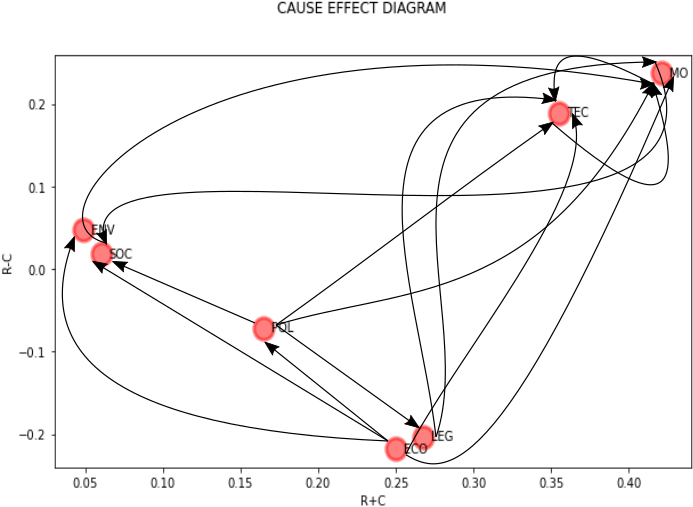
1. Determine the local weights of the independent PESTELMO categories by forming a pairwise comparison matrix.
A pairwise comparison matrix was formed by the e-government experts (ref. section 4.1) using Saaty’s scale Table 1: Overview of categorisation of e-government challenges in literature (with modifications from (Mkude & Wimmer, 2016)) Table 2). The local weights of the PESTELMO challenges are given in, assuming there is no dependence among them. The corresponding consistency ratio (CR) was calculated and displayed in the last row of Table 4.
2. Determine the inner dependence matrix of PESTELMO’s main categories based on the digraph derived using DEMATEL (Fig. 3). The inner dependencies of the categories were determined as follows:
Pairwise comparison matrix of PESTELMO challenges
Pairwise comparison matrix of PESTELMO challenges
The inner dependence matrix of the factors with respect to socio-cultural challenges
The inner dependence matrix of the factors with respect to Managerial and Organizational challenges
The inner dependence with respect to SOC is POL, ECO and MO. The inner dependence with respect to MO is ECO, SOC, TEC, LEG and POL. The inner dependence with respect to TEC is POL, ECO, LEG, and MO. The inner dependence with respect to ENV is ECO. The inner dependence with respect to POL is ECO. The inner dependence with respect to LEG is POL.
Tables 5–10 provide inner dependence matrices; consistency ratios are indicated in the last row of each table.
The inner dependence matrix of the factors with respect to Technological challenges
The inner dependence matrix of the factors with respect to Environmental challenges
The inner dependence matrix (IDM) of the PESTELMO challenges was formed based on the weights of the inner dependence of the challenges as follows:
The inner dependence matrix of the factors with respect to Political challenges
The inner dependence matrix of the factors with respect to Legal challenges
3. The interdependent weights of the PESTELMO challenges were calculated by multiplying the local weights in the second step by the IDM in the third step. The interdependent weights of the PESTELMO challenges were calculated as follows:
Results of the matrix
This section synthesises and discusses the main results of this study. Explicitly, it has emerged that the presentation/analysis of e-government challenges is more than what is mainly found in the literature. The results have illustrated the significance of a deeper analysis of e-government challenges, particularly the linkages and influences among the challenges. The study has demonstrated that such an analysis can provide crucial information to e-government policy/strategy makers: (1) causal relationships among categories of challenges and (2) interdependent weights. The causal relationships highlight the complexity of e-government challenges that ought to be taken into account by policy/strategy makers. The ANP weights help prioritise the challenges, such as focusing on economic constraints in e-government implementation.
Managerial and organisational challenges are the most encountered challenges in e-government implementation in Tanzania. Eight of the 27 e-government challenges identified in Tanzania are managerial and organisational. Environmental (ENV) and legal (LEG) challenges seem to be the least encountered in Tanzania. At this point, limitations of qualitative analysis emerged; that is, it does not show whether the most encountered challenges are the most significant or the least encountered challenges are the least significant. This phenomenon could further be explored using quantitative methods.
According to the direct and indirect matrix (ref. Table 3), the importance of the seven categories can be prioritised as MO
The digraph illustrates the complexity of e-government challenges and that there is no independent challenge (ref. Fig. 3). Political challenges influence Technological, Socio-cultural and Legal challenges, while Economic challenges influence all other challenges except legal ones. The digraph also illustrates that Socio-cultural, Technological and Environmental challenges do not influence any category of challenges. Legal challenges are affected by Political challenges and Managerial and Organizational challenges. In summary, e-government policy/strategy makers should focus more on three causes (ECO, LEG and POL) rather than the receivers (SOC, TEC, ENV and MO) to propagate beneficial results.
Finally, the interdependent matrix (IDM in stage 3 of ANP) shows that the most significant challenges in e-government implementation are Economic, with a value of 0.620799. This is a crucial result for politicians and government actors; without proper management of foreseen economic challenges, e-government strategies/programmes/projects will likely continue to end up in partial success or failure. In this regard, Tanzanian’s critical actors in e-government implementation are argued to pay special attention to the stretched availability of national funds due to overarching development agendas (ECO 1), poor allocation of funds for better provision of ICT education (ECO 2), high cost of suitable ICT devices (ECO 3); low pace to cope with the rapid rate of technological obsolescence (ECO 4); and high costs of reliable internet connectivity (ECO 5). Accordingly, results show that addressing economic challenges, among the net causes, can yield positive changes to socio-cultural, technological and legal challenges. Therefore, e-government strategy planners must know that resolutions to address e-government challenges must consider the causal relationships. This approach is expected to positively affect e-government implementation in developing countries, which requires a holistic perspective in addressing the challenges (Asogwa, 2013; Mkude, 2016; United Nations, 2020).
Conclusion and future research
The objectives of this study were twofold: (1) to investigate causal relationships among the categories of e-government challenges and (2) to examine the interdependencies among the identified categories of challenges using the DEMATEL and ANP methods. The objectives were achieved using the qualitative analysis method PESTELMO and quantitative analysis methods DEMATEL and ANP. Prior literature review revealed that the literature still falls short in analysing the complexity of e-government challenges caused by the existing interdependencies. The analysis showed no independent challenge, but all challenges are interdependent. Twenty-seven e-government challenges in Tanzania were subjected to DEMATEL, and it was found that there are three net causes (ECO, LEG and POL) and four net receivers (SOC, TEC, ENV and MO). Furthermore, the ANP interdependent weights fundamentally show that economic challenges are the most significant.
On practical implications of the study, the methodical mix of qualitative and quantitative analysis presented can be used as a guideline for country-context (or organizational-context) analysis in e-government strategic planning and implementation. Visualising the interdependencies deepens the understanding of policy/strategy makers in the complexities of e-government challenges. Moreover, the weights obtained from the ANP rank the categories of challenges so that policy/strategy makers can focus on more critical challenges to enhance the implementation of e-government. Such a focus is significant for developing countries since the national budgets are already overstretched. The proposed methods are recommended to any country, provided a contextual approach is strictly observed.
Regarding future research, this study only covers the main categories of PESTELMO, whereas analysis can be extended to the sub-categories of PESTELMO and offer much more profound insights. The scope of this study, which looked into e-government challenges at national level, informs high level officials regarding the weights of the main factors for national-level e-government strategies/action plans. A detailed and sophisticated analysis of the sub-categories’ weights could be more beneficial for sector-wise or organizational studies on e-government challenges. Furthermore, sophisticated studies can address the vagueness of PESTELMO’s structure using fuzzy numbers.
Footnotes
Authors’ biographies
Dr Catherine G. Mkude is an expert in information systems strategic planning and implementation, evaluation and sustainability. Dr. Mkude has specialized in e-government research and strategic planning and implementation. Dr Mkude has knowledge, skills and experience in strategic planning, implementation and evaluation of aspects related to e-government, e-participation and stakeholder engagement. Furthermore, Dr. Mkude is skilled in strategy development and impact assessment as well as evaluation projects towards strategic goals (therewith ensuring IT alignment with strategic business goals of governments).
Academically, Dr. Mkude has a Doctor of Philosophy (PhD) degree in E-Government with specialization in strategic planning and implementation from Koblenz University in Germany. Dr. Mkude attained MSc Business Information Systems Management at Middlesex University in London, United Kingdom, where she specialized in software systems failure, e-commerce systems and knowledge management. Dr. Mkude graduated with BSc. in Computer Science at the University of Dar es Salaam in Tanzania.
Mr. Michael Peter is an expert in applied mathematics. Mr. Michael has specialized in computational mathematics and has knowledge, skills and experience in computation skills like exploratory data analysis using R, Python and MATLAB. Furthermore, Mr. Michael is skilled in exploratory decisions using Super Decision software and text mining using R software.
Academically, Mr. Michael has attained MSc in Mathematical Sciences at AIMS-Tanzania and MSc in Mathematical Modeling at the University of Dar es Salaam, United Republic of Tanzania. Mr. Michael graduated with BSc. (Mathematics) at the Open University of Tanzania, United Republic of Tanzania.