



Abstract
The COVID-19 pandemic has exposed the inaccessibility of government information and communication technologies (ICTs) for members of the disability community. Organizational learning around ICT accessibility can be impacted by factors influencing strategies and assumptions or values and norms. Using data collected over two time periods in 2021, we study how the accessibility of US state health agencies COVID-19 information and vaccine websites improve over time. We examine how time, state policies, and partisanship influence organizational learning around website accessibility. Our analysis determines that the longer a COVID-19 related website exists on the Internet, the less accessible the website. We also find that more extensive internal state accessibility policies are more correlated with websites that meet fundamental accessibility requirements. Additionally, we find that partisanship plays an unexpected role in meeting fundamental accessibility demands, although both state policies and politics do not influence if an ICT meets the best practices standards of accessibility. Our paper initiates a discussion around the factors that influence organizational learning about government website accessibility and points to future research questions where the primary ICT function is not influenced by a rapidly evolving pandemic.
Keywords
Introduction
E-government is the use of information and communication technologies (ICTs) by government agencies. ICTs allow citizens to access information and resources and create opportunities to participate in the political process (MacLean & Titah, 2022). ICTs are a useful tool to improve transparency, increase communication, and meet the needs of diverse populations (Yu, 2021). However, the impacts of e-government differ greatly for individuals with disabilities (Cook & Harrison, 2015).
One in four Americans are disabled and that number is predicted to rise due to COVID-19 (Hereth et al., 2022). Previous definitions of disability were formed in the medical community and focused on the limitations a person’s disability placed on their social life and ability to complete basic life tasks (Lollar & Crews, 2003). This definition permeated into aspects of governance, leading to systemic discrimination in the public health sector (Rimmer, 2011; Sabatello et al., 2020). Currently, definitions of disability focus on how an external environment does not provide a functional experience for all people (Lollar & Crews, 2003). This definition encompasses a wide range of disabilities, including hearing, mobility, vision, cognitive, self-care, and independent living disabilities (Centers for Disease Control & Prevention, 2019).
The disability community faces inclusion issues in public life (Rimmer, 2011), encountering accessibility issues in most physical and electronic infrastructures (Rimmer, 2011; Sabatello et al., 2020). As an underserved community, individuals with disabilities face challenges to access basic public services, including Internet access (Sabatello et al., 2020). The digital divide, which identifies people with access to the Internet, is greater for individuals with disabilities, especially for those who also identify as a person of color or as low-income (Dobransky and Hargittai, 2016). In November 2021, 70.6% of individuals with disabilities used the internet at home, compared to 83.8% of individuals without a disability (National Telecommunications and Information Administration, 2022).
Even after overcoming the digital divide, the disability community faces ICT accessibility barriers. Legally, federal and state government services are required to provide reasonable accommodations, both online and in-person, but most accommodations focus on legal compliance (Sabatello et al., 2020). Exclusion from public and online spaces leads to feelings of isolation and decreased physical and psychological health (McDonald et al., 2015). The traditional focus on legal compliance rather than functional accessibility is especially concerning considering the communication needed between a government and its population during a crisis (National Council on Disability, 2014).
With a wide range of individual circumstances at play, defining ICT inaccessibility is difficult, but is often based on the Web Content Accessibility Guidelines (WCAG). State and federal websites tend to be more accessible when compared to randomly selected private websites, but many government websites fail to meet basic accessibility standards, including 42% of popular federal websites (McQuinn & Castro, 2017). Accessibility barriers include: interacting with screen readers, but not using strong, contrasting colors, using very small text sizes, having broken links etc. (Yu & Parmanto, 2011). The lack of awareness around ICT accessibility is especially critical during disasters, like the COVID-19 pandemic. Ableism was exacerbated during the COVID-19 pandemic when individuals with disabilities reported a major barrier to state-sponsored vaccination efforts was the limited ability to find online information about vaccines or schedule an appointment online (Ryerson et al., 2021).
As government services increasingly move towards online functions, research should focus on how ICTs work to enhance social equity (Blessett et al., 2019), a pillar of public administration research. Understanding how government-provided services are created with inclusion in mind should reduce participation barriers for the disability community (Turnbull & Stowe, 2001). Government ICTs must provide equal access and engagement in specific information policies to overcome the systematic accessibility gap between the disability and non-disability community (Dobransky & Hargaittai, 2016).
In delivering public services, state agencies engage in an organizational learning process to improve outputs and provide better services. While governments increasingly use the Internet as a tool for information sharing and feedback (Gilson et al., 2009), ICT accessibility differs widely across states. We ask, “What factors influence a U.S. state health agency’s organizational learning process leading to increasing accessibility of COVID-19 related websites?” We focus on four factors that could influence organizational learning: length of website existence, website complexity for users, internal state accessibility policies, and partisanship. We use assessments from two points in 2021 to capture the influence of these factors on the organizational learning process leading to changes in website accessibility. Our research shows learning mostly occurs when factors influence an organization’s values, instead of strategy. We first review ICT accessibility and organizational learning. We present hypotheses based on the single and double loop learning model. We then report our data, methods, and discuss our findings.
Online communication, inclusion, and the disability community
The digital divide extends beyond Internet availability to website content accessibility (Baker, Hanson, & William, 2009). Accessibility on the Internet focuses on the capacity to equally meet an individual’s need to obtain and meaningfully interact with web-based content (Jaeger & Xie, 2009). Accessibility in e-government requires governments to ensure equal access to information provided through ICTs, in addition to compatibility with any Internet-connected devices (Sonnenberg, 2020). Current web accessibility standards are formed from a mixture of government regulations and private sector guidelines (Jaeger & Xie, 2009). From a state government standpoint, accessibility focuses on compliance with dated federal statutes like the American with Disabilities Act (ADA) and Sections 504 and 508 of the Rehabilitation Act (Yang & Chen, 2015). In lieu of specific, up-to-date federal compliance mandates, the U.S. Justice Department suggests accessibility guidelines based on WCAG 2.0’s minimal (level A) and acceptable (level AA) standards (Barrett & Greene, 2021; U.S. Access Board, n.d.). Government employees tasked with creating accessible websites often turn to outside resources, like the Web Accessibility Initiative (Jaeger & Xie, 2009).
ICT accessibility varies based on social and political factors. Successful ICT delivery depends on effective organizational learning through meaningful and systematic evaluation (quickly detecting and correcting errors) and adjusting outputs based on lessons learned (Dunlop, 2017). Research on e-government is less clear about the relationship between organizational learning and success in generating accessible ICTs, particularly what factors influence this type of organizational learning. Most research focuses on compliance, viewing the work of accessibility not as a social equity imperative and ethical obligation (Palmer & Palmer, 2018), but as an organizational burden. Viewing ICT accessibility as a compliance burden ignores organizational knowledge deficits and what factors influence an organization’s learning process when creating and maintaining accessible websites (O’Neill, 2021), a gap this paper tries to fill.
Organizational learning
Organizational learning is the process of gathering and employing knowledge to improve an organization’s performance. Organizational learning is relational in nature and occurs as a social and political process (Vince & Saleem, 2004). The learning process is critical to successful organizational performance, especially when learning is passed from the individual to the team and organization (Jerez-Gómez et al., 2005). Governments engage in organizational learning to modify the effectiveness, efficiency, and equity of public goods/services delivery (Choi & Chandler, 2020). When errors occur in public service, governments are expected to learn and respond appropriately (Dekker Hansén, 2004). Government agencies engaging in organizational learning face unique contexts (political, social, and otherwise), making understanding the factors influencing learning an important point of emphasis in public administration research (Rashman, Withers, & Hartley, 2009).
Traditionally, organizational learning is evaluated either using experience curves, which focus on growing stated outcomes or outputs (Jerez-Gómez et al., 2005), or the organization’s capacity to learn (Gilson et al., 2009). We focus on the changes in an organization’s outputs (Jerez-Gómez et al., 2005). We assume that organizational learning takes place over time within the government agencies that provide COVID-19 information websites (Gkeredakis et al., 2021; Gilson et al., 2009). Evidence of learning lies in the changes within the organization’s output – in this case, increased accessibility for COVID-19 related websites. We are interested in what factors influence these agencies’ learning process and examine whether certain factors affect an agency’s strategies and assumptions (single-loop organizational learning) or values and norms (double-loop learning) to produce an updated, more accessible COVID-19 related website.
Single-loop and double-loop learning.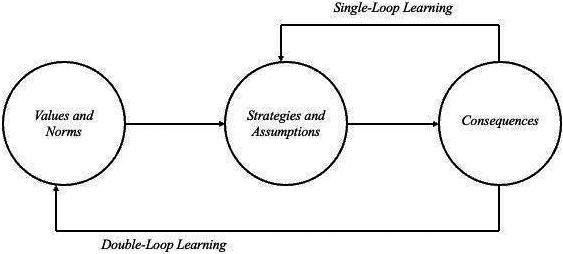
Argyris & Schön (1996) describe organizational learning using a single and double-loop analogy (see Fig. 1). In single-loop learning, an organization generates a set of strategies and assumptions around producing an output. These strategies and assumptions lead to consequences that alter the output (Basten & Haamann, 2018). When a mismatch occurs between the expected and executed output, organizations adapt their strategies and assumptions to improve. Argyris & Schön (1996) compare this type of learning to quality control inspectors working to correct product defects.
In double-loop learning, an organization’s values and norms dictate the strategies and assumptions about producing an output. When a mismatch between the intended and realized output is identified, organizations respond to ensure that the output falls within the organization’s values (Patky, 2020). The focus is not on the quality of the outcome (although errors are corrected), but on the connection between the outcome and the organization’s values (Argyris & Schön, 1996). Government bodies also modify actions either through systematic problem solving or with subsequent adjustments to agency norms and values (Gilson et al., 2009; Basten & Haamann, 2018).
Within public service organizations, different factors can influence the use of single-loop or double-loop learning. For example, single-loop learning may be implemented when complaints about the public service arise (Tagg, 2010). Limitations in the customer experience (Younis, 1997) and changing expectations about the output (Diefenbach, 2009) may also influence single-loop learning. On the other hand, pressure from political authorities may promote double-loop learning (Barbieri & Salvatore, 2010; Balasubramanian, Al-Ahbabi, & Sreejith, 2020). Changes in organizational resources, capability (Pee and Kankanhalli, 2016), and government policy traditions (Voorberg et al., 2017) may also influence double-loop learning.
We examine various factors impacting U.S. state health agencies’ learning around the accessibility of COVID-19 related websites. We focus solely on website accessibility, which is an important predictor of usability (Bai, 2019). As agencies had to adapt quickly due to the accelerated nature of information gathering during the COVID pandemic, we evaluate websites at two different time periods: March 2021 and December 2021. We analyze websites by examining the accessibility of COVID-19 information and COVID-19 vaccine location websites. We define accessibility as equivalent access to and the ability for users with disabilities to engage with a website’s content. We examine accessibility using two tiers: (1) fundamental accessibility, which refers to the basic requirements for users to engage with website content (i.e., errors) and (2) best practices accessibility, which focuses on maximizing website structure to ensure equivalent engagement is possible (i.e., alerts).
We argue that the single and double loop learning perspective explains why some states are more successful in providing accessible websites (see Fig. 2). Different factors influence the single and double loop learning process. We examine four factors: website complexity from the user side, timing of website launch, state policies, and partisanship. From a single loop learning perspective, state health agencies identify a mismatch between the expected and realized website. Potential influencing factors, like the timing of the website launch or the complexity of the website from the user perspective, may lead agencies to adjust their strategies and assumptions in creating and maintaining accessible websites. As the state health agency engages in the organizational learning process, the strategies and assumptions about website creation change and the website becomes more accessible. No agency values or norms are altered. Rather, assumptions around website functionality and strategies to generate accessible websites are influenced.
Factors influencing single-loop and double-loop learning for state health agencies’ COVID-19 related websites.
From a double loop learning perspective, state health agencies respond to the mismatch between an expected and realized output. Factors, like internal state policies and partisanship, influence the agency’s examination of values and norms. The agency adjusts their values and norms, which subsequently alters their strategies and assumptions around accessible websites, leading to an improved, more accessible website.
Most websites are not created with accessibility as the default (Wentz, Jaeger, & Lazar, 2011); website accessibility standards face escalating hurdles as new Internet-capable devices are created (Sonnenberg, 2020). Information-based, or static, websites (i.e., descriptions of public health crises) are comparably more inclusive for individuals with disabilities than interactive, or dynamic, websites (i.e., maps showing COVID-19 vaccination sites) (Jaeger & Xie, 2009; Sonnenberg, 2020). State health agency COVID-19 information websites list details about the virus, preventative measures, and other pandemic-related information. State health agency COVID-19 vaccine information websites are more complex. Users interacting with COVID-19 vaccine information websites used maps to locate a vaccine clinic, filled out forms to identify inoculation eligibility, and navigated through PDFs, pop-up windows, or online videos. Dynamic websites require more individual specifications options for different users to experience the same level of access (Jaeger & Xie, 2009).
Website complexity on the user’s end can cause increased accessibility challenges, especially in accelerated time frames (Gkeredakis et al., 2021). As state health agencies learn about the mismatch between the intended ICT output and the actual, inaccessible website, the complexity of the user-end experience might pressure organizations to revisit strategies and assumptions around website creation and maintenance leading to an altered, more accessible ICT. For COVID-19 information websites, accessibility challenges are easy to identify and address meaning the state health agencies might be more likely in the single-loop learning process. For the more dynamic, COVID-19 vaccine locator websites, the complexity of the website presents additional accessibility challenges requiring more in-depth learning to subsequently alter strategies and assumptions. This burden of increased learning suggests state health agencies will be less likely to engage in the process and produce more accessible dynamic websites, especially with the high demands on agency resources during the COVID-19 pandemic. We hypothesize:
Hypothesis 1a: The COVID-19 information websites will be negatively related to errors over time compared to COVID-19 vaccine locator websites. Hypothesis 1b: The COVID-19 information websites will be negatively related to alerts over time compared to COVID-19 vaccine locator websites.
Single loop: Timing of website launch
Pressure-filled and changing time frames can frustrate organizational learning processes and lead to performance failures. When timing issues lead to website accessibility failures, barriers of access for groups already experiencing unequal accessibility levels increase (Gkeredakis et al., 2021). If rapid iterations of a product are required, timing demands can interfere with organizational strategies and assumptions limiting the spread of needed information (Bowser et al., 2021).
Government agencies responded to the COVID-19 pandemic by quickly creating ICTs (Meijer et al., 2020). Due to the evolving nature of the COVID-19 pandemic, the speed of state health agency website development increased. We believe the timing of a website’s deployment will be negatively associated with the accessibility of a COVID-19 related website (for both the main website and vaccine locator page). We believe the earlier a COVID-19 related website is deployed, the less accessible the website is over time, due to the disruption in a state health agency’s learning process. We hypothesize:
Hypothesis 2: Early launching COVID-19 related websites will be positively related to website errors and alerts.
Double loop: State accessibility policies
The values and norms of government agencies are shaped by environmental, political, and social factors. A state health agency’s organizational learning process may depend on power-based institutional mechanisms, such as control strategies and formal policies, that can regulate values and norms (Gilson et al., 2009; Lawrence et al., 2005). Technology in government settings is mostly initiated from institutional policies and often requires top-level support to be feasible and effective (Gilson et al., 2009). Leeuw et al. (1994) argue that governments have increased learning when information comes from internal, rather than external, sources. Internal policies about website accessibility may be viewed as more credible and provide knowledge and support resources. Internal policies may carry more weight when influencing organizational values, due to the hierarchical nature of government.
We believe that state governments with more extensive internal website accessibility policies are more likely to have accessible COVID-19 related websites. The most extensive policies require state websites to meet all federally-required standards and support WCAG’s list of best-standard practices. When the mismatch between the preference for accessibility and the reality of inaccessible websites is identified, state health agencies engage in the learning process. After confronting and adjusting any norms and values in opposition to internal accessibility policies, changes in the strategies and assumptions around website accessibility practices should occur, ultimately creating a more accessible website. We hypothesize:
Hypothesis 3: The extensiveness of a state’s accessibility policy will be negatively related to COVID-19 related website errors and alerts
Double loop: Partisanship
Research in accessibility shows the importance of measuring partisanship when considering website accessibility (Rubaii-Barrett & Wise, 2008). Partisanship is also considered a strong predictor of what, and how, public health policies are adopted (Adolph et al., 2021). The executive branch’s political party (Holmgren, 2018) and a location’s general partisan atmosphere (Dekker & Hansén, 2004) helps establish norms around accessibility and ICT use in general. Elected officials, like governors, seek to control the actions of public agency personnel (Doherty, Lewis, & Limbocker, 2019). Partisan politics influence a state health agency’s commitment to establishing and maintaining access for certain disadvantaged populations (Rubaii-Barrett & Wise, 2008). In the e-government literature, partisanship has been found, in general, to impede e-government and influence the likelihood of adopting new digital innovations (Norris & Moon, 2005).
Conservative states with a high number of Republican legislators are more likely to disapprove of e-government initiatives as a way to reduce the size of government and cut costs (West, 2000). During the pandemic, governors responded to partisan opinions when making public health decisions (Choi, Allgood, & Swindell, 2022). We believe that more conservative states are less likely to have accessible COVID-19 related websites. The partisan leaning of a state should indicate if state health agencies adjusted norms and values around accessible websites during the learning process, due to the politically charged atmosphere around the COVID-19 pandemic response. We hypothesize:
Hypothesis 4: States that voted conservatively in the 2020 elections will have COVID-19 related websites that are positively related to errors and alerts.
Data and methods
Over a period of two weeks spaced nine months apart (Time 1: 3/15/2021–3/21/2021 and Time 2: 12/13/2021–12/20/2021), we reviewed all 50 U.S. state health agency websites. The time periods were chosen to capture the effects of COVID-19 on organizational learning after the start, and normalizing of, pandemic-based protocols. We assessed website errors and alerts using the WAVE Google Chrome extension provided by Utah State University’s WebAIM project (WebAIM, n.d.). The WAVE tool has been used to evaluate governments (Youngblood & Mackiewicz, 2011) and institutions of higher education (Massengale & Vasquez, 2016). For example, Yu (2021) compares the violations of fundamental WCAG guidelines (i.e., errors) for local Australian governmental and non-governmental COVID-19 information websites over time, identifying that both non-governmental and governmental websites sharing COVID-19 information were presented in an inaccessible manner. The focus of our assessment is on state health agency’s websites for (a) COVID-19 related information and (b) COVID-19 vaccine location information. The approach for locating vaccines varied from state to state, so only the landing page for the vaccine location information is evaluated. Each researcher tackled 25 state websites, focusing on a different set for the second review, and uploaded the results for review by her colleague.
The assessment focused on the accessibility of publicly available information retrieved from each state’s COVID-19 related websites. COVID-19 information websites covered a myriad of topics including how to obtain a COVID-19 test, how to quarantine, and press releases. COVID-19 vaccine locator websites presented variations on the following: a location search for vaccine sites, an inoculation eligibility form, and/or a text or map-based list of vaccine sites. Two states provided only one website with general COVID-19 information and vaccine location on the same webpage.1
We include clustered standard errors in the analysis to account for any duplication of information.
We measure accessibility using errors and alerts as reported by the WAVE tool. Users download a browser extension to assess website accessibility using the most up to date WCAG guidelines (WebAIM, n.d.). Evaluations provide feedback on multiple elements including two specific accessibility categories: errors and alerts (WebAIM, n.d.). We consider errors to be a measure of fundamental accessibility and alerts to be a stand-in for best practices accessibility. Errors refer to web elements that are missing or broken. Alerts refer to websites with web elements that are insufficient in addressing accessibility needs or have the potential to create additional accessibility barriers as the element is incomplete or incorrectly used. Websites with no errors and a low number of alerts indicate a more accessible website. A full list of the errors and alerts can be found in the Appendix.
We measure timing by identifying the difference between the first available website cache and a pandemic-related date of interest. The earliest cached dates for each website are identified using the Wayback Machine, an Internet archive. The Wayback Machine website can be accessed using this link:
We measure the extensiveness of each state’s website accessibility policies by rating the policy on a three-point scale. States are given a zero (0) if the website accessibility policy does not go beyond federally mandated practices (from the ADA and Sections 504 and 508) and focuses only on minimal WCAG compliance standards. States are given a one (1) if the website accessibility policy does not go beyond federally mandated practices and focuses on acceptable WCAG compliance. States are given a two (2) if the website accessibility policy goes beyond federally mandated practices and starts to consider optimal WCAG compliance.
We use a dummy variable (0 for Republican and 1 for Democrat) to measure state partisanship. To capture partisanship, we rely on the political party whose presidential candidate won a state’s 2020 electoral college votes. While the 2020 election results may not reflect a state’s normative partisanship, these results reflect the overall partisan leanings of each state during the COVID-19 crisis. We create the partisanship dummy variable using data collected from the United States National Archives and Records Administration (National Archives and Records Administration, 2021). For states that split electoral votes, we coded the variable based on the presidential candidate who won the majority of that state’s electoral votes.
Descriptive statistics
Notes:
The descriptive statistics for all variables of interest are displayed in Table 1. We focus on the organization as the unit of analysis. 58% of states voted for the Democratic candidate in 2020. 40% of states require government website accessibility to only meet the federal standards of accessibility. Most COVID-19 information websites went live about two and half weeks before March 11, 2020. Most COVID-19 vaccine locator websites went live a little over a month before December 11, 2020.
We capture state health agencies’ organizational learning as evidenced by changes in COVID-19 related website accessibility. There is evidence some organizational learning occurs as the average and total number of errors and alerts decrease over time. On average, a state’s COVID-19 information homepage was observed to have about 24 total errors in Time 1 and about 12 total errors in Time 2; a state’s COVID-19 vaccine locator webpage was observed to have about 21 total errors in Time 1 and about 12 total errors in Time 2, indicating, at face value increased accessibility (Appendix Table 1 reports the full breakdown). We assess the differences in total errors and alerts for Time 1 (March 2021) and Time 2 (December 2021) using two sample T-tests. As Table 2 shows, we find a statistically significant difference in overall total errors between Time 1 and Time 2 (
Two sample
Note: Standard errors reported in parentheses.
We further our exploration using a regression analysis. The dependent variables (i.e., website errors and alerts) are count measures indicating a Poisson or negative binomial maximum likelihood model is most appropriate due to the skewed distributions (see the Appendix) (Cameron & Trivedi, 1998). Poisson regressions assume that the dependent variables have no over-dispersion. Negative binomial regressions adjust for any inflated variance and account for over dispersed dependent variables (Hilbe, 2007). To determine the most appropriate method, we test whether the dependent variable is over-dispersed using the Poisson goodness-of-fit test in STATA (version 15.1). We reject the null hypothesis that the mean equals the variance (
Zero inflated negative binomial estimation is not needed due to the low number of zeros.
We present the results for each hypothesis with results displayed in Table 3.
Negative binomial regression results
Negative binomial regression results
Notes: Clustered standard errors reported in parentheses.
Hypotheses 1a and 1b state that COVID-19 information websites will have a negative relationship to errors (1a) and alerts (1b) over time when compared to COVID-19 vaccine locator websites. Using a seemingly unrelated regression analysis, we compare total errors for the COVID-19 information and vaccine locator pages (Models 2 and 3). We fail to reject that the coefficient equations are proportional (
Hypothesis 2 states that early launching COVID-19 websites will be positively related to increased website alerts and errors. Early launching of both COVID-19 information or vaccination websites are significantly related to website errors and alerts across all models. Models 1 & 4 (combined websites) show that early launching increases errors, by a factor3
These are the Incidence Rate Ratios (IRR) based on the coefficients found in Table 3.
Hypothesis 3 states that the extensiveness of a state’s accessibility policy will be related to a decrease in COVID-19 website errors and alerts. Model 2 shows that the extensiveness of a state’s accessibility policy reduces the website errors for a COVID-19 information website by a factor of 0.66 (
Hypothesis 4 claims that conservative states will have COVID-19 websites that increase in website errors and alerts. Model 2 finds liberal states are likely to have lower errors by a factor of 0.59 (
During the COVID-19 pandemic, state governments relied on COVID-19 related websites to communicate important information about the virus and vaccination efforts. These websites were published quickly and updated frequently to keep up with the ever-changing pandemic. This rapid pace produced inaccessible websites raising concerns that state health agencies were reinforcing ICT inaccessibility barriers (Moreno et al. 2018). As website accessibility issues were identified, state health agencies engaged in single and double loop organizational learning to increase ICT accessibility.
We examine two potential influencing factors for the single-loop learning: user-end complexity and website launch timing. We find no relationship between the user-end complexity of a website and changes in accessibility. We do find the earlier a COVID-19 related website went live, in relation to important pandemic dates, the less likely it is that website accessibility improves. While state health agencies may consider accessibility at the initial stage of website creation, that consideration may lag as content is edited (Barrett & Greene, 2021). Information changed rapidly and government services faced overwhelming demands throughout the course of the pandemic (Carter & May, 2020); the practical issue of updating complex websites frequently may explain why organizations did not engage in the learning process to improve accessibility.
With double-loop learning, we examine the influence of internal state level accessibility policies and partisanship on a state health agency’s values and norms. We find that internal policies influence learning leading to an improvement in fundamental accessibility (i.e., a reduction in errors), both COVID-19 related websites over time. The more extensive the state’s accessibility policy, the more likely the state is to have a fundamentally accessible website. A similar pattern exists for states that elected the 2020 Democratic presidential candidate. The connection between a state’s accessibility policy and a state health agency’s learning process point to the potential importance of detailed compliance expectations established in more extensive accessibility policies. The partisan vantage point of health policy (Pollack & Bagenstos, 2020) may explain the influence of partisanship on an agency’s learning process. As Dekker and Hansén (2004) point out, organizational learning can be positively influenced by political attention. In 2020, leading Democratic politicians focused on presenting comprehensive disability-focused policies (Mosely, 2020), which may have influenced the state health agency to adjust internal values and norms to produce a more accessible website.
State accessibility policy and partisan leaning have no influence on decreasing alerts (i.e., improving accessibility on a best practices level). The lack of improvement in accessibility on the best practices standard is unfortunate, but not surprising. The incentive to move beyond fundamental accessibility and required legal compliance to a standard of best practices is low, due to the cost, time, and required resources (Bai, 2019). However, when websites follow the best practices of accessibility, the experience is improved for all users (Bai, 2019). As we find support that organizational learning is occurring, we believe that an additional commitment of resources could catalyze increased accessibility at the best practices level.
Organizational learning can help researchers understand why organizational outputs change over time (Basten & Haamann, 2018). With our focus on factors influencing agency learning around accessible websites, we did not study the learning process or capacity that shifted (Wang & Huang, 2013). Future research may address this limitation by studying the learning capability of state health agencies (Jerez-Gomez, Céspedes-Lorente, & Valle-Cabrera, 2005) or identifying the learning process itself (Huber, 1991). We feel our research captures overall learning around an organization’s output as a response to website accessibility issues, rather than a microcosm of individual changes in behaviors or attitudes.
We chose to examine the accessibility of COVID-19 related websites a year into the pandemic to capture more regular, albeit frequent, changes to COVID-19 related websites while avoiding the frenetic chaos that encapsulated the first year of the pandemic. This research serves as an exploratory study that can be applied across different agencies in state or local government that engage in regular website maintenance. The amount of data stored in the Internet Archive allows for more data points to be collected over longer periods of time. We encourage other researchers to examine the changes in accessibility local governments websites, and other ICT forms, both within and outside the U.S.
This paper contributes to the literature and theory in several ways. First, we provide insight into how different factors influence a state health agencies’ learning processes as evidenced by improved website accessibility. Second, public administration researchers rarely focus on the inequities experienced by the disability community (Sabharwal, Levin, & d’Agostino, 2018), which are perpetuated by an ever-growing reliance on technology. Members of the disability community face untenable barriers when accessing government ICTs. State health agencies, and other government units, must learn from current website accessibility failures to improve their service for all constituents. More research is needed to understand what other factors may influence organizational learning about website accessibility, including organizational characteristics. State governments should consider doing more than the bare minimum to increase ICT accessibility for constituents, especially the disability community.
Footnotes
Supplementary data
The supplementary files are available to download from https://dx-doi-org.web.bisu.edu.cn/10.3233/IP-220045.
Author biography
Michelle Allgood is an assistant professor in the University of New Mexico’s School of Public Affairs. Her research focuses on public management, workplace coping and employee well-being, and equity and access issues, especially for members of the disability community.
Ashlee Frandell is an assistant professor at University of Nevada at Las Vegas. Her research interests are on technology use and equity in the public sector, which includes public-private partnerships, STEM workforce mobility and policy communication and the inclusion of disadvantaged groups.