



Abstract
Handling complexity in conceptual ship design processes requires a thorough understanding of complexity aspects in general. More than 100 scientific papers on the subject published since 1962 are, therefore, reviewed and discussed in this paper. The paper expands the understanding of complexity theory by reviewing the literature in the engineering domain. Different definitions of complexity, characteristics of complex systems, aspects of complexity in design, complexity sources, and its drivers are explored and discussed in detail. Furthermore, the findings are arranged into relevant complexity factors in ship design. Related complexity factors in ship design, are also discussed by use of examples from everyday ship design practices. This study is a theoretical elaboration to shed light on the current practice and future research direction in handling complexity in conceptual ship design processes to improve competitiveness.
Introduction
Complexity has been discussed in several research domains, such as physics, biology, chemistry, mathematics, computer science, economics, engineering, and management, for a long time. The idea of a ship as a complex system is also well established in the naval architecture and marine engineering discipline. It was recognised in the early ship design spiral theory [35], which already addresses ship design as an extremely complex problem. A ship as a product is a unit formed by many diverse parts and subsystems, which are integrated to serve the proposed mission requirements. Complexity research relating to ship design and ships’ supplementary work processes is more recent. The authors of this paper deal with such complexity in conceptual ship design projects daily. Typically, the different stakeholders involved in ship design projects will have alternative or even contradictory expectations. These expectations result from different motives, desires, and purposes, thereby the ship design process becomes a complex and challenging task. Multiple selections of main dimensions to form different size configurations, different equipment and technology and/or capacity and capability choices or the selection of alternative materials are normal ship design practices. In such circumstances, design parameters relating to multiple functional requirements. At the same time, these functional requirements are interrelated and in many cases in conflict with each other [29]. Very often, small changes in criteria selection or vessel particulars can have significant consequences for the eventual and final performance of the vessel design [43].
In addition to the ship’s design-related complexity aspects listed above, externalities such as a prevailing dynamic business environment, changing customer expectations, and competition influence the development of expectations or requirements of a ship design in the works. Such a fuzzy combination of real-life internalities and externalities most often increases the complexity of the ship design object, process, and context. This seems to be a quite frequently occurring situation that ship design firms and shipbuilding companies cannot escape from or neglect. Thus, they need to deal with the complexity issue in an appropriate way to avoid ill-founded decision making [10,57,118]. In recent years, inappropriate complexity handling in naval architecture and marine engineering processes is being associated with negative consequences for the design and later in the operation of the vessel. Ill-founded decision-making in the early stages of ship design processes can easily lead to extra new-building costs, inferior performance, project productivity loss, and in some cases a complete or partial business case failure. However, Mauror (2007) explains that there is also a positive side of complexity, which helps the firms to gain higher market share by improved product competitiveness and sometimes strategic advantages, respectively. To reap the benefits of a complex situation, a proper identification of the aspects of complexity and a deeper understanding of its drivers and enablers are essential tasks [65,100,117].
Addressing the issue of ship design complexity and methods for handling it, is not a new topic in literature. Evans (1959) discusses ship as a complex structure and its ship design process based on design spiral is also perceived as a complex and time-consuming process [35]. Mistree et al. (1990) addresses decision making aspects of ship design complexity and suggests critical system thinking to handle it in a conceptual ship design process with an additional lifecycle assessment of the design solution [73]. Levander (2007) introduces system based ship design to deal with structural and functional aspects of ship design complexity [61]. Andrews in different articles addresses structural, functional and decision making complexity aspects in ship design and uses a systemic block building diagram approach to handle such aspects [4–6]. To handle the conflicting nature of design objectives in the early ship design process, Singer et al. (2009) propose set-based design as a means of handling decision-making complexity [104]. Gaspar and Ross (2012, 2013) introduced and applied the Epoch-Era analysis method to approach contextual and temporal complexity in ship design [38].
Most of the reviewed articles in ship design are primarily about complexity handling. They typically address structural, functional and decision-making aspects of complexity in early ship design and introduce different methods to handle them. The focus of this paper is primarily to create a better understanding of different complexity aspects influencing the ship design, by involving the research findings from different industries including ship design. The idea is to first identify and summarize different aspects of complexity and their constituting items. A new ship design complexity model is therefore reviewed in this study, which includes at least product, process, and organization (firm) complexity aspects. Then we translate them into a ship design context by using examples from daily design practices. This article reviews and elaborates findings of different relevant researches but is not limited to previous complexity aspects categorizations in ship design literature, including: structural, decision-making and functional aspects by Andrews (2006), Mistree et al. (1990), Singer et al. (2009) [6,74,104], five system complexity aspects by Gaspar et al. (2012) [37], organizational and technological aspects by Delft University of Technology [49].
Research methodology
The method applied in this study is an integrative literature review approach [106] and the categorisation of information elements. Research articles, books, and other relevant published texts are collected, collated, and synthesized during this review process. In contrast to the systematic literature review method, an integrative review approach was selected for this research since the purpose of this review is not to cover all articles ever published on the topic [106]. Rather the aim was to combine different perspectives to create or enhance a new theoretical model [106], classifying different factors constituting complexity in ship design. The topic of complexity has been approached differently by different researchers and studied within diverse disciplines. Therefore, to make a better ground for the conducted taxonomy the scope of this research is not limited to ship design literature and expanded to cover different industrial sectors. This paper reviews the literature covering complexity theory applied in different disciplines. Engineering systems, manufacturing, and product design, project management, supply chain management, shipbuilding industry, the automotive industry, the aerospace industry, information technology, and organisational theory have been reviewed sectors in this review (Fig. 1). Qualitative evaluation is used to synthesize the articles. Further design complexity taxonomy process and translation of the identified factors into ship design context was conducted by the support of expert group judgment. Microsoft and Google open accesses search engines beside scientific publication web domains of Elsevier-Research gates and NTNU online library are used in the search process. Complexity theory, engineering design complexity, ship design complexity, complexity handling, complexity management, complexity in the manufacturing industry, complexity measurement, complexity aspects, and complexity drivers are used as main keywords to conduct the literature search. Almost 50% of the publications reviewed in this study come from the field of manufacturing and product design, and 70% of all the studies were published after 2010. This paper focuses, therefore, on recently published articles with a specific focus on design and manufacturing applications. Such a reference selection makes the study more applicable and relevant in exploring how complexity is approached in different industries. The findings of this research can be applied in the study of complexity in conceptual ship design.
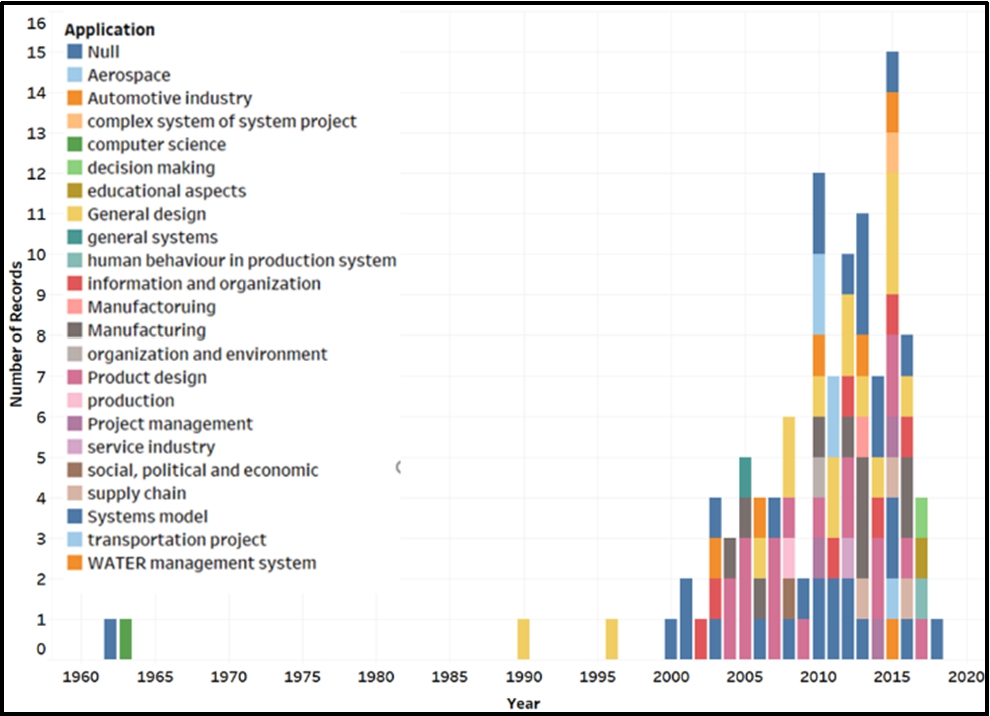
Timeline and the segments of the reviewed papers.
This literature review supports the identification of complexity aspects. The validity and relative importance of the complexity aspects are evaluated based on the number of publications citing a specific aspect. However, a qualitative evaluation of the definitions and related drivers of different identified aspects are used to categorise different complexity aspects into nine main complexity factors constituting ship design complexity.
Definitions of complexity are diverse, and there is no universal definition for it, as Simon states [103]. The term complexity is context-oriented, and, often, experts have a different perception of complexity due to their domain of knowledge and experience and area of application [82,87,95,117]. In this paper, ship design complexity is discussed in relation to the ship design as a product, ship design process and design organisation, a ship design firm, and the market.
The Oxford dictionary defines [1] the word ‘complex’ as something ‘consisting of many different and connected parts’ which is ‘not easy to analyse or understand’. Simon (1962) [103] indicates complexity as part of system characteristics and defines it as a system usually consisting of many members, elements, or agents, which interact with one another and with the environment in a non-simplistic way and where the properties of the parts and the laws of their interaction do not completely explain the properties of the whole [103]. Suh (2005) states that complexity is ‘the measure of uncertainty in achieving the functional requirements of a system within their specified design range’ [110]. He defines a good design as one which handles the complexity by reducing the number of design elements and components and their internal relations and dependencies while still satisfying all functional needs and requirements [109,110]. Kolmogorov (1963, 1998) presents complexity as a measure of the computational resources required to specify an object [58]. Nikosa (2014) discusses complexity as the sophistication of structure and stored information on how the system is actually made and works [92]. Fabac (2010) [36], Maurer (2007) [64], Asan (2013) [10], Ramasesh (2014) [82], and Elmaraghy et al. (2005) [30] define a complex system as one consisting of several elements with interdependency among the elements. A large variety of elements and their changes over time (dynamics) are also brought into the definition of complexity [4,37,106,118].
The term ‘complexity’ is sometimes used as a synonym of the term ‘complicated’ [117]. This goes back to the vague definition of complexity and the way the system is interpreted by practitioners. The Cynefin framework in knowledge management [105] postulates that the external environment describes five main domains of understanding system behaviour in ordered, unordered, and disordered categories. In this categorisation, ordered domains are known (simple) or knowable (complicated) systems, while un-ordered domains can be complex or chaotic. However, the borderlines between these domains are very flexible [25,46,95,103]. The main difference between complexity and complicatedness is the ability to understand the causalities and predict the performance of the system. While in complex systems the behaviour of the system is not predictable through the identified interaction of system constituents, in complicated systems, by assigning adequate time and resources, it is possible to understand the causalities of the system elements and predict their interactive behaviour. In a complex system, finding the patterns and explaining the events is an important task to understand the behaviour of complex systems although most often it relates to the perception of the practitioner [56,109,110]. Such perceived complexity may comprise measurable aspects of the objective system complexity besides the aspects that can only be considered in conjunction with the human involvement [20].
Common criteria and characteristics of complex systems
Jackson (2006) looks at complexity from a system perspective and defines a system as complex when the functioning of the whole depends on its parts and the interactions between those parts [50]. Levander (2007) defines ships ‘as a system operating in a dynamic environment’, referring to the ocean. Based on his definition, the ship is a technical system consisting of several interconnected subsystems contributing to its overall performance and complexity [61]. Such a definition of ships comprises the definition of complexity in itself by addressing several subsystems/constituents and their interconnectedness and interactions. Hence, the importance of expanding the boundary of the research domain from the definition of complexity to understanding the characteristics of complex systems is conspicuous.
In the Architecture of Complexity, Simon (1962) describes the significance of a hierarchical system structure for complex systems, saying that a hierarchic system is ‘a system that is composed of interrelated subsystems, each of the latter being, in turn, hierarchic in structure until we reach some lowest level of elementary subsystem’. According to this definition, the difference between a system and a complex system is in the interpretation of the meaning of the word ‘large’ [103]. Later, in 1969, Von Bertalanffy defined a system as a complex of interacting elements. He adopts systems thinking in all disciplines to discover the general principles applicable to all systems [119].
Summarizing different definitions of complexity in the reviewed literature, six common criteria are identified, which are used frequently to explain complex problems or complex systems. Table 1 shows these criteria based on the numerous definitions found in this literature study. Whereas a variety of elements or an intensity of interaction among the elements (connectivity) and the dynamics of the elements are used more in the definitions of complex systems. The type of relationships, the number of hierarchical levels, and the number of possible states is less addressed in the reviewed literature.
Common criteria of complex problems found in the literature
Common criteria of complex problems found in the literature
Figure 2 presents the influence and interrelationship of different complexity criteria on each other and their influence on complexity. For example, the degree of connectivity is directly influenced by the dynamics of the elements and the type of connection. Such connections mean the degree and type of connectivity among system elements can change over time in complex systems.
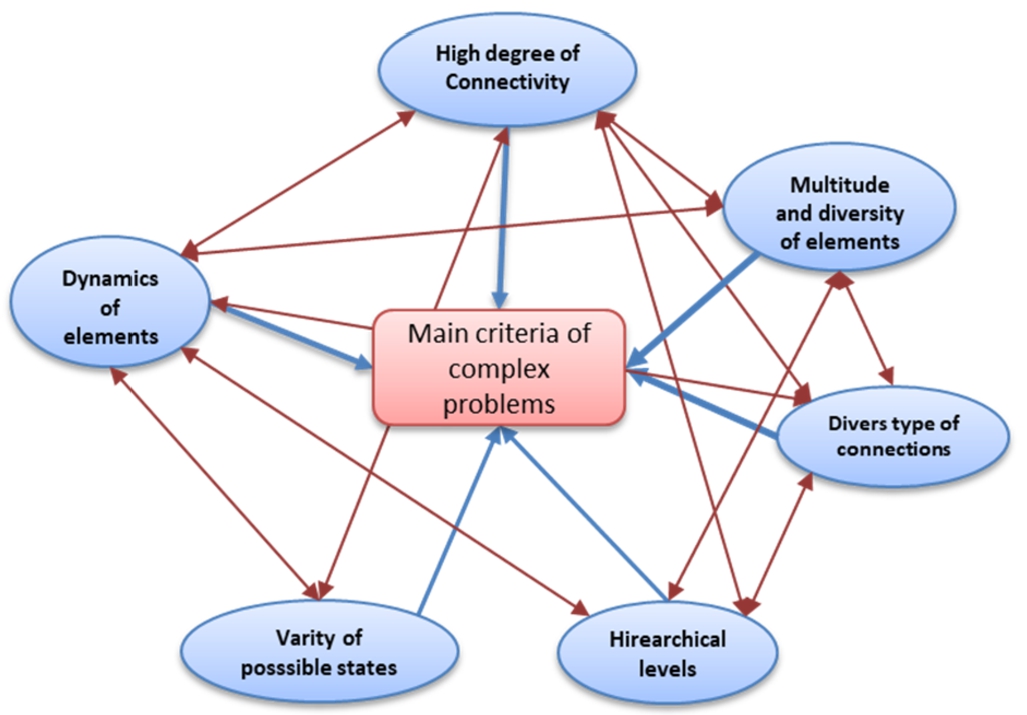
A causality map representing the different criteria associated with complex problems.
For example, in the traditional ship design process, the level of experience, the competencies, and even in some cases the intuition or gut feeling of the naval architects have a high level of influence on the final design solution. However, over time, by automating more of the design process, the level of such influence will be lower. A similar argument is also applicable to the number of elements and their variety, which can change over time. These changes in the number of elements will also influence the connectivity and the type of interactions between the elements. Complex adaptive systems are examples of such a phenomenon where adaptation assumes change, fluctuation, and observable measurements in a process that uses the information to adjust and be fit for the surrounding changing environment [107]. As a consequence of these criteria, complex systems have some specific characteristics [17,64]. These characteristics of complex systems are further elaborated in the next paragraphs with some relevant ship design examples.
Ships are defined as systems [61] operating in a larger logistic system or fleet of vessels (system of systems), which are in contact with their operating environment and eco-system. According to literature complex system have eight specific characteristics. These characteristics of complex systems are important to be aware of and understand to be able to handle the complexity of ships both in the design process and at the product level [17,64]. According to reviewed literature, seven characteristics of complex systems are identified as follows:
Hierarchy: complex systems have subsystems and are a subset of larger systems and the relationships among them are complicated and enmeshed [32]. As explained ships are complex of sub-systems that operate in a larger system as a fleet of vessels or in a specific logistic setting.
Control: Complex systems typically contain controlling mechanisms to ensure the stability of the system, its existence, and its performance based on a set of predefined functionalities. The controlling mechanism holds the system together and maintains a stable state of operation. For example, dynamic positioning (DP) systems in offshore vessels are controlling mechanism, which controls the position and heading of a vessel at sea during different site operations like cargo transfer to oil platform or standby position near the platform [41,85,111,116].
Communication: information regarding the internal and external states of the system is passed among the elements of the system. To execute such a DP operation, information-flow between external environmental condition and internal vessel systems and subsystems is essential. Different vessel environmental sensors like wind and current sensors capture the environmental data and transfer it to DP processor. The global positioning system (GPS) monitors the position of the vessel in a real-time condition. Environmental forces are calculated and when the vessel moves from an intended position, DP computer calculates the required thrust, which will then be applied by the thrusters to maintain the position of the vessel. Such information-flow between external and internal systems is a vital part of DP operation [1,68].
Emergence: at different levels of systems different properties emerge which is apparent in a system as a whole and does not exist for any part individually and cannot be assessed by looking at the individual property of the parts. Position keeping capability emerges when propellers, environmental sensors, DP processor, GPS, and power generation system are integrated as a position keeping system. Such capability does not exist in each of the individual components and emerges in the system as a whole. If one of these constituent component fails, the whole position keeping capability will also fail [32,87,98]. In complex systems emergent behaviour can also be thought of as unexpected behaviours that stem from interaction between the components of an application and the environment [54]. The case of Ulstein X-Bow is a good example of such emergent behaviour. The primary intentions for such a bow shape development had been to improve the hydrodynamic performance, besides creating a unique appearance for Ulstein designs as a branding strategy. However, when the first vessel came into operation, substantial improvements in seakeeping performance was realized in harsh sea conditions compared to initial thought and expectations.
Phase transition: a complex system internally can suddenly respond to an external change by taking up a new form. It is the same system exhibiting different properties in responding to different environmental constraints [27,40,111]. Vessels parametric resonance as a response to the specific environmental condition is an example that can lead to phase change from stable vessel condition to unstable or even capsized vessel. Parametric roll resonance is a ship roll motion induced by a time-varying restoring arm as a parameter in equations of motions. When the natural roll frequency of the vessel is equal to wave encounter frequency, induced roll motions could be so severe that a ship could even capsize, which is called low cycle resonance or principal resonance. Such a phase transition from stable to unstable form is a response of a ship as a system to changes in the frequency of encountering waves. Since vessel natural frequencies are the consequences of the physical properties of the design-shape, form, and weight distribution, a design of a vessel should have a range of natural frequency away from typical wave frequencies of different operational regions. The other example of phase transition in the complex maritime market is the vessel status change from being in service to laid up. Market dynamics and its changes can always influence the vessel’s operational contract and service status. During the last 5 years as a response to a significant drop in the oil and gas market almost 30% of different offshore vessel types have faced such a phase transition. Where some temporarily and some are permanently laid off.
Nonlinearity: the system path is nonlinear over time. Therefore, even a large perturbation in the environment may have small effects on the system performance or small perturbations may have large effects on the system [9,32,44,49,119]. The dynamic maritime market environment and its changes over time is a good example of the nonlinearity characteristics. Because of such nonlinearity, it is an extremely difficult task to predict the market situation for the period of vessel operation. Some statistical regression and scenario mapping methods are used to determine the market trends and their optimistic and pessimistic scenarios based on historical data. However, all these approaches are associated with significant uncertainty where the actual results might be different than forecasts.
Adaptiveness: in response to external stimuli and changes, complex systems adapt themselves to new situations or take advantage to maintain and/or to improve performance [45,69]. During the last five years as a response to such a massive drop in the maritime market, design firms, ship operators, and shipyards have tried to adapt their organization to new situations to survive. In ship design firms, developing more effective design tools, efficient process and efficacy design teams have been some of those adaptation strategies to safely path through the situation. In Ulstein, although the number of employees has been reduced compared to good oil and gas years, more new ship market segments are included in the product and service portfolio as a consequence of a necessary change process. New service elements like big operational data analysis and digital services are also included in the product and service portfolio as a result of such adaptation strategies, to respond to the new needs in the maritime market.
Handling complexity is a critical task in vessel design and has a significant impact on the success of new vessels. Hence, complexity drivers and critical factors that determine design complexity need to be identified, classified and recorded. Interdependencies between the complexity drivers have to be analysed, and their influence on design portfolio development should be determined within the design process [31,73,106,109]. According to definitions, complexity sources are the origin of complexity. In the reviewed literature, complexity items and complexity drivers are considered synonymous and represent that which increases the complexity of the system, whereas complexity factors or complexity aspects typically represent how researchers have categorised complexity drivers based on their relevance to the domain of application. Typically, different factors or aspects contain several complexity drivers. A few practitioners treat complexity factors as synonymous with drivers. However, in this paper, we use the term complexity factor as a group of relevant complexity items in relation to the ship design context.

In the literature reviewed in this study, the main sources of complexity are divided into internal, external, and interface sources [27,64,65,71,80,82,92,95,100,118]. Internal complexity, indicated in Fig. 2 by purple, is experienced within the organisation, the design process, or the product itself when design requirements are conceptualised and converted into physical products. Internal complexity deals mainly with the structural architecture of the product and its operational performance. Moreover, it contains the organisational structure and design processes, which are incorporated into the ship design development and production process [27,29,55,97,111]. External complexity, which is indicated by grey in Fig. 3 [94,97], is generally raised by sources outside the control of the system. Usually, external sources are in a direct relationship with the system and influence its performance. Typically, the internal organisation and processes are also influenced by external complexity sources [70]. Interface complexity is indicated by orange in Fig. 3. This type of complexity is generated from the interaction between internal and external sources. Items such as supply chain, information management systems, and customer relationship management are the drivers of interface complexity. Figure 3 represents a model showing the relationships between the external, internal, and interface complexity sources of the ship design process.
In conceptual ship design processes, vessel dimensioning and equipment choices, as well as the vessel mission requirements, are part of the internal complexity factors. However, all these factors are also influenced by, for example, the market environment (good or bad market situations), the intensity of the purchase behaviour of customers, and, likewise, new rules and regulations. For example, the new emission regulations imposed by the International Maritime Organization (IMO), which entered into force in January 2020, directly influence the selection of the power plant system and the use of specific energy sources, such as hydrogen or biofuel, marine diesel oil, or LNG. Likewise, uncertainties in the future market can lead to more of a flexible, prepared-for-type design solution – a future proof. These are some examples of ship design situations where an internal design process complexity is influenced and, in most cases, enhanced by external sources. Different studies in the design and manufacturing industry, as well as in the ship design sector, show how the increased variety and enhanced functionality of products lead to increasing complexity in the product development process. Thus, the increased complexity of the process requires a deep understanding of the multi-layered contexts in the organisational project setup and process improvements in the design organisation – the firm [95]. The more volatile the market, the greater the influence of external complexity due to increased uncertainty [6,106]. Market competition and competitiveness, supply and demand, and technological advancement are some recognised external market-related items in manufacturing companies [97]. Push for higher efficiency, smarter control, and the instability of the end user for an information device are other types of market-related drivers in the industry [108].
Complexity items based on their sources can be delineated into four groups of i: product-oriented, ii: market-oriented, iii: process-oriented, and iv) organisational. This type of categorising is common in the manufacturing industry. Complexity items such as product variety, technology changes, multiple system elements, dynamic opportunities, uncertainty in information, variety of system elements, internal complexity of sub-elements, number of relationship among elements, lack of encapsulated interactions, lack of observer capability, un-intuitive system organisation, lack of experience and very large scale-up, fragmented markets, power of customers, dynamism of the business environment, number of competitors in new markets, power of the competitors and their market shares, industrial collaborations, number of suppliers, degree of differentiation and the level of interrelationships among the suppliers, uncertainty (e.g. limited information), culture, politics, and geography or weather changes are relevant identified complexity drivers in such categorisation [5,38,42,55,57,57,65,82,92,108,109]. For example, design layout and geometries as well as physical and engineering characteristics are defined as product-oriented items, and the number of tasks used to design or build a ship, interrelations among the tasks or ill-founded assembly sequence of vessels at the yard are defined as process-oriented complexity items. Alternatively, the organisation, culture, resources, capabilities, knowledge and experience of designers, product specifications, requirements, and market needs are all categorised under the label of the market and organisation category of items [27,87].
In addition to categorising complexity items based on their sources, other types of factor groups are also observed in the literature based on the different perspectives of researchers and their domains of application. Simon (1962) addresses the structural aspect of complex systems by hierarchical form and distinguishes between the physical form and time for the development of a system by static or dynamic terms [103]. Suh (1995) [109,110] also explains that complexity can be static (time independent) or time dependent (dynamic) depending on whether or not the system range changes as a function of time. He also groups different complexity drivers into real or imaginary factors. Real complexity, in this definition, is an objective measure used to demonstrate the level of associated uncertainties in design to meet required functions, while imaginary complexity arises because of the designer’s lack of knowledge and understanding regarding a specific design problem and task. By such a categorisation in addition to time, the interpretation of human competences and perceptions of design needs are also addressed as other relevant complexity aspects. In ship design practices, such imaginary complexity, because of the wrong interpretation of design needs, has a dramatic impact on the design cases. For example, in the design of a cruise ship, the wrong interpretation of the required vessel luxury level can lead to a design solution that does not comply with passengers’ expectations and can eventually influence the operational reputation of the vessel. Sometimes, the interior luxury and complexity of the product and production processes are underestimated in the early conceptual design phase. Such circumstances can easily end up in a lower estimated contractual price than real construction cost, which again can influence the survival of shipyards due to losses in finalising the new-building project. A wrong interpretation of the design task at hand, by overestimating the interior luxury level, in some cases, might end up in a higher estimated project cost, which, eventually, can lead to a loss of the commercial project in tough market competition when the ship is put into operation.
In another study conducted at Delft University of Technology [49] complexity aspects are categorized into organizational and technological aspects. In that categorization organizational aspect of complexity is divided into vertical and horizontal subcategories. The number of different nationalities, languages, and standards, number of locations, size of the project team, experience with partners involved, size in CAPEX, size in engineering hours, required local content, number of departments directly involved with construction and required local content are introduced as items constituting such categories. In their categorization technological complexity addresses the number of systems and tasks, variety of tasks, experience with technology, experience with partners involved, global newness of the technology, interrelations between technical processes, dependencies between tasks, interrelations between technical processes, dependencies between tasks, and variety of tasks. In an alternative categorization of system complexity, Adam and Rhodes (2010) identify five aspects of complexity relating to engineering design. In their classification, structural complexity relates to the form of the system components and their interrelationships. Behavioural complexity is related to performance and operations, and reactions to stimuli and contextual drivers represent the circumstances in which the system exists. They also define a temporal category, which relates to the dimensions and properties of the systems over time, and a perceptual category as those complexity drivers which relate to stakeholder preferences, perceptions, and cognitive biases [86].
Conducting this literature review, we have identified 20 different terms used in the literature to explain different aspects of complexity. After qualitative scrutiny and synthesising these different terms, we identified similarities in their descriptions. Through such an observation we suggest merging some aspects and reduce the number of aspects to nine complexity factors in this paper. Table 2 summarises 20 different aspects to explain complexity identified by this literature study and their categorisation into nine factors representing the relevant complexity factors in ship design (F1 to F9).
Summary table of different relevant complexity aspect identified in literature
(Continued)
The 20 different terms identified and used by this research are suggested to be considered as nine main ship design complexity factors based on the number tally of citations and frequency of appearances. The suggested factors are as follows: structural complexity, temporal complexity, behavioural complexity, spatial complexity, contextual complexity, perceptual complexity, decision-making complexity, directional complexity, and technological complexity. These nine factors can be integrated and represent the construct ‘ship design complexity’.
As a premise to handle complexity in conceptual ship design, we need to translate and interpret these nine complexity factors into ship design application. To do so, we look both to the factors and the sources which generate such complexity factors. Four sources of product, process, organisation, and market adopted from the manufacturing literature are used in our interpretation of these complexity factors. In such circumstances, each factor can relate to one of the sources of product (ship design solution), process, or firm or market or may relate to two or more simultaneously.
Structural complexity relates to the architecture of a product, a process, or an organisation and means many elements, high degree of diversity among elements, and variety of interconnections between elements. In product design, structural complexity reflects the number of product components, their diversity, and different types of material and degrees of interconnectivity between different components. The structural complexity of a process typically reflects the number of process steps, interconnectedness between different process steps, diversity in the types of operations in each step and degree of interrelations and priorities between various steps of the process. The variety of decision points in the process and the number of feedback loops as well as redundancies in the process [30] also directly influence the structural complexity of a process. At the organisational level, structural complexity is defined as size, the number of hierarchical levels [72], and the number of different professional specialisations that exist within the organisation [26]. Andrews in his extensive studies (1986, 1998, 2007, 2018) addresses this aspect of complexity and utilizes the systemic thinking and complex systems terminology when justifying his comprehensive methodology for ship. He uses, the building block approach as a design method; to reflect internal system architecture and interrelationship between different systems [4,5,7]. The method presents a functional breakdown of the system into semi-independent building blocks as a design technique. This strategy can be understood to handle structural complexity. Erikstad (2009–2019) also addresses the structural aspect of complexity in ship design and presents an overview of modularization related to shipbuilding, emphasizing the modularization task, platform technologies in the product development and tendering phase of the process [34]. Levander (2007) in his system-based design approach, addresses the structural aspect of complexity by breaking down the vessel into systems and subsystems and further designing the vessel to respond the needed functions [61]. Caprace and Rigo (2012) address the structural aspect of complexity in conceptual design by shape factor and the number of hierarchical levels in system architecture [22].
The behavioural complexity of a vessel design relates mostly to its performance in different environmental or operating conditions and reactions to stimuli [86]. Gaspar et al. (2012) suggest decomposing the expected performance of the ship into key performance indicators (KPIs) by the use of model-based tools [38]. Applying methods like simulation in design [33], big data analytics of operational data are the methods [90] to capture better the behavioural aspect of the developed solution in its operational lifetime. It is proposed that there is no possibility to estimate this so-called higher-order behaviour by aggregating the behaviour of different constituting elements [50]. In general, behavioural complexity relates to the nonlinearity of performance in complex systems [32]. For example, to estimate the operability of an offshore crane operation in different environmental conditions, it does not suffice to aggregate the result of a crane factory test and vessel movements in a simplistic model. The operability is also a result of nonlinear interaction between environmental factors, physical factors, and human behaviour in the operational condition. Different crane operators or captains of the ship can exhibit different behaviour in similar operating conditions based on their attitude, level of competences, and experiences. Wave period, wave height, wavelength and direction, wind, and current speed and direction are examples of environmental factors influencing crane operation. The natural frequency of the crane and the vessel are the result of physical characteristics and the geometry of the vessel and the crane, which influence the complexity of the operation. Figure 4 schematically illustrates a support vessel loading cargo on a large semi-submersible. All explained environmental, physical, and human-related factors influence the behavioural complexity of such an operation.

Schematic model of offshore crane operation.
Spatial complexity as explained in Table 3 relates to space utilisation in product or distributed design offices in different geographical places in process or any type of organisational distribution [77]. This type of complexity can be looked upon as part of structural complexity of product, and handled by approaches like building block diagram approach as Andrews (2006–2007) suggests [6,7]. However, structural complexity of the product in most of the reviewed literature is the consequence of product size, diversity, and variety of elements and their internal interactions. In daily ship design practices, we can compare two ships with identical size and installed functions that have different compartmentation and internal arrangements. In such circumstances based on our definitions both vessels have similar structural complexity, but due to different internal arrangements or different sizes of main equipment one can face space issues compared to the other one. As a recent case example, Ulstein has introduced its next generation of Factory Stern Trawler (FST) vessel into the market. In the new generation, a two-factory-deck solution is used to separate wet and dry operations. A new vessel vertical functional arrangement is implemented to smoothen the onboard logistics compared to horizontal functional subdividing in conventional trawlers. Such improvements are considered as part of spatial complexity handling strategies (Fig. 5).
Translation of different complexity factors into ship design practice
(Continued)
(Continued)
(Continued)
(Continued)

Conventional stern trawler arrangement with the arrangement of new FST solution.
Contextual complexity is related to circumstances in which the system exists [86] and raised by the environment a system operates in or a product is designed for. This type of complexity can be looked upon from product, process, organisation, and market perspectives. For example, the environmental condition of the region a vessel is designed for drives product-oriented contextual complexity. However, market competition, different actors in the region of operation, age and size of the vessel, and other relevant market information constitute the market-oriented contextual complexity aspect [38,120].
Perceptual complexity is a subjective aspect that is directly related to human factors such as physical or psychological moods, experience level, background, competencies, perceptions, and semantics of the design problem [39,110]. Andrews (2018) presents the example of design requirements and argues they are rarely expressed in the form of an explicit and coherent statement. For that reason, the nature of the problem has been characterized as being ‘wicked’, in that determining the actual requirements is the major challenge in preliminary design. The matter of the dialogue that takes place between the user and the designer, in order to clarify the requirements, is fundamental in the formative stages of initial design [5] and depends the way the needs are communicated and perceived. Perceptual complexity can relate to the perception of a visual image [77] or problem at hand or a design solution and is mainly a product- or process-oriented aspect. The type and level of details in the information communicated with the customer is a type of a product- or process-oriented perceptual complexity driver. Figure 6 compares the two type of vessel arrangements which can be communicated in the early conceptual design phase. Figure 6a provides detailed information on the arrangement of a vessel. However, based on experiences at Ulstein, a simple, functional diagram such as that in Fig. 6b improves the effectiveness of early meetings with customers to achieve a common understanding of the vessel design expectations and functional needs. At the organisational level, the communication department, the sales department, or after-sales services all are types of functional activities which directly influence perceptual complexity. For example, digital developments these days have provided a great opportunity to provide different types of vessel operational data services as an after-sales service to keep a long-term relationship with the customers. Our experience shows that, over time, such types of after-sales services create new trust and mutual ties between design firms and their customers in addition to substantially facilitating the understanding of the real functional needs of customers for their future projects.

a) Detailed general arrangement, b) simple functional diagram.
Decision-making complexity is an inherent part of conceptual ship design [115]. Typically, a final design solution should be selected among several alternative choices due to specific reasons and rationales. Decision-based design by Mistre et al. (1990) [73], set-based design by Singer et al. (2009) [104], critical system thinking in ship design (Ulstein & Brett 2012) [115] are different methods introduced and applied in ship design to address and handle this aspect of complexity effectively. The decision-making complexity factor can generally have sources in the product, process, firm, or market. Alternative vessel functions or different propulsion types are examples of the product-based decision-making complexity aspect while deciding about the precision level in different design steps, types of tools for running, and different decision gates in the design process are examples of the process-oriented decision-making complexity aspect. The capability of competitors and availability of substitute designs in the market are indications of market-oriented decision-making complexity.
Temporal complexity is a type of complexity which is related to time. Process aspects of temporal complexity relate to the process time needed for different design tasks. For instance, in the ship design process, the required time to develop and run a computational fluid dynamic (CFD) analysis or to perform a local and global structural analysis in a finite element model are part of this type of temporal complexity. The market aspect of temporal complexity characterises changes over time as well as time-based properties such as survivability or adaptability and the resilience of the system or the firm over its lifespan [37,84,86]. Uncertainties related to supply and demand in the market, charter rates, changes in the operational profile of the ship, or new market needs over time are examples of temporal complexity aspects in ship design.
Directional complexity is a part of organisational complexity which relates to the ambiguity of vision in design firms and unclear work-processes [113]. Directional complexity is found in organisations or design environments characterised by unshared or multiple interpretations of goals and objectives [11]. Peter Senge (2004) [99], in his book The Fifth Discipline, suggests learning organizations that can better comprehend the interconnectedness of people, ideas, and their operating context to develop sustainable competitiveness. He describes four necessary practices or disciplines: personal mastery, mental model, shared vision, and team learning, when integrated into a cohesive whole via systems thinking, they are conducive to an effective learning organization. The idea of directional complexity in such taxonomy is to demonstrate that aspect of complexity in design which is typically neglected in the studies. At the product level, any ambiguities or uncertainties exposed to the design environment due to new rules and regulations are considered as part of directional complexity.
The technological complexity aspect is driven by technological advancements and technology changes over the years in the maritime industry [21]. Technological systems have become increasingly complex over time because of knowledge and technologies’ cumulative nature. Technologies also become more complex due to their growing range of functions. [125. For example, new plug-in hybrid-battery power plant solutions are more complex in design, construction, operation, and maintenance compared to conventional diesel-electric/diesel-mechanic solutions. As another example, providing alternative green energy sources such as hydrogen has faced significant technological problems regarding production and distribution over the last few years.
Table 3 summarises the findings of this research work regarding the nine synthesised complexity factors in the ship design context. The nine introduced complexity factors are described based on their source of initiation from product, process, organisation, or market. The presented 2-dimensional taxonomy table illustrates how different complexity aspects can have different meaning and constituting items based on the originating source. Some of these items inside the table can relate to more than one aspect – source. However, it is tried to allocate the items to the most relevant cell, based on expert group judgment. To develop and verify the table, a group of five experts from Ulstein and NTNU was employed in this research to review the points, and their related examples. Based on our reviewed literature directional complexity addresses more process-related and organizational complexity aspects. Hence in Table 3, Factor 8, the product-related cell is not filled with any relevant item.
A more simplistic conceptual model with a highest possible explanatory power is the most favourable situation as Occam’s Razor states ‘plurality should not be posited without necessity’. The result of our literature review study shows most of the previous works in the topic including five aspect framework by [86] address primarily product/system related complexity aspects. While we experience in our organization and we see in other ship design firms, process related, or firm related complexity aspects have at least equal if not stronger consequences on ship design competitiveness. Therefore, the necessity for new elaborations on ship design complexity aspects and their drivers were observed during the process.
This article focuses on the identification and operationalisation of complexity in conceptual ship design. Different complexity sources and drivers and complexity aspects have been identified through a literature review and discussed in the paper. Twenty different types of complexity aspects were identified from the literature representing the different perspectives of researchers in explaining and handling complexity in difficult contextual settings. Furthermore, in this research work, these 20 aspects are grouped together based on their similarity in definitions and drivers into nine main complexity factors all relating to ship design. These nine aspects include: structural complexity, behavioural complexity, spatial complexity, contextual complexity, perceptual complexity, decision making complexity, temporal complexity, directional complexity and technological complexity. The interpretation of the nine complexity factors in the ship design context is also presented in this article reflecting current ship design practices. Four main complexity sources of product, process, organisation/firm, and market with supporting design examples are used in this article to explain different ship design complexity factors.
It can still be argued that there are similarities among some of identified complexity factors. Parts of such arguments are discussed here for better clarifications. For example, spatial complexity might be perceived as part of structural complexity. In most of our reviewed literature structural complexity is however considered as a consequence of product size, diversity, and variety of elements and their internal interactions. Two ships with identical size and installed functions can have different compartmentation and internal arrangements. In such a case, based on our definitions, both vessels have similar structural complexity but different spatial complexity. Our factory stern trawler case illustrates such differences. As another example, vessel engine room layout arrangement can be mentioned. Engine room layout design requirements like, safe distances between equipment, needed walkways, or enough spaces for maintenances should be met regardless of available spaces. In such circumstances, a design with more confined engine room space typically requires more design iterations and extra time to develop an optimum layout.
Perceptual and decision-making complexity factors are other two aspects which can be argued as similar aspects. It is quite frequent in the design process we face different alternative solutions and want to choose among possible alternatives quite frequently. This situation is well documented as a decision-making complexity according to reviewed literature. For example, selecting among diesel mechanic, diesel-electric, hybrid electric-mechanic or hybrid battery solutions for an offshore vessel is a very complex facts-based decision-making problem. We have to deal with different technical, operational and commercial aspects to make a selection among possible alternatives. The way we communicate and convey our findings to the customer relates to perceptual complexity issues. Different customers from different cultures or experience background can perceive similar information in different ways. This also implies when design needs are communicated from customers to the design organization. We experience our salespeople who have typically sales and commercial and not technical background perceive information differently than our naval architects and marine engineers in the early meetings with the customers. In the design process, number of decision gates in the design process, the power of customer, lack of design experiences all are addressed as items raising decision making complexity. Therefore, it is argued in this article that decision making complexity is different than misconceived perception of customer needs or ineffective communication of the design solution to the customer. Although they might be closely related, and some similar items contribute to both factors. Misconceived perception of the situation might lead to wrong decisions but does not necessarily mean these two are similar identities.
Directional complexity is another aspect which is addressed in this article. This type of complexity addresses more inter-organizational types of complexities that are created due to unshared goals, unstable design organization, unclear design strategy, and tactics or unestablished relations between design organization and its surrounding society. The issue of categorizing directional complexity under the category of perceptual complexity is neglecting the firm related aspects of complexity. In our daily design practices, we experience how important process and firm related complexity issues are in ship design, which are rarely addressed in the ship design literature. In the developed taxonomy of this article this type of complexity can also be the consequence of different perceptions of stakeholders including naval architect of the collaborating organization. It may address aspects relating to governance and management of the organization and employee behavior. We suggest, therefore, that frequent organizational changes, and the lack of leadership or following different or even contradictory design philosophies are not only perceptual or decision-making issues. But this also relates to another third dimension, which we call directional complexity according to reviewed literature.
The nine complexity factors explained in this article provide ship design firms and practitioners with a thorough understanding of the content characteristics of ship design complexity and its drivers. The findings of this research article are used in the further research work to measure and quantify the influence of complexity on ship design competitiveness in a structured way. Such an understanding of the influence of different complexity factors on ship design competitiveness helps practitioners to find effective and efficient ways to handle complexity and improve their competitiveness in this volatile and hard maritime market.