



Abstract
Background:
Exposure of the brain to ionizing radiation might promote the development of Alzheimer’s disease (AD).
Objective:
Analysis of AD death rates versus radon background radiation and total background radiation in U.S. states.
Methods:
Total background, radon background, cosmic and terrestrial background radiation measurements are from Assessment of Variations in Radiation Exposure in the United States and Report No. 160 - Ionizing Radiation Exposure of the Population of the United States. 2013 AD death rates by U.S. state are from the Alzheimer’s Association.
Results:
Radon background ionizing radiation was significantly correlated with AD death rate in 50 states and the District of Columbia (r = 0.467, p = 0.001). Total background ionizing radiation was also significantly correlated with AD death rate in 50 states and the District of Columbia (r = 0.452, p = 0.001). Multivariate linear regression weighted by state population demonstrated that AD death rate was significantly correlated with radon background (β= 0.169, p < 0.001), age (β= 0.231, p < 0.001), hypertension (β= 0.155, p < 0.001), and diabetes (β= 0.353, p < 0.001).
Conclusion:
Our findings, like other studies, suggest that ionizing radiation is a risk factor for AD. Intranasal inhalation of radon gas could subject the rhinencephalon and hippocampus to damaging radiation that initiates AD. The damage would accumulate over time, causing age to be a powerful risk factor.
INTRODUCTION
Exposure of the brain to ionizing radiation might promote the development of Alzheimer’s disease (AD) [1, 2]. A case control study of cranial irradiation suggested an increased risk of 31% (odds ratio 1.31) [3]. Radiotherapy is an effective treatment for primary and metastatic brain tumors; but cognitive defects have been well documented after whole brain irradiation of adults and children [4, 5].
South Dakota, with one of the highest total background ionizing radiation measurements (962.9 mrem/y), had an AD death rate of 49.5 per 100,000 in 2013. Florida, with the lowest total background radiation (131.5 mrem/y), had an AD death rate 26 per 100,000 [6 –8]. Yet some investigators believe that external beam radiation treatment of AD holds promise [9]. Cranial irradiation of a mouse AD model reduced beta amyloid plaques in the brain and improved cognitive functioning [10]. An 81-year-old woman with AD improved after 5 computer tomographic scans of the brain, about 40 mGy irradiation each, over a period of 3 months [11].
In order to further examine a possible AD-ionizing radiation relationship, we analyzed AD death rates versus radon background radiation and total background radiation in U.S. states.
METHODS
Total background, radon background, cosmic, and terrestrial background radiation measurements are from Assessment of Variations in Radiation Exposure in the United States [6] and Report No. 160 - Ionizing Radiation Exposure of the Population of the United States [7].
AD 2013 death rates by U.S. state are from the Alzheimer’s Association [8]. There were 84,767 AD deaths in 2013. We used simple linear regression to determine the univariate correlation coefficient and statistical significance in Figs. 1 and 2. SPSS v. 22 was used for statistical analysis. Statistical significance was taken to be p < 0.05 two tailed.
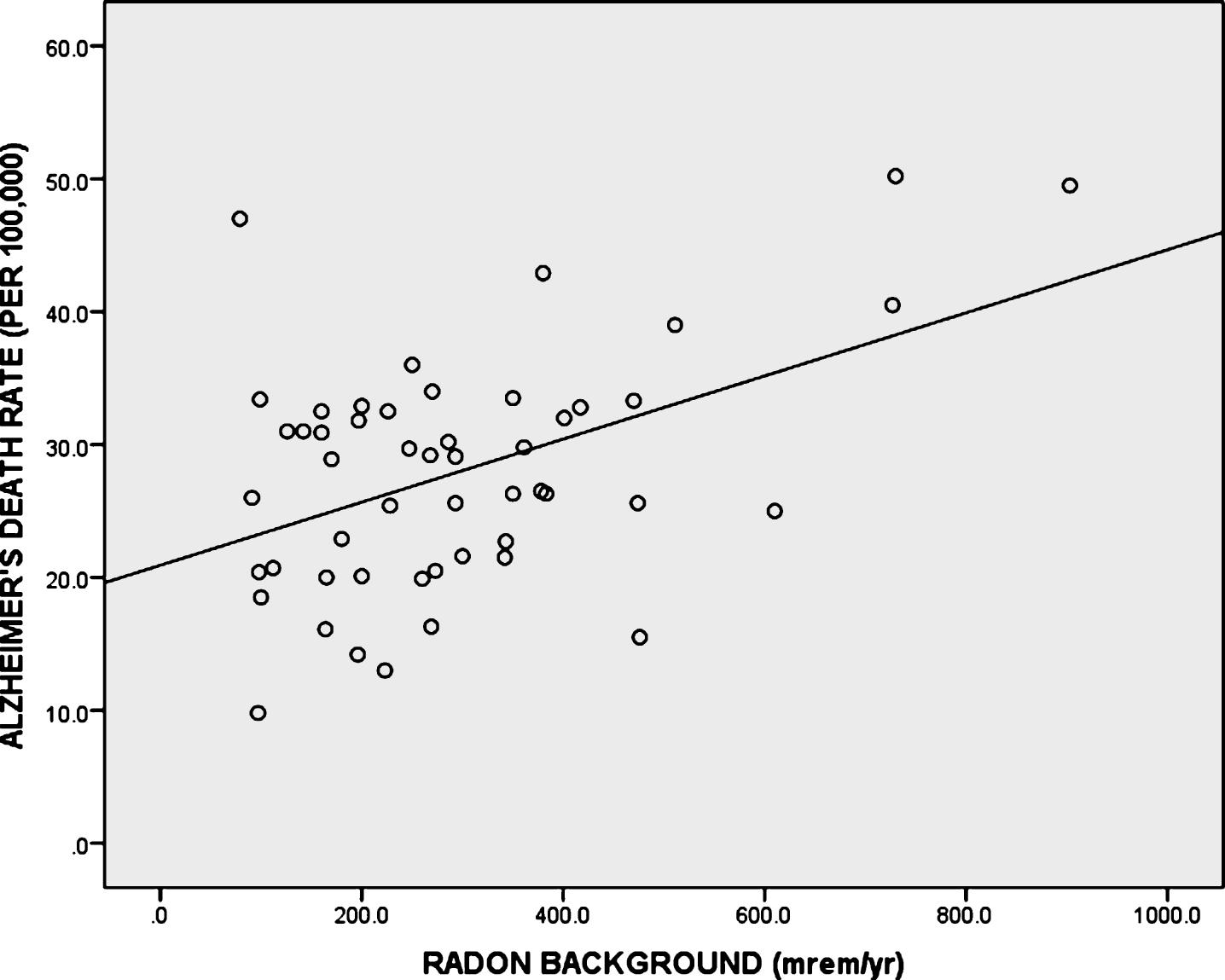
Radon background ionizing radiation was significantly correlated with Alzheimer’s disease death rate in 50 states and the District of Columbia (r = 0.467, p = 0.001).
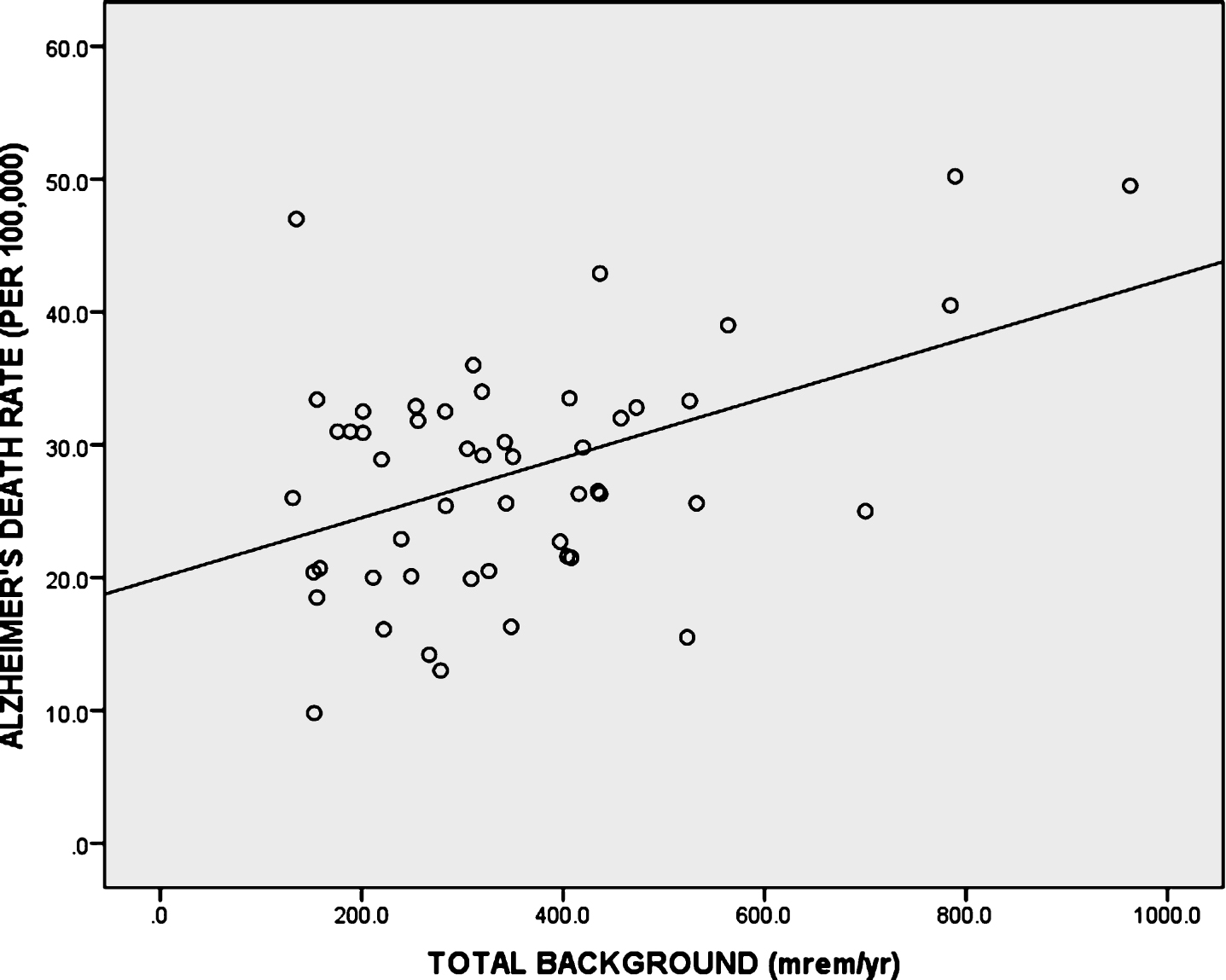
Total background ionizing radiation was significantly correlated with Alzheimer’s disease death rate in 50 states and the District of Columbia (r = 0.452, p = 0.001).
Advancing age, hypertension, and diabetes are risk factors for AD [8]. We used multivariate linear regression to factor out the effects of these risk factors. U.S. State death rates for hypertension and diabetes are from National Vital Statistics Reports, “Deaths: Final Data for 2013” [12]. Population size and mean age of US state populations are from the 2010 US Census [13].
RESULTS
Radon background ionizing radiation was significantly correlated with AD death rate in 50 states and the District of Columbia (r = 0.467, 95% CI 0.22 –0.657, p = 0.001; Fig. 1 and Table 1). Total background ionizing radiation was also significantly correlated with AD death rate in 50 states and the District of Columbia (r = 0.452, 95% CI 0.202 –0.646, p = 0.001; Fig. 2).
Radon background (mrem/y) and Alzheimer’s disease deaths per 100,000 in 2013
Cosmic background ionizing radiation was not significantly correlated with AD death rate in 50 states and the District of Columbia (r = –0.201, p = 0.158). Terrestrial background ionizing radiation was not significantly correlated with AD death rate in 50 states and the District of Columbia (r = 0.087, p = 0.542). Ionizing radiation from radon contributed 84% of total background, terrestrial 7.5%, and cosmic 8.5% (Fig. 3).
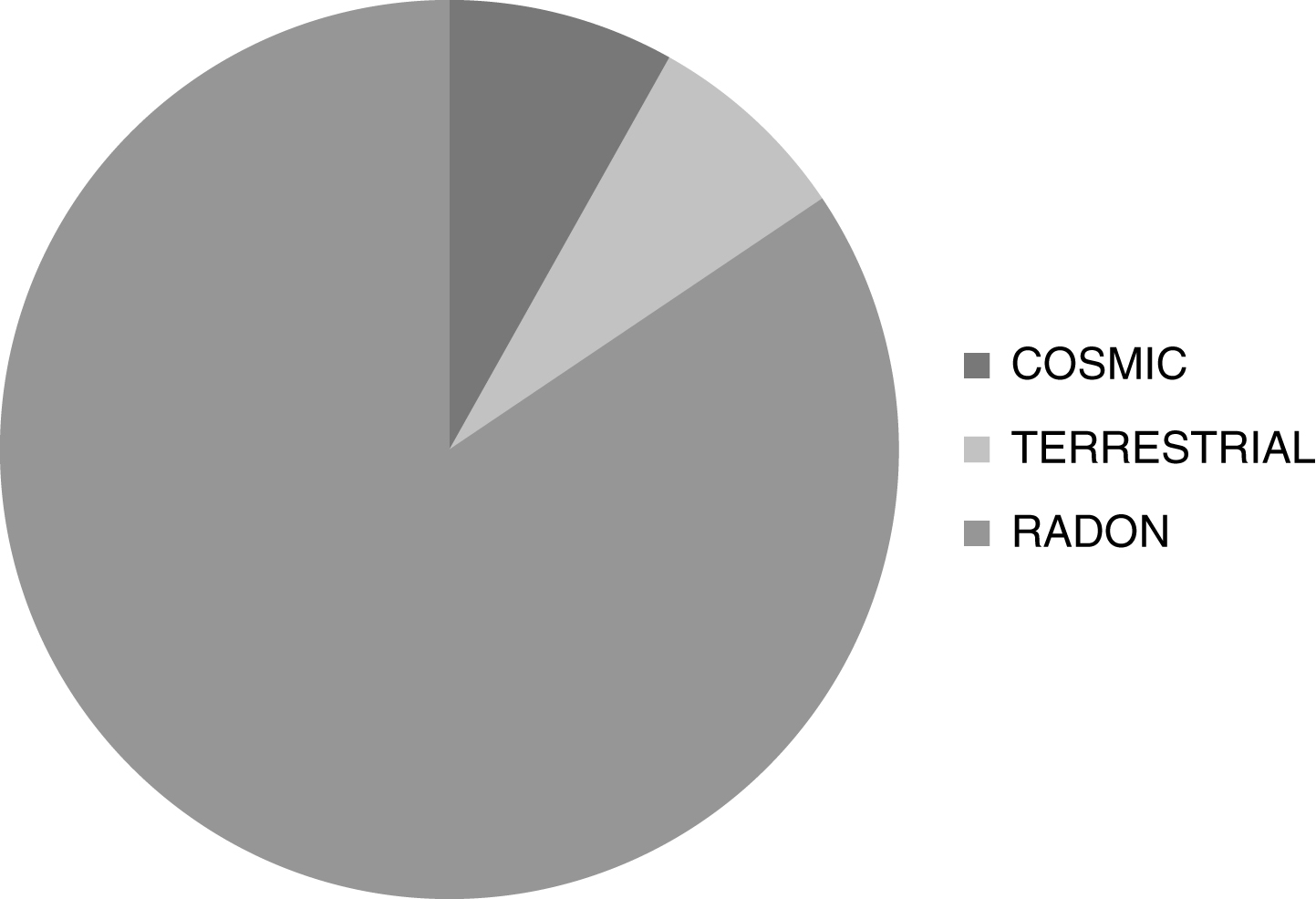
Contribution of cosmic, terrestrial, and radon to total background ionizing radiation in this study. Radon contributed 84% of the total, terrestrial 7.5%, cosmic 8.5%.
Multivariate linear regression was performed with AD death rate as dependent variable, radon background radiation, hypertension death rate, diabetes death rate, and age as independent variables. AD death rate was significantly correlated with radon background (β= 0.508, p < 0.001) and age (β= 0.345, p = 0.004) but was unrelated to hypertension (β= 0.224, p = 0.136) and diabetes (β= 0.198, p = 0.175).
To correct for the effect of state population size, we repeated the multivariate regression weighted by state population; AD death rate as dependent variable, radon background radiation, hypertension death rate, diabetes death rate, and age as independent variables. AD death rate was significantly correlated with radon background (β= 0.169, p < 0.001), age (β= 0.231, p < 0.001), hypertension (β= 0.155, p < 0.001), and diabetes (β= 0.353, p < 0.001).
Multivariate regression was done with AD death rate as dependent variable, total background radiation, hypertension death rate, diabetes death rate, and mean age as independent variables. AD death rate was significantly correlated with total background (β= 0.505, p < 0.001) and age (β= 0.362, p = 0.003) but was unrelated to hypertension (β= 0.234, p = 0.123) and diabetes (β= 0.199, p = 0.175).
To correct for the effect of state population size, we repeated the multivariate analysis weighted by state population; AD death rate as dependent variable, total background radiation, hypertension death rate, diabetes death rate, and age as independent variables. AD death rate was significantly correlated with total background (β= 0.172, p < 0.001), age (β= 0.233, p < 0.001), hypertension (β= 0.157, p < 0.001), and diabetes (β= 0.353, p < 0.001).
DISCUSSION
We found a highly significant positive correlation between AD and radon background ionizing radiation and between AD and total background ionizing radiation. Multivariate analysis demonstrated that the effect of radon and total background on AD was significant, even when the known effects of hypertension, diabetes, and advancing age are covariates. Our findings, like other studies, suggest that ionizing radiation is a risk factor for AD.
The inhalation of naturally occurring radon (222Rn) gas from indoor air exposes lung tissue to α-particle bombardment, a highly mutagenic form of ionizing radiation that damages DNA and increases the lifetime risk of lung cancer [14]. Whereas intranasal inhalation of insulin is an AD treatment [15], intranasal inhalation of radon gas could subject the rhinencephalon and hippocampus to damaging radiation that initiates AD [16, 17]. The damage would accumulate over time, causing age to be a powerful risk factor.
222Rn gas arises from the radioactive decay of radium-226, present throughout the earth’s crust and in many building materials. 222Rn has a 3.8-day half-life and builds up indoors where most exposure to the general population occurs. The airways and lungs are the primary target organs, but dose calculations predict that inhaled radon gas and radon progeny can pass the blood-brain-barrier. Radon and its daughters accrue preferentially in AD brain proteins,] and are higher in AD subjects than in healthy controls [18]. Although estimated brain doses are low, a relationship between residential radon and AD may exist; a relationship of residential radon and brain tumors has been demonstrated [19].
The lack of correlation we noted between AD and cosmic background radiation, and AD and terrestrial background radiation, is not surprising. The contributions of cosmic background (8.5%) and terrestrial background (7.5%) to total background are relatively small. Radon background would tend to obscure their effects on AD.
Ionizing radiation exposure is a risk factor for cancer and also a treatment. Could ionizing radiation be an AD treatment, as well as a risk factor? The association of radiation therapy with second radiation-induced cancers [20, 21] does not preclude radiation treatment for cancer. Would an association of radiation exposure with AD argue against radiation treatment for AD? With the data presented above, we are unable to say.
A weakness in our study is possible confounding by the ecological fallacy (or ecological inference fallacy), a logical fallacy in the interpretation of statistical data where inferences about the nature of individuals are derived from inference for the group to which those individuals belong [22]. In this case, inferences about AD in individuals are being drawn from the characteristics of US states where they reside, rather than from the individuals themselves.
Another weakness is that the death certificate is not totally accurate in terms of diagnosis, especially if the subject died in a nursing home or at home [23]. Vascular dementia is an important contributor to cognitive impairment in late life and can overlap clinically with AD [24].
Moreover, multiple factors that we were unable to incorporate in the current analysis can raise incidence of AD. For example, South Dakota had a population of 858,469 in 2015; indigent people are 14.2% overall and 17.7% of children are indigent. In 2012, the Census Bureau estimated that 86.2% of South Dakotans were White, 8.9% were American Indian or Alaskan Native, 3.1% were Hispanic or Latino, 1.7% Black or African American, 1.1% Asian, and 0.1% were Pacific Islander or Native Hawaiian. Income inequality ratio is 13.0 and hunger and food insecurity is at 11.9%. American Indians, particularly Nakota (Sioux), Lakota, and Dakota, are predominant in many areas of the state, making up 20% of the population of West River. South Dakota currently has the third highest percentage of Native Americans of any state, with 5 counties remaining wholly within Indian reservations [25]. These factors influence the elevated AD death rate in South Dakota irrespective of radon and ionizing radiation.
More people than ever before receive relatively high levels of ionizing radiation from medical equipment and cosmic radiation in airplanes. 62 million CT scans are performed in the U.S. each year; one third being examinations of the head [2]. The tissue dose for one CT study is 10–100 mGy [26], but CT scans are often performed again and again, with corresponding dose augmentation.
The National Institute of Occupational Safety and Health reports that flight crew members are exposed to approximately 3 times as much cosmic radiation, plus some additional radiation from “solar flares”, compared with members of the public [27]. Although cosmic radiation constitutes only 8.5% of total radiation exposure for the general population, the percentage would be higher for flight crew members. A potential increase in early AD in pilots is unsettling, especially given that the 2007 Fair Treatment of Experienced Pilots Act mandated an increase in the mandatory retirement age for commercial airline pilots from 60 to 65 [28].
Therefore, further studies of AD and ionizing radiation would definitely be worthwhile.
DISCLOSURE STATEMENT
Authors’ disclosures available online (http://j-alz.com/manuscript-disclosures/17-0308r2).