



Abstract
Background:
Encoding of new information is considered to be impossible in people with Alzheimer’s disease (PWAD) at a moderate to severe stage. However, a few case studies reported new learning under special circumstances, especially with music.
Objective:
This article aims at clarifying PWAD’s learning capacities toward unknown material under more ecological settings, which is repeated exposure without encoding instruction.
Methods:
Twenty-three PWAD (Age: m = 84.6(5.2), 5≤MMSE≤19) underwent presentations of unknown artistic pieces (targets) through 8 daily individual sessions. These sessions were followed by a test session, during which their knowledge of the targets was assessed through a verbal and behavioral scale (the sense of familiarity scale) against a series of unknown items (distractors).
Results:
Through this design, we were able to objectify encoding of three types of targets (verses, paintings, and music) against distractors the day after exposure sessions, and 2 months after the last presentation (study 1). Music and paintings were eventually well-encoded by most participants, whereas poems encoding was poorer. When compared to distractors, target items were significantly better recognized. We then compared the recognition of target paintings against two types of painting distractors, either perceptually or semantically related (study 2). The targets were better recognized than all three painting distractors, even when they were very close to the targets.
Conclusion:
Despite massive anterograde amnesia, our results clearly showed that recognition-based learning without conscious memory of the encoding context is preserved in PWAD at a severe stage, revealed through an increasing sense of familiarity following repeated exposure. These findings could open new perspective both for researchers and clinicians and improve the way we understand and care for PWAD living in healthcare facilities.
INTRODUCTION
Alzheimer’s disease (AD) is mainly considered as a pathology of encoding declarative memory [1] even if other cognitive function deficits exist. Works in neuropsychology, neurology, and clinical neuroscience have painted a portrait of AD from what is impaired in the disease, with a straight conclusion: People with Alzheimer’s disease (PWAD) at a moderate stage cannot learn new long-term declarative information. This is due notably to extensive damage to the hippocampus, implicating both encoding and retrieval deficits [2–4]. Aside from these reports, some studies have investigated implicit memory integrity in the same population. Implicit memory differs from explicit memory in that it does not require effort to remember once it is encoded [5]. For example, implicit memory can be expressed by an alteration of behaviors towards an item resulting from mere prior presentation and not involving conscious learning. Thus, two main paradigms emerged in neuropsychology: priming (or direct priming) and mere exposure effect. Direct priming refers to the “facilitation in the processing of a stimulus as a function of a recent encounter with the same stimulus” [5], whereas mere exposure effect describes the fact that subjects repeatedly exposed to a stimulus develop an increasingly greater preference for it [6].
A classic dissociation has been reported between impaired declarative memory and mostly preserved implicit memory for PWAD from the mild stage. Typically, in studies with PWAD, implicit memory is assessed through either direct priming or mere exposure effect, whereas declarative memory is assessed through familiarity-based or recollection-based recognition. In a paradigm asking subjects to estimate the age of briefly flashed faces, Willems et al. [7] studied the mere exposure effect by presenting pairs of faces (old and new) and asking participants to select the face they liked, and then assessed the explicit recognition with a forced-choice task. They found that the mere exposure effect was still normal, whereas recognition was impaired. These findings were confirmed more recently by Deason et al. [8] using newly-exposed music pieces. In this study, familiarity, recognition, and preference were measured for novel songs through three presentations of the items. Mere exposure effect was assessed through preference ratings, familiarity by a confidence Likert scale (going from 1 = certain the item is new to 6 = certain the item is old), and recognition by a familiarity score reflecting “oldness” of the song (regardless of the level of confidence) matching the fact that it was indeed presented before. Mere exposure effect was expressed similarly in healthy controls (HC) and PWAD for songs and melodies, but weaker for spoken lyrics in the PWAD group (this could be due to language impairments according to the authors). By contrast, PWAD performed significantly lower than HC regarding familiarity for melodies and songs, but similarly regarding familiarity for lyrics (although scores were low for both groups). Finally, recognition accuracy was lower for PWAD than HC, and higher for the spoken condition in PWAD compared with the song and instrumental conditions. Another study had also established that PWAD at a mild stage showed preserved conceptual priming in a task in which participants had to make a semantic decision as to whether a degraded picture of an object encountered previously belonged to the category of living or non-living things compared to a recognition memory task. Here, the AD group showed a dissociation between impaired performance on the recognition task and preserved priming for semantic decisions to degraded pictures [9].
Some authors have argued that preservation of implicit mechanisms may rely on a specific memory system [10, 11] which is different from the ones recruited in recognition-based memory [12, 13]. This conception validates the dissociation that explains the gap between performance in implicit and explicit memory in PWAD as tested in previous studies noted above. However, across studies on implicit memory in PWAD, the distinction between severe impairment of explicit learning and relative preservation of implicit learning was shown using only a limited number of presentations (max = 3). Hence, repeated mere exposure could rely on semantic encoding without systematically requiring the hippocampus [12, 14– 16].
In everyday life, music is a relevant example of a medium that naturally relies on repeated exposure for learning. Moreover, PWAD are able, even at severe stages of the disease, to understand the emotional connotations of musical material and to react while listening [17]. They maintain a good musical appreciation at perceptual and emotional levels [18], while their other cognitive abilities (especially verbal) are largely deteriorated. Yet, aside from the psychosocial, well-being, and behavioral benefits [19, 20], these studies also have shown that many aspects of retrograde memory for music in PWAD are well-preserved (semantic memory for old songs, and musical or vocal performance of previously learned pieces for musicians) [21, 22]. In addition, a few authors used repeated exposure (6 presentations or more) to songs with PWAD and demonstrated evidence of possible explicit learning, such as the case study of a PWAD at a severe stage without musical training learning a new song [15], and a group of patients at a mild to moderate stage learning made-up songs mixing autobiographical memories and familiar melodies [23]. Furthermore, a few group studies have given arguments for the possibility of encoding of recently-presented musical items [22, 24].
Considering these elements, our goal was to study preserved learning abilities in PWAD to better understand the impact of the nature of material, and the modalities of encoding and retrieval. To objectify and characterize learning of new information in amnesic moderate to severe AD, we designed two controlled group studies. These were inspired by observations of partially preserved learning for new songs reported by clinicians (doctors and psychologists) working in special care units (SCU) during singing workshops (see Supplementary Material, video “Group learning of a new song”). Although diagnosed with AD at a moderate or severe stage, patients were humming or mumbling songs that they had only been recently exposed to, long after the onset of the disease [25]. Regarding both results from published studies, and reports from field workers, we hypothesized that learning of new information using artistic items in PWAD at a moderate to severe stage is still possible under the right settings. Comparisons between different art forms (music, paintings, and poems, the latter being labelled “verses” throughout the article) and retrieval settings (single-item versus forced choice recognition) were conducted to test this hypothesis.
METHODS
Participants
For the two studies, participants were recruited through the SCU of retirement homes. They all had a diagnosis of probable Alzheimer’s disease at a moderate or severe stage [26] prior to the study, according to the NINCDS-ADRDA criteria from a specialist (neurologist or geriatrician) accompanied by a neuropsychologist’s cognitive and clinical assessment [27, 28]. Inclusion criteria consisted of 1) a major anterograde amnestic syndrome and 2) an MMSE score below 20, to match the criteria for moderate to severe AD [28]. Participants did not present visual or auditory impairment that would hamper/hinder their perception of the stimuli. We also made sure that participants did not experience any major traumatic brain injury or psychiatric condition in the past (Table 1). Finally, each patient participated in only one of the studies.
Main characteristics of the participants in the two studies
Consent was provided from the residents’ family, regarding the participation to the activities for research purposes and the video capture of the sessions. Moreover, assent was asked from every participant before the beginning of each session, regarding what would be going on (“Would you agree to look at and/or listen to art pieces with me for a little while?”). Because the activities were part of daily routine, and psychologists or psychologists in training proposed the activities, there was no need for the approval from an ethical committee at the time of the study. Moreover, the study protocol respected the Declaration of Helsinki and consent was asked before the beginning of the study from the family and participant and was systematically asked again before each session.
Sense of Familiarity (SoF) Scale used to assess learning in individuals with AD (MP, Memory process; BR, Behavioral response). Y, yes; N, no
Material
Assessment of the sense of familiarity
When studying PWAD, especially at a moderate to severe stage, classical “laboratory” paradigms are limited especially because verbal “yes/no” answers are not always sufficient to account for learning. Indeed, PWAD at a moderate to severe stage can show either great hesitation or language impairment, which result in difficulties accounting for answers based solely on language. Behavioral cues also need to be taken into account to measure the behavioral changes that reflect learning (especially modification of the feeling of familiarity or recognition).
Therefore, the answers of the participants were collected and coded using the Sense of Familiarity (SoF) Scale (Table 2), created by our team [22, 29] for the purpose of studying memory with people suffering memory losses (for examples of its use, please refer to supplementary video data). The assessment of the scale consists in questioning the person regarding the familiarity he/she has towards each item. The verbal answers and behavioral reactions are then scored on the scale from 1 to 6. Scores 1 and 2 represented an absence of any form of conscious recognition, with (2) or without (1) marks of interest. Higher scores correspond to emergence of the sense of familiarity (3) and clear recognition (4). Responses 5 and 6 indicated retrieval of additional contextual information. Hence for these studies, we chose to use the score “4 or above” as the threshold to signify familiarity-based recognition. Even though few answers a “5” were reported, they merely showed some contextual elements, which were not the main interest of the study.
Items
The items used to assess SoF were either created for the experiment or chosen from unknown verses, songs, music, or paintings (please refer to each study for further information). They were divided into two groups: 1) Target items refer to unfamiliar items that were used during the presentation sessions and 2) Distractors (unfamiliar as well) were only used in the test sessions, mixed with target items. Previously, every item was pretested with a control population of age-paired healthy subjects (MMSE > 27) to ensure their unfamiliar nature. Furthermore, the score at the SoF Scale at the first session also served as a control (Scores of 1 or 2 attesting for no previous knowledge of the item).
Procedure
PWAD’s preserved incidental learning may be preferentially triggered due to their episodic impairments as an adaptation mechanism [11, 30]. Using more than 3 repetitions for new items seems to be necessary to elucidate explicit encoding abilities [24, 25]. The insufficient number of repetitions in most studies may explain the discrepancy between literature reports of experimental studies concluding the impossibility of explicit long-term learning, and healthcare professionals’ reports on the familiarization to faces, places, and even some specific items. Thus, material was exposed across 8 individual exposure sessions. These sessions took place with a neuropsychologist and were set in a quiet room. One exposure session with a participant consisted of the presentation and familiarity rating of all the target items in the experiment (6 to 36 items, please refer to each study for additional information).
The material and item presentation order was pseudo-randomized between patients and sessions (including the test session) to avoid serial position effect. Participants were merely encouraged to comment on the items to ensure focus on the piece (most of the time, spontaneous comment emerged from the presentation). However, no explicit memorization instruction was given. After the presentation of an item, the familiarity toward it was coded with the SoF Scale either immediately, or later via a video recording of the session (see the Supplementary Material for video examples) in case of doubt regarding the score (in that situation, another psychologist provided an additional rating). At the end of the 8 exposure sessions, subjects completed a test session, during which the learning of target items was compared with distractors. Each experiment consisted of 8 exposure sessions over 2 weeks, and a test session the day after the last exposure session (cf. Fig. 1)

Organization of the sessions through the 2 weeks of the studies.
Statistical analyses
For the two studies, we conducted non-parametric analyses, as part of or our data violated the normality assumption necessary to conduct parametric analyses. For all analyses, we considered significant comparisons with a p-value α< 0.05, and we assessed the effect size using rank bivariate correlation (r), considering strong effect (0.5), medium effect (0.3), and small effect (0.1) [31]. The patients’ scores analyzed were the median of their SoF Scale score for a category of items during a session (exposure or test).
STUDY 1: IS LONG-TERM LEARNING FOR VERBAL, VISUAL, AND AUDIO MATERIAL POSSIBLE IN MODERATE TO SEVERE AD?
Participants
For this study, we recruited participants according to the criteria presented earlier. Group characteristics are presented in Table 3.
Besides MMSE [32], we used two French test batteries: the BEC96 [33], which consists in orientation, memory, visuo-construction and executive functioning assessment, and the denomination subtest of the Lexis battery [34] measuring denomination ability. For the BEC96, the norms on a French population are as follows: between 30 and 60 in consistent with moderate AD, and below 30 for severe AD (these scores have been matched with MMSE scores [33]). A Lexis score above 42 is considered normal.
Material
Items for the familiarization
The modification of the SoF Scale was assessed with three types of items: audio (music), visual (paintings), and verbal (verses)rmbox1\footnote [1]The complete designation of the material should be “non-verbal audio” for music, “non-verbal visual” for paintings, and “verbal audio” for verses. For purposes of simplicity, we will refer to them as “audio”, “visual”, and “verbal” throughout the article.. All items have been chosen from a corpus of existing open source songs, paintings, and verses that did not hit notoriety.
Music recordings were chosen from a “classical music” repertory of existing pieces, exclusively instrumental, and each extract lasted about 30 seconds. Half of the excerpts were labeled “joyful”, and the other half “sad” by an age-matched control population. The items were presented through speakers connected to a portable computer (for samples of the music used, please refer to the Supplementary Material).
Paintings were classified into four themes: portraits, animals, landscapes, and still-life. Half of the paintings represented living objects (portraits and animals); whereas the other half featured non-living objects (landscapes and still-lives). They were presented on A4 plasticized paper sheets to allow manipulation (for samples of the paintings used, please refer to the Supplementary Material).
Verses were chosen to be easily understandable by the participants (simple and about 4 verses long). Half of them had an abstract theme (love, friendship, etc.), and half of them had a concrete theme (dogs, flowers, etc.). They were all spoken by three different male voices, so that for each patient, one of two different voices was used during the learning sessions, and another voice was used for the testing session. Verses were presented through speakers connected to a portable computer (for samples of the poems used, please refer to the Supplementary Material).
Each item type had a set of 12 items, for a total of 36 items. Within each set, 8 items were used for the exposure sessions (targets), and 4 items for only the test session (distractors), in a pseudo-randomized setting.
No difference in scores was found between the two musical emotions, the two painting characteristics, and the two verse themes.
Procedure
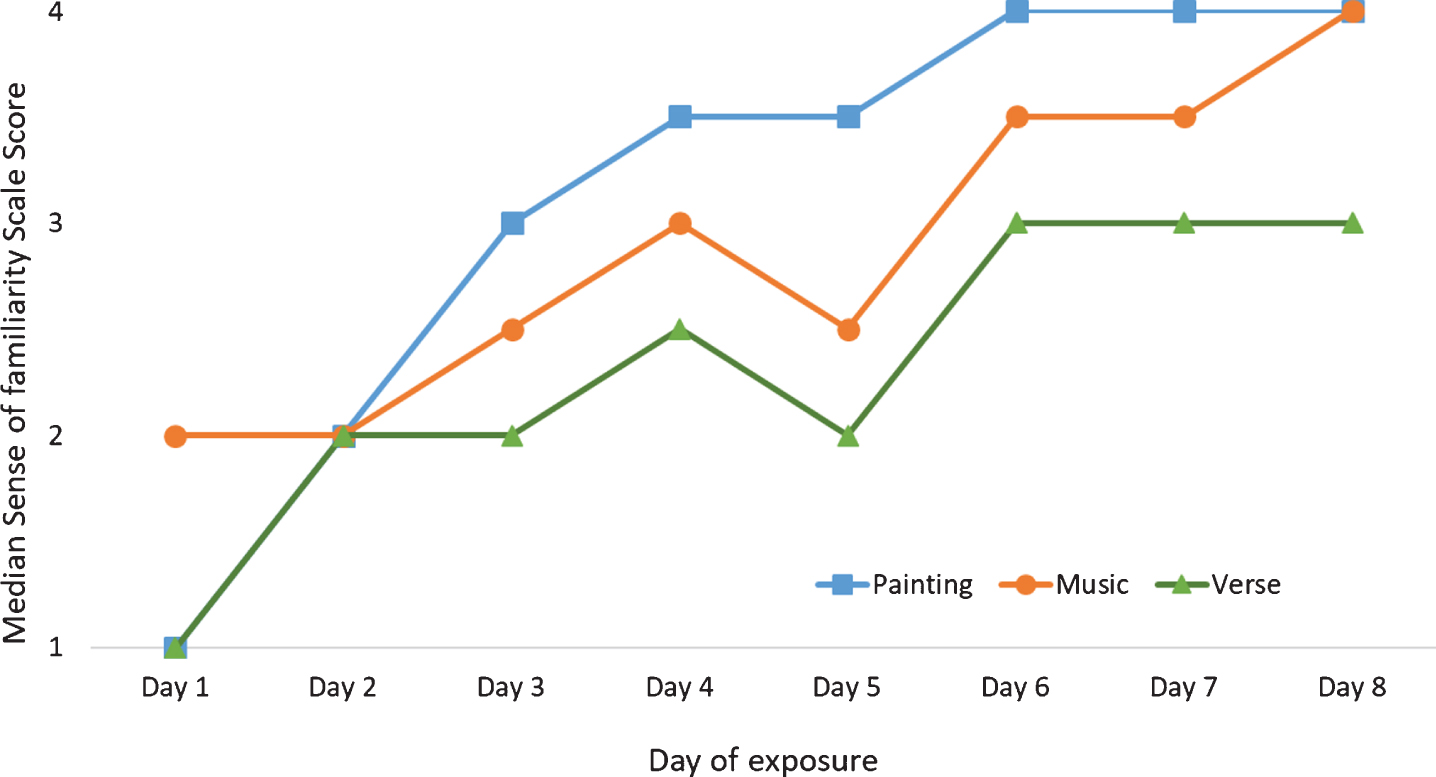
Evolution of the median SoF scores of the 13 PWAD during the exposure sessions for study 1.
The specificity of this first study is that a long-term test session was conducted two months after the test session without re-exposure to assess the persistence of learning. This long-term test session had the exact same design as the test session, with the same target and distractors.
Population of Study 1
Results
Exposure sessions
A group median score strictly above 3, which reflects that more than half of the participants reached the SoF (Score 3), was reached on day 4 for paintings, day 6 for music and was never reached for verses (Fig. 2). We can observe a drop in scores at day 5, which can be associated with the fact that session 4 and session 5 were separated by a three day weekend, while the other sessions were consecutive.

Median, quartiles, max, and mix scores of the 13 PWAD obtained at the test session of study 1 (each white circle represents one patient’s score).
Test session
For the test session, we compared the SoF score between distractors and targets for each condition (Fig. 3). Paired comparisons with the Wilcoxon (Wx) test reported a difference in the SoF score between target and distractors for the three contrasts: Target (Mdn = 4) and distractor (Mdn = 1.5) paintings (z = 2.934; p = 0.006; r = 0.57); Target (Mdn = 3) and distractor (Mdn = 2) music (z = 2.756; p = 0.003; r = 0.54); Target (Mdn = 3) and distractor (Mdn = 1.5) verses (z = 2, p = 0.045, r = 0.39).
Population of long-term test session of study 1
We also compared SoF scores for the different target items. The Wx test revealed a significantly higher SoF score (z = 2.51, p = 0.012, r = 0.49) only for paintings (Mdn = 4) compared to verses (Mdn = 3).
Long term test session (2 months)
Only 8 participants from the 13 took part in the long-term test session, after 2 months without re-exposure to items (Table 4), as 5 participants had either developed acute disease, relocated, or deceased.
After 2 months, the results from the long-term test session showed a significant superiority of target (Mdn = 3) compared to distractor (Mdn = 2) paintings, (z = 2.52, p = 0.01, r = 0.56), and target (Mdn = 4) compared to distractor (Mdn = 3) music (z = 2.2, p = 0.03, r = 0.49), but no statistical difference between target and distractors verses.
Results from this session showed a higher SoF score (z = 2.2, p = 0.03, r = 0.49) for target music (Mdn = 4) when compared to verses (Mdn = 2.5), and for target paintings (Mdn = 3) compared to target verses (Mdn = 2.5) (z = 2.5, p = 0.052, r = 0.43).
Moreover, a comparison between scores for paired target items from the test session and the long-term test session did not reveal any significant differences, which fails to show a modification of the SoF scores after two months without re-exposure.
Discussion for study 1
Besides massive episodic memory deficits, our results indicate that learning is still possible, and resilient in AD at a moderate to severe stage, as revealed through the modification of the sense of familiarity towards items. This learning seems to be modulated by the nature of the information: stronger for visual information (paintings), and auditory information (music), but weaker for verbal information (verses), which fits with the literature on learning in the early stages of AD [8, 35– 37]. However, the fact that we deliberately chose to change the voices between the exposure sessions and the test session may explain the low scores regarding verses and suggest that SoF is mainly sustained by the encoding of perceptual characteristics of the exposed stimuli. Once familiarity has emerged, it seems to persist even after 2 months with little to no modification.
Population of Study 2
These results support the hypothesis of a discrepancy between possible anterograde declarative learning in AD at mild to severe stages despite severely impaired encoding revealed through neuropsychological testing. Such discrepancy between musical memory and neuropsychological testing has previously been reported, but for young onset AD and retrograde musical memory [38].

Example of target and distractors for test session of study 2.
Regarding musical items, we can observe higher SoF Scale scores than other materials for unknown items (both at the beginning of the exposure sessions, and for distractors items at the test session). This may be due to the type of music we chose, as they were orchestral lyric pieces. For some of our participants, such pieces sound alike, and remind them of other well-known pieces (see the Supplementary Material for music examples of study 1). Therefore, their interest was triggered more often while listening to music than when looking at paintings or listening to verses, which may account for the smaller difference between musical target and distractors items at the test session. Moreover, our results show no statistical difference between scores for exposed paintings and exposed music, which is why we decided to further study encoding for new paintings in the next study, as no previous results had ever reported such learning.
STUDY 2: DOES LEARNING THROUGH SENSE OF FAMILIARITY REFLECT A GENERAL PERCEPTUAL TRACE OR ITEM-SPECIFICITY?
Regarding previous results from the literature, which focused primarily on memory for music, we were not expecting paintings to be recognized as well as music. In this study, we assessed whether familiarity for paintings may rely on non-dynamic features, and hence answer whether familiarity for paintings was relying merely on a perceptive trace. From previous studies (Evaluation of visual recognition memory in MCI patients [39, 40]), we should expect forced-choice for previously presented images to fail, whereas based on the results from study 1, we expect them to give better results than cued recognition.
Participants
Ten participants took part in this study, the inclusion and exclusion criteria for the participants were the same as the one described in the general methodology (Table 5).
For this study, we decided to assess language using the DO80 [41] rather than the Lexis from previous study, as it was more suited for PWAD. For this denomination test, a score below 78 is considered subnormal.
Material
All of the items (paintings) for this study have been selected from an internet-based corpus of paintings from unknown painters. They were pretested with an age-matched control population without cognitive impairment (MMSE > 27, Mean Age: 85.5) to ensure that the paintings were unknown to people from our subjects’ generation.
Six paintings have been chosen from this pretest to be used as target items. From these 6 target items, 12 “modified” targets have been created: 6 “background modified” paintings on which only the background (i.e., the part of the painting at the back) had been changed but not the foreground, and 6 “foreground modified” paintings on which the background remained the same, but the foreground (i.e., the part of the painting at the front) was changed. Finally, 2 “semantic” distractors per target item have been chosen from the pretest item. They were paintings that shared the same theme as the target painting (beach landscapes, an older sailor, etc.), with perceptive and semantic features relatively close to the targets (Fig. 4).
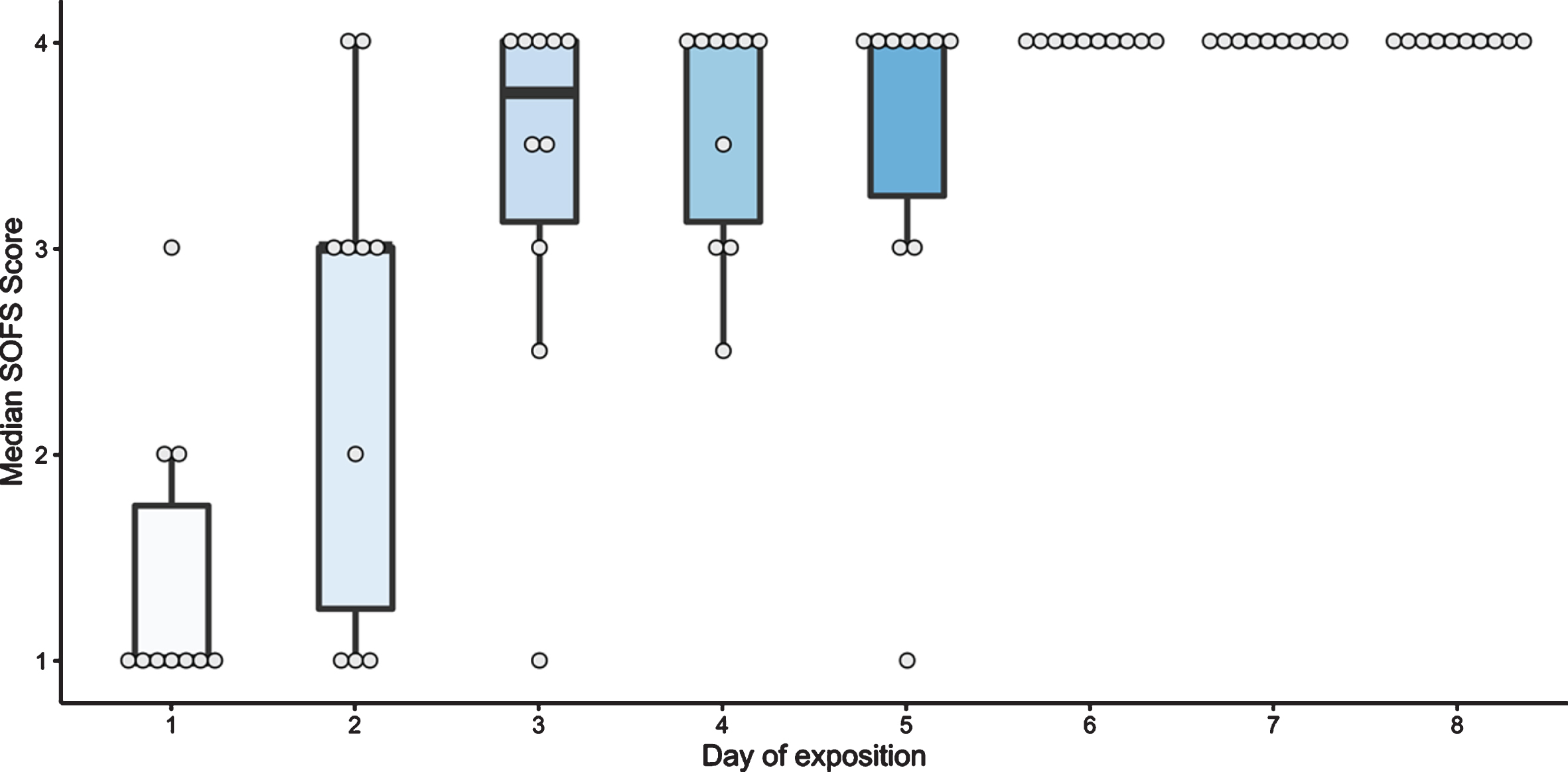
Median, 1st and 3d Quartiles, min max scores of the SoF score of the 10 PWAD for the exposure sessions of Study 2 (each white circle represents one patient’s score).
Procedure
Exposure sessions
The same design as described in the general methodology was used for the exposure to target paintings: 8 exposure sessions over 2 weeks, followed by a test session. After the presentation of an item, the familiarity towards it was coded with the SoF Scale. As for the previous study, participants were not asked to remember the items, and only a verbal description of the painting was encouraged although it was generally spontaneous. The presentation order was pseudo-randomized between patients and sessions to avoid serial position effect.
Test session
For the test session, each target item was randomly presented with one of the modified targets (background or foreground) and two semantic distractors (distractors) on the same A4 plasticized paper sheet (Fig. 5). Participants were asked to identify the item they felt that had already been shown to them. The place of the target and the distractors items on the presentation sheets were pseudo randomized to avoid a position effect.
Results
Exposure sessions
As for study 1, an increase in the SoF was observed throughout the exposure sessions for the paintings, and it reached a median max score of 4 on day 3. From day 6, all 6 items were recognized by every participant (Fig. 6).
Test session
For all comparisons from the test session, we used Wx test. The “distractors” condition combines both semantic distractors’ scores. Results showed a higher number of target paintings (Mdn = 5.5) chosen as “previously seen” compared to modified distractors (Mdn = 1; z = 2.8; p = 0.005; r = 0.63) and Semantic Distractors (Mdn = 1; z = 2.8; p = 0.005; r = 0.63).
Discussion for Study 2
Confronted with six paintings, patients reached scores of “3” and “4” faster than in the previous study. This may be explained by the fact that a small amount (6) of items is encoded faster than a larger amount (36 as in study 1), but also because paintings seem to trigger faster learning (also see study 1). The main result of this study is that the SoF seems to be linked to a specific item rather than a general activation of item features, as target items elicited greater recognition than modified targets and distractors. This directly contradicts results from the literature for recognition-based forced-choice with PWAD at a mild stage [42, 43]. Moreover, this second study, despite a small sample of patients, presents very strong statistical effects, showing that all PWAD patients, despite their severe amnesia, encode the exposed items in long-term memory and rarely make mistakes when faced with sometimes very similar distractors.
DISCUSSION
Our results showed that encoding of new information is still possible for PWAD at a moderate to late stage. Although caregivers and single case studies had reported learning towards music [15], these were considered as singularities and anecdotal. This specific learning, assessed by the increasing of SoF across exposures, is not exhibited equally between different exposure contexts. To summarize our findings, we observed that learning is not specific to music but is also efficient with paintings (study 1). Verbal items (verses) seemed to be much more difficult to learn (study 1). Paintings, on the other hand, appeared to trigger a stronger and faster SoF (study 1 and 2).
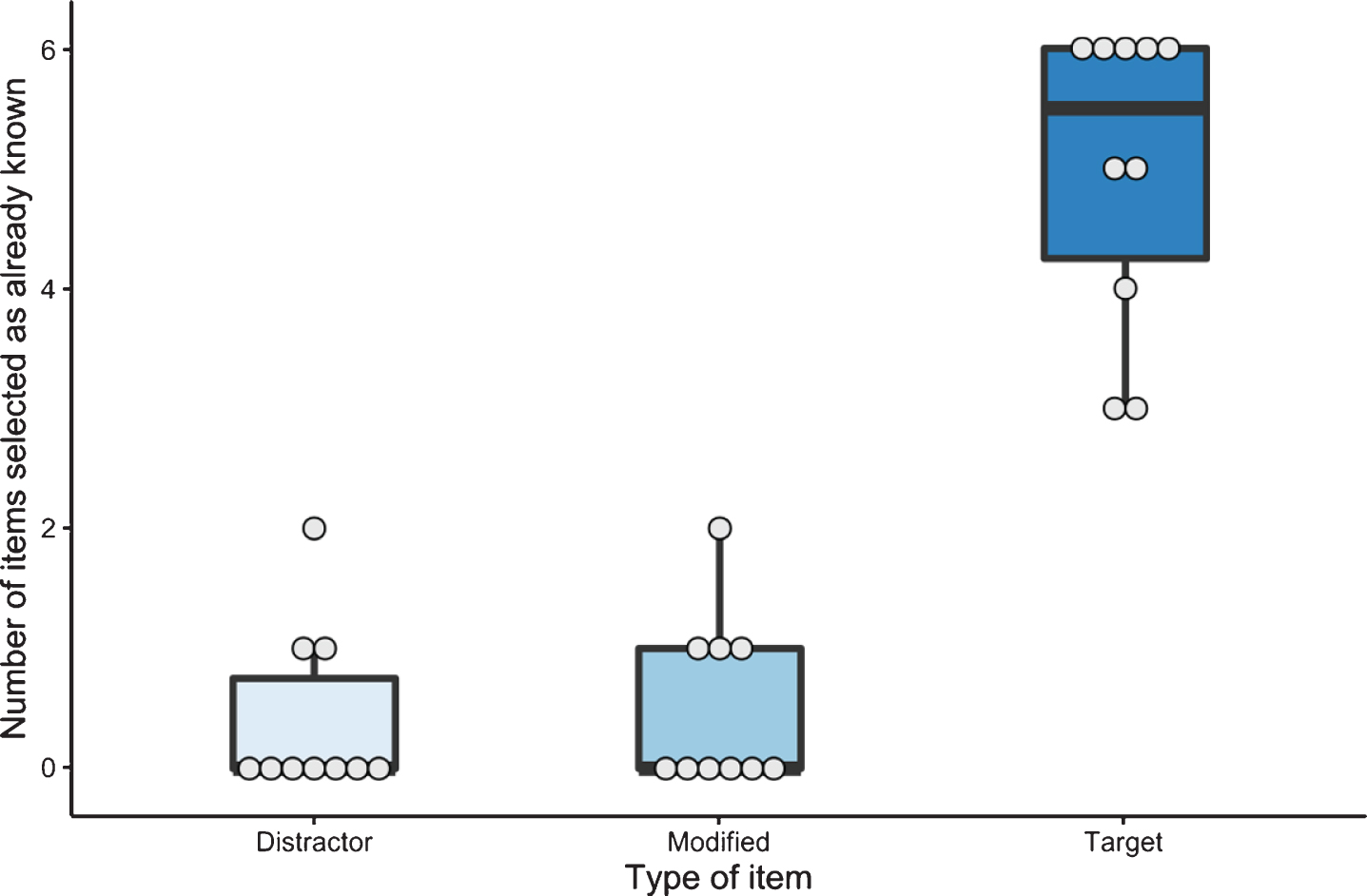
Mean, 1st and 3d Quartiles, min max number of target paintings correctly recognized among distractors for the test session of Study 2 (each white circle represents one patient’s score).
Recognition-based learning has never been reported within a group of patients with moderate to severe AD. This may be due to impairments in memory and other cognitive or instrumental functions in PWAD [44], making it difficult to rely on “yes/no” answers to account for new learning. That is the reason why we used the SoF Scale, both for its richer gradient of possible scores, and for the incorporation of non-verbal cues (such as humming, moving the head, etc.; refer to Supplementary Material). However, the verbal answers and comments of the patients were sufficiently explicit to demonstrate the lack of familiarity during the first exposure sessions and the certitude of knowing the same items during the last sessions.
Based on the results of these two studies, we wondered whether the learning supported by repeated daily exposure existed on a continuum of interest, a sense of familiarity and actual recognition. The increasing of interest without recognition (translated by the transition between score 1 and score 2 on the SoF Scale) could be explained by the use of preserved implicit memory through mere exposure effect [7, 45], which is known to be functional in AD. Our results suggest the possibility of a mere exposure effect even late into the disease, triggered by limited exposure (2 to 4 sessions).
Transition to the sense of familiarity, translated by a SoF Scale score of 3 (i.e., hesitation), is different from familiarity-based recognition, as it refers to an uncertainty regarding the familiarity of an item. This phenomenon is rarely studied in AD research, as it is mostly disregarded as an absence of knowledge. Hence, deprived of the possibility to refer to an encoding context, and involving a “feeling” (at first uncertain and subject to doubt), that progressively becomes a certitude (when reaching an SoF score of 4, attesting recognition) [22], we decided to name the phenomenon corresponding to the score of 3 “sense of familiarity” [25, 46]. It appears that it is “transition state” of encoding, although often considered as irrelevant, could be very useful while studying PWAD.
Recognition-based memory (or familiarity-based recognition), illustrated by a SoF Scale score of 4, is largely considered as being supported by the rhinal cortices (see [13, 38] for review), which are among the first to be impaired in AD. Indeed, familiarity-based recognition is thought to reflect semantic learning of new information according to mainstream memory models [12, 49].
From these conceptions, familiarity-based processes reveal semantic memory processes, as opposed to recollection being supported by episodic memory, and priming referring to implicit memory. Therefore, the semantic nature of this kind of response directly contrasts with most of the literature on the impossibility to rely on declarative memory for PWAD [7, 46]. The clear difference between the SoF score for targets and distractors allowed us to verify that recognition was linked to exposed items (study 1), and even precisely to specific items (study 2) rather than a generally affirmative answer.
Similar results of familiarity-based learning without hippocampal involvement have long been conceptualized [50] and demonstrated both with individual case studies [14, 51] and group studies with Transient Global Amnesia patients [52] or Korsakoff patients [53]. Although patients from these studies suffered enough damage to limbic areas to completely impair episodic learning [54], they were still able to learn new semantic information from repeated exposure [55], and supposedly better under ecological settings (as shown by results of R.S. patient’s natural acquisition of post-morbid vocabulary contrasting with his impossibility to learn under experimental situations [56]).
From these previous studies along with our results, an important feature of non-hippocampal learning is the absence of recollection of the encoding context. Even though patients sometimes gave answers such as “Yes, sure, I have listened to that song with you”, songs were overwhelmingly recognized without context rather than a true episodic recall. When further investigation was conducted, for example by asking “was it in this room or at home?” or “Was it with me or my older friend?” patients could not actually give specific details about the context.
One question remains: why was such learning considered impossible? The answer probably lies in the learning settings. First, we used individual sessions taking place in a familiar setting, which allowed distractions to be avoided and ensured patients’ focus throughout the session. Secondly, the number of repetitions appears to be critical. In most studies, the number of repetitions was below 4, which was the number of repetitions necessary to reach sense of familiarity of targets for most subjects in our study. In a case study, Baird et al. [15] obtained equivalent results with one PWAD at a severe stage partially learning a new song (humming but no lyrics). They employed a similar design (individual sessions and daily repetitions), which further provides evidence that these specific learning conditions are important for PWAD to acquire new information. Fraile et al. [23] also showed interesting results regarding the possibility for PWAD to encode lyrics related to strong autobiographical events, sung with a familiar melody. In this study, like in the previous one, the peculiar methodological parameter was the number of repetitions (10 sessions). Another aspect of study design may be critical to allow learning: not explicitly asking the patients to memorize the items and not informing them that they would be questioned about their memory or knowledge later on. Indeed, this procedure seems to matter as it frequently involves incidental encoding which may bypass hippocampal recruitment [57], and is likely to work well because it is errorless [58, 59] and effortless [60].
This design can account for why verbal items are much more difficult to encode, as they trigger a heuristic learning brain response that relies on episodic memory [61–63]. As such, using mainly verbal information learning for neuropsychological testing, with little presentations of the material, may prove to be unfit to capture the day-to-day abilities of patients. Such a discrepancy between musical memory and neuropsychological testing has already been reported, but for retrograde musical memory in the context of young onset AD [38].
Recruiting PWAD with a major amnestic syndrome but without massive impairments in other cognitive functions or comorbidities proved to be challenging, but it seemed essential to us that the population of our studies, even though carrying AD at a moderate to late stage, had sufficient residual capabilities to avoid response biases or interruption of the sessions, while still presenting with severe amnestic syndrome. Thus, due to patients available and interested at the time of the study, our samples are mainly composed of women, and presents some heterogeneity regarding neuropsychological profiles, although they all matched our criteria. However, no correlation was found between behavioral results and severity of the cognitive impairment.
New paradigms relying on sense of familiarity preservation may thus be important for both diagnosis and care, as they could provide a more accurate view of what PWAD until an advanced stage can still do, and within which modalities. By having this kind of information, care facilities could be designed to encourage the emergence of sense of familiarity for example, and therefore allow a faster and smoother integration in specialized care units for PWAD. More precisely, finding ways to increase SoF faster may help alleviate the burden of both residents and caregivers while confronted with a new entry into such care facilities. Hence, some familiarization to settings, places and people could be performed in order to prepare PWAD for entering into a care facility, making it a more “familiar” place, and diminishing anxiety and associated behavioral troubles. Possible applications also involve preparing PWAD for excursions. An application towards caregivers would be the possibility of using familiarity-based learning as a lever to modify caregivers’ and families’ conception of PWAD, especially regarding the impression of uselessness spending time or doing activities with PWAD, and the disappointment often associated with it.
Further studies combining these learning paradigms with investigations of brain integrity are required to gain understanding into PWAD, and help further unravel how and why learning is still possible in moderate to severe AD.
Footnotes
ACKNOWLEDGMENTS
This work was supported by a FEDER (Fonds Européen de Développement Régional) grant of Normandie (n°2889/33527). The authors would like to thank the “Hom’Age” Retirement Houses group for opening their doors to our research team. Many thanks to Rocio Gonzales, Alice Breton, Sauvane Carrière for data gathering and helping creating the protocols. Finally, the authors would like to acknowledge Mathilde Thomas for extensive research on bibliography about learning in AD, Marty Fiati and Melanie Ambler for Proof reading, and Sebastien Polvent and Mickaël Laisney for their help on the statistical analyses.
