



Abstract
Background:
The role of semantic knowledge in emotion recognition remains poorly understood. The semantic variant of primary progressive aphasia (svPPA) is a degenerative disorder characterized by progressive loss of semantic knowledge, while other cognitive abilities remain spared, at least in the early stages of the disease. The syndrome is therefore a reliable clinical model of semantic impairment allowing for testing the propositions made in theoretical models of emotion recognition.
Objective:
The main goal of this study was to investigate the role of semantic memory in the recognition of basic emotions conveyed by music in individuals with svPPA.
Methods:
The performance of 9 individuals with svPPA was compared to that of 32 control participants in tasks designed to investigate the ability: a) to differentiate between familiar and non-familiar musical excerpts, b) to associate semantic concepts to musical excerpts, and c) to recognize basic emotions conveyed by music.
Results:
Results revealed that individuals with svPPA showed preserved abilities to recognize familiar musical excerpts but impaired performance on the two other tasks. Moreover, recognition of basic emotions and association of musical excerpts with semantic concepts was significantly better for familiar than non-familiar musical excerpts in participants with svPPA.
Conclusion:
Results of this study have important implications for theoretical models of emotion recognition and music processing. They suggest that impairment of semantic memory in svPPA affects both the activation of emotions and factual knowledge from music and that this impairment is modulated by familiarity with musical tunes.
INTRODUCTION
Semantic memory stores all acquired declarative knowledge about the world, including objects name and features, word meaning, encyclopedic knowledge, knowledge about people, facts, etc. Semantic memory plays a central role in cognition and is involved in most of verbal and non-verbal cognitive activities [1, 2]. Studies revealed that semantic memory also plays a role in emotion processing [3–8]. However, there is still some debate in the neuropsychological literature as to the extent and the necessity of semantic involvement [9–11].
For instance, according to some models, the recognition of basic emotions can be achieved solely based on the processing of perceptual features, without requiring the retrieval of semantic knowledge (for a review, see [12]). Emotions are an intricate set of interactions between subjective and objective factors that may result in affective experiences, generate cognitive processes, activate physiological and behavioral adjustments to internal or external arousing states. In cognitive theories, emotions are conceptualized as basic emotion categories, such as happiness, sadness, and fear, or characterized along a number of emotional dimensions, including arousal (high/low intensity of the emotion) and valence (pleasantness/unpleasantness of the emotion) [13, 14]. According to “basic emotions” models [15–17], the recognition of basic emotions is sustained by central mechanisms triggered by autonomic systems such as skin conductance and temperature or heart rate changes. A unique pattern of experience, physiology, and behavior is associated with each basic emotion. This makes emotions readily recognizable.
Alternatively, psychological constructionist models propose that the perception of arousal and valence is inborn, whereas the recognition of basic emotions strongly depends on semantic knowledge [6, 18]. Such accounts assert that emotional expressions are made meaningful as instances of basic emotions using semantic knowledge, which is acquired over the course of development based on experience. Defenders of this hypothesis argue that this process is supported by language, and postulate that semantic knowledge about emotions is acquired by bootstrapping emotional situations and related knowledge to the lexical labels that were used to express emotions [5].
Theoretical models of emotions have generally focused on the cognitive processes involved in the recognition of facial expressions [5, 19–21]. However, emotions can be conveyed by various mediums such as words, pictures, photographic scenes, prosody, and music. Music is an important part of our life that has the potential to influence thoughts, feelings, behaviors, and mood. Theoretical models of music processing represent a valuable alternative to explore the role of semantic knowledge in the recognition of basic emotions. The influential model of music processing proposed by Peretz and Coltheart [22], derived from cognitive neuropsychology studies, includes several components devoted to peripheral processes (pitch and temporal acoustic analyses) connected to central processing components. These central components include the musical lexicon, encoding all the representations of music to which a person has been exposed during a lifetime, the emotion analysis component, devoted to the recognition of emotions from music, and the associative memory in which the nonmusical information about music (e.g., title and genre of the piece) can be retrieved. This theoretical model can therefore be used to explain the specific impairments that might affect the ability to recognize familiar tunes, the ability to recognize basic emotions from music, and the ability to retrieve semantic knowledge associated with music.
Interesting evidence on the role of semantics in the recognition of emotions also come from neuropsychological studies. Very few studies have explored the recognition of emotions conveyed by music, and even fewer addressed the question related to the representation of musical knowledge in semantic memory. Interesting findings come from studies conducted with individuals presenting with the semantic variant of primary progressive aphasia (svPPA). This degenerative disorder is characterized by relatively circumscribed deterioration of the anterior temporal lobes (ATL) and a progressive loss of semantic knowledge, while other cognitive abilities remain spared, at least in the early stages of the disease [23, 24]. The svPPA is therefore a reliable clinical model of semantic impairment allowing for testing the propositions made in theoretical models of emotion recognition. All the studies demonstrated that individuals with svPPA exhibit a significant disturbance in the recognition of basic emotions conveyed by facial expressions [7, 26], prosody [7, 28], and voices [29, 30]. A few studies also explored the recognition of music-evoked emotions in svPPA. All of them reported impairment of the recognition of the basic emotions conveyed by familiar [31, 32] and unfamiliar [33] tunes. In a more recent study [34], we reported similar impairment in two participants with svPP. This study was also the first that explored the activation of factual knowledge associated with music in semantic memory. The results showed that both participants with svPPA had substantial difficulty in the association of semantic concepts to musical excerpts, therefore suggesting that the left ATL is involved in binding music to semantics.
The present study aimed at investigating the role of semantic memory in the recognition of basic emotions conveyed by music in individuals with svPPA. It was also designed to discuss the theoretical models of emotion recognition as well as theoretical models of music processing. Studies on the ability to recognize familiar tunes in svPPA have yielded inconsistent results [35, 36]. In this study, we attempted to clarify the issue by exploring the ability of svPPA individuals to differentiate familiar and unfamiliar musical stimuli by means of a familiarity judgement task on musical excerpts. The activation of factual knowledge associated with music in semantic memory remains largely unexplored in svPPA. In this study, we studied the ability of svPPA individuals to activate the semantic knowledge associated with music by means of a task of association of musical excerpts with semantic concepts. The progressive loss of semantic knowledge in svPPA is known to affect the retrieval of knowledge associated with words, famous people, actions, etc. Therefore, we hypothesized that the performance of svPPA individuals would be impaired in this task. As reported before, the recognition of basic emotions conveyed by musical excerpts was explored in a few previous studies [31–34] who showed impairment in svPPA. In the present study, we went a step further by considering the potential role of music familiarity on the performance in a recognition of basic emotions from music task. In svPPA, the positive influence of familiarity on performance has been shown in object use [37], picture naming [38], recognition of environmental sounds [39], activation of semantic knowledge [40], etc. In concordance with these studies, we hypothesized that the performance of svPPA individuals the recognition of basic emotions conveyed by music would be better preserved for musical excerpts judged as familiar compared to those judged unfamiliar.
METHODS
Participants
Nine individuals with a clinical diagnosis of probable svPPA (7 men; 2 women), with a mean age of 64.3 years (SD = 7.8) and a mean education level of 17.5 years (SD = 4.85), were recruited from the Clinique Interdisciplinaire de Mémoire (CIME) du Centre Hospitalier Universitaire (CHU) de Québec (n = 7) and the Centre de recherche de l’Institut universitaire de gériatrie de Montréal (CRIUGM) (n = 2). Diagnosis of svPPA was made according to Gorno-Tempini et al. [24] criteria. The duration of the disease varied between 2 to 10 years (mean = 6.7; SD = 2.6). All participants with svPPA underwent structural brain imaging and showed atrophy within the ATL, as indicated by visual inspection of brain images by a radiologist (left predominant ATL atrophy, n = 4; bilateral ATL atrophy, n = 5). Thirty-two control participants (27 men; 6 women), with a mean age of 66.5 years (SD = 7.4) and a mean education level of 15.6 years (SD = 2.8), were recruited from the CERVO Brain Research Centre. The control group was comparable to the group of participants with svPPA in terms of demographic characteristics (mean age: p = 0.38; mean education level: p = 0.32; sex: p = 0.78). All control participants performed on the Montreal Cognitive Assessment [37] above the cut-off established for the Quebec-French population according to sex, education, and age [41], suggesting the preservation of general cognitive functioning.
All participants provided a comprehensive medical and psychiatric history. Those who reported a history of neurological (except participants with svPPA) or cerebrovascular disease, past or current psychiatric illness according to DSM-V criteria [42], traumatic brain injury, untreated medical or metabolic condition (e.g., diabetes, hypothyroidism), former intracranial surgery, and uncorrected hearing and/or vision, were excluded from the study. None of the participants had received musical training and all stated on an informal questionnaire having common listening habits of music (e.g., How much do you enjoy listening to music? How often do you listen to music? What type of music do you enjoy?). All participants provided written informed consent after having received a complete description of the study. They all received a financial compensation (20$CAN) to defray travel and parking expenses. The study was approved by the local research ethics board (Comité d’éthique de la recherche sectoriel en neurosciences et santé mentale – approval #296). All participants gave written informed consent for their participation.
Neuropsychological assessment
All participants with svPPA were administered a neuropsychological battery that included tests of general cognitive functioning (Montreal Cognitive Assessment, MoCA) [41, 43], visuoconstructional abilities (Copy of the Rey-Osterrieth Complex Figure, ROCF) [44, 45], executive functions (Trail Making Test A and B, TMT-A and TMT-B) [46, 47], visual episodic memory (3- and 20-min recall of the ROCF), working memory (Digit Span subtest from the Wechsler Adult Intelligence Scale, 4th edition, WAIS-IV) [48], language and semantic memory [49–54], and visuo-perceptual abilities (Size-match and Object decision subtests from the Birmingham Object Recognition Battery, BORB) [55, 56]. The performance of svPPA participants on neuropsychological tests was compared to normative data when available, or to the performance of a sub-group of control participants (n = 11). This sub-group was comparable to the entire group of control participants in terms of demographic characteristics (mean age: p = 0.83; mean education level: p = 0.82; male/female ratio: 9/2).
Experimental study
Materials
The list of 80 musical excerpts, without lyrics, used by Macoir et al. [34] was used in this study. These musical excerpts, lasting 18–23 seconds, had been selected by these authors from the corpus of Peretz et al. [57] as well as from the Internet. They consisted of famous melodies of French or French-Quebec folk songs, Christmas tunes, and other familiar melodies (e.g., famous movie soundtracks). The Christmas tunes used in the experiments were chosen because they are very commonly heard during Christmas time, in religious and non-religious contexts (e.g., in shopping malls, shopping streets, public buildings). The musical excerpts were validated for their familiarity, as well as for their association with basic emotions or with semantic concepts in a previous study conducted in Quebec-French individuals with no musical training (n = 30) [58]. Based on the validation study, 39 and 41 stimuli were respectively judged as familiar and unfamiliar musical excerpts. The 80 excerpts were representative of four basic emotions: happiness (32), sadness (30), anger and fear (18). Anger and fear were grouped for the analyses given that they are not well differentiated when conveyed by musical excerpts (e.g., [59]). Forty-one excerpts were representative of seven semantic concepts: children lullaby (8), funeral (8), wedding (2), birthday (2), circus (6), military (7), and Christmas (8). Thirteen of the musical excerpts could be associated with both emotions and semantic concepts, whereas others could be associated with emotions or concepts only. For example, the excerpt from the wedding march could be associated both with happiness and wedding, while the Concierto de Aranjuez by Joaquin Rodrigo could be associated with sadness only.
Procedure
All participants were administered three computerized experimental tasks, presented in a fixed order, assessing: 1) the recognition of musical excerpts, 2) the ability to associate musical excerpts with related semantic concepts, and 3) the recognition of basic emotions conveyed by musical excerpts. Initial practice trials, similar for all participants, were provided for each task to ensure that they understood the instructions. For all of them, including those with svPPA, the practice items were explicit enough to understand the experimental tasks.
Feedback on response accuracy was provided for practice items only.
Familiarity judgement on musical excerpts. The goal of this task was to assess the activation of perceptual representations of musical excerpts in long-term memory through a task in which participants were asked to differentiate familiar (i.e., musical excerpts to which they have been exposed during lifetime) and unfamiliar musical stimuli. Each of the 80 musical excerpts was presented one at a time in a pseudo-random order using iTunes software for Windows. The order of items was different across participants. For each item, participants were asked to orally indicate whether they recognized the musical excerpts. Two musical excerpts that were not played in the main series were used to provide an initial practice.
Association of musical excerpts with semantic concepts. The goal of this task was to assess the ability of participants to associate events or semantic concepts to musical excerpts. This was achieved through the administration of a music-to-concept matching task. Each of the 41 musical excerpts that could be associated with conceptual categories was presented one at a time in a pseudo-random order using the iTunes software. The order of items was different across participants. The comprehension of the seven conceptual categories was first assessed in participants with svPPA through a written word matching task in which they were asked to point to the word the most semantically associated (e.g., baby) to the category name (e.g., lullaby), while rejecting the foil (e.g., boy). When errors were made, feedback and explanation were provided, and the entire task was again administered until a perfect score was obtained. Each item was presented with a list four concepts (a target and three distracters) written on screen (one on the top left, one on the top right, one on the bottom left and one on the bottom right) using Microsoft PowerPoint for Windows. Based on the similarity in music style, two of the three distractors were semantically distant from the target, and one was semantically close to it. This similarity was established on the structural rhythmic pulse of the music (e.g., fast tempo in circus music versus slow tempo in funeral music), tonality scale (e.g., major scale in military music versus minor scale in funeral music), melody (e.g., harmonious melody in lullabies versus dissonance in circus music), and instrumentation (e.g., same type of instruments in circus and military music). For instance, for an excerpt corresponding to circus, the two semantically distant distractors were children and funeral, and the semantically close distractor was military. For each musical excerpt, participants were asked to indicate orally or to point at the screen which of the four concepts presented could be best matched with the musical excerpt. Two musical excerpts that were not played in the main series were used to provide an initial practice.
Recognition of basic emotions from music. The goal of this task was to assess the ability of participants to identify the emotional character associated with the musical excerpts. This was achieved through the administration of a music-to-emotion matching task. Prior to the administration of the experimental tasks, individuals with svPPA were asked to give an example of situations related to all basic emotion labels to ensure that difficulties in the task could not be attributed to deficits in the ability to understand the meaning of emotional words. All participants with svPPA were able to do so. The 80 musical excerpts were presented one at a time in a pseudo-random order using E-Prime 2.0 software. The order of items was different across participants. Each item was presented twice with a basic emotion label written on the screen (i.e., happiness, sadness, anger, or fear): once with the correct answer (e.g., happiness), once with a wrong answer randomly chosen among the other possible choices (e.g., sadness or anger or fear). For each item, participants had to respond if they agreed with the proposed label (press the letter F on the keyboard) or if they disagreed (press the letter J on the keyboard). The same label or the same emotion were not presented more than two times in a row. Three musical excerpts that were not played in the main experimental list were used to provide an initial practice.
Statistical analysis
When dealing with data derived from a small group of patients as in the present study, the use of parametric methods has clear advantages compared to non-parametric tests [60]. With patient data, one is interested in measures of location such as the mean to test whether there are differences with a population of comparison (normal controls in our case). In these cases, the use of parametric tests such as analysis of variance (ANOVA) for differences in the means among the groups is preferred with patient and biomedical data [61]. Additionally, the use of ANOVA allows the study of the interaction between factors. That is why we conducted parametric tests. Analyses of variance ANOVAs were used to compare groups on their demographic and neuropsychological data. Independent-samples t-tests were conducted to compare the number of correct responses between individuals with svPPA and control participants on the tasks assessing the recognition of musical excerpts and the association of musical excerpts with semantic concepts. Analyses of variance ANOVA were conducted on the recognition of basic emotions from music, with group (svPPA, and controls) as a between-subjects factor, basic emotions as a within-subjects factor, and number of errors as dependent variable. The difference in performance on the three experimental tasks between the svPPA participants with bilateral versus left temporal lobe atrophy was also analyzed using t-tests for independent samples.
To investigate the influence of the ability to recognize familiar musical excerpts on the recognition of basic emotions conveyed by music, performances were carefully examined for each participant with svPPA. First, recognized and unrecognized musical excerpts were separated based on performance on the familiarity judgement of musical excerpts. For instance, if one was able to judge as familiar the Ravel’s Bolero, this stimulus was considered as a recognized musical excerpt. In the case where this excerpt was judged as unfamiliar, the item was considered unrecognized. Then, a t-test for dependent samples was used to compare the mean percentage of correct responses in the recognition of basic emotions between recognized and unrecognized musical excerpts (see Fig. 1A).
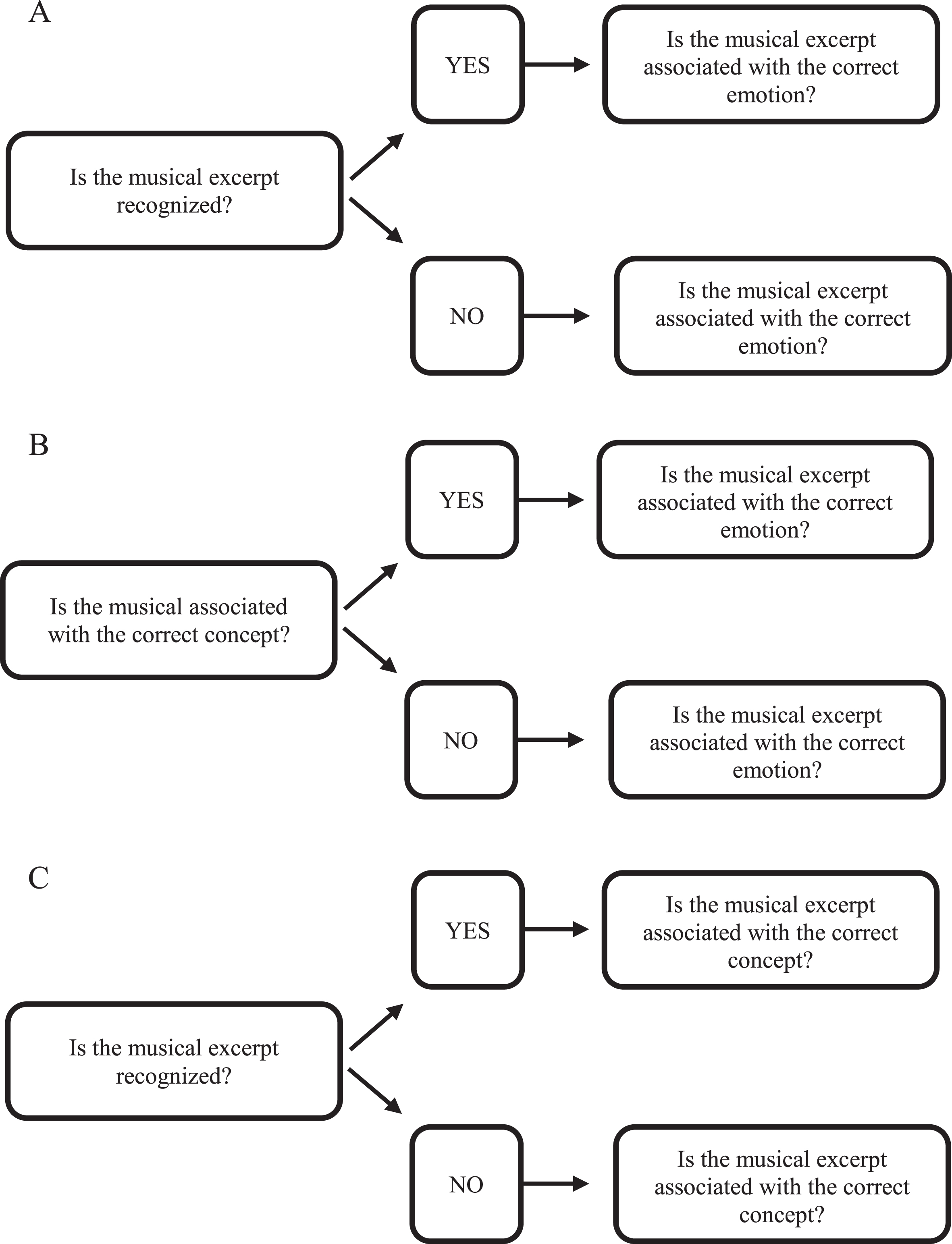
A) Procedure used to address the association between the recognition of musical excerpts and the recognition of emotion they convey. B) Procedure used to address the association between the ability to match musical excerpts with semantic concepts and the recognition of emotion conveyed by musical excerpts. C) Procedure used to address the association between the recognition of musical excerpts and the ability to match them with semantic concepts.
A similar procedure was used to investigate the influence of the ability to activate semantic knowledge related to music on the recognition of basic emotions conveyed by music. First, semantically associated and non-semantically associated stimuli were separated based on performance on the association of musical excerpts with semantic concepts. For instance, if one was able to associate Adeste Fideles with the Christmas concept, this stimulus was considered as semantically associated. In the case where the association of this excerpt with the Christmas concept was incorrect, the item was considered not semantically associated. A t-test for dependent samples was then used to establish causality in performance by comparing the mean percentage of correct responses in the recognition of basic emotions between semantically associated and non-semantically associated stimuli (see Fig. 1B).
Finally, a t-test for dependent samples was also used to investigate the influence of the ability to recognize familiar musical excerpts on the activation of semantic knowledge related to music (see Fig. 1C). All statistical analyses were performed using SPSS 24.0 software for Macintosh and the alpha level was set at p < 0.05.
RESULTS
Sociodemographic variables
As shown on Table 1, there were no significant group differences on sociodemographic variables, while a significant group difference was observed on the general cognitive status assessed with the MoCA [41, 43]. Compared to control participants, individuals with svPPA showed impaired performance on all measures of language and semantic memory. One of the svPPA participants (#4) had mild impairment of mental flexibility (TMT B), while in four other participants impaired flexibility was rather due to reduction in visual scanning/processing speed (TMT A). Finally, visual associative agnosia was present in three out of the nine svPPA participants (Object decision subtest of the BORB), a deficit frequently associated with this syndrome [62].
Demographics and neuropsychological data of the participants in this study, as a function of group (svPPA and controls)
M, mean; SD, standard deviation; χ2, Chi-square test; F, ANOVA; p, p-value; †Missing information; ATL, anterior temporal lobe; ATL atrophy: L, left predominant, B, bilateral; MoCA, Montreal Cognitive Assessment; DS, Digit span; ROCF, Rey-Osterrieth Complex Figure; TMT, Trail Making Test; BORB, Birmingham Object Recognition Battery; TDQ-60, Test de Dénomination de Québec, 60 items; KDT, Kissing and dancing test; PPTT, Pyramids and Palm Trees Test. *Performance is –2.00 standard deviations below the mean or performance below the cut-off according to normative data or control group. –, data not available.
Familiarity judgement on musical excerpts
As shown in Table 2, results demonstrated no significant difference between the svPPA and the control participants on the familiarity judgement of musical excerpts, t(38) = –1.81, p = 0.08. There was no difference between svPPA participants with bilateral (M = 50.5, SD = 12.0) versus left (M = 37.25, SD = 19.5) ATL atrophy, t(7) = –1.04, p = 0.33.
Comparison of performance between individuals with svPPA (raw score and z-score) and controls (Mean and SD) on the familiarity judgement of musical excerpts, the association of musical excerpts with semantic concepts, and the recognition of basic emotion from music
M, mean; SD, standard deviation; svPPA, semantic variant of primary progressive aphasia; SD, standard deviation. aLevene’s test indicated unequal variances (F = 7.20, p = 0.01), so degrees of freedom were adjusted from 40 to 10. bLevene’s test indicated unequal variances (F = 9.47, p = 0.004), so degrees of freedom were adjusted from 34 to 8.
Association of musical excerpts with semantic concepts
There was a significant main effect of group on the task assessing the association of musical excerpts with semantic concepts, with individuals with svPPA performing significantly worse than control participants, t(38) = 11.93, p < 0.001. There was no difference between svPPA participants with bilateral (M = 20.6, SD = 6.4) versus left (M = 20.75, SD = 4.1) ATL atrophy, t(7) = 0.04, p = 0.97.
Recognition of basic emotions from music
On the task assessing the recognition of basic emotions from music, the analysis yielded a main effect of Group, F(1, 162) = 97.38, p < 0.001,
Association between the knowledge for musical excerpts and the recognition of basic emotions conveyed by musical excerpts
There was a significant difference on performance between recognized and unrecognized musical excerpts on the task exploring the recognition of basic emotions in individuals with svPPA, t(8) = –3.45, p = 0.016, with significantly better scores for the recognized (M = 55.4, SD = 18.19) than for the unrecognized (M = 32.0, SD = 9.24) musical excerpts. However, the performance of the svPPA participants in the recognition of basic emotions from music was comparable for excerpts that were correctly associated with semantic concepts (M = 34.34, SD = 18.89) and those that were incorrectly associated with concepts (M = 45.25, SD = 22.03), t(8) = 1.13, p = 0.50. Finally, there was a significant difference on performance between recognized and unrecognized musical excerpts on the task assessing the association of musical excerpts with semantic concepts in individuals with svPPA, t(8) = 2.13, p < 0.05, with significantly better scores for recognized (M = 13.8, SD = 5.95) than for unrecognized (M = 8, SD = 5.6) musical excerpts.
DISCUSSION
In this study, we investigated the role of semantic memory in the recognition of basic emotions conveyed by music. More specifically, this study aimed at investigating the role of semantic memory in the recognition of basic emotions conveyed by music in individuals with svPPA. To that end, we explored the ability of svPPA individuals to differentiate familiar and unfamiliar musical stimuli by means of a familiarity judgement task on musical excerpts. We also studied the ability of svPPA individuals to activate the semantic knowledge associated with music by means of a task of association of musical excerpts with semantic concepts. Finally, we assessed the recognition of basic emotions conveyed by musical excerpts with a recognition of basic emotions from music task. This study was designed to discuss the theoretical models of emotion recognition as well as theoretical models of music processing.
The differentiation between familiar and unfamiliar musical stimuli in svPPA
Deficits in the recognition of familiar objects [62], word forms [8], everyday sounds [63], brand names [64], and famous people [65] have been described in participants with svPPA. Unlike these previous impairments, the results of our study indicate that the ability to recognize familiar musical excerpts is preserved in individuals with svPPA. This is consistent with previous similar studies [31, 66]. However, in one study conducted with 13 individuals with svPPA, Hsieh et al. [35], found that the ability to recognize familiar tunes was associated with the degree of right ATL atrophy. In the present study, the performance of the 5 individuals with bilateral ATL atrophy did not differ from the performance of the 4 individuals with left ATL atrophy. Our results are thus incongruent with those of Hsieh et al. [35].
The activation of factual knowledge associated with music in svPPA
Our findings show that, compared to control participants, individuals with svPPA showed impaired activation of the semantic representations associated with musical excerpts. In a recent study conducted with two individuals with svPPA, we reported a similar impairment in the activation of semantic knowledge from music [34]. This is not a surprising result given that ATL atrophy in svPPA is characterized by a progressive loss of semantic knowledge [23], leading to difficulties to retrieve the semantic information associated with words [67], famous people [68], famous logos and brand names [64], objects [67], smells [69], tastes [70], and actions [71].The results of the present study extend the role of the ATLs to the semantic information associated with music.
The impairment of the recognition of the basic emotions evoked by music in svPPA
Unlike the recognition of emotions in facial expressions, the recognition of emotions from music remains largely understudied in svPPA. Our results show that svPPA was accompanied by impairment in the recognition of emotions conveyed by music, either for happiness, sadness, and anger/fear. A few studies also explored music-evoked emotions in svPPA. Omar et al. [31] compared the performance in the recognition of basic emotions triggered by musical excerpts of two professional musicians. One was a person with Alzheimer’s disease, while the other was a participant with the svPPA. They showed disproportionate impairment in the participant with svPPA compared to that of the participant with Alzheimer’s disease. The same group of researchers [32] replicated these results in a group of 10 novice and non-musician participants with svPPA. They showed that the impairment was associated to the atrophy of a distributed brain network involving temporal and frontal regions bilaterally. The impairment of the recognition of the basic emotions conveyed by unfamiliar musical excerpts was also reported in eleven individuals with svPPA by Hsieh et al. [33]. Using voxel-based morphometry, they showed that the degree of atrophy in the right temporal pole, amygdala, and insula was associated with the impairment in the recognition of music-evoked emotions. These brain regions are known to be involved in the recognition of emotions from music [72]. Finally, in another study [34], the authors contrasted the performance in the recognition of emotions from music of two participants with svPPA who differed in brain atrophy locus identified through voxel-wise analysis: bilateral ATL atrophy in one participant and atrophy largely restricted to the left ATL in the other. Results showed that only the participant with bilateral ATL atrophy had impaired performance, suggesting that the right ATL is essential for the recognition of emotions conveyed by music. In the present study, no difference in the ability to associate basic emotions with music was observed between the svPPA participants with bilateral versus left ATL atrophy. However, our results are not associated with an objective measure of cerebral atrophy so that conclusive statements cannot be made regarding the differential role of the left and the right ATL.
Our results show that the recognition of basic emotions in individuals with svPPA is better for recognized than for unrecognized musical excerpts. This highlights the relationship between the familiarity of music (i.e., better recognition for more familiar items) and the recognition of the basic emotions evoked by music (i.e., better recognition of emotions for correctly recognized items). Moreover, the association of musical excerpts with semantic concepts is also better for recognized than for unrecognized musical excerpts. Thus, the activation of semantic representations of music (emotions, associated concepts) appears to be linked to the familiarity of musical excerpts. A similar relationship was also demonstrated for word recognition in individuals with svPPA, who showed better performance in lexical decision tasks for semantically preserved words than for semantically degraded words [73]. Similarly, other studies found that individuals with svPPA showed better semantic processing of recognized than unrecognized words [74, 75]. Taken together, these results suggest the bidirectionality of the lexical-semantic links in word processing. Finally, our results show that the performance of svPPA participants in the recognition of basic emotions from music was comparable for excerpts that were correctly associated with semantic concepts and those that were incorrectly associated with concepts. This absence of relationship suggests that the activation of semantic representations of music is dissociable from basic emotions and from other semantic knowledge.
Interpretation of results according to theoretical models of emotion recognition and music processing
The results of the present study also inform theoretical models of emotion recognition as well as theoretical models of music processing. Regarding models of emotion recognition, our results cannot easily be accounted for by the “basic emotions” model [15–17] in which basic emotions are recognized solely through the processing of perceptual distinctive features without the involvement of semantics [12]. Our results are rather consistent with psychological constructionist theories, according to which basic emotions are recognized when internal sensations and the perception of emotional expressions are made meaningful through conceptualization, a cognitive process relying on the activation of episodic and semantic knowledge [6, 76]. Notably, our results show that the recognition of basic emotions in participants with svPPA is significantly better for recognized than for unrecognized musical excerpts. Moreover, the association of musical excerpts with semantic concepts is also better for recognized than for unrecognized musical excerpts. Thus, the activation of semantic representations of music (emotions, associated concepts) appears to be linked to the familiarity of musical excerpts. A similar relationship was also demonstrated for word recognition in individuals with svPPA, who showed better performance in lexical decision tasks for semantically preserved words than for semantically degraded words [73]. Similarly, other studies found that individuals with svPPA showed better semantic processing of recognized than unrecognized words [74, 75]. Taken together, these results suggest the bidirectionality of the lexical-semantic links in word processing. Finally, the absence of relationship between the recognition of the basic emotions conveyed by music and the ability to associate musical excerpts with semantic concepts suggests that the semantic representations of music can be independently activated from basic emotions and other semantic knowledge.
With respect to theoretical models of music processing, the results of the present study are globally consistent with the proposal of Baird and Samson [77] related to musical memory. According to these authors, the mental representations of music are encoded in two distinct long-term memory systems, that is episodic and semantic musical memory systems. Based on the theoretical model of long-term memory proposed by Tulving [78], the proposal made by Baird and Samson [77] suggests that episodic musical memory encodes the spatiotemporal, personal, and emotional contexts of the musical experience, while semantic musical memory is involved in the encoding of factual knowledge about music, including associative (i.e., functional, encyclopedic, visual) and emotional attributes. The results of the present study showed impaired semantic musical memory in svPPA. This impairment affects both the activation of emotions and factual knowledge. Moreover, according to Baird and Samson [77], the recognition of familiar tunes enables the activation of the associated information in semantic musical memory. Our results are in line with this assumption since we show that the activation of emotional and factual semantic knowledge in participants with svPPA is better preserved for the musical excerpts still judged as familiar, compared to those judged as unfamiliar. Finally, our results can only partially be explained by the model of music processing proposed by Peretz and Coltheart [22]. The preservation of the ability to recognize familiar musical excerpts suggests that the musical lexicon is preserved in svPPA. By contrast, the difficulty to recognize emotions from music indicates that the emotion analysis component is impaired, as well as the ability to retrieve non-musical information about music in the associative memory. In Peretz and Coltheart’s model, the musical lexicon and the emotion expression analysis are directly triggered by the peripheral components responsible for pitch and temporal acoustic analyses. These two components are also linked together through a unidirectional connection going from the emotion expression analysis to the musical lexicon. Finally, the associative memory is linked to the musical lexicon through bidirectional links. The performance on the task assessing the association of musical excerpts with semantic concepts according to the familiarity of musical excerpts confirm that the ability to recognize familiar tunes in the musical lexicon is a prerequisite for the activation of their semantic knowledge in the associative memory store. Conversely, Peretz and Coltheart’s model puts forward that the ability to recognize the emotions conveyed by familiar tunes should be independent from the ability to judge them as familiar (i.e., activated in the musical lexicon). The model also predicts that the ability to recognize the emotions conveyed by familiar tunes is independent from the ability to retrieve their semantic features in associative memory. In the present study, we found that the ability to recognize the emotions conveyed by tunes was dependent on participants’ ability to judge them as familiar and to retrieve their semantic features. To reconcile Peretz and Coltheart’s model with our results, the model should propose distinct processing components according to the familiarity/unfamiliarity of music. For example, the link between the musical lexicon and the emotion expression analysis should be bidirectional for familiar tunes.
Limitations
This study has some limitations. First, although the svPPA is characterized by atrophy of the ATL, other brain structures, known to be associated with the recognition of emotions in music may also be involved. For example, in a study conducted with 16 individuals with the behavioral variant of frontotemporal dementia and ten individuals with svPPA, Omar et al. [32] showed that the degree of impairment in the recognition of music-evoked emotions was associated, in both populations, with bilateral atrophy in the amygdala, orbitofrontal cortex, cingulate cortex, anterior and posterior temporal cortices, and parietal cortex. This distributed brain network involved in the processing of emotions evoked by musical stimuli [72] overlaps with some brain areas supporting semantic memory [1]. The impairment in the activation of semantic representations associated with musical excerpts reported in individuals with svPPA in this study is highly likely to be attributed to ATL atrophy. However, we cannot completely rule out that the impairment of individuals with svPPA for emotion recognition of musical excerpts resulted from the atrophy of brain regions supporting the processing of emotions per se.
In this study, five out of nine participants with svPPA showed bilateral ATL atrophy while the remaining four had predominant left ATL atrophy. In the three experimental tasks, no difference between svPPA participants with bilateral versus left ATL atrophy was observed. The study of svPPA participants with predominant right versus left ATL atrophy should be conducted to disentangle the specific role of the two brain areas in the processing of music in terms of familiarity, emotional value, and conceptual content.
Finally, the small sample size is also another limitation of the present study. PPA is a rare syndrome with a prevalence estimated at about 3 cases per 100,000 for the three variants [79]. Our sample size therefore appeared largely acceptable and comparable to other studies of this type [32, 68]. Nevertheless, other studies with larger samples of participants are needed to confirm our results and determine whether the reported pattern of performance accurately represents the population with svPPA.
CONCLUSIONS
To conclude, the findings of the present study suggest that ATL atrophy in svPPA affects the ability to retrieve the semantic representations associated with music, as well as to associate basic emotions with familiar music. This result is in line with the proposal according to which the ATLs are a convergence zone that creates transmodal and generalizable semantic representations from information activated in sensory, motor, and language modality-specific association cortices [80]. The ATLs are also involved in the recognition of familiar melodies [81], yet this ability was preserved in the present study, as it was in previous studies [31, 66]. One way to address this apparent inconsistency is to question the depth of processing of musical stimuli in tasks of familiarity judgment, association with semantic concepts, and association with basic emotions. It would be logical to assume that familiarity judgment would be processed at a basic level, linking the output of acoustic analysis with the corresponding representation in the musical lexicon. By contrast, more in-depth processing would be required to associate music with semantic concepts or with basic emotions. Therefore, by analogy with what was observed in svPPA for concrete objects (progressive loss from specific to basic/superordinate semantic features) [82], we suggest that the low level of processing required for the recognition of familiar tunes explains its preservation in the svPPA participants of this study. The cognitive processing of emotions has been studied in numerous studies, most of which have addressed the recognition of facial expressions in humans. The determinant role of familiarity, shown in the present study, should also be explored in further studies in which basic emotions and emotional valence are conveyed by various mediums such as faces, prosody sounds, pictorial scenes, and words.
Footnotes
ACKNOWLEDGMENTS
The authors are grateful to the participants and their families for supporting our research.
C.H. was supported by a salary award from the Fonds de recherche du Québec – Santé (26809). M-P.T. was supported by a scholarship from the Centre thématique de recherche en neurosciences (CTRN).
Data collection and participant testing were partially supported by funds granted to M.A.W. by the Fonds de recherche du Québec- Société et culture (FRQ-SC), grant number: FRQ-SC 2013-NP-168556, and the Quebec Network for Research on Aging (RQRV).
